REVIEW 2 major objections 6 minor 1 cited by
Opto- and magneto-tunable exceptional degeneracies in non-Hermitian ferromagnet/$p$-wave magnet junctions
T0 review · 2 major / 6 minor · reviewed 2026-08-06 · deepseek-v4-flash
Pith's one-line read Light and magnetic fields steer exceptional points in p-wave magnet junctions.
desk verdict Analytically solid model of EP tuning in FM/UPM junctions, with the main caveat being the wide-band self-energy assumption that underpins all quantitative predictions. read the letter →
The pith
A machine-rendered reading of the paper's core claim, the machinery that carries it, and where it could break.
The reading
What carries the argument
The load-bearing object is the complex vector $\mathbf{p}$ in the Pauli decomposition $H=\epsilon_0+\mathbf{p}\cdot\boldsymbol{\sigma}$, whose real and imaginary parts must satisfy the simultaneous conditions $\mathbf{p}_r^2=\mathbf{p}_i^2$ and $\mathbf{p}_r\cdot\mathbf{p}_i=0$ for an exceptional point. In this junction $\mathbf{p}_r=(\lambda k_y,-\lambda k_x,2t\,\boldsymbol{\alpha}\cdot\mathbf{k})$ and $\mathbf{p}_i=(0,0,-\gamma)$, so the imaginary part encodes the spin-asymmetric coupling to the ferromagnetic lead while the real part mixes Rashba spin-momentum locking with the linear $p$-wave spin splitting. The two conditions convert a would-be exceptional ring $\lambda^2(k_x^2+k_y^2)=\gamma^2$ into two discrete points whose connecting line rotates with $\boldsymbol{\alpha}$. The same decomposition carries the tuning analysis: magnetic fields add $\mathbf{B}\cdot\boldsymbol{\sigma}$ to selected components, and circularly polarized light, entering through the high-frequency van Vleck correction, renormalizes the Rashba and $\sigma_z$ coefficients.
What would settle it
Compute the lead self-energy from a realistic tight-binding ferromagnet instead of the wide-band form, and check whether the discriminant $(\mathbf{p}_r^2-\mathbf{p}_i^2)^2+4(\mathbf{p}_r\cdot\mathbf{p}_i)^2$ still vanishes at the momenta of Eq. (11) and at the claimed magnetic and optical thresholds; any shift or splitting of the zeros would falsify the quantitative prediction. A spectral probe such as angle-resolved photoemission should also show simultaneous coalescence of real and imaginary parts of the two branches at those momenta, not merely a band touching.
Extended reading notes
Core claim
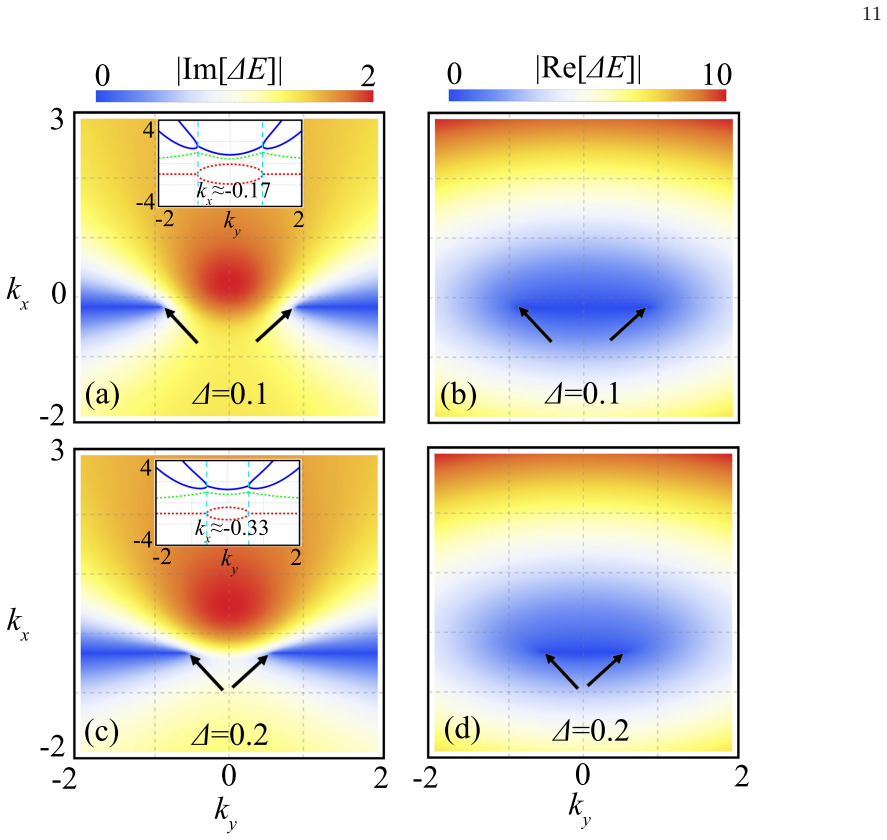
The central claim is that the effective $2\times2$ Hamiltonian $H = \epsilon_0 + \mathbf{p}\cdot\boldsymbol{\sigma}$ with $\mathbf{p}_r = (\lambda k_y,\,-\lambda k_x,\,2t\,\boldsymbol{\alpha}\cdot\mathbf{k})$ and $\mathbf{p}_i = (0,0,-\gamma)$ develops exceptional points exactly where $\mathbf{p}_r^2 = \mathbf{p}_i^2$ and $\mathbf{p}_r\cdot\mathbf{p}_i = 0$. These two conditions force $2t(\alpha_x k_x + \alpha_y k_y)=0$ and place the degenerate pair at $k_x = \pm \gamma\alpha_y/(\lambda\sqrt{\alpha_x^2+\alpha_y^2})$ and $k_y = \mp \gamma\alpha_x/(\lambda\sqrt{\alpha_x^2+\alpha_y^2})$. In the special $p_x$ or $p_y$ case the points sit on the $k_x=0$ or $k_y=0$ line, whereas a general $p_{xy}$ magnet rotates the connecting line by angle $\eta = \tan^{-1}(-\alpha_x/\alpha_y)$. A magnetic field enters as a Zeeman term and shifts, compresses, merges, or destroys the pair depending on orientation, with thresholds such as $B_y>\gamma$ and $B_z>2\gamma\alpha_x/\lambda$. Circularly polarized light acts through a first-order van Vleck Floquet correction, renormalizing the $\sigma_z$ and Rashba terms so that the pair moves in momentum and annihilates beyond $\Delta>\alpha_x\gamma\lambda/(4\alpha_x^2+\lambda^2)$. The authors verify the degeneracies by eigenvector overlap and by coalescence of spin projections, and interpret the two controls as mechanistically different: global Floquet renormalization for light versus orientation-selective Zeeman shifts for the field.
Load-bearing premise
The quantitative EP locations and thresholds assume the ferromagnetic lead is a wide-band reservoir whose spin-dependent coupling $\gamma$ is constant in momentum and frequency; if the lead's density of states varies near the Fermi level, the EP conditions become momentum- and frequency-dependent and the predicted positions and thresholds could shift.
Editorial extensions
If this is right
- If the central claim is right, an FM/UPM junction hosts two exceptional points without fine-tuning: their separation is set by $\gamma/\lambda$ and their orientation by the UPM magnetization vector $\boldsymbol{\alpha}$.
- A magnetic field along $y$ or $z$ can merge the pair into a single exceptional point and then annihilate it beyond thresholds such as $B_y>\gamma$ and $B_z>2\gamma\alpha_x/\lambda$, providing a magnetic switch for the degeneracies.
- Off-resonant circularly polarized light provides an all-optical route to the same control, annihilating the pair above $\Delta>\alpha_x\gamma\lambda/(4\alpha_x^2+\lambda^2)$, and reversing the light handedness reflects the pattern across the $k_x=0$ or $k_y=0$ axis depending on the UPM orientation.
- The degeneracies occur as a two-point reorientable line, in contrast to the four-point patterns of $d$-wave altermagnet junctions; this difference is a direct consequence of the linear-in-$k$ coupling of odd-parity $p$-wave magnets.
- The imaginary part of the energy at the exceptional points stays pinned at $-\Gamma$, so the existence of the degeneracies is insensitive to the UPM strength while their location remains tunable.
Reading between the lines
- A natural testable extension is to relax the wide-band lead: with a realistic energy-dependent density of states, $\gamma$ becomes frequency- and momentum-dependent and the EP conditions become coupled equations, so the quantitative thresholds would shift even if the two-point structure survives.
- Because the EP line orientation is set entirely by $\boldsymbol{\alpha}$, any experimental handle that rotates the UPM magnetization vector, such as strain, electrical switching, or an exchange field, would reorient the exceptional line in situ, a non-Hermitian analogue of spin-valve control.
- The same Floquet treatment applied to noncollinear odd-parity spin textures could produce more than two exceptional points; the linear-in-$k$ coupling is what fixes the multiplicity here, so richer textures would likely enrich the degeneracy structure.
- The predicted annihilation thresholds define sharp boundaries in the $(B,\Delta)$ parameter plane across which the degeneracy switches on and off; sweeping those boundaries in a transport or spectral experiment is a direct way to map the non-Hermitian phase diagram.
Editorial analysis
A structured set of objections, weighed in public.
Referee Report
Summary. The paper constructs a non-Hermitian effective model for a ferromagnet/uncharacteristic $p$-wave magnet (UPM) junction with Rashba spin-orbit coupling, Eq. (6), and derives exact conditions for exceptional points (EPs) as $p_r^2=p_i^2$ and $p_r\cdot p_i=0$, Eqs. (10a)-(10b). The central quantitative results are the analytic EP coordinates Eq. (11), their orientation Eq. (12), the magnetic-field-induced shifting, merging, and annihilation thresholds of Section III.C, and the off-resonant CPL Floquet renormalization and threshold of Section III.D. The authors support the analytic conditions with energy spectra, eigenvector overlap, and spin-projection plots, and contrast the resulting two-point EP structure with the four-point structure found in $d$-wave altermagnet junctions.
Significance. If the wide-band self-energy premise is accepted, the analytic results are internally consistent and exact for the stated model. The paper fits nothing to data: the EP positions follow directly from the Hamiltonian plus the standard discriminant definition, and the thresholds $B_y=\gamma$, $B_z=2\gamma\alpha_x/\lambda$, and $\Delta>\alpha_x\gamma\lambda/(4\alpha_x^2+\lambda^2)$ are explicit, falsifiable predictions. I verified Eq. (29) against the Floquet commutator computation in Appendix A and spot-checked Eqs. (10), (15), (19), (31), and (32), including the figure-caption coordinates. The conceptual comparison with $d$-wave altermagnets is clean: the linear UPM spin coupling $\propto k\cdot\alpha$ forces the EP condition onto a line and reduces the multiplicity from four points to two. The main weakness, which the stress-test note correctly identifies, is that every quantitative prediction inherits the constant, momentum- and frequency-independent $\gamma$ of Eq. (4); that premise is not validated for a realistic FM/UPM junction. The Floquet sector also rests on a first-order van Vleck truncation used near the edge of its expected validity.
major comments (2)
- [Section II, Eqs. (4)-(5); Section III.A Eq. (11); Section III.C; Section III.D Eq. (32)] The advertised exact EP coordinates and all merging/annihilation thresholds assume the wide-band self-energy $\Sigma^r(\omega=0)=-i\Gamma\sigma_0-i\gamma\sigma_z$ with momentum- and frequency-independent $\gamma$. Equation (5) makes explicit that $\Gamma_{\uparrow,\downarrow}=\pi|t'|^2\rho_{\uparrow,\downarrow}$, so $\gamma$ inherits the ferromagnetic lead density of states. For a semi-infinite FM lead, $\rho_{\uparrow,\downarrow}(\omega,k)$ varies on the lead bandwidth scale, while the UPM states at the EPs sit at finite energy Re$E=t(\alpha^2+k^2)-\mu$ (plus field/CPL shifts), not at $\omega=0$. Once $\gamma=\gamma(\omega,k)$, the discriminant conditions become self-consistent equations, e.g. $\lambda^2k^2=\gamma^2(E(k),k)$ on the $\alpha\cdot k=0$ line, and the EP coordinates, the thresholds $B_y=\gamma$ and $B_z=2\gamma\alpha_x/\lambda$, and the CPL threshold $\Delta>\alpha_x\gamma\lambda/(4\alpha_x^2+\lambda^2)$ can all shift, merge, or disappear. The final paragraph of Section IV mentions disorder and clean-interface idealizations but does not address the energy dependence of the self-energy. I ask the authors to test robustness with an energy-dependent lead DOS or the explicit retarded self-energy of the semi-infinite FM lead and to delineate the parameter window in which Eq. (11) remains valid.
- [Section III.D and Appendix A, Eqs. (28)-(32)] The CPL predictions rest on a first-order van Vleck expansion, Eq. (28), used with $\Omega=2$ in units where $t=1$ and momenta and energies are of order unity. The high-frequency condition $\Omega\gg$ bandwidth is not satisfied, and for the plotted $\Delta=0.2$-$0.25$ with $\lambda=1$, the dimensionless vector-potential amplitude is $eA=\sqrt{2\Omega\Delta}/\lambda\simeq 0.9$-$1.0$, so the $A\cdot k$ and $A^2$ terms are not small. The EP shifts and the threshold $\Delta_c=\alpha_x\gamma\lambda/(4\alpha_x^2+\lambda^2)$ are derived from the truncated Hamiltonian Eq. (29); higher-order terms in the van Vleck expansion could renormalize both the $\sigma_z$ term and the RSOC terms. Please either justify the truncation by computing the next-order correction, repeat the key EP results at larger $\Omega$, or explicitly restrict the claims to the regime where the truncation is controlled.
minor comments (6)
- [Section III.A, paragraph after Fig. 2] The sentence 'the imaginary part of the energy at the EPs remains fixed at Im[E]=1' conflicts with the sign convention of Eq. (8), where the base energy contains $-i\Gamma$; with $\Gamma=(\Gamma_\uparrow+\Gamma_\downarrow)/2=1$, the imaginary part at the EP is $-1$. Please correct the sign or the wording.
- [Section III.D, Eq. (31b)] Equation (31b) reads $\gamma(\alpha_xk_x+\alpha_yk_y+\Delta)=0$, whereas the $\sigma_z$ coefficient in Eq. (29) with $t=\hbar^2/2m=1$ is $2(k\cdot\alpha+\Delta)$; the factor of 2 does not affect the vanishing condition, but the notation should be made consistent.
- [Section III.C, Case IV] The statement that an 'additional numerical factor due to $\cos\phi\neq0$' is 'neglected' is misleading, because the field components $B_x$ and $B_y$ are used directly as parameters; please clarify the parametrization of the planar field.
- [Section III.D, paragraph comparing CPL with $B_z$] The sentence 'Unlike it effect in $d$-wave AMs [53]' contains a typo and should read 'Unlike its effect in $d$-wave AMs'.
- [Section III.D, paragraph after Eq. (31)] The claim that 'when $\lambda\ll1$, the CPL effect in $2\Delta\sigma_z$ term becomes negligible' is unclear because $2\Delta\sigma_z$ is independent of $\lambda$; please clarify what is being compared.
- [Figure 2 caption] There are minor typographical errors in the captions, e.g. 'idicates' for 'indicates' and 'green-dashed line' hyphenation; these should be corrected during production.
Circularity Check
No circularity: all EP predictions are derived from the stated model Hamiltonian, with no fitted inputs or load-bearing self-citations.
full rationale
The paper's central claims—EP emergence at Eq. (11), the field-induced shifts, merging and annihilation thresholds, and the CPL-induced renormalization—are obtained by solving the standard exceptional-point conditions p_r^2 = p_i^2 and p_r·p_i = 0 applied to the explicit Hamiltonian (6) and its magnetic-field and Floquet extensions. These are analytic consequences of the stated model, not quantities fitted to data or imported from the authors' prior work. The constant wide-band self-energy in Eq. (4) is an explicitly acknowledged modeling assumption; relaxing it would modify quantitative EP locations, but that is a robustness/approximation concern rather than a circular reduction. The only self-citation, Ref. [70], appears in the experimental feasibility discussion of CPL intensities and is not load-bearing for any derivation. No uniqueness theorem, author-imported ansatz, or renamed known result is used to force the conclusions. Therefore no circular step can be exhibited.
Assumptions & free parameters
free parameters (6)
- alpha (UPM magnetization vector) =
alpha_x = 0.6 or 0.5; alpha_y = 0, 0.5, or 0.3 (scanned)
- lambda (RSOC strength) =
1 (units of t/a)
- gamma (spin-asymmetric lead coupling) =
1 (from Gamma_up = 2, Gamma_down = 0)
- Delta (CPL intensity parameter) =
0.1 and 0.2; annihilation above 0.25
- Omega (CPL frequency) =
2 (units of t/a^2)
- mu (chemical potential) =
implicitly 0 (never specified)
assumptions (4)
- domain assumption The semi-infinite FM lead is described by a momentum- and frequency-independent wide-band self-energy: Sigma^r(omega = 0) = -i Gamma sigma_0 - i gamma sigma_z (Eq. 4).
- domain assumption The van Vleck Floquet expansion is truncated at first order, H_F ~ H_0 + [H_-1, H_+1]/Omega (Eq. 28), with Omega treated as large.
- domain assumption The UPM is modeled by the collinear odd-parity Hamiltonian H_p = t[(k^2 + alpha^2) sigma_0 + 2 k·alpha sigma_z] (Eq. 2).
- domain assumption The FM proximity induces isotropic Rashba spin-orbit coupling lambda(k_y sigma_x - k_x sigma_y) (Eq. 3).
Cite this review
Pith. "Pith review of Opto- and magneto-tunable exceptional degeneracies in non-Hermitian ferromagnet/$p$-wave magnet junctions." pith.science (2026). https://pith.science/paper/XLCSJQXW
@misc{pith2026250801295,
  author       = {Pith},
  title        = {Pith review of: Opto- and magneto-tunable exceptional degeneracies in non-Hermitian ferromagnet/$p$-wave magnet junctions},
  year         = {2026},
  howpublished = {\url{https://pith.science/paper/XLCSJQXW}},
  note         = {Machine review of arXiv:2508.01295}
}
abstract
Unconventional $p$-wave magnets (UPMs) with odd-parity spin textures have attracted interest for their zero net magnetization and anisotropic spin-split Fermi surfaces. Here, we explore a non-Hermitian open quantum system composed of a ferromagnet and a UPM, subjected to an external magnetic field and off-resonant circularly polarized light (CPL), serving as tunable control parameters. We demonstrate the emergence of exceptional points (EPs) in the proposed junction, whose locations can be modulated by the intrinsic properties of the UPM. These EPs exhibit different multiplicities and formation conditions compared to those in even-parity magnets (dubbed $d$- wave altermagnets), a distinction attributable to the preserved time-reversal and broken inversion symmetries characteristic of UPMs. We find that both the unidirectional magnetic field (with adjustable strength and orientation) and the CPL induce momentum-direction-dependent modifications to the EPs, such as their shifting, tilting, merging, or annihilation, supported by analyses of spin projection and eigenvector overlap. Although both perturbations influence the EP structure, they operate via distinct mechanisms: CPL induces a global Floquet re-normalization, enabling dynamic tunability through light, whereas the unidirectional magnetic field selectively alters orientation-aligned terms, lacking such tunability. Beyond revealing EP dynamics in UPM-based junctions, our results highlight UPMs as promising platforms for non-Hermitian phenomena in future spintronics.
Figures


Figures from the paper (4 more)



Forward citations
Cited by 1 Pith paper
-
Hexagonal Warping Control of Exceptional Points in Topological Insulator--Ferromagnetic Heterojunctions
For a topological-insulator–ferromagnet junction with hexagonal warping, exceptional points form a hexagon whose positions and number can be tuned by an in-plane magnetic field.
Reference graph
Works this paper leans on
-
[53]
Datta,Electronic transport in mesoscopic systems (Cambridge university press, 1997)
S. Datta,Electronic transport in mesoscopic systems (Cambridge university press, 1997)
1997
- [49]
-
[70]
M. Alipourzadeh, Y. Hajati, and I. Makhfudz, Photo- and exchange-field controlled line-type resonant peaks and enhanced spin and valley polarizations in a mag- netic WSe2 junction, J. Phys. D: Appl. Phys.55, 165301 (2022)
work page 2022
-
[1]
I. ˇZuti´ c, J. Fabian, and S. D. Sarma, Spintronics: Fun- damentals and applications, Rev. Mod. Phys.76, 323 (2004). 17
work page 2004
-
[2]
2(c), indicating the emer- gence of two EPs at (k x, ky) = (±1/ √ 2,∓1/ √ 2)
The second EP is shown in the inset of Fig. 2(c), indicating the emer- gence of two EPs at (k x, ky) = (±1/ √ 2,∓1/ √ 2). Again, the overlap (dashed-green line) confirms this prediction in Fig. 2(c). Noting that, the overlap is not shown in the inset to avoid the graphical complexity. Case IV: The more general case is that the x- and y- components of the ...
-
[3]
Baltz, A
V. Baltz, A. Manchon, M. Tsoi, T. Moriyama, T. Ono, and Y. Tserkovnyak, Antiferromagnetic spintronics, Rev. Mod. Phys.90, 015005 (2018)
2018
-
[4]
ˇSmejkal, J
L. ˇSmejkal, J. Sinova, and T. Jungwirth, Emerging re- search landscape of altermagnetism, Phys. Rev. X12, 040501 (2022)
2022
-
[5]
Eschrig, Spin-polarized supercurrents for spintronics: a review of current progress, Rep
M. Eschrig, Spin-polarized supercurrents for spintronics: a review of current progress, Rep. Prog. Phys.78, 104501 (2015)
2015
Show all 75 references
-
[6]
Liao, Y.-C
C.-T. Liao, Y.-C. Wang, Y.-C. Tien, S.-Y. Huang, and D. Qu, Separation of inverse altermagnetic spin-splitting effect from inverse spin Hall effect in RuO 2, Phys. Rev. Lett.133, 056701 (2024)
2024
-
[7]
Krempask` y, L
J. Krempask` y, L. ˇSmejkal, S. D’souza, M. Hajlaoui, G. Springholz, K. Uhl ´ ıˇ rov´ a, F. Alarab, P. Constantinou, V. Strocov, D. Usanov,et al., Altermagnetic lifting of Kramers spin degeneracy, Nature626, 517 (2024)
2024
-
[8]
A. B. Hellenes, T. Jungwirth, J. Sinova, and L. ˇSmejkal, p-wave magnets, arXiv:2309.01607 (2023)
2023 arXiv
-
[9]
ˇSmejkal, J
L. ˇSmejkal, J. Sinova, and T. Jungwirth, Beyond conven- tional ferromagnetism and antiferromagnetism: A phase with nonrelativistic spin and crystal rotation symmetry, Phys. Rev. X12, 031042 (2022)
2022
-
[10]
ˇSmejkal, A
L. ˇSmejkal, A. B. Hellenes, R. Gonz´ alez-Hern´ andez, J. Sinova, and T. Jungwirth, Giant and tunneling mag- netoresistance in unconventional collinear antiferromag- nets with nonrelativistic spin-momentum coupling, Phys. Rev. X12, 011028 (2022)
2022
-
[11]
S. Lee, S. Lee, S. Jung, J. Jung, D. Kim, Y. Lee, B. Seok, J. Kim, B. G. Park, L. ˇSmejkal,et al., Broken Kramers degeneracy in altermagnetic MnTe, Phys. Rev. Lett.132, 036702 (2024)
2024
-
[12]
A. A. Hedayati and M. Salehi, Transverse spin current at normal-metal/p-wave magnet junctions, Phys. Rev. B 111, 035404 (2025)
2025
-
[13]
Fukaya, K
Y. Fukaya, K. Maeda, K. Yada, J. Cayao, Y. Tanaka, and B. Lu, Fate of the Josephson effect and odd-frequency pairing in superconducting junctions with unconven- tional magnets, arXiv:2411.02679 (2024)
2024 arXiv
-
[14]
Ezawa, Third-order and fifth-order nonlinear spin- current generation ing-wave andi-wave altermagnets and perfectly nonreciprocal spin current inf-wave mag- nets, Phys
M. Ezawa, Third-order and fifth-order nonlinear spin- current generation ing-wave andi-wave altermagnets and perfectly nonreciprocal spin current inf-wave mag- nets, Phys. Rev. B111, 125420 (2025)
2025
-
[15]
Maeda, B
K. Maeda, B. Lu, K. Yada, and Y. Tanaka, Theory of tun- neling spectroscopy in unconventionalp-wave magnet- superconductor hybrid structures, J. Phys. Soc. Jap.93, 114703 (2024)
2024
-
[16]
Soori, Crossed Andreev reflection in collinearp-wave magnet/triplet superconductor junctions, Phys
A. Soori, Crossed Andreev reflection in collinearp-wave magnet/triplet superconductor junctions, Phys. Rev. B 111, 165413 (2025)
2025
-
[17]
Fukaya, K
Y. Fukaya, K. Maeda, K. Yada, J. Cayao, Y. Tanaka, and B. Lu, Josephson effect and odd-frequency pairing in superconducting junctions with unconventional magnets, Phys. Rev. B111, 064502 (2025)
2025
-
[18]
El-Ganainy, K
R. El-Ganainy, K. G. Makris, M. Khajavikhan, Z. H. Musslimani, S. Rotter, and D. N. Christodoulides, Non- Hermitian physics and PT symmetry, Nat. Phys.14, 11 (2018)
2018
-
[19]
L. Lu, J. D. Joannopoulos, and M. Soljaˇ ci´ c, Topological photonics, Nat. Photonics8, 821 (2014)
2014
-
[20]
Lindblad, On the generators of quantum dynamical semigroups, Commun
G. Lindblad, On the generators of quantum dynamical semigroups, Commun. Math. Phys.48, 119 (1976)
1976
-
[21]
Kawabata, K
K. Kawabata, K. Shiozaki, M. Ueda, and M. Sato, Sym- metry and topology in non-Hermitian physics, Phys. Rev. X9, 041015 (2019)
2019
-
[22]
E. J. Bergholtz, J. C. Budich, and F. K. Kunst, Ex- ceptional topology of non-Hermitian systems, Rev. Mod. Phys.93, 015005 (2021)
2021
-
[23]
Ashida, Z
Y. Ashida, Z. Gong, and M. Ueda, Non-Hermitian physics, Adv. Phys.69, 249 (2020)
2020
-
[24]
C.-A. Li, B. Trauzettel, T. Neupert, and S.-B. Zhang, Enhancement of second-order non-Hermitian skin effect by magnetic fields, Phys. Rev. Lett.131, 116601 (2023)
2023
-
[25]
Zhang, T
X. Zhang, T. Zhang, M.-H. Lu, and Y.-F. Chen, A review on non-Hermitian skin effect, Adv. Phys.: X7, 2109431 (2022)
2022
-
[26]
Banerjee, R
A. Banerjee, R. Sarkar, S. Dey, and A. Narayan, Non- Hermitian topological phases: principles and prospects, J. Phys.: Cond. Matt.35, 333001 (2023)
2023
-
[27]
W. D. Heiss, The physics of exceptional points, J. Phys. A: Math. Theor.45, 444016 (2012)
2012
-
[28]
Dembowski, H.-D
C. Dembowski, H.-D. Gr¨ af, H. Harney, A. Heine, W. Heiss, H. Rehfeld, and A. Richter, Experimental observation of the topological structure of exceptional points, Phys. Rev. Lett.86, 787 (2001)
2001
-
[29]
Yokomizo and S
K. Yokomizo and S. Murakami, Non-Bloch band theory of non-Hermitian systems, Phys. Rev. Lett.123, 066404 (2019)
2019
-
[30]
Arouca, J
R. Arouca, J. Cayao, and A. M. Black-Schaffer, Topolog- ical superconductivity enhanced by exceptional points, Phys. Rev. B108, L060506 (2023)
2023
-
[31]
Cayao, Exceptional degeneracies in non-Hermitian Rashba semiconductors, J
J. Cayao, Exceptional degeneracies in non-Hermitian Rashba semiconductors, J. Phys.: Cond. Matt.35, 254002 (2023)
2023
-
[32]
S.-B. Lee, J. Yang, S. Moon, S.-Y. Lee, J.-B. Shim, S. W. Kim, . f. J.-H. Lee, and K. An, Observation of an excep- tional point in a chaotic optical microcavity, Phys. Rev. Lett.103, 134101 (2009)
2009
-
[33]
Chen, S ¸
W. Chen, S ¸. Kaya ¨Ozdemir, G. Zhao, J. Wiersig, and L. Yang, Exceptional points enhance sensing in an optical microcavity, Nature548, 192 (2017)
2017
-
[34]
Longhi and L
S. Longhi and L. Feng, Unidirectional lasing in semicon- ductor microring lasers at an exceptional point, Photon. Res.5, B1 (2017)
2017
-
[35]
Hodaei, A
H. Hodaei, A. U. Hassan, S. Wittek, H. Garcia-Gracia, R. El-Ganainy, D. N. Christodoulides, and M. Kha- javikhan, Enhanced sensitivity at higher-order excep- tional points, Nature548, 187 (2017)
2017
-
[36]
Nagai, Y
Y. Nagai, Y. Qi, H. Isobe, V. Kozii, and L. Fu, DMFT reveals the non-Hermitian topology and Fermi arcs in heavy-Fermion systems, Phys. Rev. Lett.125, 227204 (2020)
2020
-
[37]
H. Zhou, C. Peng, Y. Yoon, C. W. Hsu, K. A. Nelson, L. Fu, J. D. Joannopoulos, M. Soljaˇ ci´ c, and B. Zhen, Ob- servation of bulk Fermi arc and polarization half charge from paired exceptional points, Science359, 1009 (2018)
2018
-
[38]
Delplace, T
P. Delplace, T. Yoshida, and Y. Hatsugai, Symmetry- protected multifold exceptional points and their topo- logical characterization, Phys. Rev. Lett.127, 186602 (2021)
2021
-
[39]
Okugawa and T
R. Okugawa and T. Yokoyama, Topological exceptional surfaces in non-Hermitian systems with parity-time and parity-particle-hole symmetries, Phys. Rev. B99, 041202 (2019). 18
2019
-
[40]
M. A. Reja and A. Narayan, Emergence of tunable excep- tional points in altermagnet-ferromagnet junctions, Phys. Rev. B110, 235401 (2024)
2024
-
[41]
Yoshida, R
T. Yoshida, R. Peters, and N. Kawakami, Non-Hermitian perspective of the band structure in heavy-Fermion sys- tems, Phys. Rev. B98, 035141 (2018)
2018
-
[42]
E. J. Bergholtz and J. C. Budich, Non-Hermitian Weyl physics in topological insulator ferromagnet junctions, Phys. Rev. Res.1, 012003 (2019)
2019
-
[43]
S. Dey, A. Banerjee, D. Chowdhury, and A. Narayan, Hall conductance of a non-Hermitian Weyl semimetal, New J. Phys.26, 023057 (2024)
2024
-
[44]
G. K. Dash, S. Panda, and S. Nandy, Fingerprint of non- Hermiticity in ad-wave altermagnet, Phys. Rev. B111, 155119 (2025)
2025
-
[45]
Cayao and A
J. Cayao and A. M. Black-Schaffer, Exceptional odd- frequency pairing in non-Hermitian superconducting sys- tems, Phys. Rev. B105, 094502 (2022)
2022
-
[46]
Kornich and B
V. Kornich and B. Trauzettel, Andreev bound states in junctions formed by conventional and PT-symmetric non-Hermitian superconductors, Phys. Rev. Res.4, 033201 (2022)
2022
-
[47]
Cayao and M
J. Cayao and M. Sato, Non-Hermitian phase-biased Josephson junctions, Phys. Rev. B110, L201403 (2024)
2024
-
[48]
Kornich and B
V. Kornich and B. Trauzettel, Signature of PT- symmetric non-Hermitian superconductivity in angle- resolved photoelectron fluctuation spectroscopy, Phys. Rev. Res.4, L022018 (2022)
2022
-
[50]
Kornich, Current-voltage characteristics of the normal metal-insulator-PT-symmetric non-Hermitian supercon- ductor junction as a probe of non-Hermitian formalisms, Phys
V. Kornich, Current-voltage characteristics of the normal metal-insulator-PT-symmetric non-Hermitian supercon- ductor junction as a probe of non-Hermitian formalisms, Phys. Rev. Lett.131, 116001 (2023)
2023
-
[51]
D. A. Ryndyk, R. Guti´ errez, B. Song, and G. Cuniberti, Green function techniques in the treatment of quantum transport at the molecular scale, inEnergy Transfer Dy- namics in Biomaterial Systems, edited by I. Burghardt, V. May, D. A. Micha, and E. R. Bittner (Springer Berlin...
2009
-
[52]
P. Rao, A. Mook, and J. Knolle, Tunable band topology and optical conductivity in altermagnets, Phys. Rev. B 110, 024425 (2024)
2024
-
[54]
Amundsen, A
M. Amundsen, A. Brataas, and J. Linder, RKKY interac- tion in Rashba altermagnets, Phys. Rev. B110, 054427 (2024)
2024
-
[55]
Kitagawa, T
T. Kitagawa, T. Oka, A. Brataas, L. Fu, and E. Demler, Transport properties of nonequilibrium systems under the application of light: Photoinduced quantum Hall in- sulators without Landau levels, Phys. Rev. B84, 235108 (2011)
2011
-
[56]
Yarmohammadi, U
M. Yarmohammadi, U. Z¨ ulicke, J. Berakdar, J. Linder, and J. K. Freericks, Anisotropic light-tailored RKKY in- teraction in two-dimensionald-wave altermagnets, Phys. Rev. B111, 224412 (2025)
2025
-
[57]
Ezawa, Photoinduced topological phase transition and a single Dirac-cone state in silicene, Phys
M. Ezawa, Photoinduced topological phase transition and a single Dirac-cone state in silicene, Phys. Rev. Lett. 110, 026603 (2013)
2013
-
[58]
J. Chen, K. Wu, W. Hu, and J. Yang, Spin–orbit cou- pling in 2 D semiconductors: A theoretical perspective, J. Phys. Chem. Lett.12, 12256 (2021)
2021
-
[59]
Platero and R
G. Platero and R. Aguado, Photon-assisted transport in semiconductor nanostructures, Phys. Rep.395, 1 (2004)
2004
-
[60]
and in NiI 2 [61]. The fabrication of junctions involving ferromagnetic layers in proximity with non-magnetic semiconductors exhibiting strong spin-orbit coupling, such as InAs [62] and InSb [63], is a well-established practice utilizing stan- dard thin film deposition and lit...
-
[61]
Q. Song, S. Stavri´ c, P. Barone, A. Droghetti, D. S. An- tonenko, J. W. Venderbos, C. A. Occhialini, B. Ilyas, E. Erge¸ cen, N. Gedik,et al., Electrical switching of a p-wave magnet, Nature , 1 (2025)
2025
-
[62]
Ezawa, Purely electrical detection of the n´ eel vector ofp-wave magnets based on linear and nonlinear conduc- tivities, arXiv:2410.21854 (2024)
M. Ezawa, Purely electrical detection of the n´ eel vector ofp-wave magnets based on linear and nonlinear conduc- tivities, arXiv:2410.21854 (2024)
2024 arXiv
-
[63]
Yamada, M
R. Yamada, M. T. Birch, P. R. Baral, S. Okumura, R. Nakano, S. Gao, Y. Ishihara, K. K. Kolincio, I. Be- lopolski, H. Sagayama,et al., Gapping the spin-nodal planes of an anisotropicp-wave magnet to induce a large anomalous hall effect, arXiv:2502.10386 (2025)
2025
-
[64]
Nichele, E
F. Nichele, E. Portol´ es, A. Fornieri, A. M. Whiticar, A. C. Drachmann, S. Gronin, T. Wang, G. Gardner, C. Thomas, A. Hatke,et al., Relating Andreev bound states and supercurrents in hybrid Josephson junctions, Phys. Rev. Lett.124, 226801 (2020)
2020
-
[65]
Kjærgaard, F
M. Kjærgaard, F. Nichele, H. J. Suominen, M. Nowak, M. Wimmer, A. Akhmerov, J. Folk, K. Flens- berg, J. Shabani, w. C. Palmstrøm,et al., Quan- tized conductance doubling and hard gap in a two- dimensional semiconductor–superconductor heterostruc- ture, Nat. Commun.7, 12841 (2016)
2016
-
[66]
Gazibegovic, G
S. Gazibegovic, G. Badawy, T. L. Buckers, P. Leubner, J. Shen, F. K. de Vries, S. Koelling, L. P. Kouwen- hoven, M. A. Verheijen, and E. P. Bakkers, Bottom-up grown 2 D InSb nanostructures, Adv. Mater.31, 1808181 (2019)
2019
-
[67]
S. Feng, C. Cong, S. Konabe, J. Zhang, J. Shang, Y. Chen, C. Zou, B. Cao, L. Wu, N. Peimyoo,et al., Engi- neering valley polarization of monolayer WS2: a physical doping approach, Small15, 1805503 (2019)
2019
-
[68]
Razmadze, E
D. Razmadze, E. O’Farrell, P. Krogstrup, and C. Mar- cus, Quantum dot parity effects in trivial and topolog- ical Josephson junctions, Phys. Rev. Lett.125, 116803 (2020)
2020
-
[69]
B. Zhu, H. Zeng, J. Dai, Z. Gong, and X. Cui, Anoma- lously robust valley polarization and valley coherence in bilayer WS 2, Proc. Natl. Acad. Sci. U.S.A.111, 11606 (2014)
2014
-
[71]
or strain [72] tuning of the AM properties, which could be generalized to the UPMs, but needs more ex- perimental evidences, such as what is done in Ref. [61]. Notably, the RSOC presented in this work also can be tuned by electric field [41]. V. CONCLUSION In summary, we have ...
-
[72]
Liu and Y
D.-N. Liu and Y. Guo, Optoelectronic superlattices based on 2 D transition metal dichalcogenides, Appl. Phys. Lett.118, 123101 (2021)
2021
-
[73]
Qiu, Z.-Z
X.-J. Qiu, Z.-Z. Cao, J. Hou, and C.-Y. Yang, Controlled giant magnetoresistance and spin–valley transport in an asymmetrical MoS 2 tunnel junction, Appl. Phys. Lett. 117, 102401 (2020)
2020
-
[74]
Y. Chen, X. Liu, H.-Z. Lu, and X. Xie, Electrical switch- ing of altermagnetism, arXiv preprint arXiv:2412.20938 (2024)
2024 arXiv
-
[75]
Chakraborty, R
A. Chakraborty, R. Gonz´ alez Hern´ andez, L.ˇSmejkal, and J. Sinova, Strain-induced phase transition from antiferro- magnet to altermagnet, Phys. Rev. B109, 144421 (2024)
2024
Reviewed August 6, 2026 · model on record in the stance chip above.
Discussion (0). Continue with ORCID to comment.