REVIEW 3 major objections 5 minor 92 references
Free-space model for a balloon-based quantum network
T0 review · 3 major / 5 minor · reviewed 2026-08-11 · deepseek-v4-flash
Pith's one-line read High-altitude balloons could carry national quantum communication networks more cheaply than satellites, with a crossover near 80 km where balloon links beat fiber links for QKD.
desk verdict Useful, well-documented simulation study of balloon-based QKD networks; the downlink analysis is convincing and the 80-km crossover is a real quantitative result, but the uplink model in Appendix D has a load-bearing flaw that undermines the MDI-QKD and repeater claims. read the letter →
The pith
A machine-rendered reading of the paper's core claim, the machinery that carries it, and where it could break.
The reading
What carries the argument
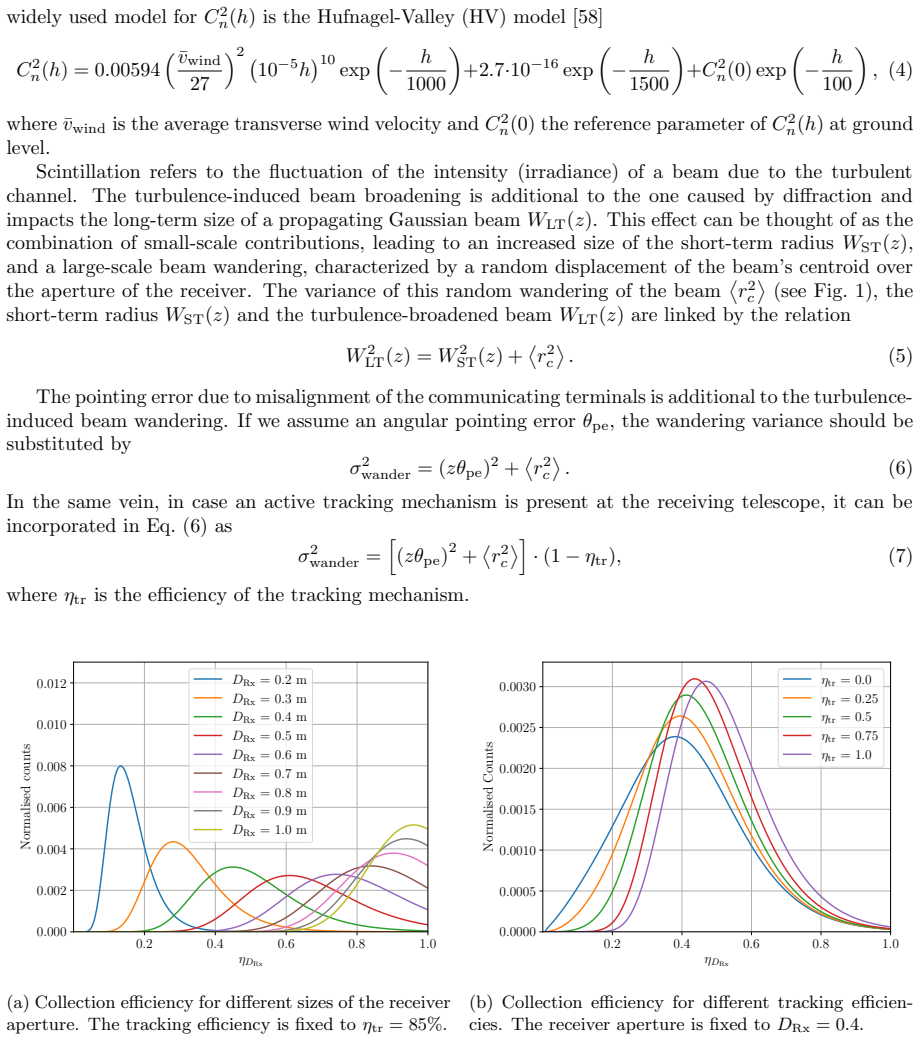
The load-bearing object is the total free-space channel efficiency $\eta_{\mathrm{free-space}} = \eta_{\mathrm{atm}} \cdot \eta_{D_{\mathrm{Rx}}} \cdot \eta_{\mathrm{SMF}}$. The atmospheric transmittance $\eta_{\mathrm{atm}}$ comes from a standard absorption/scattering model at 1550 nm; the collection efficiency $\eta_{D_{\mathrm{Rx}}}$ is a probability distribution built through the law of total probability, mixing a Gaussian beam-wandering term with a truncated log-normal spot-distortion term so it interpolates between weak and strong scintillation regimes; and the single-mode-fiber coupling efficiency $\eta_{\mathrm{SMF}}$ factors into a diffraction-limited term, a scintillation term, and a wavefront-aberration term whose phase coefficients are expanded in annular Zernike polynomials and attenuated by the control loop of an adaptive-optics system. The uplink channel is not modeled directly: it is obtained by reciprocity from the downlink, with anisoplanatism re-expressed as a fixed loss coming from the downlink beacon's pointing error. This cascade of distributions and PDFs is what lets the simulator output per-photon loss probabilities rather than a single average efficiency.
What would settle it
A field experiment that measures ground-to-balloon uplink channel efficiency and compares it with the reciprocity prediction: if the measured efficiency is consistently lower than the downlink-derived value scaled by the SPAD detector efficiency, or if the efficiency drops when balloon drift exceeds a few meters in a way consistent with $\sigma_{\mathrm{aniso}} = (\theta_{\mathrm{pe}}/\theta_0)^{5/3}$, the model's weakest assumption is falsified; the cleanest version is a vertical uplink test at 20–35 km with the balloon's GPS position logged against received power.
Extended reading notes
Core claim
The paper's central claim is that balloons are a realistic alternative to satellites for free-space quantum communication at the scale of a national network. Its signature quantitative result is that for inter-city distances above roughly 80 km, a balloon-based free-space link yields higher QKD rates than a fiber link between two metropolitan nodes; this crossover appears both in the number of shared Bell pairs per second and in the number of successful MDI-QKD rounds per second. In a benchmark Italian network (Venezia–Padova–Firenze–Siena), a trusted-node BB84 architecture with a balloon above each city achieves secret-key rates of tens of kilobits per second on the horizontal balloon-to-balloon leg and about 112 kbit/s on the vertical downlinks, while an untrusted entanglement-based architecture without balloon-to-balloon relay achieves tens of bits per second. The authors also report that an uplink channel, modeled by reciprocity with the downlink, reaches about half the efficiency of the downlink, which keeps ground-to-balloon protocols such as MDI-QKD feasible in principle.
Load-bearing premise
The load-bearing premise of the uplink and repeater scenarios is reciprocity: ground-to-balloon propagation is treated as a downlink with adaptive-optics pre-compensation, so the only significant anisoplanatism is the pointing error of the downlink beacon, because balloon motion is assumed to be Gaussian with a variance of a few meters and therefore negligible; if real stationkeeping or atmospheric conditions produce larger pointing offsets or uncorrected anisoplanatism, the uplink and MDI-QKD rates are overestimated.
Editorial extensions
If this is right
- Past roughly 80 km of city separation, a balloon middle node outperforms a ground-based fiber middle node for both entanglement-based QKD and MDI-QKD, so national quantum backbones can be planned around aerial nodes.
- Balloon-to-balloon horizontal links at 18–38 km altitude carry rates of tens of kbit/s with the baseline hardware, making a string of balloons the most efficient topology among those tested.
- A receiving telescope of about 40 cm diameter with adaptive-optics correction up to radial order 6 is near-optimal for the downlink, so prototype ground stations can be specified from these values.
- Ground-to-balloon uplinks are efficient enough (roughly half the downlink) to support trusted-node BB84 and, in principle, MDI-QKD with a balloon as the untrusted middle node.
- If combined with quantum memories, the balloon-based Bell-state measurement node would act as a quantum repeater, extending entanglement over city-scale distances; the paper leaves that modeling to future work.
Reading between the lines
- If the reciprocity-based uplink model survives field data, the same machinery could support aerial entanglement swapping and delegated quantum computing, not only QKD; the paper does not pursue these protocols.
- The 80 km crossover suggests an optimization problem the paper does not solve: a mixed fiber–balloon topology that assigns ground fiber links to short hops and balloon links to long hauls would likely minimize the cost per secure bit.
- A testable prediction follows from the model: uplink efficiency should degrade with balloon GPS drift according to $\sigma_{\mathrm{aniso}} = (\theta_{\mathrm{pe}}/\theta_0)^{5/3}$; logging drift during a field trial would calibrate the weakest assumption.
- The model also implies that pointing error, not raw detector efficiency, is the limiting specification for aerial nodes, since the beam-wandering PDF depends quadratically on $z\cdot\theta_{\mathrm{pe}}$; improving stationkeeping may matter more than faster single-photon detectors.
Editorial analysis
A structured set of objections, weighed in public.
Referee Report
Summary. The paper develops a free-space channel loss model for quantum communication between ground stations and high-altitude balloons, covering downlink, horizontal, and uplink channels. The model includes atmospheric transmittance, scintillation, beam wandering, receiver collection efficiency, single-mode fiber coupling with adaptive optics, tracking, and pointing errors. The model is embedded in the NetSquid simulator, validated against the paper's own theoretical formulas, and used to explore parameter trade-offs and to simulate BB84 trusted-node, entanglement-based untrusted-node, and MDI-QKD architectures in an Italian network. The central claim is that balloon-based links are a realistic alternative to satellites for national-scale quantum networks, with critical distances around 80 km beyond which balloon links outperform fiber links.
Significance. If the central claims survive scrutiny, this is a valuable contribution: it provides an open-source simulation tool for a relatively underexplored platform, systematically treats realistic hardware parameters and statistical channel effects, and identifies concrete crossover distances between free-space balloon links and fiber links. Strengths include the public GitHub code, the validation of the NetSquid implementation against the theoretical model with small statistical errors, the parameter exploration (receiver aperture, beam waist, AO order, zenith angle), and the concrete network architectures. The paper is useful for experimentalists and network engineers planning aerial-platform quantum links.
major comments (3)
- [Appendix D, Eq. (D1)] As printed, Eq. (D1) is not dimensionally consistent: with the definitions in Eqs. (D2) and (D3), μ1u and μ2u have units of m^(1/3), so the bracket [2.91 k^2 (μ1u + 0.62 μ2u Λ^(11/6))] has units of m^(-5/3); raising it to the +3/5 power and dividing by (H - h0) gives m^(-2), which cannot be an angle. The standard isoplanatic-angle expression requires the -3/5 exponent (or, equivalently, a different weighting in the integrand). This error propagates through Eq. (D6) into ηaniso in Eq. (D7), which enters the uplink efficiencies of Fig. 12 and the MDI-QKD rates of Fig. 18. Please correct the formula and re-evaluate the affected numerical results, including the claimed 80-km crossover.
- [Appendix D, with Eqs. (B12) and (C25)] The uplink model assumes that reciprocity with the downlink allows the same beam-wandering and coherence-width formulas to be used. However, reciprocity for point-source channels does not directly extend to the statistics of a finite-aperture uplink Gaussian beam: for an uplink, turbulence near the ground transmitter is weighted by the remaining propagation distance and produces larger centroid wander at the balloon, whereas the downlink formulas in Eqs. (B12) and (C25) weight turbulence by the distance to the ground receiver. Reusing these downlink expressions is therefore likely to overestimate both ηDRx and ηSMF on the uplink. The authors should either derive uplink-specific expressions or provide a quantitative argument that the difference is negligible for the altitudes and zenith angles considered, and should state how Figs. 12 and 18 change under such a check.
- [Table 1 and Appendix D] The assumption of a 1 µrad pointing error is load-bearing for the uplink and MDI-QKD results, but it is not demonstrated for a balloon platform. The statement in Appendix D that a balloon position variance of 'a few meters' produces anisoplanatism of 'a very small fraction of a µrad' appears inconsistent: at H = 35 km, a few meters corresponds to an angular offset of order 100 µrad. Published aerial-platform QKD demonstrations (e.g., Ref. [48]) report larger pointing errors, and no stationkeeping data are provided. Because ηaniso = exp[-(θpe/θ0)^(5/3)] degrades quickly with θpe, Fig. 18 and the 80-km crossover for MDI-QKD are sensitive to this value. Please add a sensitivity analysis over θpe (at least the 1-20 µrad range) and clarify the relation between balloon motion, the beacon angle, and the model's θpe.
minor comments (5)
- [Sec. 2.1, Fig. 2 caption] The caption contains a typo: 'Amospheric transmittance' should be 'Atmospheric transmittance'.
- [Sec. 4.2.4, Fig. 18] The axis label 'Successful MDI round per second' should be 'Successful MDI rounds per second' for grammatical consistency.
- [Sec. 3] The paper states that noise is not simulated but fixed to a realistic value (QBER = 4%); the abstract and conclusion should qualify 'realistic' accordingly, since the channel noise model is an input rather than an output of the simulation.
- [Sec. 4.2.4 and Fig. 18] The 80-km crossover for MDI-QKD is presented in terms of successful MDI rounds per second, not final secret key rate including finite-size effects and the full QBER; the text should state this distinction more explicitly.
- [Appendix E, Table 5] The verification of model assumptions (aperture averaging, Rayleigh criterion, small wandering) is reported only for the vertical downlink geometry of the Italian network; the MDI-QKD simulation in Fig. 18 uses a different geometry (uplink, NAO = 10, distances up to 140 km), and the same conditions are not checked there.
Circularity Check
No significant circularity: the network-rate predictions are computed from external atmospheric models and fixed hardware parameters, not from fitted inputs or load-bearing self-citation.
full rationale
The central outputs are channel efficiencies and QKD rates for balloon-based links. These are computed by evaluating published atmospheric-turbulence models (Andrews/Phillips [58]), LOWTRAN transmittance [64,65], the total-probability collection-efficiency PDF [60], and the AO-corrected fiber-coupling model [56,59], with hardware parameters (apertures, detector efficiencies, AO order, pointing error) stated as fixed inputs in Tables 1 and 2. The QBER used in Eq. (13) is taken as 4% from an external field trial [70], not fitted to produce the results. The 80-km crossover in Figs. 15 and 18 emerges from comparing these independently parameterized free-space losses with the fixed fiber loss of 0.18 dB/km; no parameter is adjusted to force the crossover. The self-citations ([49], [50], [51], [52], [55]) concern the NetSquid-based simulator and the 'quantum city' network architecture; they are code/infrastructure reuse, and the load-bearing physical formulas are not drawn from the authors' own prior results. The uplink model in Appendix D is an explicit assumption (reciprocity with the downlink, with anisoplanatism from pointing error) rather than a result derived from the claim it supports; whether that assumption is quantitatively accurate is a correctness/validation question, not a circularity. Internal checks comparing NetSquid output to the analytic formulas validate code implementation, not the physics claims. No step in the derivation chain reduces by construction to its own inputs.
Assumptions & free parameters
free parameters (10)
- QBER Qx = Qz =
4%
- Mean photon number per pulse mu =
0.01
- Source rate rsource =
80 MHz
- Ground detector efficiency =
0.85 (SNSPD)
- Balloon detector efficiency =
0.25 (SPAD)
- Refractive index structure constant at ground Cn2(0) =
9.6e-14 m^-2/3
- Pointing error theta_pe =
1 urad
- Tracking efficiency eta_tr =
80%
- Balloon altitude H =
35 km
- Telescope apertures and beam waists =
DRx_ground=40 cm, DRx_balloon=30 cm, W0_ground=20 cm, W0_balloon=10 cm
assumptions (7)
- domain assumption Kolmogorov spectrum and Hufnagel-Valley Cn2(h) profile describe atmospheric turbulence
- domain assumption LOWTRAN atmospheric transmittance is accurate for 1550 nm slanted paths
- domain assumption Reciprocity allows the uplink channel to be modeled as a pre-compensated downlink
- domain assumption Small residual wavefront error after AO (Rayleigh criterion) and small beam wandering
- domain assumption Aperture averaging applies for the chosen receiver diameters
- domain assumption No noise in quantum channels; QBER fixed at 4%
- standard math Spherical Earth geometry
Cite this review
Pith. "Pith review of Free-space model for a balloon-based quantum network." pith.science (2026). https://pith.science/paper/XLOSTMBW
@misc{pith2026241203356,
  author       = {Pith},
  title        = {Pith review of: Free-space model for a balloon-based quantum network},
  year         = {2026},
  howpublished = {\url{https://pith.science/paper/XLOSTMBW}},
  note         = {Machine review of arXiv:2412.03356}
}
read the original abstract
Long-distance communication is one of the main bottlenecks in the development of quantum communication networks. Free-space communication is a way to circumvent exponential fiber loss and to allow longer communication distances. Satellite nodes are the main devices currently studied for free-space communication, but they come with downsides such as high cost and low availability. In this work, we study an alternative to satellites, namely aerial platforms such as high-altitude balloons. We provide a loss model to simulate the channel efficiency of balloon-to-ground, ground-to-balloon, and balloon-to-balloon communication channels, considering a large set of hardware parameters. We perform a parameter exploration to exhibit important trade-offs in these channels, as well as simulations of different quantum key distribution network architectures including balloon nodes. We demonstrate that balloons are a realistic alternative to satellites for free-space communications in national network architectures.
Figures


Figures from the paper (18 more)


Reference graph
Works this paper leans on
-
[48]
Experimental Demonstration of Drone-Based Quantum Key Distribution
Xiao-Hui Tian et al. “Experimental Demonstration of Drone-Based Quantum Key Distribution”. In: Physical Review Letters 133.20 (Nov. 13, 2024), p. 200801. issn: 0031-9007, 1079-7114. doi: 10.1103/PhysRevLett.133.200801 . url: https://link.aps.org/doi/10.1103/PhysRevLett. 133.200801 (visited on 11/24/2024)
-
[1]
The security of practical quantum key distribution
Valerio Scarani et al. “The security of practical quantum key distribution”. In: Rev. Mod. Phys.81 (Sept. 2009), pp. 1301–1350. doi: 10.1103/RevModPhys.81.1301 . url: https://link.aps.org/ doi/10.1103/RevModPhys.81.1301
-
[2]
Maor Ganz. “Quantum Leader Election”. In: Quantum Information Processing16 (Oct. 2009). doi: 10.1007/s11128-017-1528-8
-
[3]
Mark Hillery, Vladim ´ ır Buˇ zek, and Andr´ e Berthiaume. “Quantum secret sharing”. In: Physical Review A 59.3 (Mar. 1999), pp. 1829–1834. issn: 1094-1622. doi: 10.1103/physreva.59.1829 . url: http://dx.doi.org/10.1103/PhysRevA.59.1829
-
[4]
Quantum Communication Complexity
Gilles Brassard. “Quantum Communication Complexity”. In: Foundations of Physics33.11 (Nov. 2003), pp. 1593–1616. doi: 10.1023/A:1026009100467 . url: https://doi.org/10.1023/A: 1026009100467
-
[5]
Private quantum computation: An introduction to blind quantum computing and related protocols
Joseph Fitzsimons. “Private quantum computation: An introduction to blind quantum computing and related protocols”. In: npj Quantum Information 3 (Nov. 2016). doi: 10.1038/s41534-017- 0025-3
-
[6]
Composable Security of Delegated Quantum Computation
Vedran Dunjko et al. “Composable Security of Delegated Quantum Computation”. In: Advances in Cryptology – ASIACRYPT 2014. Ed. by Palash Sarkar and Tetsu Iwata. Berlin, Heidelberg: Springer Berlin Heidelberg, 2014, pp. 406–425. isbn: 978-3-662-45608-8
2014
-
[7]
Practical quantum electronic voting
Federico Centrone, Eleni Diamanti, and Iordanis Kerenidis. “Practical quantum electronic voting”. In: Phys. Rev. Applied18 (2022), p. 014005
2022
Show all 92 references
-
[8]
Anonymity for practical quantum networks
Anupama Unnikrishnan et al. “Anonymity for practical quantum networks”. In: Physical Review Letters 122 (Nov. 2018)
2018
-
[9]
Distributed Measurement-based Quantum Computation
Vincent Danos et al. “Distributed Measurement-based Quantum Computation”. In: Electronic Notes in Theoretical Computer Science170 (2007). Proceedings of the 3rd International Work- shop on Quantum Programming Languages (QPL 2005), pp. 73–94. issn: 1571-0661. doi: https: //doi....
2007 doi
-
[10]
Private network parameter estimation with quantum sensors
Nathan Shettell, Majid Hassani, and Damian Markham. Private network parameter estimation with quantum sensors. 2022. arXiv: 2207.14450 [quant-ph]. 21
2022 arXiv
-
[11]
A trusted node–free eight-user metropolitan quantum communica- tion network
Siddarth Koduru Joshi et al. “A trusted node–free eight-user metropolitan quantum communica- tion network”. In: Science Advances 6.36 (Sept. 2020), eaba0959. issn: 2375-2548. doi: 10.1126/ sciadv.aba0959. url: http://dx.doi.org/10.1126/sciadv.aba0959
2020 doi
-
[12]
An integrated space-to-ground quantum communication network over 4,600 kilometres
Yu-Ao Chen et al. “An integrated space-to-ground quantum communication network over 4,600 kilometres”. In: Nature 589.7841 (2021), pp. 214–219. issn: 0028-0836. doi: 10.1038/s41586-020- 03093-8
2021 doi
-
[13]
Quantum internet: A vision for the road ahead
Stephanie Wehner, David Elkouss, and Ronald Hanson. “Quantum internet: A vision for the road ahead”. In: Science 362.6412 (2018). issn: 0036-8075. doi: 10 . 1126 / science . aam9288. eprint: https : / / science . sciencemag . org / content / 362 / 6412 / eaam9288 . full . pdf....
2018
-
[14]
The Link Layer service in a Quantum Internet
Axel Dahlberg, Matthew Skrzypczyk, and Stephanie Wehner. The Link Layer service in a Quantum Internet. Internet-Draft draft-dahlberg-ll-quantum-03. Work in Progress. Internet Engineering Task Force, Oct. 2019. 14 pp. url: https://datatracker.ietf.org/doc/html/draft-dahlberg-ll...
2019
-
[15]
Fundamental limits of repeaterless quantum communications
Stefano Pirandola et al. “Fundamental limits of repeaterless quantum communications”. In: Nature Communications 8.1 (Apr. 2017). doi: 10.1038/ncomms15043. url: https://doi.org/10.1038% 5C%2Fncomms15043
2017 doi
-
[16]
Fundamental rate-loss tradeoff for optical quantum key distribution
Masahiro Takeoka, Saikat Guha, and Mark M. Wilde. “Fundamental rate-loss tradeoff for optical quantum key distribution”. In:Nature Communications5.1 (Oct. 2014). doi: 10.1038/ncomms6235. url: https://doi.org/10.1038%2Fncomms6235
2014 doi
-
[18]
Inside Quantum Repeaters
William J. Munro et al. “Inside Quantum Repeaters”. In: IEEE Journal of Selected Topics in Quantum Electronics 21.3 (2015), pp. 78–90. doi: 10.1109/JSTQE.2015.2392076
2015
-
[19]
Quantum repeaters based on atomic ensembles and linear optics
Nicolas Sangouard et al. “Quantum repeaters based on atomic ensembles and linear optics”. In: Rev. Mod. Phys. 83 (1 Mar. 2011), pp. 33–80. doi: 10.1103/RevModPhys.83.33 . url: https: //link.aps.org/doi/10.1103/RevModPhys.83.33
2011 doi
-
[20]
Quantum repeaters: From quantum networks to the quantum internet
Koji Azuma et al. “Quantum repeaters: From quantum networks to the quantum internet”. In: arXiv preprint arXiv:2212.10820(2022)
2022 arXiv
-
[21]
Experimental demonstration of memory-enhanced quantum communication
M. K. Bhaskar et al. “Experimental demonstration of memory-enhanced quantum communication”. In: Nature 580.7801 (Mar. 2020), pp. 60–64. doi: 10.1038/s41586- 020- 2103- 5. url: https: //doi.org/10.1038%5C%2Fs41586-020-2103-5
2020 doi
-
[23]
Telecom-heralded entanglement between multimode solid-state quantum memories
Dario Lago-Rivera et al. “Telecom-heralded entanglement between multimode solid-state quantum memories”. In: Nature 594.7861 (June 2021), pp. 37–40. doi: 10.1038/s41586-021-03481-8 . url: https://doi.org/10.1038%2Fs41586-021-03481-8
2021 doi
-
[24]
Near-term quantum-repeater experiments with nitrogen-vacancy centers: Overcoming the limitations of direct transmission
Filip Rozpedek et al. “Near-term quantum-repeater experiments with nitrogen-vacancy centers: Overcoming the limitations of direct transmission”. In: Phys. Rev. A99 (5 May 2019), p. 052330. doi: 10.1103/PhysRevA.99.052330 . url: https://link.aps.org/doi/10.1103/PhysRevA.99. 052330
2019 doi
-
[25]
Quantum networks based on color centers in diamond
Maximilian Ruf et al. “Quantum networks based on color centers in diamond”. In: Journal of Applied Physics 130.7 (Aug. 2021), p. 070901. doi: 10.1063/5.0056534. url: https://doi.org/ 10.1063%5C%2F5.0056534. 22
2021 doi
-
[26]
Requirements for a processing-node quantum repeater on a real-world fiber grid
Guus Avis et al. “Requirements for a processing-node quantum repeater on a real-world fiber grid”. In: arXiv preprint arXiv:2207.10579(2022)
2022 arXiv
-
[27]
Feasibility of satellite quantum key distribution
C Bonato et al. “Feasibility of satellite quantum key distribution”. In: New Journal of Physics11.4 (Apr. 2009), p. 045017. doi: 10.1088/1367- 2630/11/4/045017 . url: https://doi.org/10. 1088/1367-2630/11/4/045017
2009 doi
-
[28]
A comprehensive design and performance analysis of low Earth orbit satellite quantum communication
J-P Bourgoin et al. “A comprehensive design and performance analysis of low Earth orbit satellite quantum communication”. In: New Journal of Physics15.2 (Feb. 2013), p. 023006. doi: 10.1088/ 1367-2630/15/2/023006. url: https://doi.org/10.1088/1367-2630/15/2/023006
2013 doi
-
[29]
Experimental Demonstration of Free-Space Decoy-State Quan- tum Key Distribution over 144 km
Tobias Schmitt-Manderbach et al. “Experimental Demonstration of Free-Space Decoy-State Quan- tum Key Distribution over 144 km”. In: Physical Review Letters98.1 (Jan. 2007). doi: 10.1103/ physrevlett.98.010504. url: https://doi.org/10.1103/physrevlett.98.010504
2007 doi
-
[30]
Air-to-ground quantum communication
Sebastian Nauerth et al. “Air-to-ground quantum communication”. In: Nature Photonics 7.5 (Mar. 2013), pp. 382–386. doi: 10.1038/nphoton.2013.46. url: https://doi.org/10.1038/nphoton. 2013.46
2013 doi
-
[31]
Experimental Satellite Quantum Communications
Giuseppe Vallone et al. “Experimental Satellite Quantum Communications”. In: Physical Review Letters 115.4 (July 2015). doi: 10.1103/physrevlett.115.040502 . url: https://doi.org/10. 1103/physrevlett.115.040502
2015 doi
-
[32]
Quantum-limited measurements of optical signals from a geostationary satellite
Kevin G¨ unthner et al. “Quantum-limited measurements of optical signals from a geostationary satellite”. In: Optica 4.6 (June 2017), p. 611. doi: 10 . 1364 / optica . 4 . 000611. url: https : //doi.org/10.1364/optica.4.000611
2017 doi
-
[33]
Micius quantum experiments in space
Chao-Yang Lu et al. “Micius quantum experiments in space”. In: Reviews of Modern Physics 94.3 (July 2022). doi: 10 . 1103 / revmodphys . 94 . 035001. url: https : / / doi . org / 10 . 1103 / revmodphys.94.035001
2022
-
[34]
Satellite-to-ground quantum key distribution
Sheng-Kai Liao et al. “Satellite-to-ground quantum key distribution”. In: Nature 549.7670 (Aug. 2017), pp. 43–47. doi: 10.1038/nature23655. url: https://doi.org/10.1038/nature23655
2017 doi
-
[35]
Entanglement-based secure quantum cryptography over 1, 120 kilometres
Juan Yin et al. “Entanglement-based secure quantum cryptography over 1, 120 kilometres”. In: Nature 582.7813 (June 2020), pp. 501–505. doi: 10 . 1038 / s41586 - 020 - 2401 - y. url: https : //doi.org/10.1038/s41586-020-2401-y
2020 doi
-
[36]
Ground-to-satellite quantum teleportation
Ji-Gang Ren et al. “Ground-to-satellite quantum teleportation”. In: Nature 549.7670 (Aug. 2017), pp. 70–73. doi: 10.1038/nature23675. url: https://doi.org/10.1038/nature23675
2017 doi
-
[37]
Adaptive-Optics-Enabled Quantum Communication: A Technique for Daytime Space-To-Earth Links
Mark T. Gruneisen et al. “Adaptive-Optics-Enabled Quantum Communication: A Technique for Daytime Space-To-Earth Links”. In: Physical Review Applied16.1 (July 29, 2021), p. 014067. issn: 2331-7019. doi: 10.1103/PhysRevApplied.16.014067 . url: https://link.aps.org/doi/10. 1103/P...
2021 doi
-
[38]
Performance of the Adaptive Optics System for Laser Communications Relay Demonstration’s Ground Station 1
Lewis C. Roberts et al. “Performance of the Adaptive Optics System for Laser Communications Relay Demonstration’s Ground Station 1”. In: Applied Optics62.23 (Aug. 10, 2023), G26– G36. issn: 2155-3165. doi: 10.1364/AO.486752 . url: https://opg.optica.org/ao/abstract. cfm...
2023 doi
-
[39]
CubeSat quantum communications mission
Daniel KL Oi et al. “CubeSat quantum communications mission”. In: EPJ Quantum Technology 4.1 (Apr. 2017). issn: 2196-0763. doi: 10.1140/epjqt/s40507- 017- 0060- 1. url: http://dx. doi.org/10.1140/epjqt/s40507-017-0060-1
2017 doi
-
[40]
A CubeSat platform for space based quantum key distribution
Srihari Sivasankaran et al. “A CubeSat platform for space based quantum key distribution”. In: 2022 IEEE International Conference on Space Optical Systems and Applications (ICSOS). 2022, pp. 51–56. doi: 10.1109/ICSOS53063.2022.9749724
2022
-
[41]
Spooky action at a global distance: analysis of space-based entanglement distribution for the quantum internet
Sumeet Khatri et al. “Spooky action at a global distance: analysis of space-based entanglement distribution for the quantum internet”. In: npj Quantum Information 7.1 (Jan. 2021). doi: 10. 1038/s41534-020-00327-5 . url: https://doi.org/10.1038%5C%2Fs41534-020-00327-5
2021
-
[42]
Global observer hydrogen UA V begins flight tests
G. Warwick. “Global observer hydrogen UA V begins flight tests”. In: 172 (Aug. 2010). 23
2010
-
[43]
Direct and full-scale experimental verifications towards ground–satellite quan- tum key distribution
Jian-Yu Wang et al. “Direct and full-scale experimental verifications towards ground–satellite quan- tum key distribution”. In: Nature Photonics 7.5 (Apr. 2013), pp. 387–393. doi: 10.1038/nphoton. 2013.89. url: https://doi.org/10.1038/nphoton.2013.89
2013 doi
-
[44]
Feasibility of quantum key distribution from high altitude platforms
Yi Chu et al. “Feasibility of quantum key distribution from high altitude platforms”. In: Quantum Science and Technology 6.3 (June 2021), p. 035009. doi: 10 . 1088 / 2058 - 9565 / abf9ae. url: https://dx.doi.org/10.1088/2058-9565/abf9ae
2021 doi
-
[45]
A review on practical challenges of aerial quantum communication
Umang Dubey et al. “A review on practical challenges of aerial quantum communication”. In: Physics Open 19 (2024), p. 100210. issn: 2666-0326. doi: https://doi.org/10.1016/j.physo. 2024.100210. url: https://www.sciencedirect.com/science/article/pii/S2666032624000085
2024
-
[46]
Drone-Based Quantum Communication Links
Andrew Conrad et al. “Drone-Based Quantum Communication Links”. In: Quantum Computing, Communication, and Simulation III. Quantum Computing, Communication, and Simulation III. Ed. by Philip R. Hemmer and Alan L. Migdall. San Francisco, United States: SPIE, Mar. 8, 2023, p. 42....
2023 doi
-
[47]
Majumdar
Arun K. Majumdar. Laser Communication with Constellation Satellites, UA Vs, HAPs and Bal- loons. Springer Cham, 2022. doi: https://doi.org/10.1007/978-3-031-03972-0
2022 doi
-
[49]
Quantum City: simulation of a practical near-term metropolitan quantum net- work
Raja Yehia et al. “Quantum City: simulation of a practical near-term metropolitan quantum net- work”. In: arXiv preprint arXiv:2211.01190 (2022). doi: 10 . 48550 / ARXIV . 2211 . 01190. url: https://arxiv.org/abs/2211.01190
-
[50]
Connecting Quantum Cities: Simulation of a Satellite-Based Quantum Network
Raja Yehia et al. “Connecting Quantum Cities: Simulation of a Satellite-Based Quantum Network”. In: New Journal of Physics26 (2023). doi: 10.1088/1367-2630/ad5b13
2023 doi
-
[51]
QuantumCity
Raja Yehia. QuantumCity. GitHub repository. 2023. url: https : / / github . com / RajaYehia / QuantumCity (visited on 09/26/2024)
2023
-
[52]
netsquid-freespace
Matteo Schiavon and Tim Coopmans. netsquid-freespace. GitHub repository. 2023. url: https: //github.com/matteoschiav/netsquid-freespace (visited on 09/26/2024)
2023
-
[53]
url: https://netsquid.org/
Netsquid website, https://netsquid.org/. url: https://netsquid.org/
-
[54]
NetSquid, a discrete-event simulation platform for quantum networks
Tim Coopmans et al. NetSquid, a discrete-event simulation platform for quantum networks. 2021. arXiv: 2010.12535 [quant-ph]
2021 arXiv
-
[55]
ballon qnet
Ilektra Karakosta-Amarantidou and Raja Yehia. ballon qnet. GitHub repository. 2024. url: https: //github.com/RajaYehia/balloon_qnet
2024
-
[56]
Optimal design and performance evaluation of free-space Quantum Key Distribution systems
Alessia Scriminich et al. “Optimal design and performance evaluation of free-space Quantum Key Distribution systems”. In: Quantum Science and Technology7.4 (2022), p. 045029
2022
-
[57]
Impact of turbulence on high-precision ground- satellite frequency transfer with two-way coherent optical links
Cl´ elia Robert, Jean-Marc Conan, and Peter Wolf. “Impact of turbulence on high-precision ground- satellite frequency transfer with two-way coherent optical links”. In: Physical Review A93.3 (2016), p. 033860
2016
-
[58]
Laser beam propagation through random media
Larry C Andrews and Ronald L Phillips. “Laser beam propagation through random media”. In: Laser Beam Propagation Through Random Media: Second Edition(2005)
2005
-
[59]
Statistical properties of single-mode fiber coupling of satellite-to-ground laser links partially corrected by adaptive optics
Lucien Canuet et al. “Statistical properties of single-mode fiber coupling of satellite-to-ground laser links partially corrected by adaptive optics”. In: JOSA A 35.1 (2018), pp. 148–162
2018
-
[60]
Theory of atmospheric quantum channels based on the law of total probability
D Vasylyev, W Vogel, and AA Semenov. “Theory of atmospheric quantum channels based on the law of total probability”. In: Physical Review A97.6 (2018), p. 063852. 24
2018
-
[61]
Reciprocity-enhanced optical communication through atmospheric turbulence—Part I: Reciprocity proofs and far-field power transfer optimization
Jeffrey H Shapiro and Andrew L Puryear. “Reciprocity-enhanced optical communication through atmospheric turbulence—Part I: Reciprocity proofs and far-field power transfer optimization”. In: Journal of Optical Communications and Networking4.12 (2012), pp. 947–954
2012
-
[62]
Reciprocity-enhanced optical commu- nication through atmospheric turbulence—Part II: Communication architectures and performance
Andrew L Puryear, Jeffrey H Shapiro, and Ronald R Parenti. “Reciprocity-enhanced optical commu- nication through atmospheric turbulence—Part II: Communication architectures and performance”. In: Journal of Optical Communications and Networking5.8 (2013), pp. 888–900
2013
-
[63]
Phase Estimation at the Point-Ahead Angle for AO Pre-Compensated Ground to GEO Satellite Telecoms
Perrine Lognon´ e et al. “Phase Estimation at the Point-Ahead Angle for AO Pre-Compensated Ground to GEO Satellite Telecoms”. In: Optics Express 31.3 (Jan. 30, 2023), pp. 3441–3458. issn: 1094-4087. doi: 10.1364/OE.476328. url: https://opg.optica.org/oe/abstract.cfm?uri=oe- 31...
2023 doi
-
[64]
Users guide to LOWTRAN 7
Francis X Kneizys. Users guide to LOWTRAN 7. Vol. 88. 177. Air Force Geophysics Laboratory, 1988
1988
-
[65]
lowtran-piccia
Francesco Picciariello. lowtran-piccia. GitHub repository. 2023. url: https : / / github . com / francescopiccia/lowtran-piccia (visited on 09/29/2024)
2023
-
[66]
Quantum cryptography: Public key distribution and coin tossing
Charles H. Bennett and Gilles Brassard. “Quantum cryptography: Public key distribution and coin tossing”. In: Theoretical Computer Science560 (2014). Theoretical Aspects of Quantum Cryptog- raphy – celebrating 30 years of BB84, pp. 7–11. issn: 0304-3975. doi: https : / / doi ....
2014
-
[67]
Quantum cryptography based on Bell’s theorem
Artur K. Ekert. “Quantum cryptography based on Bell’s theorem”. In: Phys. Rev. Lett.67.6 (Aug. 1991), pp. 661–663. doi: 10.1103/PhysRevLett.67.661 . url: https://link.aps.org/doi/10. 1103/PhysRevLett.67.661
1991 doi
-
[68]
Quantum cryptography without Bell’s theorem
Charles H. Bennett, Gilles Brassard, and N. David Mermin. “Quantum cryptography without Bell’s theorem”. In: Phys. Rev. Lett.68 (5 Feb. 1992), pp. 557–559. doi: 10.1103/PhysRevLett.68.557. url: https://link.aps.org/doi/10.1103/PhysRevLett.68.557
1992 doi
-
[69]
Simple Proof of Security of the BB84 Quantum Key Distribution Protocol
Peter W. Shor and John Preskill. “Simple Proof of Security of the BB84 Quantum Key Distribution Protocol”. In: Phys. Rev. Lett.85 (2 July 2000), pp. 441–444. doi: 10.1103/PhysRevLett.85.441. url: https://link.aps.org/doi/10.1103/PhysRevLett.85.441
-
[70]
Intermodal quantum key distribution field trial with active switching between fiber and free-space channels
Francesco Picciariello et al. “Intermodal quantum key distribution field trial with active switching between fiber and free-space channels”. In: arXiv preprint arXiv:2310.17441(2023)
2023 arXiv
-
[71]
Measurement-Device-Independent Quantum Key Distribution
Hoi-Kwong Lo, Marcos Curty, and Bing Qi. “Measurement-Device-Independent Quantum Key Distribution”. In: Physical Review Letters 108.13 (Mar. 2012). issn: 1079-7114. doi: 10 . 1103 / physrevlett.108.130503. url: http://dx.doi.org/10.1103/PhysRevLett.108.130503
2012 doi
-
[72]
Measurement-Device-Independent Quantum Key Distribution over Untrustful Metropolitan Network
Yan-Lin Tang et al. “Measurement-Device-Independent Quantum Key Distribution over Untrustful Metropolitan Network”. In: Phys. Rev. X6 (1 Mar. 2016), p. 011024. doi: 10.1103/PhysRevX.6. 011024. url: https://link.aps.org/doi/10.1103/PhysRevX.6.011024
2016 doi
-
[73]
Long-Distance Free-Space Measurement-Device-Independent Quantum Key Distri- bution
Yuan Cao et al. “Long-Distance Free-Space Measurement-Device-Independent Quantum Key Distri- bution”. In: Physical Review Letters125.26 (Dec. 2020). issn: 1079-7114. doi: 10.1103/physrevlett. 125.260503. url: http://dx.doi.org/10.1103/PhysRevLett.125.260503
2020 doi
-
[74]
Ancilla-assisted linear optical Bell measurements and their optimality
Andrea Olivo and Fr´ ed´ eric Grosshans. “Ancilla-assisted linear optical Bell measurements and their optimality”. In: Phys. Rev. A98 (4 Sept. 2018), p. 042323. doi: 10.1103/PhysRevA.98.042323 . url: https://link.aps.org/doi/10.1103/PhysRevA.98.042323
2018 doi
-
[75]
Bell-state measurement exceeding 50% success probability with linear optics
Matthias J. Bayerbach et al. “Bell-state measurement exceeding 50% success probability with linear optics”. In: Science Advances 9.32 (Aug. 2023). issn: 2375-2548. doi: 10.1126/sciadv.adf4080 . url: http://dx.doi.org/10.1126/sciadv.adf4080
2023 doi
-
[76]
Realization of a multinode quantum network of remote solid-state qubits
M. Pompili et al. “Realization of a multinode quantum network of remote solid-state qubits”. In: Science 372.6539 (2021), pp. 259–264. doi: 10.1126/science.abg1919 . eprint: https://www. science.org/doi/pdf/10.1126/science.abg1919 . url: https://www.science.org/doi/abs/ 10.112...
2021 doi
-
[77]
Delegating private quantum computations
Anne Broadbent. “Delegating private quantum computations”. In: Canadian Journal of Physics 93.9 (Sept. 2015), pp. 941–946. issn: 1208-6045. doi: 10 . 1139 / cjp - 2015 - 0030. url: http : //dx.doi.org/10.1139/cjp-2015-0030
2015 doi
-
[78]
Optimization of High Data Rate Ground to Satellite Links Pre-compensated by Adaptive Optics
Perrine Lognon´ e. “Optimization of High Data Rate Ground to Satellite Links Pre-compensated by Adaptive Optics”. PhD thesis. Institut Polytechnique de Paris, Dec. 13, 2023. url: https : //theses.hal.science/tel-04465340 (visited on 04/02/2024)
2023
-
[79]
Fundamentals of photonics
Bahaa EA Saleh and Malvin Carl Teich. Fundamentals of photonics. john Wiley & sons, 2019
2019
-
[80]
Electromagnetic beam propagation in turbulent media
Ronald L Fante. “Electromagnetic beam propagation in turbulent media”. In: Proceedings of the IEEE 63.12 (1975), pp. 1669–1692
1975
-
[81]
Fade statistics and aperture aver- aging for Gaussian beam waves in moderate-to-strong turbulence
Frida Str¨ omqvist Vetelino, Cynthia Young, and Larry Andrews. “Fade statistics and aperture aver- aging for Gaussian beam waves in moderate-to-strong turbulence”. In: Applied optics 46.18 (2007), pp. 3780–3789
2007
-
[82]
Turbulence-induced fading probability in coherent optical communication through the atmosphere
Nicolas Perlot. “Turbulence-induced fading probability in coherent optical communication through the atmosphere”. In: Applied optics 46.29 (2007), pp. 7218–7226
2007
-
[83]
Coupling of large telescopes and single-mode waveguides: application to stellar interferometry
Cyril Ruilier and Fr´ ed´ eric Cassaing. “Coupling of large telescopes and single-mode waveguides: application to stellar interferometry”. In: JOSA A 18.1 (2001), pp. 143–149
2001
-
[84]
Aperture averaging of scintillation
David L Fried. “Aperture averaging of scintillation”. In: JOSA 57.2 (1967), pp. 169–175
1967
-
[85]
Zernike polynomials and atmospheric turbulence
Robert J Noll. “Zernike polynomials and atmospheric turbulence”. In: JOsA 66.3 (1976), pp. 207– 211
1976
-
[86]
Zernike annular polynomials and atmospheric turbu- lence
Guang-ming Dai and Virendra N Mahajan. “Zernike annular polynomials and atmospheric turbu- lence”. In: Journal of the Optical Society of America A24.1 (2006), pp. 139–155
2006
-
[87]
Standards for reporting the optical aberrations of eyes
Larry N Thibos et al. Standards for reporting the optical aberrations of eyes. 2002
2002
-
[88]
Optical resolution through a randomly inhomogeneous medium for very long and very short exposures
David L Fried. “Optical resolution through a randomly inhomogeneous medium for very long and very short exposures”. In: JOSA 56.10 (1966), pp. 1372–1379
1966
-
[89]
Nonrecursive determination of orthonormal polyno- mials with matrix formulation
Guang-ming Dai and Virendra N Mahajan. “Nonrecursive determination of orthonormal polyno- mials with matrix formulation”. In: Optics letters 32.1 (2007), pp. 74–76
2007
-
[90]
Orthonormal polynomials in wavefront analysis: error analysis
Guang-ming Dai and Virendra N Mahajan. “Orthonormal polynomials in wavefront analysis: error analysis”. In: Applied optics 47.19 (2008), pp. 3433–3445
2008
-
[91]
Adaptive optics in astronomy
Fran¸ cois Roddier. “Adaptive optics in astronomy”. In: (1999)
1999
-
[92]
Wave-front temporal spectra in high- resolution imaging through turbulence
Jean-Marc Conan, G´ erard Rousset, and Pierre-Yves Madec. “Wave-front temporal spectra in high- resolution imaging through turbulence”. In: JOSA A 12.7 (1995), pp. 1559–1570
1995
-
[93]
Optical shop testing
Daniel Malacara. Optical shop testing. Vol. 59. John Wiley & Sons, 2007
2007
-
[94]
Anisoplanatism in adaptive optics
David L Fried. “Anisoplanatism in adaptive optics”. In: JOSA 72.1 (1982), pp. 52–61. 26 Appendices A Geometrical considerations We give a brief description of the geometrical considerations relevant for the definition of the free-space models developed in this work. In particu...
1982
Reviewed August 11, 2026 · model on record in the stance chip above.
Discussion (0). Continue with ORCID to comment.