REVIEW 4 major objections 5 minor 1 cited by
PromptCanvas: Composable Prompting Workspaces Using Dynamic Widgets for Exploration and Iteration in Creative Writing
T0 review · 4 major / 5 minor · reviewed 2026-08-07 · deepseek-v4-flash
Pith's one-line read PromptCanvas turns prompts into persistent, adjustable widgets on an infinite canvas, and in a lab study this interface outperformed a conversational UI on the Creativity Support Index while reducing mental demand and frustration.
desk verdict A solid system-level evaluation of dynamic widgets for creative writing, with an under-specified baseline and overclaimed causal framing; deserves peer review. read the letter →
The pith
A machine-rendered reading of the paper's core claim, the machinery that carries it, and where it could break.
The reading
What carries the argument
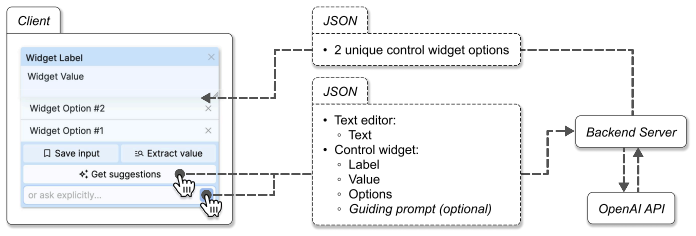
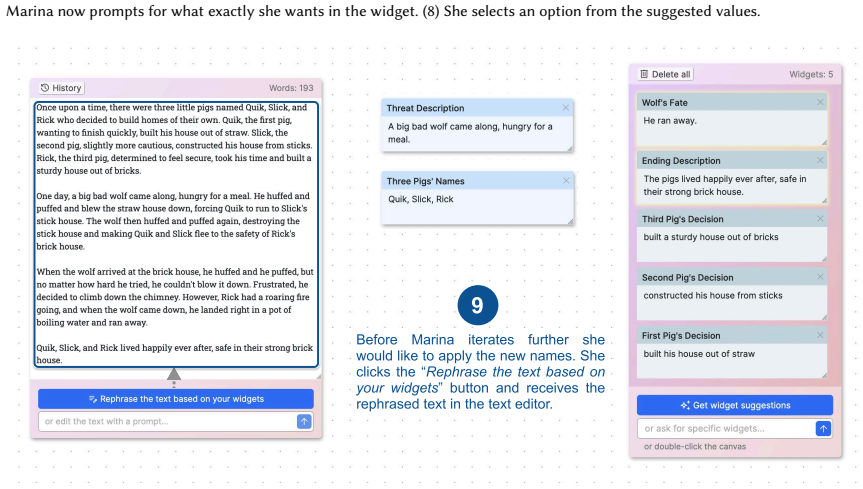
The load-bearing object is the dynamic widget: a small interactive panel with a title, a current value, and a list of alternative values, tied to one attribute of the text under revision. It carries the argument by converting an ephemeral prompt into a persistent, manipulable interface object: the label-value pairs of all active widgets are sent together with the draft to the same language model that generates the text, so the user's specifications become reusable state rather than one-shot chat history. The surrounding mechanism is the infinite canvas and the widget panel, which let users generate, arrange, cluster, and discard widgets without losing the workflow, and the rephrasing pipeline that streams revised text back into the editor.
What would settle it
Run a larger preregistered within-subject study in which the chat baseline is augmented with persistent prompt history, editable previous messages, and one-click suggestion options; if the roughly 20-point Creativity Support Index gap and the NASA-TLX differences disappear or reverse, the claim that dynamic widgets themselves improve creative writing support would be falsified.
Extended reading notes
Core claim
PromptCanvas's central claim is that dynamic widgets make prompting composable: each widget represents one attribute of the text (such as tone, length, or a character name), carries a current value and a set of alternatives, and can be created from system suggestions, a user prompt, or an empty double-click on the canvas. Once placed on the canvas, active widgets are converted into label-value pairs and sent to the language model to rephrase the draft, so the prompt does not evaporate after one exchange but remains visible and editable as the writing evolves. The paper reports that this design outperformed a conversational baseline in the lab, with an overall Creativity Support Index of 82.09 against 61.65, significant differences favoring PromptCanvas on mental demand (1.89 vs 3.06, p = 0.02) and frustration (1.28 vs 2.17, p = 0.03), and far fewer prompts needed (4.0 vs 11.1, p = 0.0006). Eighty-nine percent of participants preferred PromptCanvas, and the two-week field study echoed the creativity results, with participants also using the canvas for programming and multilingual writing.
Load-bearing premise
The comparative claim rests on the 18-person lab study and on the assumption that the ChatGPT-style chat interface built as the baseline is a fair, representative control rather than a deliberately plain one; the two-week field study had no baseline, so it cannot independently support the relative advantage.
Editorial extensions
If this is right
- If PromptCanvas is right, chat is not the default interface for LLM writing support; persistent widgetized prompts are a more effective pattern for open-ended creative tasks.
- Users needing roughly one-third the number of prompts (4.0 vs 11.1) implies widget canvases can compress iterative refinement into fewer, more targeted model calls.
- Lower mental demand and frustration on NASA-TLX implies the visual persistence of prompt variables reduces metacognitive load, not just user preference.
- The field-study use of widgets for programming and non-English writing suggests the pattern generalizes beyond creative writing to other LLM-assisted workflows.
Reading between the lines
- A factorial follow-up could separate the effects of persistence, spatial layout, and suggestion content; this study does not isolate which component of the widget format carries the creativity gain.
- The widget pattern could be extended to code generation and image generation, where attributes such as model, seed, or style could become widgets on a canvas instead of arguments buried in a prompt.
- Because widget values and layouts are structured, they could be logged and shared as reusable prompt workflows, turning prompt engineering from throwaway utterances into compositional, named components.
Editorial analysis
A structured set of objections, weighed in public.
Referee Report
Summary. The paper introduces PromptCanvas, a workspace for LLM-based creative writing in which prompts are decomposed into interactive 'dynamic widgets' placed on an infinite canvas. Widgets can be system-suggested, user-prompted, or manually created, and each widget controls an attribute of the generated text (tone, names, plot elements, etc.). The authors report a within-subject lab study (N=18) comparing PromptCanvas with a custom chat-based 'conversational UI', finding significantly higher Creativity Support Index scores and lower NASA-TLX mental demand and frustration for PromptCanvas, alongside qualitative reports of improved exploration and control. A two-week field study (N=10) without a baseline reports high CSI and SUS scores. The paper frames these results as answering RQ2/RQ3, i.e., that dynamic widgets improve creativity support and reduce cognitive load relative to conversational UIs.
Significance. If the comparative claims held, PromptCanvas would be a useful design pattern for LLM writing tools: modular, persistent widgets that make prompt attributes visible and editable could support decomposition of tasks, iterative exploration, and a greater sense of control. The paper's strengths include a within-subject, counterbalanced lab design using the same underlying LLM (gpt-4o-2024-08-06) in both conditions, standardized instruments (CSI, NASA-TLX, SUS), Bonferroni-Holm correction, and a clearly described system implementation. The qualitative analysis is rich and gives concrete insight into how users appropriate widget-based interfaces. However, the central comparative claim is undermined by confounds between conditions and by an insufficiently specified baseline, so the significance of the specific RQ2/RQ3 conclusions is currently provisional.
major comments (4)
- [§5.2 and §4.2] The baseline conversational UI is not specified to the same level as PromptCanvas. For PromptCanvas the paper states a sampling temperature of 1.06 (§4.2) and gives the full system prompts for each backend service (Tables 4–8 referenced in §4.2.1–4.2.5), including an explicit instruction that natural-language editing must return the complete modified text (§4.2.5). For the baseline, the paper reports neither the temperature nor the system prompt, nor how regeneration/rephrasing handles the previous message. Without matched parameters, the significant differences in CSI and NASA-TLX (§6.2, §6.3) could be driven by backend configuration rather than by the dynamic-widget concept. Please report the baseline's prompts, temperature, and output-completeness behavior, or run a comparison with matched settings.
- [§5.2, §4.1, and §6.2–6.3] The two conditions differ in many features beyond dynamic widgets: PromptCanvas includes an infinite canvas, a directly editable text editor with history and word counts, a widget panel, and a dedicated 'rephrase based on widgets' action, while the baseline chat UI offers only copy and edit-message functionality. Consequently, RQ2 and RQ3 ('Do dynamic widgets ... improve creativity support / reduce cognitive load?') are not answered by this design; at best the study shows a system-level comparison. To support the widget-specific claim, the authors should either add a condition that isolates the widgets (e.g., a chat UI augmented with the same editor and history features, or a widget-based UI without the canvas), or explicitly reframe RQ2/RQ3 as comparisons of PromptCanvas as a whole against a chat UI and temper the causal language accordingly.
- [Abstract and §5.4] The abstract states that the field study (N=10) 'confirmed these results', but the field study has no baseline condition and only measures PromptCanvas itself (CSI and SUS, §5.4.1, Table 3). It cannot confirm relative superiority over a conversational UI. The relative claim rests entirely on the 18-participant lab comparison. The authors should either add a comparative baseline to the field study or revise the abstract and §5.4 to state that the field study provided further qualitative and usability evidence for PromptCanvas, not confirmation of the comparative advantage.
- [§6.1.6] Participant P12 is quoted as saying that in the static UI 'some of my previous texts were being cut off' when regenerating text. This suggests a functional deficiency or different regeneration behavior in the baseline, rather than an inherent property of chat UIs. If the baseline's regeneration replaced only part of the message or truncated it, this would bias the mental-demand and frustration ratings in favor of PromptCanvas. The manuscript should clarify how the baseline handled regeneration and, if the behavior was not the intended one, treat this as a confound rather than as evidence about the interface paradigm.
minor comments (5)
- [§6.3.1] For the significant NASA-TLX differences, only p-values are reported. Please add effect sizes (e.g., Cohen's d or rank-biserial correlation) and confidence intervals for the CSI and TLX comparisons, especially given the modest sample size.
- [§5.2 and Figure 12] The paper describes the baseline as 'designed according to the design and interaction principles of ChatGPT' but does not provide a screenshot annotation of its regeneration/edit behavior. A short description of what happens when a user edits a message or regenerates would help readers assess the fairness of the baseline.
- [§7.1] The limitations section mentions sample size and generalizability but does not acknowledge the confounds between the two conditions or the lack of a field-study baseline. Consider adding these as explicit limitations.
- [References] Reference [1] is formatted incorrectly ('Philip T. Kortum Aaron Bangor' should be 'Aaron Bangor, Philip T. Kortum, and James T. Miller'). Also, references [37] and [38] both list the same Luminate paper; one duplicate should be removed.
- [Figures 14 and 16] The stacked percentage bars in Figures 14 and 16 sum to over 100% within some rows (e.g., 'Which tool made you feel hurried or rushed' shows 39% + 39% + 33% = 111%). Please clarify the response format or adjust the visualization so readers can correctly interpret the preference data.
Circularity Check
No circularity: the comparative claims rest on external instruments and a separate baseline UI, not on the paper's own definitions.
full rationale
This paper is an empirical HCI study, not a derivation or modeling paper. The central claims, that PromptCanvas outperforms a conversational UI on the Creativity Support Index and reduces perceived cognitive load, are supported by standardized, external measurement instruments (CSI, NASA-TLX, SUS) and by a direct lab comparison against a separately implemented baseline chat interface (Section 5.2, 5.3, 6.2, 6.3). There is no fitted parameter, no mathematical derivation, and no self-referential definition in which a predicted quantity is constructed from the same data used to fit it. The few self-citations in the related-work section (e.g., Buschek's 'Collage is the New Writing' and Dang et al.'s writing tools) are used to motivate design goals and relate prior work, not to establish the empirical result, so they are not load-bearing circularity. The field study's claim that it 'confirmed these results' is a validity concern because it lacks a baseline condition, but it is not a circularity concern: it is a separate deployment with its own measurements, not a reduction of the target claim to its own inputs. Concerns about the fairness or representativeness of the baseline UI are methodological threats to validity, not instances of circular reasoning. Accordingly, no circular step can be quoted, and the appropriate score is 0.
Assumptions & free parameters
assumptions (5)
- domain assumption Self-report instruments (CSI, NASA-TLX, SUS) validly measure creativity support, workload, and usability in this context.
- domain assumption The conversational UI is a fair, representative baseline.
- domain assumption Counterbalanced within-subject design with 18 participants adequately controls learning and order effects.
- domain assumption The same gpt-4o model produces comparable generation quality across both UIs.
- domain assumption Open coding by the first author, refined with co-authors, captures user experience faithfully.
Cite this review
Pith. "Pith review of PromptCanvas: Composable Prompting Workspaces Using Dynamic Widgets for Exploration and Iteration in Creative Writing." pith.science (2026). https://pith.science/paper/XMFKM3X6
@misc{pith2026250603741,
  author       = {Pith},
  title        = {Pith review of: PromptCanvas: Composable Prompting Workspaces Using Dynamic Widgets for Exploration and Iteration in Creative Writing},
  year         = {2026},
  howpublished = {\url{https://pith.science/paper/XMFKM3X6}},
  note         = {Machine review of arXiv:2506.03741}
}
read the original abstract
We introduce PromptCanvas, a concept that transforms prompting into a composable, widget-based experience on an infinite canvas. Users can generate, customize, and arrange interactive widgets representing various facets of their text, offering greater control over AI-generated content. PromptCanvas allows widget creation through system suggestions, user prompts, or manual input, providing a flexible environment tailored to individual needs. This enables deeper engagement with the creative process. In a lab study with 18 participants, PromptCanvas outperformed a traditional conversational UI on the Creativity Support Index. Participants found that it reduced cognitive load, with lower mental demand and frustration. Qualitative feedback revealed that the visual organization of thoughts and easy iteration encouraged new perspectives and ideas. A follow-up field study (N=10) confirmed these results, showcasing the potential of dynamic, customizable interfaces in improving collaborative writing with AI.
Figures


Figures from the paper (14 more)




Forward citations
Cited by 1 Pith paper
-
From Words to Widgets for Controllable LLM Generation
Reifying ad-hoc preference phrases as GUI widgets, steered by log-probability modulation at decode time, improves precision and perceived control of LLM writing over natural-language prompting alone.
Reference graph
Works this paper leans on
-
[1]
Kortum Aaron Bangor and James T
Philip T. Kortum Aaron Bangor and James T. Miller. 2008. An Empirical Evaluation of the System Usability Scale.International Journal of Human–Computer Interaction24, 6 (2008), 574–594. doi:10.1080/10447310802205776 arXiv:https://doi.org/10.1080/10447310802205776
-
[2]
Christopher Ahlberg and Ben Shneiderman. 1994. Visual information seeking: tight coupling of dynamic query filters with starfield displays. In Proceedings of the SIGCHI Conference on Human Factors in Computing Systems(Boston, Massachusetts, USA)(CHI ’94). Association for Computing Machinery, New York, NY, USA, 313–317. doi:10.1145/191666.191775
-
[3]
Belle Dang Andy Nguyen, Yvonne Hong and Xiaoshan Huang. 2024. Human-AI collaboration patterns in AI-assisted academic writing.Studies in Higher Education49, 5 (2024), 847–864. doi:10.1080/03075079.2024.2323593
arXiv 2024
-
[5]
Jacob Austin, Augustus Odena, Maxwell Nye, Maarten Bosma, Henryk Michalewski, David Dohan, Ellen Jiang, Carrie Cai, Michael Terry, Quoc Le, and Charles Sutton. 2021. Program Synthesis with Large Language Models. doi:10.48550/arXiv.2108.07732 arXiv:2108.07732
-
[6]
Shraddha Barke, Michael B. James, and Nadia Polikarpova. 2023. Grounded Copilot: How Programmers Interact with Code-Generating Models.Proc. ACM Program. Lang.7, OOPSLA1, Article 78 (apr 2023), 27 pages. doi:10.1145/3586030
doi:10.1145/3586030 2023
-
[7]
Michel Beaudouin-Lafon and Wendy E. Mackay. 2000. Reification, polymorphism and reuse: three principles for designing visual interfaces. In Proceedings of the Working Conference on Advanced Visual Interfaces(Palermo, Italy)(A VI ’00). Association for Computing Machinery, New York, NY, USA, 102–109. doi:10.1145/345513.345267
arXiv 2000
-
[8]
Advait Bhat, Saaket Agashe, Parth Oberoi, Niharika Mohile, Ravi Jangir, and Anirudha Joshi. 2023. Interacting with Next-Phrase Suggestions: How Suggestion Systems Aid and Influence the Cognitive Processes of Writing. InProceedings of the 28th International Conference on Intelligent User Interfaces(Sydney, NSW, Australia)(IUI ’23). Association for Computin...
arXiv 2023
-
[9]
Michael Mose Biskjaer, Jonas Frich, Lindsay MacDonald Vermeulen, Christian Remy, and Peter Dalsgaard. 2019. How Time Constraints in a Creativity Support Tool Affect the Creative Writing Experience. InProceedings of the 31st European Conference on Cognitive Ergonomics(BELFAST, United Kingdom)(ECCE ’19). Association for Computing Machinery, New York, NY, US...
Show all 41 references
-
[11]
Daniel Buschek. 2024. Collage is the New Writing: Exploring the Fragmentation of Text and User Interfaces in AI Tools. InProceedings of the 2024 ACM Designing Interactive Systems Conference(Copenhagen, Denmark)(DIS ’24). Association for Computing Machinery, New York, NY, USA, ...
2024
-
[12]
Daniel Buschek, Martin Zürn, and Malin Eiband. 2021. The Impact of Multiple Parallel Phrase Suggestions on Email Input and Composition Behaviour of Native and Non-Native English Writers. InProceedings of the 2021 CHI Conference on Human Factors in Computing Systems(Yokohama, J...
2021
-
[13]
Carroll, Celine Latulipe, Richard Fung, and Michael Terry
Erin A. Carroll, Celine Latulipe, Richard Fung, and Michael Terry. 2009. Creativity factor evaluation: towards a standardized survey metric for creativity support. InProceedings of the Seventh ACM Conference on Creativity and Cognition(Berkeley, California, USA)(C&C ’09). Asso...
2009
-
[15]
Hai Dang, Sven Goller, Florian Lehmann, and Daniel Buschek. 2023. Choice Over Control: How Users Write with Large Language Models using Diegetic and Non-Diegetic Prompting. InProceedings of the 2023 CHI Conference on Human Factors in Computing Systems(Hamburg, Germany)(CHI ’23...
2023
-
[16]
Leah Findlater and Krzysztof Z. Gajos. 2009. Design Space and Evaluation Challenges of Adaptive Graphical User Interfaces.AI Magazine30, 4 (Sep. 2009), 68. doi:10.1609/aimag.v30i4.2268
2009 doi
-
[17]
Iona Gilburt. 2024. A machine in the loop: the peculiar intervention of artificial intelligence in writer’s block.New Writing21, 1 (2024), 26–37
2024
-
[18]
Charles Goodwin. 2015. Professional vision. InAufmerksamkeit: Geschichte-theorie-empirie. Springer, Cham, Switzerland, 387–425
2015
-
[19]
John R. Hayes. 2012. Modeling and Remodeling Writing.Written Communication29, 3 (2012), 369–388. doi:10.1177/0741088312451260
2012 doi
- [20]
-
[22]
Abdulrahman Khamaj and Abdulelah M. Ali. 2024. Adapting user experience with reinforcement learning: Personalizing interfaces based on user behavior analysis in real-time.Alexandria Engineering Journal95 (2024), 164–173. doi:10.1016/j.aej.2024.03.045
2024 doi
-
[23]
2016.Track changes: A literary history of word processing
Matthew G Kirschenbaum. 2016.Track changes: A literary history of word processing. Harvard University Press, Cambridge, MA
2016
-
[24]
Max Kreminski. 2024. The Dearth of the Author in AI-Supported Writing. InProceedings of the Third Workshop on Intelligent and Interactive Writing Assistants(Honolulu, HI, USA)(In2Writing ’24). Association for Computing Machinery, New York, NY, USA, 48–50. doi:10.1145/3690712.3690725
2024
-
[26]
Zamfirescu-Pereira, Matthew G Lee, Sauhard Jain, Shanqing Cai, Piyawat Lertvittayakumjorn, Michael Xuelin Huang, Shumin Zhai, Bjoern Hartmann, and Can Liu
Susan Lin, Jeremy Warner, J.D. Zamfirescu-Pereira, Matthew G Lee, Sauhard Jain, Shanqing Cai, Piyawat Lertvittayakumjorn, Michael Xuelin Huang, Shumin Zhai, Bjoern Hartmann, and Can Liu. 2024. Rambler: Supporting Writing With Speech via LLM-Assisted Gist Manipulation. InProcee...
2024
-
[27]
Damien Masson, Young-Ho Kim, and Fanny Chevalier. 2024. Textoshop: Interactions Inspired by Drawing Software to Facilitate Text Editing. arXiv:2409.17088
2024 arXiv
-
[29]
Mathewson, Jaylen Pittman, and Richard Evans
Piotr Mirowski, Kory W. Mathewson, Jaylen Pittman, and Richard Evans. 2023. Co-Writing Screenplays and Theatre Scripts with Language Models: Evaluation by Industry Professionals. InProceedings of the 2023 CHI Conference on Human Factors in Computing Systems(Hamburg, Germany)(C...
2023
-
[30]
Arpit Narechania, Kaustubh Odak, Mennatallah El-Assady, and Alex Endert. 2025. ProvenanceWidgets: A Library of UI Control Elements to Track and Dynamically Overlay Analytic Provenance.IEEE Transactions on Visualization and Computer Graphics31, 1 (2025), 1235–1245. doi:10.1109/...
2025
-
[31]
Zhenhui Peng, Xingbo Wang, Qiushi Han, Junkai Zhu, Xiaojuan Ma, and Huamin Qu. 2023. Storyfier: Exploring Vocabulary Learning Support with Text Generation Models. InProceedings of the 36th Annual ACM Symposium on User Interface Software and Technology(San Francisco, CA, USA) (...
2023
-
[32]
Hua Xuan Qin, Shan Jin, Ze Gao, Mingming Fan, and Pan Hui. 2024. CharacterMeet: Supporting Creative Writers’ Entire Story Character Construction Processes Through Conversation with LLM-Powered Chatbot Avatars. InProceedings of the CHI Conference on Human Factors in Computing S...
2024
-
[33]
Emily Reif, Crystal Qian, James Wexler, and Minsuk Kahng. 2024. Automatic Histograms: Leveraging Language Models for Text Dataset Exploration. InExtended Abstracts of the CHI Conference on Human Factors in Computing Systems(Honolulu, HI, USA)(CHI EA ’24). Association for Compu...
2024
-
[34]
Battersby, Melanie Tory, Rich Gossweiler, and Angel X
Vidya Setlur, Sarah E. Battersby, Melanie Tory, Rich Gossweiler, and Angel X. Chang. 2016. Eviza: A Natural Language Interface for Visual Analysis. InProceedings of the 29th Annual Symposium on User Interface Software and Technology(Tokyo, Japan)(UIST ’16). Association for Com...
2016
-
[35]
Ben Shneiderman. 1983. Direct manipulation: A step beyond programming languages.Computer16, 08 (1983), 57–69. Manuscript submitted to ACM 30 Amin et al
1983
-
[36]
Arjun Srinivasan and Vidya Setlur. 2023. BOLT: A Natural Language Interface for Dashboard Authoring. InEuroVis 2023 - Short Papers. The Eurographics Association, Eindhoven, The Netherlands, 5. doi:10.2312/evs.20231035
2023 doi
-
[38]
Sangho Suh, Meng Chen, Bryan Min, Toby Jia-Jun Li, and Haijun Xia. 2024. Luminate: Structured Generation and Exploration of Design Space with Large Language Models for Human-AI Co-Creation. InProceedings of the CHI Conference on Human Factors in Computing Systems(Honolulu, HI,...
2024
-
[39]
Sangho Suh, Jian Zhao, and Edith Law. 2022. CodeToon: Story Ideation, Auto Comic Generation, and Structure Mapping for Code-Driven Storytelling. InProceedings of the 35th Annual ACM Symposium on User Interface Software and Technology(Bend, OR, USA)(UIST ’22). Association for C...
2022
-
[40]
Lev Tankelevitch, Viktor Kewenig, Auste Simkute, Ava Elizabeth Scott, Advait Sarkar, Abigail Sellen, and Sean Rintel. 2024. The Metacognitive Demands and Opportunities of Generative AI. InProceedings of the CHI Conference on Human Factors in Computing Systems(Honolulu, HI, USA...
2024
-
[41]
Leiva, and Antti Oulasvirta
Kashyap Todi, Gilles Bailly, Luis A. Leiva, and Antti Oulasvirta. 2021. Adapting User Interfaces with Model-based Reinforcement Learning. arXiv:2103.06807
2021 arXiv
-
[42]
Glassman, Jeevana Priya Inala, and Chenglong Wang
Priyan Vaithilingam, Elena L. Glassman, Jeevana Priya Inala, and Chenglong Wang. 2024. DynaVis: Dynamically Synthesized UI Widgets for Visualization Editing. InProceedings of the CHI Conference on Human Factors in Computing Systems(Honolulu, HI, USA)(CHI ’24). Association for ...
2024
-
[43]
Priyan Vaithilingam and Philip J. Guo. 2019. Bespoke: Interactively Synthesizing Custom GUIs from Command-Line Applications By Demonstration. InProceedings of the 32nd Annual ACM Symposium on User Interface Software and Technology(New Orleans, LA, USA)(UIST ’19). Association f...
2019
-
[44]
Zhijie Wang, Yuheng Huang, Da Song, Lei Ma, and Tianyi Zhang. 2024. PromptCharm: Text-to-Image Generation through Multi-modal Prompting and Refinement. InProceedings of the CHI Conference on Human Factors in Computing Systems. ACM, Honolulu HI USA, 1–21. doi:10.1145/3613904.3642803
2024
-
[45]
Jason Wu, Kashyap Todi, Joannes Chan, Brad A Myers, and Ben Lafreniere. 2024. FrameKit: A Tool for Authoring Adaptive UIs Using Keyframes. In Proceedings of the 29th International Conference on Intelligent User Interfaces(Greenville, SC, USA)(IUI ’24). Association for Computin...
2024
-
[46]
Ann Yuan, Andy Coenen, Emily Reif, and Daphne Ippolito. 2022. Wordcraft: Story Writing With Large Language Models. InProceedings of the 27th International Conference on Intelligent User Interfaces(Helsinki, Finland)(IUI ’22). Association for Computing Machinery, New York, NY, ...
2022
-
[47]
Zamfirescu-Pereira, Richmond Y
J.D. Zamfirescu-Pereira, Richmond Y. Wong, Bjoern Hartmann, and Qian Yang. 2023. Why Johnny Can’t Prompt: How Non-AI Experts Try (and Fail) to Design LLM Prompts. InProceedings of the 2023 CHI Conference on Human Factors in Computing Systems(Hamburg, Germany)(CHI ’23). Associa...
2023
-
[48]
Zheng Zhang, Jie Gao, Ranjodh Singh Dhaliwal, and Toby Jia-Jun Li. 2023. VISAR: A Human-AI Argumentative Writing Assistant with Visual Programming and Rapid Draft Prototyping. InProceedings of the 36th Annual ACM Symposium on User Interface Software and Technology(San Francisc...
2023
Reviewed August 7, 2026 · model on record in the stance chip above.
Discussion (0). Sign in to comment.