REVIEW 2 major objections 5 minor 44 references
First-Order Methods for Distributionally Robust Constrained Optimization
T0 review · 2 major / 5 minor · reviewed 2026-07-14 · grok-4.5
Pith's one-line read Entropic smoothing plus stochastic Frank–Wolfe turns Wasserstein DRO into a practical first-order method for constrained and combinatorial problems.
desk verdict Solid methods paper: packages known WDRO smoothing with momentum SFW, proves the dual-compactness and variance pieces needed for constrained sets, and shows the expected ERM–robust tradeoff on two standard OR problems. read the letter →
The pith
A machine-rendered reading of the paper's core claim, the machinery that carries it, and where it could break.
The reading
What carries the argument
The entropically smoothed dual objective F(x,λ) (equation (4)), whose x- and λ-gradients are expectations under the Gibbs reweighting π_{x,λ}; these gradients are estimated by self-normalized Monte-Carlo averages and fed to a momentum Frank–Wolfe iteration that only needs a linear minimization oracle over conv(X).
What would settle it
On a traffic-assignment or quadratic-MST instance whose true loss is convex and C^{2}, run the algorithm with the stated step-sizes and check whether average suboptimality of F decays like 1/√t and whether the returned solution has lower out-of-sample loss than ERM under a controlled Wasserstein shift; systematic failure of either test falsifies the claim.
Extended reading notes
Core claim
Under standard smoothness, compactness and ground-cost assumptions, the entropically regularized dual Wasserstein DRO objective is convex and twice differentiable; its Monte-Carlo mini-batch gradient estimators are asymptotically unbiased and have uniformly bounded variance; and a momentum stochastic Frank–Wolfe scheme on the compactified dual domain therefore converges at rate O(1/√t) in expectation while producing decisions that improve shifted-test loss relative to empirical risk minimization.
Load-bearing premise
Every scenario must make the loss convex and twice continuously differentiable in the decision variable; if that fails, the gradient formulas and the smoothness needed for the convergence rate no longer hold.
Editorial analysis
A structured set of objections, weighed in public.
Referee Report
Summary. The paper develops a first-order method for Wasserstein distributionally robust constrained optimization. Starting from the dual WDRO reformulation, it replaces the sample-wise inner supremum by an entropic log-sum-exp approximation (smoothed objective F in (4)), derives Monte-Carlo mini-batch gradient estimators (11), and optimizes F over conv(X)×[0,λ_max] by a momentum stochastic Frank–Wolfe scheme that only needs a linear minimization oracle. Under Assumptions 1–3 and ρ > L_c σ^{2} d, Proposition 1 establishes convexity and C^{2} of F, Proposition 3/Corollary 1 restrict the dual variable to a compact interval, Lemma 2 bounds the variance of the gradient estimator, and Theorem 1 obtains an O(1/√t) expected suboptimality rate by invoking Braun et al. Numerical illustrations on traffic assignment and quadratic minimum spanning tree show the expected ERM–robust tradeoff under distributional shift.
Significance. If the claims hold, the paper supplies a unified, oracle-based algorithmic template for Wasserstein DRO over constraint sets that admit a linear minimization oracle (spanning trees, flows, matchings, traffic assignment, etc.). The technical contributions that close the gap relative to prior unconstrained smoothing work—explicit dual compactness (Prop. 3/Cor. 1) and a uniform variance bound for the self-normalized mini-batch estimator (Lemma 2)—are carefully derived from stated assumptions and make the subsequent rate (Theorem 1) non-vacuous. The two running examples satisfy the hypotheses and the experiments are presented only as illustrations, which is appropriate. The main modeling limitation (C^{2}-convexity of f(·,ξ) for every scenario) is already acknowledged by the authors and correctly restricts the scope; within that scope the contribution is solid and of clear interest to the mathematical programming community.
major comments (2)
- Assumption 1 (C^{2}-convexity of x ↦ f(x,ξ) on conv(X) for every ξ) is load-bearing for differentiability of F, the gradient formulae (7)–(8), L_F-smoothness (Lemma 1), and therefore for the invocation of Braun et al. that yields Theorem 1. Many natural combinatorial or nonconvex travel-time models violate it. The paper correctly states the assumption and verifies it for the two examples, but the abstract and introduction still speak of a “general” method for constrained/combinatorial WDRO; a short, explicit delimitation of the modeling scope (and a pointer to possible future nonconvex extensions) would prevent over-reading of the claim.
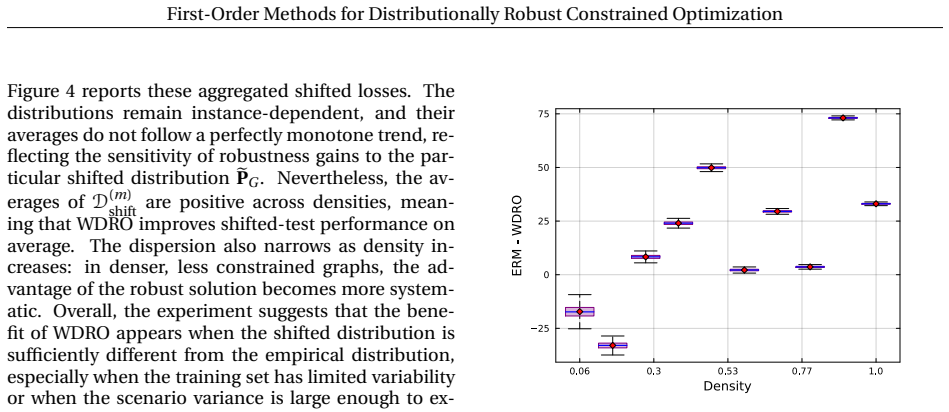
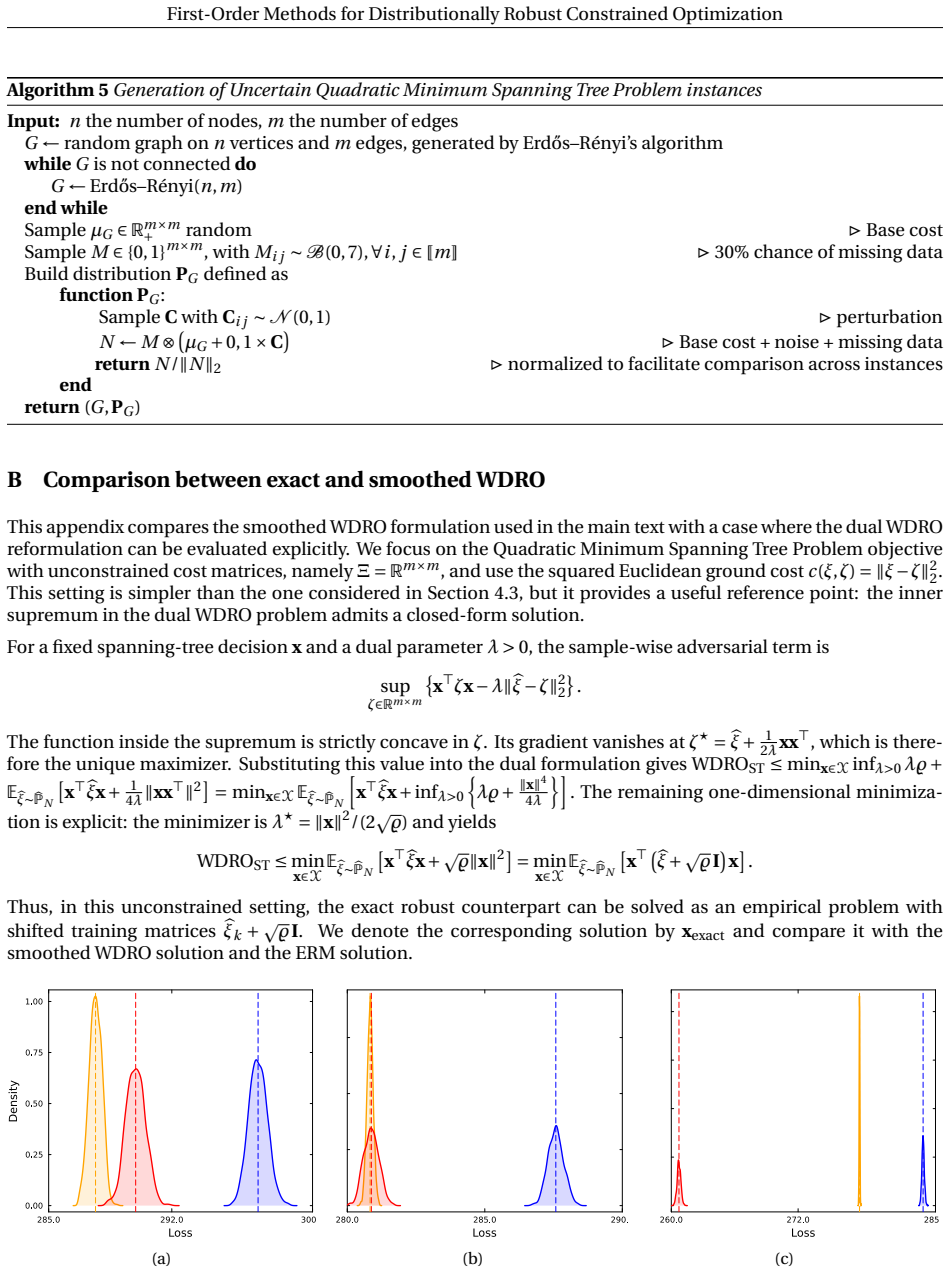
- Section 4 and Appendix B: the numerical comparison with the exact closed-form robust counterpart (available when Ξ = R^{m imes m}) is only qualitative and instance-dependent. Because the paper’s central algorithmic claim is that the smoothed surrogate is a practical and faithful proxy, a quantitative table (or a short additional experiment) reporting the gap between smoothed and exact robust values, and the out-of-sample losses of both, would strengthen the empirical support without changing the theoretical development.
minor comments (5)
- Algorithm 2 line “LMO(∇̂F)”: the notation is slightly inconsistent with the earlier definition (12); write LMO_X explicitly.
- Figure 3 caption and surrounding text: the color coding (red = robust, blue = ERM) is reversed relative to the traffic-assignment figures; a uniform convention would help readability.
- Page 5, display of the Monte-Carlo weights: the double-superscript notation w^{(k)}_s is dense; a short inline definition of the self-normalized importance weights would improve clarity.
- References: a few recent works on stochastic Frank–Wolfe for DRO / robust combinatorial optimization could be added for completeness, but this is optional.
- Typographical: “Holder’s inequality” → “Hölder’s”; occasional missing spaces around ± and × symbols.
Circularity Check
No significant circularity: rate and estimators follow from stated assumptions plus external Braun et al. theorem; self-citations supply only the smoothing model.
-
self citation load bearing
[§1.2 and §2 (Eq. 4, Prop. 1)]
"we first replace the inner sample-wise supremum by an entropic log-sum-exp approximation, following Azizian et al. [2023], Gao and Kleywegt [2023], Vincent et al. [2024]. This yields the smoothed WDRO problem min … F(x,λ) …"
The smoothing model that makes F differentiable is taken from prior work co-authored by Malick. This is ordinary background citation, not a load-bearing uniqueness claim or a fitted quantity re-used as a prediction; the subsequent variance bound, dual compactness argument and rate invocation are independent of that citation. Flagged only as the sole self-reference that touches the modelling premise.
full rationale
The paper’s central claim (Theorem 1) is an O(1/√t) expected-suboptimality guarantee for momentum mini-batch stochastic Frank–Wolfe applied to the entropically regularized dual F on the compact set conv(X)×[0,λ_max]. The derivation is: dual WDRO (3) → entropic surrogate F (4) → gradient formulae (Prop. 1) → Monte-Carlo/mini-batch estimators (11) and asymptotic unbiasedness (Prop. 2) → explicit dual-radius bound λ_max (Prop. 3 / Cor. 1) → L_F-smoothness (Lemma 1) → uniform variance bound V_max (Lemma 2) → invoke Theorem 4.12 of Braun et al. (2025). All constants (λ_max, L_F, V_max, D) are derived from Assumptions 1–3 and the explicit condition ρ > L_c σ² d; none is fitted to data and then re-labelled a prediction. The only self-citations (Azizian et al. 2023, Vincent et al. 2024, Le & Malick 2024) introduce the already-published smoothing model and its statistical guarantees; they are not used to force uniqueness, forbid alternatives, or close the rate proof. The rate form itself is imported from an external reference whose authors do not overlap. Numerical parameters (ε, ρ, σ²) shape the surrogate but do not appear inside the statement of Theorem 1. Experiments are presented only as illustrations of the ERM–robust tradeoff, not as forced predictions. Consequently the derivation chain is self-contained against its own inputs; the single minor self-citation is background, not load-bearing, yielding score 1.
Assumptions & free parameters
free parameters (5)
- ε (entropic smoothing temperature)
- σ² (Gaussian sampling variance)
- ρ (Wasserstein radius)
- S, b (Monte Carlo and mini-batch sizes)
- λ_max (dual upper bound, calibrated)
assumptions (6)
- domain assumption Assumption 1: for each ξ, x ↦ f(x,ξ) is C² and convex on conv(X); ξ ↦ ∇_x f(x,ξ) continuous.
- domain assumption Assumption 2: Ξ and X are compact and nonempty.
- domain assumption Assumption 3: μ‖ξ−ζ‖₂² ≤ c(ξ,ζ) ≤ L_c ‖ξ−ζ‖₂² on Ξ×Ξ.
- domain assumption Feasible set admits a tractable linear minimization oracle over conv(X).
- standard math Momentum stochastic Frank–Wolfe converges at the stated rate when the objective is convex L-smooth on a compact set of diameter D and stochastic gradients have uniformly bounded variance (Braun et al., Thm 4.12).
- domain assumption Entropic regularization of WDRO preserves statistical guarantees of the Wasserstein formulation (cited Azizian et al. 2023; Le & Malick 2024).
Cite this review
Pith. "Pith review of First-Order Methods for Distributionally Robust Constrained Optimization." pith.science (2026). https://pith.science/paper/XMLBP4UH
@misc{pith2026260711460,
  author       = {Pith},
  title        = {Pith review of: First-Order Methods for Distributionally Robust Constrained Optimization},
  year         = {2026},
  howpublished = {\url{https://pith.science/paper/XMLBP4UH}},
  note         = {Machine review of arXiv:2607.11460}
}
read the original abstract
We consider constrained optimization problems in which input data are affected by estimation errors. In such settings, Wasserstein distributionally robust optimization provides a principled framework to mitigate model risk by optimizing against worst-case distributions within Wasserstein ambiguity sets. However, the numerical resolution of the resulting problems remains challenging, especially in constrained and combinatorial settings. In this paper, we propose a tractable stochastic approach based on two key ingredients: (i) an entropic regularization of the distributionally robust value function, which makes it possible to compute stochastic gradient estimators, and (ii) the combination of these estimators with a stochastic Frank-Wolfe algorithm, allowing us to optimize the regularized robust objective while naturally handling constraints. We illustrate the method, and its interests against empirical risk minimization, on two classical optimization problems, the minimum quadratic spanning tree and the traffic assignment problems. Our approach provides a general, practical way to address Wasserstein distributionally robust formulations in the presence of constraints.
Figures


Figures from the paper (1 more)
Reference graph
Works this paper leans on
-
[1]
Data-driven distributionally robust optimization using the
Mohajerin Es\-fahani, Peyman and Kuhn, Daniel , journal=. Data-driven distributionally robust optimization using the. 2018 , publisher=
2018
-
[2]
Universal generalization guarantees for
Le, Tam and Malick, J. Universal generalization guarantees for. arXiv preprint , year=
-
[3]
Regularization for
Azizian, Wa. Regularization for. ESAIM: Control, Optimisation and Calculus of Variations , year=
-
[4]
Foundations and Trends in Machine Learning , title =
Gabriel Peyr. Foundations and Trends in Machine Learning , title =. 2019 , volume =
2019
-
[5]
A Smoothed Dual Approach for Variational
Marco Cuturi and Gabriel Peyré , year=. A Smoothed Dual Approach for Variational. 1503.02533 , archivePrefix=
-
[6]
2025 , eprint=
Conditional Gradient Methods , author=. 2025 , eprint=
2025
-
[7]
Mathematical programming , year=
Smooth minimization of non-smooth functions , author=. Mathematical programming , year=
-
[8]
arXiv preprint , year=
The gradient's limit of a definable family of functions admits a variational stratification , author=. arXiv preprint , year=
Show all 44 references
-
[9]
Unregularized limit of stochastic gradient method for
Le, Tam , journal=. Unregularized limit of stochastic gradient method for
-
[10]
Operations Research , year=
Distributionally robust convex optimization , author=. Operations Research , year=
-
[11]
Vincent and Azizian and Iutzeler and Malick , journal=
-
[12]
Besan. A. arXiv preprint arXiv:2411.19848 , year=
-
[13]
Naval Research Logistics , year=
The quadratic minimum spanning tree problem , author=. Naval Research Logistics , year=
-
[14]
2007 , publisher=
Measure theory , author=. 2007 , publisher=
2007
-
[15]
SIAM Journal on optimization , volume=
The sample average approximation method for stochastic discrete optimization , author=. SIAM Journal on optimization , volume=. 2002 , publisher=
2002
-
[16]
Mathematics of Operations Research , volume=
Quantifying distributional model risk via optimal transport , author=. Mathematics of Operations Research , volume=. 2019 , publisher=
2019
-
[17]
Journal of the American statistical association , volume=
Probability inequalities for sums of bounded random variables , author=. Journal of the American statistical association , volume=. 1963 , publisher=
1963
-
[18]
2022 , publisher=
Measure theory, probability, and stochastic processes , author=. 2022 , publisher=
2022
-
[19]
2000 , publisher=
Asymptotic statistics , author=. 2000 , publisher=
2000
-
[20]
2008 , publisher=
Combinatorics and graph theory , author=. 2008 , publisher=
2008
-
[21]
2002 , publisher=
Combinatorial optimization , author=. 2002 , publisher=
2002
-
[22]
Operations Research , volume=
The distributionally robust chance-constrained vehicle routing problem , author=. Operations Research , volume=. 2020 , publisher=
2020
-
[23]
European Journal of Operational Research , year=
Distributionally robust facility location problem under decision-dependent stochastic demand , author=. European Journal of Operational Research , year=
-
[24]
Transportation science , year=
Distributionally robust fair transit resource allocation during a pandemic , author=. Transportation science , year=
-
[25]
INFORMS Journal on Computing , year=
Target-oriented distributionally robust optimization and its applications to surgery allocation , author=. INFORMS Journal on Computing , year=
-
[26]
2021 , publisher=
Lectures on stochastic programming: modeling and theory , author=. 2021 , publisher=
2021
-
[27]
predict, then optimize
Smart “predict, then optimize” , author=. Management Science , volume=. 2022 , publisher=
2022
-
[28]
Journal of Machine Learning Research , volume=
Variance-based regularization with convex objectives , author=. Journal of Machine Learning Research , volume=
-
[29]
arXiv preprint arXiv:2604.04342 , year=
Generative models for decision-making under distributional shift , author=. arXiv preprint arXiv:2604.04342 , year=
-
[30]
INFORMS Journal on Computing , volume=
Besan. INFORMS Journal on Computing , volume=. 2022 , publisher=
2022
-
[31]
Improved algorithms and novel applications of the
Besan. Improved algorithms and novel applications of the. ACM Transactions on Mathematical Software , volume=. 2025 , publisher=
2025
-
[32]
Revisiting
Jaggi, Martin , booktitle=. Revisiting. 2013 , organization=
2013
-
[33]
SIAM review , volume=
Optimization methods for large-scale machine learning , author=. SIAM review , volume=. 2018 , publisher=
2018
-
[34]
2018 , publisher=
Lectures on convex optimization , author=. 2018 , publisher=
2018
-
[35]
Scientific data , volume=
A unified dataset for the city-scale traffic assignment model in 20 US cities , author=. Scientific data , volume=. 2024 , publisher=
2024
-
[36]
2015 , publisher=
The traffic assignment problem: models and methods , author=. 2015 , publisher=
2015
-
[37]
European Journal of Operational Research , year=
Spanning and splitting: Integer semidefinite programming for the quadratic minimum spanning tree problem , author=. European Journal of Operational Research , year=
-
[38]
2019 , publisher=
Kuhn, Daniel and Esfahani, Peyman Mohajerin and Nguyen, Viet Anh and Shafieezadeh-Abadeh, Soroosh , booktitle=. 2019 , publisher=
2019
-
[39]
The stiff is moving—Conjugate direction
Mitradjieva, Maria and Lindberg, Per Olov , journal=. The stiff is moving—Conjugate direction. 2013 , publisher=
2013
-
[40]
Naval research logistics quarterly , volume=
An algorithm for quadratic programming , author=. Naval research logistics quarterly , volume=. 1956 , publisher=
1956
-
[41]
Mathematics of Operations Research , volume=
Distributionally robust stochastic optimization with Wasserstein distance , author=. Mathematics of Operations Research , volume=. 2023 , publisher=
2023
-
[42]
Convex mixed-integer optimization with
Hendrych, Deborah and Troppens, Hannah and Besan. Convex mixed-integer optimization with. Mathematical Programming Computation , volume=. 2025 , publisher=
2025
-
[43]
Operations Research , volume=
A unified theory of robust and distributionally robust optimization via the primal-worst-equals-dual-best principle , author=. Operations Research , volume=. 2025 , publisher=
2025
-
[44]
, title =
Owen, Art B. , title =. 2013 , note =
2013
Reviewed July 14, 2026 · model on record in the stance chip above.
Discussion (0). Continue with ORCID to comment.