REVIEW 2 major objections 7 minor 60 references
Sample size calculations for the experimental comparison of multiple algorithms on multiple problem instances
T0 review · 2 major / 7 minor · reviewed 2026-08-14 · deepseek-v4-flash
Pith's one-line read This paper shows how to choose the number of instances and the number of runs per instance for comparing any number of algorithms, with controlled error rates and prespecified power to detect a minimally relevant difference.
desk verdict A genuinely useful extension of the two-algorithm sample-size machinery to arbitrary A, with real software; the main soft spot is the unvalidated mean-power approximation in Algorithm 2. read the letter →
The pith
A machine-rendered reading of the paper's core claim, the machinery that carries it, and where it could break.
The reading
What carries the argument
Minimally relevant effect size (MRES), $d^*=|\delta^*|/\sigma$, the smallest standardised mean paired difference judged practically relevant, anchors both the power calculation and the interpretation of detected effects. Holm's step-down procedure assigns significance level $\alpha'_r=\alpha_f/(K-r+1)$ to the $r$-th ordered hypothesis, controlling the familywise error rate while being less conservative than Bonferroni; the paper uses these levels in the instance-count calculation. The instance-count engine is Equation (38), a noncentral $t$ power formula with noncentrality $|d^*|\sqrt{N}$, together with Algorithm 2, which finds $N$ by averaging per-comparison powers. The run-count engine is Algorithm 1, a greedy allocation that reduces the worst pairwise standard error on each instance subject to $se^*$, using the optimal ratios $n_i/n_j=\sigma_i/\sigma_j$ and $n_1/n_j=(\sigma_1/\mu_1)/(\sigma_j/\mu_j)$ to decide which algorithm receives the next run.
What would settle it
Run a Monte Carlo simulation of the designed experiment: generate $A$ algorithms on $N$ instances with all pairwise standardised differences exactly $d^*$ (and also with only some pairs differing and the rest null), apply Holm's step-down procedure, and compare the empirical mean, best, and worst rejection power across many repetitions to the values predicted by Equation (38) and Algorithm 2. A systematic shortfall would show that the recommended instance count is miscalibrated in mean-power mode.
Extended reading notes
Core claim
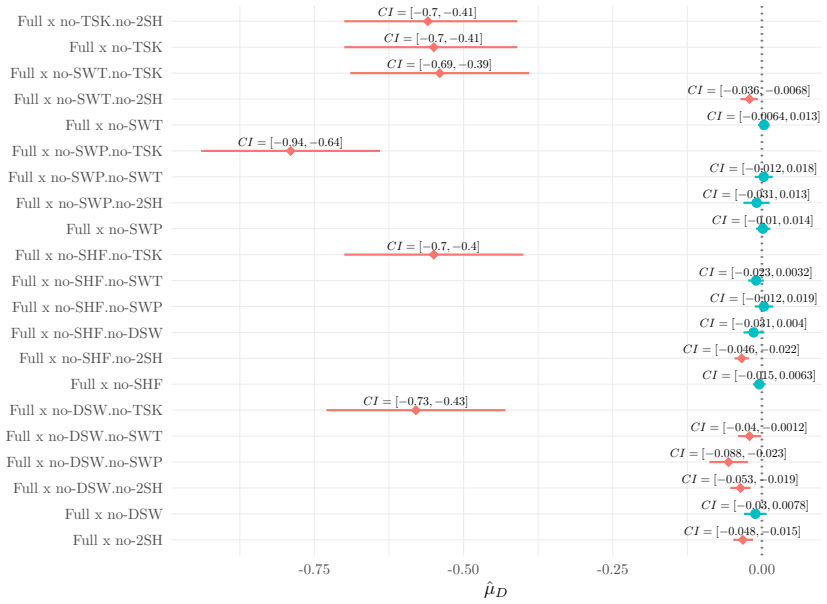
The paper establishes that the comparison of $A$ algorithms over a problem class can be planned as a set of paired comparisons on instance-blocked differences, and that the required number of instances $N$ is the smallest integer satisfying the noncentral $t$ condition $t_{N-1}^{1-\alpha/2}\le t_{N-1}^{\beta^*;|ncp^*|}$ with $|ncp^*|=|d^*|\sqrt{N}$, where the significance level is corrected by Holm's step-down procedure. For the least-favourable comparison this correction is $\alpha_f/K$; for mean-power design, the paper's Algorithm 2 iterates $N$ until the average of per-comparison powers $\mathrm{Power}(\alpha/i, N, d^*, H_1)$ reaches $\pi^*$. Within each instance, the number of runs is the solution of a constrained minimization: the smallest total runs such that every pairwise standard error $se_{(ij)|\ell}^2\le(se^*)^2$. The paper derives optimal allocation ratios $n_i/n_j=\sigma_i/\sigma_j$ for simple differences and for all-vs-all percent differences, and $n_1/n_j=(\sigma_1/\mu_1)/(\sigma_j/\mu_j)$ for all-vs-one percent differences, and embeds them in a greedy algorithm that allocates the next run to the algorithm most responsible for the current worst standard error. The case study with 21 variants of a simulated-annealing scheduler demonstrates that the instance count (57 in that experiment) and per-instance run counts determined this way deliver the planned power and controlled standard errors.
Load-bearing premise
The load-bearing premise is that the planned mean power of a Holm-corrected experiment is well approximated by the average of per-comparison powers computed at fixed thresholds $\alpha/i$ ($i=1,\dots,K$) with every comparison at effect size $d^*$; actual Holm thresholds are assigned to ordered, dependent $p$-values, so the realised mean power can differ from the planned $\pi^*$.
Editorial extensions
If this is right
- An experimenter who fixes $d^*$, $\pi^*$, and $\alpha_f$ can compute the minimum number of instances directly, instead of using the entire benchmark set or an arbitrary default.
- Because Holm's procedure is less conservative than Bonferroni, designing for mean power yields a smaller $N$ than the Bonferroni-equivalent design, while the worst-case power stays close to $\pi^*$ in the paper's examples.
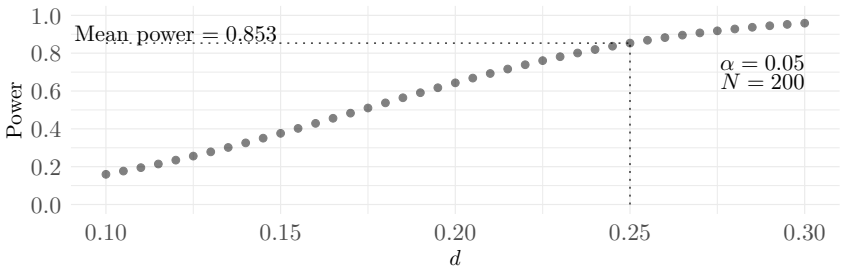
- For a fixed available set of instances, the same formulas give a power-versus-effect-size curve, so researchers can report the sensitivity their chosen benchmark set actually provides.
- The per-instance run allocation guarantees, up to the computational budget, that all pairwise estimates meet the chosen accuracy $se^*$, which keeps estimation noise from inflating the residual variance used in the paired tests.
- All-vs-one and one-sided designs are systematically cheaper than all-vs-all and two-sided designs, since they create fewer and less heavily corrected hypotheses.
Reading between the lines
- A natural extension, not explored in the paper, would replace the single $d^*$ with a distribution of effect sizes across pairs or instance subclasses; the same noncentral-$t$ machinery could then be integrated over that distribution to size experiments under heterogeneity.
- The mean-power shortcut in Algorithm 2 ignores the dependence among Holm-ordered $p$-values and the possibility that some null hypotheses are true; a Monte Carlo calibration across those scenarios would state how much the realised power can deviate from $\pi^*$.
- The optimal-run ratios are derived per pair and ignore correlations among comparisons that share the reference algorithm or the grand mean; a joint allocation rule could in principle beat the greedy rule in total runs when such correlations are strong.
- Because the method can reserve unused benchmark instances, it offers a practical guard against tuning a heuristic to a fixed benchmark set; this suggests a testable protocol where held-out instances, not just held-out runs, are used to validate algorithm-design choices.
Signed reviews
Editorial analysis
A structured set of objections, weighed in public.
Referee Report
Summary. The paper generalizes the authors' earlier sample-size methodology from two algorithms to an arbitrary number. The number of repeated runs per instance is framed as a constrained minimization problem on the standard errors of estimated paired differences; the authors derive optimal sample-size ratios for simple differences and for percent differences under all-vs-one and all-vs-all comparisons, and give a greedy sampling algorithm (Algorithm 1). The number of instances is derived from a paired-t-test power calculation (Eq. 38), with significance levels corrected by either Bonferroni or Holm. For Holm's procedure they propose worst-case, mean-power, and median-power planning modes (Algorithm 2), and they illustrate the whole protocol on a 22-algorithm comparison of simulated-annealing variants on a scheduling benchmark. The main advertised advances are the multi-algorithm generalization, the Holm-based instance-number formulas, and the per-instance run-allocation ratios.
Significance. If the proposed formulas are valid, the paper supplies a practical and much-needed alternative to arbitrary choices of instance counts and repetition numbers in metaheuristic comparisons. The worst-case (Bonferroni) instance-size formulas are standard and correctly applied, and the derivations of the per-instance optimal ratios are carefully executed for the three difference types. The accompanying R package and the realistic case study are valuable. The principal weakness is that the recommended mean-power mode for Holm's procedure rests on an unvalidated approximation of the achieved rejection rate, so the central claim about this design mode is not yet established.
major comments (2)
- [Section 4, Algorithm 2; Eq. (39)] The mean-power planning in Algorithm 2 averages Power(α/i, N, d*, H1) over i = 1,...,K, treating the Holm thresholds as fixed quantities assigned to comparisons. In the actual Holm procedure, the threshold available to a comparison depends on the rank of its p-value among all K tests, and that rank is random and correlated with the p-value itself; for example, with K = 2 independent tests under the global null, the average of the fixed thresholds is 3α/4, whereas the expected per-test rejection rate under Holm is α/2 + 3α^2/8. The paper provides no proof or simulation that the achieved mean rejection probability equals the averaged quantity when some alternatives are true or effect sizes vary, and Figure 2 is generated from the same approximation, so it cannot serve as evidence. The case study in Section 5.4 reports realized p-values and confidence intervals but not achieved power, so it also does not validate the approximation. Because Section 4 recommends mean power as the preferred design target, this gap is load-bearing; please provide either an analytic justification under stated conditions or a simulation study covering equal and unequal effect sizes, and revise the corresponding claims if the approximation is optimistic.
- [Section 3, Algorithm 1 and text following Eq. (13)] The text states that if Algorithm 1 is interrupted by the computational budget, 'the resulting standard errors of estimation will be the smallest ones achievable.' This global optimality claim is not established: the greedy rule of augmenting the algorithm that contributes most to the current maximal standard error does not in general imply that the realized standard-error vector is minimal for the total number of runs used, because early choices constrain later possibilities. The procedure is a reasonable heuristic for reducing the worst-case standard error, but the claim should either be proved or weakened to say that the procedure is designed to reduce the worst-case standard error. This secondary issue does not affect the derivation of the pairwise sample-size ratios, but it is directly tied to the optimality language used to motivate Algorithm 1.
minor comments (7)
- [Section 4, paragraph after Eq. (39)] Holm's thresholds become less strict as r increases, since α'_r = α/(K - r + 1) grows with r; the phrase 'increasingly stricter significance level' is therefore inverted and should be corrected.
- [Section 5.2] The sentence 'an all vs. one design was be the most appropriate' contains a grammatical error and should read 'was the most appropriate.'
- [Section 3.1, Eq. (13)] The lower-bound constraints n_k|ℓ ≥ 2 are mentioned only in the prose; include them in the displayed formulation or explicitly state that they are implicit.
- [Table 1] The inserted row 'Stop rejecting H0' is informal; use a conventional separation, such as a rule or boldfaced boundary, and state clearly that all comparisons below the line are not rejected.
- [Section 5.3 vs. reference [14]] The text says CAISEr version 1.0.5 was used, while reference [14] lists version 1.0.13; please make these consistent.
- [Section 4, Algorithm 2] The pseudocode does not state explicitly that all K comparisons are assumed to be under the alternative with effect size d*; this assumption should be written into the algorithm's contract.
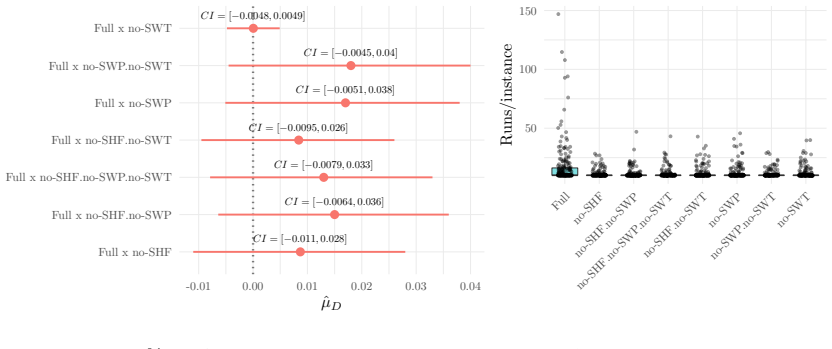
- [Figure 3] The figure is extremely dense and the instance labels are difficult to read; consider faceting by instance size or using a rotated, smaller set of labels.
Circularity Check
Algorithm 2's 'mean power' design is self-definitional: it sizes N until an average of fixed-threshold per-comparison powers reaches π*, so the mean-power outcome is true by construction rather than a predicted property of Holm's step-down procedure.
-
self definitional
[Section 4, Algorithm 2 (pseudocode preceding Fig. 2)]
"5: for i∈{ 1,...,K } do 6: pi← Power (α/i,N,d∗,H 1) ⊿ See [15] for details. 7: end for 8: ¯p =∑Ki=1pi/K ⊿ Calculate mean power"
Holm's thresholds (Eq. 39) are α_f/(K−r+1) applied to ordered p-values, so the significance level available to a comparison depends on its p-value rank and on the realized ordering of all p-values. The pseudocode instead evaluates Power(α/i, N, d*, H1) at K fixed levels and defines the experiment's 'mean power' as their arithmetic mean; the while-loop stops when this defined average reaches π*.
full rationale
The derivation chain of Section 3 is self-contained: the optimal run-allocation ratios follow from KKT conditions on minimizing total runs subject to se^2 ≤ (se*)^2, and Algorithm 1 is a greedy sampling procedure whose behavior is not asserted as a statistical prediction. The instance-number formula (38) is the standard paired-t power calculation; its use for Bonferroni and worst-case Holm designs is an ordinary alpha-adjustment and is not circular. The self-citations to Campelo and Takahashi [15] supply derivations and nonparametric extensions, but the invoked formulas are standard, parameter-free, and externally checkable, so they do not make the paper circular. The one genuinely circular element is Algorithm 2. Holm's procedure assigns thresholds by p-value rank (Eq. 39), so actual mean power is a property of the joint distribution of the ordered p-values. Algorithm 2 instead defines the experiment's mean power as the arithmetic average of Power(α/i, N, d*, H1) over fixed i, and stops when that defined average reaches π*. The returned N is therefore the solution of an equation involving the algorithm's own definition; the paper supplies no proof or simulation that this quantity equals the mean rejection probability of the Holm procedure, and the case study does not verify it. Because mean-power planning is one of the four advertised design modes and is explicitly recommended in Section 4, this is partial circularity rather than a harmless approximation.
Assumptions & free parameters
free parameters (3)
- MRES d* =
0.5 in case study
- Per-instance standard error threshold se* =
0.05 in case study
- Standard deviation of paired differences across instances (sigma_d)
assumptions (5)
- domain assumption Paired differences across instances are independent and approximately normal, supporting the paired t-test and noncentral t power formula (Eq. 38).
- domain assumption Performance follows the additive block model Y_k|l = mu_k + theta_l + epsilon_kl (Eq. 1), so instance effects can be blocked out and each algorithm has a constant mean effect over the problem class.
- domain assumption All performance observations are strictly positive when percent differences are used (Section 3.2.2).
- ad hoc to paper In the all-vs-all percent-difference standard error, the term C_ij^2 is treated as constant when differentiating with respect to n_i and n_j.
- ad hoc to paper Algorithm 2 treats Holm thresholds as fixed at alpha/i and assumes every comparison has effect size d* when computing mean power.
Cite this review
Pith. "Pith review of Sample size calculations for the experimental comparison of multiple algorithms on multiple problem instances." pith.science (2026). https://pith.science/paper/XMNKNIQZ
@misc{pith2026190801720,
  author       = {Pith},
  title        = {Pith review of: Sample size calculations for the experimental comparison of multiple algorithms on multiple problem instances},
  year         = {2026},
  howpublished = {\url{https://pith.science/paper/XMNKNIQZ}},
  note         = {Machine review of arXiv:1908.01720}
}
read the original abstract
This work presents a statistically principled method for estimating the required number of instances in the experimental comparison of multiple algorithms on a given problem class of interest. This approach generalises earlier results by allowing researchers to design experiments based on the desired best, worst, mean or median-case statistical power to detect differences between algorithms larger than a certain threshold. Holm's step-down procedure is used to maintain the overall significance level controlled at desired levels, without resulting in overly conservative experiments. This paper also presents an approach for sampling each algorithm on each instance, based on optimal sample size ratios that minimise the total required number of runs subject to a desired accuracy in the estimation of paired differences. A case study investigating the effect of 21 variants of a custom-tailored Simulated Annealing for a class of scheduling problems is used to illustrate the application of the proposed methods for sample size calculations in the experimental comparison of algorithms.
Figures


Figures from the paper (3 more)
Reference graph
Works this paper leans on
-
[15]
Journal of Heuristics25(2), 305–338 (2019)
Campelo, F., Takahashi, F.: Sample size estimation for power and accuracy in the experimental comparison of algorithms. Journal of Heuristics25(2), 305–338 (2019)
work page 2019
-
[1]
Applied Soft Computing12(10), 3176–3192 (2012)
del Amo, I.G., Pelta, D.A., González, J.R., Masegosa, A.D.: An algorithm comparison for dynamic optimization problems. Applied Soft Computing12(10), 3176–3192 (2012)
work page 2012
-
[2]
Journal of Heuristics1(1), 9–32 (1995)
Barr, R.S., Golden, B.L., Kelly, J.P., Resende, M.G.C., Stewart, W.R.: Designing and report- ing on computational experiments with heuristic methods. Journal of Heuristics1(1), 9–32 (1995)
work page 1995
-
[3]
Bartroff, J., Lai, T., Shih, M.C.: Sequential Experimentation in Clinical Trials: Design and Analysis. Springer (2013)
work page 2013
-
[4]
Bartz-Beielstein, T.: New Experimentalism Applied to Evolutionary Computation. Ph.D. thesis, Universität Dortmund, Germany (2005)
work page 2005
-
[5]
Bartz-Beielstein, T.: Experimental Research in Evolutionary Computation. Springer (2006) 27
work page 2006
-
[6]
Bartz-Beielstein, T.: How to create generalizable results. In: J. Kacprzyk, W. Pedrycz (eds.) Handbook of Computational Intelligence. Springer (2015)
work page 2015
-
[7]
Bartz-Beielstein, T., Chiarandini, M., Paquete, L., Preuss, M.: Experimental Methods for the Analysis of Optimization Algorithms. Springer (2010)
work page 2010
Show all 60 references
-
[8]
In: 30th International conference on machine learning, pp
Benavoli, A., Corani, G., Mangili, F., Zaffalon, M., Ruggeri, F.: A bayesian wilcoxon signed- rank test based on the dirichlet process. In: 30th International conference on machine learning, pp. 1026–1034 (2014)
2014
-
[9]
Birattari, M.: On the estimation of the expected performance of a metaheuristic on a class of instances: how many instances, how many runs? Tech. Rep. IRIDIA/2004-001, Université Libre de Bruxelles, Belgium (2004)
2004
-
[10]
Springer Berlin Heidelberg (2009)
Birattari, M.: Tuning Metaheuristics – A Machine Learning Perspective. Springer Berlin Heidelberg (2009)
2009
-
[11]
Birattari, M., Dorigo, M.: How to assess and report the performance of a stochastic algorithm on a benchmark problem: Mean or best result on a number of runs? Optimization Letters1, 309–311 (2007)
2007
-
[12]
Behavior Research Methods38(1), 65–76 (2006)
Botella, J., Ximénez, C., Revuelta, J., Suero, M.: Optimization of sample size in controlled experiments: The CLAST rule. Behavior Research Methods38(1), 65–76 (2006)
2006
-
[13]
In: Proceedings of the Genetic and Evolutionary Computation Conference, GECCO ’19, pp
Calvo, B., Shir, O.M., Ceberio, J., Doerr, C., Wang, H., Bäck, T., Lozano, J.A.: Bayesian performance analysis for black-box optimization benchmarking. In: Proceedings of the Genetic and Evolutionary Computation Conference, GECCO ’19, pp. 1789–1797. ACM (2019)
2019
-
[14]
URL https://CRAN.R-project.org/package=CAISEr
Campelo, F.: CAISEr: Comparison of Algorithms with Iterative Sample Size Estimation (2019). URL https://CRAN.R-project.org/package=CAISEr. Package version 1.0.13
2019
-
[16]
IEEE Transactions on Evolutionary Computation 15(6), 848–870 (2011)
Carrano, E.G., Wanner, E.F., Takahashi, R.H.C.: A multicriteria statistical based compari- son methodology for evaluating evolutionary algorithms. IEEE Transactions on Evolutionary Computation 15(6), 848–870 (2011)
2011
-
[17]
In: Experimental Methods for the Analysis of Optimization Algorithms, pp
Chimani, M., Klein, K.: Algorithm engineering: Concepts and practice. In: Experimental Methods for the Analysis of Optimization Algorithms, pp. 131–158. Springer Berlin Heidelberg (2010)
2010
-
[18]
INFORMS Journal on Computing12(1), 24–44 (2000)
Coffin, M., Saltzman, M.J.: Statistical analysis of computational tests of algorithms and heuris- tics. INFORMS Journal on Computing12(1), 24–44 (2000)
2000
-
[19]
In: Proceedings of the 2004 IEEE Congress on Evolutionary Computation
Czarn, A., MacNish, C., Vijayan, K., Turlach, B.: Statistical exploratory analysis of genetic algorithms: the importance of interaction. In: Proceedings of the 2004 IEEE Congress on Evolutionary Computation. Institute of Electrical & Electronics Engineers (IEEE) (2004)
2004
-
[20]
Journal of Machine Learning Research7, 1–30 (2006) 28
Demšar, J.: Statistical comparisons of classifiers over multiple data sets. Journal of Machine Learning Research7, 1–30 (2006) 28
2006
-
[21]
Information Sciences289, 41–58 (2014)
Derrac, J., García, S., Hui, S., Suganthan, P.N., Herrera, F.: Analyzing convergence perfor- mance of evolutionary algorithms: A statistical approach. Information Sciences289, 41–58 (2014)
2014
-
[22]
Swarm and Evolutionary Computation1(1), 3–18 (2011)
Derrac, J., García, S., Molina, D., Herrera, F.: A practical tutorial on the use of nonpara- metric statistical tests as a methodology for comparing evolutionary and swarm intelligence algorithms. Swarm and Evolutionary Computation1(1), 3–18 (2011)
2011
-
[23]
Journal of the American Statistical Associ- ation 56(293), 52–64 (1961)
Dunn, O.J.: Multiple comparisons among means. Journal of the American Statistical Associ- ation 56(293), 52–64 (1961)
1961
-
[24]
In: Proceedings of the 2002 IEEECongress on Evolutionary Computation
Eiben, A., Jelasity, M.: A critical note on experimental research methodology in EC. In: Proceedings of the 2002 IEEECongress on Evolutionary Computation. Institute of Electrical & Electronics Engineers (IEEE) (2002)
2002
-
[25]
Cambridge University Press (2010)
Ellis, P.D.: The Essential Guide to Effect Sizes, 1st edn. Cambridge University Press (2010)
2010
-
[26]
Journal of the Royal Statistical Society
Fieller, E.C.: Some problems in interval estimation. Journal of the Royal Statistical Society. Series B (Methodological)16(2), 175–185 (1954)
1954
-
[27]
org/pdf/0710.2024v1.pdf
Franz, V.: Ratios: A short guide to confidence limits and proper use (2007).https://arxiv. org/pdf/0710.2024v1.pdf
2007 arXiv
-
[28]
Soft Computing 13(10), 959–977 (2009)
García, S., Fernández, A., Luengo, J., Herrera, F.: A study of statistical techniques and performance measures for genetics-based machine learning: accuracy and interpretability. Soft Computing 13(10), 959–977 (2009)
2009
-
[29]
Information Sciences180(10), 2044–2064 (2010)
García, S., Fernández, A., Luengo, J., Herrera, F.: Advanced nonparametric tests for multi- ple comparisons in the design of experiments in computational intelligence and data mining: Experimental analysis of power. Information Sciences180(10), 2044–2064 (2010)
2010
-
[30]
Journal of Heuristics15(6), 617–644 (2008)
García, S., Molina, D., Lozano, M., Herrera, F.: A study on the use of non-parametric tests for analyzing the evolutionary algorithms’ behaviour: a case study on the CEC’2005 Special session on real parameter optimization. Journal of Heuristics15(6), 617–644 (2008)
2008
-
[31]
Cam- bridge university press (2006)
Gelman, A., Hill, J.: Data analysis using regression and multilevel/hierarchical models. Cam- bridge university press (2006)
2006
-
[32]
Annals of Discrete Mathematics 5, 287–326 (1979)
Graham, R.L., Lawler, E.L., Lenstra, J.K., Rinnooy Kan, A.H.G.: Optimization and approxi- mation in deterministic sequencing and scheduling: a survey. Annals of Discrete Mathematics 5, 287–326 (1979)
1979
-
[33]
URL https://arxiv.org/abs/1603.08776
Hansen, N., Tˇ usar, T., Mersmann, O., Auger, A., Brockoff, D.: COCO: The experimental procedure (2016). URL https://arxiv.org/abs/1603.08776
2016 arXiv
-
[34]
Scandinavian journal of statistics 6(2), 65–70 (1979)
Holm, S.: A simple sequentially rejective multiple test procedure. Scandinavian journal of statistics 6(2), 65–70 (1979)
1979
-
[35]
Operations Research42(2), 201–212 (1994)
Hooker, J.N.: Needed: An empirical science of algorithms. Operations Research42(2), 201–212 (1994)
1994
-
[36]
Journal of Heuristics1(1), 33–42 (1996) 29
Hooker, J.N.: Testing heuristics: We have it all wrong. Journal of Heuristics1(1), 33–42 (1996) 29
1996
-
[37]
Ecological Monographs 54(2), 187–211 (1984)
Hurlbert, S.H.: Pseudoreplication and the design of ecological field experiments. Ecological Monographs 54(2), 187–211 (1984)
1984
-
[38]
John Wiley and Sons Ltd (1991)
Jain, R.K.: The Art of Computer Systems Performance Analysis. John Wiley and Sons Ltd (1991)
1991
-
[39]
Johnson, D.: A theoretician’s guide to the experimental analysis of algorithms. In: M. Gold- wasser, D. Johnson, C. McGeoch (eds.) Data Structures, Near Neighbor Searches, and Method- ology: Fifth and Sixth DIMACS Implementation Challenges, DIMACS Series in Discrete Mathematic...
2002
-
[40]
Applied Soft Computing37, 217–226 (2015)
Krohling, R.A., Lourenzutti, R., Campos, M.: Ranking and comparing evolutionary algorithms with hellinger-TOPSIS. Applied Soft Computing37, 217–226 (2015)
2015
-
[41]
Aca- demic Press, Inc
Kruschke, J.K.: Doing Bayesian Data Analysis: A Tutorial with R and BUGS, 1st edn. Aca- demic Press, Inc. (2010)
2010
-
[42]
In: Handbooks in Operations Research and Management Science, vol
Lawler, E.L., Lenstra, J.K., Rinnooy Kan, A.H., Shmoys, D.B.: Sequencing and scheduling: Algorithms and complexity. In: Handbooks in Operations Research and Management Science, vol. 4, chap. 9, pp. 445–522. Elsevier (1993)
1993
-
[43]
Lazic, S.E.: The problem of pseudoreplication in neuroscientific studies: is it affecting your analysis? BMC Neuroscience11(5), 397–407 (2010)
2010
-
[44]
The American Statistician 55(3), 187–193 (2001)
Lenth, R.V.: Some practical guidelines for effective sample size determination. The American Statistician 55(3), 187–193 (2001)
2001
-
[45]
In preparation
Maravilha, A.L., Pereira, L.M., Campelo, F.: Statistical characterization of neighborhood structures for the unrelated parallel machine problem with sequence-dependent setup times. In preparation
-
[46]
Matthews Malnar & Bailey Inc
Mathews, P.: Sample Size Calculations: Practical Methods for Engineers and Scientists, 1st edn. Matthews Malnar & Bailey Inc. (2010)
2010
-
[47]
INFORMS Journal on Computing8(1), 1–15 (1996)
McGeoch, C.C.: Feature article—toward an experimental method for algorithm simulation. INFORMS Journal on Computing8(1), 1–15 (1996)
1996
-
[48]
Fisheries Research 70, 397–407 (2004)
Millar, R., Anderson, M.: Remedies for pseudoreplication. Fisheries Research 70, 397–407 (2004)
2004
-
[49]
John Wiley & Sons (2013)
Montgomery, D.C.: Design and Analysis of Experiments, 8th edn. John Wiley & Sons (2013)
2013
-
[50]
Wiley (2013)
Montgomery, D.C., Runger, G.C.: Applied Statistics and Probability for Engineers, 6th edn. Wiley (2013)
2013
-
[51]
Master’s thesis, Universi- dade Federal de Minas Gerais, Belo Horizonte, Brazil (2019)
Pereira, L.M.: Análise de Estruturas de Vizinhança para o Problema de Sequenciamento de Máquinas Paralelas Não Relacionadas com Tempos de Preparação . Master’s thesis, Universi- dade Federal de Minas Gerais, Belo Horizonte, Brazil (2019). URLhttps://ppgee.ufmg.br/ defesas/1615...
2019
-
[52]
R Foundation for Statistical Computing, Vienna, Austria (2017)
R Core Team: R: A Language and Environment for Statistical Computing. R Foundation for Statistical Computing, Vienna, Austria (2017). URLhttps://www.R-project.org/
2017
-
[53]
Ridge, E.: Design of Experiments for the Tuning of Optimisation Algorithms. Ph.D. thesis, The University of York, UK (2007)
2007
-
[54]
International Transactions in Operational Research00 (2016)
Santos, H.G., Toffolo, T.A., Silva, C.L., Berghe, G.V.: Analysis of stochastic local search methods for the unrelated parallel machine scheduling problem. International Transactions in Operational Research00 (2016)
2016
-
[55]
Annual review of psychology46(1), 561–584 (1995)
Shaffer, J.P.: Multiple hypothesis testing. Annual review of psychology46(1), 561–584 (1995)
1995
-
[56]
Taylor & Francis (2011)
Sheskin, D.J.: Handbook of Parametric and Nonparametric Statistical Procedures. Taylor & Francis (2011)
2011
-
[57]
In: Handbook of Heuristics, pp
Sörensen, K., Sevaux, M., Glover, F.: A history of metaheuristics. In: Handbook of Heuristics, pp. 1–18. Springer International Publishing (2018)
2018
-
[58]
European Journal of Operational Research211(3), 612–622 (2011)
Vallada, E., Ruiz, R.: A genetic algorithm for the unrelated parallel machine scheduling prob- lem with sequence dependent setup times. European Journal of Operational Research211(3), 612–622 (2011)
2011
-
[59]
Parallel Problem Solving From Nature - PPSN VIII3242, 172–181 (2004)
Yuan, B., Gallagher, M.: Statistical racing techniques for improved empirical evaluation of evolutionary algorithms. Parallel Problem Solving From Nature - PPSN VIII3242, 172–181 (2004)
2004
-
[60]
In: Proceedings of the 11th Annual conference on Genetic and evolutionary computation - GECCO09
Yuan, B., Gallagher, M.: An improved small-sample statistical test for comparing the success rates of evolutionary algorithms. In: Proceedings of the 11th Annual conference on Genetic and evolutionary computation - GECCO09. Association for Computing Machinery (ACM) (2009) 31
2009
Reviewed August 14, 2026 · model on record in the stance chip above.
Discussion (0). Continue with ORCID to comment.