REVIEW 3 major objections 4 minor 51 references
Text-promptable Object Counting via Quantity Awareness Enhancement
T0 review · 3 major / 4 minor · reviewed 2026-08-06 · deepseek-v4-flash
Pith's one-line read Counting by naming counts: quantity-aware text prompts lift text-promptable counting on FSC-147, CARPK, PUCPR+, and ShanghaiTech.
desk verdict Well-ablated counting paper with a real but fixable training-time leak confound in the prompt-feature ablation; worth reviewing, but the mechanism claim needs a clean control. read the letter →
The pith
A machine-rendered reading of the paper's core claim, the machinery that carries it, and where it could break.
The reading
What carries the argument
The central object is the quantity-oriented text prompt, written as 'a photo of [num] [class]' with the factual count $a_p$ and $N=7$ counterfactual counts $a_p \pm k\Delta$ for a dynamically chosen interval $\Delta$ proportional to the count magnitude. Around it sit three mechanisms: (1) the vision-text quantity alignment loss $L_{\text{align}}$ that orders image-text similarity scores by numerical distance from the true count; (2) the dual-stream adaptive counting decoder, which runs a Transformer stream and a CNN stream in parallel, with T2C-adapters (a cross-attention block plus a channel-excitation block) passing global Transformer knowledge into the CNN stream and a gating net fusing the two density maps; and (3) the cross-stream quantity ranking loss $L_{\text{rank}}$ that compares patch counts across and within streams with an interval $l=5$. The machine does its work by making quantity ordering a training signal, then converting the enhanced visual features into density predictions.
What would settle it
Train QUANet with the counterfactual counts' labels randomly permuted (so the ordinal structure of $L_{\text{align}}$ is broken while the positive/negative distinction stays); if test MAE on FSC-147 does not rise relative to the ordered version, the ordinal constraint is not the source of the gain. Alternatively, feed a fixed image with prompts 'a photo of k objects' for k = 1...20 and check whether predicted density changes monotonically; if it stays flat, the alignment did not transfer to inference.
Extended reading notes
Core claim
On the paper's own terms, the discovery is that a vision-language counter can be made quantity-aware by supervising the ordinal relation between an image and text prompts that state different object counts. QUANet constructs a factual prompt with the ground-truth count $a_p$ and counterfactual prompts with counts $a_p \pm k\Delta$, then applies a vision-text quantity alignment loss $L_{\text{align}}$ that forces the positive pair to have the highest cosine similarity and forces negative pairs to be ranked by numerical closeness to $a_p$. A cross-stream quantity ranking loss $L_{\text{rank}}$ additionally enforces patch-level count ordering inside and across the two decoder streams. With this training, the model reaches a test MAE of 13.24 on FSC-147, outperforming prior text-promptable methods (CountDiff: 14.83) despite removing the count from the prompt at inference, and generalizes zero-shot to CARPK (MAE 6.32), PUCPR+ (MAE 44.34), and ShanghaiTech SHA (MAE 140.2).
Load-bearing premise
The improvement depends on the model actually learning, from the auxiliary pairs, that a text number closer to the true count should look more similar to the image; if the vision–text embedding cannot represent that numerical closeness, the quantity alignment loss cannot be what improves counting.
Editorial extensions
If this is right
- Text-promptable counting narrows the gap to exemplar-based counting: QUANet's 13.24 test MAE approaches CounTR (11.95) and LOCA (10.79) without needing manual exemplars.
- The alignment loss's ordinal supervision transfers to inference: at test time the count is absent from the prompt, yet the model counts better, implying quantity awareness is baked into visual features rather than read off the text.
- The DAC-decoder is a portable component: replacing the decoders of CLIP-Count and VLCounter with it improves their FSC-147 MAE, suggesting the dual-stream design generalizes beyond QUANet.
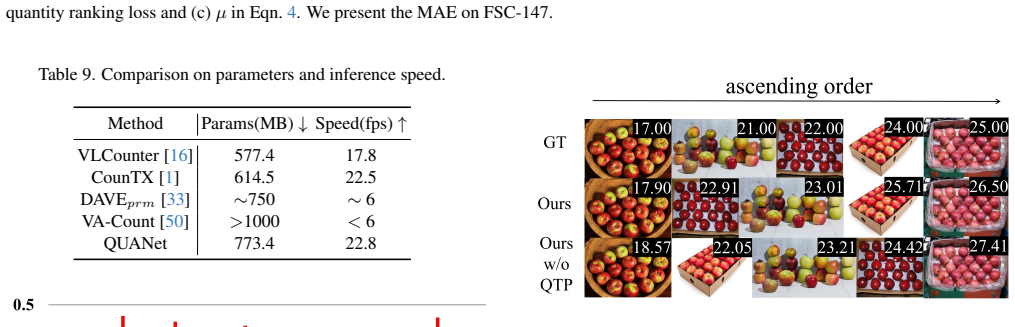
- Adaptive intervals matter for counts spanning 7 to 1912: fixed intervals $\Delta=3,5,7,9$ all underperform the count-proportional $\Delta$ schedule.
- Zero-shot domain transfer works: training only on FSC-147 yields strong results on drone car lots (CARPK) and dense crowds (ShanghaiTech) without fine-tuning.
Reading between the lines
- The ordinal constraint between negative pairs is effectively a form of embedding-space regression: it teaches the model to represent 'how different' two numbers are, which could be extended to directly predicting counts from similarity slopes rather than from density integration.
- If the mechanism is robust, synthetic counterfactual prompting could be applied to other VLM tasks where ordinal quantities matter, such as referring expression counting or visual grounding of 'more/less' relations.
- A testable extension: train on FSC-147 with an expanded count range or synthesized images with known counts to see whether the alignment loss scales beyond the 1,000-object ceiling of the training data.
- The direction of knowledge transfer (Transformer to CNN only) suggests that global contextual cues are most valuable when injected into local density estimation; a similar asymmetry may appear in other dense prediction tasks.
Editorial analysis
A structured set of objections, weighed in public.
Referee Report
Summary. The paper introduces QUANet, a text-promptable object counting method that augments category prompts with explicit count information during training. A frozen BERT text encoder and a fine-tuned DINOv2 vision encoder are used with a novel quantity alignment loss applied to factual and counterfactual 'a photo of [num] [class]' prompts. The method also proposes a dual-stream adaptive counting decoder with Transformer and CNN streams, T2C-adapters, and a cross-stream quantity ranking loss. Experiments on FSC-147 and cross-dataset evaluations on CARPK, PUCPR+, and ShanghaiTech report state-of-the-art results among text-promptable methods, with extensive ablations of each component.
Significance. If the reported results and attributions hold, QUANet would be a meaningful advance in text-promptable class-agnostic counting, closing much of the gap to exemplar-based methods and demonstrating strong cross-dataset generalization. The paper's strengths include a clearly described loss formulation, systematic ablations of the proposed components, cross-dataset evaluation on four benchmarks, and public code release. However, the central mechanistic claim—that quantity-oriented prompts improve counting by enhancing quantity awareness in the vision encoder—is currently confounded by a training-time information leak in the category-conditioning feature, and the headline SOTA comparisons are partly confounded by a backbone change relative to prior methods.
major comments (3)
- [Section 3.2, Section 3.4, Table 4]
- [Section 4.2, Table 1]
- [Section 3.2, Eq. (2), Sec. 4.1]
minor comments (4)
- [Section 4.1]
- [Section 4.4, Fig. 5]
- [Section 3.4, Eq. (3)]
- [Table 5]
Circularity Check
No circular derivation: the method is trained with ground-truth quantity prompts but evaluated on held-out test prompts that contain no count, and the reported gains are benchmarked externally.
full rationale
The paper's claimed derivation chain is not circular under the definitions used here. The quantity-oriented prompts (QTPs) are constructed from ground-truth counts during training only; at inference the paper explicitly replaces them with a category-only prompt ('a photo of birds'), so the reported test MAE values are genuine predictions and do not reduce to reading the count from the prompt. The counting loss, alignment loss, and ranking loss (Eqs. 1-4) are all supervised by ground-truth density/count on the FSC-147 training set, while the reported results are on held-out FSC-147 test, validation, and cross-dataset benchmarks (CARPK, PUCPR+, ShanghaiTech) without fine-tuning. The ablation tables (Tab. 4, Tab. 5, Tab. 8) compare variants using the same evaluation protocol, so they are standard empirical ablations rather than fitted inputs renamed as predictions. The skeptical concern about train-time leakage through the contextualized BERT embeddings (removing the [num] token does not fully erase count information from neighboring tokens) is a plausible attribution confound for interpreting the ablation gain, but it is not a definitional equivalence: no equation in the paper makes the test-time density output equal to the training-time count input. It is therefore a correctness/interpretability risk, not circularity. The paper also contains no load-bearing self-citation chain: the authors' prior works appear only in the related-work section on crowd counting and are not invoked as uniqueness theorems or as justification for the central loss or decoder design. The central components are evaluated against external baselines and held-out data, so the appropriate finding is no significant circularity.
Assumptions & free parameters
free parameters (4)
- Dynamic interval Delta mapping =
{1,2,3,5,10,20,35,50}
- Number of counterfactual prompts N =
7
- Patch interval l in L_rank =
5
- Loss weight mu =
0.1
assumptions (4)
- domain assumption Pre-trained DINOv2 (ViT-B/14) and BERT-base (top 9 blocks) provide a joint embedding space in which numerical proximity can be aligned.
- domain assumption Cosine similarity between global image and text embeddings is a monotone proxy for object count proximity.
- domain assumption Ground truth density maps in FSC-147 support accurate patch-level rank supervision.
- domain assumption Frozen text encoder preserves numerical semantics of number words.
Cite this review
Pith. "Pith review of Text-promptable Object Counting via Quantity Awareness Enhancement." pith.science (2026). https://pith.science/paper/XMXPXC3B
@misc{pith2026250706679,
  author       = {Pith},
  title        = {Pith review of: Text-promptable Object Counting via Quantity Awareness Enhancement},
  year         = {2026},
  howpublished = {\url{https://pith.science/paper/XMXPXC3B}},
  note         = {Machine review of arXiv:2507.06679}
}
read the original abstract
Recent advances in large vision-language models (VLMs) have shown remarkable progress in solving the text-promptable object counting problem. Representative methods typically specify text prompts with object category information in images. This however is insufficient for training the model to accurately distinguish the number of objects in the counting task. To this end, we propose QUANet, which introduces novel quantity-oriented text prompts with a vision-text quantity alignment loss to enhance the model's quantity awareness. Moreover, we propose a dual-stream adaptive counting decoder consisting of a Transformer stream, a CNN stream, and a number of Transformer-to-CNN enhancement adapters (T2C-adapters) for density map prediction. The T2C-adapters facilitate the effective knowledge communication and aggregation between the Transformer and CNN streams. A cross-stream quantity ranking loss is proposed in the end to optimize the ranking orders of predictions from the two streams. Extensive experiments on standard benchmarks such as FSC-147, CARPK, PUCPR+, and ShanghaiTech demonstrate our model's strong generalizability for zero-shot class-agnostic counting. Code is available at https://github.com/viscom-tongji/QUANet
Figures


Figures from the paper (3 more)


Reference graph
Works this paper leans on
-
[1]
N. Amini-Naieni, K. Amini-Naieni, T. Han, and A. Zisser- man. Open-world text-specified object counting. In British Machine Vision Conference, 2023. 2, 3, 4, 6, 7, 9, 10
work page 2023
-
[2]
Carlos Arteta, Victor Lempitsky, and Andrew Zisserman. Counting in the wild. In Computer Vision–ECCV 2016: 14th European Conference, Amsterdam, The Netherlands, Octo- ber 11–14, 2016, Proceedings, Part VII 14 , pages 483–498. Springer, 2016. 2
work page 2016
-
[3]
Single domain generalization for few-shot counting via universal representation matching
Xianing Chen, Si Huo, Borui Jiang, Hailin Hu, and Xinghao Chen. Single domain generalization for few-shot counting via universal representation matching. In Proceedings of the Computer Vision and Pattern Recognition Conference, pages 4639–4649, 2025. 2
work page 2025
-
[4]
Reproducible scal- ing laws for contrastive language-image learning
Mehdi Cherti, Romain Beaumont, Ross Wightman, Mitchell Wortsman, Gabriel Ilharco, Cade Gordon, Christoph Schuh- mann, Ludwig Schmidt, and Jenia Jitsev. Reproducible scal- ing laws for contrastive language-image learning. In Pro- ceedings of the IEEE/CVF Conference on Computer Vision and Pattern Recognition, pages 2818–2829, 2023. 3
work page 2023
-
[5]
Referring ex- pression counting
Siyang Dai, Jun Liu, and Ngai-Man Cheung. Referring ex- pression counting. In Proceedings of the IEEE/CVF Con- ference on Computer Vision and Pattern Recognition, pages 16985–16995, 2024. 2, 3
work page 2024
-
[6]
Bert: Pre-training of deep bidirectional transformers for language understanding
Jacob Devlin. Bert: Pre-training of deep bidirectional transformers for language understanding. arXiv preprint arXiv:1810.04805, 2018. 6
arXiv 2018
-
[7]
An image is worth 16x16 words: Trans- formers for image recognition at scale
Alexey Dosovitskiy, Lucas Beyer, Alexander Kolesnikov, Dirk Weissenborn, Xiaohua Zhai, Thomas Unterthiner, Mostafa Dehghani, Matthias Minderer, Georg Heigold, Syl- vain Gelly, et al. An image is worth 16x16 words: Trans- formers for image recognition at scale. arXiv preprint arXiv:2010.11929, 2020. 2
arXiv 2010
-
[8]
Semantic generative augmentations for few-shot counting
Perla Doubinsky, Nicolas Audebert, Michel Crucianu, and Hervé Le Borgne. Semantic generative augmentations for few-shot counting. In Proceedings of the IEEE/CVF Win- ter Conference on Applications of Computer Vision , pages 5443–5452, 2024. 2
work page 2024
Show all 51 references
-
[9]
Domain- general crowd counting in unseen scenarios
Zhipeng Du, Jiankang Deng, and Miaojing Shi. Domain- general crowd counting in unseen scenarios. In Proceedings of the AAAI Conference on Artificial Intelligence, pages 561– 570, 2023. 2
2023
-
[10]
Regressor-segmenter mutual prompt learning for crowd counting
Mingyue Guo, Li Yuan, Zhaoyi Yan, Binghui Chen, Yaowei Wang, and Qixiang Ye. Regressor-segmenter mutual prompt learning for crowd counting. In Proceedings of the IEEE/CVF Conference on Computer Vision and Pattern Recognition, pages 28380–28389, 2024. 2
2024
-
[11]
Learning to count anything: Reference-less class-agnostic counting with weak supervision
Michael Hobley and Victor Prisacariu. Learning to count anything: Reference-less class-agnostic counting with weak supervision. Proceedings of the IEEE Conference on Com- puter Vision and Pattern Recognition (CVPR), 2023. 7
2023
-
[12]
Drone- based object counting by spatially regularized regional pro- posal network
Meng-Ru Hsieh, Yen-Liang Lin, and Winston H Hsu. Drone- based object counting by spatially regularized regional pro- posal network. In Proceedings of the IEEE international conference on computer vision, pages 4145–4153, 2017. 2, 6
2017
-
[13]
Squeeze-and-excitation net- works
Jie Hu, Li Shen, and Gang Sun. Squeeze-and-excitation net- works. In Proceedings of the IEEE conference on computer vision and pattern recognition, pages 7132–7141, 2018. 4
2018
-
[14]
Class-agnostic object counting with text-to-image diffusion model
Xiaofei Hui, Qian Wu, Hossein Rahmani, and Jun Liu. Class-agnostic object counting with text-to-image diffusion model. In European Conference on Computer Vision, pages 1–18. Springer, 2024. 6, 7
2024
-
[15]
Clip- count: Towards text-guided zero-shot object counting
Ruixiang Jiang, Lingbo Liu, and Changwen Chen. Clip- count: Towards text-guided zero-shot object counting. arXiv preprint arXiv:2305.07304, 2023. 2, 3, 4, 6, 7, 9
2023 arXiv
-
[16]
Vlcounter: Text-aware visual representation for zero- shot object counting
Seunggu Kang, WonJun Moon, Euiyeon Kim, and Jae-Pil Heo. Vlcounter: Text-aware visual representation for zero- shot object counting. In Proceedings of the AAAI Conference on Artificial Intelligence, pages 2714–2722, 2024. 2, 3, 6, 7, 9, 10
2024
-
[17]
Calibrating uncertainty for semi-supervised crowd counting
Chen Li, Xiaoling Hu, Shahira Abousamra, and Chao Chen. Calibrating uncertainty for semi-supervised crowd counting. In 2023 IEEE/CVF International Conference on Computer Vision (ICCV), pages 16685–16695. IEEE, 2023. 2
2023
-
[18]
Blip-2: Bootstrapping language-image pre-training with frozen image encoders and large language models
Junnan Li, Dongxu Li, Silvio Savarese, and Steven Hoi. Blip-2: Bootstrapping language-image pre-training with frozen image encoders and large language models. In In- ternational conference on machine learning , pages 19730– 19742. PMLR, 2023. 1
2023
-
[19]
Csrnet: Di- lated convolutional neural networks for understanding the highly congested scenes
Yuhong Li, Xiaofan Zhang, and Deming Chen. Csrnet: Di- lated convolutional neural networks for understanding the highly congested scenes. In Proceedings of the IEEE con- ference on computer vision and pattern recognition , pages 1091–1100, 2018. 8
2018
-
[20]
An end-to-end transformer model for crowd localization
Dingkang Liang, Wei Xu, and Xiang Bai. An end-to-end transformer model for crowd localization. European Confer- ence on Computer Vision, 2022. 1, 2
2022
-
[21]
Crowdclip: Unsupervised crowd counting via vision-language model
Dingkang Liang, Jiahao Xie, Zhikang Zou, Xiaoqing Ye, Wei Xu, and Xiang Bai. Crowdclip: Unsupervised crowd counting via vision-language model. In Proceedings of the IEEE/CVF conference on computer vision and pattern recognition, pages 2893–2903, 2023. 2 11
2023
-
[22]
A fixed-point approach to unified prompt-based counting
Wei Lin and Antoni B Chan. A fixed-point approach to unified prompt-based counting. In Proceedings of the AAAI Conference on Artificial Intelligence , pages 3468– 3476, 2024. 6
2024
-
[23]
Countr: Transformer-based generalised visual count- ing
Chang Liu, Yujie Zhong, Andrew Zisserman, and Weidi Xie. Countr: Transformer-based generalised visual count- ing. arXiv preprint arXiv:2208.13721, 2022. 2, 3, 4, 6, 7
2022 arXiv
-
[24]
Point-query quadtree for crowd counting, localization, and more
Chengxin Liu, Hao Lu, Zhiguo Cao, and Tongliang Liu. Point-query quadtree for crowd counting, localization, and more. In Proceedings of the IEEE/CVF International Con- ference on Computer Vision, pages 1676–1685, 2023. 2, 6
2023
-
[25]
Visual instruction tuning
Haotian Liu, Chunyuan Li, Qingyang Wu, and Yong Jae Lee. Visual instruction tuning. Advances in neural information processing systems, 36, 2024. 1
2024
-
[26]
Point in, box out: Beyond counting persons in crowds
Yuting Liu, Miaojing Shi, Qijun Zhao, and Xiaofang Wang. Point in, box out: Beyond counting persons in crowds. In Proceedings of the IEEE/CVF conference on computer vi- sion and pattern recognition, pages 6469–6478, 2019. 2
2019
-
[27]
Discovering regression- detection bi-knowledge transfer for unsupervised cross- domain crowd counting
Yuting Liu, Zheng Wang, Miaojing Shi, Shin’ichi Satoh, Qijun Zhao, and Hongyu Yang. Discovering regression- detection bi-knowledge transfer for unsupervised cross- domain crowd counting. Neurocomputing, 494:418–431,
-
[28]
Decoupled weight decay regularization
I Loshchilov. Decoupled weight decay regularization. arXiv preprint arXiv:1711.05101, 2017. 6
2017 arXiv
-
[29]
Class-agnostic counting
Erika Lu, Weidi Xie, and Andrew Zisserman. Class-agnostic counting. In Computer Vision–ACCV 2018: 14th Asian Con- ference on Computer Vision, Perth, Australia, December 2– 6, 2018, Revised Selected Papers, Part III 14 , pages 669–
2018
-
[30]
A large contextual dataset for classification, detection and counting of cars with deep learning
T Nathan Mundhenk, Goran Konjevod, Wesam A Sakla, and Kofi Boakye. A large contextual dataset for classification, detection and counting of cars with deep learning. In Com- puter Vision–ECCV 2016: 14th European Conference, Am- sterdam, The Netherlands, October 11-14, 2016, Pro...
2016
-
[31]
Dinov2: Learning robust visual features without supervision
Maxime Oquab, Timothée Darcet, Théo Moutakanni, Huy V o, Marc Szafraniec, Vasil Khalidov, Pierre Fernandez, Daniel Haziza, Francisco Massa, Alaaeldin El-Nouby, et al. Dinov2: Learning robust visual features without supervision. arXiv preprint arXiv:2304.07193, 2023. 6
2023 arXiv
-
[32]
Teaching clip to count to ten
Roni Paiss, Ariel Ephrat, Omer Tov, Shiran Zada, Inbar Mosseri, Michal Irani, and Tali Dekel. Teaching clip to count to ten. In Proceedings of the IEEE/CVF International Con- ference on Computer Vision, pages 3170–3180, 2023. 2, 3, 9
2023
-
[33]
Dave-a detect-and-verify paradigm for low-shot counting
Jer Pelhan, Vitjan Zavrtanik, Matej Kristan, et al. Dave-a detect-and-verify paradigm for low-shot counting. In Pro- ceedings of the IEEE/CVF Conference on Computer Vision and Pattern Recognition, pages 23293–23302, 2024. 2, 6, 9, 10
2024
-
[34]
Single domain general- ization for crowd counting
Zhuoxuan Peng and S-H Gary Chan. Single domain general- ization for crowd counting. In Proceedings of the IEEE/CVF Conference on Computer Vision and Pattern Recognition , pages 28025–28034, 2024. 2, 6
2024
-
[35]
Learning transferable visual models from natural language supervi- sion
Alec Radford, Jong Wook Kim, Chris Hallacy, Aditya Ramesh, Gabriel Goh, Sandhini Agarwal, Girish Sastry, Amanda Askell, Pamela Mishkin, Jack Clark, et al. Learning transferable visual models from natural language supervi- sion. In International conference on machine learning, ...
2021
-
[36]
Crowd- diff: Multi-hypothesis crowd density estimation using dif- fusion models
Yasiru Ranasinghe, Nithin Gopalakrishnan Nair, Wele Gedara Chaminda Bandara, and Vishal M Patel. Crowd- diff: Multi-hypothesis crowd density estimation using dif- fusion models. In Proceedings of the IEEE/CVF Conference on Computer Vision and Pattern Recognition, pages 12809– ...
2024
-
[37]
Exemplar free class agnostic counting
Viresh Ranjan and Minh Hoai Nguyen. Exemplar free class agnostic counting. In Proceedings of the Asian Conference on Computer Vision, pages 3121–3137, 2022. 1, 3
2022
-
[38]
Learning to count everything
Viresh Ranjan, Udbhav Sharma, Thu Nguyen, and Minh Hoai. Learning to count everything. In Proceedings of the IEEE/CVF Conference on Computer Vision and Pattern Recognition, pages 3394–3403, 2021. 2, 6, 7
2021
-
[39]
Re- visiting perspective information for efficient crowd counting
Miaojing Shi, Zhaohui Yang, Chao Xu, and Qijun Chen. Re- visiting perspective information for efficient crowd counting. In Proceedings of the IEEE/CVF conference on computer vi- sion and pattern recognition, pages 7279–7288, 2019. 2
2019
-
[40]
Represent, compare, and learn: A similarity-aware framework for class-agnostic counting
Min Shi, Hao Lu, Chen Feng, Chengxin Liu, and Zhiguo Cao. Represent, compare, and learn: A similarity-aware framework for class-agnostic counting. In Proceedings of the IEEE/CVF Conference on Computer Vision and Pattern Recognition, pages 9529–9538, 2022. 2, 6, 7
2022
-
[41]
A low-shot object counting network with iterative prototype adaptation
Nikola Ðuki ´c, Alan Lukeži ˇc, Vitjan Zavrtanik, and Matej Kristan. A low-shot object counting network with iterative prototype adaptation. In Proceedings of the IEEE/CVF In- ternational Conference on Computer Vision , pages 18872– 18881, 2023. 2, 6
2023
-
[42]
Exploring contextual at- tribute density in referring expression counting
Zhicheng Wang, Zhiyu Pan, Zhan Peng, Jian Cheng, Liwen Xiao, Wei Jiang, and Zhiguo Cao. Exploring contextual at- tribute density in referring expression counting. In Proceed- ings of the Computer Vision and Pattern Recognition Con- ference, pages 19587–19596, 2025. 3
2025
-
[43]
Learning super-features for image re- trieval
Philippe Weinzaepfel, Thomas Lucas, Diane Larlus, and Yannis Kalantidis. Learning super-features for image re- trieval. In ICLR, 2022. 10
2022
-
[44]
Boosting detection in crowd analysis via underutilized output features
Shaokai Wu and Fengyu Yang. Boosting detection in crowd analysis via underutilized output features. In Proceedings of the IEEE/CVF Conference on Computer Vision and Pattern Recognition, pages 15609–15618, 2023. 2
2023
-
[45]
Mi- croscopy cell counting and detection with fully convolutional regression networks
Weidi Xie, J Alison Noble, and Andrew Zisserman. Mi- croscopy cell counting and detection with fully convolutional regression networks. Computer methods in biomechanics and biomedical engineering: Imaging & Visualization, 6(3): 283–292, 2018. 1, 2
2018
-
[46]
Zero-shot object counting
Jingyi Xu, Hieu Le, Vu Nguyen, Viresh Ranjan, and Dim- itris Samaras. Zero-shot object counting. In Proceedings of the IEEE/CVF Conference on Computer Vision and Pattern Recognition (CVPR), pages 15548–15557, 2023. 3, 5, 6, 7
2023
-
[47]
Pbe- count: Prompt-before-extract paradigm for class-agnostic counting
Canchen Yang, Tianyu Geng, Jian Peng, and Chun Xu. Pbe- count: Prompt-before-extract paradigm for class-agnostic counting. In Proceedings of the AAAI Conference on Arti- ficial Intelligence, pages 9139–9147, 2025. 2 12
2025
-
[48]
Zero-shot object counting with vision-language prior guid- ance network
Wenzhe Zhai, Xianglei Xing, Mingliang Gao, and Qilei Li. Zero-shot object counting with vision-language prior guid- ance network. IEEE Transactions on Circuits and Systems for Video Technology, 35(3):2487–2498, 2025. 2, 3, 6, 7
2025
-
[49]
Single-image crowd counting via multi-column convolutional neural network
Yingying Zhang, Desen Zhou, Siqin Chen, Shenghua Gao, and Yi Ma. Single-image crowd counting via multi-column convolutional neural network. In Proceedings of the IEEE conference on computer vision and pattern recognition , pages 589–597, 2016. 2, 6
2016
-
[50]
Zero-shot object counting with good exemplars
Huilin Zhu, Jingling Yuan, Zhengwei Yang, Yu Guo, Zheng Wang, Xian Zhong, and Shengfeng He. Zero-shot object counting with good exemplars. In European Conference on Computer Vision, pages 368–385. Springer, 2024. 3, 6, 7, 9, 10 13
2024
-
[684]
Springer, 2019. 1, 2, 6
2019
Reviewed August 6, 2026 · model on record in the stance chip above.
Discussion (0). Sign in to comment.