REVIEW 3 minor 2 cited by
EXPO-FT: Sample-Efficient Reinforcement Learning Finetuning for Vision-Language-Action Models
T0 review · 0 major / 3 minor · reviewed 2026-06-29 · grok-4.3
Pith's one-line read EXPO-FT finetunes pretrained vision-language-action models with reinforcement learning to reach perfect task success using 19.1 minutes of robot data on average.
desk verdict EXPO-FT gets perfect success rates on several precision manipulation tasks with roughly 19 minutes of online data by adding targeted exploration to VLA RL finetuning. read the letter →
The pith
A machine-rendered reading of the paper's core claim, the machinery that carries it, and where it could break.
The reading
What carries the argument
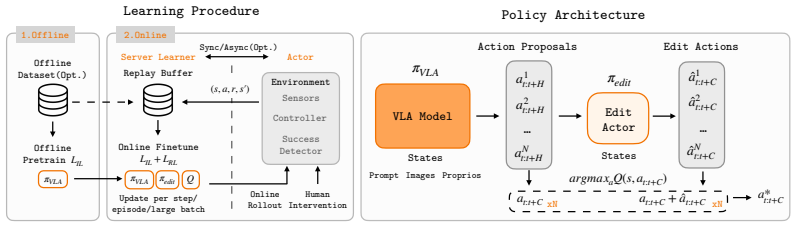
EXPO-FT, the system that performs stable reinforcement learning fine-tuning on pretrained vision-language-action policies
What would settle it
Recording fewer than 30 successes in 30 trials or requiring substantially more than 19.1 minutes of online data on average for the pool ball striking or flower insertion tasks.
Extended reading notes
Core claim
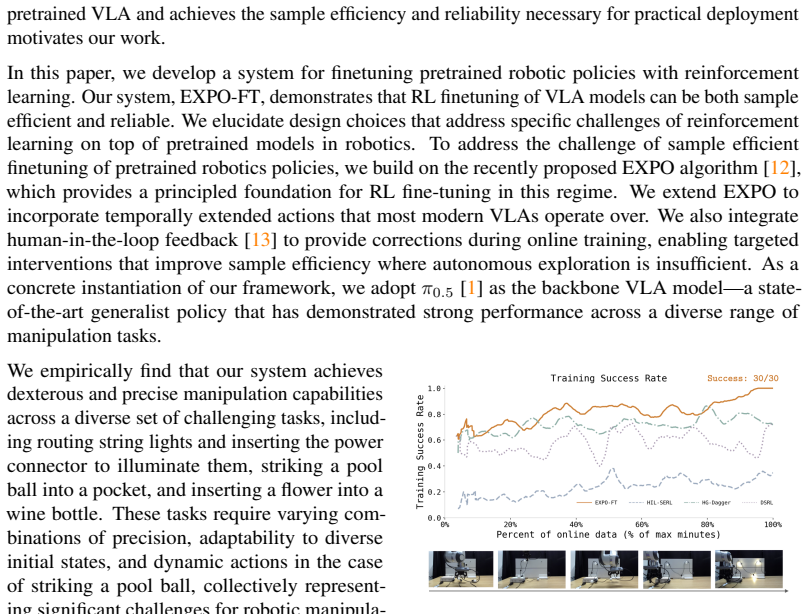
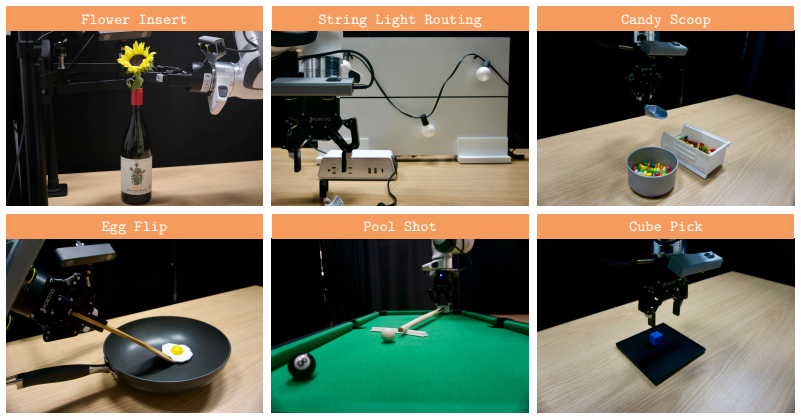
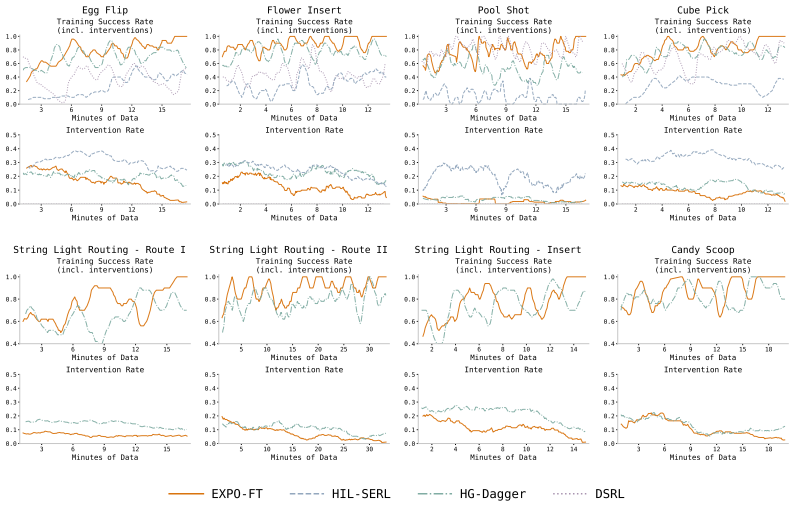
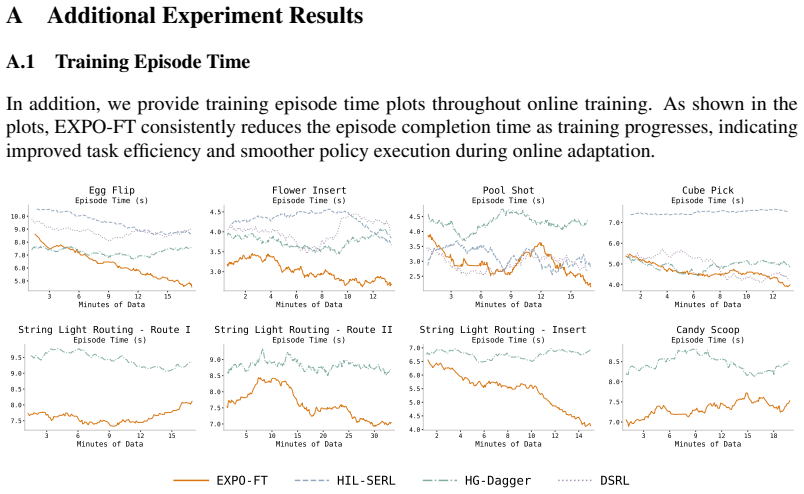
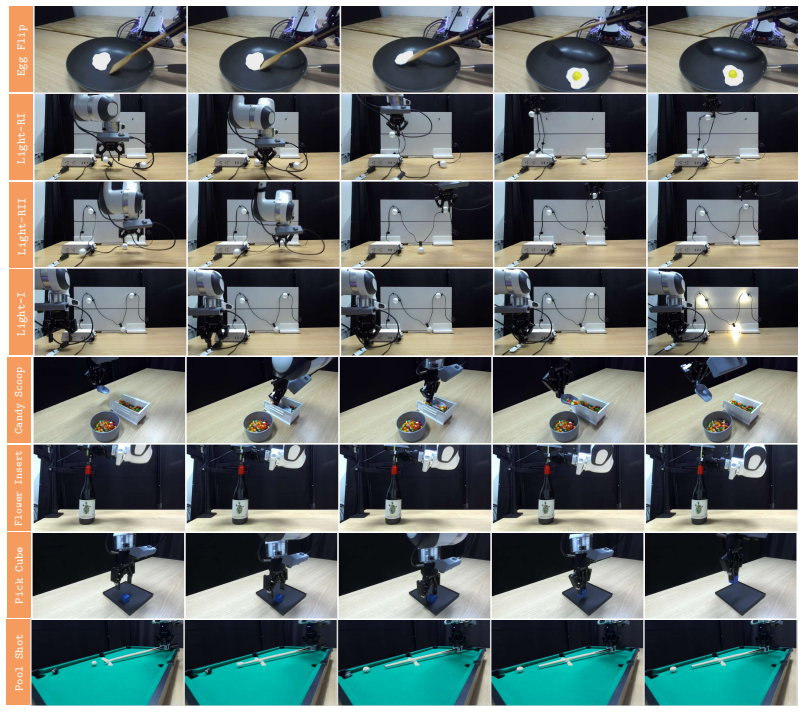
EXPO-FT is a system for stable, sample-efficient RL finetuning of pretrained VLA policies that solves a suite of challenging manipulation tasks, including routing string lights and inserting the plug to light it up, striking a pool ball into a pocket, and inserting a flower into a wine bottle, each requiring combinations of high precision, dynamic actions, and robustness to varied initial states. Our system achieves perfect task performance (30/30 successes) across all evaluated tasks within an average of 19.1 minutes of online robot data, outperforming both prior RL-from-scratch and VLA finetuning approaches.
Load-bearing premise
That the EXPO-FT system can deliver the claimed stability and sample efficiency on the described suite of high-precision, dynamic manipulation tasks when applied to pretrained VLA policies.
Editorial extensions
If this is right
- Pretrained VLA policies reach perfect success rates on high-precision tasks after limited online interaction.
- The method uses less data than RL trained from scratch while improving on prior VLA finetuning results.
- Tasks that combine dynamic actions with robustness to initial state changes become reliably solvable.
- An open-source release supports wider testing of RL finetuning for VLA models in robotics.
Reading between the lines
- The same finetuning pattern could be examined on tasks outside tabletop manipulation, such as mobile navigation or multi-arm coordination.
- If efficiency scales, the approach might reduce the total pretraining data needed by shifting more adaptation burden to short RL stages.
- Testing on hardware with greater sensor noise or longer task horizons would reveal whether the reported data requirements remain stable.
Signed reviews
Editorial analysis
A structured set of objections, weighed in public.
Referee Report
Summary. The manuscript introduces EXPO-FT, a system that augments RL finetuning of pretrained Vision-Language-Action (VLA) policies with an exploration objective, reward shaping, and VLA adaptation procedure. It reports solving a suite of high-precision, dynamic manipulation tasks (routing string lights, striking pool balls, inserting flowers into bottles) to 30/30 success using an average of 19.1 minutes of online robot data per task, outperforming both RL-from-scratch and prior VLA finetuning baselines.
Significance. If the reported outcomes hold under the stated data budgets and task conditions, the work provides a concrete route to reliable real-world deployment of VLAs by addressing stability and sample-efficiency gaps. The open-source codebase release is a clear strength that supports reproducibility and adoption.
minor comments (3)
- The experimental section should explicitly state the number of independent random seeds or rollouts used to compute the 30/30 success rates and any associated variance, to strengthen the stability claim.
- Figure captions and baseline descriptions would benefit from additional detail on hyperparameter matching across methods to ensure fair comparison.
- A short discussion of failure modes or edge cases observed during the 19.1-minute finetuning runs would improve clarity on the method's robustness limits.
Simulated Author's Rebuttal
We thank the referee for their positive assessment of EXPO-FT and for recommending minor revision. We appreciate the recognition that the reported outcomes, if they hold, provide a concrete route to reliable real-world VLA deployment, as well as the value placed on the open-source codebase.
Circularity Check
No significant circularity identified
full rationale
The paper is an empirical robotics contribution describing an RL finetuning system (EXPO-FT) and reporting experimental success rates on manipulation tasks. No derivation chain, first-principles predictions, fitted parameters renamed as outputs, or self-citation load-bearing steps appear in the provided abstract or described method/experimental sections. Claims rest on reported robot trials rather than any definitional or self-referential reduction.
Assumptions & free parameters
Cite this review
Pith. "Pith review of EXPO-FT: Sample-Efficient Reinforcement Learning Finetuning for Vision-Language-Action Models." pith.science (2026). https://pith.science/paper/XNIRCRJK
@misc{pith2026260525477,
  author       = {Pith},
  title        = {Pith review of: EXPO-FT: Sample-Efficient Reinforcement Learning Finetuning for Vision-Language-Action Models},
  year         = {2026},
  howpublished = {\url{https://pith.science/paper/XNIRCRJK}},
  note         = {Machine review of arXiv:2605.25477}
}
read the original abstract
The ability to efficiently and reliably learn new tasks has been a foundational challenge in robotics. Vision-Language-Action (VLA) models have demonstrated strong generalization across diverse manipulation tasks, yet pretrained policies consistently fall short of the reliability required for real-world deployment. Reinforcement learning (RL) fine-tuning offers a promising path to bridge this gap, but existing approaches either train from scratch without fully leveraging pretrained priors, or fine-tune VLAs without achieving the sample efficiency and success rates that practical deployment demands. We present EXPO-FT, a system for stable, sample-efficient RL finetuning of pretrained VLA policies that closes this gap. Our system solves a suite of challenging manipulation tasks, including routing string lights and inserting the plug to light it up, striking a pool ball into a pocket, and inserting a flower into a wine bottle, each requiring combinations of high precision, dynamic actions, and robustness to varied initial states. Our system achieves perfect task performance (30/30 successes) across all evaluated tasks within an average of 19.1 minutes of online robot data, outperforming both prior RL-from-scratch and VLA finetuning approaches. We release an open-source codebase with the aim of facilitating broader adoption of RL finetuning of VLA models in robotics.
Figures
Figures from the paper (4 more)
Forward citations
Cited by 2 Pith papers
-
Do You Really Need to Pretrain Q-Functions for Online RL Fine-Tuning?
On six robot-manipulation tasks, offline Q-pretraining does not accelerate online RL fine-tuning from a pretrained policy, while seeding the replay buffer with rollouts from an ensemble of policies (IPE) improves fina...
-
VistaVLA: Geometry- and Semantic-Aware 3D Gaussian-Grounded VLA for Robotic Manipulation
VistaVLA lifts multi-view vision-language features into 3D Gaussians, compresses them 99% via Merge-then-Query, and improves real-robot manipulation success by ~23% over baselines.
Reviewed June 29, 2026 · model on record in the stance chip above.
Discussion (0). Continue with ORCID to comment.