REVIEW 3 major objections 3 minor 51 references
Pauli blocking: probing beyond-mean-field effects in neutrino flavor evolution
T0 review · 3 major / 3 minor · reviewed 2026-08-11 · deepseek-v4-flash
Pith's one-line read The paper proposes that Pauli blocking from neutrino degeneracy shifts the stability regions of fast flavor conversion in dense astrophysical neutrinos.
desk verdict Honest toy model, but the equations never implement the recoil mechanism the paper motivates; treat the results as a sensitivity study of the ELN, not as evidence about Pauli blocking. read the letter →
The pith
A machine-rendered reading of the paper's core claim, the machinery that carries it, and where it could break.
The reading
What carries the argument
The central object is the modified single-particle Hamiltonian of Eqs. (5)-(7): the mean-field commutator $[D_0,\rho] - v[D_1,\rho]$ is evaluated using effective density matrices whose diagonal occupation entries are multiplied by $(1-B_l)^{1/2}$, with $B_l$ the local neutrino occupation number. The square-root exponent is chosen because refractive effects depend on scattering amplitudes, not cross sections. This ansatz produces an effective ELN angular distribution whose crossings decide stability; the paper's linear-stability analysis then reduces to the usual dispersion integral with the effective distributions substituted in.
What would settle it
Compute the exact many-body flavor evolution for a small, degenerate neutrino ensemble (for example, a few neutrinos in two angular modes with finite chemical potential) and extract the effective single-particle Hamiltonian; if the diagonal suppression is not proportional to $(1-B_l)^{1/2}$, the stability shifts predicted here would not occur. Alternatively, a full quantum-kinetic simulation that includes momentum correlations could check whether Case A remains unstable under the proposed correction.
Extended reading notes
Core claim
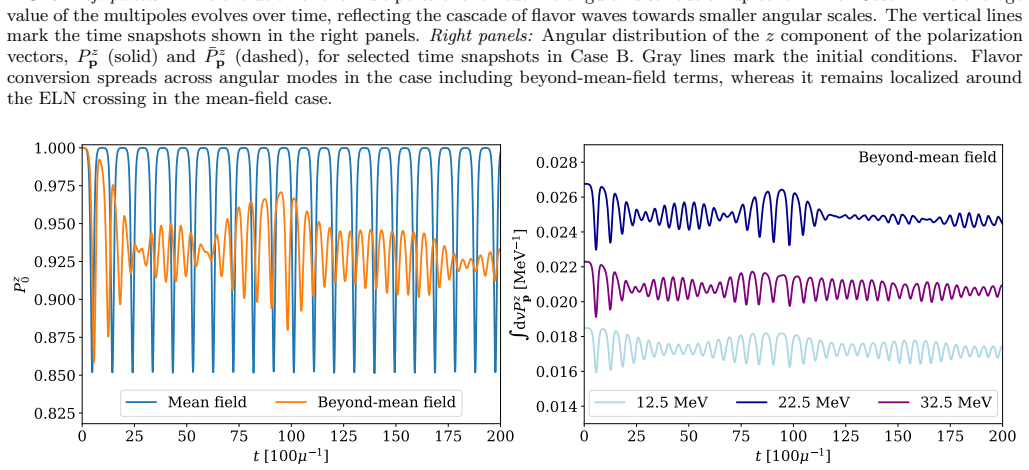
The central claim is that beyond-mean-field effects from neutrino degeneracy can be captured at the single-particle level by rescaling the diagonal entries of the (anti)neutrino density matrices with factors $(1-B_l)^{1/2}$, where $B_l$ are the occupation numbers, before they enter the self-interaction Hamiltonian. This defines an effective electron lepton number (ELN) angular distribution, and stability is governed by crossings of this effective distribution rather than the mean-field one. In a suite of single-energy toy ensembles, the linear growth rate of fast flavor instabilities is suppressed in some cases and turned on in others: Case B drops from $0.0161$ to $0.0108$, Case C from $0.0067$ to $0.0008$, while Case A, stable in the mean-field limit, acquires a small growth rate of $0.0011$. In the non-linear regime the modified equations break the conservation of the polarization-vector lengths and the periodicity of the fast flavor pendulum, and flavor conversion cascades to small angular scales. The paper presents these as indications that dedicated many-body equations of motion are worth developing, not as a completed theory.
Load-bearing premise
The load-bearing premise is that beyond-mean-field degeneracy effects can be represented by multiplying the diagonal density-matrix entries by $(1-B_l)^{1/2}$ in the self-interaction Hamiltonian; the paper explicitly states that this ansatz is not derived from a self-consistent many-body formalism.
Editorial extensions
If this is right
- If the correction is real, the region where neutrinos transition from trapped to free streaming can host fast flavor conversion even when the mean-field ELN has no crossing, and can suppress conversion where mean-field predicts it.
- The non-linear outcome is no longer the periodic fast-flavor pendulum; polarization vectors change length and the evolution decoheres, potentially altering the neutrino energy and angular spectra emitted from compact objects.
- The energy dependence introduced by the blocking factors breaks the degeneracy of the multi-energy equations, so energy modes evolve differently and the flavor outcome depends on the neutrino spectrum shape.
- Stability maps in the parameter space are shifted, meaning astrophysical simulations that rely on mean-field stability criteria could misclassify individual supernova or merger configurations.
Reading between the lines
- We infer that the qualitative message—beyond-mean-field degeneracy effects can move systems into or out of the unstable region—likely holds even if the precise exponent changes, while quantitative growth rates would shift; a first-principles derivation is needed to pin down the exponent.
- Because the correction operates through occupation numbers, its biggest effect should appear close to the neutrino sphere where degeneracy is highest but collisions are not yet negligible; future equations of motion should include it together with collisions and vacuum mixing.
- A direct test would be to solve the exact many-body problem for a small number of neutrinos with a few angular modes and finite chemical potential, and compare the resulting single-particle dynamics with the $(1-B_l)^{1/2}$ prescription.
- If adopted in simulations, this prescription would predict that flavor conversion starts at smaller radii (higher density) than mean-field theory, which could leave an imprint on the neutrino light curve; however, current detectors likely lack the sensitivity to distinguish it.
Editorial analysis
A structured set of objections, weighed in public.
Referee Report
Summary. The paper proposes a heuristic modification to the mean-field equations for neutrino flavor evolution, in which the diagonal entries of the density matrices are multiplied by (1-B_l)^{1/2}, with B_l the neutrino occupation numbers. The authors compute linear stability growth rates and perform nonlinear integrations for a suite of toy (anti)neutrino angular distributions, finding that this modification can suppress existing fast flavor instabilities or create new ones. The paper is explicitly framed as a testbed and states that a self-consistent many-body formalism is not provided.
Significance. If the heuristic ansatz were justified, the results would suggest that neutrino degeneracy can qualitatively change the stability landscape of fast flavor conversion in dense astrophysical environments. The paper is valuable as a clearly labeled toy model: the linear stability calculations and nonlinear evolutions are internally consistent, and the growth rates in Table I match the numerical results. However, the physical significance is currently limited by the absence of a derivation of the (1-B)^{1/2} ansatz and by an internal inconsistency between the stated recoil/Pauli-blocking mechanism and the actual equations, which conserve the number of particles per momentum mode. The paper may motivate future many-body work, but it does not itself establish that the proposed beyond-mean-field effect operates.
major comments (3)
- [Sec. II B and Sec. IV, Eq. (12a)] The motivating physics in Sec. II B is that neutrinos recoil into already-occupied final momentum modes, requiring non-Hermitian operators and momentum-changing scattering. However, the actual model in Eqs. (5)-(6) is a commutator with the same structure as the mean-field equation, and Eq. (12a) explicitly shows that Tr(ρ_p) is conserved for each exact momentum mode. Therefore the (1-B)^{1/2} rescaling cannot implement the described Pauli-blocking recoil process; it only modifies the effective background entering the dispersion relation in Eq. (10). This is an internal-validity concern: the equations do not embody the mechanism they are designed to test. Please either provide a derivation showing how a commutator equation can capture the effect, or revise the physical motivation to match what the model actually does.
- [Sec. II B, Eqs. (6)-(8)] The exponent n=1/2 in the blocking factors (1-B_l)^{1/2} is introduced by analogy with scattering amplitudes, but no microscopic derivation or quantitative justification is given. Because the stability results in Secs. III-V depend sensitively on the functional form of these factors—they alter the effective ELN crossing—the central conclusions are conditional on an unmotivated choice. I recommend testing the sensitivity to n (for example, comparing n=1/2 with n=1 and n=0.25) to show whether the reported shifts in stability regions are robust or an artifact of the chosen exponent.
- [Sec. III, Eq. (10) and Fig. 3] The claim that beyond-mean-field corrections 'shift the stability regions' is largely a direct consequence of reweighting the ELN by (1-B)^{1/2} in the dispersion relation. Since the ansatz is not derived, the circularity concern is real: the outcome is baked into the chosen model. The growth rates themselves are computed correctly, but the interpretation as physical Pauli blocking is not supported. Please reframe the results as a phenomenological study of how an arbitrary modification of the effective ELN affects fast flavor instabilities, or strengthen the derivation to break the circularity.
minor comments (3)
- [Fig. 3 caption] The color-bar label 'log10(|Im( )|/ )' is missing the subscript and denominator; it should read e.g. 'log10(|Im(Ω)|/μ)'.
- [Appendix A, after Eq. (A5)] The paragraph introducing the singlet-state interpretation of the spectator interaction is speculative and not connected to the algebraic form of the ansatz in Eq. (6). Clarify that this is an intuitive picture, not a derivation.
- [Sec. V, Fig. 8] The left panel legend uses 'Pz0' and the right panel uses 'dv Pz_p [MeV^{-1}]'; the notation is inconsistent with the rest of the paper, where P_z^0 and P_z^p are used. Please standardize.
Circularity Check
No significant circularity: the heuristic ansatz is an explicit model input and all growth rates are computed, not fitted.
full rationale
The derivation chain is not circular in the senses defined here. The central modification (Eqs. 5–6) is an openly stated heuristic ansatz: the paper explicitly says it does not provide a self-consistent formalism and that deriving the non-Hermitian Hamiltonian is beyond scope. The blocking factors (1-B)^{1/2} are an input assumption, not a parameter fitted to a target result; the exponent n=1/2 is chosen a priori from the amplitude/cross-section distinction. The stability growth rates (Secs. III–V) are computed from the modified equations, not read off from the input distributions: notably Case A becomes unstable while Cases B and C are damped, so the outcome is not forced to be monotonic. There is no load-bearing self-citation: Ref. [45] (with two of the present authors) is used only as an analogy for absorbing a term into an effective ELN, and the ansatz itself is introduced without citing it. No uniqueness theorem is imported. The reviewer-level concern that Eq. (5) conserves Tr(rho_p) per momentum mode (Eq. 12a), while the motivating recoil-into-occupied-state process would change per-mode occupation, is a physical-consistency/validity objection about whether the ansatz implements the claimed mechanism; it is not circular because the prediction (stability shift) is not equivalent to the input by construction. Therefore score 0.
Assumptions & free parameters
free parameters (4)
- Angular distribution width b =
varied over [0.1, 0.8]
- Angular distribution amplitude d =
varied over [0.20, 0.45]
- Blocking exponent n =
1/2
- Representative supernova thermodynamic inputs (E, T, mu_nu_e) =
E=10.7 MeV, T=10 MeV, mu_nu_e=3 MeV
assumptions (6)
- domain assumption Mean-field neutrino quantum kinetic equations in a homogeneous, axisymmetric medium are the correct zeroth-order description (Eq. 4)
- ad hoc to paper Beyond-mean-field degeneracy effects can be captured by replacing rho_p with an effective density matrix whose diagonal entries are multiplied by (1-B_l)^(1/2)
- domain assumption Fast flavor conversion can be analyzed while neglecting the vacuum mixing term
- standard math The linearized eigenvalue problem in Eq. (9) determines flavor instability growth rates
- domain assumption Equilibrium Fermi-Dirac occupations describe the initial (anti)neutrino spectra
- ad hoc to paper The interpretation in Fig. 2 and Appendix A that a scattered neutrino forms a singlet with an identical spectator is physically valid
invented entities (2)
-
Square-root Pauli-blocking factor (1-B_l)^(1/2) applied to diagonal entries of density matrices in the self-interaction Hamiltonian
-
Spectator neutrino singlet state between the outgoing wavepacket and an identical spectator neutrino
Cite this review
Pith. "Pith review of Pauli blocking: probing beyond-mean-field effects in neutrino flavor evolution." pith.science (2026). https://pith.science/paper/XNZH77RU
@misc{pith2026241212268,
  author       = {Pith},
  title        = {Pith review of: Pauli blocking: probing beyond-mean-field effects in neutrino flavor evolution},
  year         = {2026},
  howpublished = {\url{https://pith.science/paper/XNZH77RU}},
  note         = {Machine review of arXiv:2412.12268}
}
read the original abstract
Neutrino quantum kinetics in dense astrophysical environments is investigated relying on the mean-field approximation. In this paper, we heuristically explore whether beyond-mean-field effects due to neutrino degeneracy could hinder flavor instabilities that are otherwise foreseen. Our results show that these corrections shift the stability regions for a suite of (anti)neutrino ensembles: the flavor conversion of previously unstable distributions can be damped, but angular distributions that are stable in the mean-field case can also become unstable. Our work should serve as a motivation to further investigate the limitations of the mean-field treatment.
Figures


Figures from the paper (6 more)



Reference graph
Works this paper leans on
-
[1]
Wolfenstein, Neutrino Oscillations in Matter, Phys
L. Wolfenstein, Neutrino Oscillations in Matter, Phys. Rev. D 17, 2369 (1978)
1978
-
[2]
S. P. Mikheyev and A. Y. Smirnov, Resonance Amplifica- tion of Oscillations in Matter and Spectroscopy of Solar Neutrinos, Sov. J. Nucl. Phys. 42, 913 (1985)
work page 1985
-
[3]
S. P. Mikheev and A. Y. Smirnov, Neutrino Oscillations in a Variable Density Medium and Neutrino Bursts Due to the Gravitational Collapse of Stars, Sov. Phys. JETP 64, 4 (1986), arXiv:0706.0454 [hep-ph]
work page Pith review arXiv 1986
-
[4]
J. T. Pantaleone, Neutrino oscillations at high densities, Phys. Lett. B 287, 128 (1992)
work page 1992
-
[5]
Sigl and G
G. Sigl and G. G. Raffelt, General kinetic description of relativistic mixed neutrinos, Nucl. Phys. B 406, 423 (1993)
1993
-
[6]
Instability in the dense supernova neutrino gas with flavor-dependent angular distributions
A. Mirizzi and P. D. Serpico, Instability in the Dense Supernova Neutrino Gas with Flavor-Dependent Angu- lar Distributions, Phys. Rev. Lett. 108, 231102 (2012), arXiv:1110.0022 [hep-ph]
work page Pith review arXiv 2012
-
[7]
I. Tamborra and S. Shalgar, New Developments in Flavor Evolution of a Dense Neutrino Gas, Ann. Rev. Nucl. Part. Sci. 71, 165 (2021), arXiv:2011.01948 [astro-ph.HE]
arXiv 2021
-
[8]
S. Richers and M. Sen, Fast Flavor Transformations, in Handbook of Nuclear Physics, edited by I. Tanihata, H. Toki, and T. Kajino (2022) pp. 1–17, arXiv:2207.03561 [astro-ph.HE]
arXiv 2022
Show all 51 references
-
[9]
M. C. Volpe, Neutrinos from dense environments: Fla- vor mechanisms, theoretical approaches, observations, and new directions, Rev. Mod. Phys. 96, 025004 (2024), arXiv:2301.11814 [hep-ph]
2024 arXiv
-
[10]
Tamborra, Neutrinos from explosive transients at the dawn of multi-messenger astronomy, (2024), arXiv:2412.09699 [astro-ph.HE]
I. Tamborra, Neutrinos from explosive transients at the dawn of multi-messenger astronomy, (2024), arXiv:2412.09699 [astro-ph.HE]
2024 arXiv
-
[11]
Banerjee, A
A. Banerjee, A. Dighe, and G. G. Raffelt, Linearized flavor-stability analysis of dense neutrino streams, Phys. Rev. D 84, 053013 (2011), arXiv:1107.2308 [hep-ph]
2011 arXiv
-
[12]
Airen, F
S. Airen, F. Capozzi, S. Chakraborty, B. Dasgupta, G. G. Raffelt, and T. Stirner, Normal-mode Analy- sis for Collective Neutrino Oscillations, JCAP 12, 019, arXiv:1809.09137 [hep-ph]
-
[13]
Izaguirre, G
I. Izaguirre, G. G. Raffelt, and I. Tamborra, Fast Pair- wise Conversion of Supernova Neutrinos: A Dispersion- Relation Approach, Phys. Rev. Lett. 118, 021101 (2017), arXiv:1610.01612 [hep-ph]
2017 arXiv
-
[14]
Chakraborty, R
S. Chakraborty, R. S. Hansen, I. Izaguirre, and G. G. Raffelt, Self-induced neutrino flavor conversion without flavor mixing, JCAP 03, 042, arXiv:1602.00698 [hep-ph]
-
[15]
Morinaga, Fast neutrino flavor instability and neu- trino flavor lepton number crossings, Phys
T. Morinaga, Fast neutrino flavor instability and neu- trino flavor lepton number crossings, Phys. Rev. D 105, L101301 (2022), arXiv:2103.15267 [hep-ph]
2022 arXiv
-
[16]
Padilla-Gay, I
I. Padilla-Gay, I. Tamborra, and G. G. Raffelt, Neu- trino Flavor Pendulum Reloaded: The Case of Fast Pair- wise Conversion, Phys. Rev. Lett. 128, 121102 (2022), arXiv:2109.14627 [astro-ph.HE]
2022 arXiv
-
[17]
D. F. G. Fiorillo and G. G. Raffelt, Slow and fast col- lective neutrino oscillations: Invariants and reciprocity, Phys. Rev. D 107, 043024 (2023), arXiv:2301.09650 [hep- ph]
2023
-
[18]
D. F. G. Fiorillo, M. Goimil-Garc ´ ıa, and G. G. Raffelt, Fast Flavor Pendulum: Instability Condition, (2024), arXiv:2412.09027 [hep-ph]
2024 arXiv
-
[19]
Dasgupta, Collective Neutrino Flavor Instability Re- quires a Crossing, Phys
B. Dasgupta, Collective Neutrino Flavor Instability Re- quires a Crossing, Phys. Rev. Lett. 128, 081102 (2022), arXiv:2110.00192 [hep-ph]
2022 arXiv
-
[20]
Capozzi, B
F. Capozzi, B. Dasgupta, E. Lisi, A. Marrone, and A. Mirizzi, Fast flavor conversions of supernova neu- trinos: Classifying instabilities via dispersion relations, Phys. Rev. D 96, 043016 (2017), arXiv:1706.03360 [hep- ph]
2017 arXiv
-
[21]
Johns, H
L. Johns, H. Nagakura, G. M. Fuller, and A. Burrows, Neutrino oscillations in supernovae: angular moments and fast instabilities, Phys. Rev. D 101, 043009 (2020), arXiv:1910.05682 [hep-ph]
2020 arXiv
-
[22]
R. F. Sawyer, Speed-up of neutrino transformations in a supernova environment, Phys. Rev. D 72, 045003 (2005), arXiv:hep-ph/0503013
2005 arXiv
-
[23]
R. F. Sawyer, The multi-angle instability in dense neutrino systems, Phys. Rev. D 79, 105003 (2009), arXiv:0803.4319 [astro-ph]
2009 arXiv
-
[24]
R. F. Sawyer, Neutrino cloud instabilities just above the neutrino sphere of a supernova, Phys. Rev. Lett. 116, 081101 (2016), arXiv:1509.03323 [astro-ph.HE]
2016 arXiv
-
[25]
Ehring, S
J. Ehring, S. Abbar, H.-T. Janka, G. G. Raffelt, and I. Tamborra, Fast neutrino flavor conversion in core- collapse supernovae: A parametric study in 1D mod- els, Phys. Rev. D 107, 103034 (2023), arXiv:2301.11938 [astro-ph.HE]
2023 arXiv
-
[26]
Ehring, S
J. Ehring, S. Abbar, H.-T. Janka, G. G. Raffelt, and I. Tamborra, Fast Neutrino Flavor Conversions Can Help and Hinder Neutrino-Driven Explosions, Phys. Rev. Lett. 131, 061401 (2023), arXiv:2305.11207 [astro-ph.HE]
2023 arXiv
-
[27]
Nagakura, Roles of Fast Neutrino-Flavor Conver- sion on the Neutrino-Heating Mechanism of Core- Collapse Supernova, Phys
H. Nagakura, Roles of Fast Neutrino-Flavor Conver- sion on the Neutrino-Heating Mechanism of Core- Collapse Supernova, Phys. Rev. Lett. 130, 211401 (2023), arXiv:2301.10785 [astro-ph.HE]
2023 arXiv
-
[28]
M.-R. Wu, I. Tamborra, O. Just, and H.-T. Janka, Imprints of neutrino-pair flavor conversions on nucle- osynthesis in ejecta from neutron-star merger remnants, Phys. Rev. D 96, 123015 (2017), arXiv:1711.00477 [astro- ph.HE]
2017 arXiv
-
[29]
George, M.-R
M. George, M.-R. Wu, I. Tamborra, R. Ardevol-Pulpillo, and H.-T. Janka, Fast neutrino flavor conversion, ejecta properties, and nucleosynthesis in newly-formed hyper- massive remnants of neutron-star mergers, Phys. Rev. D 102, 103015 (2020), arXiv:2009.04046 [astro-ph.HE]
2020 arXiv
-
[30]
O. Just, S. Abbar, M.-R. Wu, I. Tamborra, H.-T. Janka, and F. Capozzi, Fast neutrino conversion in hydrody- namic simulations of neutrino-cooled accretion disks, Phys. Rev. D 105, 083024 (2022), arXiv:2203.16559 [astro-ph.HE]
2022 arXiv
-
[31]
Fern´ andez, S
R. Fern´ andez, S. Richers, N. Mulyk, and S. Fahlman, Fast flavor instability in hypermassive neutron star disk outflows, Phys. Rev. D 106, 103003 (2022), arXiv:2207.10680 [astro-ph.HE]
2022 arXiv
-
[32]
Li and D
X. Li and D. M. Siegel, Neutrino Fast Flavor Conver- sions in Neutron-Star Postmerger Accretion Disks, Phys. Rev. Lett. 126, 251101 (2021), arXiv:2103.02616 [astro- ph.HE]
2021 arXiv
-
[33]
D. F. G. Fiorillo, G. G. Raffelt, and G. Sigl, Inhomo- geneous Kinetic Equation for Mixed Neutrinos: Tracing the Missing Energy, Phys. Rev. Lett.133, 021002 (2024), arXiv:2401.05278 [hep-ph]
2024 arXiv
-
[34]
A. V. Patwardhan, M. J. Cervia, E. Rrapaj, P. Siwach, 12 and A. B. Balantekin, Many-Body Collective Neutrino Oscillations: Recent Developments, in Handbook of Nu- clear Physics, edited by I. Tanihata, H. Toki, and T. Ka- jino (2023) pp. 1–16, arXiv:2301.00342 [hep-ph]
2023 arXiv
-
[35]
Shalgar and I
S. Shalgar and I. Tamborra, Do we have enough evidence to invalidate the mean-field approximation adopted to model collective neutrino oscillations?, Phys. Rev. D107, 123004 (2023), arXiv:2304.13050 [astro-ph.HE]
2023 arXiv
-
[36]
Johns, Neutrino many-body correlations, Int
L. Johns, Neutrino many-body correlations, Int. J. Mod. Phys. A 39, 2450122 (2024), arXiv:2305.04916 [hep-ph]
2024 arXiv
-
[37]
Tamborra, L
I. Tamborra, L. Huedepohl, G. G. Raffelt, and H.-T. Janka, Flavor-dependent neutrino angular distribution in core-collapse supernovae, Astrophys. J. 839, 132 (2017), arXiv:1702.00060 [astro-ph.HE]
2017 arXiv
-
[38]
T. D. Brandt, A. Burrows, C. D. Ott, and E. Livne, Results From Core-Collapse Simulations with Multi- Dimensional, Multi-Angle Neutrino Transport, Astro- phys. J. 728, 8 (2011), arXiv:1009.4654 [astro-ph.HE]
2011 arXiv
-
[39]
Shalgar and I
S. Shalgar and I. Tamborra, On the Occurrence of Cross- ings Between the Angular Distributions of Electron Neu- trinos and Antineutrinos in the Supernova Core, Astro- phys. J. 883, 80 (2019), arXiv:1904.07236 [astro-ph.HE]
2019 arXiv
-
[40]
Stirner, G
T. Stirner, G. Sigl, and G. G. Raffelt, Liouville term for neutrinos: Flavor structure and wave interpretation, JCAP 05, 016, arXiv:1803.04693 [hep-ph]
-
[41]
Volpe, D
C. Volpe, D. V¨ a¨ an¨ anen, and C. Espinoza, Extended evo- lution equations for neutrino propagation in astrophys- ical and cosmological environments, Phys. Rev. D 87, 113010 (2013), arXiv:1302.2374 [hep-ph]
2013 arXiv
-
[42]
A. Kost, L. Johns, and H. Duan, Once-in-a-lifetime en- counter models for neutrino media: From coherent oscil- lations to flavor equilibration, Phys. Rev. D 109, 103037 (2024), arXiv:2402.05022 [hep-ph]
2024 arXiv
-
[43]
M. A. Rudzskii, Kinetic equations for neutrino spin- and type-oscillations in a medium, Astrophys. Sp. Sci. 165, 65 (1990)
1990
-
[44]
D. F. G. Fiorillo and G. G. Raffelt, Theory of neutrino fast flavor evolution. Part I. Linear response theory and stability conditions., JHEP 08, 225, arXiv:2406.06708 [hep-ph]
-
[45]
Dedin Neto, I
P. Dedin Neto, I. Tamborra, and S. Shalgar, Energy De- pendence of Flavor Instabilities Stemming from Crossings in the Neutrino Flavor Lepton Number Angular Distri- bution, (2023), arXiv:2312.06556 [astro-ph.HE]
2023 arXiv
-
[46]
D. F. G. Fiorillo and G. G. Raffelt, Flavor solitons in dense neutrino gases, Phys. Rev. D 107, 123024 (2023), arXiv:2303.12143 [hep-ph]
2023
-
[47]
G. G. Raffelt, N-mode coherence in collective neutrino oscillations, Phys. Rev. D 83, 105022 (2011), [Erratum: Phys.Rev.D 104, 089902 (2021)], arXiv:1103.2891 [hep- ph]
2011 arXiv
-
[48]
Johns, H
L. Johns, H. Nagakura, G. M. Fuller, and A. Burrows, Fast oscillations, collisionless relaxation, and spurious evolution of supernova neutrino flavor, Phys. Rev. D102, 103017 (2020), arXiv:2009.09024 [hep-ph]
2020 arXiv
-
[49]
Shalgar and I
S. Shalgar and I. Tamborra, Dispelling a myth on dense neutrino media: fast pairwise conversions depend on en- ergy, JCAP 01, 014, arXiv:2007.07926 [astro-ph.HE]
2007 arXiv
-
[50]
Shalgar and I
S. Shalgar and I. Tamborra, A change of direction in pair- wise neutrino conversion physics: The effect of collisions, Phys. Rev. D 103, 063002 (2021), arXiv:2011.00004 [astro-ph.HE]
2021 arXiv
-
[51]
Padilla-Gay, I
I. Padilla-Gay, I. Tamborra, and G. G. Raffelt, Neutrino fast flavor pendulum. II. Collisional damping, Phys. Rev. D 106, 103031 (2022), arXiv:2209.11235 [hep-ph]
2022 arXiv
Reviewed August 11, 2026 · model on record in the stance chip above.
Discussion (0). Continue with ORCID to comment.