REVIEW 3 major objections 6 minor 1 cited by
VoxDet: Rethinking 3D Semantic Occupancy Prediction as Dense Object Detection
T0 review · 3 major / 6 minor · reviewed 2026-08-07 · deepseek-v4-flash
Pith's one-line read VoxDet reformulates 3D occupancy prediction as dense object detection, with class labels alone supplying the instance-level supervision.
desk verdict VoxDet is a solid method paper with a genuinely useful label-to-offset trick, but the unablated label-filtering step leaves the headline SOTA claim not fully unpacked. read the letter →
The pith
A machine-rendered reading of the paper's core claim, the machinery that carries it, and where it could break.
The reading
What carries the argument
The load-bearing object is the 4D offset field $\Delta \in \mathbb{R}^{X \times Y \times Z \times 6}$, produced by the Voxel-to-Instance (VoxNT) trick and predicted by the regression branch. For each voxel, VoxNT scans along the positive and negative $x$, $y$, and $z$ directions until the voxel class changes, records the run length as the distance to the instance border in that direction, rounds and normalizes the six distances into $[0,1]$; the regression head is then trained with an L1 loss on this field. The predicted offsets are not just an output: they select six boundary voxels per voxel that the classification branch aggregates over via attention (Equation 6), which is what makes the prediction instance-aware. Supporting this are the Spatially-decoupled Voxel Encoder's dense projection onto tri-perspective planes with deformable convolution, which separates classification and regression features and avoids task misalignment, and the auxiliary voxel-centric segmentation loss that stabilizes training.
What would settle it
Compare the VoxNT offset labels with true instance-boundary distances on a dataset that has instance IDs, or run a controlled experiment on SemanticKITTI validation where the regression branch is trained on the VoxNT offsets versus on offsets computed from real instance IDs; if the two targets differ substantially at touching same-class objects and the accuracy gap is large, the free-lunch assumption is the fragile part. A second decisive test: keep the full architecture but replace the learned offsets with random or identity aggregation; if IoU and mIoU do not degrade, the offset field is not what carries the claimed instance-level gain.
Extended reading notes
Core claim
The central claim is that instance boundaries are already readable from semantic occupancy labels. Because voxels do not occlude one another, a voxel's class label plus the labels of its neighbors determines which instance it belongs to well enough to regress distances to that instance's borders in six directions, with the empty class acting as a boundary. The paper proposes VoxNT to generate those offset targets for free, then VoxDet to learn them: a Spatially-decoupled Voxel Encoder produces separate feature volumes for classification and regression in a tri-perspective projection space, and a Task-decoupled Dense Predictor regresses the 4D offset field and uses the predicted offsets in an attention-based instance-level aggregation before the classification head. On the paper's reported benchmarks, this yields 47.27 IoU and 18.47 mIoU on the SemanticKITTI camera test set, 48.59 and 21.40 on SSCBench-KITTI-360, and 63.0 IoU and 26.0 mIoU on the SemanticKITTI LiDAR test set, ranking first on the online leaderboard without extra labels, data, temporal information, or models.
Load-bearing premise
The premise that carries the method is that a change in voxel class label (or a transition to the empty class) marks a true instance boundary, so scanning along each axis until the class changes yields correct offset targets; this fails when two same-class instances touch, when an instance is broken by missing voxels, or when the ground-truth labels of dynamic objects are noisy.
Editorial extensions
If this is right
- Occupancy models can be trained with instance-level supervision without any instance annotations, since the VoxNT trick derives offset targets directly from class labels.
- A single detection-style formulation covers both camera and LiDAR inputs by swapping the 3D volume source, so improvements need not be duplicated across modalities.
- The regressed offset field doubles as a label-quality tool: abnormally small or large instance scales flag isolated voxels and the motion after-images of dynamic objects, which can then be filtered from training.
- The reported efficiency gains follow from the same reformulation: 53 million parameters and 159 ms inference time on the camera benchmark, compared with heavier segmentation-based baselines.
- Replacing the learned offsets with local or outside-instance aggregation degrades performance, which the paper takes as evidence that the instance-boundary signal, not the extra parameters, drives the gains.
Reading between the lines
- Inference: the same scan-until-class-change construction could convert existing 3D semantic segmentation datasets into weak instance-boundary supervision for panoptic or instance segmentation, a use the paper mentions only in passing.
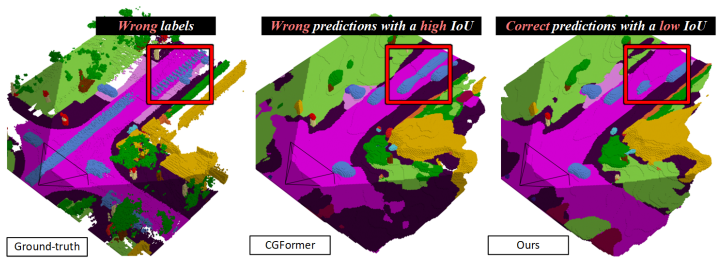
- Inference: the reported gains may partly come from the label-filtering side effect (removing wrong dynamic-object labels) rather than from instance-aware aggregation; a fair ablation that trains with and without the label filter would separate these effects.
- Inference: because the offset field encodes object extents without bounding boxes, it suggests a path toward 3D object detection purely from semantic occupancy labels, though the paper explicitly leaves the required 3D NMS for future work.
Editorial analysis
A structured set of objections, weighed in public.
Referee Report
Summary. The paper proposes VoxDet, a framework that reformulates 3D semantic occupancy prediction as dense object detection. The central idea is a Voxel-to-Instance (VoxNT) trick that converts voxel-level class labels into 6-direction instance-boundary offset labels by scanning each voxel until the class label changes; these offsets supervise a regression branch whose predictions in turn guide instance-level aggregation in a classification branch. The architecture decouples features for the two sub-tasks via a Spatially-decoupled Voxel Encoder and a Task-decoupled Dense Predictor. The paper reports state-of-the-art results on SemanticKITTI camera (47.27 IoU / 18.47 mIoU), SSCBench-KITTI-360 (48.59 / 21.40), and SemanticKITTI LiDAR (63.0 / 26.0), with lower parameter counts and faster inference than prior methods, plus validation-set ablations, sensitivity analyses, and multiple-run robustness curves.
Significance. If the reported gains genuinely come from the instance-centric formulation, the paper makes a valuable and practical contribution: it extracts instance-level supervision from existing voxel class labels without extra annotation, unifies camera and LiDAR pipelines, and improves both accuracy and efficiency. The strengths are the externally benchmarked test-set results, the multiple-run robustness analysis, the detailed efficiency comparison, and the fact that the core VoxNT label generation is given as pseudocode. However, the central claim is currently conditional because the label-filtering step Eq. (12) is never ablated, so the reported improvements over baselines may partly reflect robust training against noisy dynamic-object labels rather than instance-level perception. The paper itself acknowledges that the "free-lunch" boundary assumption fails for noisy and dynamic labels, so the contribution is best assessed as a heuristic that needs tighter isolation from its label-cleaning component.
major comments (3)
- [§5.2, Table 4; App. B.3, Eq. (12); App. C.2] The main ablation does not isolate the effect of the label-filtering step. App. B.2 documents that the VoxNT-derived offsets are corrupted by isolated voxels and motion afterimages for the car class, and Eq. (12) with thresholds Kmin=3 and Kmax=30 is used to mask those voxels during training, as stated in App. C.2. Because every reported VoxDet result is obtained with this filtering, the gains over baselines could come from ignoring noisy labels rather than from the regression branch or the instance-level aggregation in Eq. (6). I request an ablation of: (i) the full model without Eq. (12); (ii) a baseline that only applies Eq. (12) to the standard segmentation loss; (iii) sensitivity of results to Kmin and Kmax; and (iv) an oracle version that replaces VoxNT offsets with true instance boundaries. Without these experiments, the state-of-the-art claim is not yet attributable to the proposed formulation.
- [§4.3, Eq. (5), Fig. 4; App. B.2–B.3] The "free lunch" assumption that voxel class-label changes delineate instances is violated for touching same-class instances, instances split by missing voxels, and noisy dynamic-object labels. The paper itself confirms these failure modes for cars, so the offset labels are heuristic rather than free ground truth. This matters because the regression loss Eq. (5) trains on those labels, and the classification branch Eq. (6) consumes the predicted offsets; if the offsets are wrong, the aggregation may gather cross-instance voxels. I ask the authors to quantify how often the VoxNT boundary is incorrect (e.g., per-class statistics of touching instances or filtered voxel fractions) and to add an ablation that feeds oracle offsets into Eq. (6) instead of predicted offsets. This would separate the value of the instance-level aggregation from the regression branch's ability to predict the heuristic offsets.
- [App. B.3, App. B.4, Tables 1–3] There is a tension in the paper about the role of label filtering. App. B.3 states that the filtering operations "improve a more reasonable prediction but cannot improve the mIoU evaluation, because the ground-truth is noisy," yet the paper's overall claim is that VoxDet achieves state-of-the-art mIoU on the same benchmarks. It is not clear from the text whether Eq. (12) is applied in all reported experiments, whether it changes validation mIoU, or whether the test-set numbers would hold without it. Please clarify the exact protocol used for every result table and report the validation-set numbers with and without Eq. (12), so reviewers can understand how filtering, metrics, and instance-aware aggregation interact.
minor comments (6)
- [App. B.1, Eqs. (9)–(11)] Eq. (9) lists {δx+, δx−, δy+, δx−, δz+, δz−}, where δx− appears twice and δy− is missing; Eqs. (10) and (11) use l_y in the third coordinate where l_z is intended. These typos make the filtering rule mathematically ambiguous.
- [App. C.2 vs. §4.4, App. A.4] App. C.2 says "the loss weight terms of λ and β are empirically set to 1.0 and 0.2," which contradicts Eq. (8) and App. A.4, where λ=0.2 is the auxiliary-loss weight; β is never defined in the main text.
- [App. A.1, Table 2 caption] There are typos: "CGFomrer" in the Fig. 8 caption and "are are" in the Table 2 caption; the table header also uses inconsistent capitalization.
- [App. C.3, Algorithm 1] In run_length_positive, the last voxel along the scanning direction is initialized to 1 and the loop accumulates same-class neighbors, which effectively counts the number of voxels in the contiguous run rather than the distance to the boundary; the paper should clarify the exact off-by-one convention used in Eq. (5) and Fig. 4, and whether empty-class runs are handled consistently.
- [§4.3, Eq. (5)] The regression loss Lreg is summed over all voxels, including empty voxels, with no explicit mask in Eq. (5); please state whether empty voxels contribute to the loss and, if so, how their offsets from the VoxNT scan are defined.
- [§5.2, Fig. 5] The text reports that α=0.8 slightly outperforms the default α=1.0 in the aggregation analysis; since the paper does not adopt α=0.8, please either explain why the default is retained or report the difference in Table 4 to avoid ambiguity.
Circularity Check
No significant circularity: VoxNT derives auxiliary offset targets from class labels, but the central occupancy predictions are trained and evaluated on held-out benchmarks and do not reduce to a fitted constant.
full rationale
The derivation chain is self-contained and non-circular. VoxNT (Eq. 5, Fig. 4, Algorithm 1) constructs offset regression targets by run-length scanning the ground-truth voxel class labels and stopping at class changes; these offsets are auxiliary pseudo-labels used only to supervise the regression branch. The classification branch aggregates features at the predicted offset positions (Eq. 6), and both branches are optimized against ground-truth occupancy labels and evaluated on the held-out SemanticKITTI and SSCBench-KITTI-360 test sets (including the online CodaLab leaderboard for the LiDAR setting), so no reported IoU/mIoU number is algebraically identical to an input or to a fitted threshold. The label-cleaning masks in Eqs. 10-12 use validation-tuned thresholds (Kmin=3, Kmax=30); that is model selection and an unablated engineering choice, not a circular reduction, and the paper itself notes the filtering 'cannot improve the mIoU evaluation, because the ground-truth is noisy.' Self-citations such as [82] for 2D-to-3D lifting and the shared UNet encoder are standard implementation inheritance and are not load-bearing: the detection-based formulation is specified in the paper's own equations (Eqs. 4-8). Therefore no circular step is present.
Assumptions & free parameters
free parameters (4)
- Auxiliary loss weight lambda =
0.2
- Number of instance-level aggregation layers N =
4
- Label filtering thresholds Kmin and Kmax =
3 and 30
- Regression loss weight lambda_reg =
1.0
assumptions (3)
- domain assumption Each voxel is assigned exactly one semantic class, including empty, making instances separable by class boundaries.
- domain assumption The axis-aligned distance to the first class change is a useful proxy for instance-boundary offset.
- domain assumption Ground-truth labels, after VoxNT filtering, are reliable enough to supervise both tasks.
Cite this review
Pith. "Pith review of VoxDet: Rethinking 3D Semantic Occupancy Prediction as Dense Object Detection." pith.science (2026). https://pith.science/paper/XOCTJAXO
@misc{pith2026250604623,
  author       = {Pith},
  title        = {Pith review of: VoxDet: Rethinking 3D Semantic Occupancy Prediction as Dense Object Detection},
  year         = {2026},
  howpublished = {\url{https://pith.science/paper/XOCTJAXO}},
  note         = {Machine review of arXiv:2506.04623}
}
read the original abstract
3D semantic occupancy prediction aims to reconstruct the 3D geometry and semantics of the surrounding environment. With dense voxel labels, prior works typically formulate it as a dense segmentation task, independently classifying each voxel. However, this paradigm neglects critical instance-centric discriminability, leading to instance-level incompleteness and adjacent ambiguities. To address this, we highlight a free lunch of occupancy labels: the voxel-level class label implicitly provides insight at the instance level, which is overlooked by the community. Motivated by this observation, we first introduce a training-free Voxel-to-Instance (VoxNT) trick: a simple yet effective method that freely converts voxel-level class labels into instance-level offset labels. Building on this, we further propose VoxDet, an instance-centric framework that reformulates the voxel-level occupancy prediction as dense object detection by decoupling it into two sub-tasks: offset regression and semantic prediction. Specifically, based on the lifted 3D volume, VoxDet first uses (a) Spatially-decoupled Voxel Encoder to generate disentangled feature volumes for the two sub-tasks, which learn task-specific spatial deformation in the densely projected tri-perceptive space. Then, we deploy (b) Task-decoupled Dense Predictor to address this task via dense detection. Here, we first regress a 4D offset field to estimate distances (6 directions) between voxels and object borders in the voxel space. The regressed offsets are then used to guide the instance-level aggregation in the classification branch, achieving instance-aware prediction. Experiments show that VoxDet can be deployed on both camera and LiDAR input, jointly achieving state-of-the-art results on both benchmarks. VoxDet is not only highly efficient, but also achieves 63.0 IoU on the SemanticKITTI test set, ranking 1st on the online leaderboard.
Figures


Figures from the paper (10 more)




Forward citations
Cited by 1 Pith paper
-
MetaScope: Optics-Driven Neural Network for Ultra-Micro Metalens Endoscopy
MetaScope, an optics-driven network, corrects metalens endoscope images and outperforms prior methods on segmentation and restoration.
Reference graph
Works this paper leans on
-
[1]
Social lstm: Human trajectory prediction in crowded spaces
Alexandre Alahi, Kratarth Goel, Vignesh Ramanathan, Alexandre Robicquet, Li Fei-Fei, and Silvio Savarese. Social lstm: Human trajectory prediction in crowded spaces. InProceedings of the IEEE conference on computer vision and pattern recognition, pages 961–971, 2016
2016
-
[2]
Jongseong Bae, Junwoo Ha, and Ha Young Kim. Three cars approaching within 100m! enhanc- ing distant geometry by tri-axis voxel scanning for camera-based semantic scene completion. arXiv preprint arXiv:2411.16129, 2024
work page Pith review arXiv 2024
-
[3]
Semantickitti: A dataset for semantic scene understanding of lidar sequences
Jens Behley, Martin Garbade, Andres Milioto, Jan Quenzel, Sven Behnke, Cyrill Stachniss, and Jürgen Gall. Semantickitti: A dataset for semantic scene understanding of lidar sequences. In Proceedings of the IEEE/CVF International Conference on Computer Vision, pages 9297–9307, 2019
2019
-
[4]
Semantickitti: A dataset for semantic scene understanding of lidar sequences
Jens Behley, Martin Garbade, Andres Milioto, Jan Quenzel, Sven Behnke, Cyrill Stachniss, and Jurgen Gall. Semantickitti: A dataset for semantic scene understanding of lidar sequences. In Proceedings of the IEEE/CVF international conference on computer vision, pages 9297–9307, 2019
2019
-
[5]
Adabins: Depth estimation using adaptive bins
Shariq Farooq Bhat, Ibraheem Alhashim, and Peter Wonka. Adabins: Depth estimation using adaptive bins. InProceedings of the IEEE/CVF Conference on Computer Vision and Pattern Recognition, pages 4009–4018, 2021
2021
-
[6]
Monoscene: Monocular 3d semantic scene completion
Anh-Quan Cao and Raoul de Charette. Monoscene: Monocular 3d semantic scene completion. InProceedings of the IEEE/CVF Conference on Computer Vision and Pattern Recognition, pages 3981–3991, 2022
2022
-
[7]
Pasco: Urban 3d panoptic scene completion with uncertainty awareness
Anh-Quan Cao, Angela Dai, and Raoul De Charette. Pasco: Urban 3d panoptic scene completion with uncertainty awareness. InProceedings of the IEEE/CVF Conference on Computer Vision and Pattern Recognition, pages 14554–14564, 2024
2024
-
[8]
End-to-end object detection with transformers
Nicolas Carion, Francisco Massa, Gabriel Synnaeve, Nicolas Usunier, Alexander Kirillov, and Sergey Zagoruyko. End-to-end object detection with transformers. InProceedings of the European Conference on Computer Vision, pages 213–229, 2020
2020
Show all 89 references
-
[9]
Gaussrender: Learning 3d occupancy with gaussian rendering.arXiv preprint arXiv:2502.05040, 2025
Loà ck Chambon, Eloi Zablocki, Alexandre Boulch, MickaÃl Chen, and Matthieu Cord. Gaussrender: Learning 3d occupancy with gaussian rendering.arXiv preprint arXiv:2502.05040, 2025
2025 arXiv
-
[10]
Domain adaptive faster r-cnn for object detection in the wild
Yuhua Chen, Wen Li, Christos Sakaridis, Dengxin Dai, and Luc Van Gool. Domain adaptive faster r-cnn for object detection in the wild. InProceedings of the IEEE conference on computer vision and pattern recognition, pages 3339–3348, 2018
2018
-
[11]
Disen- tangle your dense object detector
Zehui Chen, Chenhongyi Yang, Qiaofei Li, Feng Zhao, Zheng-Jun Zha, and Feng Wu. Disen- tangle your dense object detector. InProceedings of the 29th ACM international conference on multimedia, pages 4939–4948, 2021
2021
-
[12]
3d u-net: learning dense volumetric segmentation from sparse annotation
Özgün Çiçek, Ahmed Abdulkadir, Soeren S Lienkamp, Thomas Brox, and Olaf Ronneberger. 3d u-net: learning dense volumetric segmentation from sparse annotation. InMedical Image Computing and Computer-Assisted Intervention–MICCAI 2016: 19th International Conference, Athens, Greece...
2016
-
[13]
Deformable convolutional networks
Jifeng Dai, Haozhi Qi, Yuwen Xiong, Yi Li, Guodong Zhang, Han Hu, and Yichen Wei. Deformable convolutional networks. InProceedings of the IEEE international conference on computer vision, pages 764–773, 2017
2017
-
[14]
Worldscore: A unified evaluation benchmark for world generation.arXiv preprint arXiv:2504.00983, 2025
Haoyi Duan, Hong-Xing Yu, Sirui Chen, Li Fei-Fei, and Jiajun Wu. Worldscore: A unified evaluation benchmark for world generation.arXiv preprint arXiv:2504.00983, 2025
2025
-
[15]
MIT press, 1993
Olivier Faugeras.Three-dimensional computer vision: a geometric viewpoint. MIT press, 1993
1993
-
[16]
Two stream 3d semantic scene completion
Martin Garbade, Yueh-Tung Chen, Johann Sawatzky, and Juergen Gall. Two stream 3d semantic scene completion. InProceedings of the IEEE/CVF Conference on Computer Vision and Pattern Recognition Workshops, pages 0–0, 2019
2019
-
[17]
Are we ready for autonomous driving? the kitti vision benchmark suite
Andreas Geiger, Philip Lenz, and Raquel Urtasun. Are we ready for autonomous driving? the kitti vision benchmark suite. In2012 IEEE conference on computer vision and pattern recognition, pages 3354–3361. IEEE, 2012
2012
-
[18]
Fast r-cnn
Ross Girshick. Fast r-cnn. InProceedings of the IEEE international conference on computer vision, pages 1440–1448, 2015
2015
-
[19]
Sgformer: Satellite-ground fusion for 3d semantic scene completion
Xiyue Guo, Jiarui Hu, Junjie Hu, Hujun Bao, and Guofeng Zhang. Sgformer: Satellite-ground fusion for 3d semantic scene completion. InProceedings of the IEEE/CVF international conference on computer vision, 2025
2025
-
[20]
Masked autoencoders are scalable vision learners
Kaiming He, Xinlei Chen, Saining Xie, Yanghao Li, Piotr Dollár, and Ross Girshick. Masked autoencoders are scalable vision learners. InProceedings of the IEEE/CVF Conference on Computer Vision and Pattern Recognition, pages 16000–16009, 2022. 24
2022
-
[21]
Deep residual learning for image recognition
Kaiming He, Xiangyu Zhang, Shaoqing Ren, and Jian Sun. Deep residual learning for image recognition. InProceedings of the IEEE/CVF conference on computer vision and pattern recognition, pages 770–778, 2016
2016
-
[22]
Tri-perspective view for vision-based 3d semantic occupancy prediction
Yuanhui Huang, Wenzhao Zheng, Yunpeng Zhang, Jie Zhou, and Jiwen Lu. Tri-perspective view for vision-based 3d semantic occupancy prediction. InProceedings of the IEEE/CVF Conference on Computer Vision and Pattern Recognition, pages 9223–9232, 2023
2023
-
[23]
Symphonize 3d semantic scene completion with contextual instance queries.Proceedings of the IEEE/CVF Conference on Computer Vision and Pattern Recognition, 2024
Haoyi Jiang, Tianheng Cheng, Naiyu Gao, Haoyang Zhang, Wenyu Liu, and Xinggang Wang. Symphonize 3d semantic scene completion with contextual instance queries.Proceedings of the IEEE/CVF Conference on Computer Vision and Pattern Recognition, 2024
2024
-
[24]
Cornernet: Detecting objects as paired keypoints
Hei Law and Jia Deng. Cornernet: Detecting objects as paired keypoints. InProceedings of the European conference on computer vision (ECCV), pages 734–750, 2018
2018
-
[25]
Hierarchical temporal context learning for camera-based semantic scene completion
Bohan Li, Jiajun Deng, Wenyao Zhang, Zhujin Liang, Dalong Du, Xin Jin, and Wenjun Zeng. Hierarchical temporal context learning for camera-based semantic scene completion. In European Conference on Computer Vision, 2024
2024
-
[26]
Stereoscene: Bev-assisted stereo matching empowers 3d semantic scene completion.arXiv preprint arXiv:2303.13959, 2023
Bohan Li, Yasheng Sun, Xin Jin, Wenjun Zeng, Zheng Zhu, Xiaoefeng Wang, Yunpeng Zhang, James Okae, Hang Xiao, and Dalong Du. Stereoscene: Bev-assisted stereo matching empowers 3d semantic scene completion.arXiv preprint arXiv:2303.13959, 2023
2023 arXiv
-
[27]
Instantsplamp: Fast and generalizable stenography framework for generative gaussian splatting
Chenxin Li, Hengyu Liu, Zhiwen Fan, Wuyang Li, Yifan Liu, Panwang Pan, and Yixuan Yuan. Instantsplamp: Fast and generalizable stenography framework for generative gaussian splatting. InThe Thirteenth International Conference on Learning Representations, 2025
2025
-
[28]
U-kan makes strong backbone for medical image segmentation and generation
Chenxin Li, Xinyu Liu, Wuyang Li, Cheng Wang, Hengyu Liu, Yifan Liu, Zhen Chen, and Yixuan Yuan. U-kan makes strong backbone for medical image segmentation and generation. InProceedings of the AAAI Conference on Artificial Intelligence, volume 39, pages 4652–4660, 2025
2025
-
[29]
Occmamba: Semantic occupancy prediction with state space models.arXiv preprint arXiv:2408.09859, 2024
Heng Li, Yuenan Hou, Xiaohan Xing, Yuexin Ma, Xiao Sun, and Yanyong Zhang. Occmamba: Semantic occupancy prediction with state space models.arXiv preprint arXiv:2408.09859, 2024
2024 arXiv
-
[30]
Htd: Heterogeneous task decoupling for two-stage object detection.IEEE Transactions on Image Processing, 30:9456–9469, 2021
Wuyang Li, Zhen Chen, Baopu Li, Dingwen Zhang, and Yixuan Yuan. Htd: Heterogeneous task decoupling for two-stage object detection.IEEE Transactions on Image Processing, 30:9456–9469, 2021
2021
-
[31]
Scan: Cross domain object detection with semantic conditioned adaptation
Wuyang Li, Xinyu Liu, Xiwen Yao, and Yixuan Yuan. Scan: Cross domain object detection with semantic conditioned adaptation. InProceedings of the AAAI Conference on Artificial Intelligence, 2022
2022
-
[32]
Sigma: Semantic-complete graph matching for domain adaptive object detection
Wuyang Li, Xinyu Liu, and Yixuan Yuan. Sigma: Semantic-complete graph matching for domain adaptive object detection. InProceedings of the IEEE/CVF conference on computer vision and pattern recognition, pages 5291–5300, 2022
2022
-
[33]
Unifying voxel- based representation with transformer for 3d object detection.Advances in Neural Information Processing Systems, 35:18442–18455, 2022
Yanwei Li, Yilun Chen, Xiaojuan Qi, Zeming Li, Jian Sun, and Jiaya Jia. Unifying voxel- based representation with transformer for 3d object detection.Advances in Neural Information Processing Systems, 35:18442–18455, 2022
2022
-
[34]
Sscbench: A large-scale 3d semantic scene completion benchmark for autonomous driving, 2024
Yiming Li, Sihang Li, Xinhao Liu, Moonjun Gong, Kenan Li, Nuo Chen, Zijun Wang, Zhiheng Li, Tao Jiang, Fisher Yu, Yue Wang, Hang Zhao, Zhiding Yu, and Chen Feng. Sscbench: A large-scale 3d semantic scene completion benchmark for autonomous driving, 2024
2024
-
[35]
Choy, Chaowei Xiao, José M
Yiming Li, Zhiding Yu, Christopher B. Choy, Chaowei Xiao, José M. Álvarez, Sanja Fidler, Chen Feng, and Anima Anandkumar. V oxformer: Sparse voxel transformer for camera-based 3d semantic scene completion. InProceedings of the IEEE/CVF Conference on Computer Vision and Pattern...
2023
-
[36]
Skip mamba diffusion for monocular 3d semantic scene completion.arXiv preprint arXiv:2501.07260, 2025
Li Liang, Naveed Akhtar, Jordan Vice, Xiangrui Kong, and Ajmal Saeed Mian. Skip mamba diffusion for monocular 3d semantic scene completion.arXiv preprint arXiv:2501.07260, 2025
2025 arXiv
-
[37]
Kitti-360: A novel dataset and benchmarks for urban scene understanding in 2d and 3d.IEEE Transactions on Pattern Analysis and Machine Intelligence, pages 3292–3310, 2022
Yiyi Liao, Jun Xie, and Andreas Geiger. Kitti-360: A novel dataset and benchmarks for urban scene understanding in 2d and 3d.IEEE Transactions on Pattern Analysis and Machine Intelligence, pages 3292–3310, 2022
2022
-
[38]
Kitti-360: A novel dataset and benchmarks for urban scene understanding in 2d and 3d.IEEE Transactions on Pattern Analysis and Machine Intelligence, 45(3):3292–3310, 2022
Yiyi Liao, Jun Xie, and Andreas Geiger. Kitti-360: A novel dataset and benchmarks for urban scene understanding in 2d and 3d.IEEE Transactions on Pattern Analysis and Machine Intelligence, 45(3):3292–3310, 2022
2022
-
[39]
Feature pyramid networks for object detection
Tsung-Yi Lin, Piotr Dollár, Ross Girshick, Kaiming He, Bharath Hariharan, and Serge Belongie. Feature pyramid networks for object detection. InProceedings of the IEEE/CVF Conference on Computer Vision and Pattern Recognition, pages 2117–2125, 2017
2017
-
[40]
Focal loss for dense object detection
Tsung-Yi Lin, Priya Goyal, Ross Girshick, Kaiming He, and Piotr Dollár. Focal loss for dense object detection. InProceedings of the IEEE international conference on computer vision, pages 2980–2988, 2017. 25
2017
-
[41]
Lgs: A light-weight 4d gaussian splatting for efficient surgical scene reconstruction
Hengyu Liu, Yifan Liu, Chenxin Li, Wuyang Li, and Yixuan Yuan. Lgs: A light-weight 4d gaussian splatting for efficient surgical scene reconstruction. InInternational Conference on Medical Image Computing and Computer-Assisted Intervention, pages 660–670. Springer, 2024
2024
-
[42]
X-grm: Large gaussian reconstruction model for sparse-view x-rays to computed tomography
Yifan Liu, Wuyang Li, Weihao Yu, Chenxin Li, Alexandre Alahi, Max Meng, and Yixuan Yuan. X-grm: Large gaussian reconstruction model for sparse-view x-rays to computed tomography. arXiv preprint arXiv:2505.15235, 2025
2025 arXiv
-
[43]
Decoupled weight decay regularization.arXiv preprint arXiv:1711.05101, 2017
Ilya Loshchilov and Frank Hutter. Decoupled weight decay regularization.arXiv preprint arXiv:1711.05101, 2017
2017 arXiv
-
[44]
Detrs beat yolos on real-time object detection.arXiv preprint arXiv:2304.08069, 2023
Wenyu Lv, Shangliang Xu, Yian Zhao, Guanzhong Wang, Jinman Wei, Cheng Cui, Yuning Du, Qingqing Dang, and Yi Liu. Detrs beat yolos on real-time object detection.arXiv preprint arXiv:2304.08069, 2023
2023 arXiv
-
[45]
Camera-based 3d semantic scene completion with sparse guidance network
Jianbiao Mei, Yu Yang, Mengmeng Wang, Junyu Zhu, Xiangrui Zhao, Jongwon Ra, Laijian Li, and Yong Liu. Camera-based 3d semantic scene completion with sparse guidance network. arXiv preprint arXiv:2312.05752, 2023
2023 arXiv
-
[46]
Inverse++: Vision- centric 3d semantic occupancy prediction assisted with 3d object detection.arXiv preprint arXiv:2504.04732, 2025
Zhenxing Ming, Julie Stephany Berrio, Mao Shan, and Stewart Worrall. Inverse++: Vision- centric 3d semantic occupancy prediction assisted with 3d object detection.arXiv preprint arXiv:2504.04732, 2025
2025 arXiv
-
[47]
Lift, splat, shoot: Encoding images from arbitrary camera rigs by implicitly unprojecting to 3d
Jonah Philion and Sanja Fidler. Lift, splat, shoot: Encoding images from arbitrary camera rigs by implicitly unprojecting to 3d. InProceedings of the European Conference on Computer Vision, pages 194–210, 2020
2020
-
[48]
Borderdet: Border feature for dense object detection
Han Qiu, Yuchen Ma, Zeming Li, Songtao Liu, and Jian Sun. Borderdet: Border feature for dense object detection. InEuropean Conference on Computer Vision, pages 549–564. Springer, 2020
2020
-
[49]
Faster r-cnn: Towards real-time object detection with region proposal networks.IEEE transactions on pattern analysis and machine intelligence, 39(6):1137–1149, 2016
Shaoqing Ren, Kaiming He, Ross Girshick, and Jian Sun. Faster r-cnn: Towards real-time object detection with region proposal networks.IEEE transactions on pattern analysis and machine intelligence, 39(6):1137–1149, 2016
2016
-
[50]
Semantic scene completion using local deep implicit functions on lidar data.IEEE transactions on pattern analysis and machine intelligence, 44(10):7205–7218, 2021
Christoph B Rist, David Emmerichs, Markus Enzweiler, and Dariu M Gavrila. Semantic scene completion using local deep implicit functions on lidar data.IEEE transactions on pattern analysis and machine intelligence, 44(10):7205–7218, 2021
2021
-
[51]
Lmscnet: Lightweight multiscale 3d semantic completion
Luis Roldão, Raoul de Charette, and Anne Verroust-Blondet. Lmscnet: Lightweight multiscale 3d semantic completion. InProceedings of the International Conference on 3D Vision, pages 111–119, 2020
2020
-
[52]
3d semantic scene completion: A survey.International Journal of Computer Vision, 130(8):1978–2005, 2022
Luis Roldao, Raoul De Charette, and Anne Verroust-Blondet. 3d semantic scene completion: A survey.International Journal of Computer Vision, 130(8):1978–2005, 2022
1978
-
[53]
Mobilestereonet: Towards lightweight deep networks for stereo matching
Faranak Shamsafar, Samuel Woerz, Rafia Rahim, and Andreas Zell. Mobilestereonet: Towards lightweight deep networks for stereo matching. InProceedings of the IEEE/CVF Winter Conference on Applications of Computer Vision, pages 2417–2426, 2022
2022
-
[54]
Revisiting the sibling head in object detector
Guanglu Song, Yu Liu, and Xiaogang Wang. Revisiting the sibling head in object detector. In Proceedings of the IEEE/CVF conference on computer vision and pattern recognition, pages 11563–11572, 2020
2020
-
[55]
Chang, Manolis Savva, and Thomas A
Shuran Song, Fisher Yu, Andy Zeng, Angel X. Chang, Manolis Savva, and Thomas A. Funkhouser. Semantic scene completion from a single depth image. InProceedings of the IEEE/CVF Conference on Computer Vision and Pattern Recognition, pages 190–198, 2017
2017
-
[56]
Fcos: Fully convolutional one-stage object detection
Zhi Tian, Chunhua Shen, Hao Chen, and Tong He. Fcos: Fully convolutional one-stage object detection. InProceedings of the IEEE/CVF international conference on computer vision, pages 9627–9636, 2019
2019
-
[57]
V oxel proposal network via multi-frame knowledge distillation for semantic scene completion.Advances in Neural Information Processing Systems, 37:101096–101115, 2024
Lubo Wang, Di Lin, Kairui Yang, Ruonan Liu, Qing Guo, Wuyuan Xie, Miaohui Wang, Lingyu Liang, Yi Wang, and Ping Li. V oxel proposal network via multi-frame knowledge distillation for semantic scene completion.Advances in Neural Information Processing Systems, 37:101096–101115, 2024
2024
-
[58]
Vlscene: Vision- language guidance distillation for camera-based 3d semantic scene completion
Meng Wang, Huilong Pi, Ruihui Li, Yunchuan Qin, Zhuo Tang, and Kenli Li. Vlscene: Vision- language guidance distillation for camera-based 3d semantic scene completion. InProceedings of the AAAI Conference on Artificial Intelligence, volume 39, pages 7808–7816, 2025
2025
-
[59]
Nas-fcos: Fast neural architecture search for object detection
Ning Wang, Yang Gao, Hao Chen, Peng Wang, Zhi Tian, Chunhua Shen, and Yanning Zhang. Nas-fcos: Fast neural architecture search for object detection. Inproceedings of the IEEE/CVF conference on computer vision and pattern recognition, pages 11943–11951, 2020
2020
-
[60]
L2cocc: Lightweight camera-centric semantic scene completion via distillation of lidar model.arXiv preprint arXiv:2503.12369, 2025
Ruoyu Wang, Yukai Ma, Yi Yao, Sheng Tao, Haoang Li, Zongzhi Zhu, Yong Liu, and Xingxing Zuo. L2cocc: Lightweight camera-centric semantic scene completion via distillation of lidar model.arXiv preprint arXiv:2503.12369, 2025
2025 arXiv
-
[61]
Not all voxels are equal: Hardness-aware semantic scene completion with self-distillation.arXiv 26 preprint arXiv:2404.11958, 2024
Song Wang, Jiawei Yu, Wentong Li, Wenyu Liu, Xiaolu Liu, Junbo Chen, and Jianke Zhu. Not all voxels are equal: Hardness-aware semantic scene completion with self-distillation.arXiv 26 preprint arXiv:2404.11958, 2024
2024 arXiv
-
[62]
Fcos3d: Fully convolutional one-stage monocular 3d object detection
Tai Wang, Xinge Zhu, Jiangmiao Pang, and Dahua Lin. Fcos3d: Fully convolutional one-stage monocular 3d object detection. InProceedings of the IEEE/CVF international conference on computer vision, pages 913–922, 2021
2021
-
[63]
Yue Wang, Vitor Guizilini, Tianyuan Zhang, Yilun Wang, Hang Zhao, , and Justin M. Solomon. Detr3d: 3d object detection from multi-view images via 3d-to-2d queries. InConference on Robot Learning, pages 180–191, 2021
2021
-
[64]
H2gformer: Horizontal-to-global voxel transformer for 3d semantic scene completion
Yu Wang and Chao Tong. H2gformer: Horizontal-to-global voxel transformer for 3d semantic scene completion. InProceedings of the AAAI Conference on Artificial Intelligence, pages 5722–5730, 2024
2024
-
[65]
Surroundocc: Multi-camera 3d occupancy prediction for autonomous driving
Yi Wei, Linqing Zhao, Wenzhao Zheng, Zheng Zhu, Jie Zhou, and Jiwen Lu. Surroundocc: Multi-camera 3d occupancy prediction for autonomous driving. InProceedings of the IEEE/CVF International Conference on Computer Vision, pages 21729–21740, 2023
2023
-
[66]
Scpnet: Semantic scene completion on point cloud
Zhaoyang Xia, Youquan Liu, Xin Li, Xinge Zhu, Yuexin Ma, Yikang Li, Yuenan Hou, and Yu Qiao. Scpnet: Semantic scene completion on point cloud. InProceedings of the IEEE/CVF conference on computer vision and pattern recognition, pages 17642–17651, 2023
2023
-
[67]
Instance-aware monocular 3d semantic scene completion.IEEE Transactions on Intelligent Transportation Systems, 2024
Haihong Xiao, Hongbin Xu, Wenxiong Kang, and Yuqiong Li. Instance-aware monocular 3d semantic scene completion.IEEE Transactions on Intelligent Transportation Systems, 2024
2024
-
[68]
Revisiting ap loss for dense object detection: Adaptive ranking pair selection
Dongli Xu, Jinhong Deng, and Wen Li. Revisiting ap loss for dense object detection: Adaptive ranking pair selection. InProceedings of the IEEE/CVF conference on computer vision and pattern recognition, pages 14187–14196, 2022
2022
-
[69]
Sparse single sweep lidar point cloud segmentation via learning contextual shape priors from scene completion
Xu Yan, Jiantao Gao, Jie Li, Ruimao Zhang, Zhen Li, Rui Huang, and Shuguang Cui. Sparse single sweep lidar point cloud segmentation via learning contextual shape priors from scene completion. InProceedings of the AAAI conference on artificial intelligence, pages 3101–3109, 2021
2021
-
[70]
Event-driven dynamic scene depth completion.arXiv preprint arXiv:2505.13279, 2025
Zhiqiang Yan, Jianhao Jiao, Zhengxue Wang, and Gim Hee Lee. Event-driven dynamic scene depth completion.arXiv preprint arXiv:2505.13279, 2025
2025 arXiv
-
[71]
Rignet++: Semantic assisted repetitive image guided network for depth completion.International Journal of Computer Vision, pages 1–23, 2025
Zhiqiang Yan, Xiang Li, Le Hui, Zhenyu Zhang, Jun Li, and Jian Yang. Rignet++: Semantic assisted repetitive image guided network for depth completion.International Journal of Computer Vision, pages 1–23, 2025
2025
-
[72]
Tri-perspective view decomposition for geometry-aware depth completion
Zhiqiang Yan, Yuankai Lin, Kun Wang, Yupeng Zheng, Yufei Wang, Zhenyu Zhang, Jun Li, and Jian Yang. Tri-perspective view decomposition for geometry-aware depth completion. In Proceedings of the IEEE/CVF Conference on Computer Vision and Pattern Recognition, pages 4874–4884, 2024
2024
-
[73]
Rignet: Repetitive image guided network for depth completion
Zhiqiang Yan, Kun Wang, Xiang Li, Zhenyu Zhang, Jun Li, and Jian Yang. Rignet: Repetitive image guided network for depth completion. InEuropean Conference on Computer Vision, pages 214–230. Springer, 2022
2022
-
[74]
Prediction-guided distillation for dense object detection
Chenhongyi Yang, Mateusz Ochal, Amos Storkey, and Elliot J Crowley. Prediction-guided distillation for dense object detection. InEuropean conference on computer vision, pages 123–138. Springer, 2022
2022
-
[75]
Semantic segmentation-assisted scene completion for lidar point clouds
Xuemeng Yang, Hao Zou, Xin Kong, Tianxin Huang, Yong Liu, Wanlong Li, Feng Wen, and Hongbo Zhang. Semantic segmentation-assisted scene completion for lidar point clouds. In 2021 IEEE/RSJ International Conference on Intelligent Robots and Systems (IROS), pages 3555–3562. IEEE, 2021
2021
-
[76]
Concealgs: Concealing invisible copyright information in 3d gaussian splatting.arXiv preprint arXiv:2501.03605, 2025
Yifeng Yang, Hengyu Liu, Chenxin Li, Yining Sun, Wuyang Li, Yifan Liu, Yiyang Lin, Yixuan Yuan, and Nanyang Ye. Concealgs: Concealing invisible copyright information in 3d gaussian splatting.arXiv preprint arXiv:2501.03605, 2025
2025 arXiv
-
[77]
Daocc: 3d object detection assisted multi-sensor fusion for 3d occupancy prediction.arXiv preprint arXiv:2409.19972, 2024
Zhen Yang, Yanpeng Dong, Heng Wang, Lichao Ma, Zijian Cui, Qi Liu, and Haoran Pei. Daocc: 3d object detection assisted multi-sensor fusion for 3d occupancy prediction.arXiv preprint arXiv:2409.19972, 2024
2024
-
[78]
Depthssc: Depth-spatial alignment and dynamic voxel resolution for monocular 3d semantic scene completion.arXiv preprint arXiv:2311.17084, 2023
Jiawei Yao and Jusheng Zhang. Depthssc: Depth-spatial alignment and dynamic voxel resolution for monocular 3d semantic scene completion.arXiv preprint arXiv:2311.17084, 2023
2023 arXiv
-
[79]
Language driven occupancy prediction
Zhu Yu, Bowen Pang, Lizhe Liu, Runmin Zhang, Qihao Peng, Maochun Luo, Sheng Yang, Mingxia Chen, Si-Yuan Cao, and Hui-Liang Shen. Language driven occupancy prediction. arXiv preprint arXiv:2411.16072, 2024
2024 arXiv
-
[80]
Aggregating feature point cloud for depth completion
Zhu Yu, Zehua Sheng, Zili Zhou, Lun Luo, Si-Yuan Cao, Hong Gu, Huaqi Zhang, and Hui-Liang Shen. Aggregating feature point cloud for depth completion. InProceedings of the IEEE/CVF international conference on computer vision, pages 8732–8743, 2023
2023
-
[81]
Aggregating feature point cloud for depth completion
Zhu Yu, Zehua Sheng, Zili Zhou, Lun Luo, Si-Yuan Cao, Hong Gu, Huaqi Zhang, and Hui-Liang Shen. Aggregating feature point cloud for depth completion. InProceedings of the IEEE/CVF International Conference on Computer Vision, pages 8732–8743, 2023. 27
2023
-
[82]
Context and geometry aware voxel transformer for semantic scene completion
Zhu Yu, Runmin Zhang, Jiacheng Ying, Junchen Yu, Xiaohai Hu, Lun Luo, Si-Yuan Cao, and Hui-liang Shen. Context and geometry aware voxel transformer for semantic scene completion. InThe Thirty-eighth Annual Conference on Neural Information Processing Systems, 2024
2024
-
[83]
Varifocalnet: An iou-aware dense object detector
Haoyang Zhang, Ying Wang, Feras Dayoub, and Niko Sunderhauf. Varifocalnet: An iou-aware dense object detector. InProceedings of the IEEE/CVF conference on computer vision and pattern recognition, pages 8514–8523, 2021
2021
-
[84]
Bridging the gap between anchor-based and anchor-free detection via adaptive training sample selection
Shifeng Zhang, Cheng Chi, Yongqiang Yao, Zhen Lei, and Stan Z Li. Bridging the gap between anchor-based and anchor-free detection via adaptive training sample selection. InProceedings of the IEEE/CVF conference on computer vision and pattern recognition, pages 9759–9768, 2020
2020
-
[85]
Yunpeng Zhang, Zheng Zhu, and Dalong Du. Occformer: Dual-path transformer for vision- based 3d semantic occupancy prediction.Proceedings of the IEEE/CVF Conference on Com- puter Vision and Pattern Recognition, pages 9433–9443, 2023
2023
-
[86]
Monoocc: Digging into monocular semantic occupancy prediction.arXiv preprint arXiv:2403.08766, 2024
Yupeng Zheng, Xiang Li, Pengfei Li, Yuhang Zheng, Bu Jin, Chengliang Zhong, Xiaoxiao Long, Hao Zhao, and Qichao Zhang. Monoocc: Digging into monocular semantic occupancy prediction.arXiv preprint arXiv:2403.08766, 2024
2024 arXiv
-
[87]
Localization distillation for dense object detection
Zhaohui Zheng, Rongguang Ye, Ping Wang, Dongwei Ren, Wangmeng Zuo, Qibin Hou, and Ming-Ming Cheng. Localization distillation for dense object detection. InProceedings of the IEEE/CVF conference on computer vision and pattern recognition, pages 9407–9416, 2022
2022
-
[88]
Bottom-up object detection by grouping extreme and center points
Xingyi Zhou, Jiacheng Zhuo, and Philipp Krahenbuhl. Bottom-up object detection by grouping extreme and center points. InProceedings of the IEEE/CVF conference on computer vision and pattern recognition, pages 850–859, 2019
2019
-
[89]
Deformable detr: Deformable transformers for end-to-end object detection.arXiv preprint arXiv:2010.04159, 2020
Xizhou Zhu, Weijie Su, Lewei Lu, Bin Li, Xiaogang Wang, and Jifeng Dai. Deformable detr: Deformable transformers for end-to-end object detection.arXiv preprint arXiv:2010.04159, 2020. 28
2010 arXiv
Reviewed August 7, 2026 · model on record in the stance chip above.
Discussion (0). Sign in to comment.