REVIEW 3 major objections 4 minor 42 references
Deterministic Coherence Distillation
T0 review · 3 major / 4 minor · reviewed 2026-08-14 · deepseek-v4-flash
Pith's one-line read The paper proves a necessary and sufficient condition for deterministically converting mixed coherent states into pure coherent states under strictly incoherent operations, and derives the exact maximum number of maximally coherent qubits…
desk verdict Plausible and important claim about deterministic coherence distillation under SIO, but the necessity proof has a genuine gap and the distillation-rate formula lacks an optimality proof. read the letter →
The pith
A machine-rendered reading of the paper's core claim, the machinery that carries it, and where it could break.
The reading
What carries the argument
The load-bearing object is the dephased-majorization criterion for pure-state transformations under strictly incoherent operations: a pure state $\psi$ can be converted to pure $\varphi$ if and only if $\Delta\psi\prec \Delta\varphi$. Theorem 1 lifts this to mixed states by demanding a complete family of incoherent projections whose conditionalized states are pure and whose dephased distributions have a least upper bound $\bigvee S$ that is majorized by $\Delta\varphi$. To construct the projectors, the paper uses the nonnegative matrix $A=(\Delta\rho)^{-1/2}|\rho|(\Delta\rho)^{-1/2}$, whose all-ones irreducible principal submatrices of maximal dimension pick out the relevant subspaces; a cited averaging lemma from majorization-lattice theory computes the least upper bound. The max norm $\|\psi\|_\infty$ of the resulting pure state then converts the majorization check into the count $N_{\max}$.
What would settle it
For a concrete small mixed state, enumerate every orthogonal and complete set of incoherent projectors that satisfies Theorem 1, and for each set compute the pure state whose dephased form is the least upper bound of the conditional dephased distributions; if any admissible set produces a pure state with a smaller max norm than the state obtained from the maximally dimensional all-ones principal submatrices of $A$, then the claimed formula is not the true maximum.
Extended reading notes
Core claim
The central claim, Theorem 1, is that $\rho$ can be forced to a pure coherent state $\varphi$ by a strictly incoherent operation exactly when some orthogonal and complete family of incoherent projectors $\{P_\alpha\}$ has the property that every nonzero projected and renormalized state $P_\alpha\rho P_\alpha/\mathrm{Tr}(P_\alpha\rho P_\alpha)$ is a pure coherent state $\psi_\alpha$ whose dephased distribution satisfies $\Delta\psi_\alpha \prec \Delta\varphi$; equivalently, the least upper bound of the dephased states in the majorization lattice is majorized by $\Delta\varphi$. Theorem 2 then states that the largest number of two-dimensional maximally coherent states deterministically distillable from a finite collection $\rho_1\otimes\cdots\otimes\rho_n$ is $N_{\max}=\lfloor \log_2 \|\psi\|_\infty^{-1}\rfloor$, where $\psi$ is the pure state whose dephased form is the least upper bound of the dephased distributions attached to the maximally dimensional all-ones principal submatrices of $A=(\Delta\rho)^{-1/2}|\rho|(\Delta\rho)^{-1/2}$. The paper argues this completes the deterministic distillation framework under strictly incoherent operations and that the states convertible to a pure coherent state form a strictly smaller class than the distillable ones, so convertible states are never bound coherent states, with the converse failing.
Load-bearing premise
The proof of the maximum number assumes that the particular set of projected pieces singled out by the construction is the one that yields the largest possible yield; the paper uses that set without proving that no other admissible projector family gives more.
Editorial extensions
If this is right
- Any mixed state satisfying Theorem 1 can be converted into the target pure coherent state with certainty via a strictly incoherent operation, not merely with some probability.
- For a finite collection of coherent states, the distillable number of maximally coherent qubits is a single computable integer, $\lfloor \log_2 \|\psi\|_\infty^{-1}\rfloor$, fixed entirely by the dephased data of the input.
- The pure-state deterministic distillation result emerges as the special case where all inputs are pure, so the mixed-state criterion contains and extends the earlier result.
- States that can be transformed into a pure coherent state under strictly incoherent operations cannot be bound coherent states, i.e., states from which no coherence can be extracted at all, and the convertible class is strictly smaller than the class of states from which some coherence can be distilled asymptotically.
- The theorem also gives an operational meaning to the majorization lattice join in coherence theory: the join of dephased conditional states is exactly the state whose distillability determines the yield.
Reading between the lines
- The paper's $N_{\max}$ formula is proven for the particular set $S_m$ of dephased distributions obtained from maximally dimensional all-ones principal submatrices; if some other admissible projector family from Theorem 1 produced a strictly larger join, the claimed maximum would be an upper bound only. Exhaustive enumeration over small mixed states could test this.
- The majorization-lattice method should extend to deterministic distillation into $d$-dimensional maximally coherent states by replacing the target $\mathrm{diag}(2^{-N},\ldots,2^{-N},0,\ldots)$ with a $d$-level uniform distribution and optimizing over $d$; the same join computation would set the boundary.
- The resemblance to the majorization condition familiar in entanglement distillation suggests that analogous deterministic conversion criteria could be formulated for other free-operation sets in coherence theory, where the projector structure and the majorization condition would have to be modified.
- If the bound is tight, it gives a single-parameter operational measure of deterministic distillable coherence, complementing the asymptotic distillable coherence and offering a finite-resource counterpart.
Signed reviews
Editorial analysis
A structured set of objections, weighed in public.
Referee Report
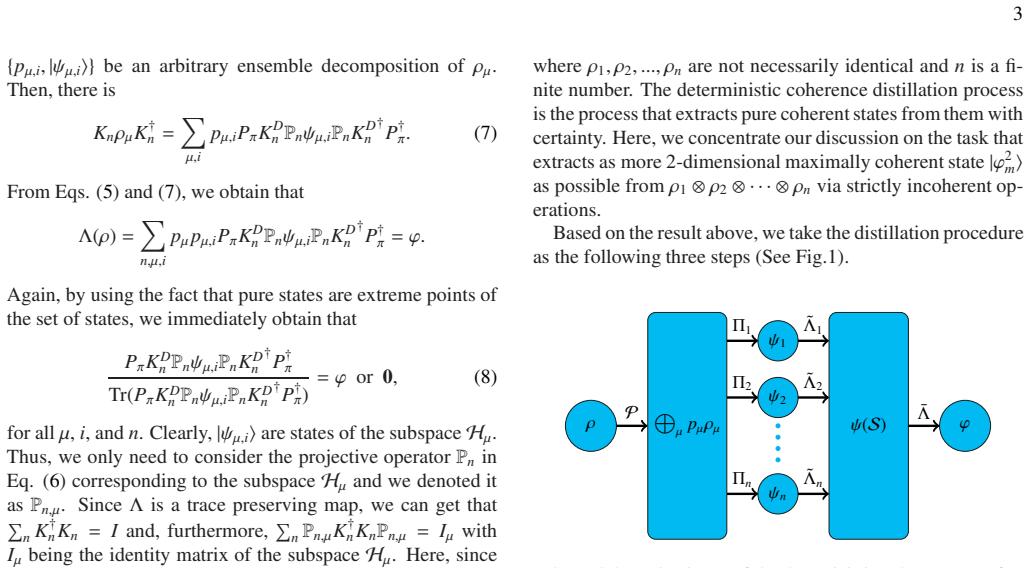
Summary. The manuscript studies deterministic coherence distillation under strictly incoherent operations (SIO) for a finite number of coherent states. It states Theorem 1, a necessary and sufficient condition for converting a mixed state rho into a pure coherent state phi via SIO: there must exist an orthogonal and complete set of incoherent projectors {P_alpha} such that each normalized projected state psi_alpha is pure coherent and Delta psi_alpha is majorized by Delta phi, equivalently the majorization join satisfies \vee S \prec Delta phi. It then proposes a three-step distillation scheme: block-diagonalize rho, construct projectors from maximally dimensional all-ones principal submatrices of A = (Delta rho)^{-1/2} |rho| (Delta rho)^{-1/2}, compute the least upper bound Delta psi of the dephased projected states, and distill floor(log_2 ||psi||_infty^{-1}) maximally coherent qubits. The paper also gives a corollary about conversion to some pure coherent state, compares with bound coherence, and notes that the pure-state case recovers the known result of Regula et al.
Significance. If the main theorem and the optimality claim are correct, the paper would complete the one-shot deterministic distillation problem under SIO and provide a simple, computable formula for the maximum number of distillable maximally coherent qubits. The connection to the majorization lattice is a useful structural insight, and the scheme is explicit and in principle implementable. The derivation of Eq. (14) from the majorization condition has no fitted parameters. However, the proof gaps described below affect the central iff statement and the claimed maximum, so the results are not yet established at the level of rigor required for publication.
major comments (3)
- [Theorem 1, only-if direction, Eqs. (6)-(9)] The proof produces, for each Kraus operator K_n and each irreducible block rho_mu, a projector P_{n,mu} and a pure state psi_{n,mu}, and then asserts that the condition in Eq. (1) follows. This is the point where a merging or orthogonalization step is missing. The supports of the projectors P_{n,mu} for different n need not be mutually orthogonal, because sum_n K_n^dagger K_n = I does not force the column supports of different K_n to be disjoint; pure-state SIO conversions can require several Kraus operators with overlapping column supports. No argument is given that the overlapping principal submatrices can be merged into a complete family of orthogonal projectors while preserving the purity of the normalized projections and the relation Delta psi_alpha \prec Delta phi. Until this step is supplied, the necessity direction of the central iff is incomplete. Separately, Eq. (9) states an equality of unnormalized projections, but Eq. (8) only gives proportionality after the filter K_n^D; the normalization should be included, e.g., P psi_i P / Tr(P psi_i P) = P psi_j P / Tr(P psi_j P).
- [Theorem 2 and distillation algorithm, Eqs. (10)-(14)] The formula N_max = floor(log_2 ||psi||_infty^{-1}) is computed from the specific set S_m obtained from the maximally dimensional all-ones principal submatrices of A_mu. The paper itself notes that the set {P_alpha} in Theorem 1 is not unique, but it does not prove that S_m is globally optimal among all admissible sets of projectors. Since Theorem 2 and the title claim the maximum distillable number, an upper-bound argument is required showing that no other orthogonal complete family admitted by Theorem 1 yields a strictly larger N. Without such an argument, Eq. (14) is only a lower bound on the distillable number, not the claimed maximum.
- [Corollary (if direction)] The proof of the 'if' part of the Corollary is incomplete. The displayed definition of |psi'_alpha> is not generally a two-level state despite the surrounding text, the assertion that S' is an ordered set is not justified, and the statement that the join \vee S' equals one of the Delta psi'_alpha and corresponds to a two-level state does not follow from the preceding inequalities. Since this corollary is used in the discussion relating the result to bound coherence, it should be proved carefully or its statement should be weakened/removed.
minor comments (4)
- [General] There are several typos, including 'Cond ensed' and 'Central of Excellence' in the author affiliation, 'The the dephasing map' in the resource-theory section, and the phrase 'the maximum number of 2-dimensional maximally coherent state that can distill' in the paragraph before Theorem 2.
- [Fig. 1 caption] The caption contains 'phiP', which appears to be a typo for 'phi'.
- [Eq. (2)] The use of the join \vee S should be clarified: the majorization lattice is defined up to permutation, so Eq. (2) should explicitly state that the relevant ordering is understood up to the equivalence used in the lattice definition.
- [Proof of Theorem 1, decomposition of K_n] The decomposition K_n = P_pi K_n^D P_n in Eq. (6) uses the symbol n both for the Kraus index and for the dimension of the diagonal matrix; this overloading is confusing and should be fixed.
Circularity Check
No circularity: the derived majorization condition and the Nmax formula are not re-statements of the inputs; the only self-citation is minor and not load-bearing.
full rationale
The derivation chain is self-contained. Theorem 1's if-direction invokes the independent pure-to-pure strictly-incoherent conversion criterion (Refs. [13,33,34]) and builds Lambda = direct sum Lambda_alpha; the only-if direction derives the projector condition from the assumed SIO map and the extremality of pure states, rather than assuming the target condition. Theorem 2's Nmax = floor(log_2 ||psi||_infty^{-1}) is obtained by applying majorization and the max-norm inequality to the join Delta(psi) of the constructed set S_m; Nmax is not a fitted parameter and no quantity is defined in terms of the target maximum. The lone self-citation (Ref. [24] for the A-matrix criterion 'all elements of A are 1 if and only if rho is a pure coherent state') is a parameter-free algebraic fact used to locate candidate projectors; it does not by itself force Theorem 1 or Theorem 2. Two genuine concerns exist, but they are correctness gaps rather than circularity: the only-if proof omits the orthogonality/merging argument for the projectors {P_{n,mu}}, and the paper does not prove that the chosen set S_m of maximally dimensional principal submatrices is globally optimal for Nmax. Neither gap makes the predictions equivalent to their inputs by construction.
Assumptions & free parameters
assumptions (3)
- domain assumption Pure-state SIO transformation criterion: |psi> -> |phi> via SIO iff Delta(psi) is majorized by Delta(phi).
- domain assumption Structural decomposition of SIO Kraus operators: each Kraus operator has at most one nonzero element per row and column, and can be written as P_pi K^D_n P_n.
- standard math Majorization lattice lemma (Cicalese-Vaccaro).
Cite this review
Pith. "Pith review of Deterministic Coherence Distillation." pith.science (2026). https://pith.science/paper/XPA2RCVR
@misc{pith2026190804914,
  author       = {Pith},
  title        = {Pith review of: Deterministic Coherence Distillation},
  year         = {2026},
  howpublished = {\url{https://pith.science/paper/XPA2RCVR}},
  note         = {Machine review of arXiv:1908.04914}
}
read the original abstract
Coherence distillation is one of the central problems in the resource theory of coherence. In this Letter, we complete the deterministic distillation of quantum coherence for a finite number of coherent states under strictly incoherent operations. Specifically, we find the necessary and sufficient condition for the transformation from a mixed coherent state into a pure state via strictly incoherent operations, which recovers a connection between the resource theory of coherence and the algebraic theory of majorization lattice. With the help of this condition, we present the deterministic coherence distillation scheme and derive the maximum number of maximally coherent states obtained via this scheme.
Figures
Reference graph
Works this paper leans on
-
[1]
M. A. Nielsen and I. L. Chuang, Quantum Computation and Quantum Information, Cambridge University Press, Cam- bridge, 2000
work page 2000
-
[2]
By substituting the expression in Eq
(11) 4 A useful property of A is that all the elements of A are 1 if and only if ρis a pure coherent state [24]. By substituting the expression in Eq. ( 10) into Eq. ( 11), we obtain that A = (∆ρ)− 1 2 |ρ|(∆ρ)− 1 2 = L⨁ µ=1 Aµ ⨁ 0, where Aµ= (∆ρµ)− 1 2 |ρµ|(∆ρµ)− 1 2 are also irreducible nonneg- ative matrices. Next, we should find out all the maximally di...
-
[3]
L. K. Grover, Phys. Rev. Lett. 79, 325 (1997)
1997
-
[4]
P . W. Shor,SIAM J. Comput. 26, 1484 (1997)
work page 1997
-
[5]
Giovannetti, S
V . Giovannetti, S. Lloyd, and L. Maccone, Science 306, 1330 (2004)
2004
-
[6]
C. H. Bennett and G. Brassard, in Proceedings of the IEEE In- ternational Conference on Computers, Systems and Signal Pro- cessing, Bangalore, India, 175 (1984)
work page 1984
-
[7]
N. Lambert, Y .-N. Chen, Y .-C. Cheng, C.-M. Li, G.-Y . Chen, and F. Nori, Nat. Phys. 9, 10 (2013)
work page 2013
-
[8]
Giovannetti, S
V . Giovannetti, S. Lloyd, and L. Maccone, Nat. Photonics 5, 222 (2011)
2011
Show all 42 references
-
[9]
Baumgratz, M
T. Baumgratz, M. Cramer, and M. B. Plenio, Phys. Rev. Lett. 113, 140401 (2014)
2014
- [10]
-
[11]
and was shown that it can neither create nor use coher- ence and has a physical interpretation in terms of interfero me- try in Ref. [12]. Thus, the strictly incoherent operations a re a physically well-motivated set of free operations for coher ence and a strong candidate for...
-
[12]
Levi and F
F. Levi and F. Mintert, New J. Phys. 16, 033007 (2014)
2014
-
[13]
Winter and D
A. Winter and D. Yang, Phys. Rev. Lett. 116, 120404 (2016)
2016
-
[14]
Yadin, J
B. Yadin, J. Ma, D. Girolami, M. Gu, and V . V edral,Phys. Rev. X 6, 041028 (2016)
2016
-
[15]
Chitambar and G
E. Chitambar and G. Gour, Phys. Rev. Lett. 117, 030401 (2016)
2016
-
[16]
Chitambar and G
E. Chitambar and G. Gour, Phys. Rev. A 94, 052336 (2016)
2016
-
[17]
J. I. de Vicente and A. Streltsov, J. Phys. A: Math. Theor . 50, 045301 (2017)
2017
-
[18]
Y u, D.-J
X.-D. Y u, D.-J. Zhang, G. F. Xu, and D. M. Tong, Phys. Rev. A 94, 060302(R) (2016)
2016
-
[19]
M.-L. Hu, X. Hu, J.-C. Wang, Y . Peng, Y .-R. Zhang, and H. Fan, Phys. Rep. 762-764, 1 (2018)
2018
-
[20]
Streltsov, G
A. Streltsov, G. Adesso, and M. B. Plenio, Rev. Mod. Phys. 89, 041003 (2017)
2017
-
[21]
F. G. S. L. Brand˜ao and G. Gour, Phys. Rev. Lett. 115, 070503 (2015)
2015
-
[22]
C. L. Liu, X.-D. Y u, and D. M. Tong, Phys. Rev. A 99, 042322 (2019)
2019
-
[23]
Y uan, H
X. Y uan, H. Zhou, Z. Cao, and X. Ma, Phys. Rev. A 92, 022124 (2015)
2015
-
[24]
K. Fang, X. Wang, L. Lami, B. Regula, and G. Adesso, Phys. Rev. Lett. 121, 070404 (2018)
2018
-
[25]
Q. Zhao, Y . Liu, X. Y uan, E. Chitambar, and A. Winter, arXiv: 1808.01885
-
[26]
C. L. Liu, Y . Q. Guo, and D. M. Tong, Phys. Rev. A 96, 062325 (2017)
2017
-
[27]
Chitambar, Phys
E. Chitambar, Phys. Rev. A 97, 050301(R) (2018)
2018
-
[28]
K. Bu, U. Singh, S.-M. Fei, A. K. Pati, and J. Wu, Phys. Rev. Lett. 119, 150405 (2017)
2017
- [29]
-
[30]
L. Lami, B. Regula, and G. Adesso, Phys. Rev. Lett. 122, 150402 (2019)
2019
-
[31]
Regula, L
B. Regula, L. Lami, and A. Streltsov, Phys. Rev. A 98, 052329 (2018)
2018
-
[32]
Regula, K
B. Regula, K. Fang, X. Wang, and G. Adesso, Phys. Rev. Lett. 121, 010401 (2018)
2018
-
[33]
Q. Zhao, Y . Liu, X. Y uan, E. Chitambar, and X. Ma, Phys. Rev. Lett. 120, 070403 (2018)
2018
-
[34]
Bhatia, Matrix Analysis, Springer-V erlag, New Y ork, 1997
R. Bhatia, Matrix Analysis, Springer-V erlag, New Y ork, 1997
1997
-
[35]
S. Du, Z. Bai and Y . Guo, Phys. Rev. A 91, 052120 (2015)
2015
-
[36]
H. Zhu, Z. Ma, Z. Cao, S. M. Fei, and V . V edral, Phys. Rev. A 96 032316 (2017)
2017
-
[37]
M. A. Nielsen, Phys. Rev. Lett. 83, 436 (1999)
1999
-
[38]
Cicalese and U
F. Cicalese and U. V accaro, IEEE Trans. Inf. Theory 48, 933 (2002)
2002
-
[39]
B. A. Davey and H. A. Prisetly, Introduction to Lattices and Order, Cambridge University Press, Cambridge, 1990
1990
-
[40]
Y u and O
X.-D. Y u and O. G¨ uhne,Phys. Rev. A 99, 062310 (2019)
2019
-
[41]
Morikoshi and M
F. Morikoshi and M. Koashi, Phys. Rev. A 64, 022316 (2001)
2001
-
[42]
Hayashi, M
M. Hayashi, M. Koashi, K. Matsumoto, F. Morikoshi, and A. Winter, J. Phys. A: Math. Theor . 36, 527(2003)
2003
Reviewed August 14, 2026 · model on record in the stance chip above.
Discussion (0). Continue with ORCID to comment.