REVIEW 3 major objections 5 minor 52 references
Efficient Quantum-Mechanical Modeling of Nonradiative Charge Transfer Processes
T0 review · 3 major / 5 minor · reviewed 2026-08-01 · deepseek-v4-flash
Pith's one-line read For nonradiative multiphonon transitions with unequal curvatures, an equal-curvature surrogate that preserves the crossing point reproduces quantum-mechanical rates—including tunneling—at a small fraction of the cost.
desk verdict The crossing-preserving approximation is a genuinely new and useful tool for TCAD-scale NMP rates, but it has an undisclosed structural zero at ΔE = -E_f^R that lands right where the line-shape should peak. read the letter →
The pith
A machine-rendered reading of the paper's core claim, the machinery that carries it, and where it could break.
The reading
What carries the argument
The crossing-preserving approximation (CPA): a geometric mapping from an unequal-curvature two-parabola system to an effective equal-curvature system, with the effective displacement ΔQeff and effective relaxation energy EReff determined by requiring the dominant crossing point (ΔQX, ΔEX) to stay fixed; a separate branch (Eq. 42) regularizes the singular limit where the crossing sits at the initial minimum. On the mapped model, the continuum limit of the vibronic spectrum converts the line-shape into a closed-form expression involving a modified Bessel function of order |p|, where p is the energy offset in units of the effective phonon energy. This replaces a costly double sum over vibration
What would settle it
Compute the full multidimensional quantum NMP capture coefficient for a specific defect using its complete DFT-derived phonon spectrum and compare it with the CPA's one-dimensional result over a range of temperatures; a disagreement larger than about one order of magnitude for any defect class would falsify the scalar-coordinate reduction on which the approximation rests.
Extended reading notes
Core claim
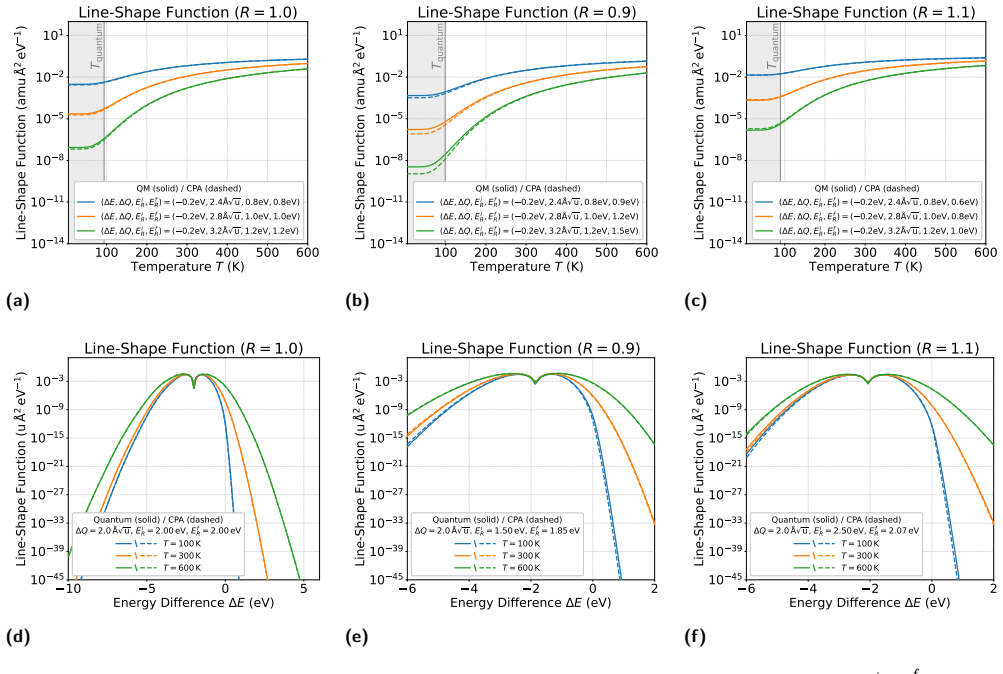
The central claim is that for the widely encountered near-equal-curvature case, mapping an unequal-curvature NMP system onto an effective equal-curvature model—while preserving the dominant diabatic crossing point (ΔQX, ΔEX)—yields a fully analytic line-shape function that closely tracks the exact quantum result. The effective displacement and relaxation energy are fixed by Eqs. (40)–(42), and with the continuum approximation for the vibronic spectrum the transition rate becomes a closed-form modified Bessel function expression (Eq. 43). This crossing-preserving approximation (CPA) remains accurate for curvature ratios roughly 0.8 ≲ R ≲ 1.2, reproduces the low-temperature tunneling plateau w
Load-bearing premise
The load-bearing premise is the reduction to a single scalar configuration coordinate: all phonon modes not along the initial-to-final displacement direction are discarded and folded into one broadening parameter, and the paper relies on prior studies indicating this shifts total rates by less than one order of magnitude.
Editorial extensions
If this is right
- CPA makes quantum NMP capture and emission rates about two orders of magnitude faster than direct quantum-mechanical evaluation, with a Bessel-function lookup table reducing runtime further.
- The approximation remains accurate at cryogenic temperatures, reproducing the nuclear-tunneling plateau where the classical high-temperature approximation freezes out.
- Defect-to-band continuum rates reduce to single-point band-edge expressions, with a clamping rule that repairs the approximation when an interior maximum of the line shape dominates.
- The framework casts NMP rates into the same operational form as Shockley–Read–Hall theory, showing that SRH capture cross sections are phenomenological fits rather than microscopic predictions.
- Since the mapping preserves the crossing point, classical Arrhenius activation at high temperature and quantum tunneling at low temperature are described within one continuous analytic rate.
Reading between the lines
- If the CPA's accuracy holds broadly, it could make full quantum NMP rates a default choice in device reliability simulators, replacing classical rates everywhere except the high-temperature limit where they coincide.
- The crossing-preserving mapping suggests a natural generalization to multidimensional configuration spaces: one might preserve multiple dominant crossing points or saddle points, potentially capturing multi-mode effects while keeping analytic structure.
- The band-edge approximation's clamping to an interior maximum could be recast as a saddle-point evaluation when the line-shape is known analytically, offering a principled way to handle strongly exothermic or endothermic transitions.
- A direct test of the scalar-coordinate assumption would be to compare CPA rates with path-integral or full phonon-spectrum calculations for a few representative defects, as the paper only cites prior one-dimensional validation.
Editorial analysis
A structured set of objections, weighed in public.
Referee Report
Summary. The paper develops a hierarchy of nonradiative multiphonon (NMP) rate expressions for defect charge capture/emission, starting from a two-state diabatic Hamiltonian and reducing the nuclear problem to one effective configuration coordinate. The central new contribution is the crossing-preserving approximation (CPA), which maps an unequal-curvature system onto an effective equal-curvature model by preserving the dominant diabatic crossing point, and then evaluates the equal-curvature line-shape in the continuum vibronic limit to obtain the closed-form Bessel expression, Eq. (43). The paper also extends the formalism to transitions between a localized defect and electronic band continua, derives a band-edge approximation with a clamping procedure for the interior-maximum regime, compares with SRH theory, and demonstrates the framework in BTI device simulations. The authors claim that the CPA closely reproduces the full quantum-mechanical line-shape over a broad parameter range, including the tunneling-dominated low-temperature regime, at orders-of-magnitude lower cost than direct quantum evaluation.
Significance. If correct, the CPA would make quantum-mechanical NMP rates practically usable in large-scale TCAD simulations, an important step given the widespread use of classical or purely empirical rate models in reliability modeling. The manuscript is unusually transparent: the derivations are step-by-step, the assumptions and validity regimes are explicitly discussed, the continuum extension is carefully built up, and the BTI simulations provide a concrete end-to-end demonstration. The closed-form expression after the mapping is parameter-free, and the comparison set spans many temperatures, energies, and curvature ratios. However, the validation claim is weakened by a structural zero in Eq. (43) at the barrierless crossing, and by the fact that the 'exact' reference itself depends on the phenomenological Gaussian broadening sigma. These issues do not invalidate the overall derivation but do require a correction or a substantial caveat before the central claim can be accepted as stated.
major comments (3)
- [§3.2, Eq. (43); SI-4 Eq. (193)] The CPA line-shape contains the prefactor ΔQ_X^2. For any original system with ΔE = -E_f^R, the dominant crossing point coincides with the initial minimum (V_f(0)=0), so Eq. (21) gives ΔQ_X = 0. Equation (43) then returns exactly zero at this energy offset. The broadened quantum-mechanical reference (Eq. (33)) is not zero at the same ΔE: off-resonant vibronic transitions contribute through the Gaussian tails, with weights O(0.1–0.6) of the on-peak weight for σ in the quoted range 0.5–2.0 ℏΩ_i. SI-5 shows that the exact line-shape maximum lies near ΔE ≈ -E_f^R, so this forced zero occurs at the largest rates, not in a negligible tail. The stated validity range R ∈ [0.8, 1.2] does not remove the problem; it is a failure of the continuum prefactor, not of the curvature mapping. This directly undermines the 'closely reproduces' claim and needs regularization, e.g. by retaining the transition
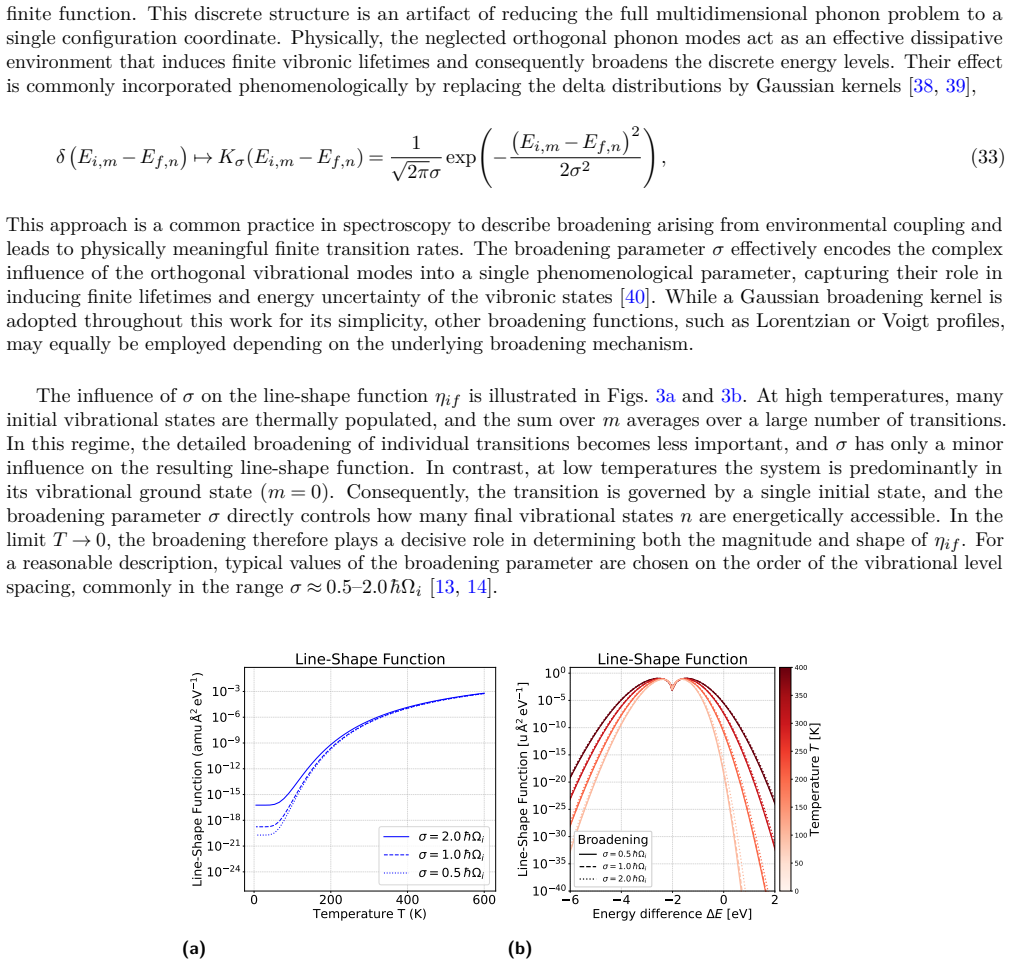
- [§3, Eq. (33), Fig. 3; §3.2 low-temperature discussion] The numerical 'exact' quantum-mechanical benchmark is not unique because it depends on the phenomenological broadening parameter σ, while the CPA line-shape Eq. (43) is independent of σ. The paper acknowledges that the largest CPA deviations occur at low temperature and depend on the chosen σ, but it does not quantify this sensitivity. Since the central claim explicitly includes the tunneling-dominated low-temperature regime, the validation should either fix a physically motivated default σ and report the CPA error as a function of σ over the stated range 0.5–2.0 ℏΩ_i, or state clearly that the agreement is conditional on an uncalibrated broadening parameter. As written, the comparison is a test of how well a σ-independent envelope reproduces a σ-dependent broadened comb, and the strength of the claim is correspondingly limited.
- [§2, effective configuration-coordinate reduction] The authors appropriately state that the straight-line scalar path is generally not the true minimum-energy path and that orthogonal phonon modes may individually contribute comparably to the effective mode, citing prior work that bounds the total effect at less than one order of magnitude. This is an explicit scope limitation, but it should be made more prominent in the abstract and conclusions because every subsequent rate — QM, CPA, and classical — is a rate of the reduced one-dimensional model, not of the full multidimensional PES. The paper should clearly separate the two claims: 'CPA reproduces the 1D QM result' and 'the 1D QM result reproduces the physical rate.' The latter is not established here and rests on the cited external bound.
minor comments (5)
- [§3.2, after Eq. (32)] Typo: 'and and∆Svib' should read 'and ∆Svib'.
- [SI-6, derivation of rates] Duplicate sentence: 'The probability of finding the electronic subsystem in the final state|ϕf⟩ at time t is The probability of finding the electronic subsystem in the final charge state|ϕf⟩ at time t is obtained...' Remove the first repetition.
- [Fig. 10 caption] The abbreviation 'CPAI' is used without definition; please spell out the interpolation-based CPA variant.
- [Fig. 9 and Fig. 15 captions] Units appear inconsistently as 'Å u' and '√uÅ'; standardize the notation for the configuration-coordinate units.
- [References] Reference [15] should be 'Shi et al.' rather than 'Shiet al.'; other author formatting is otherwise consistent.
Circularity Check
No significant circularity: CPA is a geometric crossing-preserving map plus a standard Bessel envelope, benchmarked against independent Franck–Condon sums; minor self-citations are not load-bearing.
full rationale
The derivation is not circular. The CPA effective parameters are set by a geometric crossing-preserving map: ΔQX and ΔEX are computed from the original PES parameters via Eq. (21), and Eqs. (40)–(42) invert the equal-curvature crossing conditions to fix ΔQeff and Eeff_R. These equations never involve the predicted line-shape or a fitted rate. Eq. (43) is then the standard equal-curvature continuum envelope (Bessel expression, after Stoneham [12]) evaluated with these mapped parameters; the validation in Figs. 9 and 16 compares this expression against numerically exact Franck–Condon sums computed from the same 1D model, which is an independent benchmark. The only input set by hand in the benchmark is the phenomenological broadening σ in Eq. (33), chosen a priori in the range σ≈0.5–2 ℏΩi [13,14]; this affects the exact reference but is not tuned to the CPA, and the paper explicitly notes the low-temperature sensitivity to σ. Self-citations appear (e.g., [30] for the ≤1 order-of-magnitude effect of orthogonal phonons, [31,32] for cryogenic breakdown), but the 1D reduction is also supported by external first-principles studies [13,15], and these citations do not supply the central result. The uniqueness of the CPA mapping is an elementary algebraic inversion, not an imported theorem from the authors’ prior work. A real but non-circular limitation is that the CPA line-shape (Eq. 43) carries the prefactor ΔQX^2, which vanishes exactly at ΔE = −Ef_R where the broadened QM rate is nonzero; this structural zero near the line-shape maximum is an accuracy issue the paper does not explicitly flag, not a reduction of the prediction to its inputs. Overall, no load-bearing step reduces by construction or by self-citation.
Assumptions & free parameters
free parameters (1)
- Gaussian vibronic broadening sigma =
0.5-2.0 hbar*Omega_i (chosen per defect)
assumptions (9)
- standard math Thermally averaged Fermi golden rule for the reduced electronic dynamics
- domain assumption Diabatic potential-energy surfaces are harmonic (quadratic Taylor expansion)
- domain assumption Static/diabatic basis with linear off-diagonal electron-phonon coupling
- domain assumption Effective one-dimensional configuration-coordinate reduction; orthogonal phonon modes are neglected
- domain assumption Vibrational subsystem is thermally equilibrated within each charge state
- domain assumption Delta functions replaced by Gaussian broadening with phenomenological sigma
- domain assumption CPA validity requires moderate curvature mismatch and a dense vibronic spectrum
- domain assumption Deep localized defect approximation for band-continuum coupling
- domain assumption Band-edge expansion is dominated by states near E0, repaired by clamping to E*
Cite this review
Pith. "Pith review of Efficient Quantum-Mechanical Modeling of Nonradiative Charge Transfer Processes." pith.science (2026). https://pith.science/paper/XPCFS2SI
@misc{pith2026260717730,
  author       = {Pith},
  title        = {Pith review of: Efficient Quantum-Mechanical Modeling of Nonradiative Charge Transfer Processes},
  year         = {2026},
  howpublished = {\url{https://pith.science/paper/XPCFS2SI}},
  note         = {Machine review of arXiv:2607.17730}
}
read the original abstract
Nonradiative charge transfer processes play a central role in a wide range of physical phenomena, including reliability phenomena in semiconductor devices such as bias temperature instability, hysteresis, random telegraph noise, and trap-assisted tunneling. nonradiative multiphonon (NMP) theory provides a physically rigorous framework for describing such charge transitions, but its full quantum-mechanical formulation is computationally too demanding for large-scale simulations. In this work, we present a systematic and implementation-oriented treatment of NMP-based models for practical large-scale simulations. Starting from the quantum-mechanical foundations of coupled electron--phonon dynamics, we derive computationally efficient approximations for charge capture and emission rates and clearly identify the underlying assumptions and validity regimes. In particular, we introduce an effective crossing-preserving approximation that yields fully analytic, numerically stable, and computationally inexpensive transition rates while retaining the essential quantum-mechanical physics. The resulting expressions are therefore well suited for large-scale device simulations, where capture coefficients must be evaluated repeatedly over broad multidimensional parameter spaces. Furthermore, we derive continuum formulations for transitions between localized defect states and extended electronic bands, enabling direct incorporation into semiconductor-device simulations. The resulting framework bridges microscopic defect physics and practical large-scale simulations of charge transfer processes in complex semiconductor devices. At the same time this work serves as a practical guide for implementing physically grounded NMP-based models, providing both a systematic derivation of the underlying theory and a clear guidance on the validity limits.
Figures


Figures from the paper (14 more)




Reference graph
Works this paper leans on
-
[1]
Statistics of the Recombinations of Holes and Electrons
W. Shockley and W. T. Read. “Statistics of the Recombinations of Holes and Electrons”. In:Physical Review 87.5 (1952), pp. 835–842.issn: 0031-899X.doi: 10.1103/physrev.87.835.url: http://dx.doi.org/10. 1103/PhysRev.87.835
-
[2]
Electron-Hole Recombination in Germanium
R. N. Hall. “Electron-Hole Recombination in Germanium”. In:Physical Review87.2 (1952), pp. 387–387.issn: 0031-899X.doi:10.1103/physrev.87.387.url:http://dx.doi.org/10.1103/PhysRev.87.387
work page doi:10.1103/physrev.87.387.url:http://dx.doi.org/10.1103/physrev.87.387 1952
-
[3]
S.M. Sze and Kwok K. Ng.Physics of Semiconductor Devices. Wiley, Apr. 2006.isbn: 9780470068328.doi: 10.1002/0470068329.url:http://dx.doi.org/10.1002/0470068329
work page doi:10.1002/0470068329.url:http://dx.doi.org/10.1002/0470068329 2006
-
[4]
Global TCAD Solutions, GmbH
Global TCAD Solutions, GmbH.GTS Minimos-NT User Manual, Release 2025.09. Global TCAD Solutions, GmbH. Vienna, Austria, 2025
2025
-
[5]
Synopsys, Inc
Synopsys, Inc.Sentaurus Device User Guide, Version T-2024.09. Synopsys, Inc. Mountain View, CA, USA, 2024
2024
-
[6]
M.J. Kirton and M.J. Uren. “Noise in solid-state microstructures: A new perspective on individual defects, interface states and Low-Frequency (1/f) Noise”. In:Advances in Physics38.4 (Jan. 1989), pp. 367–468.issn: 1460-6976.doi:10.1080/00018738900101122.url:http://dx.doi.org/10.1080/00018738900101122
work page doi:10.1080/00018738900101122.url:http://dx.doi.org/10.1080/00018738900101122 1989
-
[7]
Interface-state capture cross section—Why does it vary so much?
J. T. Ryan et al. “Interface-state capture cross section—Why does it vary so much?” In:Applied Physics Letters106.16 (Apr. 2015).issn: 1077-3118.doi: 10.1063/1.4919100.url: http://dx.doi.org/10.1063/1. 4919100
-
[8]
Applicability of Shockley–Read–Hall Theory for Interface States
Bernhard Ruch et al. “Applicability of Shockley–Read–Hall Theory for Interface States”. In:IEEE Transactions on Electron Devices68.4 (Apr. 2021), pp. 2092–2097.issn: 1557-9646.doi: 10.1109/ted.2021.3049760.url: http://dx.doi.org/10.1109/TED.2021.3049760
arXiv 2021
Show all 52 references
-
[9]
Theory of Light Absorption and Non-Radiative Transitions inF-Centres
Kun Huang and Avril Rhys. “Theory of Light Absorption and Non-Radiative Transitions inF-Centres”. In: Proceedings of the Royal Society of London. Series A. Mathematical and Physical Sciences204.1078 (Dec. 1950), pp. 406–423.issn: 2053-9169.doi: 10.1098/rspa.1950.0184.url: http...
1950
-
[10]
Application of the Method of Generating Function to Radiative and Non- Radiative Transitions of a Trapped Electron in a Crystal
Ryogo Kubo and Yutaka Toyozawa. “Application of the Method of Generating Function to Radiative and Non- Radiative Transitions of a Trapped Electron in a Crystal”. In:Progress of Theoretical Physics13.2 (Feb. 1955), pp. 160–182.issn: 0033-068X.doi:10.1143/ptp.13.160.url:http://...
1955 doi
-
[11]
Multiphonon Processes in the Nonradiative Decay of Large Molecules
Karl F. Freed and Joshua Jortner. “Multiphonon Processes in the Nonradiative Decay of Large Molecules”. In:The Journal of Chemical Physics52.12 (1970), pp. 6272–6291.issn: 1089-7690.doi: 10.1063/1.1672938. url:http://dx.doi.org/10.1063/1.1672938
1970 doi
-
[12]
Non-radiative transitions in semiconductors
A M Stoneham. “Non-radiative transitions in semiconductors”. In:Reports on Progress in Physics44.12 (Dec. 1981), pp. 1251–1295.issn: 1361-6633.doi: 10.1088/0034-4885/44/12/001.url: http://dx.doi.org/10. 1088/0034-4885/44/12/001
1981 doi
-
[13]
First-principles theory of nonradiative carrier capture via multiphonon emission
Audrius Alkauskas, Qimin Yan, and Chris G. Van de Walle. “First-principles theory of nonradiative carrier capture via multiphonon emission”. In:Physical Review B90.7 (Aug. 2014).issn: 1550-235X.doi: 10.1103/ physrevb.90.075202.url:http://dx.doi.org/10.1103/PhysRevB.90.075202
2014 doi
-
[14]
Nonrad: Computing nonradiative capture coefficients from first principles
Mark E. Turiansky et al. “Nonrad: Computing nonradiative capture coefficients from first principles”. In: Computer Physics Communications267 (Oct. 2021), p. 108056.issn: 0010-4655.doi: 10.1016/j.cpc.2021. 108056.url:http://dx.doi.org/10.1016/j.cpc.2021.108056
2021
-
[15]
Comparative study of ab initio nonradiative recombination rate calculations under different formalisms
Lin Shi, Ke Xu, and Lin-Wang Wang. “Comparative study of ab initio nonradiative recombination rate calculations under different formalisms”. In:Physical Review B91.20 (May 2015).issn: 1550-235X.doi: 10.1103/physrevb.91.205315.url:http://dx.doi.org/10.1103/PhysRevB.91.205315
2015 doi
-
[16]
A Charge-Trapping Model for the Fast Component of Positive Bias Temperature Instability (PBTI) in High-κ Gate-Stacks
Luca Vandelli et al. “A Charge-Trapping Model for the Fast Component of Positive Bias Temperature Instability (PBTI) in High-κ Gate-Stacks”. In:IEEE Transactions on Electron Devices61.7 (2014), pp. 2287–2293.issn: 1557-9646.doi:10.1109/ted.2014.2323085.url:http://dx.doi.org/10...
2014
-
[17]
Comphy — A compact-physics framework for unified modeling of BTI
G. Rzepa et al. “Comphy — A compact-physics framework for unified modeling of BTI”. In:Microelectronics Reliability85 (2018), pp. 49–65.issn: 0026-2714.doi: 10.1016/j.microrel.2018.04.002 .url: http: //dx.doi.org/10.1016/j.microrel.2018.04.002. 48/51
2018 doi
-
[18]
Extensive assessment of the charge-trapping kinetics inInGaAs MOS gate-stacks for the demonstration of improved BTI reliability
Vamsi Putcha et al. “Extensive assessment of the charge-trapping kinetics inInGaAs MOS gate-stacks for the demonstration of improved BTI reliability”. In:Microelectronics Reliability115 (Dec. 2020), p. 113996.issn: 0026-2714.doi: 10.1016/j.microrel.2020.113996.url: http://dx.d...
2020
-
[19]
Physical modeling of the hysteresis inMoS2 transistors
Theresia Knobloch et al. “Physical modeling of the hysteresis inMoS2 transistors”. In:2017 47th European Solid-State Device Research Conference (ESSDERC). IEEE, 2017, pp. 284–287.doi:10.1109/essderc.2017. 8066647.url:http://dx.doi.org/10.1109/essderc.2017.8066647
2017
-
[20]
A standardized approach to characterize hysteresis in 2D-materials-based transistors for stability benchmarking and performance projection
Alexander Karl et al. “A standardized approach to characterize hysteresis in 2D-materials-based transistors for stability benchmarking and performance projection”. In:Nature Communications17.1 (Nov. 2025).issn: 2041-1723.doi:10.1038/s41467-025-66210-z.url:http://dx.doi.org/10....
2025 doi
-
[21]
Mapping diverse hysteresis dynamics in scaledMoS2 FETs using the universal method derived from TCAD modeling
Y. Z. Lv et al. “Mapping diverse hysteresis dynamics in scaledMoS2 FETs using the universal method derived from TCAD modeling”. In:npj 2D Materials and Applications10.1 (Feb. 2026).issn: 2397-7132.doi: 10.1038/s41699-026-00671-8.url:http://dx.doi.org/10.1038/s41699-026-00671-8
2026 doi
-
[22]
Stochastic charge trapping in oxides: From random telegraph noise to bias temperature instabilities
Tibor Grasser. “Stochastic charge trapping in oxides: From random telegraph noise to bias temperature instabilities”. In:Microelectronics Reliability52.1 (Jan. 2012), pp. 39–70.issn: 0026-2714.doi: 10.1016/j. microrel.2011.09.002.url:http://dx.doi.org/10.1016/j.microrel.2011.09.002
2012 doi
-
[23]
Deepunderstandingofrandomtelegraphnoise(RTN)effectsonSRAMstability
DongyuanMaoetal.“Deepunderstandingofrandomtelegraphnoise(RTN)effectsonSRAMstability”.In:2016 International Symposium on VLSI Technology, Systems and Application (VLSI-TSA). IEEE, Apr. 2016, pp. 1–2. doi:10.1109/vlsi-tsa.2016.7480513.url:http://dx.doi.org/10.1109/VLSI-TSA.2016.7480513
2016
-
[24]
Anomalous random telegraph noise in nanoscale transistors as direct evidence of two metastable states of oxide traps
Shaofeng Guo et al. “Anomalous random telegraph noise in nanoscale transistors as direct evidence of two metastable states of oxide traps”. In:Scientific Reports7.1 (2017).issn: 2045-2322.doi: 10.1038/s41598- 017-06467-7.url:http://dx.doi.org/10.1038/s41598-017-06467-7
2017 doi
-
[25]
Statistical simulation of leakage currents in mos and flash memory devices with a new multiphonon trap-assisted tunneling model
L. Larcher. “Statistical simulation of leakage currents in mos and flash memory devices with a new multiphonon trap-assisted tunneling model”. In:IEEE Transactions on Electron Devices50.5 (May 2003), pp. 1246–1253. issn: 0018-9383.doi:10.1109/ted.2003.813236.url:http://dx.doi....
2003
-
[26]
Three-Dimensional Mechanistic Modeling of Gate Leakage Current in High-κ> MOSFETs
Feilong Liu et al. “Three-Dimensional Mechanistic Modeling of Gate Leakage Current in High-κ> MOSFETs”. In:Physical Review Applied13.2 (Feb. 2020).issn: 2331-7019.doi: 10.1103/physrevapplied.13.024020. url:http://dx.doi.org/10.1103/PhysRevApplied.13.024020
2020 doi
-
[27]
Comphy v3.0—A compact-physics framework for modeling charge trapping related reliability phenomena in MOS devices
Dominic Waldhoer et al. “Comphy v3.0—A compact-physics framework for modeling charge trapping related reliability phenomena in MOS devices”. In:Microelectronics Reliability146 (2023), p. 115004.issn: 0026-2714. doi:10.1016/j.microrel.2023.115004.url:http://dx.doi.org/10.1016/j...
2023
-
[28]
Identification of oxide defects in semiconductor devices: A systematic approach linking DFT to rate equations and experimental evidence
W. Goes et al. “Identification of oxide defects in semiconductor devices: A systematic approach linking DFT to rate equations and experimental evidence”. In:Microelectronics Reliability87 (Aug. 2018), pp. 286–320. issn: 0026-2714.doi: 10.1016/j.microrel.2017.12.021.url: http:/...
2018 doi
-
[29]
Toward Automated Defect Extraction From Bias Temperature Instability Measure- ments
Dominic Waldhoer et al. “Toward Automated Defect Extraction From Bias Temperature Instability Measure- ments”. In:IEEE Transactions on Electron Devices68.8 (Aug. 2021), pp. 4057–4063.issn: 1557-9646.doi: 10.1109/ted.2021.3091966.url:http://dx.doi.org/10.1109/TED.2021.3091966
2021
-
[30]
Multiscale Modeling of Defect-Related Reliability Phenomena in Nanoelectronics
Dominic Waldhör. “Multiscale Modeling of Defect-Related Reliability Phenomena in Nanoelectronics”. en. PhD thesis. 2024.doi: 10.34726/HSS.2024.126322.url: https://repositum.tuwien.at/handle/20.500. 12708/211246
2024
-
[31]
Efficient Modeling of Charge Trapping at Cryogenic Temperatures—Part I: Theory
Jakob Michl et al. “Efficient Modeling of Charge Trapping at Cryogenic Temperatures—Part I: Theory”. In: IEEE Transactions on Electron Devices68.12 (Dec. 2021), pp. 6365–6371.issn: 1557-9646.doi:10.1109/ted. 2021.3116931.url:http://dx.doi.org/10.1109/TED.2021.3116931
2021
-
[32]
Efficient Modeling of Charge Trapping at Cryogenic Temperatures—Part II: Experimental
Jakob Michl et al. “Efficient Modeling of Charge Trapping at Cryogenic Temperatures—Part II: Experimental”. In:IEEE Transactions on Electron Devices68.12 (Dec. 2021), pp. 6372–6378.issn: 1557-9646.doi:10.1109/ ted.2021.3117740.url:http://dx.doi.org/10.1109/TED.2021.3117740
2021
-
[33]
Minimum Energy Paths for Non-Adiabatic Charge Transitions in Oxide Defects
D. Waldhoer et al. “Minimum Energy Paths for Non-Adiabatic Charge Transitions in Oxide Defects”. In: 2019 IEEE International Integrated Reliability Workshop (IIRW). IEEE, Oct. 2019, pp. 1–5.doi:10.1109/ iirw47491.2019.8989889.url:http://dx.doi.org/10.1109/IIRW47491.2019.8989889. 49/51
2019
-
[34]
Intrinsic phonon relaxation times from first-principles studies of the thermal conductivities of Si and Ge
A. Ward and D. A. Broido. “Intrinsic phonon relaxation times from first-principles studies of the thermal conductivities of Si and Ge”. In:Physical Review B81.8 (Feb. 2010).issn: 1550-235X.doi:10.1103/physrevb. 81.085205.url:http://dx.doi.org/10.1103/PhysRevB.81.085205
2010 doi
-
[35]
Non-equilibrium longitudinal optical phonons and their lifetimes
David K. Ferry. “Non-equilibrium longitudinal optical phonons and their lifetimes”. In:Applied Physics Reviews 8.2 (2021).issn: 1931-9401.doi:10.1063/5.0044374.url:http://dx.doi.org/10.1063/5.0044374
2021 doi
-
[36]
Validating first-principles phonon lifetimes via inelastic neutron scattering
Enda Xiao et al. “Validating first-principles phonon lifetimes via inelastic neutron scattering”. In:Physical Review B106.14 (Oct. 2022).issn: 2469-9969.doi: 10.1103/physrevb.106.144310.url: http://dx.doi. org/10.1103/PhysRevB.106.144310
2022 doi
-
[37]
Laplace-transform deep-level spectroscopy: The technique and its applications to the study of point defects in semiconductors
L. Dobaczewski, A. R. Peaker, and K. Bonde Nielsen. “Laplace-transform deep-level spectroscopy: The technique and its applications to the study of point defects in semiconductors”. In:Journal of Applied Physics 96.9 (Nov. 2004), pp. 4689–4728.issn: 1089-7550.doi: 10.1063/1.179...
2004 doi
-
[38]
Wiley, Feb
Volkhard May and Oliver Kühn.Charge and Energy Transfer Dynamics in Molecular Systems. Wiley, Feb. 2011. isbn: 9783527633791.doi:10.1002/9783527633791.url:http://dx.doi.org/10.1002/9783527633791
2011 doi
-
[39]
The temperature dependence of vibronic lineshapes: Linear electron-phonon coupling
Claudia Roos et al. “The temperature dependence of vibronic lineshapes: Linear electron-phonon coupling”. In:The Journal of Chemical Physics141.15 (Oct. 2014).issn: 1089-7690.doi: 10.1063/1.4898081.url: http://dx.doi.org/10.1063/1.4898081
2014 doi
-
[40]
From the Fermi Golden Rule to Open Quantum Systems: Basic Concepts on Non-radiative Rates
Andrea Landi, D. K. Andrea Phan Huu, and Anna Painelli. “From the Fermi Golden Rule to Open Quantum Systems: Basic Concepts on Non-radiative Rates”. In:The Journal of Physical Chemistry C128.43 (Oct. 2024), pp. 18598–18611.issn: 1932-7455.doi: 10.1021/acs.jpcc.4c05567.url: htt...
2024 doi
-
[41]
An analytic formula of one-dimensional Franck-Condon factors for linear harmonic oscillators
Kuo-mei Chen and Cheng-chih Pei. “An analytic formula of one-dimensional Franck-Condon factors for linear harmonic oscillators”. In:Journal of Molecular Spectroscopy140.2 (Apr. 1990), pp. 401–406.issn: 0022-2852. doi:10.1016/0022-2852(90)90150-o.url:http://dx.doi.org/10.1016/0...
1990 doi
-
[42]
Analytic and Algebraic Evaluation of Franck-Condon Overlap Integrals
F. Iachello and M. Ibrahim. “Analytic and Algebraic Evaluation of Franck-Condon Overlap Integrals”. In:The Journal of Physical Chemistry A102.47 (1998), pp. 9427–9432.issn: 1520-5215.doi: 10.1021/jp981911m. url:http://dx.doi.org/10.1021/jp981911m
1998 doi
-
[43]
Exact evaluation and recursion relations of two-center harmonic oscillator matrix elements
P. J. Drallos and J. M. Wadehra. “Exact evaluation and recursion relations of two-center harmonic oscillator matrix elements”. In:The Journal of Chemical Physics85.11 (Dec. 1986), pp. 6524–6529.issn: 1089-7690. doi:10.1063/1.451433.url:http://dx.doi.org/10.1063/1.451433
1986 doi
-
[44]
Computationally efficient recurrence relations for one-dimensional Franck–Condon overlap inte- grals
P.P. Schmidt. “Computationally efficient recurrence relations for one-dimensional Franck–Condon overlap inte- grals”. In:Molecular Physics108.11 (2010), pp. 1513–1529.issn: 1362-3028.doi:10.1080/00268971003762142. url:http://dx.doi.org/10.1080/00268971003762142
2010 doi
-
[45]
The Franck-Condon Principle and Its Application to Crystals
Melvin Lax. “The Franck-Condon Principle and Its Application to Crystals”. In:The Journal of Chemical Physics20.11 (Nov. 1952), pp. 1752–1760.issn: 1089-7690.doi: 10.1063/1.1700283.url: http://dx.doi. org/10.1063/1.1700283
1952 doi
-
[46]
Advanced Modeling of Oxide Defects
Wolfgang Goes, Franz Schanovsky, and Tibor Grasser. “Advanced Modeling of Oxide Defects”. In:Bias Temperature Instability for Devices and Circuits. Springer New York, 2013, pp. 409–446.isbn: 9781461479093. doi:10.1007/978-1-4614-7909-3_16.url:http://dx.doi.org/10.1007/978-1-46...
2013 doi
-
[47]
Quantum Chemistry Treatment of Silicon-Hydrogen Bond Rupture by Nonequilibrium Carriers in Semiconductor Devices
Markus Jech et al. “Quantum Chemistry Treatment of Silicon-Hydrogen Bond Rupture by Nonequilibrium Carriers in Semiconductor Devices”. In:Physical Review Applied16.1 (2021).issn: 2331-7019.doi: 10.1103/ physrevapplied.16.014026.url:http://dx.doi.org/10.1103/PhysRevApplied.16.014026
2021 doi
-
[48]
First-principles calculations for point defects in solids
Christoph Freysoldt et al. “First-principles calculations for point defects in solids”. In:Reviews of Modern Physics86.1 (Mar. 2014), pp. 253–305.issn: 1539-0756.doi: 10.1103/revmodphys.86.253 .url: http: //dx.doi.org/10.1103/RevModPhys.86.253
2014 doi
-
[49]
doi:10.1002/0471749095.url:http://dx.doi.org/10.1002/0471749095
DieterK.Schroder.Semiconductor Material and Device Characterization.Wiley,Apr.2005.isbn:9780471749097. doi:10.1002/0471749095.url:http://dx.doi.org/10.1002/0471749095
2005 doi
-
[50]
Oxford University PressOxford, Jan
Heinz-Peter Breuer and Francesco Petruccione.The Theory of Open Quantum Systems. Oxford University PressOxford, Jan. 2007.isbn: 9780191706349.doi: 10.1093/acprof:oso/9780199213900.001.0001 .url: http://dx.doi.org/10.1093/acprof:oso/9780199213900.001.0001. 50/51
2007
-
[51]
Springer Berlin Heidelberg, 1993.isbn: 9783540788621.doi: 10.1007/978-3-540-78862-1.url: http://dx.doi.org/10.1007/978-3- 540-78862-1
Ernst Hairer and Gerhard Wanner.Solving Ordinary Differential Equations I. Springer Berlin Heidelberg, 1993.isbn: 9783540788621.doi: 10.1007/978-3-540-78862-1.url: http://dx.doi.org/10.1007/978-3- 540-78862-1
1993 doi
-
[52]
Springer Berlin Heidelberg, 1996.isbn: 9783642052217.doi: 10.1007/978-3-642-05221-7.url: http://dx.doi.org/10.1007/978-3- 642-05221-7
Ernst Hairer and Gerhard Wanner.Solving Ordinary Differential Equations II. Springer Berlin Heidelberg, 1996.isbn: 9783642052217.doi: 10.1007/978-3-642-05221-7.url: http://dx.doi.org/10.1007/978-3- 642-05221-7. 51/51
1996 doi
Reviewed August 1, 2026 · model on record in the stance chip above.
Discussion (0). Continue with ORCID to comment.