REVIEW 3 major objections 4 minor 71 references
Forces on alkali Rydberg atoms due to non-linearly polarized light
T0 review · 3 major / 4 minor · reviewed 2026-08-16 · deepseek-v4-flash
Pith's one-line read Elliptically polarized far off-resonant light induces a vector polarizability in alkali Rydberg atoms that can dominate and reverse the sign of the total polarizability, turning the normally repulsive laser force into an attractive trap.
desk verdict A plausible and well-executed proposal for Rydberg trapping via vector polarizability, but the dynamic alpha_V and loss claims need external validation before the mechanism is trusted. read the letter →
The pith
A machine-rendered reading of the paper's core claim, the machinery that carries it, and where it could break.
The reading
What carries the argument
The load-bearing object is the dynamic vector polarizability $\alpha_V(\omega)$, the rank-1 component of the AC Stark shift that appears only for non-linearly polarized light and enters the light shift multiplied by $f_V = A\cos\theta_k\, M_J/(2J)$. The authors compute $\alpha_S$, $\alpha_V$, and $\alpha_T$ by a sum-over-states method using quantum-defect energies and Coulomb-approximation Whittaker-function radial wavefunctions for the Rydberg electron, with core contributions from relativistic many-body perturbation theory. The vector polarizability is what the proposal hinges on: because it scales as $\omega^{-1}$ rather than $\omega^{-2}$, and because its geometric prefactor can be tuned between $-1$ and $1$, it can dominate and reverse the total polarizability for high-$n$ states. The repulsive ponderomotive potential, computed from the same Rydberg wavefunction via first-order perturbation theory, is the competing term that the Stark shift must overcome.
What would settle it
Measure the total AC Stark shift of, for example, the $60S_{1/2},m=+1/2$ or $60D_{3/2},m=-3/2$ rubidium state at 1000 nm in elliptically polarized light as the geometric factor $A\cos\theta_k$ is varied; if the shift does not move from negative to positive at $A\cos\theta_k=1$ for a state the paper identifies as trappable, or if an attempted red-detuned Gaussian trap with the paper's parameters fails to confine the Rydberg atom, the central claim is wrong.
Extended reading notes
Core claim
The central claim is that for alkali Rydberg atoms the dynamic vector polarizability $\alpha_V(\omega)$, normally negligible for ground states, becomes the dominant contribution to the AC Stark shift for the $nS$, $nP$, and $nD$ series once the principal quantum number $n$ is large enough (around 30 for the $D$ series and around 55 for the $S$ series in rubidium, with analogous behavior in cesium). The paper shows numerically that $\alpha_V(\omega)$ scales as $-V/\omega$ while the scalar and tensor parts scale as $-S/\omega^2$ and $-T/\omega^2$, so the vector part grows in relative importance over the experimentally accessible wavelengths from 500 to 2200 nm. With elliptically polarized light, the geometric factor $A\cos\theta_k$ multiplies $\alpha_V(\omega)$, allowing the total polarizability to be shifted upward or downward depending on the ellipticity $A$, the propagation direction, and the magnetic sublevel $M_J$. For sufficiently high $n$, this shift can reverse the sign of the total polarizability. The resulting attractive Stark shift can dominate the repulsive ponderomotive potential, producing a confining potential in a red-detuned Gaussian beam, and by tuning $A\cos\theta_k$ the potentials for the ground and Rydberg states can be made nearly equal over the Rydberg wavefunction, a magic-wavelength-like condition.
Load-bearing premise
The whole proposal rests on the calculated dynamic vector polarizability being accurate in size and sign for rubidium and cesium Rydberg states across 500 to 2200 nanometers, and the paper does not compare that specific quantity with any independent measurement.
Editorial extensions
If this is right
- Red-detuned Gaussian beams can confine rubidium and cesium Rydberg atoms in the $nS$, $nP$, and $nD$ series with $n$ as low as 30, with trap depths around a tenth of a millikelvin in the examples shown.
- Tuning the single parameter $A\cos\theta_k$ realizes approximate magic-wavelength conditions in which ground-state and Rydberg-state trapping potentials match across the full Rydberg wavefunction, reducing differential motion.
- Because the trapping light is far off resonance, spontaneous-emission losses are strongly suppressed, so long-lived traps and long coherence times become available for quantum simulation and metrology.
- The sign of the vector contribution depends on the magnetic sublevel $M_J$, so the force is state-dependent and can be used to selectively address or sort Rydberg states.
- Wide frequency windows of several hundred nanometers exist where the total polarizability varies only weakly, making the choice of laser wavelength less critical.
Reading between the lines
- An immediate experimental target suggested by the paper is a direct measurement of $\alpha_V(\omega)$ for one rubidium or cesium Rydberg state via the differential light shift between $M_J$ sublevels in elliptical light; such a measurement would test the sign and magnitude on which the whole trapping proposal rests.
- The same vector-polarizability mechanism should also operate in other alkali atoms and, likely, in alkaline-earth and divalent Rydberg atoms where the valence electron is far from the core, which would broaden the technique beyond rubidium and cesium.
- The clean $\omega^{-1}$ scaling of $\alpha_V$ means trap depth and wavelength can be designed from a one-parameter fit, so extrapolating the reported calculations to other values of $n$ should be straightforward until resonances become dense.
- Because the vector force flips direction with $M_J$, a pair of Rydberg atoms in different $M_J$ states could experience opposite forces in the same beam, which might be exploited to create position-dependent interactions or hybrid light-atom bound structures.
Signed reviews
Editorial analysis
A structured set of objections, weighed in public.
Referee Report
Summary. The manuscript proposes using elliptically polarized, far off-resonant light to induce a vector polarizability in alkali Rydberg states, with the goal of making the total AC Stark shift attractive and large enough to overcome the repulsive ponderomotive potential. The authors compute scalar, vector, and tensor polarizabilities for Rb and Cs Rydberg states by a quantum-defect/Coulomb-approximation sum-over-states method, extract one-parameter scaling forms alpha_S = -S/omega^2, alpha_V = -V/omega, and alpha_T = -T/omega^2, and then use these polarizabilities to evaluate trapping potentials for Gaussian beams at 1000 nm. They demonstrate that for states such as 60S, 80S, and 30D through 80D, tuning the geometric factor Acos(theta_k) can produce an attractive total potential and approximate simultaneous trapping of ground and Rydberg states. Static scalar and tensor polarizabilities are benchmarked against literature values in Table I, and analogous results for cesium are presented in the appendices.
Significance. If the dynamic vector polarizabilities are quantitatively correct, the proposal is significant: it offers a wavelength-flexible, geometry-tunable route to trapping Rydberg atoms in the high-intensity region of a simple Gaussian beam, without relying on blue-detuned bottle beams or near-resonant dressing. The paper is careful in several respects: the geometric factors Acos(theta_k) and (3cos^2(theta_p)-1)/2 are treated as genuine experimental controls; the static polarizability benchmarks in Table I cover multiple n values and compare with several independent calculations and measurements; and the manuscript separately analyzes the ponderomotive contribution, including the spatial extent of the Rydberg electron. The scaling collapses in Figs. 6 and 12 are clean and provide a useful compact parametrization. However, the central dynamical quantity, alpha_V(omega), is not benchmarked, and the treatment of the continuum and of photoionization is incomplete, so the quantitative predictions for trap depths and for the 'lossless' claim rest on a load-bearing assumption that is not yet established.
major comments (3)
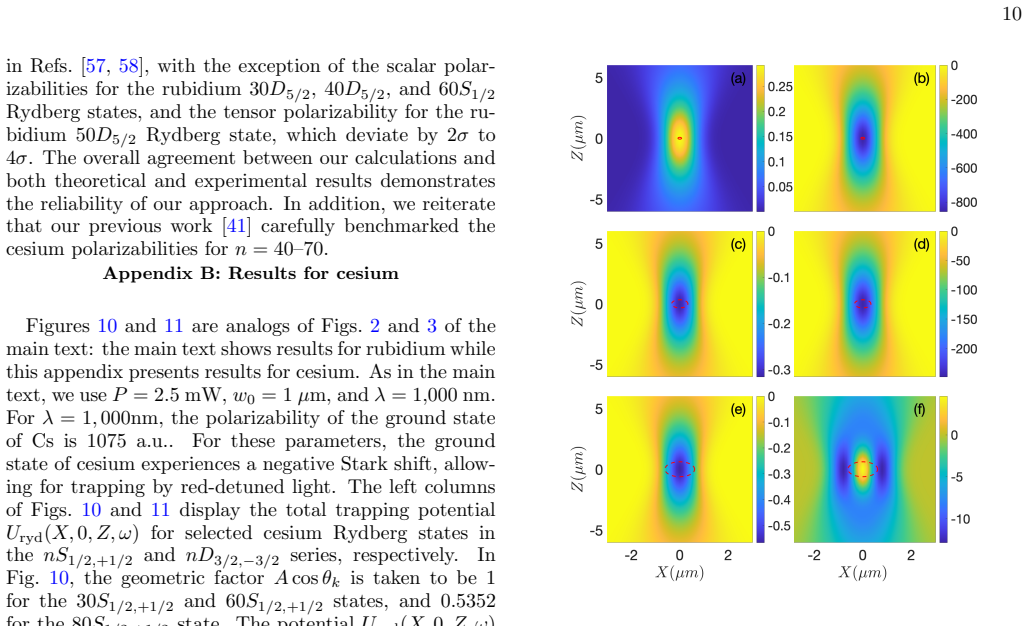
- [Appendix A and Sec. II (Eq. (6))] The trapping potentials in Figs. 4, 5, 10, and 11 require that the dynamic vector polarizability alpha_V(omega) has the computed sign and magnitude over the 500-2200 nm range. Appendix A states that the sum-over-states calculation includes 'virtual excited bound states' only, and Sec. II says the real parts are obtained 'by setting the lifetimes of the intermediate states to zero.' No continuum contribution and no imaginary part are included. For n=30, whose binding energy is about 15 meV, every wavelength in the considered range lies far above the one-photon ionization threshold. The manuscript therefore does not yet establish either the sign and magnitude of alpha_V(omega) or the conclusion that the approach 'strongly suppresses unwanted losses' and enables long coherence times. I ask for a quantitative estimate of the continuum contribution to alpha_V(omega) and of the one-photon ionization rate at the proposed trap wavelengths, or a clear physical justification for why both can be neglected.
- [Table I and Figs. 6, 8, 9] The benchmarks in Table I validate only static scalar and tensor polarizabilities, alpha_S(0) and alpha_T(0). The dynamic vector polarizability alpha_V(omega), which is the quantity that enables the sign reversal in Figs. 8, 9, 13, and 14, is not compared with any independent measurement or independent all-order/B-spline calculation. The clean 1/omega scaling is a one-parameter fit to the authors' own numerical data and therefore does not by itself validate the calculation. I request at least one finite-frequency benchmark for alpha_V, for example a comparison with an independent calculation at one or two wavelengths for a low-n Rydberg state, or a measurement-based constraint on the vector light shift.
- [Abstract and Fig. 6] The abstract's claim that the vector polarizability is 'several orders of magnitude larger than the usual scalar and tensor polarizabilities' is not uniformly supported by the presented data. Figure 6(a) shows |alpha_V| < |alpha_S| for the 30S_1/2 state, and Fig. 4(a) shows that this state cannot be trapped with the proposed red-detuned scheme. The claimed dominance holds for the 60S, 30D, and 60D cases shown, but not for all n as low as 30 in the nS series. The statement should be qualified to the specific series and n ranges where it is true.
minor comments (4)
- [Sec. II, Figure 2 caption] In the text introducing Fig. 2, 'omega_0 = 1 micrometer' should be 'w_0 = 1 micrometer'; the beam waist is w_0, not an angular frequency.
- [Fig. 6 top axis] The wavelength tick labels in Fig. 6 appear garbled, e.g., '1 520' and '5 70' instead of '1520' and '570'. Please correct these axis labels.
- [Conclusion] The sentence 'non-linearly polarized light induces a vector polarizability... which is accompanied by a fictitious magnetic field' would benefit from a reference or a brief explanation, since the magnetic-field picture is not developed elsewhere in the manuscript.
- [Eq. (9) and Figs. 4-5] The optimization metric in Eq. (9) is evaluated in the Y=0 plane only. A sentence clarifying that the same minimization was checked, or is expected to hold, along the transverse Y direction would help the reader assess the three-dimensional trapping performance.
Circularity Check
No significant circularity: the trapping potentials are computed directly from numerical polarizabilities and physical geometry parameters, not from the fitted scaling laws or from the authors' prior benchmark.
full rationale
The paper's derivation chain is self-contained. The dynamic scalar, vector, and tensor polarizabilities are computed by an explicit sum-over-states method, and the trapping potentials in Figs. 4, 5, 10, and 11 are evaluated from Eq. (6) using those numerical polarizabilities, not from the one-parameter fits α_S=-S/ω^2, α_V=-V/ω, and α_T=-T/ω^2. The fits are presented only as descriptive summaries of the numerical data (Fig. 6), so their agreement is not a prediction derived from fitted inputs. The geometric factor A cosθ_k is an experimental control parameter, not a constant chosen to reproduce a target result; the minimization in Eq. (9) is an explicit optimization of the differential potential, not a disguised restatement of the desired outcome. The self-citation to Ref. [41] is used for numerical implementation details and is not the only validation: Table I benchmarks static scalar and tensor polarizabilities against independent theoretical and experimental data. The fact that the dynamic vector polarizability α_V(ω) is not independently benchmarked, and that continuum contributions are omitted, is a correctness or validation concern, but it is not a circularity: no equation or claim reduces to its own input by construction.
Assumptions & free parameters
free parameters (2)
- Scaling coefficients S, V, T in alpha_S=-S/omega^2, alpha_V=-V/omega, alpha_T=-T/omega^2 =
state dependent (see Fig. 7)
- Geometric factor Acos(theta_k) for each demonstrated trap =
Rb: 1, 0.3923, 0.1915, 0.0308; Cs: 1, 0.5352, 0.1710, 0.0919
assumptions (6)
- domain assumption The scalar, vector, and tensor decomposition of the AC Stark shift, Eq. (2), is complete for a non-linearly polarized, far off-resonant field.
- domain assumption An external magnetic field sets a quantization axis and M_J remains a good quantum number under the trapping light.
- domain assumption Quantum defect theory with Coulomb (Whittaker) wavefunctions and literature quantum defects gives quantitatively accurate wavefunctions and dipole matrix elements for Rb and Cs Rydberg states.
- domain assumption The ponderomotive potential is accurately given by first-order perturbation theory, Eq. (7), using the unperturbed Rydberg wavefunction.
- domain assumption Away from resonances, setting intermediate-state lifetimes to zero and taking the real parts of the polarizabilities gives the relevant light shifts.
- domain assumption The hyperfine basis can be replaced by the (J, M_J, I_N, M_I) basis without changing the polarizabilities.
Cite this review
Pith. "Pith review of Forces on alkali Rydberg atoms due to non-linearly polarized light." pith.science (2026). https://pith.science/paper/XPM4WT6Q
@misc{pith2026250501071,
  author       = {Pith},
  title        = {Pith review of: Forces on alkali Rydberg atoms due to non-linearly polarized light},
  year         = {2026},
  howpublished = {\url{https://pith.science/paper/XPM4WT6Q}},
  note         = {Machine review of arXiv:2505.01071}
}
abstract
Trapped Rydberg atoms are highly promising candidates for quantum science experiments. While several approaches have been put forward to exert (trapping) forces on isolated Rydberg atoms, a widely applicable lossless technique is lacking. This paper proposes a robust versatile alternative technique that avoids lifetime compromising losses. Our proposal leverages the vector polarizability, which is induced by non-linearly polarized light and is shown to be several orders of magnitude larger than the usual scalar and tensor polarizabilities for commonly used alkali Rydberg series such as the $nS$, $nP$, and $nD$ series with principal quantum number $n$ as low as 30. The resulting force can be used to trap isolated Rydberg atoms over long times, which constitutes a key advance that is expected to impact quantum simulation applications, as well as to generate large light--Rydberg-atom hybrid states, which possess non-trivial position-dependent forces.
Figures


Figures from the paper (8 more)




Reference graph
Works this paper leans on
-
[1]
Additionally, the vector polarizability contribution in the ground state is typically small [35]. As a result, the combined effect of the vector polarizability and the as- sociated prefactorf V (A,θk,J,M J) provides very small tunability of the total dynamic polarizability [35]. There- fore, the trapping potential experienced by an alkali atom in the grou...
-
[2]
(Pis the power of the laser). Figure 2 uses typical experimental parameters, namely ω0 = 1µm,λ= 1,000 nm, andP= 1.25 mW and 2.5 mW. For this wavelength, we find that the polariz- abilityα(ω) of the ground state is equal to 820.2 a.u.. If the size ¯rof the Rydberg atom is comparable to or larger than the beam waistω 0, then the energy shift in- duced by th...
work page 1915
-
[3]
O. Firstenberg, C. S. Adams, and S. Hofferberth, Non- linear quantum optics mediated by Rydberg interactions, Journal of Physics B: Atomic, Molecular and Optical Physics49, 152003 (2016)
work page 2016
-
[4]
M. D. Lukin, Colloquium: Trapping and manipulating photon states in atomic ensembles, Rev. Mod. Phys.75, 457 (2003)
2003
-
[5]
T. Peyronel, O. Firstenberg, Q.-Y. Liang, S. Hofferberth, A. V. Gorshkov, T. Pohl, M. D. Lukin, and V. Vuleti´ c, Quantum nonlinear optics with single photons enabled by strongly interacting atoms, Nature488, 57 (2012)
work page 2012
-
[6]
Zeiher, J.-y
J. Zeiher, J.-y. Choi, A. Rubio-Abadal, T. Pohl, R. van Bijnen, I. Bloch, and C. Gross, Coherent many-body spin dynamics in a long-range interacting ising chain, Phys. Rev. X7, 041063 (2017)
2017
- [7]
-
[8]
Weimer, M
H. Weimer, M. M¨ uller, I. Lesanovsky, P. Zoller, and H. P. B¨ uchler, A Rydberg quantum simulator, Nature Physics 6, 382 (2010)
2010
Show all 71 references
-
[9]
Saffman, Quantum computing with atomic qubits and Rydberg interactions: progress and challenges, Journal of Physics B: Atomic, Molecular and Optical Physics49, 202001 (2016)
M. Saffman, Quantum computing with atomic qubits and Rydberg interactions: progress and challenges, Journal of Physics B: Atomic, Molecular and Optical Physics49, 202001 (2016)
2016
-
[10]
Malz and J
D. Malz and J. I. Cirac, Few-body analog quantum sim- ulation with Rydberg-dressed atoms in optical lattices, PRX Quantum4, 020301 (2023)
2023
-
[11]
C. S. Adams, J. D. Pritchard, and J. P. Shaffer, Ry- dberg atom quantum technologies, Journal of Physics B: Atomic, Molecular and Optical Physics53, 012002 (2019)
2019
-
[12]
U. D. Jentschura, P. J. Mohr, J. N. Tan, and B. J. Wundt, Fundamental Constants and Tests of Theory in Rydberg States of Hydrogenlike Ions, Phys. Rev. Lett.100, 160404 (2008)
2008
-
[13]
K. C. Cox, D. H. Meyer, F. K. Fatemi, and P. D. Kunz, Quantum-limited atomic receiver in the electrically small regime, Phys. Rev. Lett.121, 110502 (2018)
2018
-
[14]
Knuffman and G
B. Knuffman and G. Raithel, Multipole transitions of Rydberg atoms in modulated ponderomotive potentials, Phys. Rev. A75, 053401 (2007)
2007
-
[15]
A. M. Kaufman and K.-K. Ni, Quantum science with optical tweezer arrays of ultracold atoms and molecules, Nature Physics17, 1324 (2021). 13 - 1000010002000polarizability /s97/s32(ω) (a.u.)( a) 30D 3 /2, -3/2 8 001 2001 6002 00004000800012000w avelength λ (nm)( b) 60D 3 /2,-3/2...
2021
-
[16]
Hollerith, J
S. Hollerith, J. Zeiher, J. Rui, A. Rubio-Abadal, V. Walther, T. Pohl, D. M. Stamper-Kurn, I. Bloch, and C. Gross, Quantum gas microscopy of Rydberg macrodimers, Science364, 664 (2019)
2019
-
[17]
Gorlach, O
A. Gorlach, O. Neufeld, N. Rivera, O. Cohen, and I. Kaminer, The quantum-optical nature of high har- monic generation, Nature Communications11, 4598 (2020)
2020
-
[18]
T. Sneh, S. Corsetti, M. Notaros, K. Kikkeri, J. Voldman, and J. Notaros, Optical tweezing of microparticles and cells using silicon-photonics-based optical phased arrays, Nature Communications15, 8493 (2024)
2024
-
[19]
T.-W. Hsu, W. Zhu, T. Thiele, M. O. Brown, S. B. Papp, A. Agrawal, and C. A. Regal, Single-atom trapping in a metasurface-lens optical tweezer, PRX Quantum3, 030316 (2022)
2022
-
[20]
Almeida, I
F. Almeida, I. Sousa, O. Kremer, B. P. da Silva, D. S. Tasca, A. Z. Khoury, G. Tempor˜ ao, and T. Guerreiro, Trapping microparticles in a structured dark focus, Phys. Rev. Lett.131, 163601 (2023)
2023
-
[21]
J. Ye, H. J. Kimble, and H. Katori, Quantum State Engi- neering and Precision Metrology Using State-Insensitive Light Traps, Science320, 1734 (2008)
2008
-
[22]
Shahabadi, E
V. Shahabadi, E. Madadi, and D. Abdollahpour, Op- timized anti-reflection core-shell microspheres for en- hanced optical trapping by structured light beams, Sci- entific Reports11, 4996 (2021)
2021
-
[23]
Katori, T
H. Katori, T. Ido, and M. Kuwata-Gonokami, Optimal Design of Dipole Potentials for Efficient Loading of Sr Atoms, Journal of the Physical Society of Japan68, 2479 (1999)
1999
-
[24]
S. Das, A. Bhowmik, K. Mukherjee, and S. Ma- jumder, Transfer of orbital angular momentum super- - 400004000polarizability /s97/s32(ω) (a.u.)( a) Rb 60P 3 /2,-3/2 8 001 2001 6002 000-400004000w avelength λ (nm)( b) Cs 60P 3 /2,-3/2 FIG. 15. Polarizability of the ground and Ryd...
2020
-
[25]
L. J. LeBlanc and J. H. Thywissen, Species-specific opti- cal lattices, Phys. Rev. A75, 053612 (2007)
2007
-
[26]
Cooper, J
A. Cooper, J. P. Covey, I. S. Madjarov, S. G. Porsev, M. S. Safronova, and M. Endres, Alkaline-earth atoms in optical tweezers, Phys. Rev. X8, 041055 (2018)
2018
-
[27]
Topcu and A
T. Topcu and A. Derevianko, Dynamic polarizability of Rydberg atoms: Applicability of the near-free-electron approximation, gauge invariance, and the Dirac sea, Phys. Rev. A88, 042510 (2013)
2013
-
[28]
S. K. Dutta, J. R. Guest, D. Feldbaum, A. Walz- Flannigan, and G. Raithel, Ponderomotive optical lattice for rydberg atoms, Phys. Rev. Lett.85, 5551 (2000)
2000
-
[29]
Zhang, F
S. Zhang, F. Robicheaux, and M. Saffman, Magic- wavelength optical traps for Rydberg atoms, Phys. Rev. A84, 043408 (2011)
2011
-
[30]
Manakov, V
N. Manakov, V. Ovsiannikov, and L. Rapoport, Atoms in a laser field, Physics Reports141, 320 (1986)
1986
-
[31]
Topcu and A
T. Topcu and A. Derevianko, Tune-out wavelengths and landscape-modulated polarizabilities of alkali-metal Ry- dberg atoms in infrared optical lattices, Phys. Rev. A88, 053406 (2013)
2013
-
[32]
Barredo, V
D. Barredo, V. Lienhard, P. Scholl, S. de L´ es´ eleuc, T. Boulier, A. Browaeys, and T. Lahaye, Three- dimensional trapping of individual Rydberg atoms in ponderomotive bottle beam traps, Phys. Rev. Lett.124, 023201 (2020)
2020
-
[33]
J. H. Becher, S. Baier, K. Aikawa, M. Lepers, J.-F. Wyart, O. Dulieu, and F. Ferlaino, Anisotropic polariz- ability of erbium atoms, Phys. Rev. A97, 012509 (2018)
2018
-
[34]
Mitroy, M
J. Mitroy, M. S. Safronova, and C. W. Clark, Theory and applications of atomic and ionic polarizabilities, Journal of Physics B: Atomic, Molecular and Optical Physics43, 202001 (2010). 14
2010
-
[35]
V. V. Flambaum, V. A. Dzuba, and A. Derevianko, Magic Frequencies for Cesium Primary-Frequency Stan- dard, Phys. Rev. Lett.101, 220801 (2008)
2008
-
[36]
B. K. Sahoo and B. Arora, Magic wavelengths for trap- ping the alkali-metal atoms with circularly polarized light, Phys. Rev. A87, 023402 (2013)
2013
-
[37]
V. V. Tsyganok, D. A. Pershin, E. T. Davletov, V. A. Khlebnikov, and A. V. Akimov, Scalar, tensor, and vector polarizability of Tm atoms in a 532-nm dipole trap, Phys. Rev. A100, 042502 (2019)
2019
-
[38]
Arora and B
B. Arora and B. K. Sahoo, State-insensitive trapping of Rb atoms: Linearly versus circularly polarized light, Phys. Rev. A86, 033416 (2012)
2012
-
[39]
J. T. Wilson, S. Saskin, Y. Meng, S. Ma, R. Dilip, A. P. Burgers, and J. D. Thompson, Trapping alkaline earth Rydberg atoms optical tweezer arrays, Phys. Rev. Lett. 128, 033201 (2022)
2022
-
[40]
J. A. Sherman, T. W. Koerber, A. Markhotok, W. Nagourney, and E. N. Fortson, Precision Measure- ment of Light Shifts in a Single Trapped Ba + Ion, Phys. Rev. Lett.94, 243001 (2005)
2005
-
[41]
S. E. Anderson, K. C. Younge, and G. Raithel, Trapping Rydberg atoms in an optical lattice, Phys. Rev. Lett. 107, 263001 (2011)
2011
-
[42]
Saffman and T
M. Saffman and T. G. Walker, Analysis of a quantum logic device based on dipole-dipole interactions of opti- cally trapped Rydberg atoms, Phys. Rev. A72, 022347 (2005)
2005
-
[43]
J. Bai, S. Liu, J. He, and J. Wang, Towards implementa- tion of a magic optical-dipole trap for confining ground- state and Rydberg-state cesium cold atoms, Journal of Physics B: Atomic, Molecular and Optical Physics53, 155302 (2020)
2020
-
[44]
Bhowmik, M
A. Bhowmik, M. Gaudesius, G. Biedermann, and D. Blume, Double, triple, and quadruple magic wave- lengths for cesium ground, excited, and Rydberg states, Phys. Rev. A110, 043114 (2024)
2024
-
[45]
Bhowmik, N
A. Bhowmik, N. N. Dutta, and S. Majumder, Tunable magic wavelengths for trapping with focused laguerre- gaussian beams, Phys. Rev. A97, 022511 (2018)
2018
-
[46]
L. Li, Y. O. Dudin, and A. Kuzmich, Entanglement be- tween light and an optical atomic excitation, Nature498, 466 (2013)
2013
-
[47]
Verde, C
M. Verde, C. T. Schmiegelow, U. Poschinger, and F. Schmidt-Kaler, Trapped atoms in spatially-structured vector light fields, Scientific Reports13, 21283 (2023)
2023
-
[48]
Lampen, H
J. Lampen, H. Nguyen, L. Li, P. R. Berman, and A. Kuzmich, Long-lived coherence between ground and Rydberg levels in a magic-wavelength lattice, Phys. Rev. A98, 033411 (2018)
2018
-
[49]
Bhowmik, N
A. Bhowmik, N. N. Dutta, and S. Majumder, Vector po- larizability of an atomic state induced by a linearly po- larized vortex beam: External control of magic, tune-out wavelengths, and heteronuclear spin oscillations, Phys. Rev. A102, 063116 (2020)
2020
-
[50]
Zhang, J
R.-K. Zhang, J. Jiang, C.-Z. Dong, and Y.-B. Tang, Dy- namic polarizabilities and triply magic trapping condi- tions for 5s 2 1S0→5s5p 3P0,2 transitions of Cd atoms, Phys. Rev. A109, 032821 (2024)
2024
-
[51]
Ramos, K
A. Ramos, K. Moore, and G. Raithel, Measuring the Rydberg constant using circular Rydberg atoms in an intensity-modulated optical lattice, Phys. Rev. A96, 032513 (2017)
2017
-
[52]
Beloy,Theory of the ac Stark Effect on the Atomic Hy- perfine Structure and Applications to Microwave Atomic Clocks, Ph.D
K. Beloy,Theory of the ac Stark Effect on the Atomic Hy- perfine Structure and Applications to Microwave Atomic Clocks, Ph.D. thesis, University of Nevada, Reno (2009)
2009
-
[53]
Jiang, L
J. Jiang, L. Jiang, X. Wang, D.-H. Zhang, L.-Y. Xie, and C.-Z. Dong, Magic wavelengths of the Ca + ion for circu- larly polarized light, Phys. Rev. A96, 042503 (2017)
2017
-
[54]
Browaeys and T
A. Browaeys and T. Lahaye, Many-body physics with individually controlled Rydberg atoms, Nature Physics 16, 132 (2020)
2020
-
[55]
E. K. Dietsche, A. Larrouy, S. Haroche, J. M. Raimond, M. Brune, and S. Gleyzes, High-sensitivity magnetome- try with a single atom in a superposition of two circular Rydberg states, Nature Physics15, 326 (2019)
2019
-
[56]
X. Wu, X. Liang, Y. Tian, F. Yang, C. Chen, Y.-C. Liu, M. K. Tey, and L. You, A concise review of Rydberg atom based quantum computation and quantum simulation, Chinese Physics B30, 020305 (2021)
2021
-
[57]
M. S. O’Sullivan and B. P. Stoicheff, Scalar and tensor polarizabilities of 2D Rydberg states in Rb, Phys. Rev. A33, 1640 (1986)
1986
-
[58]
V. A. Yerokhin, S. Y. Buhmann, S. Fritzsche, and A. Surzhykov, Electric dipole polarizabilities of Rydberg states of alkali-metal atoms, Phys. Rev. A94, 032503 (2016)
2016
-
[59]
Z. Lai, S. Zhang, Q. Gou, and Y. Li, Polarizabilities of rydberg states of rb atoms withnup to 140, Phys. Rev. A98, 052503 (2018)
2018
-
[60]
counteract
For this series, the upshift ofα(ω) forAcosθ k >0 occurs for negativeM J, as opposed to for positiveM J as in Fig. 8, sinceα V (ω) is negative. Use ofM J = +3/2 would, forAcosθ k >0, lead to a down-shift ofα(ω) of the Rydberg states in Fig. 9. Another notable feature of the tu...
2001
-
[61]
M. S. O’Sullivan and B. P. Stoicheff, Scalar polarizabili- ties and avoided crossings of high Rydberg states in Rb, Phys. Rev. A31, 2718 (1985)
1985
-
[62]
M. J. Seaton, Quantum defect theory, Reports on Progress in Physics46, 167 (1983)
1983
-
[63]
van Wijngaarden and J
W. van Wijngaarden and J. Li, Polarizabilities of ce- sium S, P, D, and F states, Journal of Quantitative Spec- troscopy and Radiative Transfer52, 555 (1994)
1994
-
[64]
M. Mack, F. Karlewski, H. Hattermann, S. H¨ ockh, F. Jessen, D. Cano, and J. Fort´ agh, Measurement of absolute transition frequencies of 87Rb tonSandnD Rydberg states by means of electromagnetically induced transparency, Phys. Rev. A83, 052515 (2011)
2011
-
[65]
W. Li, I. Mourachko, M. W. Noel, and T. F. Gallagher, Millimeter-wave spectroscopy of cold Rb Rydberg atoms in a magneto-optical trap: Quantum defects of the ns, np, and nd series, Phys. Rev. A67, 052502 (2003)
2003
-
[66]
J. Han, Y. Jamil, D. V. L. Norum, P. J. Tanner, and T. F. Gallagher, Rbnfquantum defects from millimeter-wave spectroscopy of cold 85Rb Rydberg atoms, Phys. Rev. A 74, 054502 (2006)
2006
-
[67]
Deiglmayr, H
J. Deiglmayr, H. Herburger, H. Saßmannshausen, P. Jansen, H. Schmutz, and F. Merkt, Precision mea- surement of the ionization energy of Cs i, Phys. Rev. A 93, 013424 (2016)
2016
-
[68]
Lorenzen and K
C.-J. Lorenzen and K. Niemax, Quantum Defects of the n2P1/2,3/2 Levels in 39K I and 85Rb I, Physica Scripta 27, 300 (1983)
1983
-
[69]
J. Bai, R. Song, J. Fan, Y. Jiao, J. Zhao, S. Jia, and G. Raithel, Quantum defects ofnF J levels of Cs Rydberg atoms, Phys. Rev. A108, 022804 (2023)
2023
-
[70]
D. R. Bates, A. Damgaard, and H. S. W. Massey, The calculation of the absolute strengths of spectral lines, Philosophical Transactions of the Royal Society of Lon- don. Series A, Mathematical and Physical Sciences242, 15 101 (1949), note that Eq. (13) of this reference contain...
1949
-
[71]
Van Wijngaarden, Scalar and tensor polarizabilities of low lying S, P, D, F and G states in rubidium, Journal of Quantitative Spectroscopy and Radiative Transfer57, 275 (1997)
W. Van Wijngaarden, Scalar and tensor polarizabilities of low lying S, P, D, F and G states in rubidium, Journal of Quantitative Spectroscopy and Radiative Transfer57, 275 (1997)
1997
Reviewed August 16, 2026 · model on record in the stance chip above.
Discussion (0). Continue with ORCID to comment.