REVIEW 3 major objections 5 minor 2 references
Weight Friction: A Simple Method to Overcome Catastrophic Forgetting and Enable Continual Learning
T0 review · 3 major / 5 minor · reviewed 2026-08-14 · deepseek-v4-flash
Pith's one-line read Weight friction slows forgetting at a fraction of EWC's cost
desk verdict Weight friction is a genuinely simple and new continual-learning heuristic, but the convergence proof is invalid and the empirical comparison is too confounded to support the claims. read the letter →
The pith
A machine-rendered reading of the paper's core claim, the machinery that carries it, and where it could break.
The reading
What carries the argument
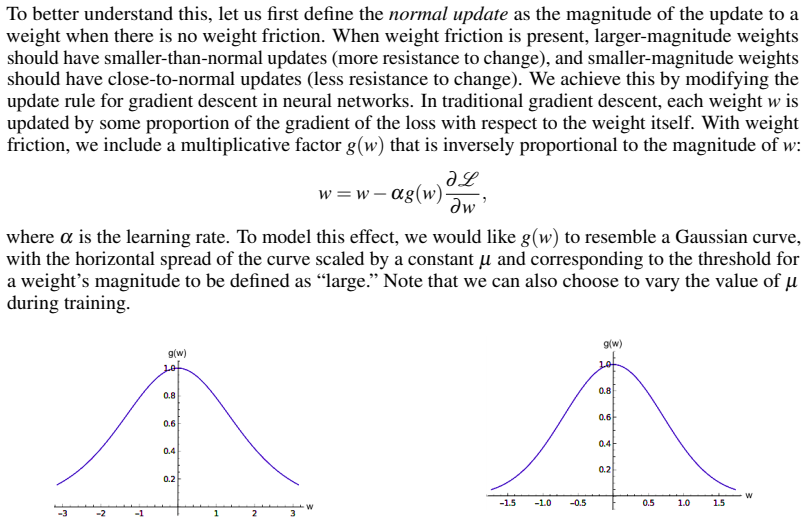
The load-bearing object is the friction factor $g(w) = 4e^{\mu w}/(1+e^{\mu w})^2$, applied multiplicatively to the gradient on every coordinate of the update $w_{t+1} = w_t - \alpha g(w_t) \nabla L(w_t)$. It converts the optimizer into a weight-dependent adaptive learning-rate method: large weights experience heavy friction and move little, small weights move almost normally. In the convergence analysis, $g$ is treated as a scalar that can be bounded by 1 to telescope the regret sum, while in the experiments the same function is grid-searched over $\mu$ and applied only after the first task.
What would settle it
For a one-dimensional convex quadratic loss, run the friction update with $g(w)=4e^{\mu w}/(1+e^{\mu w})^2$ for several $\mu$ values and $\alpha \le 1/L$, then compute the cumulative regret $R_L(T)$. If the regret is not bounded by a constant multiple of $\|w_1 - w^*\|^2$ independent of $T$, the fixed-scalar treatment of $g$ fails; in two dimensions, evaluating Lemma 1 with coordinate-dependent $g$ directly shows the norm identity breaks.
Extended reading notes
Core claim
The central discovery is that applying a weight-magnitude-dependent scale to the gradient update—rather than adding a regularization term, storing old data, or growing a new network—can preserve performance on previously learned tasks. Formally, for a convex loss with $L$-Lipschitz gradient and learning rate $\alpha \in (0,1/L]$, the paper's Theorem 2 claims the regret satisfies $R_L(T) \le \frac{1}{2\alpha g}\|w_1 - w^*\|^2$, giving $O(\|w_1 - w^*\|^2)$ convergence. Empirically, after training on MNIST then Fashion-MNIST, weight friction raises first-task accuracy from 26.09% to 83.82%, and on ten Permuted MNIST tasks it performs comparably to EWC, PNN, and A-GEM while reducing memory use by 3.04x to 35.71x and training time by 1.29x to 2.16x relative to those methods. The paper presents this as evidence that weight friction enables continual learning across multiple task domains with minimal overhead.
Load-bearing premise
The convergence proof treats the friction factor $g(w_t)$ as a single fixed scalar throughout the telescoping sum, even though the update rule applies $g$ separately to each weight coordinate and $w_t$ changes at every step.
Editorial extensions
If this is right
- Because the method modifies only the update rule, it is inherently applicable to any gradient-trained network architecture, including convolutional and recurrent networks.
- Weight friction removes the need to store episodic memories or task-specific networks, so the per-task overhead is negligible in both time and memory.
- On MNIST to Fashion-MNIST and Permuted MNIST, the method recovers a large share of lost first-task accuracy while keeping second-task accuracy essentially unchanged, and its advantage grows relative to EWC as more tasks are added.
Reading between the lines
- A direct extension the paper leaves implicit is applying friction only above a magnitude threshold, or annealing $\mu$ during training, which could sharpen the plasticity-stability trade-off beyond the fixed-shape Gaussian curve.
- The convergence proof silently treats $g(w_t)$ as a single scalar although the update applies it per coordinate at a vector $w_t$; a rigorous treatment would need a coordinate-wise or time-varying analysis, so the theorem should be viewed as a heuristic bound until then.
- The task-order asymmetry in the two image-classification settings suggests a testable schedule: train on easy tasks first with low friction, then increase friction on harder tasks, which would directly test whether weight friction amplifies forward transfer.
Signed reviews
Editorial analysis
A structured set of objections, weighed in public.
Referee Report
Summary. The paper proposes "weight friction," a modification of gradient descent in which each weight update is multiplied by a factor g(w) = 4e^{\mu w}/(1+e^{\mu w})^2 that is small for large-magnitude weights and close to 1 for small-magnitude weights. The intent is to make strong memories (large weights) more resistant to change and thereby mitigate catastrophic forgetting. Section 3.2 presents Lemma 1 and Theorem 2, claiming that for a convex loss with Lipschitz gradient and learning rate \alpha \le 1/L, the weight-friction update achieves regret R_L(T) = O(||w_1 - w_*||^2), comparable to SGD. Section 3.3 reports experiments on MNIST-to-Fashion-MNIST, the reverse order, and Permuted MNIST, comparing weight friction to EWC, PNN, A-GEM, and an Adam baseline, and claims substantial gains in computation time and memory cost.
Significance. The motivation is intuitive and the efficiency advantages of the proposed method are plausible; if the convergence theorem were correct, the paper would offer a simple and useful contribution to continual learning. The empirical setup follows common benchmarks and reports averages over 10 initializations. However, the central theoretical claim is not established: the proof of Theorem 2 treats the friction factor as a scalar constant even though the algorithm applies it coordinate-wise and the factor changes with time. The empirical section also lacks error bars and a fully specified model-selection protocol. Because the advertised convergence guarantee is the paper's main contribution, the current manuscript cannot support its central claims.
major comments (3)
- [Section 3.2, Lemma 1] Lemma 1 is stated for a scalar factor \alpha g, but the weight-friction update defined in Section 3.1 applies g(w) coordinate-wise: each weight component is updated as w_{t+1,i} = w_{t,i} - \alpha g(w_{t,i}) \partial_i L(w_t). For such an update, the expansion of ||w_{t+1} - w_*||^2 contains terms of the form \sum_i g(w_{t,i}) (w_{t,i} - w_{*,i}) \partial_i L(w_t) and \sum_i g(w_{t,i})^2 (\partial_i L(w_t))^2, which cannot be factored as the scalar expression used in the lemma unless all g(w_{t,i}) are equal. The proof therefore does not apply to the actual coordinate-wise algorithm.
- [Section 3.2, Theorem 2 proof] Even if g were a global scalar, g(w_t) depends on the current weight vector and hence changes with t. The proof states "In subsequent steps of this proof we denote g(w_t) as g" and then pulls the factor 1/(2\alpha g) out of the sum over t in the final telescoping step. This is invalid for a time-varying factor. No uniform lower bound on g(w_t) is proved; in fact, for the chosen function g(w) = 4e^{\mu w}/(1+e^{\mu w})^2, g(w) tends to 0 as |w| increases. The derived bound R_L(T) \le ||w_1 - w_*||^2/(2\alpha g) is therefore unsupported.
- [Section 3.3, empirical evaluation] The empirical section reports average accuracies and efficiency comparisons without error bars, standard deviations, or significance tests. The paper states that \mu is optimized by gridsearch, but it is not clear whether the test set was used for model selection in Settings 1 and 2, and in Setting 3 cross-validation is mentioned without details of the protocol. Reusing hyperparameters from [Cha+18] for the baselines while gridsearching \mu for weight friction makes the comparison favorable to the proposed method. These issues weaken the claim that weight friction "performs comparably" to EWC, PNN, and A-GEM, although the raw numbers in Figures 3-5 are suggestive.
minor comments (5)
- [Introduction] The phrase "an simple, effective" should be "a simple, effective."
- [Figure 2] The caption uses x in g(w) = e^{-x^2}, but the text consistently uses w; also the caption mentions \mu=1 although the displayed formula does not contain \mu.
- [Section 3.2] The same symbol L is used for both the loss function and the Lipschitz constant of its gradient; this creates avoidable confusion and should be disambiguated (e.g., use \ell for the Lipschitz constant).
- [Section 3.2, after Eq. (5)] The replacement of \alpha by 1/L inside the parenthetical is in fact valid because it changes the subtracted term in a direction that preserves the upper bound; the fatal issue is the treatment of g as a constant in the scalar algebra and in the telescoping sum. Clarifying this distinction would help readers.
- [Section 3.3] The claim of memory-efficiency gains is based on training-cost measurements in Figure 6; the paper should state whether this includes inference-time memory and whether the comparison accounts for the full training lifecycle.
Circularity Check
No significant circularity: the convergence proof is a standard template adaptation and the empirical claims are measurements, not predictions from fitted parameters.
full rationale
The paper's derivation chain does not reduce to its own inputs. Theorem 2 follows the standard SGD regret template: convexity and Lipschitz-gradient assumptions are imported from the external reference [Kim+17], Lemma 1 is just the algebraic expansion of ||w_{t+1} - w*||^2 under the stated update rule, and the telescoping regret bound is the usual rearrangement of that identity. The proof does contain a genuine mathematical flaw: it treats the coordinate-wise, time-varying factor g(w_t) as a scalar constant when pulling it out of vector norms and out of the sum over t, and it substitutes 1/L and g(w)=1 in directions that do not preserve the inequality. That is a correctness defect in the analysis, not circularity by construction. The hyperparameter mu is grid-searched on each benchmark and the reported accuracies are empirical measurements, so no fitted value is renamed as a prediction of the regret bound. The paper's self-acknowledged interpretation as a weight-based adaptive learning rate is an analogy, not a disguised reuse of a known result. All cited prior work is external and none is invoked as a uniqueness theorem to force the method. Therefore no pattern of circularity is present; the appropriate finding is score 0.
Assumptions & free parameters
free parameters (1)
- μ (weight friction scale) =
not reported; gridsearched per setting
assumptions (3)
- domain assumption The loss L is convex and ∇L is L-Lipschitz continuous (Section 3.2).
- ad hoc to paper g(w) is a single scalar applied to the whole weight vector in the norm algebra of the proof (Lemma 1, Theorem 2).
- standard math There exists a unique finite minimizer w* of L.
Cite this review
Pith. "Pith review of Weight Friction: A Simple Method to Overcome Catastrophic Forgetting and Enable Continual Learning." pith.science (2026). https://pith.science/paper/XPTRRKSZ
@misc{pith2026190801052,
  author       = {Pith},
  title        = {Pith review of: Weight Friction: A Simple Method to Overcome Catastrophic Forgetting and Enable Continual Learning},
  year         = {2026},
  howpublished = {\url{https://pith.science/paper/XPTRRKSZ}},
  note         = {Machine review of arXiv:1908.01052}
}
read the original abstract
In recent years, deep neural networks have found success in replicating human-level cognitive skills, yet they suffer from several major obstacles. One significant limitation is the inability to learn new tasks without forgetting previously learned tasks, a shortcoming known as catastrophic forgetting. In this research, we propose a simple method to overcome catastrophic forgetting and enable continual learning in neural networks. We draw inspiration from principles in neurology and physics to develop the concept of weight friction. Weight friction operates by a modification to the update rule in the gradient descent optimization method. It converges at a rate comparable to that of the stochastic gradient descent algorithm and can operate over multiple task domains. It performs comparably to current methods while offering improvements in computation and memory efficiency.
Figures


Reference graph
Works this paper leans on
-
[1]
Efficient Lifelong Learning with A-GEM
[Cha+18] Arslan Chaudhry, Marc’Aurelio Ranzato, Marcus Rohrbach, and Mohamed Elhoseiny. “Efficient Lifelong Learning with A-GEM”. In: arXiv preprint arXiv:1812.00420 (2018). [DY+14] Li Deng, Dong Yu, et al. “Deep Learning: Methods and Applications”. In:Foundations and Trends R© in Signal Processing 7.3–4 (2014), pp. 197–387. 8 [GB10] Xavier Glorot and Yosh...
arXiv 2018
-
[436]
The MNIST Database of Hand- written Digits
[LCB98] Yann LeCun, Corinna Cortes, and Christopher Burges. “The MNIST Database of Hand- written Digits”. In: (1998). [LP+17] David Lopez-Paz et al. “Gradient Episodic Memory for Continual Learning”. In: Ad- vances in Neural Information Processing Systems. 2017, pp. 6467–6476. [NSS02] Esther A Nimchinsky, Bernardo L Sabatini, and Karel Svoboda. “Structure...
arXiv 1998
Reviewed August 14, 2026 · model on record in the stance chip above.
Discussion (0). Continue with ORCID to comment.