REVIEW 3 major objections 3 minor 40 references
Dynamic Entanglement Distribution for Multi-User and Multi-Protocol Quantum Networking
T0 review · 3 major / 3 minor · reviewed 2026-08-01 · deepseek-v4-flash
Pith's one-line read A single reconfigurable optical core can dynamically route entanglement among six users over deployed metropolitan fibre, sustaining a full-mesh quantum network for 157.3 hours while also supporting slicing and multi-protocol operation.
desk verdict Real network result, overstated protocol claim: the q-ROADM full-mesh experiment is solid, but the SIAT timing is a calculation with an unvalidated overhead assumption. read the letter →
The pith
A machine-rendered reading of the paper's core claim, the machinery that carries it, and where it could break.
The reading
What carries the argument
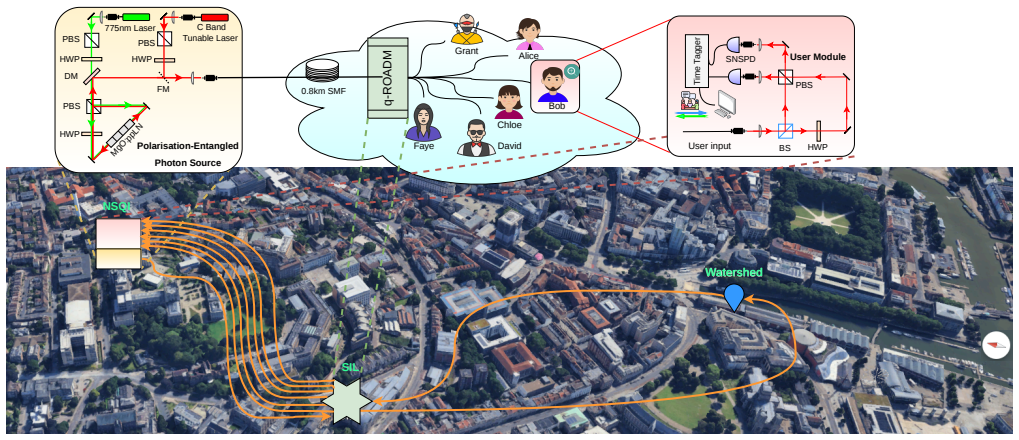
The central mechanism is the q-ROADM (quantum reconfigurable optical add-drop multiplexer): a demultiplexer divides the broadband entangled-photon source into 30 ITU 100-GHz wavelength channels, fibre polarisation controllers stabilise each channel against birefringence, a 192x192 optical fibre switch routes individual channels, and output multiplexers or wavelength-selective switches combine selected channels for each user. Because energy conservation ties channel λ_i to channel λ_-i, the switch can allocate a specific entangled wavelength pair to any chosen user pair. This device is what converts a single source and shared fibre plant into a programmable entanglement resource whose topolog
What would settle it
Run the SIAT protocol live on the same six-user q-ROADM network with full post-processing and measure wall-clock time for both authentication strategies under the favourable and challenging source/detector conditions. If the measured totals exceed the predicted 1356 s/1298 s or 6958 s/4371 s by more than the time-tag-exchange contribution, the g≈g^TT approximation underpinning the protocol-level claim is falsified.
Extended reading notes
Core claim
On its own terms, the paper's central claim is that a quantum reconfigurable optical add-drop multiplexer (q-ROADM) can serve as the core of a metropolitan entanglement network. The q-ROADM slices one broadband entangled-photon source into 30 DWDM wavelength channels, pairs symmetric channels that carry polarisation-entangled photons, neutralises fibre-induced polarisation drift, and routes the pairs to six users. Using this core, the authors demonstrate six-user full-mesh BBM92 key distribution for 157.3 hours, programmable full-mesh/partial-mesh and sliced topologies, and the same infrastructure running the SIAT authentication-transfer protocol with multi-path flooding. The protocol timing
Load-bearing premise
The SIAT timing results rest on the assumption that for every link the authenticated classical communication is almost entirely time-tag exchange, with post-processing overhead such as error correction and status checks negligible by comparison; if that overhead is comparable, the reported authentication times and the 2587-s saving would not transfer to a live deployment.
Editorial extensions
If this is right
- A metropolitan entanglement network can run unattended for days: after a single polarisation re-neutralisation, the six-user full-mesh network kept stable secret-key rates for more than 140 additional hours, surviving reconfiguration and a power outage.
- There is no universally optimal allocation strategy; full-mesh generated more total key under a bright, low-jitter source, but time-shared partial-mesh won for many links under low heralding efficiency and high detector jitter, so the topology should be chosen from live link conditions.
- Quantum network slicing works on shared fibre: independent sub-networks can run concurrently, and an interconnection link can be added or removed without significantly degrading the existing links.
- New-user onboarding can be planned as a sequence of q-ROADM configurations; the SIAT execution time is order-dependent, with up to 2587 s difference between the two studied strategies under challenging conditions.
- The same physical infrastructure can serve different protocols, not just QKD, provided the protocol can be expressed as a demand for particular user-pair links at particular times.
Reading between the lines
- The 30-channel DWDM grid and the beam-splitter sharing described in the supplement suggest a scaling path beyond six users; the stated bottleneck is user modules and detector channels, not the routing core itself.
- The reported SIAT times are timing-model results, not live protocol executions: they assume time-tag exchange dominates authenticated classical traffic on each link, so the 2587-s saving is best read as an upper bound until an end-to-end live run is measured.
- The full-mesh versus partial-mesh comparison suggests a natural closed-loop controller: periodically measure per-link SKR and QBER, then let the q-ROADM re-select topology and pump power in response, something the paper demonstrates manually rather than automatically.
- The same protocol-aware distribution layer could plausibly host entanglement-consuming services beyond key distribution, such as entanglement swapping or distributed quantum computing, whenever those services can be scheduled as a set of user-pair links.
Editorial analysis
A structured set of objections, weighed in public.
Referee Report
Summary. The manuscript reports a six-user entanglement-based quantum network enabled by a quantum reconfigurable optical add-drop multiplexer (q-ROADM) over deployed campus and metropolitan fibre in Bristol. The network is used to demonstrate full-mesh, partial-mesh, and sliced topologies, with long-term secret-key-rate monitoring over a claimed 157.3-hour period, and to compare full-mesh with time-shared partial-mesh operation under favourable and challenging source/detector conditions. The multi-protocol part of the claim is based on a timing analysis of the SIAT authentication-transfer protocol combined with flooding, using the measured secret-key rates and an explicit approximation for classical communication overhead. The paper's central experimental results are the q-ROADM architecture, the six-user BBM92 entanglement distribution, and the programmable topologies.
Significance. If the claims are taken at face value, the q-ROADM architecture is a significant step: a single reconfigurable optical core can distribute broadband entangled-photon pairs to six users, support multiple logical topologies, and sustain multi-user entanglement distribution over deployed fibre for an extended period. The data are presented honestly, including SNSPD interruptions, polarisation re-neutralisation, and a power outage. The quantitative SKR results and topology comparisons are useful for the quantum-networking community. The SIAT portion, however, is not a live protocol demonstration but a model-based timing estimate. After a clear reframing of that part, the experimental networking contribution is strong and well within the scope of the journal.
major comments (3)
- [§3.4 and Supplement S3, Eqs. (S7)–(S14)] The SIAT 'showcase' is not an executed protocol run. The main text states that the timing analysis uses measured SKRs, and Supplement S3 explicitly assumes g_A−X ≈ g^TT_A−X, i.e. that all authenticated classical communication is dominated by time-tag exchange. The headline saving under the challenging condition (6958 s for Strategy 1 vs 4371 s for Strategy 2) is therefore a calculated projection, not a measured protocol-level result. The model also omits q-ROADM reconfiguration and fibre-polarisation neutralisation times when adding each new SIAT link. If real post-processing overhead, error-correction syndrome exchange, or reconfiguration delays are non-negligible, the quantitative protocol claims do not transfer to a live deployment. The manuscript should either present at least one live SIAT execution on a single link or clearly label the entire SIAT analysis as a simulation/projectio
- [§3.1 and Fig. 4] The claim of 'stable six-user full-mesh operation over more than 150 hours' is ambiguous. The narrative records a polarisation re-neutralisation at T1 = 18.43 h, SNSPD-cycling interruptions at T2 = 58.03 h and T3 = 82.03 h, reconfiguration for other experiments between these times, and a power outage lasting more than 24 hours shortly after T3. As written, the 157.3 h appears to be an elapsed deployment period, not a continuous interval of simultaneous full-mesh key generation on all 15 links. Since long-term stability is a central claim, the authors should define the uptime metric precisely: the total time during which all links produced usable keys, the number and duration of gaps, and how the power outage was handled. If the uninterrupted interval is substantially shorter, the abstract and conclusion should be adjusted.
- [§3.2, Figs. 5 and 6] The full-mesh/partial-mesh comparison uses a 40-minute full-mesh run and two 20-minute partial-mesh runs. The figures show accumulated keys, which conflate integration time with per-link key rate. The conclusion that partial-mesh configurations 'can outperform' the full-mesh configuration for many links under the challenging condition should be supported by time-normalised per-link rates, or the text should state explicitly that the comparison is in terms of accumulated keys over these unequal active windows. This is important for interpreting Fig. 6(b).
minor comments (3)
- [Eq. (3), §3.1] The SKR formula is asymptotic and assumes the phase error rate equals the bit error rate. The value of f_EC is not stated. For the lower-rate links (e.g. ~5–10 bps) and 10-minute integration blocks, finite-size corrections can be non-negligible. The authors should state the f_EC value and add a caveat that all quoted SKRs are asymptotic, or provide finite-size adjusted rates where relevant.
- [Fig. 4] In the zoomed panel, the locations of T1–T3 and the periods of reconfiguration/power loss are not marked. Adding shaded regions or vertical lines would make the stability narrative much easier to verify.
- [References] Reference [14] appears to duplicate Reference [6], and reference [23] is missing a full article title. A data-availability statement would also be helpful, given the long dataset.
Circularity Check
No significant circularity: the q-ROADM results are measured, and the SIAT timings are a model-based computation from measured SKRs under an explicitly stated approximation.
full rationale
The paper's central claims are experimental: six-user full-mesh SKRs are measured over 157.3 hours (Fig. 4), full-mesh vs partial-mesh comparisons use measured accumulated keys (Figs. 5-6), and slicing uses measured SKR/QBER (Fig. 7). The only potentially load-bearing calculation is the SIAT timing analysis in Sec. 3.4 and Supplement S3. That analysis is not a derivation of the result from the result: it takes measured SKRs R_l, forms a measured classical-to-secret-key ratio g_l = D_l/K_l (Eq. S7), and applies published Wegman-Carter and flooding formulas (Eqs. S8-S14) from Refs. [38,40]. The approximation g_A-X ≈ g^TT_A-X is explicitly acknowledged: 'the extra information needed for post-processing is not comparable to the information needed for time tagging exchange. Therefore, in this paper, we assume g_A-X≈g^TT_A-X for all the quantum links.' This is a stated modelling assumption about classical overhead, not an input defined in terms of the reported authentication times. Ref. [38] has overlapping authors but is an externally published protocol specification, not a uniqueness theorem invoked to force this paper's choices. The qualitative SIAT ordering (Strategy 2 faster under challenging conditions) follows from measured link rates and the min-rate flooding formula, not from circular reuse of the output. The SIAT caveat is a validation/correctness concern, not circularity.
Assumptions & free parameters
free parameters (4)
- η (key reservation fraction) =
1 in main-text SIAT comparison; 0.1–1.0 in Supplement S4
- ε_c (authentication insecurity) =
10^-9 and 10^-15
- f_EC (error-correction efficiency) =
not stated
- coincidence window width =
not stated
assumptions (7)
- domain assumption The Sagnac-loop type-0 SPDC source produces the |Φ+⟩ state with photon pairs in symmetric wavelength channels λ_i and λ_-i.
- domain assumption The 100 GHz DEMUX channel slicing preserves pairwise entanglement and the channels are sufficiently independent of each other in the full-mesh assignment.
- domain assumption Fibre polarisation neutralisation with weak coherent reference states and FPC settings establishes the agreed H/V and D/A bases for all users over the deployed fibre.
- domain assumption For BBM92, the phase error rate equals the bit error rate in the asymptotic key-rate expression.
- domain assumption The Wegman-Carter authentication key requirement formula (Eq. S9) and self-consistency condition (Eq. S10) from Refs. [38,40] apply to the SIAT timing calculation.
- ad hoc to paper For each link, g_A−X ≈ g^TT_A−X, i.e., the total authenticated classical communication is dominated by time-tag exchange and all other post-processing overhead is negligible.
- domain assumption In flooding-based SIAT, each path's end-to-end key rate is limited by its slowest link, and the Step 1 transfer rate is limited by the slowest selected path.
Cite this review
Pith. "Pith review of Dynamic Entanglement Distribution for Multi-User and Multi-Protocol Quantum Networking." pith.science (2026). https://pith.science/paper/XPWI7AM2
@misc{pith2026260715262,
  author       = {Pith},
  title        = {Pith review of: Dynamic Entanglement Distribution for Multi-User and Multi-Protocol Quantum Networking},
  year         = {2026},
  howpublished = {\url{https://pith.science/paper/XPWI7AM2}},
  note         = {Machine review of arXiv:2607.15262}
}
read the original abstract
Dynamic entanglement distribution is a key requirement for scalable, multi-user and multi-protocol quantum networks. We demonstrate a metropolitan-scale entanglement-based quantum communication network enabled by a quantum reconfigurable optical add-drop multiplexer (q-ROADM), which dynamically distributes polarisation-entangled photon pairs from a broadband source to six users over deployed campus and metropolitan fibre. The network supports programmable full-mesh, partial-mesh and sliced sub-network configurations, enabling flexible allocation of entanglement resources according to link condition and service requirement. We demonstrate stable six-user full-mesh operation over more than 150 hours, compare full-mesh and time-shared partial-mesh strategies under different source and detector conditions, and realise quantum network slicing with optional/additional interconnection links. We also show that the same infrastructure can support different quantum protocols by showcasing Secure Inaugural Authentication-Transfer (SIAT) combined with Network flooding over multiple paths to improve the security of onboarding a new user. These results demonstrate a q-ROADM-enabled entanglement distribution architecture as a novel route towards reconfigurable, service-oriented quantum networking over optical fibre infrastructure.
Figures


Figures from the paper (6 more)


Reference graph
Works this paper leans on
-
[1]
Quantum internet: A vision for the road ahead,
S. Wehner, D. Elkouss, and R. Hanson, “Quantum internet: A vision for the road ahead,”Science, vol. 362, no. 6412, p. eaam9288, 2018
2018
-
[2]
The quantum internet,
H. J. Kimble, “The quantum internet,”Nature, vol. 453, pp. 1023–1030, 2008
2008
-
[3]
Quantum re- peaters: From quantum networks to the quantum internet,
K. Azuma, S. E. Economou, D. Elkouss, P. Hilaire, L. Jiang, H.-K. Lo, and I. Tzitrin, “Quantum re- peaters: From quantum networks to the quantum internet,”Reviews of Modern Physics, vol. 95, no. 4, p. 045006, 2023
2023
-
[4]
Long-distance entanglement-based quantum key distribution,
G. Ribordy, J. Brendel, J.-D. Gautier, N. Gisin, and H. Zbinden, “Long-distance entanglement-based quantum key distribution,”Physical Review A, vol. 63, no. 1, p. 012309, 2000
2000
-
[5]
Entanglement-based secure quantum cryptog- raphy over 1,120 kilometres,
J. Yin, Y.-H. Li, S.-K. Liao, M. Yang, Y. Cao, L. Zhang, J.-G. Ren, W.-Q. Cai, W.-Y. Liu, S.-L. Li 8 et al., “Entanglement-based secure quantum cryptog- raphy over 1,120 kilometres,”Nature, vol. 582, no. 7813, pp. 501–505, 2020
2020
-
[6]
Quantum inter- net: Networking challenges in distributed quantum computing,
A. S. Cacciapuoti, M. Caleffi, F. Tafuri, F. S. Catal- iotti, S. Gherardini, and G. Bianchi, “Quantum inter- net: Networking challenges in distributed quantum computing,”IEEE Network, vol. 34, no. 1, pp. 137– 143, 2020
2020
-
[7]
Experimental quan- tum teleportation,
D. Bouwmeester, J.-W. Pan, K. Mattle, M. Eibl, H. Weinfurter, and A. Zeilinger, “Experimental quan- tum teleportation,”Nature, vol. 390, no. 6660, pp. 575–579, 1997
1997
-
[8]
Advances in quantum telepor- tation,
S. Pirandola, J. Eisert, C. Weedbrook, A. Furusawa, and S. L. Braunstein, “Advances in quantum telepor- tation,”Nature photonics, vol. 9, no. 10, pp. 641–652, 2015
2015
Show all 40 references
-
[9]
Quantumteleportationcoexistingwithclassicalcom- munications in optical fiber,
J. M. Thomas, F. I. Yeh, J. H. Chen, J. J. Mam- bretti, S. J. Kohlert, G. S. Kanter, and P. Kumar, “Quantumteleportationcoexistingwithclassicalcom- munications in optical fiber,”Optica, vol. 11, no. 12, pp. 1700–1707, 2024
2024
-
[10]
Teleportation systems toward a quantum internet,
R. Valivarthi, S. I. Davis, C. Peña, S. Xie, N. Lauk, L. Narváez, J. P. Allmaras, A. D. Beyer, Y. Gim, M. Husseinet al., “Teleportation systems toward a quantum internet,”PRX Quantum, vol. 1, no. 2, p. 020317, 2020
2020
-
[11]
Quantum telepor- tation across a metropolitan fibre network,
R. Valivarthi, M. l. G. Puigibert, Q. Zhou, G. H. Aguilar, V. B. Verma, F. Marsili, M. D. Shaw, S. W. Nam, D. Oblak, and W. Tittel, “Quantum telepor- tation across a metropolitan fibre network,”Nature Photonics, vol. 10, no. 10, pp. 676–680, 2016
2016
-
[12]
Distributed quantum computation over noisy channels,
J. I. Cirac, A. Ekert, S. F. Huelga, and C. Macchi- avello, “Distributed quantum computation over noisy channels,”Physical Review A, vol. 59, no. 6, p. 4249, 1999
1999
-
[13]
Distributed quantum computing across an optical network link,
D. Main, P. Drmota, D. P. Nadlinger, E. M. Ainley, A. Agrawal, B. C. Nichol, R. Srinivas, G. Araneda, and D. M. Lucas, “Distributed quantum computing across an optical network link,”Nature, vol. 638, no. 8050, pp. 383–388, 2025
2025
-
[14]
Quantum inter- net: Networking challenges in distributed quantum computing,
A. S. Cacciapuoti, M. Caleffi, F. Tafuri, F. S. Catal- iotti, S. Gherardini, and G. Bianchi, “Quantum inter- net: Networking challenges in distributed quantum computing,”IEEE Network, vol. 34, no. 1, pp. 137– 143, 2019
2019
-
[15]
Osi stack redesign for quantum networks: Requirements, tech- nologies, challenges, and future directions,
S. Ahmed, M. K. Saeed, and A. Khokhar, “Osi stack redesign for quantum networks: Requirements, tech- nologies, challenges, and future directions,”arXiv preprint arXiv:2506.12195, 2025
2025 arXiv
-
[16]
Scalable network for simultaneous pairwise quantum key distribution via entanglement-based time-bin coding,
E. Fitzke, L. Bialowons, T. Dolejsky, M. Tippmann, O. Nikiforov, F. Wissel, M. Gunkel, and T. Walther, “Scalable network for simultaneous pairwise quantum key distribution via entanglement-based time-bin coding,”PRX Quantum, vol. 3, p. 020341, 2022
2022
-
[17]
The evolution of quantum key distribu- tion networks: On the road to the qinternet,
Y. Cao, Y. Zhao, J. Wang, X. Zhang, S. X. Ng, and L. Hanzo, “The evolution of quantum key distribu- tion networks: On the road to the qinternet,”IEEE Communications Surveys & Tutorials, vol. 24, no. 2, pp. 839–894, 2022
2022
-
[18]
Madqci: a heterogeneous and scalable sdn-qkd network deployed in production facilities,
V. Martinet al., “Madqci: a heterogeneous and scalable sdn-qkd network deployed in production facilities,”npj Quantum Information, vol. 10, p. 80, 2024
2024
-
[19]
Feasibility of quantum key distribution through a dense wave- length division multiplexing network,
B. Qi, W. Zhu, L. Qian, and H.-K. Lo, “Feasibility of quantum key distribution through a dense wave- length division multiplexing network,”New Journal of Physics, vol. 12, no. 10, p. 103042, 2010
2010
-
[20]
A quantum access network,
B. Fröhlich, J. F. Dynes, M. Lucamarini, A. W. Sharpe, Z. Yuan, and A. J. Shields, “A quantum access network,”Nature, vol. 501, no. 7465, pp. 69– 72, 2013
2013
-
[21]
An entanglement-based wavelength-multiplexedquantumcommunicationnet- work,
S. Wengerowsky, S. K. Joshi, F. Steinlechner, H. Hübel, and R. Ursin, “An entanglement-based wavelength-multiplexedquantumcommunicationnet- work,”Nature, vol. 564, no. 7735, pp. 225–228, 2018
2018
-
[22]
A trusted node–free eight- user metropolitan quantum communication network,
S. K. Joshi, D. Aktas, S. Wengerowsky, M. Lončarić, S. P. Neumann, B. Liu, T. Scheidl, G. C. Lorenzo, Ž. Samec, L. Klinget al., “A trusted node–free eight- user metropolitan quantum communication network,” Science advances, vol. 6, no. 36, p. eaba0959, 2020
2020
-
[23]
Aktaset al.,Laser & Photonics Reviews, vol
D. Aktaset al.,Laser & Photonics Reviews, vol. 10, no. 3, pp. 451–457, 2016
2016
-
[24]
40-user fully connected entanglement-based quantum key distri- bution network without trusted node,
X. Liu, J. Liu, R. Xue, H. Wang, H. Li, X. Feng, F. Liu, K. Cui, Z. Wang, L. Youet al., “40-user fully connected entanglement-based quantum key distri- bution network without trusted node,”PhotoniX, vol. 3, no. 1, pp. 1–15, 2022
2022
-
[25]
A 15-user quantum secure direct commu- nication network,
Z. Qi, Y. Li, Y. Huang, J. Feng, Y. Zheng, and X. Chen, “A 15-user quantum secure direct commu- nication network,”Light: Science & Applications, vol. 10, no. 1, pp. 1–8, 2021
2021
-
[26]
Entanglement distribution in optical networks,
A. Ciurana, V. Martin, J. Martinez-Mateo, B. Schrenk, M. Peev, and A. Poppe, “Entanglement distribution in optical networks,”IEEE Journal of Selected Topics in Quantum Electronics, vol.21, no.3, pp. 37–48, 2014
2014
-
[27]
Quantum entanglement network enabled by 9 a state-multiplexing quantum light source,
Y.-R. Fan, Y. Luo, K. Guo, J.-P. Wu, H. Zeng, G.- W. Deng, Y. Wang, H.-Z. Song, Z. Wang, L.-X. You et al., “Quantum entanglement network enabled by 9 a state-multiplexing quantum light source,”Light: Science & Applications, vol. 14, no. 1, p. 189, 2025
2025
-
[28]
Adaptive band- width management for entanglement distribution in quantum networks,
N. B. Lingaraju, H.-H. Lu, S. Seshadri, D. E. Leaird, A. M. Weiner, and J. M. Lukens, “Adaptive band- width management for entanglement distribution in quantum networks,”Optica, vol. 8, no. 3, pp. 329– 332, 2021
2021
-
[29]
Toward a reconfigurable quantum network enabled by a broadband entangled source,
E. Y. Zhu, C. Corbari, A. Gladyshev, P. G. Kazansky, H.-K. Lo, and L. Qian, “Toward a reconfigurable quantum network enabled by a broadband entangled source,”JOSA B, vol. 36, no. 3, pp. B1–B6, 2019
2019
-
[30]
Flexible entanglement-distribution network with an algaas chip for secure communications,
F. Appas, F. Baboux, M. I. Amanti, A. Lemaítre, F. Boitier, E. Diamanti, and S. Ducci, “Flexible entanglement-distribution network with an algaas chip for secure communications,”npj Quantum In- formation, vol. 7, no. 1, pp. 1–10, 2021
2021
-
[31]
Flexible cloud/user- centric entanglement and photon pair distribution with synthesizable optical router,
F. Laudenbach, B. Schrenk, M. Achleitner, N. Vokić, D. Milovančev, and H. Hübel, “Flexible cloud/user- centric entanglement and photon pair distribution with synthesizable optical router,”IEEE Journal of Selected Topics in Quantum Electronics, vol. 26, no. 3, pp. 1–9, 2020
2020
-
[32]
Experimental real- ization of an entanglement access network and secure multi-party computation,
X.-Y. Chang, D.-L. Deng, X.-X. Yuan, P.-Y. Hou, Y.-Y. Huang, and L.-M. Duan, “Experimental real- ization of an entanglement access network and secure multi-party computation,”Scientific reports, vol. 6, no. 1, p. 29453, 2016
2016
-
[33]
Demonstration of active routing of entanglement in a multi-user network,
I. Herbauts, B. Blauensteiner, A. Poppe, T. Jen- newein, and H. Huebel, “Demonstration of active routing of entanglement in a multi-user network,” Optics express, vol. 21, no. 23, pp. 29013–29024, 2013
2013
-
[34]
Coexistence of entanglement-based quantum channels with DWDM classical channels over hollow core fibre in a four node quantum commu- nication network,
M. J. Clark, O. Alia, S. Bahrani, G. T. Jasion, H. Sakr, P. Petropoulos, F. Poletti, G. T. Kanel- los, J. Rarity, R. Nejabati, S. K. Joshi, R. Wang, and D. Simeonidou, “Coexistence of entanglement-based quantum channels with DWDM classical channels over hollow core fibre in a ...
2025
-
[35]
Entanglement distribution over metropolitan fiber using an on-chip broadband polarization-entangled photon source,
Z.-H. Jiang, Y. Chen, W. Yan, C. Lu, W. Wen, Y.- Y. An, L. Chen, Y. Liu, H.-Y. Liu, Z. Xieet al., “Entanglement distribution over metropolitan fiber using an on-chip broadband polarization-entangled photon source,”Physical Review Applied, vol. 24, no. 4, p. 044098, 2025
2025
-
[36]
Reconfigurable en- tanglement distribution network based on pump man- agement of a spontaneous four-wave mixing source,
J. Liu, D. Liu, Z. Jin, Z. Lin, H. Li, L. You, X. Feng, F. Liu, K. Cui, W. Zhanget al., “Reconfigurable en- tanglement distribution network based on pump man- agement of a spontaneous four-wave mixing source,” Science Advances, vol. 10, no. 50, p. eado9822, 2024
2024
-
[37]
Quantum fusion of independent networks based on multi-user entanglement swapping,
Y. Huang, Y. Yang, H. Li, J. Wang, J. Qiu, Z. Qi, Y. Zhang, Y. Li, Y. Zheng, and X. Chen, “Quantum fusion of independent networks based on multi-user entanglement swapping,”Nature Photonics, vol. 20, no. 1, pp. 87–95, 2026
2026
-
[38]
Scalable authentication and optimal flooding in a quantum network,
N. R. Solomons, A. I. Fletcher, D. Aktas, N. Venkat- achalam, S. Wengerowsky, M. Lončarić, S. P. Neu- mann, B. Liu, Ž. Samec, M. Stipčevićet al., “Scalable authentication and optimal flooding in a quantum network,”PRX Quantum, vol. 3, no. 2, p. 020311, 2022
2022
-
[39]
Quantum cryptography without bell’s theorem,
C. H. Bennett, G. Brassard, and N. D. Mermin, “Quantum cryptography without bell’s theorem,” Physical review letters, vol. 68, no. 5, p. 557, 1992
1992
-
[40]
New hash functions and their use in authentication and set equality,
M. N. Wegman and J. L. Carter, “New hash functions and their use in authentication and set equality,” Journal of computer and system sciences, vol. 22, no. 3, pp. 265–279, 1981. 10 Supplementary Material S1 Quantum Network Polarisation Neu- tralisation Polarisation neutralisat...
1981
Reviewed August 1, 2026 · model on record in the stance chip above.
Discussion (0). Sign in to comment.