REVIEW 3 major objections 5 minor 78 references
Online Identification of IT Systems through Active Causal Learning
T0 review · 3 major / 5 minor · reviewed 2026-08-05 · deepseek-v4-flash
Pith's one-line read This paper presents the first principled method for online, data-driven identification of an IT system as a causal model, proving that the Gaussian-process estimator is Bayes-optimal and that rollout-chosen interventions improve on passive
desk verdict Solid engineering paper with correct but standard theory; the empirical validation has a load-bearing circularity when it compares its online GP to a 'ground truth' fitted with the same GP estimator. read the letter →
The pith
A machine-rendered reading of the paper's core claim, the machinery that carries it, and where it could break.
The reading
What carries the argument
The structural causal model (SCM): a known directed acyclic causal graph G over exogenous and endogenous variables, with unknown causal functions F_t, one per endogenous variable. The estimator φ(D_t) = ∏ P[f_{V_i,t} | D_t], the product of independent Gaussian process posteriors; its mean is the Bayes-optimal point estimate (Prop. 1). The rollout policy: a dynamic program with belief state b_t = φ(D_t), step cost g(b,u) = expected surrogate-loss change plus intervention cost c(u), approximated by lookahead simulation (Eqs. 11–12) with the improvement guarantee of Prop. 3. The surrogate loss L(b) is the engine: it is zero exactly when the belief is a point mass on one set of causal functions,
What would settle it
Run the online learner against a ground-truth SCM whose causal functions include a discontinuity — outside the smooth kernel's RKHS — with the graph correct: Prop. 2 predicts per-function squared error tends to zero, while the violated RKHS assumption predicts a plateau; measuring which happens settles the estimator claim. In a second test, delete one edge from the causal graph; if the estimated functions still track the true ones, the method tolerates graph misspecification, contradicting the paper's stated assumption.
Extended reading notes
Core claim
Identifying an IT system, on the paper's terms, reduces to estimating the causal functions of a known-graph structural causal model. Each causal function has an independent Gaussian process prior; posteriors update per intervention batch, and the estimate is their product distribution φ(D_t). Prop. 1: the posterior mean minimizes expected loss among all graph-compatible models (Bayes-optimal). Prop. 2: it converges to the true functions as data grows, under an RKHS condition. Interventions are chosen by a rollout policy that trades expected surrogate-loss reduction against intervention cost; Prop. 3 guarantees it improves on the base policy. Testbed: 30 active samples track ground truth clos
Load-bearing premise
The method assumes the causal graph — the list of which variables causally depend on which — and the distribution of external factors are fixed and known; if the dependency structure changes while the system runs, the guarantees and the loss weighting no longer apply.
Editorial extensions
If this is right
- Operators can keep a continuously updated causal model of their system from routine measurements plus a small number of targeted interventions, replacing expert-built, static models.
- One identified model feeds forecasting, anomaly detection, root-cause analysis, automatic control, and digital-twin simulation, so the cost of learning it is amortized over many management tasks.
- Bayes-optimality means that, within the model class defined by the known graph, no other estimator can achieve lower expected loss on the same data.
- The rollout guarantee gives a safety property for deployment: the active policy is never worse than pure monitoring, so adopting it cannot degrade identification performance.
- Consistency means the model converges to the true causal functions with sufficient data, making downstream predictions asymptotically exact under the stated regularity conditions.
Reading between the lines
- The paper fixes the causal graph, but its expected-loss machinery can be turned into a posterior over graphs: score each candidate graph by the same surrogate loss and let rollout pick interventions that discriminate between graph hypotheses, yielding joint structure-and-function identification — a direction the authors leave for future work.
- Intervention costs are assigned per type (load emulation costs 3000, routing 1000, monitoring 1); making these costs state-dependent, e.g., higher during peak load, would change which interventions the policy selects and is directly testable on the same testbed.
- Forgetting in the non-stationary scenario is handled by a fixed-size FIFO buffer of 10 samples; a Bayesian change-point detector on the GP posteriors could decide autonomously when a function has drifted, replacing the fixed forgetting schedule.
- The surrogate loss weights every function by the exogenous distribution P[U]; reweighting it by a task-specific utility, such as prediction error on response time under the loads that actually occur, would tie identification directly to the operator's objective.
Editorial analysis
A structured set of objections, weighed in public.
Referee Report
Summary. The paper proposes an online method, called active causal learning, for identifying the causal functions of a structural causal model (SCM) of an IT system, assuming the causal graph and the distribution of exogenous variables are known and fixed. The method iteratively estimates the causal functions via Gaussian process regression and selects interventions through a rollout-based policy that trades off expected reduction in surrogate loss against intervention cost. The authors prove Bayes-optimality of the posterior-mean estimator (Prop. 1), consistency of the GP estimator under RKHS assumptions (Prop. 2), and a cost-improvement guarantee for rollout under exact cost-to-go and compactness assumptions (Prop. 3). They validate the method on a synthetic SCM and on a Kubernetes/Istio testbed, reporting that the active policy achieves much lower loss than passive monitoring on both stationary and non-stationary scenarios.
Significance. If the empirical claims held as stated, the paper would make a solid contribution to network/service management: it provides a clean formal formulation of the online causal identification problem, a transparent combination of GP regression and rollout, and standard but correctly applied theoretical guarantees. The authors also make code and traces available ([29]), which is a strength. The main value is the integration of existing tools—GP-based Bayesian learning and rollout—into a principled framework for causal model identification of IT systems, rather than a fundamentally new theoretical result. However, the central empirical claim that the method 'enables accurate identification of a causal system model' is currently not supported because the testbed 'ground truth' functions are themselves estimated with the same GP estimator and kernel used by the proposed method. This circularity substantially weakens the experimental evidence and needs to be fixed before the paper can be accepted.
major comments (3)
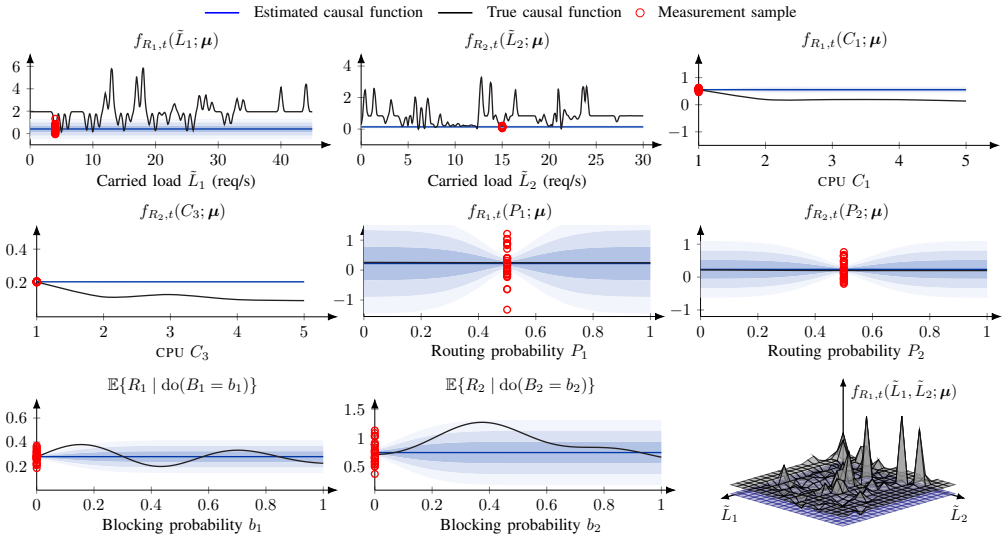
- [§VII-D, Figs. 14–17] The testbed evaluation is circular. Section VII-D constructs the ground-truth functions F_t by collecting >30,000 offline samples and then 'use[s] this data and the estimator φ [cf. (6)] to learn the causal functions F_t'—the same GP estimator, with the same Matérn kernel (13) and zero mean, used by the online method. Consequently, the loss L(ˆF_t, F_t) reported in Fig. 17 measures the difference between an online GP posterior (30 active samples) and an offline GP posterior (30,000 samples) under the same prior family. If the kernel is misspecified for the actual IT system (e.g., non-smooth or discontinuous dependencies), both estimates share the same inductive bias and the loss can be small even when both are far from the true system. The paper provides no direct measurements at held-out configurations, no non-GP ground truth, and no baseline such as random or uniform-coverage intervent
- [§V-B, Prop. 3 vs. Eq. (11)–(12), App. C] The theoretical guarantee for the intervention policy does not cover the implemented algorithm. Proposition 3 assumes an exact cost-to-go estimate (˜J_π = J_π), a compact discretized belief space, and a bounded cost function. The implementation uses Monte Carlo sampling with L=10, a terminal approximation ˜J = L(b), a FIFO buffer, and differential evolution for the minimization in (12). These approximations are not shown to satisfy the proposition's conditions, so the claim in the abstract that the method 'produces effective interventions' is only a conditional statement under idealized conditions. The experiments compare the rollout policy only to passive monitoring; they do not demonstrate that the rollout policy is competitive with random intervention selection or a myopic uncertainty-sampling baseline. Adding such baselines would also help validate that the rollout approximation beha
- [§IV, Prop. 2, §XI] Several assumptions that are load-bearing for the guarantees are either unverified or acknowledged as future work but not discussed in terms of their impact. Prop. 2 requires the true causal functions to lie in the RKHS of the chosen GP kernel; this is not verifiable on the testbed, and no sensitivity analysis with respect to kernel choice is provided. In addition, Scenario 2 involves time-varying functions, so Prop. 2—stated for fixed functions—does not apply there; the FIFO buffer heuristic (Section VII-E) is not covered by any theoretical tracking guarantee. Since the abstract claims optimality and effectiveness without these caveats, the paper should either restrict the claims to the assumptions actually verified or provide an explicit discussion of how the time-varying and misspecification cases are handled.
minor comments (5)
- [Eq. (11) vs. Eq. (5)] The symbol L is used both for the loss function (5) and for the number of Monte-Carlo rollouts in (11), which is confusing. Consider renaming the latter, e.g., N_rollout.
- [§VI, App. C] The hardware is referred to as 'M4PRO'; use the vendor style 'M4 Pro' for consistency.
- [Ref. [33]] Typo: 'Instistute' should be 'Institute'.
- [§VII-D] The description '100 samples per system variable for each configuration' is ambiguous—please specify the number of configurations, the varied variables, and the total count per variable.
- [Fig. 12] The caption says 'upper plots show the ground truth causal functions for Scenario 1 and the lower plots show the ground truth causal functions for Scenario 2,' but the figure also includes several panels that are not labeled 'Scenario 1' or 'Scenario 2' individually. Make the panel grouping explicit.
Circularity Check
Testbed 'ground truth' causal functions are learned with the same GP estimator and kernel used by the online method, so the empirical validation reduces to comparing one GP fit to another.
-
fitted input called prediction
[Section VII-D 'Causal Functions' (after Eq. (14), before Fig. 12); compare Eq. (6) and Eq. (13)]
"To evaluate our method, we need access to the causal functions F_t [cf. (14)] to compute the loss function L; cf. (5). To obtain these functions, we explore the (complete) operating region [cf. Def. 1] and collect100samples per system variable for each configuration of control variables we consider. This (offline) process takes several days and yields a total dataset of over30,000 measurement samples per system variable. We then use this data and the estimator φ[cf. (6)] to learn the causal functions F_t."
The 'true' causal functions F_t used as ground truth for the loss L (Eq. 5) are not measured independently; they are produced by the paper's own estimator φ (Eq. 6), instantiated with the same zero-mean Matérn kernel (Eq. 13) that the online active-learning method uses. Consequently, the loss curves in Fig. 17 and the visual comparisons in Figs. 14/15 measure distance between two posterior means from the same GP family: the offline φ-learned 'truth' and the online φ(D_t) estimate. Any misspecification of the GP prior/kernel relative to the real IT system is shared by both, so a small loss only shows that the online GP can approximate the offline GP, not that either accurately represents the actual system. No held-out direct measurements or non-GP ground truth are provided, so the abstract'
full rationale
The mathematical derivation is not circular. The estimator φ(D_t) is defined independently in Eq. (6) as a product of independent GP posteriors; Proposition 1 is a standard posterior-mean optimality argument proved in Appendix B; Proposition 2 cites an external GP-consistency theorem [14]; Proposition 3 cites Bertsekas's rollout results [16],[21],[22]. Author self-citations ([11],[18]-[20],[29]-[33]) are contextual or implementation-related and are not load-bearing for the proofs. The substantive circularity is confined to the testbed validation: Section VII-D constructs the 'ground truth' causal functions by applying the same estimator φ, with the same kernel (13), to offline data. The reported loss therefore compares two outputs of the same GP model family rather than the learned model to an independently characterized system. This makes the central empirical claim partially circular, while leaving the theoretical claims intact. Score 6 reflects one empirically load-bearing circular construction, not a circular derivation of the method itself.
Assumptions & free parameters
free parameters (7)
- GP noise variance sigma_epsilon^2 =
not reported
- GP covariance hyperparameters =
unit variance, Matern 5/2 with unit length scale (13)
- Discount factor gamma =
not specified
- Intervention costs c =
Table 3: load 3000, routing 1000, blocking 2000, CPU 3000, passive 1
- Horizons l, m and MC samples L =
l=1, m=5, L=10 (Tables 1,5)
- FIFO buffer size =
10
- DE minimizer parameters =
population 10, iterations 30 (Table 5)
assumptions (6)
- domain assumption The causal graph G is known, fixed, and encodes all causal dependencies among system variables.
- domain assumption The distribution P[U] of exogenous variables is known and fixed.
- ad hoc to paper The true causal functions lie in the RKHS of the chosen GP kernel (or are well approximated by the GP prior).
- domain assumption Measurement samples are collected after the system reaches steady state under each intervention.
- ad hoc to paper Independent GP priors are placed on each causal function.
- ad hoc to paper Rollout improvement conditions: exact cost-to-go estimation, compact operating region, bounded cost, discretized belief space.
Cite this review
Pith. "Pith review of Online Identification of IT Systems through Active Causal Learning." pith.science (2026). https://pith.science/paper/XPXLA46R
@misc{pith2026250902130,
  author       = {Pith},
  title        = {Pith review of: Online Identification of IT Systems through Active Causal Learning},
  year         = {2026},
  howpublished = {\url{https://pith.science/paper/XPXLA46R}},
  note         = {Machine review of arXiv:2509.02130}
}
read the original abstract
Identifying a causal model of an IT system is fundamental to many branches of systems engineering and operation. Such a model can be used to predict the effects of control actions, optimize operations, diagnose failures, detect intrusions, etc., which is central to achieving the longstanding goal of automating network and system management tasks. Traditionally, causal models have been designed and maintained by domain experts. This, however, proves increasingly challenging with the growing complexity and dynamism of modern IT systems. In this paper, we present the first principled method for online, data-driven identification of an IT system in the form of a causal model. The method, which we call active causal learning, estimates causal functions that capture the dependencies among system variables in an iterative fashion using Gaussian process regression based on system measurements, which are collected through a rollout-based intervention policy. We prove that this method is optimal in the Bayesian sense and that it produces effective interventions. Experimental validation on a testbed shows that our method enables accurate identification of a causal system model while inducing low interference with system operations.
Figures


Figures from the paper (15 more)




Reference graph
Works this paper leans on
-
[29]
Source code and traces for the paper
K. Hammar and F. S. Samani, “Source code and traces for the paper ”Online identification of IT systems through active causal learning”,” 2025, https://github.com/Limmen/csle and https://github.com/foroughsh/ online policy adaptation using rollout
work page 2025
-
[1]
Policy driven management for distributed systems,
M. Sloman, “Policy driven management for distributed systems,”Journal of Network and Systems Management, vol. 2, no. 4, pp. 333–360, 1994
work page 1994
-
[2]
The vision of autonomic computing,
J. O. Kephart and D. M. Chess, “The vision of autonomic computing,” Computer, vol. 36, no. 1, pp. 41–50, 2003
2003
-
[3]
Self-organization in communication networks: principles and design paradigms,
C. Prehofer and C. Bettstetter, “Self-organization in communication networks: principles and design paradigms,”IEEE Communications magazine, vol. 43, no. 7, pp. 78–85, 2005
work page 2005
-
[4]
RFC 9315: Intent-based networking-concepts and definitions,
A. Clemm, L. Ciavaglia, L. Z. Granville, and J. Tantsura, “RFC 9315: Intent-based networking-concepts and definitions,” 2022
work page 2022
-
[5]
Smart zero-touch man- agement of UA V-based edge network,
C. Grasso, R. Raftopoulos, and G. Schembra, “Smart zero-touch man- agement of UA V-based edge network,”IEEE Transactions on Network and Service Management, vol. 19, no. 4, pp. 4350–4368, 2022
work page 2022
-
[6]
Zero touch man- agement: A survey of network automation solutions for 5G and 6G networks,
E. Coronado, R. Behravesh, T. Subramanya, A. Fernandez-Fernandez, M. S. Siddiqui, X. Costa-P ´erez, and R. Riggio, “Zero touch man- agement: A survey of network automation solutions for 5G and 6G networks,”IEEE Communications Surveys & Tutorials, vol. 24, no. 4, pp. 2535–2578, 2022
work page 2022
-
[7]
Pearl,Causality: models, reasoning and inference
J. Pearl,Causality: models, reasoning and inference. Cambridge university press, 2009
work page 2009
Show all 78 references
-
[8]
Complete identification methods for the causal hierarchy
I. Shpitser and J. Pearl, “Complete identification methods for the causal hierarchy.”Journal of Machine Learning Research, vol. 9, no. 9, 2008
2008
-
[9]
Peters, D
J. Peters, D. Janzing, and B. Sch ¨olkopf,Elements of causal inference: foundations and learning algorithms. The MIT press, 2017
2017
-
[10]
J. L. Hellerstein, Y . Diao, S. Parekh, and D. M. Tilbury,Feedback Control of Computing Systems. USA: Wiley & Sons, 2004
2004
-
[11]
Online policy adaptation for networked systems using rollout,
F. S. Samani, K. Hammar, and R. Stadler, “Online policy adaptation for networked systems using rollout,” inNOMS 2024-2024 IEEE Network Operations and Management Symposium, 2024, pp. 1–9
2024
-
[12]
Identification of non-linear system structure and parameters using regime decomposition,
T. A. Johansen and B. A. Foss, “Identification of non-linear system structure and parameters using regime decomposition,”Automatica, vol. 31, no. 2, pp. 321–326, 1995
1995
-
[13]
C. E. Rasmussen and C. K. I. Williams,Gaussian Processes for Machine Learning. The MIT Press, 2006
2006
-
[14]
Consistency of Gaussian process regression in metric spaces,
P. Koepernik and F. Pfaff, “Consistency of Gaussian process regression in metric spaces,”Journal of Machine Learning Research, vol. 22, no. 244, pp. 1–27, 2021
2021
-
[15]
C. Oh, J. M. Tomczak, E. Gavves, and M. Welling,Combinatorial Bayesian optimization using the graph cartesian product. Red Hook, NY , USA: Curran Associates Inc., 2019
2019
-
[16]
Bertsekas,Rollout, Policy Iteration, and Distributed Reinforcement Learning, ser
D. Bertsekas,Rollout, Policy Iteration, and Distributed Reinforcement Learning, ser. Athena scientific optimization and computation series. Athena Scientific, 2021
2021
-
[17]
Rollout algorithms and approximate dynamic programming for Bayesian optimization and sequential estimation,
——, “Rollout algorithms and approximate dynamic programming for Bayesian optimization and sequential estimation,” 2022, https:// arxiv.org/abs/2212.07998
2022 arXiv
-
[18]
Adaptive network security policies via belief aggregation and rollout,
K. Hammar, Y . Li, T. Alpcan, E. C. Lupu, and D. Bertsekas, “Adaptive network security policies via belief aggregation and rollout,” 2025, https: //arxiv.org/abs/2507.15163
2025 arXiv
-
[19]
Incident response planning using a lightweight large language model with reduced hallucination,
K. Hammar, T. Alpcan, and E. C. Lupu, “Incident response planning using a lightweight large language model with reduced hallucination,” 2025, https://arxiv.org/abs/2508.05188
2025 arXiv
-
[20]
Online incident response planning under model misspecification through Bayesian learning and belief quantization,
K. Hammar and T. Li, “Online incident response planning under model misspecification through Bayesian learning and belief quantization,” inProceedings of the 2025 Workshop on Artificial Intelligence and Security, ser. AISec ’25. New York, NY , USA: Association for Computing Ma...
2025 arXiv
-
[21]
Bertsekas,Reinforcement learning and optimal control
D. Bertsekas,Reinforcement learning and optimal control. Athena Scientific, 2019
2019
-
[22]
Athena Scientific, 2018
——,Abstract Dynamic Programming. Athena Scientific, 2018
2018
-
[23]
Differential evolution – a simple and efficient heuristic for global optimization over continuous spaces,
R. Storn and K. Price, “Differential evolution – a simple and efficient heuristic for global optimization over continuous spaces,”Journal of Global Optimization, vol. 11, no. 4, pp. 341–359, Dec 1997
1997
-
[24]
Available at: https: //flask.palletsprojects.com/en/2.1.x/, Accessed on: June 7, 2022
Flask community, “Flask,” [Online]. Available at: https: //flask.palletsprojects.com/en/2.1.x/, Accessed on: June 7, 2022
2022
-
[25]
Production-grade container orchestration,
Kubernetes community, “Production-grade container orchestration,”
-
[26]
Simplify observability, traffic management, security, and policy with the leading service mesh,
Istio community, “Simplify observability, traffic management, security, and policy with the leading service mesh,” 2017. [Online]. Available at: https://istio.io/, Accessed on: June 7, 2022
2017
-
[27]
Mongodb,
MongoDB community, “Mongodb,” 2009. [Online]. Available at: https: //www.mongodb.com/, Accessed on: June 7, 2022
2009
-
[28]
Internet time synchronization: the network time protocol,
D. Mills, “Internet time synchronization: the network time protocol,” IEEE Transactions on Communications, vol. 39, no. 10, pp. 1482–1493, 1991
1991
-
[30]
Intrusion prevention through optimal stopping,
K. Hammar and R. Stadler, “Intrusion prevention through optimal stopping,”IEEE Transactions on Network and Service Management, vol. 19, no. 3, pp. 2333–2348, 2022
2022
-
[31]
Learning near-optimal intrusion responses against dynamic at- tackers,
——, “Learning near-optimal intrusion responses against dynamic at- tackers,”IEEE Transactions on Network and Service Management, vol. 21, no. 1, pp. 1158–1177, 2024
2024
-
[32]
Digital twins for security automation,
——, “Digital twins for security automation,” inNOMS 2023-2023 IEEE/IFIP Network Operations and Management Symposium, 2023, pp. 1–6
2023
-
[33]
Optimal security response to network intrusions in IT systems,
K. Hammar, “Optimal security response to network intrusions in IT systems,” Ph.D. dissertation, KTH Royal Instistute of Technology, 2024
2024
-
[34]
Conditional density estimation of service metrics for networked services,
F. S. Samani, R. Stadler, C. Flinta, and A. Johnsson, “Conditional density estimation of service metrics for networked services,”IEEE Transactions on Network and Service Management, vol. 18, no. 2, pp. 2350–2364, 2021
2021
-
[35]
Real-time Bayesian neural networks for 6G cooperative positioning and tracking,
B. C. Tedeschini, G. Kwon, M. Nicoli, and M. Z. Win, “Real-time Bayesian neural networks for 6G cooperative positioning and tracking,” IEEE Journal on Selected Areas in Communications, vol. 42, no. 9, pp. 2322–2338, 2024. 16
2024
-
[36]
Local and global sparse Gaussian process approximations,
E. Snelson and Z. Ghahramani, “Local and global sparse Gaussian process approximations,” inProceedings of the Eleventh International Conference on Artificial Intelligence and Statistics, ser. Proceedings of Machine Learning Research, M. Meila and X. Shen, Eds., vol. 2. San Jua...
2007
-
[37]
Deep Gaussian processes,
A. Damianou and N. D. Lawrence, “Deep Gaussian processes,” in Proceedings of the Sixteenth International Conference on Artificial Intel- ligence and Statistics, ser. Proceedings of Machine Learning Research, C. M. Carvalho and P. Ravikumar, Eds., vol. 31. Scottsdale, Arizona, ...
2013
-
[38]
Hedging predictions in machine learn- ing,
A. Gammerman and V . V ovk, “Hedging predictions in machine learn- ing,”The Computer Journal, vol. 50, no. 2, pp. 151–163, 2007
2007
-
[39]
V ovk, A
V . V ovk, A. Gammerman, and G. Shafer,Algorithmic Learning in a Random World. Berlin, Heidelberg: Springer-Verlag, 2005
2005
-
[40]
Garnett,Bayesian Optimization
R. Garnett,Bayesian Optimization. Cambridge University Press, 2023
2023
-
[41]
Ljung,System identification (2nd ed.): theory for the user
L. Ljung,System identification (2nd ed.): theory for the user. USA: Prentice Hall PTR, 1999
1999
-
[42]
System identification—a survey,
K. J. ˚Astr¨om and P. Eykhoff, “System identification—a survey,”Auto- matica, vol. 7, no. 2, pp. 123–162, 1971
1971
-
[43]
System identification using Kautz models,
B. Wahlberg, “System identification using Kautz models,”IEEE Trans- actions on Automatic Control, vol. 39, no. 6, pp. 1276–1282, 2002
2002
-
[44]
Finite-time identification of linear systems: Fundamental limits and optimal algorithms,
Y . Jedra and A. Proutiere, “Finite-time identification of linear systems: Fundamental limits and optimal algorithms,”IEEE Transactions on Automatic Control, vol. 68, no. 5, pp. 2805–2820, 2023
2023
-
[45]
Active learning of MDP models,
M. Araya-L ´opez, O. Buffet, V . Thomas, and F. Charpillet, “Active learning of MDP models,” inEuropean Workshop on Reinforcement Learning. Springer, 2011, pp. 42–53
2011
-
[46]
R. S. Sutton and A. G. Barto,Introduction to Reinforcement Learning, 1st ed. Cambridge, MA, USA: MIT Press, 1998
1998
-
[47]
Dyna, an integrated architecture for learning, planning, and reacting,
R. S. Sutton, “Dyna, an integrated architecture for learning, planning, and reacting,”ACM Sigart Bulletin, vol. 2, no. 4, pp. 160–163, 1991
1991
-
[48]
An information-based learning approach to dual control,
T. Alpcan and I. Shames, “An information-based learning approach to dual control,”IEEE Transactions on Neural Networks and Learning Systems, vol. 26, no. 11, pp. 2736–2748, 2015
2015
-
[49]
Simultaneous identification and adaptive control of unknown systems over finite parameter sets,
P. Kumar, “Simultaneous identification and adaptive control of unknown systems over finite parameter sets,”IEEE Transactions on Automatic Control, vol. 28, no. 1, pp. 68–76, 1983
1983
-
[50]
Reinforcement learning is direct adaptive optimal control,
R. Sutton, A. Barto, and R. Williams, “Reinforcement learning is direct adaptive optimal control,”IEEE Control Systems Magazine, vol. 12, no. 2, pp. 19–22, 1992
1992
-
[51]
K. J. ˚Astr¨om and B. Wittenmark,Adaptive Control, 2nd ed. USA: Addison-Wesley Longman Publishing Co., Inc., 1994
1994
-
[52]
Sufficiently informative functions and the minimax feedback control of uncertain dynamic systems,
D. Bertsekas and I. Rhodes, “Sufficiently informative functions and the minimax feedback control of uncertain dynamic systems,”IEEE Transactions on Automatic Control, vol. 18, no. 2, pp. 117–124, 1973
1973
-
[53]
Adaptive controller design for tracking and disturbance attenuation in parametric strict-feedback nonlinear systems,
Z. Pan and T. Basar, “Adaptive controller design for tracking and disturbance attenuation in parametric strict-feedback nonlinear systems,” IEEE Transactions on Automatic Control, vol. 43, no. 8, pp. 1066–1083, 1998
1998
-
[54]
Regret lower bounds for unbiased adaptive control of linear quadratic regulators,
I. Ziemann and H. Sandberg, “Regret lower bounds for unbiased adaptive control of linear quadratic regulators,”IEEE Control Systems Letters, vol. 4, no. 3, pp. 785–790, 2020
2020
-
[55]
On self tuning regulators,
K. ˚Astr¨om and B. Wittenmark, “On self tuning regulators,”Automatica, vol. 9, no. 2, pp. 185–199, 1973
1973
-
[56]
Active learning for nonlinear system identification with guarantees,
H. Mania, M. I. Jordan, and B. Recht, “Active learning for nonlinear system identification with guarantees,”J. Mach. Learn. Res., vol. 23, no. 1, Jan. 2022
2022
-
[57]
On adaptive control processes,
R. Bellman and R. Kalaba, “On adaptive control processes,”IRE Transactions on Automatic Control, vol. 4, no. 2, pp. 1–9, 1959
1959
-
[58]
Causal Bayesian opti- mization,
V . Aglietti, X. Lu, A. Paleyes, and J. Gonz ´alez, “Causal Bayesian opti- mization,” inProceedings of the Twenty Third International Conference on Artificial Intelligence and Statistics, ser. Proceedings of Machine Learning Research, S. Chiappa and R. Calandra, Eds., vol. 108...
2020
-
[59]
Dynamic causal Bayesian optimization,
V . Aglietti, N. Dhir, J. Gonz ´alez, and T. Damoulas, “Dynamic causal Bayesian optimization,”Advances in Neural Information Processing Systems, vol. 34, pp. 10 549–10 560, 2021
2021
-
[60]
Model-based causal Bayesian optimization,
S. Sussex, A. Makarova, and A. Krause, “Model-based causal Bayesian optimization,”arXiv preprint arXiv:2211.10257, 2022
2022 arXiv
-
[61]
Active learning for optimal intervention design in causal models,
J. Zhang, L. Cammarata, C. Squires, T. P. Sapsis, and C. Uhler, “Active learning for optimal intervention design in causal models,”Nature Machine Intelligence, vol. 5, no. 10, pp. 1066–1075, Oct 2023
2023
-
[62]
Functional causal Bayesian optimization,
L. Gultchin, V . Aglietti, A. Bellot, and S. Chiappa, “Functional causal Bayesian optimization,” inProceedings of the Thirty-Ninth Conference on Uncertainty in Artificial Intelligence, ser. Proceedings of Machine Learning Research, R. J. Evans and I. Shpitser, Eds., vol. 216. ...
2023
-
[63]
Active learning of causal networks with intervention experiments and optimal designs,
Y .-B. He and Z. Geng, “Active learning of causal networks with intervention experiments and optimal designs,”Journal of Machine Learning Research, vol. 9, no. 84, pp. 2523–2547, 2008
2008
-
[64]
Sample efficient active learning of causal trees,
K. Greenewald, D. Katz, K. Shanmugam, S. Magliacane, M. Kocaoglu, E. Boix Adsera, and G. Bresler, “Sample efficient active learning of causal trees,” inAdvances in Neural Information Processing Systems, H. Wallach, H. Larochelle, A. Beygelzimer, F. d'Alch ´e-Buc, E. Fox, and R...
2019
-
[65]
Fault localization using interventional causal learning for cloud-native applications,
S. Jha, J. Rios, N. Abe, F. Bagehorn, and L. Shwartz, “Fault localization using interventional causal learning for cloud-native applications,” in 2024 54th Annual IEEE/IFIP International Conference on Dependable Systems and Networks - Supplemental Volume (DSN-S), 2024, pp. 141– 147
2024
-
[66]
Fault injection based interventional causal learning for distributed applications,
Q. Wang, J. Rios, S. Jha, K. Shanmugam, F. Bagehorn, X. Yang, R. Filepp, N. Abe, and L. Shwartz, “Fault injection based interventional causal learning for distributed applications,”Proceedings of the AAAI Conference on Artificial Intelligence, vol. 37, no. 13, pp. 15 738–15 74...
2024
-
[67]
Proba- bilistic active learning of functions in structural causal models,
P. K. Rubenstein, I. Tolstikhin, P. Hennig, and B. Sch ¨olkopf, “Proba- bilistic active learning of functions in structural causal models,” 2017, https://arxiv.org/abs/1706.10234
2017 arXiv
-
[68]
Active learning of continuous-time Bayesian networks through interventions,
D. Linzner and H. Koeppl, “Active learning of continuous-time Bayesian networks through interventions,” inProceedings of the 38th Interna- tional Conference on Machine Learning, ser. Proceedings of Machine Learning Research, M. Meila and T. Zhang, Eds., vol. 139. PMLR, 18–24 J...
2021
-
[69]
Multi-task causal learning with Gaussian processes,
V . Aglietti, T. Damoulas, M. ´Alvarez, and J. Gonz ´alez, “Multi-task causal learning with Gaussian processes,” inAdvances in Neural In- formation Processing Systems, H. Larochelle, M. Ranzato, R. Hadsell, M. Balcan, and H. Lin, Eds., vol. 33. Curran Associates, Inc., 2020, p...
2020
-
[70]
Active Bayesian causal inference,
C. Toth, L. Lorch, C. Knoll, A. Krause, F. Pernkopf, R. Peharz, and J. von K ¨ugelgen, “Active Bayesian causal inference,” inAdvances in Neural Information Processing Systems, S. Koyejo, S. Mohamed, A. Agarwal, D. Belgrave, K. Cho, and A. Oh, Eds., vol. 35. Curran Associates, ...
2022
-
[71]
Active learning for parameter estimation in Bayesian networks,
S. Tong and D. Koller, “Active learning for parameter estimation in Bayesian networks,” inAdvances in Neural Information Processing Systems, T. Leen, T. Dietterich, and V . Tresp, Eds., vol. 13. MIT Press, 2000
2000
-
[72]
Optimal defender strate- gies for CAGE-2 using causal modeling and tree search,
K. Hammar, N. Dhir, and R. Stadler, “Optimal defender strate- gies for CAGE-2 using causal modeling and tree search,” 2024, https://arxiv.org/abs/2407.11070
2024 arXiv
-
[73]
Developing opti- mal causal cyber-defence agents via cyber security simulation,
A. Andrew, S. Spillard, J. Collyer, and N. Dhir, “Developing opti- mal causal cyber-defence agents via cyber security simulation,”arXiv preprint arXiv:2207.12355, 2022
2022 arXiv
-
[74]
{ARCUS}: symbolic root cause analysis of exploits in production systems,
C. Yagemann, M. Pruett, S. P. Chung, K. Bittick, B. Saltaformaggio, and W. Lee, “{ARCUS}: symbolic root cause analysis of exploits in production systems,” in30th USENIX Security Symposium (USENIX Security 21), 2021, pp. 1989–2006
2021
-
[75]
Root cause analysis of failures in microservices through causal discovery,
A. Ikram, S. Chakraborty, S. Mitra, S. Saini, S. Bagchi, and M. Ko- caoglu, “Root cause analysis of failures in microservices through causal discovery,” inAdvances in Neural Information Processing Systems, S. Koyejo, S. Mohamed, A. Agarwal, D. Belgrave, K. Cho, and A. Oh, Eds....
2022
-
[76]
Towards a timely causality analysis for enterprise security,
Y . Liu, M. Zhang, D. Li, K. Jee, Z. Li, Z. Wu, J. Rhee, and P. Mittal, “Towards a timely causality analysis for enterprise security,” in25th Annual Network and Distributed System Security Symposium, NDSS 2018, San Diego, California, USA, February 18-21, 2018. The Internet Soc...
2018
-
[77]
Causality rea- soning about network events for detecting stealthy malware activities,
H. Zhang, D. D. Yao, N. Ramakrishnan, and Z. Zhang, “Causality rea- soning about network events for detecting stealthy malware activities,” computers & security, vol. 58, pp. 180–198, 2016. 17
2016
-
[2014]
Available at: https://kubernetes.io/, Accessed on: June 7, 2022
[Online]. Available at: https://kubernetes.io/, Accessed on: June 7, 2022
2022
Reviewed August 5, 2026 · model on record in the stance chip above.
Discussion (0). Sign in to comment.