REVIEW 3 major objections 4 minor 28 references
Competition and Incentives in a Shared Order Book
T0 review · 3 major / 4 minor · reviewed 2026-08-15 · deepseek-v4-flash
Pith's one-line read Two exchanges sharing one order book can end up with neither offering market-making incentives.
desk verdict The math is real but the headline result is contradicted by the paper's own Figure 2(d): offering incentives is a dominant strategy in their numbers, so the claimed free-rider equilibrium with no incentives does not exist. read the letter →
The pith
A machine-rendered reading of the paper's core claim, the machinery that carries it, and where it could break.
The reading
What carries the argument
The load-bearing object is the map $\Delta(z,q)$, the unique optimal fixed point of the two market makers' Hamiltonians, which converts contract payment rates $z$ and inventories $q$ into equilibrium bid and ask quotes. Around this sits a partial-execution rule: a market maker whose quote is not the best can still be filled, but the trade pays a penalty factor $\beta\in(0,1)$, so one market maker's tighter quote pulls order flow away from the other and forces a competitive response. The paper represents every admissible contract as a terminal value of a controlled process indexed by order arrivals and the asset price; this representation converts each exchange's optimisation into a coupled Hamilton-Jacobi-Bellman PDE system whose unique solution yields the optimal contracts and the exchanges' certainty equivalents.
What would settle it
Recompute the exchanges' Nash equilibrium under strict price-time priority, where a non-best quote never executes at all; if the unique equilibrium still has zero incentives from both exchanges, the free-rider conclusion is robust to the execution rule, and if it has positive incentives, the paper's main result is an artefact of its partial-execution assumption.
Extended reading notes
Core claim
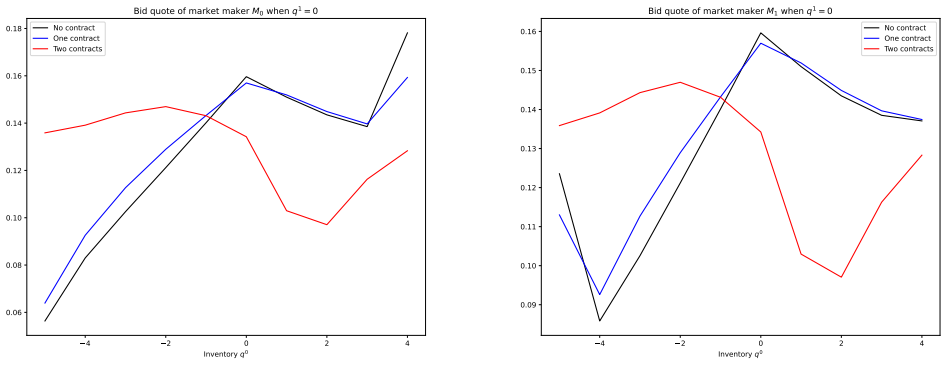
The paper's central claim is that incentive provision by an exchange to its dedicated market maker is a public good in a shared order book. An optimal contract paid by $E_0$ makes $M_0$ quote tighter spreads; the extra order flow then increases competitive pressure on $M_1$, who tightens his own quotes even though $E_1$ pays nothing. The paper shows the resulting game between exchanges has a free-rider structure and that the unique Nash equilibrium is the absence of any incentive contract by either platform. On the mathematical side, it establishes existence and uniqueness of the equilibrium, derives the optimal contracts from the unique solution of a system of coupled PDEs for the exchanges' certainty equivalents, and numerically illustrates that almost all the liquidity gain comes from the first incentive contract.
Load-bearing premise
The argument depends on the book's execution rule in which a non-best quote can still capture trades with pay scaled down by $\beta$, a rule the authors themselves note never occurs in a real limit order book; it also assumes each exchange's market maker is permanently dedicated to that exchange.
Editorial extensions
If this is right
- A unilateral incentive contract by one exchange raises the value of the passive exchange without any cost to it, because both market makers end up quoting tighter spreads.
- In the unique Nash equilibrium of the two-exchange game, neither platform offers incentives, so the shared order book can suppress liquidity provision instead of encouraging it.
- The numerical results show that almost all of the liquidity improvement comes from the first incentive contract; a second contract adds only marginal value.
- Policy evaluation of shared-order-book regulation should treat market-making incentives as a public good and expect free-riding between exchanges.
- The equilibrium contracts and value functions are computable from a coupled PDE system, so the effects of parameter changes such as volatility, risk aversion, and connection efficiency can be quantified.
Reading between the lines
- If real shared books enforce strict price priority so that only the best quote executes, the spillover channel weakens or disappears; the free-rider equilibrium is contingent on the paper's partial-execution rule.
- The same public-good logic likely applies to other venues where one platform's liquidity is visible to another's users, such as decentralised-exchange aggregators; the authors mention the analogy but do not model it.
- Allowing market makers to switch exchanges or to trade on both venues would break the pure public-good structure, because an exchange could then capture some benefit of its own incentives through the market maker's behaviour on the other venue.
- A regulation that requires both exchanges to contribute to a joint liquidity-rebate fund would be a natural remedy suggested by the public-good diagnosis, though the paper does not analyse such mechanisms.
Signed reviews
Editorial analysis
A structured set of objections, weighed in public.
Referee Report
Summary. The paper develops a continuous-time principal-agent model of two exchanges sharing a limit order book. Each exchange is the principal of a dedicated market maker, and the exchanges choose whether to offer incentive contracts while market makers choose bid and ask quotes. The authors prove a representation theorem for admissible contracts, characterize the market-maker Nash equilibrium as a fixed point, provide PDE-based verification theorems for optimal contracts in the unilateral and bilateral cases, and report numerical solutions. The advertised economic conclusion is that incentive provision is a public good with a competitiveness spillover and a free-rider problem, so that the Nash equilibrium between exchanges may involve no incentive provision by either platform.
Significance. If the headline result held, it would be a policy-relevant finding: shared-order-book regulation could reduce, rather than increase, market-making incentives. The mathematical apparatus is substantial and partly self-contained: Lemma 2.1 gives an explicit characterization of the market-maker fixed point, Theorems 2.2 and 2.3 provide verification results for the principal problems, and Lemma 2.4 gives uniqueness of the relevant PDE solutions. The contract representation builds on El Euch et al. (2021) and is not circular. However, the central economic claim is not supported by the paper's own numerical results. The utilities reported in Figure 2(d) imply that offering a contract is strictly dominant for each exchange, so the asserted no-incentive Nash equilibrium in Section 3.1 is contradicted by the paper's own numbers. The mathematical core may be salvageable, but the paper's main message, abstract, and policy discussion are currently inconsistent with the reported findings.
major comments (3)
- [Section 3.1, Figure 2(d)] The no-incentive Nash equilibrium assertion is contradicted by the paper's own numerical results. Figure 2(d) reports utilities of about -30 in the no-contract regime, about -13 for both the active and the passive exchange in the one-contract regime, and about -12 in the two-contract regime over the displayed range of risk-aversion parameters. By symmetry, each exchange compares: offering yields -13 if the rival does not offer and -12 if the rival offers, while not offering yields -30 if the rival does not offer and -13 if the rival offers. Thus 'offer' is strictly dominant and (no, no) is not a Nash equilibrium; the unique pure-strategy equilibrium is (offer, offer). Section 3.1 states flatly that 'the Nash equilibrium results in no incentive provision by any exchange,' and the abstract claims that the strategic interaction 'may lead to an equilibrium in which neither platform offers incentives.' Both statements are inconsistent with the figure the paper itself presents.
- [Section 3.1; Theorems 2.2, 2.3; Lemma 2.4] The exchange-level game is never actually solved. The paper asserts in Section 3.1 that the Nash equilibrium results in no incentive provision, but no proposition computes the payoff matrix or the equilibrium of the discrete contract-choice game between the two exchanges. Theorems 2.2 and 2.3 are verification theorems for the optimal contract conditional on the rival's contract, and Lemma 2.4 establishes uniqueness of the PDE solution, not uniqueness of the exchange-level equilibrium. The claimed existence and uniqueness of the Nash equilibrium between exchanges in the abstract is therefore not established. The authors need to formulate the binary participation game, compare the four payoff outcomes, and derive the equilibrium; the current text conflates 'best response conditional on the rival's contract' with 'equilibrium of the game.'
- [Section 2.1, beta-execution rule] The beta-penalized partial execution rule is load-bearing for the spillover mechanism, yet the authors acknowledge that it allows a market maker with the largest quote to capture trades at the expense of a more competitive market maker, something that never occurs in an actual limit order book. Because this rule is what generates the shared-execution benefit that drives the public-good and free-rider conclusions, the robustness of those conclusions to strict price priority is not established. A numerical experiment with beta=1 or with an explicit price-priority matching rule should be reported before the policy conclusions can be drawn.
minor comments (4)
- [Section 2.1, notation before Lemma 2.1] The notation for the minimum of two quotes is unclear: the text writes 'for d=(di,dj) in R^2, we defined d = min(di,dj)' but then uses the same symbol d for the vector and for the minimum; please introduce separate symbols.
- [Appendix A.2, proof of Lemma A.1] The proof contains an unresolved citation placeholder '(?, Proposition VI.I.I)' that should be replaced with a proper reference to a martingale convergence theorem.
- [Table 1] The entry for A0,A1 is printed as '10010^-5'; please clarify the intended value and its units, as this is ambiguous.
- [Figures 2 and 3 captions] The word 'vignette' is used throughout; please replace it with 'panel' for clarity, and state explicitly in the Figure 2(d) caption that the no-contract curve uses the right axis and the contract curves use the left axis.
Circularity Check
No circularity: derivation is self-contained; the unproved no-incentive Nash claim is a correctness gap, not a circular step.
full rationale
The paper's mathematical derivation is self-contained. The contract representation (Theorem 2.1), the fixed-point characterization of the market-maker equilibrium (Lemma 2.1), and the PDE verification results (Theorems 2.2 and 2.3, with Lemmas 2.2-2.4) are proved in the text or appendix using standard stochastic-control and Cauchy-Lipschitz arguments. Prior work such as El Euch et al. (2021) and Baldacci et al. (2021) is used as modeling inspiration and technique templates, not as the source of the existence or uniqueness claims. The spillover effect is a direct consequence of the shared-execution intensity structure in Section 2.1 and is not fitted or definitionally imposed. The one serious issue is Section 3.1's assertion 'as the Nash equilibrium results in no incentive provision by any exchange': no exchange-level game with the outside option of offering no contract is actually solved, and the paper's own Figure 2(d) appears to contradict the assertion, since unilateral contracting improves the active exchange's utility from about -30 to about -13 and two contracts improve both exchanges from about -13 to about -12. This is a missing-derivation and correctness gap, not a circular reduction: the claim is not equivalent by construction to any model input, fitted parameter, or self-cited theorem. Therefore the circularity score is 0.
Assumptions & free parameters
free parameters (4)
- Connection parameter beta =
reported as 5 in Table 1, must lie in (0,1)
- Order arrival intensity parameters kappa, A_j, c_j =
kappa=8, A_j and c_j from Table 1
- Risk aversion parameters eta_i, gamma_i =
eta=0.01, gamma=0.6 in Table 1
- Inventory bound q_bar and spread cap delta_infinity =
values unclear from Table 1 in the text
assumptions (5)
- domain assumption Trades arrive as Poisson processes with exponential intensities Lambda_j(d)=A_j exp(-kappa(d+c_j)/sigma) and the fundamental price is an arithmetic Brownian motion.
- domain assumption Each exchange has a dedicated market maker who never switches platform, and liquidity takers interact with a specific exchange.
- ad hoc to paper A market maker whose quote is not the best can still capture trades, with the payment penalized by factor beta; the authors note this may happen in the model but never occurs in an actual limit order book.
- ad hoc to paper Assumption 1: market makers always select the optimal fixed point policy Delta(Z_t,Q_t) from Lemma 2.1.
- standard math Standard stochastic calculus tools (dynamic programming, martingale representation, verification theorems) apply in this setting.
Cite this review
Pith. "Pith review of Competition and Incentives in a Shared Order Book." pith.science (2026). https://pith.science/paper/XPZEZQNZ
@misc{pith2026250910094,
  author       = {Pith},
  title        = {Pith review of: Competition and Incentives in a Shared Order Book},
  year         = {2026},
  howpublished = {\url{https://pith.science/paper/XPZEZQNZ}},
  note         = {Machine review of arXiv:2509.10094}
}
read the original abstract
Recent regulation on intraday electricity markets has led to the development of shared order books with the intention to foster competition and increase market liquidity. In this paper, we address the question of the efficiency of such regulations by analysing the situation of two exchanges sharing a single limit order book, i.e. a quote by a market maker can be hit by a trade arriving on the other exchange. We develop a Principal-Agent model where each exchange acts as the Principal of her own market maker acting as her Agent. Exchanges and market makers have all CARA utility functions with potentially different risk-aversion parameters. In terms of mathematical result, we show existence and uniqueness of the resulting Nash equilibrium between exchanges, give the optimal incentive contracts and provide numerical solution to the PDE satisfied by the certainty equivalent of the exchanges. From an economic standpoint, our model demonstrates that incentive provision constitutes a public good. More precisely, it highlights the presence of a competitiveness spillover effect: when one exchange optimally incentivizes its market maker, the competing exchange also reaps indirect benefits. This interdependence gives rise to a free-rider problem. Given that providing incentives entails a cost, the strategic interaction between exchanges may lead to an equilibrium in which neither platform offers incentives -- ultimately resulting in diminished overall competition.
Figures


Figures from the paper (1 more)
Reference graph
Works this paper leans on
- [1]
-
[2]
M. Avellaneda and S. Stoikov. High-frequency trading in a limit order book. Quantitative Finance, 8(3):217–224, 2008
work page 2008
-
[3]
B. Baldacci, D. Possamaï, and M. Rosenbaum. Optimal make-take fees in a multi market-maker environment. SIAM Journal on Financial Mathematics, 12(1):446–486, 2021
work page 2021
-
[4]
B. Baldacci and P. Bergault. Optimal incentives in a limit order book: a SPDE control approach. Market Microstructure and Liquidity, 2024
work page 2024
-
[5]
B. Baldacci, I. Manziuk, T. Mastrolia, and M. Rosenbaum. Market making and incentives design in the presence of a dark pool: a Stackelberg actor--critic approach. Operations Research, 71(2):727–749, 2023
work page 2023
-
[6]
B. Baldacci, P. Bergault, J. Derchu, and M. Rosenbaum. On bid and ask side-specific tick sizes. SIAM Journal on Financial Mathematics, 14(4):1215–1248, 2023
work page 2023
-
[7]
B. Baldacci, P. Jusselin, and M. Rosenbaum. How to design a derivatives market? Peter Carr Gedenkschrift: Research Advances in Mathematical Finance, 657–699, 2024
work page 2024
-
[8]
Simulating and analyzing a sparse order book: an application to intraday electricity markets
P. Bergault and E. Cognéville. Simulating and analyzing a sparse order book: an application to intraday electricity markets. arXiv preprint arXiv:2410.06839, 2024
work page Pith review arXiv 2024
Show all 28 references
-
[9]
Bergault and O
P. Bergault and O. Guéant. Size matters for OTC market makers: general results and dimensionality reduction techniques. Mathematical Finance, 31(1):279–322, 2021
2021
-
[10]
Cantillon, P
E. Cantillon, P. L. Yin. Competition between exchanges: A research agenda. International journal of industrial organization , 29(3), 329-336, 2011
2011
-
[11]
J. E. Colliard, T. Foucault. Trading fees and efficiency in limit order markets. The Review of Financial Studies , 25(11), 3389-3421, 2012
2012
-
[12]
Dayri and M
K. Dayri and M. Rosenbaum. Large tick assets: implicit spread and optimal tick size. Market Microstructure and Liquidity , 1(01), 2015
2015
-
[13]
Deschatre and X
T. Deschatre and X. Warin. A common shock model for multidimensional electricity intraday price modelling with application to battery valuation. Quantitative Finance, 24(8):1157–1176, 2024
2024
-
[14]
Deschatre and P
T. Deschatre and P. Gruet. Electricity Intraday Price Modelling with Marked Hawkes Processes. Applied Mathematical Finance, 29(4):227–260, 2022
2022
-
[15]
El Euch, T
O. El Euch, T. Mastrolia, M. Rosenbaum, and N. Touzi. Optimal make-take fees for market making regulation. Mathematical Finance, 31:109–148, 2021
2021
-
[16]
\'Elie and D
R. \'Elie and D. Possama \" i . Contracting theory with competitive interacting agents. SIAM Journal on Financial Mathematics, 57(2):1157–1188, 2019
2019
-
[17]
\'Elie, T
R. \'Elie, T. Mastrolia, and D. Possama \" i . A tale of a principal and many many agents. SIAM Journal on Financial Mathematics, 44(2):440–467, 2019
2019
-
[18]
B. Favetto. The European intraday electricity market : a modeling based on the Hawkes process. https://hal.science/hal-02089289
-
[19]
Foucault, O
T. Foucault, O. Kadan, E. Kandel. Liquidity cycles and make/take fees in electronic markets. The Journal of Finance , 68(1), 299-341, 2013
2013
-
[20]
Foucault, J
T. Foucault, J. I. Hombert, Roşu. News trading and speed. The Journal of Finance , 71(1), 335-382, 2016
2016
-
[21]
L. R. Glosten. Is the electronic open limit order book inevitable? The Journal of Finance , 49(4), 1127-1161, 1994
1994
-
[22]
Graf von Luckner and R
N. Graf von Luckner and R. Kiesel. Modeling market order arrivals on the German intraday electricity market with the Hawkes process. Journal of Risk and Financial Management, 14(4):161, 2021
2021
-
[23]
O. Guéant. Optimal market making. Applied Mathematical Finance, 24(2):112–154, 2017
2017
-
[24]
Guéant, C.-A
O. Guéant, C.-A. Lehalle, and J. Fernandez-Tapia. Dealing with the inventory risk: a solution to the market making problem. Mathematics and Financial Economics, 7(4):477–507, 2013
2013
-
[25]
Lester, G
B. Lester, G. Rocheteau, P. O. Weill. Competing for order flow in OTC markets. Journal of Money, Credit and Banking , 47(S2), 77-126, 2015
2015
-
[26]
Malamud, M
S. Malamud, M. Rostek. Decentralized exchange. American Economic Review , 107(11), 3320-3362, 2017
2017
-
[27]
J. Neveu. Discrete-parameter martingales, volume 10. Elsevier Science & Technology, 1975
1975
-
[28]
Sannikov
Y. Sannikov. A continuous-time version of the principal-agent problem. The Review of Economic Studies , 75, 957-984, 2008
2008
Reviewed August 15, 2026 · model on record in the stance chip above.
Discussion (0). Continue with ORCID to comment.