REVIEW 1 major objections 4 minor 100 references
Gravitational lensing of the wormhole in the Eddington-inspired Born-Infeld spacetime with a cosmic string
T0 review · 1 major / 4 minor · reviewed 2026-08-15 · deepseek-v4-flash
Pith's one-line read A cosmic string threading an EiBI wormhole changes strong-field lensing observables: the first image's angular separation grows and its relative brightness falls as the string parameter a decreases.
desk verdict A routine Bozza-formalism extension of a known conical EiBI wormhole whose quantitative results are undercut by inconsistent distance relations, a mis-scaled magnification, and a factor-1000 table error. read the letter →
The pith
A machine-rendered reading of the paper's core claim, the machinery that carries it, and where it could break.
The reading
What carries the argument
The load-bearing object is the conical wormhole metric $ds^2 = -dt^2 + (1+\varepsilon/r^2)^{-1}dr^2 + r^2(d\theta^2+a^2\sin^2\theta\,d\phi^2)$, where $a=1-4G\mu$ is the cosmic string parameter. The deflection angle is expressed through a complete elliptic integral of the first kind; in the strong-field limit $\varepsilon=-\lambda^2$ this collapses to the logarithmic form $\Lambda(\theta)=-(1/a)\log(D_{OL}\theta/\lambda -1)+(3/a)\log 2 -\pi$. From that expansion the paper obtains the angular positions $\theta_n$, magnifications $\mu_n$, and the standard strong-lensing observables $s$ and $R$. The string parameter enters only through products like $a\pi$ in exponentials, which is why $s$ and $R$ depend on $a$ alone.
What would settle it
Measure the angular separation $s$ and brightness ratio $R$ of the first two relativistic images around a candidate wormhole at sub-microarcsecond resolution. If the observed pair does not satisfy $R = (e^{-3a\pi}+8e^{-6a\pi})/(e^{-5a\pi}+8e^{-10a\pi})$ with the same $a$ that fits $s = 8\theta_\infty/e^{3a\pi}$, the model's strong-field predictions fail.
Extended reading notes
Core claim
The central claim is that for the conical wormhole spacetime of EiBI gravity, the cosmic string parameter $a$ enters the strong-field lensing observables exponentially. With the throat radius $\lambda$ and the deflection angle diverging logarithmically as the impact parameter approaches $a\lambda$, the paper derives $s = 8\theta_\infty / e^{3a\pi}$ and $R = (e^{-3a\pi}+8e^{-6a\pi})/(e^{-5a\pi}+8e^{-10a\pi})$. As $a$ decreases from 1, the angular separation $s$ grows and the brightness ratio $R$ falls, while both stay independent of the throat radius $\lambda$. In the $a\to 1$ limit the formulas reduce to the string-free wormhole case, and the authors argue the differences are large enough to distinguish the string-threaded EiBI wormhole from both the string-free wormhole and a Schwarzschild black hole using sub-microarcsecond observations.
Load-bearing premise
The predictions assume that the distance from the wormhole to the source, not the distance from the wormhole to the observer, controls how the cosmic string shrinks the apparent image angle; if that choice is wrong, the predicted image positions and magnifications are off by the ratio of those distances.
Editorial extensions
If this is right
- In the strong-field limit, the angular separation $s$ grows exponentially as the string parameter $a$ drops, so higher-tension cosmic strings push the first relativistic image farther from the packed set of outer images.
- The brightness ratio $R$ falls with the same parameter, so the first image becomes relatively fainter compared with the sum of all outer images.
- Because $s$ and $R$ are independent of the wormhole throat radius, they provide a direct probe of string tension alone, without needing to know the throat size.
- For throat radii around $10^{10}$-$10^{11}\;\mathrm{km}$ modeled on Sagittarius A*, the predicted angular separation is of the same order as the Schwarzschild strong-lensing separation, so high-resolution observations can distinguish the string-threaded EiBI wormhole from a Schwarzschild black hole.
- In the weak-field limit the model predicts a single image whose magnification decreases as $a$ increases, with Einstein radii for bulge and LMC lensing larger than those of the string-free EiBI wormhole.
Reading between the lines
- If the string parameter is ignored, strong-lensing estimates of the wormhole throat radius from absolute image positions would be biased; ratios such as $R$ may be a more robust probe.
- Measuring both $s$ and $R$ in the same lens system would over-determine $a$, because both are exponential functions of $a\pi$; a mismatch between the two would reveal any error in how the impact parameter is related to image angle.
- The same exponential scaling should appear in time delays between relativistic images, giving a complementary observable the paper does not compute.
- Independent cosmic-string tension bounds from gravitational-wave backgrounds could be combined with these lensing predictions to accept or reject the EiBI wormhole interpretation.
Signed reviews
Editorial analysis
A structured set of objections, weighed in public.
Referee Report
Summary. The manuscript studies gravitational lensing by a traversable wormhole in Eddington-inspired Born-Infeld (EiBI) gravity threaded by a cosmic string, using the metric of Eq. (3). It derives the deflection angle in both weak and strong field limits, constructs the strong-field lens equation, obtains image positions and magnifications, and defines the angular separation s and brightness ratio R. It then applies the formalism to Sagittarius A* and to bulge/LMC microlensing-like configurations, producing tables of Einstein angles and radii. The central claims are that the cosmic string parameter a increases the deflection relative to the Ellis-Bronnikov wormhole, that s grows and R decreases as a decreases, and that these observables are independent of the throat radius.
Significance. If the results were correct, the paper would provide a concrete, analytically tractable extension of strong-field lensing to a wormhole with a cosmic string, with parameters that are independently bounded: the EiBI parameter is constrained by GW170817/GRB170817A to |ε| ≤ 10^37 m^2, and the string tension is taken at the GUT scale, Gµ ∼ 10^-6. The derivation is analytic throughout and does not fit any free parameter to lensing data, and the paper checks the a → 1 limit against the Ellis-Bronnikov results. These are genuine strengths. The significance is currently conditional, however, because the quantitative predictions are built on an internally inconsistent set of distance relations and on a magnification formula that has the wrong scaling.
major comments (1)
- [§3, Eq. (28)] The impact-parameter relation is not consistent across the strong-field derivation. Eq. (20) states b ≃ a D_LS θ and Appendix A derives b = D_LS sin(aθ) by setting u = 1/D_LS in the conical-spacetime trajectory, but Eq. (21) uses Λ(θ) = -(1/a) log(D_OL θ/λ - 1) + (3/a) log 2 - π, which follows from Eq. (17) only if b/(aλ) = D_OL θ/λ, i.e. b = a D_OL θ. The lens-plane geometry of Fig. 4 places the observer at D_OL, not D_LS, so the Appendix A construction does not describe the angle θ seen by the observer. Because Eq. (24) for θ0_n, Eq. (25) for ΔΛ_n, Eq. (26) for image positions, Eq. (28) for magnifications, and Table 1 all carry D_OL, the strong-field observables are not derived from a single physical geometry. If the intended relation is b = a D_OL θ, then Eq. (20) and Appendix A are wrong; if b = a D_LS θ is intended, then θ∞ = λ/D_LS and the numerical values in Table 1 are mis-scaled. This must be resolved and all subsequent equations and tables re-derived consistently.
minor comments (4)
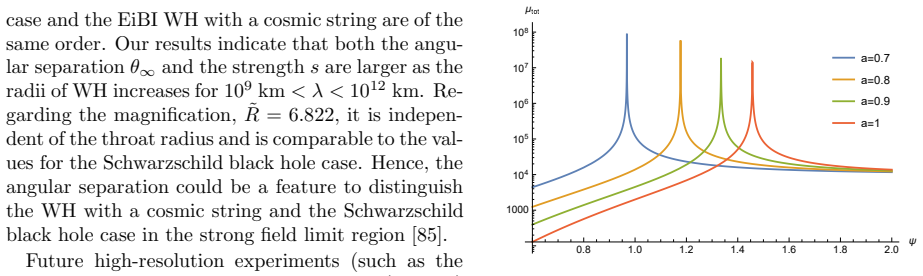
- [§3, after Eq. (28)] The sentence 'the magnification of n-th image increases exponentially with increasing n' is the opposite of what Eq. (28) implies: e^{(2n+1)aπ} appears in the denominator, so μ_n decreases as n grows. The following sentence, stating that the first image has the highest magnification, confirms the intended behavior; the wording should be corrected.
- [§5, Conclusion] The conclusion states that the angular separation 'increase[s] as cosmic string parameter increases', but Eq. (30) gives s ∝ 8θ∞/e^{3aπ}, so s decreases as a increases (equivalently, increases as a decreases). This is also inconsistent with the body text after Eq. (30) and with the abstract's claim; the conclusion sentence should be corrected.
- [§2.2, around Eqs. (4)–(6)] The symbol L is used first for the Lagrangian in Eq. (4) and then for the conserved angular momentum in Eq. (6); the statement 'For the null geodesic, it is well known that L = 0' is confusing, since it is the Lagrangian that vanishes for null curves, not the angular momentum used in Eq. (7). Please use separate symbols.
- [Throughout] There are several typographical and wording errors, including 'Eills-Bronnikov' in the abstract, 'Bozzaa' for Bozza, 'ins-pired' in the title line, and 'deflection angel' in Section 2.2. A careful proofread is needed.
Circularity Check
No circularity found: the derivation chain is analytical from the metric and geodesic equations, with no fitting to lensing data; the noted D_LS/D_OL mismatch is an internal-consistency issue, not a circular reduction.
full rationale
The paper's central chain is self-contained in the sense relevant to circularity: metric (3) yields the null geodesic equations (5)-(11), the deflection angle (14) and its strong-field expansion (17), the lens equation (19), the image positions (24)-(26), magnifications (28), and finally the observables s and R in Eqs. (30)-(31). No parameter appearing in these observables is fitted to lensing data. The wormhole throat radius lambda and cosmic string parameter a are inputs constrained by independent bounds: the GW170817 speed-of-gravity limit gives |epsilon| <= 10^37 m^2 (hence lambda <= 10^15 km), and the string tension is estimated from the GUT symmetry-breaking scale. The observables are then closed-form functions of those inputs. The a -> 1 limit recovers the Ellis-Bronnikov wormhole results, which provides an independent consistency check rather than a fitting procedure. The load-bearing citations for the spacetime metric and geodesic motion, e.g., [89], are to prior work by other authors, not to the present authors; the self-citations in the reference list ([46]-[49]) concern context and are not used to justify the central lensing derivation. The discrepancy flagged by the reader, between Eq. (20) (b ~ a D_LS theta) and Eq. (21) (which effectively uses b = a D_OL theta through log(D_OL theta/lambda - 1)), is a possible internal-consistency or correctness problem in the lens geometry, but it is not a circular reduction: neither equation is defined in terms of the predicted observables, and the derived s and R do not reduce to fitted inputs. Therefore no circularity is found and the score is 0.
Assumptions & free parameters
free parameters (2)
- a (cosmic string parameter) =
1 - 4e-6 (GUT scale assumption)
- λ (wormhole throat radius) =
varied from 10^9 to 10^12 km in tables
assumptions (5)
- domain assumption Metric (3) describes an EiBI wormhole with a cosmic string
- standard math Null geodesics are obtained from Euler-Lagrange equations on the equatorial plane
- domain assumption The Virbhadra-Ellis lens equation (18) applies to this wormhole geometry
- ad hoc to paper The impact parameter b relates to the image angle θ as b = a D_OL θ
- standard math Expansion of the complete elliptic integral of the first kind near unity
Cite this review
Pith. "Pith review of Gravitational lensing of the wormhole in the Eddington-inspired Born-Infeld spacetime with a cosmic string." pith.science (2026). https://pith.science/paper/XQBZRXNO
@misc{pith2026250507420,
  author       = {Pith},
  title        = {Pith review of: Gravitational lensing of the wormhole in the Eddington-inspired Born-Infeld spacetime with a cosmic string},
  year         = {2026},
  howpublished = {\url{https://pith.science/paper/XQBZRXNO}},
  note         = {Machine review of arXiv:2505.07420}
}
read the original abstract
In this work we study gravitational lensing of the wormhole in the Eddington-inspired Born-Infeld (EiBI) spacetime that incorporates with a cosmic string. It was found that the presence of cosmic string can enhance the light deflection in strong field limit, compared to the case of the Eills-Bronnikov wormhole. The magnification effects of this composite structure could cause some substantial impacts on the angle separation between the first and the rest of the images, and their relative brightness. Furthermore, based on these observables, we model some observable aspects in the strong and the weak field limits. The presence of a cosmic string can affect some distinguishable observables compared to the wormhole without cosmic string. This work could deepen our understanding of the spacetime structure of the wormhole in EiBI spacetime with one-dimensional topological defects.
Figures


Figures from the paper (2 more)

Reference graph
Works this paper leans on
-
[1]
Deser and G
S. Deser and G. W. Gibbons, Born-Infeld- Einstein actions?, Class. Quant. Grav. 15 (1998) L35-L39
1998
-
[2]
Banados and P
M. Banados and P. G. Ferreira, Eddington’s theory of gravity and its progeny, Phys. Rev. Lett. 105 (2010) 011101. [erratum: Phys. Rev. Lett. 113 (2014) no.11, 119901.]
2010
-
[3]
Beltran Jimenez, L
J. Beltran Jimenez, L. Heisenberg, G. J. Olmo and D. Rubiera-Garcia, Born–Infeld inspired modifications of gravity, Phys. Rept. 727 (2018) 1-129
2018
-
[4]
G. J. Olmo, Palatini Approach to Modified Gravity: f(R) Theories and Beyond, Int. J. Mod. Phys. D 20 (2011) 413-462
2011
-
[5]
G. J. Olmo, D. Rubiera-Garcia and H. Sanchis- Alepuz, Geonic black holes and remnants in Eddington-inspired Born-Infeld gravity, Eur. Phys. J. C 74 (2014) 2804
2014
-
[6]
F. S. N. Lobo, G. J. Olmo and D. Rubiera- Garcia, Semiclassical geons as solitonic black hole remnants, JCAP 07 (2013) 011
2013
-
[7]
S. W. Wei, K. Yang and Y. X. Liu, Black hole solution and strong gravitational lensing in Eddington-inspired Born–Infeld gravity, Eur. Phys. J. C 75 (2015) 253. [erratum: Eur. Phys. J. C 75 (2015) 331.] 10
2015
-
[8]
Shaikh, Wormholes with nonexotic matter in Born-Infeld gravity, Phys
R. Shaikh, Wormholes with nonexotic matter in Born-Infeld gravity, Phys. Rev. D 98 (2018) no.6, 064033
2018
Show all 100 references
-
[9]
G. J. Olmo, E. Orazi and D. Rubiera-Garcia, Multicenter solutions in Eddington-inspired Born–Infeld gravity, Eur. Phys. J. C 80 (2020) no.11, 1018
2020
-
[10]
K. Yang, X. L. Du and Y. X. Liu, Linear per- turbations in Eddington-inspired Born-Infeld gravity, Phys. Rev. D 88 (2013) 124037
2013
-
[11]
X. L. Du, K. Yang, X. H. Meng and Y. X. Liu, Large Scale Structure Formation in Eddington- inspired Born-Infeld Gravity, Phys. Rev. D 90 (2014) 044054
2014
-
[12]
M. S. Morris and K. S. Thorne, Wormholes in space-time and their use for interstellar travel: A tool for teaching general relativity, Am. J. Phys. 56 (1988) 395-412
1988
-
[13]
Einstein and N
A. Einstein and N. Rosen, The Particle Prob- lem in the General Theory of Relativity, Phys. Rev. 48 (1935) 73-77
1935
-
[14]
R. W. Fuller and J. A. Wheeler, Causality and Multiply Connected Space-Time, Phys. Rev. 128 (1962) 919-929
1962
-
[15]
K. A. Bronnikov, Scalar-tensor theory and scalar charge, Acta Phys. Polon. B 4 (1973) 251-266
1973
-
[16]
P. P. Avelino and L. Sousa, Domain walls and other defects in Eddington-inspired Born- Infeld gravity, Phys. Rev. D 102 (2020) no.10, 104021
2020
-
[17]
T. W. B. Kibble, Topology of Cosmic Domains and Strings, J. Phys. A 9 (1976) 1387-1398
1976
-
[18]
Sarangi and S
S. Sarangi and S. H. H. Tye, Cosmic string production towards the end of brane inflation, Phys. Lett. B 536 (2002) 185-192
2002
-
[19]
E. J. Copeland, R. C. Myers and J. Polchinski, Cosmic F and D strings, JHEP 06 (2004) 013
2004
-
[20]
Dvali and A
G. Dvali and A. Vilenkin, Formation and evolu- tion of cosmic D strings, JCAP 03 (2004) 010
2004
-
[21]
Vilenkin, Cosmological Density Fluctua- tions Produced by Vacuum Strings, Phys
A. Vilenkin, Cosmological Density Fluctua- tions Produced by Vacuum Strings, Phys. Rev. Lett. 46 (1981) 1169-1172. [erratum: Phys. Rev. Lett. 46 (1981) 1496]
1981
-
[22]
C. F. Chang and Y. Cui, Stochastic Gravita- tional Wave Background from Global Cosmic Strings, Phys. Dark Univ. 29 (2020) 100604
2020
-
[23]
Sousa, P
L. Sousa, P. P. Avelino and G. S. F. Guedes, Full analytical approximation to the stochas- tic gravitational wave background generated by cosmic string networks, Phys. Rev. D 101 (2020) no.10, 103508
2020
-
[24]
Agazie et al
G. Agazie et al. [NANOGrav], The NANOGrav 15 yr Data Set: Evidence for a Gravitational- wave Background, Astrophys. J. Lett. 951 (2023) no.1, L8
2023
-
[25]
Antoniadis et al
J. Antoniadis et al. [EPTA], The second data release from the European Pulsar Timing Array - I. The dataset and timing analysis, Astron. Astrophys. 678 (2023) A48
2023
-
[26]
D. J. Reardon, A. Zic, R. M. Shannon, G. B. Hobbs, M. Bailes, V. Di Marco, A. Ka- pur, A. F. Rogers, E. Thrane and J. Askew, et al. Search for an Isotropic Gravitational-wave Background with the Parkes Pulsar Timing Ar- ray, Astrophys. J. Lett. 951 (2023) no.1, L6
2023
-
[27]
H. Xu, S. Chen, Y. Guo, J. Jiang, B. Wang, J. Xu, Z. Xue, R. N. Caballero, J. Yuan and Y. Xu, et al. Searching for the Nano- Hertz Stochastic Gravitational Wave Back- ground with the Chinese Pulsar Timing Ar- ray Data Release I, Res. Astron. Astrophys. 23 (2023) no.7, 075024
2023
-
[28]
Clement, Wormhole cosmic strings, Phys
G. Clement, Wormhole cosmic strings, Phys. Rev. D 51 (1995) 6803-6809
1995
-
[29]
E. F. Eiroa and C. Simeone, Cylindrical thin shell wormholes, Phys. Rev. D 70 (2004) 044008. 11
2004
-
[30]
E. F. Eiroa, E. Rub ´ ın de Celis and C. Simeone, Thin shells joining local cosmic string geome- tries, Eur. Phys. J. C 76 (2016) no.10, 546
2016
-
[31]
E. F. Eiroa, E. R. de Celis and C. Simeone, Thin shells associated to black string space- times, Eur. Phys. J. C 79 (2019) no.3, 272
2019
-
[32]
Bejarano, E
C. Bejarano, E. F. Eiroa and C. Simeone, Thin- shell wormholes associated with global cosmic strings, Phys. Rev. D 75 (2007) 027501
2007
-
[33]
Bambhaniya, O
P. Bambhaniya, O. Trivedi, I. Dymnikova, P. S. Joshi and M. Khlopov, On the interac- tions of black holes and cosmic strings, Phys. Dark Univ. 46 (2024) 101553
2024
-
[34]
Bartelmann and P
M. Bartelmann and P. Schneider, Weak grav- itational lensing, Phys. Rept. 340 (2001) 291- 472
2001
-
[35]
Treu, Strong Lensing by Galaxies, Ann
T. Treu, Strong Lensing by Galaxies, Ann. Rev. Astron. Astrophys. 48 (2010) 87-125
2010
-
[36]
Vagnozzi, R
S. Vagnozzi, R. Roy, Y. D. Tsai, L. Visinelli, M. Afrin, A. Allahyari, P. Bambhaniya, D. Dey, S. G. Ghosh and P. S. Joshi, et al. Horizon- scale tests of gravity theories and fundamental physics from the Event Horizon Telescope im- age of Sagittarius A, Class. Quant. Grav. 40 ...
2023
-
[37]
Bozza, S
V. Bozza, S. Capozziello, G. Iovane and G. Scarpetta, Strong field limit of black hole gravitational lensing, Gen. Rel. Grav. 33 (2001) 1535-1548
2001
-
[38]
Tsukamoto, Strong deflection limit analysis and gravitational lensing of an Ellis wormhole, Phys
N. Tsukamoto, Strong deflection limit analysis and gravitational lensing of an Ellis wormhole, Phys. Rev. D 94 (2016) no.12, 124001
2016
-
[39]
Tsukamoto, Deflection angle in the strong deflection limit in a general asymptotically flat, static, spherically symmetric spacetime, Phys
N. Tsukamoto, Deflection angle in the strong deflection limit in a general asymptotically flat, static, spherically symmetric spacetime, Phys. Rev. D 95 (2017) no.6, 064035
2017
-
[40]
Igata, Deflection angle in the strong de- flection limit: a perspective from local geo- metrical invariants and matter distributions, [arXiv:2503.02320 [gr-qc]]
T. Igata, Deflection angle in the strong de- flection limit: a perspective from local geo- metrical invariants and matter distributions, [arXiv:2503.02320 [gr-qc]]
-
[41]
E. F. Eiroa, Gravitational lensing by Einstein- Born-Infeld black holes, Phys. Rev. D 73 (2006) 043002
2006
-
[42]
S. S. Zhao and Y. Xie, Strong field gravitational lensing by a charged Galileon black hole, JCAP 07 (2016) 007
2016
-
[43]
Canfora, E
F. Canfora, E. F. Eiroa and C. M. Sendra, Spherical Skyrmion black holes as gravitational lenses, Eur. Phys. J. C 78 (2018) no.8, 659
2018
-
[44]
N. U. Molla and U. Debnath, Shadows and strong gravitational lensing by Van der Waals black hole in homogeneous plasma, Annals Phys. 453 (2023) 169304
2023
-
[45]
X. M. Kuang and A. ¨Ovg¨ un, Strong gravi- tational lensing and shadow constraint from M87* of slowly rotating Kerr-like black hole, Annals Phys. 447 (2022) 169147
2022
-
[46]
L. H. Liu, M. Zhu, W. Luo, Y. F. Cai and Y. Wang, Microlensing effect of a charged spherically symmetric wormhole, Phys. Rev. D 107 (2023) no.2, 024022
2023
-
[47]
K. Gao, L. H. Liu and M. Zhu, Microlens- ing effects of wormholes associated to black- hole spacetimes, Phys. Dark Univ. 41 (2023) 101254
2023
-
[48]
Gao and L
K. Gao and L. H. Liu, Can wormholes and black holes be distinguished by magnification?, [arXiv:2307.16627 [gr-qc]]
-
[49]
Gao and L
K. Gao and L. H. Liu, Microlensing and event rate of static spherically symmetric wormhole, Phys. Lett. B 858 (2024) 139019
2024
-
[50]
N. U. Molla and U. Debnath, Gravitational Lensing of Acoustic Charged Black Holes, As- trophys. J. 947 (2023) no.1, 14. [erratum: As- trophys. J. 958 (2023) no.2, 196.]
2023
-
[51]
Q. Qi, Y. Meng, X. J. Wang and X. M. Kuang, Gravitational lensing effects of black hole with conformally coupled scalar hair, Eur. Phys. J. C 83 (2023) no.11, 1043. 12
2023
-
[52]
Zhang, H
Y. Zhang, H. Liu, D. Wen and H. Zhang, Strong lensing as a probe of braneworld, [arXiv:2312.15714 [gr-qc]]
-
[53]
Y. Duan, S. Lin and J. Jia, Deflection and grav- itational lensing with finite distance effect in the strong deflection limit in stationary and ax- isymmetric spacetimes, JCAP 07 (2023) 036
2023
-
[54]
E. L. B. Junior, J. T. S. S. Junior, F. S. N. Lobo, M. E. Rodrigues, D. Rubiera- Garcia, L. F. D. da Silva and H. A. Vieira, Gravitational lensing of a Schwarzschild-like black hole in Kalb-Ramond gravity, Phys. Rev. D 110 (2024) no.2, 024077
2024
-
[55]
K. S. Virbhadra and G. F. R. Ellis, Gravita- tional lensing by naked singularities, Phys. Rev. D 65 (2002) 103004
2002
-
[56]
K. S. Virbhadra and C. R. Keeton, Time delay and magnification centroid due to gravitational lensing by black holes and naked singularities, Phys. Rev. D 77 (2008) 124014
2008
-
[57]
K. K. Nandi, Y. Z. Zhang and A. V. Zakharov, Gravitational lensing by wormholes, Phys. Rev. D 74 (2006) 024020
2006
-
[58]
¨Ovg¨ un, Light deflection by Damour- Solodukhin wormholes and Gauss-Bonnet the- orem, Phys
A. ¨Ovg¨ un, Light deflection by Damour- Solodukhin wormholes and Gauss-Bonnet the- orem, Phys. Rev. D 98 (2018) no.4, 044033
2018
-
[59]
Shaikh, P
R. Shaikh, P. Banerjee, S. Paul and T. Sarkar, Strong gravitational lensing by wormholes, JCAP 07 (2019) 028. [erratum: JCAP 12 (2023) E01.]
2019
-
[60]
Tsukamoto, Gravitational lensing by a Bronnikov-Kim wormhole under a weak-field approximation and in a strong deflection limit, Phys
N. Tsukamoto, Gravitational lensing by a Bronnikov-Kim wormhole under a weak-field approximation and in a strong deflection limit, Phys. Rev. D 105 (2022) no.6, 064013
2022
-
[61]
S. Zhou, M. Chen and J. Jia, Effect of electric interaction on the deflection and gravitational lensing in the strong field limit, Eur. Phys. J. C 83 (2023) no.9, 883
2023
-
[62]
Godani and G
N. Godani and G. C. Samanta, Gravitational lensing effect in traversable wormholes, Annals Phys. 429 (2021) 168460
2021
-
[63]
T. Cai, H. Huang, Z. Wang and M. Zhu, Higher-order correction to weak-field lensing of an Ellis-Bronnikov wormhole, Phys. Rev. D 108 (2023) no.2, 023004
2023
-
[64]
Hsieh, D
T. Hsieh, D. S. Lee and C. Y. Lin, Throat ef- fects on strong gravitational lensing in Kerr- like wormholes, Phys. Rev. D 111 (2025) no.4, 044051
2025
-
[65]
J. B. Jim´ enez, L. J. Garay and M. P. Garrote, Mimicking Wormholes in Born–Infeld Electro- dynamics, Universe 10 (2024) no.12, 459
2024
-
[66]
X. T. Cheng and Y. Xie, Probing a black- bounce, traversable wormhole with weak de- flection gravitational lensing, Phys. Rev. D 103 (2021) no.6, 064040
2021
-
[67]
Atamurotov, F
F. Atamurotov, F. Sarikulov, A. Abdujabbarov and B. Ahmedov, Gravitational weak lensing by black hole in Horndeski gravity in presence of plasma, Eur. Phys. J. Plus 137 (2022) no.3, 336
2022
-
[68]
Tsukamoto, Gravitational lensing by two photon spheres in a black-bounce spacetime in strong deflection limits, Phys
N. Tsukamoto, Gravitational lensing by two photon spheres in a black-bounce spacetime in strong deflection limits, Phys. Rev. D 104 (2021) no.6, 064022
2021
-
[69]
M. S. Ali and S. Kauhsal, Gravitational lens- ing for stationary axisymmetric black holes in Eddington-inspired Born-Infeld gravity, Phys. Rev. D 105 (2022) no.2, 024062
2022
-
[70]
Kumar, S
J. Kumar, S. U. Islam and S. G. Ghosh, Inves- tigating strong gravitational lensing effects by supermassive black holes with Horndeski grav- ity, Eur. Phys. J. C 82 (2022) no.5, 443
2022
-
[71]
Hensh, J
S. Hensh, J. Schee, A. Abdujabbarov and Z. Stuchl ´ ık, Strong gravitational lensing around Kehagias–Sfetsos compact objects surrounded by plasma, Eur. Phys. J. Plus 137 (2022) no.2, 242. 13
2022
-
[72]
Ghosh and A
S. Ghosh and A. Bhattacharyya, Analytical study of gravitational lensing in Kerr-Newman black-bounce spacetime, JCAP 11 (2022) 006
2022
-
[73]
E. L. B. Junior, F. S. N. Lobo, M. E. Rodrigues and H. A. Vieira, Gravitational lens effect of a holonomy corrected Schwarzschild black hole, Phys. Rev. D 109 (2024) no.2, 2
2024
-
[74]
Y. Chen, P. Wang, H. Wu and H. Yang, Gravi- tational lensing by Born-Infeld naked singular- ities, Phys. Rev. D 109 (2024) no.8, 084014
2024
-
[75]
Kumaran and A
Y. Kumaran and A. ¨Ovg¨ un, Shadow and deflec- tion angle of asymptotic, magnetically-charged, non-singular black hole, Eur. Phys. J. C 83 (2023) no.9, 812
2023
-
[76]
M. A. A. de Paula, H. C. D. Lima, Junior, P. V. P. Cunha and L. C. B. Crispino, Elec- trically charged regular black holes in nonlin- ear electrodynamics: Light rings, shadows, and gravitational lensing, Phys. Rev. D 108 (2023) no.8, 084029
2023
-
[77]
Zhang, J
R. Zhang, J. Jing, Z. Peng and Q. Huang, Strong gravitational lensing of rotating regular black holes in non-minimally coupled Einstein- Yang-Mills theory*, Chin. Phys. C 47 (2023) no.10, 105105
2023
-
[78]
G. J. Olmo, J. L. Rosa, D. Rubiera-Garcia and D. Saez-Chillon Gomez, Shadows and photon rings of regular black holes and geonic horizon- less compact objects, Class. Quant. Grav. 40 (2023) no.17, 174002
2023
-
[79]
C. H. Xie, Y. Zhang, Q. Sun, Q. Q. Li and P. F. Duan, Gravitational lensing by a stable rotating regular black hole, JCAP 05 (2024) 121
2024
-
[80]
K. Liao, M. Biesiada and Z. H. Zhu, Strongly Lensed Transient Sources: A Review, Chin. Phys. Lett. 39 (2022) no.11, 119801
2022
-
[81]
K. S. Virbhadra, Compactness of supermassive dark objects at galactic centers, Can. J. Phys. 102 (2024) 512
2024
-
[82]
Toscani, O
M. Toscani, O. Burke, C. Liu, N. B. Zamel, N. Tamanini and F. Pozzoli, Strongly lensed extreme mass-ratio inspirals, Phys. Rev. D 109 (2024) no.6, 063505
2024
-
[83]
Jusufi, Conical Morris-Thorne Wormholes with a Global Monopole Charge, Phys
K. Jusufi, Conical Morris-Thorne Wormholes with a Global Monopole Charge, Phys. Rev. D 98 (2018) no.4, 044016
2018
-
[84]
Furtado, J
C. Furtado, J. R. Nascimento, A. Y. Petrov, P. J. Porf ´ ırio and A. R. Soares, Strong grav- itational lensing in a spacetime with topologi- cal charge within the Eddington-inspired Born- Infeld gravity, Phys. Rev. D 103 (2021) no.4, 044047
2021
-
[85]
A. R. Soares, R. L. L. Vit´ oria and C. F. S. Pereira, Gravitational lensing in a topologically charged Eddington-inspired Born–Infeld spacetime, Eur. Phys. J. C 83 (2023) no.10, 903
2023
-
[86]
S. W. Wei and Y. X. Liu, Equatorial and quasi- equatorial gravitational lensing by Kerr black hole pierced by a cosmic string, Phys. Rev. D 85 (2012) 064044
2012
-
[87]
Jusufi and A
K. Jusufi and A. ¨Ovg¨ un, Light Deflection by a Quantum Improved Kerr Black Hole Pierced by a Cosmic String, Int. J. Geom. Meth. Mod. Phys. 16 (2019) no.08, 1950116
2019
-
[88]
Ahmed, Gravitational lensing by Morris- Thorne–type wormhole space-time with cosmic strings, EPL 142 (2023) no.3, 39002
F. Ahmed, Gravitational lensing by Morris- Thorne–type wormhole space-time with cosmic strings, EPL 142 (2023) no.3, 39002
2023
-
[89]
Ahmed, Geodesics motion of test parti- cles around Schwarzschild-Klinkhamer worm- hole with topological defects and gravitational lensing, JCAP 11 (2023) 010
F. Ahmed, Geodesics motion of test parti- cles around Schwarzschild-Klinkhamer worm- hole with topological defects and gravitational lensing, JCAP 11 (2023) 010
2023
-
[90]
Ahmed, Gravitational lensing in a space- time with cosmic string within the Eddington- inspired Born–Infeld gravity, Int
F. Ahmed, Gravitational lensing in a space- time with cosmic string within the Eddington- inspired Born–Infeld gravity, Int. J. Geom. Meth. Mod. Phys. 21 (2024) no.11, 2450187
2024
-
[91]
Linet, The Static Metrics with Cylindri- cal Symmetry Describing a Model of Cosmic Strings, Gen
B. Linet, The Static Metrics with Cylindri- cal Symmetry Describing a Model of Cosmic Strings, Gen. Rel. Grav. 17 (1985) 1109-1115. 14
1985
-
[92]
Vilenkin and E
A. Vilenkin and E. P. S. Shellard, Cosmic Strings and Other Topological Defects, Cam- bridge University Press, 2000
2000
-
[93]
J. R. Nascimento, A. Y. Petrov, P. J. Por- firio and A. R. Soares, Gravitational lensing in black-bounce spacetimes, Phys. Rev. D 102 (2020) no.4, 044021
2020
-
[94]
K. S. Virbhadra and G. F. R. Ellis, Schwarzschild black hole lensing, Phys. Rev. D 62 (2000) 084003
2000
-
[95]
S. Jana, G. K. Chakravarty and S. Mohanty, Constraints on Born-Infeld gravity from the speed of gravitational waves after GW170817 and GRB 170817A, Phys. Rev. D 97 (2018) no.8, 084011
2018
-
[96]
Abe, Gravitational Microlensing by the Ellis Wormhole, Astrophys
F. Abe, Gravitational Microlensing by the Ellis Wormhole, Astrophys. J. 725 (2010) 787-793
2010
-
[97]
M. D. Johnson, K. Akiyama, L. Blackburn, K. L. Bouman, A. E. Broderick, V. Cardoso, R. P. Fender, C. M. Fromm, P. Galison and J. L. G´ omez, et al. Galaxies 11 (2023) no.3, 61
2023
-
[98]
Y. M. Wu, Z. C. Chen and Q. G. Huang, Constraining the Polarization of Gravitational Waves with the Parkes Pulsar Timing Array Second Data Release, Astrophys. J. 925 (2022) no.1, 37
2022
-
[99]
Y. M. Wu, Z. C. Chen and Q. G. Huang, Cos- mological interpretation for the stochastic sig- nal in pulsar timing arrays, Sci. China Phys. Mech. Astron. 67 (2024) no.4, 240412
2024
-
[100]
Abbott et al
R. Abbott et al. [LIGO Scientific, Virgo and KAGRA], Constraints on Cosmic Strings Using Data from the Third Advanced LIGO–Virgo Observing Run, Phys. Rev. Lett. 126 (2021) no.24, 241102 15
2021
Reviewed August 15, 2026 · model on record in the stance chip above.
Discussion (0). Continue with ORCID to comment.