A polynomial-time approximation scheme for minimum-weight decoding of topological codes
Pith reviewed 2026-06-27 00:01 UTC · model grok-4.3
The pith
Minimum-weight decoding of 2D topological codes admits a polynomial-time approximation scheme.
A machine-rendered reading of the paper's core claim, the machinery that carries it, and where it could break.
Core claim
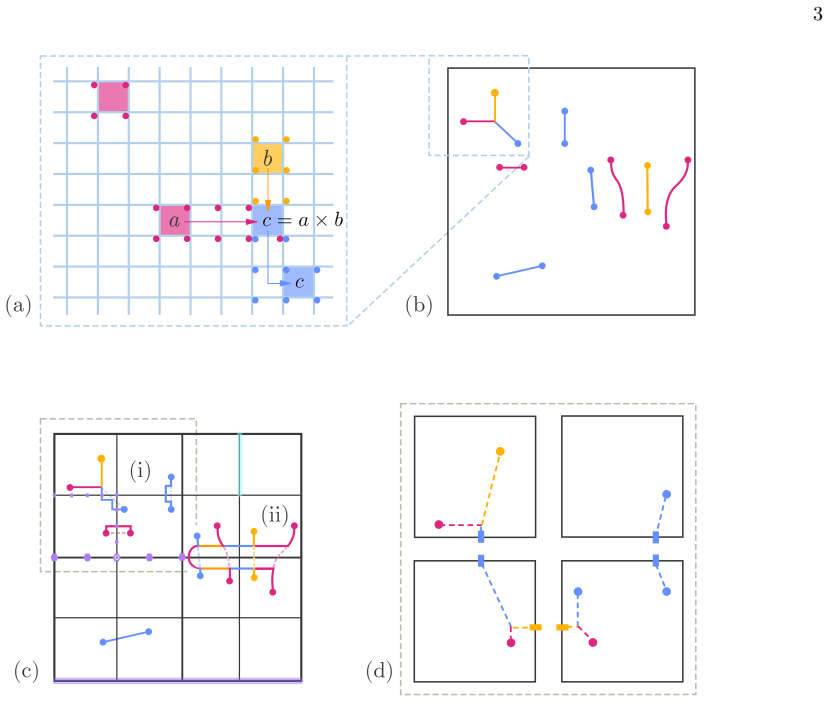
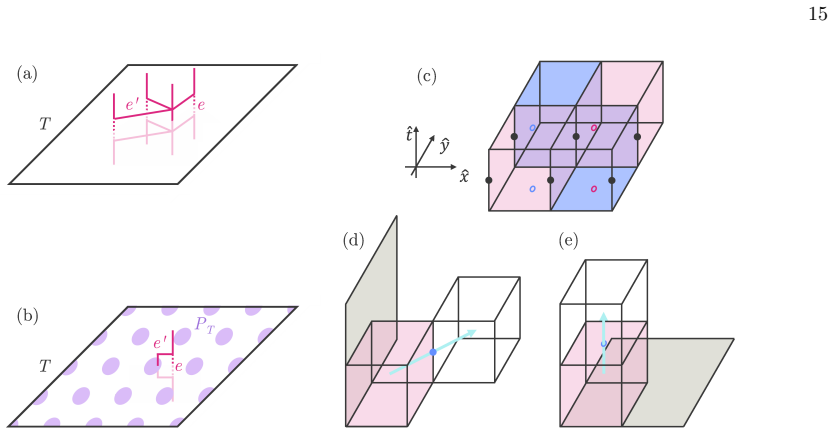
We prove that minimum-weight decoding of 2D TTI codes nonetheless admits a polynomial-time approximation scheme (PTAS), i.e., for any constant ε>0, a recovery operator of weight within a multiplicative factor of 1+ε of the minimum can be found in polynomial time. Our approach builds on Arora's PTAS for Euclidean problems, such as the traveling salesman problem, and applies when decoding can be cast in terms of point-like excitations connected by string-like errors. It therefore extends beyond two dimensions, covering certain higher-dimensional topological codes and quantum memories, including the toric code with phenomenological or circuit-level noise.
What carries the argument
Adaptation of Arora's PTAS for Euclidean geometric problems to the geometry of string-like errors that connect point-like excitations.
If this is right
- Practical decoders for large 2D color codes and toric codes can return recovery operators guaranteed to be within any constant factor of optimal.
- The same PTAS covers the toric code under phenomenological and circuit-level noise models.
- Exact minimum-weight decoding stays NP-hard while approximation becomes efficient.
- The technique reaches certain higher-dimensional topological codes whose error strings satisfy the same geometric structure.
Where Pith is reading between the lines
- Similar geometric reductions may yield PTAS results for other quantum decoding problems that reduce to connecting point defects with paths.
- Runtime benchmarks on concrete lattices such as the toric code would reveal whether the PTAS is already useful at moderate code sizes.
- The result raises the question of whether PTASs exist for decoding on lattices with defects or boundaries that still admit a string-excitation description.
Load-bearing premise
The decoding task can be cast as finding short connecting strings between point-like excitations so that Euclidean-style approximation methods apply.
What would settle it
An explicit 2D TTI code family and a fixed ε>0 for which every polynomial-time algorithm produces a recovery operator heavier than (1+ε) times the true minimum on some syndrome would falsify the claim.
Figures
read the original abstract
Two-dimensional topological translationally invariant (2D TTI) stabilizer codes lie at the heart of fault-tolerant quantum computation, but using them requires solving the decoding problem. Minimum-weight decoding of these codes was recently shown to be NP-hard, even in basic settings, such as the color code with Pauli $Z$ errors and the toric code with Pauli $X$, $Y$ and $Z$ errors. Here, we prove that minimum-weight decoding of 2D TTI codes nonetheless admits a polynomial-time approximation scheme (PTAS), i.e., for any constant $\varepsilon>0$, a recovery operator of weight within a multiplicative factor of $1+\varepsilon$ of the minimum can be found in polynomial time. Our approach builds on Arora's PTAS for Euclidean problems, such as the traveling salesman problem, and applies when decoding can be cast in terms of point-like excitations connected by string-like errors. It therefore extends beyond two dimensions, covering certain higher-dimensional topological codes and quantum memories, including the toric code with phenomenological or circuit-level noise.
Editorial analysis
A structured set of objections, weighed in public.
Referee Report
Summary. The manuscript proves that minimum-weight decoding of 2D topological translationally invariant (TTI) stabilizer codes admits a polynomial-time approximation scheme (PTAS). For any fixed ε > 0, a recovery operator whose weight is at most (1 + ε) times the minimum weight can be found in polynomial time. The proof reduces the decoding task to a geometric optimization problem on point-like excitations connected by string-like errors, to which Arora's PTAS for Euclidean problems (such as TSP) is applied. The result is stated to extend to selected higher-dimensional topological codes and to the toric code under phenomenological or circuit-level noise.
Significance. If the reduction is correctly established, the result is significant: exact minimum-weight decoding is NP-hard for the codes considered, yet a PTAS supplies a tunable approximation guarantee that becomes arbitrarily close to optimal while remaining polynomial-time. The approach re-uses a classical geometric PTAS rather than inventing a new one, and the extension beyond 2D broadens its relevance to quantum memories. No machine-checked proofs or reproducible code are mentioned, but the explicit link to an established classical result is a strength.
minor comments (2)
- The abstract states that the method 'applies when decoding can be cast in terms of point-like excitations connected by string-like errors,' but the manuscript should include a dedicated subsection that explicitly verifies the metric and embedding conditions required by Arora's PTAS (e.g., Euclidean distances versus lattice path lengths).
- A brief complexity table or statement of the running-time dependence on ε and code size would improve clarity, even if the polynomial bound is already implied by the cited classical result.
Simulated Author's Rebuttal
We thank the referee for their positive summary of the manuscript, recognition of its significance, and recommendation of minor revision. The report contains no specific major comments requiring point-by-point response.
Circularity Check
No significant circularity; derivation applies external PTAS to standard anyon model
full rationale
The paper's central result is a PTAS obtained by casting minimum-weight decoding of 2D TTI codes as a geometric optimization problem (point-like excitations connected by string-like errors) and invoking Arora's existing PTAS for Euclidean TSP-like problems. This reduction uses the standard anyon/string model of topological stabilizer codes, which is independent of the present work and externally verifiable. No equations, fitted parameters, or self-citations appear in the load-bearing steps; the NP-hardness of exact decoding is compatible with an approximation scheme. The derivation chain is self-contained against external benchmarks and does not reduce any claimed result to its own inputs by construction.
Axiom & Free-Parameter Ledger
axioms (1)
- domain assumption Arora's PTAS for Euclidean geometric problems applies once decoding is expressed as point-like excitations connected by string-like errors
Reference graph
Works this paper leans on
-
[1]
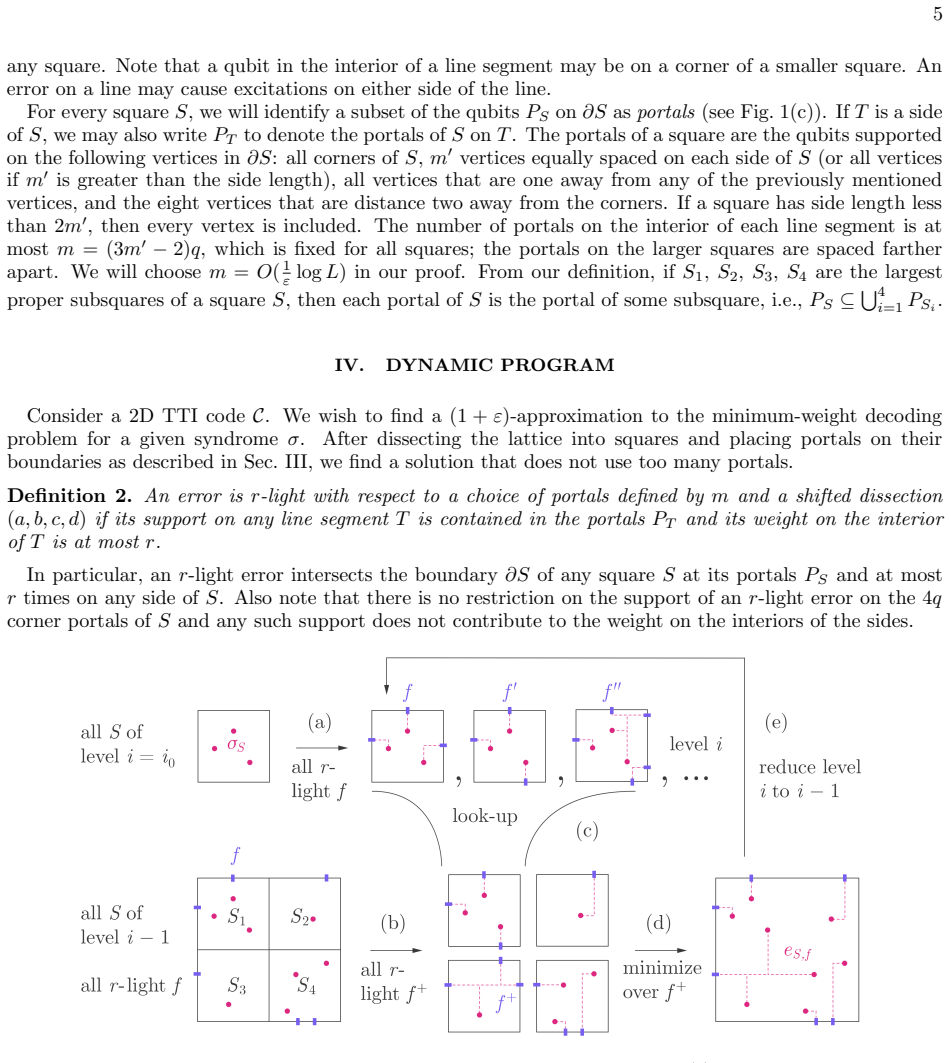
using exhaustive search, which is constant. Decoding subproblems at leveli < i 0 are solved by iterating through r-light lifts, finding the corresponding solutions to subdecoding problems at leveli+ 1, and piecing them together. Because there are four line segments that are shared between two of the four level-(i+ 1) squares as well as one corner shared b...
-
[2]
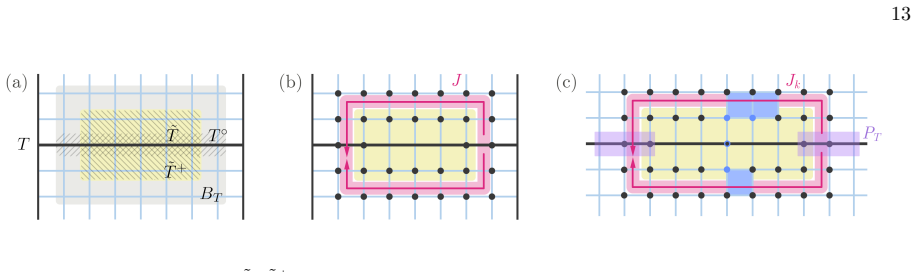
IfT ′ is a different line segment of level at leasti, then(B T ′ \T ′)∩T=∅. 2. S T ′:level(T ′)<i(BT ′ \T ′) ∩T ≤A. Proof.IfT ′ has level at leasti, then either it is entirely contained inT, it is disjoint fromT, or it intersects Tat the endpoint ofT ′. In all cases, (B T ′ \T ′)∩T=∅. IfT ′ has level less thani, i.e., level(T ′)< i, then an endpoint ofTma...
-
[3]
squares” to be slightly rectangular by rounding lines to the nearest integer coordinate. That is, for a shift (c, d), we can define the level-i“squares
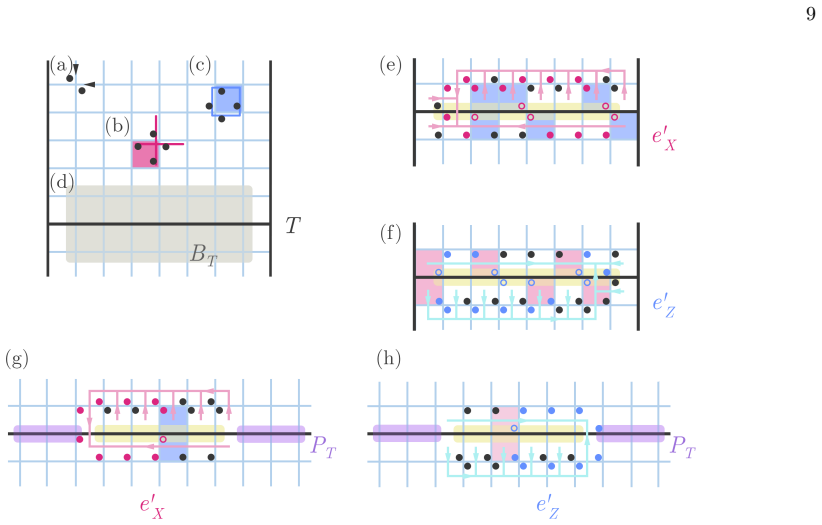
for any other line segmentT ′ of level lower than or equal to the level ofT,suppe ′ ∩T ′ =∅. Proof (toric code).The syndrome ofeconsists of excitations whose total charge is neutral and which are located on plaquettes adjacent toT. The errore ′ will be obtained from string operators that annihilate all excitations by moving allXexcitations to one place an...
2024
-
[4]
P. W. Shor, Scheme for reducing decoherence in quantum computer memory, Physical Review A52, R2493–R2496 (1995)
1995
-
[5]
A. M. Steane, Error correcting codes in quantum theory, Physical Review Letters77, 793–797 (1996)
1996
-
[6]
Gottesman, Class of quantum error-correcting codes saturating the quantum hamming bound, Physical Review A54, 1862–1868 (1996)
D. Gottesman, Class of quantum error-correcting codes saturating the quantum hamming bound, Physical Review A54, 1862–1868 (1996)
1996
-
[7]
P. W. Shor, Fault-tolerant quantum computation, inProceedings of the 37th Annual Symposium on Foundations of Computer Science, FOCS ’96 (IEEE Computer Society, USA, 1996) p. 56
1996
-
[8]
Preskill, Reliable quantum computers, Proceedings of the Royal Society of London
J. Preskill, Reliable quantum computers, Proceedings of the Royal Society of London. Series A: Mathematical, Physical and Engineering Sciences454, 385–410 (1998)
1998
-
[9]
Kitaev, Fault-tolerant quantum computation by anyons, Annals of Physics303, 2–30 (2003)
A. Kitaev, Fault-tolerant quantum computation by anyons, Annals of Physics303, 2–30 (2003)
2003
-
[10]
Bombin, An introduction to topological quantum codes (2013), arXiv:1311.0277 [quant-ph]
H. Bombin, An introduction to topological quantum codes (2013), arXiv:1311.0277 [quant-ph]
Pith/arXiv arXiv 2013
-
[11]
A. M. Kubica,The ABCs of the Color Code: A Study of Topological Quantum Codes as Toy Models for Fault- Tolerant Quantum Computation and Quantum Phases Of Matter, Ph.D. thesis (2018)
2018
-
[12]
S. B. Bravyi and A. Y. Kitaev, Quantum codes on a lattice with boundary (1998), arXiv:quant-ph/9811052 [quant-ph]
Pith/arXiv arXiv 1998
-
[13]
Haah, Commuting pauli hamiltonians as maps between free modules, Communications in Mathematical Physics 324, 351–399 (2013)
J. Haah, Commuting pauli hamiltonians as maps between free modules, Communications in Mathematical Physics 324, 351–399 (2013)
2013
-
[14]
A. A. Kovalev and L. P. Pryadko, Quantum kronecker sum-product low-density parity-check codes with finite rate, Physical Review A88, 10.1103/physreva.88.012311 (2013)
-
[15]
Bravyi, A
S. Bravyi, A. W. Cross, J. M. Gambetta, D. Maslov, P. Rall, and T. J. Yoder, High-threshold and low-overhead fault-tolerant quantum memory, Nature627, 778 (2024)
2024
-
[16]
Steffan, S
V. Steffan, S. H. Choe, N. P. Breuckmann, F. R. F. Pereira, and J. N. Eberhardt, Tile codes: High-efficiency quantum codes on a lattice with boundary, Physical Review Letters135, 170601 (2025)
2025
-
[17]
B. M. Terhal, Quantum error correction for quantum memories, Reviews of Modern Physics87, 307–346 (2015)
2015
-
[18]
Dennis, A
E. Dennis, A. Kitaev, A. Landahl, and J. Preskill, Topological quantum memory, Journal of Mathematical Physics43, 4452–4505 (2002)
2002
-
[19]
Delfosse, Decoding color codes by projection onto surface codes, Physical Review A89, 012317 (2014)
N. Delfosse, Decoding color codes by projection onto surface codes, Physical Review A89, 012317 (2014)
2014
-
[20]
Kubica and N
A. Kubica and N. Delfosse, Efficient color code decoders ind≥2 dimensions from toric code decoders, Quantum 7, 929 (2023). 18
2023
-
[21]
S. J. S. Tan, I. Gill, E. Huang, P. Liu, C. Zhao, H. Dehghani, A. Kubica, H. Zhou, and A. Dua, Generalized matching decoders for 2d topological translationally-invariant codes (2026), arXiv:2603.05402 [quant-ph]
arXiv 2026
-
[22]
K. Sahay, D. J. Williamson, and B. J. Brown, A matching decoder for bivariate bicycle codes (2026), arXiv:2602.22770 [quant-ph]
Pith/arXiv arXiv 2026
-
[23]
M. Walters and M. L. Turner, Minimum weight decoding in the colour code is np-hard (2026), arXiv:2603.04234 [quant-ph]
arXiv 2026
-
[24]
S. Gu, L. Wang, and A. Kubica, The color code, the surface code, and the transversal cnot: Np-hardness of minimum-weight decoding (2026), arXiv:2603.22064 [quant-ph]
arXiv 2026
-
[25]
Delfosse and J.-P
N. Delfosse and J.-P. Tillich, A decoding algorithm for css codes using the x/z correlations, in2014 IEEE International Symposium on Information Theory(IEEE, 2014) p. 1071–1075
2014
-
[26]
Higgott, T
O. Higgott, T. C. Bohdanowicz, A. Kubica, S. T. Flammia, and E. T. Campbell, Improved decoding of circuit noise and fragile boundaries of tailored surface codes, Physical Review X13, 031007 (2023)
2023
-
[27]
A. d. iOlius, J. E. Martinez, P. Fuentes, and P. M. Crespo, Performance enhancement of surface codes via recursive minimum-weight perfect-match decoding, Physical Review A108, 022401 (2023)
2023
-
[28]
Arora, Polynomial time approximation schemes for euclidean traveling salesman and other geometric problems, J
S. Arora, Polynomial time approximation schemes for euclidean traveling salesman and other geometric problems, J. ACM45, 753–782 (1998)
1998
-
[29]
Hsieh and F
M.-H. Hsieh and F. Le Gall, Np-hardness of decoding quantum error-correction codes, Physical Review A83, 052331 (2011)
2011
-
[30]
Kuo and C.-C
K.-Y. Kuo and C.-C. Lu, On the hardnesses of several quantum decoding problems, Quantum Information Processing19, 123 (2020)
2020
-
[31]
Yoshida, Classification of quantum phases and topology of logical operators in an exactly solved model of quantum codes, Annals of Physics326, 15–95 (2011)
B. Yoshida, Classification of quantum phases and topology of logical operators in an exactly solved model of quantum codes, Annals of Physics326, 15–95 (2011)
2011
-
[32]
Bomb´ ın, Structure of 2d topological stabilizer codes, Communications in Mathematical Physics327, 387 (2014)
H. Bomb´ ın, Structure of 2d topological stabilizer codes, Communications in Mathematical Physics327, 387 (2014)
2014
-
[33]
J. W. Harrington,Analysis of Quantum Error-Correcting Codes: Symplectic Lattice Codes and Toric Codes, phd, California Institute of Technology (2004)
2004
-
[34]
Duclos-Cianci and D
G. Duclos-Cianci and D. Poulin, Fast decoders for topological quantum codes, Physical Review Letters104, 050504 (2010)
2010
-
[35]
Bravyi and J
S. Bravyi and J. Haah, Quantum self-correction in the 3d cubic code model, Phys. Rev. Lett.111, 200501 (2013)
2013
-
[36]
Kubica and M
A. Kubica and M. Vasmer, Single-shot quantum error correction with the three-dimensional subsystem toric code, Nature Communications13, 6272 (2022)
2022
-
[37]
J. C. Bridgeman, A. Kubica, and M. Vasmer, Lifting topological codes: Three-dimensional subsystem codes from two-dimensional anyon models, PRX Quantum5, 020310 (2024)
2024
-
[38]
Bombin, Gauge color codes: optimal transversal gates and gauge fixing in topological stabilizer codes, New Journal of Physics17, 083002 (2015)
H. Bombin, Gauge color codes: optimal transversal gates and gauge fixing in topological stabilizer codes, New Journal of Physics17, 083002 (2015)
2015
-
[39]
Kubica and M
A. Kubica and M. E. Beverland, Universal transversal gates with color codes: A simplified approach, Physical Review A91, 032330 (2015)
2015
-
[40]
Bombin and M
H. Bombin and M. A. Martin-Delgado, Exact topological quantum order ind= 3 and beyond: Branyons and brane-net condensates, Physical Review B75, 075103 (2007)
2007
-
[41]
R. M. Karp, Reducibility among combinatorial problems, inComplexity of Computer Computations(Springer US, 1972) p. 85–103
1972
-
[42]
M. R. Garey and D. S. Johnson,Computers and Intractability; A Guide to the Theory of NP-Completeness(W. H. Freeman & Co., USA, 1990)
1990
-
[43]
J. M. Steele and T. L. Snyder, Worst-case growth rates of some classical problems of combinatorial optimization, SIAM Journal on Computing18, 278 (1989), https://doi.org/10.1137/0218019
-
[44]
Chamberland, A
C. Chamberland, A. Kubica, T. J. Yoder, and G. Zhu, Triangular color codes on trivalent graphs with flag qubits, New Journal of Physics22, 023019 (2020)
2020
-
[45]
Sahay and B
K. Sahay and B. J. Brown, Decoder for the triangular color code by matching on a m¨ obius strip, PRX Quantum 3, 010310 (2022)
2022
-
[46]
S.-H. Lee, A. Li, and S. D. Bartlett, Color code decoder with improved scaling for correcting circuit-level noise, Quantum9, 1609 (2025)
2025
-
[47]
A. G. Fowler, M. Mariantoni, J. M. Martinis, and A. N. Cleland, Surface codes: Towards practical large-scale quantum computation, Physical Review A86, 032324 (2012)
2012
-
[48]
Walters, Approximately decoding the colour code (2026), arXiv:2606.XXXXX
M. Walters, Approximately decoding the colour code (2026), arXiv:2606.XXXXX
2026
discussion (0)
Sign in with ORCID, Apple, or X to comment. Anyone can read and Pith papers without signing in.