Flavor phenomenology of light dark particles
Pith reviewed 2026-06-27 21:26 UTC · model grok-4.3
The pith
Flavor-violating decays of Standard Model particles produce missing-energy signals from light dark states that reach ultraviolet scales of 10^12 GeV.
A machine-rendered reading of the paper's core claim, the machinery that carries it, and where it could break.
Core claim
Light dark particles with sub-GeV masses and generic flavor-violating couplings naturally emerge from spontaneous breaking of flavored symmetries and are governed by dimension-five operators. Their production in two-body decays of Standard Model particles generates missing-energy signals observable in high-precision flavor experiments, core-collapse supernovae, and the cosmic microwave background. Dedicated laboratory searches therefore reach ultraviolet scales up to 10^12 GeV and stand as highly complementary probes to astrophysical and cosmological observations.
What carries the argument
Dimension-five operators that mediate the flavor-violating couplings between Standard Model particles and the light dark states.
If this is right
- Missing-energy signals appear in two-body decays of mesons and charged leptons.
- Flavor experiments set limits on the same couplings that astrophysical and cosmological observations constrain.
- The dimension-five nature of the operators allows laboratory sensitivity to ultraviolet scales far above the particle masses.
- Future flavor facilities can extend the reach in multiple decay channels simultaneously.
Where Pith is reading between the lines
- Non-observation of the signals would place model-independent upper bounds on the scale of flavored symmetry breaking.
- The same operators could be tested in beam-dump or fixed-target experiments that search for long-lived light states.
- Connections between flavor violation and dark-matter production mechanisms could be explored by combining the missing-energy limits with direct-detection data.
Load-bearing premise
Light dark particles with sub-GeV masses and generic flavor-violating couplings naturally emerge from spontaneous breaking of flavored symmetries and are controlled by dimension-five operators.
What would settle it
A high-precision search for missing energy in a two-body meson or lepton decay that either detects a signal rate inconsistent with all other bounds or excludes the predicted rate down to the level corresponding to a 10^12 GeV ultraviolet scale.
Figures
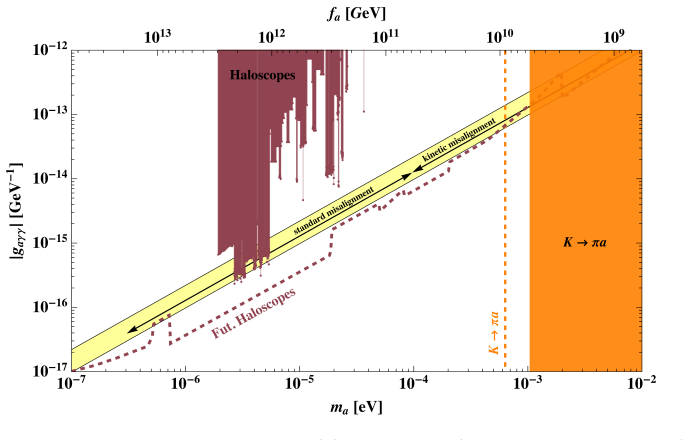
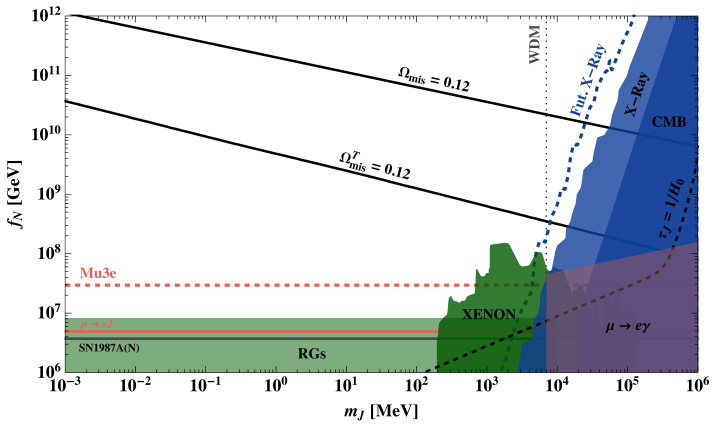
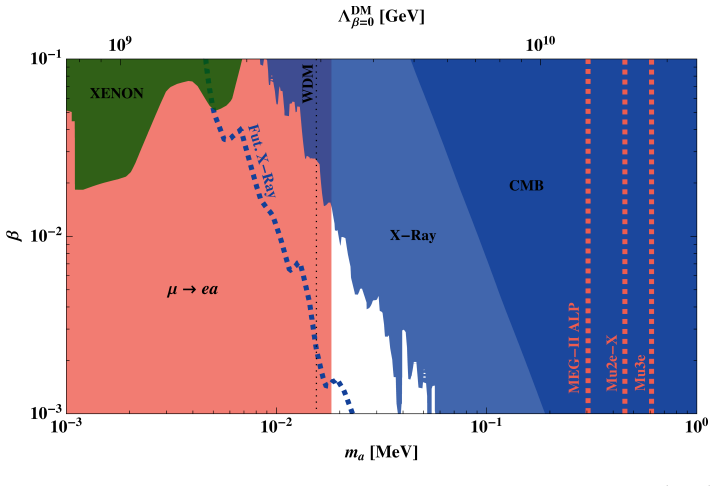
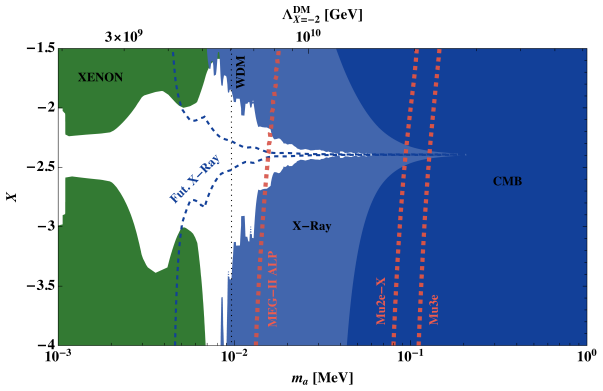
read the original abstract
We review the flavor phenomenology of light dark particles, focusing on axion-like particles with sub-GeV masses and generic flavor-violating couplings. Such states can naturally emerge from the spontaneous breaking of generic flavored symmetries, and are motivated by dark matter or the Strong CP Problem, with the QCD axion serving as a paradigmatic example. Light dark particles can be produced in two-body decays of Standard Model particles, giving rise to missing energy signals that can not only be observed in high-precision flavor experiments, but also be probed in core-collapse supernovae and the cosmic microwave background. These decays are controlled by dimension-five operators, which makes dedicated laboratory searches sensitive to very large UV scales up to $10^{12} {\rm GeV}$ and thus highly complementary to astrophysical and cosmological probes. We provide a comprehensive survey of the resulting limits and prospects across all relevant channels, highlighting the central role of flavor physics in exploring the landscape of light dark matter.
Editorial analysis
A structured set of objections, weighed in public.
Referee Report
Summary. The manuscript reviews the flavor phenomenology of sub-GeV axion-like particles (ALPs) with generic flavor-violating couplings that can arise from spontaneous breaking of flavored symmetries. Motivated by dark matter or the Strong CP problem, these particles are produced in two-body SM decays leading to missing energy. The paper provides a comprehensive survey of limits from flavor experiments, supernovae, and CMB, highlighting sensitivity to UV scales up to 10^{12} GeV via dimension-five operators, complementary to other probes.
Significance. If the compiled limits are accurate, this review offers a valuable synthesis of constraints on light dark particles from flavor physics and correctly identifies the complementarity with astrophysical probes. The central EFT scaling argument for dim-5 operator sensitivity follows standard reasoning and introduces no internal inconsistency. The work is a literature survey without new derivations, predictions, or machine-checked results.
minor comments (2)
- [Abstract] The phrase 'generic flavor-violating couplings' in the abstract and introduction would benefit from an explicit example operator (e.g., the form of the dim-5 interaction) to clarify the setup for readers.
- A consolidated table summarizing the key experimental and astrophysical limits across channels (with references) would improve the survey's accessibility and utility.
Simulated Author's Rebuttal
We thank the referee for the positive review and recommendation of minor revision. The report correctly identifies the manuscript as a literature survey on flavor-violating decays of sub-GeV ALPs and their complementarity with astrophysical and cosmological probes. No specific major comments were provided.
Circularity Check
No significant circularity; review paper with no derivations
full rationale
The manuscript is explicitly a literature survey of existing limits and prospects for light dark particles (ALPs) in flavor channels. No new predictions, derivations, or first-principles calculations are claimed or performed. The central statements about dimension-five operators and laboratory sensitivity to 10^12 GeV follow from standard EFT scaling already present in the cited literature; the paper does not fit parameters, rename results, or invoke self-citations as load-bearing uniqueness theorems. All quantitative statements are traceable to external references rather than internal construction.
Axiom & Free-Parameter Ledger
Reference graph
Works this paper leans on
-
[1]
J. L. Feng, T. Moroi, H. Murayama, and E. Schnapka,Third generation familons, b factories, and neutrino cosmology,Phys. Rev. D57(1998) 5875–5892, [hep-ph/9709411]
Pith/arXiv arXiv 1998
-
[2]
J. F. Kamenik and C. Smith,FCNC portals to the dark sector,JHEP 03(2012) 090, [arXiv:1111.6402]
Pith/arXiv arXiv 2012
-
[3]
F. Bj¨ orkeroth, E. J. Chun, and S. F. King,Flavourful Axion Phenomenology,JHEP08(2018) 117, [arXiv:1806.00660]
Pith/arXiv arXiv 2018
-
[4]
Ziegler,Flavored Axions,PoSCORFU2018(2019) 035, [arXiv:1905.01084]
R. Ziegler,Flavored Axions,PoSCORFU2018(2019) 035, [arXiv:1905.01084]
Pith/arXiv arXiv 2019
-
[5]
J. Martin Camalich, M. Pospelov, P. N. H. Vuong, R. Ziegler, and J. Zupan,Quark Flavor Phenomenology of the QCD Axion,Phys. Rev. D102(2020), no. 1 015023, [arXiv:2002.04623]
arXiv 2020
-
[6]
L. Calibbi, D. Redigolo, R. Ziegler, and J. Zupan,Looking forward to lepton-flavor-violating ALPs,JHEP09(2021) 173, [arXiv:2006.04795]
arXiv 2021
- [7]
-
[8]
Ziegler,Flavor Probes of Axion Dark Matter,PoS DISCRETE2022(2024) 086, [arXiv:2303.13353]
R. Ziegler,Flavor Probes of Axion Dark Matter,PoS DISCRETE2022(2024) 086, [arXiv:2303.13353]
arXiv 2024
-
[9]
J. Martin Camalich and R. Ziegler,Flavor Phenomenology of Light Dark Sectors,Ann. Rev. Nucl. Part. Sci.75(2025), no. 1 223–246, [arXiv:2503.17323]
arXiv 2025
-
[10]
Weinberg,A New Light Boson?,Phys
S. Weinberg,A New Light Boson?,Phys. Rev. Lett.40(1978) 223–226
1978
-
[11]
Wilczek,Problem of StrongPandTInvariance in the Presence of Instantons,Phys
F. Wilczek,Problem of StrongPandTInvariance in the Presence of Instantons,Phys. Rev. Lett.40(1978) 279–282
1978
-
[12]
R. D. Peccei and H. R. Quinn,CP Conservation in the Presence of Instantons,Phys. Rev. Lett.38(1977) 1440–1443. 108
1977
-
[13]
R. D. Peccei and H. R. Quinn,Constraints Imposed by CP Conservation in the Presence of Instantons,Phys. Rev. D16(1977) 1791–1797
1977
-
[14]
D. B. Reiss,Can the Family Group Be a Global Symmetry?,Phys. Lett. B115(1982) 217–220
1982
-
[15]
G. B. Gelmini, S. Nussinov, and T. Yanagida,Does Nature Like Nambu-Goldstone Bosons?,Nucl. Phys. B219(1983) 31–40
1983
-
[16]
Wilczek,Axions and Family Symmetry Breaking,Phys
F. Wilczek,Axions and Family Symmetry Breaking,Phys. Rev. Lett. 49(1982) 1549–1552
1982
-
[17]
Jodidio et al.,Search for Right-Handed Currents in Muon Decay, Phys
A. Jodidio et al.,Search for Right-Handed Currents in Muon Decay, Phys. Rev. D34(1986) 1967. [Erratum: Phys.Rev.D 37, 237 (1988)]. [18]SINDRUMCollaboration, R. Eichler et al.,Limits for Shortlived Neutral Particles Emittedµ + orπ + Decay,Phys. Lett. B175(1986) 101
1986
-
[18]
D. A. Bryman,RARE KAON DECAYS,Int. J. Mod. Phys. A4 (1989) 79
1989
-
[19]
R. D. Bolton et al.,Search for Rare Muon Decays with the Crystal Box Detector,Phys. Rev. D38(1988) 2077
1988
-
[20]
M. J. Dolan, F. Kahlhoefer, C. McCabe, and K. Schmidt-Hoberg,A taste of dark matter: Flavour constraints on pseudoscalar mediators, JHEP03(2015) 171, [arXiv:1412.5174]. [Erratum: JHEP 07, 103 (2015)]
Pith/arXiv arXiv 2015
-
[21]
E. Izaguirre, T. Lin, and B. Shuve,Searching for Axionlike Particles in Flavor-Changing Neutral Current Processes,Phys. Rev. Lett.118 (2017), no. 11 111802, [arXiv:1611.09355]
Pith/arXiv arXiv 2017
-
[22]
S. R. Choudhury and N. Gaur,Dileptonic decay of B(s) meson in SUSY models with large tan Beta,Phys. Lett. B451(1999) 86–92, [hep-ph/9810307]
Pith/arXiv arXiv 1999
-
[23]
D. Baumann, D. Green, and B. Wallisch,New Target for Cosmic Axion Searches,Phys. Rev. Lett.117(2016), no. 17 171301, [arXiv:1604.08614]. 109
arXiv 2016
-
[24]
C. Bird, P. Jackson, R. V. Kowalewski, and M. Pospelov,Search for dark matter inb→stransitions with missing energy,Phys. Rev. Lett.93(2004) 201803, [hep-ph/0401195]
Pith/arXiv arXiv 2004
-
[25]
A. Badin and A. A. Petrov,Searching for light Dark Matter in heavy meson decays,Phys. Rev. D82(2010) 034005, [arXiv:1005.1277]
Pith/arXiv arXiv 2010
-
[26]
C. A. J. O’Hare and E. Vitagliano,Cornering the axion with CP-violating interactions,Phys. Rev. D102(2020), no. 11 115026, [arXiv:2010.03889]
arXiv 2020
-
[27]
V. M. Mostepanenko and G. L. Klimchitskaya,The State of the Art in Constraining Axion-to-Nucleon Coupling and Non-Newtonian Gravity from Laboratory Experiments,Universe6(2020), no. 9 147, [arXiv:2009.04517]
arXiv 2020
-
[28]
J. F. Eguren, S. Klingel, E. Stamou, M. Tabet, and R. Ziegler, Flavor phenomenology of light dark vectors,JHEP08(2024) 111, [arXiv:2405.00108]
arXiv 2024
-
[29]
Heeck,Lepton flavor violation with light vector bosons,Phys
J. Heeck,Lepton flavor violation with light vector bosons,Phys. Lett. B758(2016) 101–105, [arXiv:1602.03810]
Pith/arXiv arXiv 2016
- [30]
-
[31]
E. Gabrielli, B. Mele, M. Raidal, and E. Venturini,FCNC decays of standard model fermions into a dark photon,Phys. Rev. D94(2016), no. 11 115013, [arXiv:1607.05928]
Pith/arXiv arXiv 2016
-
[32]
M. Fabbrichesi, E. Gabrielli, and B. Mele,Hunting down massless dark photons in kaon physics,Phys. Rev. Lett.119(2017), no. 3 031801, [arXiv:1705.03470]
Pith/arXiv arXiv 2017
- [33]
- [34]
-
[35]
Wess and B
J. Wess and B. Zumino,Consequences of anomalous Ward identities, Phys. Lett. B37(1971) 95–97. 110
1971
-
[36]
Witten,Global Aspects of Current Algebra,Nucl
E. Witten,Global Aspects of Current Algebra,Nucl. Phys. B223 (1983) 422–432
1983
-
[37]
G. Grilli di Cortona, E. Hardy, J. Pardo Vega, and G. Villadoro,The QCD axion, precisely,JHEP01(2016) 034, [arXiv:1511.02867]
Pith/arXiv arXiv 2016
-
[38]
M. Gorghetto and G. Villadoro,Topological Susceptibility and QCD Axion Mass: QED and NNLO corrections,JHEP03(2019) 033, [arXiv:1812.01008]
arXiv 2019
-
[39]
Preskill, M
J. Preskill, M. B. Wise, and F. Wilczek,Cosmology of the Invisible Axion,Phys. Lett. B120(1983) 127–132
1983
-
[40]
L. F. Abbott and P. Sikivie,A Cosmological Bound on the Invisible Axion,Phys. Lett. B120(1983) 133–136
1983
-
[41]
Dine and W
M. Dine and W. Fischler,The Not So Harmless Axion,Phys. Lett. B 120(1983) 137–141
1983
-
[42]
L. Di Luzio, M. Giannotti, E. Nardi, and L. Visinelli,The landscape of QCD axion models,Phys. Rept.870(2020) 1–117, [arXiv:2003.01100]
Pith/arXiv arXiv 2020
-
[43]
J. Jaeckel and A. Ringwald,The Low-Energy Frontier of Particle Physics,Ann. Rev. Nucl. Part. Sci.60(2010) 405–437, [arXiv:1002.0329]
Pith/arXiv arXiv 2010
-
[44]
I. G. Irastorza and J. Redondo,New experimental approaches in the search for axion-like particles,Prog. Part. Nucl. Phys.102(2018) 89–159, [arXiv:1801.08127]
Pith/arXiv arXiv 2018
-
[45]
Chikashige, R
Y. Chikashige, R. N. Mohapatra, and R. D. Peccei,Are There Real Goldstone Bosons Associated with Broken Lepton Number?,Phys. Lett. B98(1981) 265–268
1981
-
[46]
Schechter and J
J. Schechter and J. W. F. Valle,Neutrino Decay and Spontaneous Violation of Lepton Number,Phys. Rev. D25(1982) 774
1982
-
[47]
A. A. Anselm and N. G. Uraltsev,Flavor Changing Interactions of Goldstone Bosons with Fermions,Sov. Phys. JETP57(1983) 1142–1151
1983
-
[48]
P. W. Graham, D. E. Kaplan, and S. Rajendran,Cosmological Relaxation of the Electroweak Scale,Phys. Rev. Lett.115(2015), no. 22 221801, [arXiv:1504.07551]. 111
Pith/arXiv arXiv 2015
-
[49]
J. P. Conlon,The QCD axion and moduli stabilisation,JHEP05 (2006) 078, [hep-th/0602233]
Pith/arXiv arXiv 2006
-
[50]
P. Svrcek and E. Witten,Axions In String Theory,JHEP06(2006) 051, [hep-th/0605206]
Pith/arXiv arXiv 2006
-
[51]
A. Arvanitaki, S. Dimopoulos, S. Dubovsky, N. Kaloper, and J. March-Russell,String Axiverse,Phys. Rev. D81(2010) 123530, [arXiv:0905.4720]
Pith/arXiv arXiv 2010
-
[52]
M. Cicoli,Axion-like Particles from String Compactifications, in9th Patras Workshop on Axions, WIMPs and WISPs, pp. 235–242, 2013. arXiv:1309.6988
Pith/arXiv arXiv 2013
-
[53]
J. E. Kim,Weak Interaction Singlet and Strong CP Invariance, Phys. Rev. Lett.43(1979) 103
1979
-
[54]
M. A. Shifman, A. I. Vainshtein, and V. I. Zakharov,Can Confinement Ensure Natural CP Invariance of Strong Interactions?, Nucl. Phys. B166(1980) 493–506
1980
-
[55]
M. Dine, W. Fischler, and M. Srednicki,A Simple Solution to the Strong CP Problem with a Harmless Axion,Phys. Lett. B104(1981) 199–202
1981
-
[56]
A. R. Zhitnitsky,On Possible Suppression of the Axion Hadron Interactions. (In Russian),Sov. J. Nucl. Phys.31(1980) 260
1980
-
[57]
Davidson and M
A. Davidson and M. A. H. Vozmediano,The Horizontal Axion Alternative: The Interplay of Vacuum Structure and Flavor Interactions,Nucl. Phys. B248(1984) 647–670
1984
-
[58]
W. A. Bardeen, R. D. Peccei, and T. Yanagida,CONSTRAINTS ON VARIANT AXION MODELS,Nucl. Phys. B279(1987) 401–428
1987
-
[59]
R. D. Peccei, T. T. Wu, and T. Yanagida,A VIABLE AXION MODEL,Phys. Lett. B172(1986) 435–440
1986
-
[60]
L. M. Krauss and F. Wilczek,A SHORTLIVED AXION VARIANT, Phys. Lett. B173(1986) 189–192
1986
-
[61]
C. Q. Geng and J. N. Ng,Flavor Connections and Neutrino Mass Hierarchy Invariant Invisible Axion Models Without Domain Wall Problem,Phys. Rev. D39(1989) 1449. 112
1989
-
[62]
M. Hindmarsh and P. Moulatsiotis,Constraints on variant axion models,Phys. Rev. D56(1997) 8074–8081, [hep-ph/9708281]
Pith/arXiv arXiv 1997
-
[63]
A. Celis, J. Fuentes-Martin, and H. Serodio,An invisible axion model with controlled FCNCs at tree level,Phys. Lett. B741(2015) 117–123, [arXiv:1410.6217]
Pith/arXiv arXiv 2015
-
[64]
L. Di Luzio, F. Mescia, E. Nardi, P. Panci, and R. Ziegler, Astrophobic Axions,Phys. Rev. Lett.120(2018), no. 26 261803, [arXiv:1712.04940]
Pith/arXiv arXiv 2018
-
[65]
F. Bj¨ orkeroth, L. Di Luzio, F. Mescia, E. Nardi, P. Panci, and R. Ziegler,Axion-electron decoupling in nucleophobic axion models, Phys. Rev. D101(2020), no. 3 035027, [arXiv:1907.06575]
arXiv 2020
-
[66]
M. Badziak and K. Harigaya,Naturally astrophobic QCD axion, JHEP06(2023) 014, [arXiv:2301.09647]
arXiv 2023
-
[67]
M. Badziak, K. Harigaya, M. Lukawski, and R. Ziegler,Thermal production of astrophobic axions,JHEP09(2024) 136, [arXiv:2403.05621]
arXiv 2024
-
[68]
K. Saikawa and T. T. Yanagida,Stellar cooling anomalies and variant axion models,JCAP03(2020) 007, [arXiv:1907.07662]
arXiv 2020
-
[69]
M. Badziak, G. Grilli di Cortona, M. Tabet, and R. Ziegler, Flavor-violating Higgs decays and stellar cooling anomalies in axion models,JHEP10(2021) 181, [arXiv:2107.09708]
arXiv 2021
-
[70]
Davidson and K
A. Davidson and K. C. Wali,MINIMAL FLAVOR UNIFICATION VIA MULTIGENERATIONAL PECCEI-QUINN SYMMETRY, Phys. Rev. Lett.48(1982) 11
1982
-
[71]
Z. G. Berezhiani and M. Y. Khlopov,Cosmology of Spontaneously Broken Gauge Family Symmetry,Z. Phys. C49(1991) 73–78
1991
-
[72]
Y. Ema, K. Hamaguchi, T. Moroi, and K. Nakayama,Flaxion: a minimal extension to solve puzzles in the standard model,JHEP01 (2017) 096, [arXiv:1612.05492]
Pith/arXiv arXiv 2017
-
[73]
L. Calibbi, F. Goertz, D. Redigolo, R. Ziegler, and J. Zupan, Minimal axion model from flavor,Phys. Rev. D95(2017), no. 9 095009, [arXiv:1612.08040]. 113
Pith/arXiv arXiv 2017
-
[74]
C. D. Froggatt and H. B. Nielsen,Hierarchy of Quark Masses, Cabibbo Angles and CP Violation,Nucl. Phys. B147(1979) 277–298
1979
-
[75]
L. E. Ibanez and G. G. Ross,Fermion masses and mixing angles from gauge symmetries,Phys. Lett. B332(1994) 100–110, [hep-ph/9403338]
Pith/arXiv arXiv 1994
-
[76]
P. Binetruy and P. Ramond,Yukawa textures and anomalies,Phys. Lett. B350(1995) 49–57, [hep-ph/9412385]
Pith/arXiv arXiv 1995
-
[77]
Z. G. Berezhiani and M. Y. Khlopov,The Theory of broken gauge symmetry of families. (In Russian),Sov. J. Nucl. Phys.51(1990) 739–746
1990
-
[78]
Z. G. Berezhiani and M. Y. Khlopov,Physical and astrophysical consequences of breaking of the symmetry of families. (In Russian), Sov. J. Nucl. Phys.51(1990) 935–942
1990
-
[79]
Y. H. Ahn,Flavored Peccei-Quinn symmetry,Phys. Rev. D91 (2015) 056005, [arXiv:1410.1634]
Pith/arXiv arXiv 2015
-
[80]
T. Nomura, Y. Shimizu, and T. Yamada,A 4 ×U(1) P Q model for the lepton flavor structure and the strongCPproblem,JHEP06(2016) 125, [arXiv:1604.07650]
Pith/arXiv arXiv 2016
discussion (0)
Sign in with ORCID, Apple, or X to comment. Anyone can read and Pith papers without signing in.