REVIEW 4 major objections 5 minor 74 references
Fundamental Scaling Limit in Critical Quantum Metrology
T0 review · 4 major / 5 minor · reviewed 2026-08-15 · deepseek-v4-flash
Pith's one-line read For the quadratic critical Hamiltonian, the winding number of the phase-space trajectory sets a hard scaling bound on quantum Fisher information, and a phase-dependent on-off control saturates the resulting exponential limit.
desk verdict A genuinely new winding-number framework for QFI scaling in critical quantum metrology, with solid fixed-n bounds and a plausible but not rigorously proven exponential optimality claim. read the letter →
The pith
A machine-rendered reading of the paper's core claim, the machinery that carries it, and where it could break.
The reading
What carries the argument
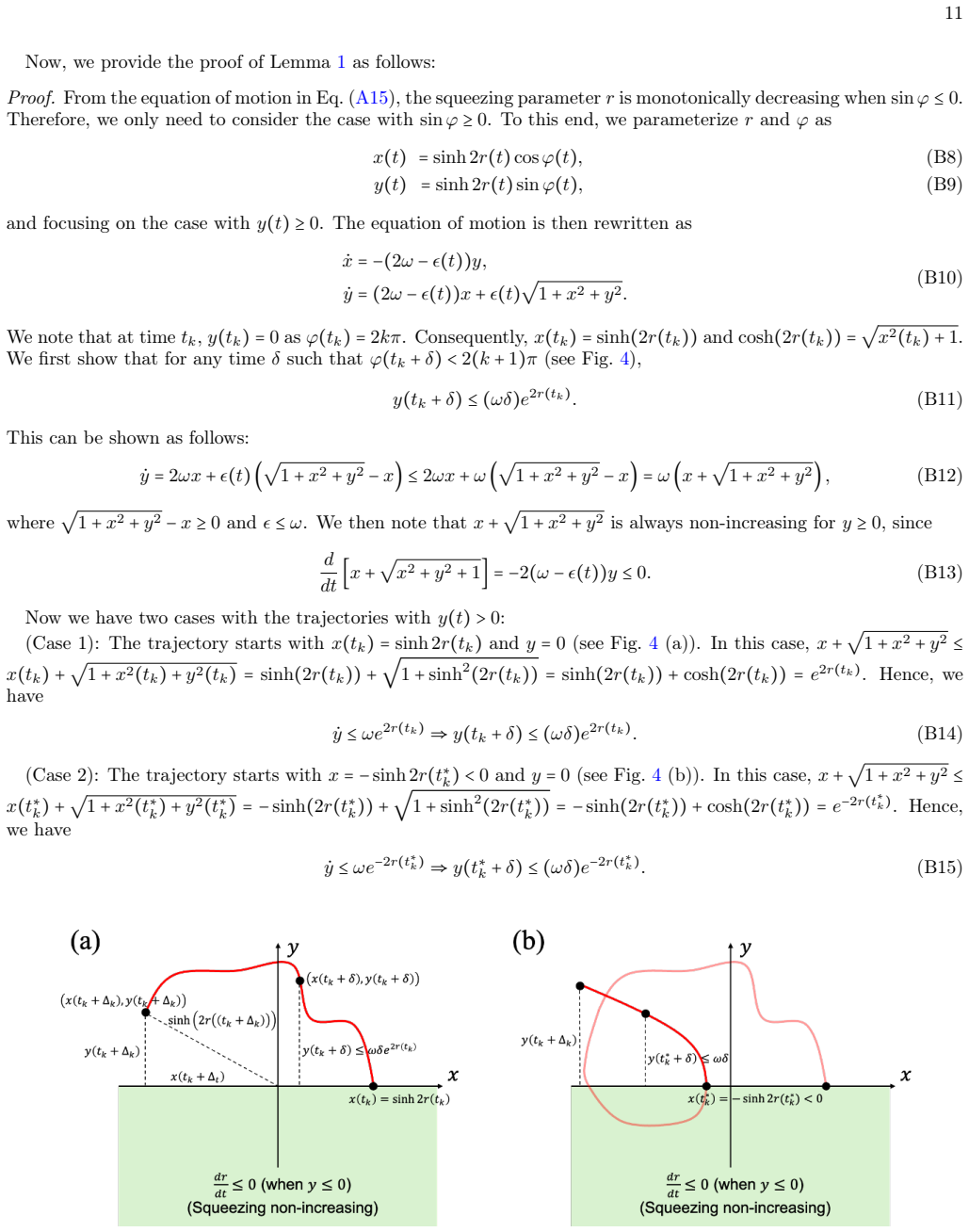
The central object is the winding number $n=\lfloor\Phi/2\pi\rfloor$, where $\Phi$ is the total phase accumulated by the squeezing angle $\varphi$ of the Gaussian state. The argument runs through the exact quantum-Fisher-information formula $F_\omega=2\left|\int_0^T dt\,\sinh 2r(t)\,e^{i\theta(t)}\right|^2$, which in the large-squeezing limit $\coth(2r)\approx 1$ and $\dot\theta\approx 0$ reduces to $F_\omega\approx 2\left(\int_0^T dt\,\sinh 2r(t)\right)^2$. The winding number bounds how fast the squeezing $r$ can grow per cycle: Lemma 1 gives $\cosh 2r(t_k+\Delta_k)\le(\omega^2\Delta_k^2+1)\cosh 2r(t_k)$ for each non-winding interval, which yields the $T^{4n+6}$ power by repeated application, and the on-off protocol extremizes $r(T,\Phi)$ in the large-$r$ asymptotic equations by saturating the bounds on $dt/d\varphi$.
What would settle it
Run the exact equations of motion (Eqs. (5) and (6) of the paper) for the proposed on-off schedule at large but finite $T$ (say $\omega T=10^3$ or $10^4$) and fit the exponent of $F_\omega(T)$; if the fitted exponent departs from $0.9745$ as $r$ grows, or if $\theta(t)$ in Eq. (6) drifts over time instead of staying constant, the asymptotic saturation claim fails.
Extended reading notes
Core claim
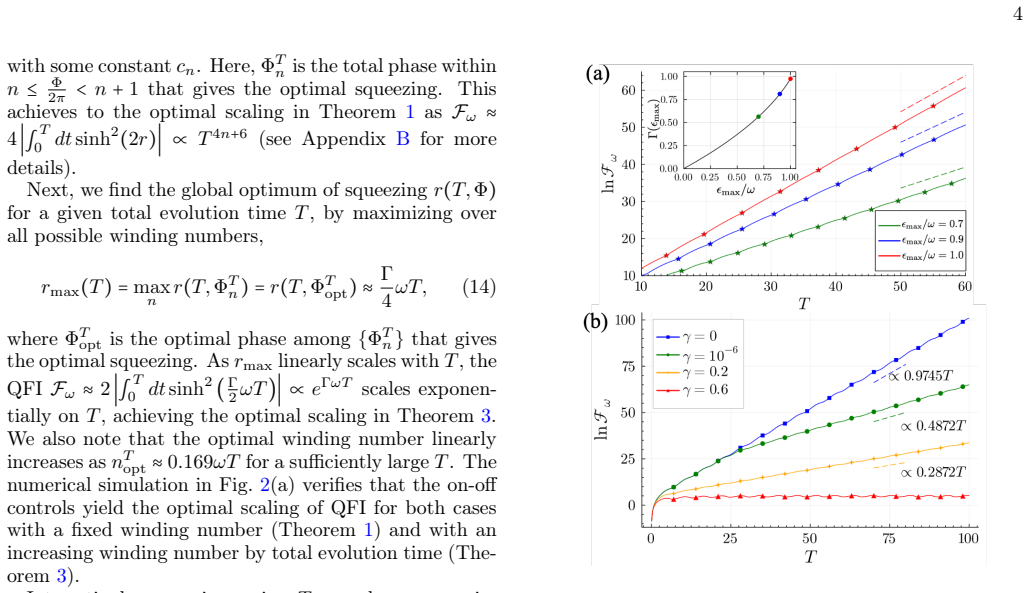
For the single-mode squeezed Hamiltonian $\hat H(t)=\omega\hat a^\dagger\hat a-\epsilon(t)(\hat a^\dagger+\hat a)^2/4$ with $0\le\epsilon(t)\le\omega$, the paper proves that the quantum Fisher information after total time $T$ is controlled by the winding number $n=\lfloor\Phi/2\pi\rfloor$ of the phase-space trajectory, where $\Phi=\int_0^T \dot\varphi\,dt$ is the total accumulated phase of the squeezing angle. Theorem 1 bounds fixed-$n$ precision by $F_\omega(T)\le c_n T^{4n+6+o(1)}$; Theorem 2 shows that every monotonic protocol has $n=0$ and hence cannot beat $T^6$; Theorem 3 establishes the global bound $F_\omega(T)\propto e^{0.9745\,\omega T}$, saturated by the winding number $n\approx 0.169\,\omega T$. The optimal protocol is a phase-dependent on-off switch alternating $\epsilon=\omega$ and $\epsilon=0$, and the optimal phase jumps discontinuously whenever the optimal winding number increases, a behavior the authors interpret as a first-order transition in the squeezing. Theorems 4 through 6 extend the exponential law to controls with $\epsilon_{\max}<\omega$ and to thermal dissipation, with exponents $\Gamma(\epsilon_{\max})\omega$ and $\Gamma(\epsilon_{\max})\omega/2-\gamma$, respectively.
Load-bearing premise
The exponential limit and its saturation rely on the large-squeezing asymptotic equations $\coth(2r)\approx 1$ and $\dot\theta\approx 0$, so if the phase alignment of the on-off path degrades at finite squeezing or over many cycles, the exact dynamics need not realize the claimed $\Gamma\approx 0.9745$ exponent.
Editorial extensions
If this is right
- Monotonic critical driving, whether adiabatic or quench-like, is provably capped at $T^6$; only non-monotonic control can do better.
- The on-off schedule is specified entirely by the phase of the squeezed state, so it can be implemented without detailed model knowledge.
- The universal exponential law $e^{0.9745\,\omega T}$ improves the exponent by roughly a factor of seven over the best previously reported periodic-driving protocol.
- Since the same exponential scaling holds for $\epsilon_{\max}<\omega$, reaching the critical point is not required; increasing the winding number is the dominant resource.
- Thermal dissipation slows the exponent by $\gamma$ per unit time but does not destroy the exponential scaling, and the exponent is independent of the bath occupation number.
Reading between the lines
- If the topological picture is robust beyond quadratic models, similar winding-number controls could improve parameter estimation in other driven Gaussian or spin systems.
- A testable extension is to measure the QFI exponent at finite squeezing and moderate $T$; the asymptotic regime may require enormous squeezing before $\Gamma\approx 0.9745$ becomes visible.
- The first-order jumps in the optimal phase suggest a continuous-variable analogue of topological phase transitions, where optimal strategies are labeled by topological sectors and switch discontinuously at critical times.
- The theory suggests that fast, phase-locked modulation can circumvent critical slowing down in many-body sensing, but the transfer of the bound beyond the single-mode Gaussian setting would need to be checked.
Signed reviews
Editorial analysis
A structured set of objections, weighed in public.
Referee Report
Summary. The manuscript studies the time-dependent quadratic bosonic Hamiltonian H(t)=ωa†a−ε(t)(a†+a)²/4 with 0≤ε(t)≤ω, starting from the vacuum state. It derives Gaussian dynamics for the squeezing parameter r and phase φ, and a closed-form expression for the quantum Fisher information. The central claims are Theorem 1 (fixed winding number n gives Fω≤c_n T^{4n+6+o(1)}), Theorem 2 (monotonically increasing ε cannot exceed T⁶), Theorem 3 (optimal winding number n≈0.169ωT yields Fω∝e^{ΓωT} with Γ≈0.9745), Theorem 4 (away from criticality, fixed n gives bounded squeezing and only T² QFI), Theorem 5 (exponential scaling with exponent Γ(εmax)), and Theorem 6 (dissipative exponent Γ(εmax)ω/2−γ). An on-off control depending on the phase is constructed to saturate the predicted scaling.
Significance. If the exponential bound is rigorously established, the paper provides a unified, parameter-free scaling theory for critical quantum metrology and an explicit, experimentally plausible protocol, unifying previous T⁴, T⁶, and periodic-driving results. The proofs of Theorems 1, 2, and 4 are detailed and internally consistent; the constants Γ≈0.9745 and n≈0.169ωT are derived from the displayed optimization equations and then confirmed by independent exact numerical simulation, with no fitted parameters. The main weakness is that the exponential 'fundamental limit' is proven only inside a large-squeezing asymptotic reduction, not as an upper bound for the original exact control system; this gap is load-bearing for the central claim.
major comments (4)
- [Appendix C, Lemma 3 and Eq. (C11)] The proof of Lemma 3, which establishes that the on-off schedule maximizes r(T,Φ), contains an unreadable corrupted expression at Eq. (C11). The text between Eq. (C10) and Eq. (C12) is not a valid mathematical derivation, so the optimality of the saturating protocol cannot be checked from the manuscript. Since Lemma 3 underlies both the fixed-n optimal protocol and the exponential-saturation claim, this must be repaired or replaced with a readable proof.
- [Appendix D, proof of Theorem 3, Eqs. (D3)-(D9); main text Eq. (10)] The proof of Theorem 3 maximizes r(T,Φ) within the large-squeezing reduced model: coth(2r)→1 and θ̇≈0 (Eq. (C1) and main-text Eq. (10)). This is an optimization inside an asymptotic model, not an upper bound for the exact control system (Eq. (5)/(A15)). For every finite r, coth(2r)>1, which changes the phase equation and can in principle allow different squeezing-per-cycle behavior; no exchange-of-limits argument is given to show that all finite-r corrections contribute only O(1) over the full time T. Therefore the claim that Γ≈0.9745 is the fundamental exponential exponent for arbitrary admissible controls is not rigorously established. The exact simulations in Fig. 2 demonstrate that the specific on-off protocol achieves the claimed scaling, but they do not establish global optimality.
- [Appendix D, proof of Theorem 5 and Theorem 6, Eqs. (D18)-(D20) and (D34)-(D47)] The same asymptotic-model issue affects Theorem 5 and the dissipative exponent. In Theorem 5, Γ(εmax) is obtained by maximizing Eq. (D19), which is derived from the large-squeezing expression for r(T,Φ) and the modified boundary condition; no proof is given that the exact finite-r dynamics cannot produce a larger exponent. In Theorem 6, the dissipative bound relies on reparameterizing s=(γt+ln(µ sinh 2r))/2 and then invoking the closed-system asymptotic scaling; again, corrections at finite r and the passage from s to r assume the r≫1 limit without a rigorous error estimate over the entire evolution time. These theorems should be restated as asymptotic optimization results within the reduced model, or supplemented with a rigorous finite-r upper bound, to support the phrase 'fundamental scaling limit.'
- [General] The paper's abstract and Theorem 3 are phrased as fundamental bounds ('cannot exceed,' 'scaling bound'), while the proof establishes only achievability and optimality within the on-off class in the large-squeezing limit. The manuscript should either sharpen the proof to a genuine upper bound over all admissible controls or explicitly qualify the theorem as an asymptotic achievability and saturation result for the constructed protocol, with the fundamental-bound status clearly separated.
minor comments (5)
- [Appendix C, first sentence] 'For larger limit' should read 'For the large squeezing limit, r≫1.'
- [Appendix D, after Eq. (D27)] 'we obatin' is a typo and should be 'we obtain.'
- [Appendix D, proof of Lemma 4, around Eqs. (D52)-(D54)] The two hypothetical Lindbladians are both written as L1; the second should be L2 for the construction to be understandable.
- [Main text, after Eq. (13)] The displayed quantity Fω≈4|∫ dt sinh2(2r)| is confusing: Eq. (6) gives Fω=2|∫ dt sinh(2r)e^{iθ}|², so the intended expression is presumably 4|∫ dt sinh(2r)|² or an equivalent squared form; please correct the notation.
- [Appendix D, Eq. (D32) and (D73)-(D75)] The factor structure in Lemma 4 is stated as Fω(ρ(T))≤4T∫dt sinh²2r(t), but the derivation passes through B(ρ(t), i[ρ(t),a†a]) and Eq. (D74); the final factor is plausible, but the intermediate constants should be checked for consistency with the standard definition of B.
Circularity Check
No significant circularity: all claimed scaling bounds are derived from the equations of motion and verified by independent exact simulation, with no fitted parameter renamed as a prediction.
full rationale
The paper's derivation chain is self-contained. The QFI formula (Eq. 6 and Appendix A) is derived from the Gaussian dynamics of the quadratic Hamiltonian, not assumed from data. Theorem 1's T^{4n+6} bound follows from Lemma 1, which bounds squeezing growth between winding-number crossings using the exact equations of motion (Appendix B). Theorem 2 is a separate no-go proof for monotonic controls with n=0, again derived from the exact dynamics. The exponential bound in Theorem 3 is obtained by maximizing the asymptotic large-squeezing expression r(T,Φ) in Appendix C, and the constants Gamma≈0.9745 and n≈0.169ωT are the output of that optimization, later confirmed by exact numerical simulation of Eqs. (5)-(6) in Fig. 2(a); they are not fitted to the target QFI data. No parameter is fitted to a subset of data and then called a prediction, no uniqueness claim is imported from the authors' prior work, and no known empirical pattern is merely renamed. The self-citations appearing in the references are background model inputs (e.g., the fully connected Hamiltonian and Gaussian-state formalism), not load-bearing justifications of the scaling results. The large-squeezing reduction (coth(2r)≈1, θ̇≈0, Appendix C Eq. C1) is a stated approximation used inside the optimization, so any concern that Theorem 3's 'fundamental' bound is not fully proven for exact finite-r dynamics is a mathematical-rigor or correctness concern, not circularity: the derivation does not assume the conclusion. Similarly, the corrupted/unreadable passage in the Lemma 3 proof in Appendix C is a completeness defect that prevents verification of that auxiliary optimality lemma, but it is not a circular step because the lemma is not imported from the authors' prior work nor defined in terms of the target result. Overall, the central claims are derived from stated equations and checked against independent exact numerics, so the circularity score is 0.
Assumptions & free parameters
assumptions (6)
- domain assumption Effective quadratic Hamiltonian exactly captures the fully connected model in the thermodynamic limit.
- domain assumption Initial vacuum state and control range 0≤ε(t)≤ω (symmetric phase).
- standard math State remains Gaussian under quadratic Hamiltonian and Lindblad dissipation.
- domain assumption Large-squeezing asymptotic equations coth(2r)≈1 and θ̇≈0 for r≫1.
- domain assumption Markovian thermal bath with constant γ and n̄.
- domain assumption In the T≫1 limit, n/ωT can be treated as a continuous optimization variable.
Cite this review
Pith. "Pith review of Fundamental Scaling Limit in Critical Quantum Metrology." pith.science (2026). https://pith.science/paper/XRPHBXBU
@misc{pith2026250619003,
  author       = {Pith},
  title        = {Pith review of: Fundamental Scaling Limit in Critical Quantum Metrology},
  year         = {2026},
  howpublished = {\url{https://pith.science/paper/XRPHBXBU}},
  note         = {Machine review of arXiv:2506.19003}
}
read the original abstract
Critical quantum metrology aims to harness critical properties near quantum phase transitions to enhance parameter estimation precision. However, critical slowing down inherently limits the achievable precision within a finite evolution time. To address this challenge, we establish a fundamental scaling limit of critical quantum metrology with respect to the total evolution time. We find that the winding number of the system's phase space trajectory determines the scaling bound of quantum Fisher information. Furthermore, we demonstrate that the exponential scaling of the quantum Fisher information can be obtained, and for this, it is necessary to increase the winding number by the total evolution time. We explicitly construct a time-dependent control to achieve optimal scaling from a simple on-off scheme depending on the system's phase and discuss its topological nature. We highlight that such an exponential scaling of quantum Fisher information remains valid even without reaching the critical point and in the presence of thermal dissipation, albeit with a decreased exponent.
Figures


Figures from the paper (3 more)


Reference graph
Works this paper leans on
- [32]
-
[1]
Giovannetti, S
V. Giovannetti, S. Lloyd, and L. Maccone, Quantum metrology, Phys. Rev. Lett.96, 010401 (2006)
2006
-
[2]
Giovannetti, S
V. Giovannetti, S. Lloyd, and L. Maccone, Advances in quantum metrology, Nat. Photonics5, 222 (2011)
2011
-
[3]
Y. Chu, X. Li, and J. Cai, Strong quantum metrologi- cal limit from many-body physics, Phys. Rev. Lett.130, 170801 (2023)
work page 2023
-
[4]
R. Schnabel, N. Mavalvala, D. E. McClelland, and P. K. Lam, Quantum metrology for gravitational wave astron- omy, Nat. Commun.1, 121 (2010)
work page 2010
-
[5]
Aslam, H
N. Aslam, H. Zhou, E. K. Urbach, M. J. Turner, R. L. Walsworth, M. D. Lukin, and H. Park, Quantum sen- sors for biomedical applications, Nat. Rev. Phys.5, 157 (2023)
2023
- [6]
-
[7]
C. Couteau, S. Barz, T. Durt, T. Gerrits, J. Huwer, R. Prevedel, J. Rarity, A. Shields, and G. Weihs, Appli- cations of single photons in quantum metrology, biology and the foundations of quantum physics, Nat. Rev. Phys. 5, 354 (2023)
work page 2023
Show all 74 references
-
[8]
Pezzè, A
L. Pezzè, A. Smerzi, M. K. Oberthaler, R. Schmied, and P.Treutlein,Quantummetrologywithnonclassicalstates of atomic ensembles, Rev. Mod. Phys.90, 035005 (2018)
2018
-
[9]
H. Kwon, K. C. Tan, T. Volkoff, and H. Jeong, Nonclas- sicality as a quantifiable resource for quantum metrology, Phys. Rev. Lett.122, 040503 (2019)
2019
-
[10]
W. Ge, K. Jacobs, S. Asiri, M. Foss-Feig, and M. S. Zubairy, Operational resource theory of nonclassical- ity via quantum metrology, Phys. Rev. Res.2, 023400 (2020)
2020
-
[11]
Maccone and A
L. Maccone and A. Riccardi, Squeezing metrology: a uni- fied framework, Quantum4, 292 (2020)
2020
-
[12]
S. L. Braunstein and C. M. Caves, Statistical distance and the geometry of quantum states, Phys. Rev. Lett. 72, 3439 (1994)
1994
-
[13]
M. W. Mitchell, J. S. Lundeen, and A. M. Steinberg, Super-resolving phase measurements with a multiphoton entangled state, Nature429, 161 (2004)
2004
-
[14]
Leibfried, M
D. Leibfried, M. D. Barrett, T. Schaetz, J. Britton, J. Chiaverini, W. M. Itano, J. D. Jost, C. Langer, and D. J. Wineland, Toward heisenberg-limited spectroscopy with multiparticle entangled states, Science 304, 1476 (2004)
2004
-
[15]
M. F. Riedel, P. Böhi, Y. Li, T. W. Hänsch, A. Sina- tra, and P. Treutlein, Atom-chip-based generation of en- tanglement for quantum metrology, Nature 464, 1170 (2010)
2010
-
[16]
Gross, T
C. Gross, T. Zibold, E. Nicklas, J. Estève, and M. K. Oberthaler, Nonlinear atom interferometer surpasses classical precision limit, Nature464, 1165 (2010)
2010
-
[17]
T. Monz, P. Schindler, J. T. Barreiro, M. Chwalla, 6 D. Nigg, W. A. Coish, M. Harlander, W. Hänsel, M. Hen- nrich, and R. Blatt, 14-qubit entanglement: Creation and coherence, Phys. Rev. Lett.106, 130506 (2011)
2011
-
[18]
Kandala, K
A. Kandala, K. Temme, A. D. Córcoles, A. Mezzacapo, J. M. Chow, and J. M. Gambetta, Error mitigation ex- tends the computational reach of a noisy quantum pro- cessor, Nature567, 491 (2019)
2019
-
[19]
M. H. Muñoz Arias, I. H. Deutsch, and P. M. Poggi, Phase-space geometry and optimal state preparation in quantum metrology with collective spins, PRX Quantum 4, 020314 (2023)
2023
-
[20]
Zanardi, M
P. Zanardi, M. G. A. Paris, and L. C. Venuti, Quantum criticality as a resource for quantum estimation, Phys. Rev. A78, 042105 (2008)
2008
-
[21]
Macieszczak, M
K. Macieszczak, M. Guţă, I. Lesanovsky, and J. P. Gar- rahan, Dynamical phase transitions as a resource for quantum enhanced metrology, Phys. Rev. A93, 022103 (2016)
2016
-
[22]
Fernández-Lorenzo and D
S. Fernández-Lorenzo and D. Porras, Quantum sensing close to a dissipative phase transition: Symmetry break- ing and criticality as metrological resources, Phys. Rev. A 96, 013817 (2017)
2017
-
[23]
M. M. Rams, P. Sierant, O. Dutta, P. Horodecki, and J. Zakrzewski, At the Limits of Criticality-Based Quan- tum Metrology: Apparent Super-Heisenberg Scaling Re- visited, Phys. Rev. X8, 021022 (2018)
2018
-
[24]
Frérot and T
I. Frérot and T. Roscilde, Quantum critical metrology, Phys. Rev. Lett.121, 020402 (2018)
2018
-
[25]
Di Fresco, B
G. Di Fresco, B. Spagnolo, D. Valenti, and A. Car- ollo, Metrology and multipartite entanglement in measurement-inducedphasetransition,Quantum 8,1326 (2024)
2024
-
[26]
Garbe, M
L. Garbe, M. Bina, A. Keller, M. G. A. Paris, and S. Felicetti, Critical Quantum Metrology with a Finite- Component Quantum Phase Transition., Phys. Rev. Lett. 124, 120504 (2019), 1910.00604
2019 arXiv
-
[27]
Y. Chu, S. Zhang, B. Yu, and J. Cai, Dynamic Frame- work for Criticality-Enhanced Quantum Sensing, Phys. Rev. Lett.126, 010502 (2021)
2021
-
[28]
Ilias, D
T. Ilias, D. Yang, S. F. Huelga, and M. B. Plenio, Criticality-Enhanced Quantum Sensing via Continuous Measurement, PRX Quantum3, 010354 (2022)
2022
-
[29]
Garbe, O
L. Garbe, O. Abah, S. Felicetti, and R. Puebla, Critical quantum metrology with fully-connected models: from heisenberg to kibble–zurek scaling, Quantum Science and Technology7, 035010 (2022)
2022
-
[30]
Gietka, L
K. Gietka, L. Ruks, and T. Busch, Understanding and Improving Critical Metrology. Quenching Superradiant Light-Matter Systems Beyond the Critical Point, Quan- tum 6, 700 (2022)
2022
-
[31]
O. Abah, G. De Chiara, M. Paternostro, and R. Puebla, Harnessingnonadiabaticexcitationspromotedbyaquan- tum critical point: Quantum battery and spin squeezing, Phys. Rev. Res.4, L022017 (2022)
2022
-
[33]
Hotter, H
C. Hotter, H. Ritsch, and K. Gietka, Combining critical and quantum metrology, Phys. Rev. Lett.132, 060801 (2024)
2024
-
[34]
R. Liu, Y. Chen, M. Jiang, X. Yang, Z. Wu, Y. Li, H. Yuan, X. Peng, and J. Du, Experimental critical quan- tum metrology with the Heisenberg scaling, npj Quan- tum Inf.7, 170 (2021)
2021
-
[35]
Ding, Z.-K
D.-S. Ding, Z.-K. Liu, B.-S. Shi, G.-C. Guo, K. Mølmer, and C. S. Adams, Enhanced metrology at the critical pointofamany-bodyRydbergatomicsystem,Nat.Phys. 18, 1447 (2022)
2022
-
[36]
Beaulieu, F
G. Beaulieu, F. Minganti, S. Frasca, M. Scigliuzzo, S. Felicetti, R. Di Candia, and P. Scarlino, Criticality- enhanced quantum sensing with a parametric supercon- ducting resonator, PRX Quantum6, 020301 (2025)
2025
-
[37]
Ribeiro, J
P. Ribeiro, J. Vidal, and R. Mosseri, Thermodynami- cal Limit of the Lipkin-Meshkov-Glick Model, Phys. Rev. Lett. 99, 43 (2007), cond-mat/0703490
2007 arXiv
-
[38]
Emary and T
C. Emary and T. Brandes, Quantum Chaos Triggered by Precursors of a Quantum Phase Transition: The Dicke Model, Phys. Rev. Lett.90, 42 (2003)
2003
-
[39]
Hwang, R
M.-J. Hwang, R. Puebla, and M. B. Plenio, Quantum Phase Transition and Universal Dynamics in the Rabi Model, Phys. Rev. Lett.115, 180404 (2015)
2015
-
[40]
Felicetti and A
S. Felicetti and A. L. Boité, Universal Spectral Features of Ultrastrongly Coupled Systems, Phys. Rev. Lett.124, 040404 (2020)
2020
-
[41]
Cai, Z.-D
M.-L. Cai, Z.-D. Liu, W.-D. Zhao, Y.-K. Wu, Q.-X. Mei, Y. Jiang, L. He, X. Zhang, Z.-C. Zhou, and L.-M. Duan, Observation of a quantum phase transition in the quan- tumRabimodelwithasingletrappedion,Nat.Commun. 12, 1126 (2021)
2021
-
[42]
X. Chen, Z. Wu, M. Jiang, X.-Y. Lü, X. Peng, and J. Du, Experimental quantum simulation of superradiant phase transition beyond no-go theorem via antisqueezing, Nat. Commun. 12, 6281 (2021)
2021
-
[43]
Zheng, W
R.-H. Zheng, W. Ning, Y.-H. Chen, J.-H. Lü, L.-T. Shen, K. Xu, Y.-R. Zhang, D. Xu, H. Li, Y. Xia, F. Wu, Z.- B. Yang, A. Miranowicz, N. Lambert, D. Zheng, H. Fan, F. Nori, and S.-B. Zheng, Observation of a Superradiant Phase Transition with Emergent Cat States, Phys. Rev. Lett...
2023
-
[44]
Z. Wu, C. Hu, T. Wang, Y. Chen, Y. Li, L. Zhao, X.-Y. Lü, and X. Peng, Experimental Quantum Simulation of Multicriticality in Closed and Open Rabi Model, Phys. Rev. Lett.133, 173602 (2024)
2024
-
[45]
Ilias, D
T. Ilias, D. Yang, S. F. Huelga, and M. B. Plenio, Criticality-enhanced electric field gradient sensor with single trapped ions, npj Quantum Inf.10, 36 (2024)
2024
-
[46]
Yuan and C.-H
H. Yuan and C.-H. F. Fung, Optimal feedback scheme and universal time scaling for hamiltonian parameter es- timation, Phys. Rev. Lett.115, 110401 (2015)
2015
-
[47]
Pang and A
S. Pang and A. N. Jordan, Optimal adaptive control for quantum metrology with time-dependent hamiltonians, Nat. Commun.8, 14695 (2017)
2017
-
[48]
J. Yang, S. Pang, Z. Chen, A. N. Jordan, and A. del Campo, Variational principle for optimal quantum con- trolsinquantummetrology,Phys.Rev.Lett. 128,160505 (2022)
2022
-
[49]
Bakemeier, A
L. Bakemeier, A. Alvermann, and H. Fehske, Quantum phase transition in the Dicke model with critical and non- critical entanglement, Phys. Rev. A85, 043821 (2012)
2012
-
[50]
Weedbrook, S
C. Weedbrook, S. Pirandola, R. García-Patrón, N. J. Cerf, T. C. Ralph, J. H. Shapiro, and S. Lloyd, Gaussian quantum information, Rev. Mod. Phys.84, 621 (2012)
2012
-
[51]
C. A. Downing and M. S. Ukhtary, Hyperbolic enhance- ment of a quantum battery, Phys. Rev. A109, 052206 (2024)
2024
-
[52]
Pinel, P
O. Pinel, P. Jian, N. Treps, C. Fabre, and D. Braun, Quantum parameter estimation using general single- mode gaussian states, Phys. Rev. A88, 040102 (2013). 7 Appendix A: Dynamics of squeezed states and the quantum Fisher information
2013
-
[53]
(A1) Let us express the quantum state at timet as ∣ψt⟩ = ˆUt∣ψ0⟩, where the dynamics ofUt is given by the Schrödinger equation: d ˆUt dt =−i ˆH(t) ˆUt
Dynamics of fully connected system In this section, we derive the equations of motion under the following effective time-dependent Hamiltonian of the fully connected system: ˆH(t)=ωˆa†ˆa−ϵ(t) 4 (ˆa†+ ˆa)2. (A1) Let us express the quantum state at timet as ∣ψt⟩ = ˆUt∣ψ0⟩, where...
-
[54]
ˆS(r) ˆR(θ 2), (A3) where ˆR(ϕ) = e−iϕˆa†ˆa is the rotation operator and ˆS(r) = e r 2 (ˆa2−ˆa†2) is the squeezing operator with a real-valued squeezing r. We note that whenˆUt is acting on the vacuum state∣ψ0⟩ = ∣0⟩, the resulting state becomes a squeezed vacuum state, ∣ψt⟩= ...
-
[55]
ˆS(r) ˆR(θ 2)+eiχ ⎡⎢⎢⎢⎢⎣ ⎛ ⎝ d ˆR(φ 2) dt ⎞ ⎠ ˆS(r) ˆR(θ 2)+ ˆR(φ 2)(d ˆS(r) dt ) ˆR(θ 2)+ ˆR(φ
-
[56]
ˆS(r)⎛ ⎝ d ˆR(θ 2) dt ⎞ ⎠ ⎤⎥⎥⎥⎥⎦ =−i 2eiχ[−2 ˙χ+ ˙φ(ˆa†ˆa) ˆR(φ
-
[57]
ˆS(r) ˆR(θ 2)+i ˙r ˆR(φ 2)( ˆa2− ˆa†2) ˆS(r) ˆR(θ 2)+ ˙θ ˆR(φ
-
[58]
ˆS(r) ˆR(θ 2)( ˆa†ˆa)] =−i 2eiχ[−2 ˙χ+ ˙φ(ˆa†ˆa)+i ˙r ˆR(φ 2)( ˆa2− ˆa†2) ˆR†(φ 2)+ ˙θ ˆR(φ
-
[59]
ˆS(r)( ˆa†ˆa) ˆS†(r) ˆR†(φ 2)] ˆR(φ
-
[60]
ˆS(r) ˆR(θ 2) =−i 2eiχ[−2 ˙χ+ ˙φ(ˆa†ˆa)+i ˙r ˆR(φ 2)( ˆa2− ˆa†2) ˆR†(φ 2)+ ˙θ ˆR(φ
-
[61]
(A5) This leads to the following expression: 1 2 [−2 ˙χ+ ˙φ(ˆa†ˆa)+i ˙r ˆR(φ 2)( ˆa2− ˆa†2) ˆR†(φ 2)+ ˙θ ˆR(φ
ˆS(r)( ˆaˆa†) ˆS†(r) ˆR†(φ 2)] ˆUt = (−i) ˆH(t) ˆUt. (A5) This leads to the following expression: 1 2 [−2 ˙χ+ ˙φ(ˆa†ˆa)+i ˙r ˆR(φ 2)( ˆa2− ˆa†2) ˆR†(φ 2)+ ˙θ ˆR(φ
-
[62]
(A6) From the action of the rotation and squeezing operations to the bosonic operators, ˆR(φ
ˆS(r)( ˆa†ˆa) ˆS†(r) ˆR†(φ 2)]= ˆH(t)=ωˆa†ˆa−ϵ(t) 4 (ˆa†+ ˆa)2. (A6) From the action of the rotation and squeezing operations to the bosonic operators, ˆR(φ
-
[63]
(A6) can be simplified as 1 2 [−2 ˙χ+ ˙φ(ˆa†ˆa)+i ˙r(eiφˆa2−e−iφˆa†2)+ ˙θ(cosh(2r)ˆa†ˆa+eiφˆa2+e−iφˆa†2 2 sinh(2r)+ sinh2(r)I)]=ωˆa†ˆa−ϵ(t) 4 (ˆa†+ ˆa)2
= eiφ 2 ˆa, (A7) ˆS(r) ˆa ˆS†(r) = cosh(r) ˆa+ sinh(r) ˆa†, (A8) Eq. (A6) can be simplified as 1 2 [−2 ˙χ+ ˙φ(ˆa†ˆa)+i ˙r(eiφˆa2−e−iφˆa†2)+ ˙θ(cosh(2r)ˆa†ˆa+eiφˆa2+e−iφˆa†2 2 sinh(2r)+ sinh2(r)I)]=ωˆa†ˆa−ϵ(t) 4 (ˆa†+ ˆa)2. (A9) 8 By collecting each order ofI, ˆa†ˆa, ˆa2, and ˆ...
-
[64]
The explicit form of the QFI is given as Fω = 4(⟨∂ωψT∣∂ωψT⟩−∣⟨ψT∣∂ωψT⟩∣2)∣ω=ω0, (A16) where ∣∂ωψT⟩= ∂∣ψT ⟩ ∂ω = ∂ ˆUT ∂ω ∣ψ0⟩
Quantum Fisher information for dynamical encoding We provide the closed form of the quantum Fisher information (QFI) when estimating the system parameter ω =ω0+δω encoded in the evolved state after timeT, ∣ψT⟩= ˆUT∣ψT⟩. The explicit form of the QFI is given as Fω = 4(⟨∂ωψT∣∂ωψ...
-
[65]
The scaling of QFI with a fixed winding numbern is bounded by Fω ≤ 1 ω2(ωT)4n+6+o(T 4n+6) (B1) whereo(T 4n+6) grows much slower thanT 4n+6
Proof of Theorem 1 In this section, we provide the detailed proof of Theorem 1: Theorem 1. The scaling of QFI with a fixed winding numbern is bounded by Fω ≤ 1 ω2(ωT)4n+6+o(T 4n+6) (B1) whereo(T 4n+6) grows much slower thanT 4n+6. Proof. By using Eq. (A26), the upper bound of ...
-
[66]
For any control with monotonically increasingϵ(t), the QFI scaling cannot exceedT 6 as the winding number remains zero
Proof of Theorem 2 We provide a proof of Theorem 2 in the main text: Theorem 2. For any control with monotonically increasingϵ(t), the QFI scaling cannot exceedT 6 as the winding number remains zero. Proof. We prove by contradiction that the winding number remains zero for any...
-
[67]
Let us state Theorem 4 again here
Proof of Theorem 4 In this section, we prove Theorem 4 in the main text. Let us state Theorem 4 again here. Theorem 4. For 0≤ϵ(t)≤ϵmax <ω and a fixed winding numbern, the squeezingr is upper bounded as sinh 2r(T)≤ 1 (1−(ϵmax/ω))n+1, (B24) regardless of the total evolution time...
-
[68]
(A14) and (A15) as ∂r ∂t =ϵ(t) sin(φ/2) cos(φ/2), ∂φ ∂t = 2(ω−ϵ(t) sin2(φ/2)), ∂θ ∂t = 0, (C1) since coth(2r)≈ 1 and 1 sinh(2r) ≈ 0
Equations of motion for r ≫ 1 For larger limit, r ≫ 1, we can rewrite Eqs. (A14) and (A15) as ∂r ∂t =ϵ(t) sin(φ/2) cos(φ/2), ∂φ ∂t = 2(ω−ϵ(t) sin2(φ/2)), ∂θ ∂t = 0, (C1) since coth(2r)≈ 1 and 1 sinh(2r) ≈ 0. In particular, we note that the control parameterϵ(t) can be explicit...
-
[69]
Optimal control protocol for givenT and Φ We show that the optimal control protocol ofϵ is given by the on/off control given as the following Lemma: Lemma 3. For a given total evolution timeT and total phaseΦ, a maximum value ofr(T, Φ) is achievable only by the following on/of...
-
[70]
Let us first find the optimal value for a fixed winding numbern, i.e., for the cases where Φn = 2nπ+ ˜ϕn with ˜ϕn < 2π
Optimal squeezing for a given winding numbern Now let us turn our focus to evaluating the optimal value ofΦ that yields the maximum value ofr(T, Φ) for the given total timeT. Let us first find the optimal value for a fixed winding numbern, i.e., for the cases where Φn = 2nπ+ ˜...
-
[71]
Let us state Theorem 3 again here
Proof of Theorem 3 In this section, we prove Theorem 3 in the main text. Let us state Theorem 3 again here. Theorem 3. The scaling bound of the QFI for a long-time limit (T ≫ 1) is given by Fω(T)∝eΓωT (D1) with Γ≈ 0.9745. This bound can be saturated by taking the winding numbe...
-
[72]
With the control parameter in the range0≤ϵ(t)≤ϵmax, the fundamental scaling limit is given as Fω(T)∝eΓ(ϵmax)ωT
Proof of Theorem 5 We now present the proof of Theorem 5 in the main manuscript: Theorem 5. With the control parameter in the range0≤ϵ(t)≤ϵmax, the fundamental scaling limit is given as Fω(T)∝eΓ(ϵmax)ωT. (D11) Proof. We follow a similar argument to that in the proof of Theorem...
-
[73]
(D22) We provide the bound on QFI as follows: Theorem 6
QFI scaling under thermal dissipation We analyze the scaling behavior of the QFI under thermal dissipation described by the following Lindblad equation, d dt ˆρ= L(ρ)=i[ˆρ, ˆH(t)]+γ(N0+ 1)(ˆaˆρˆa†− 1 2{ˆa†ˆa, ˆρ})+γN0(ˆa† ˆρˆa− 1 2{ˆaˆa†, ˆρ}). (D22) We provide the bound on QF...
-
[74]
Finally, we prove the bound provided in Lemma 4: Fω(ˆρ(T))≤ 4T ∫ T 0 dt sinh2 2r(t)
(D46) Hence, from Lemma 4, we obtain the bound, Fω ≤T ∫ T 0 dtF(ρ(t),i[ρ(t), ˆa†ˆa])≤ 4T ∫ T 0 dt sinh2 2r(t)≈ATe Γ(ϵmax )ωT 2 −γ, (D47) which completes the main proof. Finally, we prove the bound provided in Lemma 4: Fω(ˆρ(T))≤ 4T ∫ T 0 dt sinh2 2r(t). (D48) We express the QF...
Reviewed August 15, 2026 · model on record in the stance chip above.
Discussion (0). Continue with ORCID to comment.