REVIEW 3 major objections 4 minor 35 references
Reliability-Aware Hard--Soft Physics-Informed Neural Networks for Robust Learning of Challenging Partial Differential Equations
T0 review · 3 major / 4 minor · reviewed 2026-08-02 · deepseek-v4-flash
Pith's one-line read A learnable reliability field inside hard–soft PINNs fixes stagnant training and cuts relative error by up to 98.65% without relaxing embedded boundary constraints.
desk verdict Plausible and clearly presented incremental method for hard-soft PINNs, but the headline gains are not yet attributable to the reliability mechanism because the comparisons lack an equal-capacity control and the reporting is internally inconsistent. read the letter →
The pith
A machine-rendered reading of the paper's core claim, the machinery that carries it, and where it could break.
The reading
What carries the argument
The reliability-modulated ansatz u_RA = h_D + m_D ρ_φ v_θ (or ρ_φ v_θ(φ) for periodic problems), where ρ_φ = ρ_min + (1−ρ_min)σ(g_φ) is a bounded learnable scalar field. It provides local interior modulation while h_D/m_D or the Fourier feature map keep the constraints exact. The inverse-EMA global loss balancing renormalizes partial losses by their running average scale, preventing one residual term from dominating. The mixed first-order system formulation keeps all residuals first-order, so the modulated product ρ v is never differentiated twice.
What would settle it
Run the six benchmarks with 10 or more random seeds and report means and standard deviations for HSPINN and RA-HSPINN; or train an HSPINN with an auxiliary width-32 depth-3 network whose output is ignored, and check whether the claimed 29–99% error reductions persist. A second falsifier: monitor whether the reliability field stays near 1 on a trivial problem where HSPINN already solves the PDE exactly; if it does not, the regularization may be mis-tuned.
Extended reading notes
Core claim
On the paper's own terms: the fixed hard–soft ansatz u_HS = h_D + m_D v_θ is admissible but can be badly conditioned, because v_θ is a single global map that must represent sharp or heterogeneous residual structure through a vanishing mask. RA-HSPINN replaces v_θ with ρ_φ v_θ, where ρ_φ = ρ_min + (1−ρ_min)σ(g_φ) is bounded and learnable. Because ρ_φ multiplies only the masked component, the embedded Dirichlet or periodic constraints stay exact. With inverse-EMA global loss balancing and mild regularization pulling ρ toward 1, the optimizer gains local flexibility without relaxing constraints. The reported reductions vs HSPINN are 98.65% for sharp-gradient Burgers, 72.42% for noisy/incompatib
Load-bearing premise
The empirical ranking rests on single deterministic runs, and the reliability network adds parameters not matched by an equal-capacity HSPINN control; if reruns with different seeds or a matched-capacity baseline change the rankings, the attribution of the gains to reliability modulation collapses.
Editorial extensions
If this is right
- Hard–soft PINNs that are admissible but poorly conditioned can be made more robust by adding a bounded modulation field instead of softening constraints.
- The largest relative gains appear exactly when the fixed HSPINN stagnates; gains are modest when the representation is already well aligned, as in smooth Poisson.
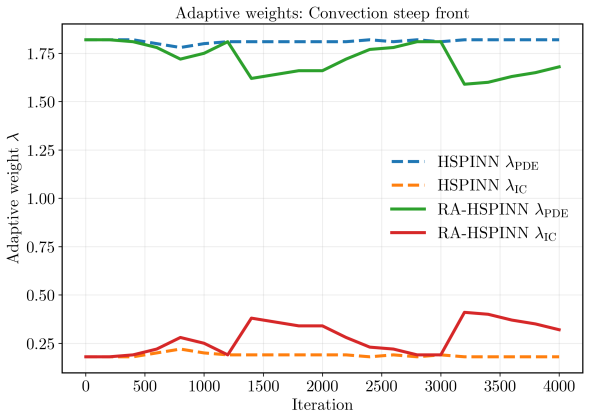
- The reliability field stays near 1 when not needed (mean 0.99 in smooth convection), so the method degrades gracefully toward the HSPINN limit without suppressing the solution channel.
- First-order residual formulations are preferable for reliability-modulated ansätze because they avoid second-order product-rule terms that stiffen optimization.
- The procedure is reproducible and lightweight: it retains the standard mean-square residual form and adds only a small auxiliary network plus EMA-based loss normalization.
Reading between the lines
- The reliability field could double as an adaptive sampling signal: regions where ρ deviates from 1 are precisely where the fixed ansatz struggles, so collocation points could be concentrated there (the paper lists adaptive sampling as future work but does not make this link).
- Because the reliability network adds roughly 6.5k parameters (width 32, depth 3) that the HSPINN control lacks, an equal-capacity HSPINN baseline would be needed to separate modulation from extra capacity; the paper does not include such a control.
- The mechanism is not tied to PINNs: any hard-constrained neural ansatz in inverse problems could benefit from a bounded learnable gate that modulates the free component without violating constraints.
- The first-order principle likely extends to other high-order operators (wave, elasticity), where reliability modulation may help more when the system is recast as first-order to avoid product-rule stiffness.
Editorial analysis
A structured set of objections, weighed in public.
Referee Report
Summary. The paper proposes RA-HSPINN, an extension of hard-soft PINNs in which a bounded learnable reliability field modulates the interior of the admissible trial space while exactly preserving embedded Dirichlet or periodic constraints. Training combines standard mean-square residuals with inverse-EMA global loss balancing and two regularization terms on the reliability field. The method is evaluated on six manufactured benchmarks: two Burgers problems (sharp-gradient and noisy/incompatible initial data), two periodic convection problems, a mixed-boundary Poisson problem, and a mixed first-order Poisson system. Compared with the fixed HSPINN baseline, the authors report relative-error reductions ranging from 29.36% to 98.65%, plus an ablation separating global loss balancing from reliability modulation. The paper also discusses a qualitative product-rule stiffness argument for why first-order system formulations interact more favorably with reliability modulation.
Significance. If the empirical claims hold, RA-HSPINN is a valuable and clearly formulated extension of hard-soft PINNs: it preserves the admissibility advantages of hard constraints while adding a mechanism to handle poorly conditioned fixed trial spaces, and it does so without changing the residual objective. The method is described with reproducible settings, all benchmarks use external manufactured solutions, and the ablation is a sensible first step toward understanding which component drives the gains. However, the current evidence is not yet sufficient to establish that the reliability field, rather than additional network capacity or run-to-run variation, is responsible for the reported improvements. The paper itself identifies repeated seeds as future work, and the ablation/main-table inconsistencies further weaken the attribution.
major comments (3)
- [§4.8, Table 3 vs. Table 2] The ablation table claims the same solution-network size, optimizer, training budget, collocation budget, and seed as the main comparison, yet the numbers differ substantially: Burgers B HSPINN is 3.67849e-1 in Table 2 but 2.64e-1 in Table 3, and RA-HSPINN is 4.965e-3 vs. 6.64e-3. The text says the ablation should be interpreted within its own controlled setting, but if the setting is identical, the numbers should match. This discrepancy undermines the ablation's validity and the reproducibility of the headline claims. Please reconcile the two tables or explain exactly what differs.
- [§3, Table 1; §4.7] RA-HSPINN adds a width-32, depth-3 reliability network on top of the width-64, depth-4 solution network, so the comparison against HSPINN is not capacity-matched. The hardest benchmarks (sharp Burgers, mixed Poisson) are precisely those where extra parameters could reduce underfitting. Without an equal-capacity HSPINN control, the reported 98.65% and 82.17% reductions cannot be attributed to reliability modulation rather than to parameter count. Please add an HSPINN baseline with comparable total parameter count (e.g., a wider or deeper solution network) and, ideally, seed-averaged results, since the current single deterministic runs do not rule out seed-induced ranking changes.
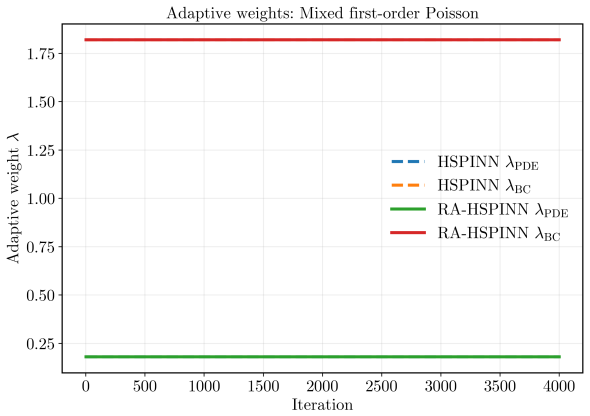
- [§4.6, mixed first-order Poisson] For the mixed Poisson problem, the final mean reliability is 0.99899, essentially at the HSPINN limit, yet the error drops by 82.17%. The paper argues the benefit comes from the optimization path created by reliability modulation, but no trajectory or gradient diagnostics are provided to support this. If the converged reliability field is nearly uniform and equal to one, it is unclear what mechanism in the final model explains the improvement. Please provide evidence about whether the modulation is active during the optimization path, or perform an experiment where the reliability field is frozen at its final near-one value and show the result, so that the attribution is not post hoc.
minor comments (4)
- [Abstract and §6] The smooth convection reduction is reported as 61.18% in the abstract and Table 2, but 61.19% in the conclusion. Please make the numbers consistent.
- [§3 and §4.5] Section 4.5 refers to an LBFGS refinement 'described in Section 3,' but Section 3 only describes the Adam stage and does not give LBFGS hyperparameters, stopping criterion, or number of iterations. Add the missing description.
- [Eq. (34)] The hand-designed initial-condition weight w_ic is applied identically to HSPINN and RA-HSPINN, which is fair, but the choice δ=0.08 is problem-specific and should be more clearly separated from the automatic reliability mechanism in the method summary.
- [General] The paper states that reproducibility settings are provided but does not include a code or data availability statement. Given the numerical nature of the contributions, a public implementation would strengthen the reproducibility claim.
Circularity Check
No significant circularity: RA-HSPINN is evaluated against external manufactured solutions; capacity/seed concerns are validity issues, not circularity.
full rationale
The central comparison is empirical: RA-HSPINN predictions are measured against manufactured exact solutions using Eq. (35), and the reliability field rho_phi is trained only on PDE residual and constraint losses, not fitted to the reported relative errors. Nothing in the derivation defines the claimed error reduction in terms of the inputs; Eq. (20) is a representational ansatz, and its benefit is assessed externally. The self-citations (e.g., [28] and other works by the same authors) are used as background or methodological references, not as a load-bearing uniqueness theorem or unverified prior that forces the result. The paper even states the reliability field is 'a numerical modulation variable, not a physical parameter or calibrated probability,' and it explicitly lists repeated random seeds as future work. The main concerns in the skeptic analysis are architectural confounding (RA-HSPINN adds a width-32 depth-3 reliability network without an equal-capacity HSPINN control) and unexplained differences between ablation and main-table HSPINN numbers. These are reproducibility and attribution concerns, not circularity: the benchmark targets are not produced by the model's fitted parameters by construction. Score 2 reflects only the minor presence of self-citations and hand-chosen hyperparameters; there is no definitional or self-citation-based circularity in the derivation chain.
Assumptions & free parameters
free parameters (5)
- ρ_min =
0.10
- α_ρ (reliability-to-one weight) =
1e-3
- α_s (reliability smoothness weight) =
1e-5
- β_w (EMA decay) =
0.98
- δ (noisy-IC weight width) =
0.08
assumptions (4)
- domain assumption The chosen tanh MLP and Adam/LBFGS optimizers can actually minimize the mean-square residual to the reported accuracy.
- standard math The manufactured/exact solutions used for evaluation are correct targets and the PDE residuals are computed correctly by automatic differentiation.
- domain assumption Minimizing the mean-square residual is a valid surrogate for minimizing relative L2 error.
- ad hoc to paper Single deterministic runs are representative of method performance.
invented entities (1)
-
Bounded reliability field ρϕ(x,t)
Cite this review
Pith. "Pith review of Reliability-Aware Hard--Soft Physics-Informed Neural Networks for Robust Learning of Challenging Partial Differential Equations." pith.science (2026). https://pith.science/paper/XRUAAMWU
@misc{pith2026260719377,
  author       = {Pith},
  title        = {Pith review of: Reliability-Aware Hard--Soft Physics-Informed Neural Networks for Robust Learning of Challenging Partial Differential Equations},
  year         = {2026},
  howpublished = {\url{https://pith.science/paper/XRUAAMWU}},
  note         = {Machine review of arXiv:2607.19377}
}
abstract
Physics-informed neural networks (PINNs) provide a mesh-free framework for solving partial differential equations, but their training is often affected by loss imbalance, optimization stiffness, and difficulty in capturing localized or multi-mode solution structures. Hard-soft PINNs (HSPINN) alleviate part of this difficulty by embedding Dirichlet or periodic constraints directly into the trial space, but the resulting fixed admissible representation can still be poorly conditioned for sharp or heterogeneous residual fields. This paper proposes a reliability-aware hard-soft PINN (RA-HSPINN) that preserves exact embedded constraints while introducing a bounded learnable reliability field to modulate the interior representation. The method combines this reliability-aware ansatz with inverse-EMA global loss balancing and lightweight regularization, while retaining the standard mean-square residual form. The reliability field is a numerical modulation variable, not a physical parameter or calibrated probability. RA-HSPINN is evaluated on nonlinear Burgers equations, periodic convection, a mixed-boundary Poisson problem, and a mixed first-order Poisson system. Compared with HSPINN, it reduces the relative error by $98.65%$ for sharp-gradient Burgers, $72.42%$ for Burgers data with noisy and incompatible initial conditions, $61.18%$ for smooth periodic convection, $60.02%$ for localized periodic convection, $29.36%$ for mixed-boundary Poisson, and $82.17%$ for a multi-mode mixed first-order Poisson system. The results show that reliability-aware modulation is most beneficial when hard-soft trial spaces are admissible but difficult to optimize, especially in localized, unreliable-data, and multi-mode PDE regimes.
Figures


Figures from the paper (10 more)




Reference graph
Works this paper leans on
-
[1]
Evans.Partial Differential Equations
Lawrence C. Evans.Partial Differential Equations. American Mathematical Society, 2 edition, 2010
2010
-
[2]
LeVeque.Finite Difference Methods for Ordinary and Partial Differential Equations: Steady-State and Time-Dependent Problems
Randall J. LeVeque.Finite Difference Methods for Ordinary and Partial Differential Equations: Steady-State and Time-Dependent Problems. SIAM, 2007
2007
-
[3]
Inverse problem solution and optimization in the vibration analysis of nanocomposite cylindrical shell using l-bfgs-b algorithm.Composite Structures, 370:119309, 2025
Duc Tien Nguyen, Nguyen Cong Tan, Darlington Yawson, and Dinh Gia Ninh. Inverse problem solution and optimization in the vibration analysis of nanocomposite cylindrical shell using l-bfgs-b algorithm.Composite Structures, 370:119309, 2025
2025
-
[4]
Duc Tien Nguyen and Dinh Gia Ninh. Modeling and quantifying uncertainty in nanocomposite shell vibrations using heteroscedastic gaussian processes.Engineering Applications of Artificial Intelli- gence, 157:111290, 2025
2025
-
[5]
Duc Tien Nguyen, Nguyen Duc Manh, Nguyen Manh Dzung, and Dinh Gia Ninh. Highly effi- cient prediction of beating phenomena in laminated nanocomposite plates using a hybrid neural– numerical–analytical framework.European Journal of Mechanics-A/Solids, page 105844, 2025
2025
-
[6]
Springer, 2016
Sören Bartels.Numerical approximation of partial differential equations, volume 64. Springer, 2016
2016
-
[7]
Why starting from differential equations for computational physics?Journal of Com- putational Physics, 257:1260–1290, 2014
Enzo Tonti. Why starting from differential equations for computational physics?Journal of Com- putational Physics, 257:1260–1290, 2014
2014
-
[8]
An analysis of finite volume, finite element, and finite difference methods using some concepts from algebraic topology.Journal of Computational Physics, 133(2):289–309, 1997
Claudio Mattiussi. An analysis of finite volume, finite element, and finite difference methods using some concepts from algebraic topology.Journal of Computational Physics, 133(2):289–309, 1997
1997
Show all 35 references
-
[9]
Finite-difference time-domain methods.Nature Reviews Methods Primers, 3(1):75, 2023
FL Teixeira, C Sarris, Y Zhang, D-Y Na, J-P Berenger, Y Su, M Okoniewski, WC Chew, V Backman, and Jamesina J Simpson. Finite-difference time-domain methods.Nature Reviews Methods Primers, 3(1):75, 2023
2023
-
[10]
The finite volume method
Fadl Moukalled, Luca Mangani, and Marwan Darwish. The finite volume method. InThe finite volume method in computational fluid dynamics: An advanced introduction with OpenFOAM®and Matlab, pages 103–135. Springer, 2015
2015
-
[11]
John Wiley & Sons, 2012
Gouri Dhatt, Emmanuel Lefrançois, and Gilbert Touzot.Finite element method. John Wiley & Sons, 2012. 29
2012
-
[12]
SIAM, 2006
Zhilin Li and Kazufumi Ito.The immersed interface method: numerical solutions of PDEs involving interfaces and irregular domains. SIAM, 2006
2006
-
[13]
Physics-informed machine learning.Nature Reviews Physics, 3(6):422–440, 2021
George Em Karniadakis, Ioannis G Kevrekidis, Lu Lu, Paris Perdikaris, Sifan Wang, and Liu Yang. Physics-informed machine learning.Nature Reviews Physics, 3(6):422–440, 2021
2021
-
[14]
Maziar Raissi, Paris Perdikaris, and George E Karniadakis. Physics-informed neural networks: A deep learning framework for solving forward and inverse problems involving nonlinear partial differential equations.Journal of Computational physics, 378:686–707, 2019
2019
-
[15]
Utilizing optimal physics-informed neural networks for dynamical analysis of nanocomposite one-variable edge plates.Thin-Walled Structures, 202:111928, 2024
NguyenCongTan, NguyenDucTien, NguyenManhDzung, NguyenHoangHa, NguyenThanhDong, and Dinh Gia Ninh. Utilizing optimal physics-informed neural networks for dynamical analysis of nanocomposite one-variable edge plates.Thin-Walled Structures, 202:111928, 2024
2024
-
[16]
St-pinn: shared-trunk pinns for discontinuous multi-domain pdes.Engineering with Computers, 42(4):113, 2026
Duc Tien Nguyen, Hang Tran, and Vu Linh Nguyen. St-pinn: shared-trunk pinns for discontinuous multi-domain pdes.Engineering with Computers, 42(4):113, 2026
2026
-
[17]
Scientific machine learning through physics–informed neural networks: Where we are and what’s next.Journal of Scientific Computing, 92(3):88, 2022
Salvatore Cuomo, Vincenzo Schiano Di Cola, Fabio Giampaolo, Gianluigi Rozza, Maziar Raissi, and Francesco Piccialli. Scientific machine learning through physics–informed neural networks: Where we are and what’s next.Journal of Scientific Computing, 92(3):88, 2022
2022
-
[18]
Physics-informed neural networks for pde problems: A comprehensive review
Kuang Luo, Jingshang Zhao, Yingping Wang, Jiayao Li, Junjie Wen, Jiong Liang, Henry Soekmadji, and Shaolin Liao. Physics-informed neural networks for pde problems: A comprehensive review. Artificial Intelligence Review, 58(10):323, 2025
2025
-
[19]
Understanding and mitigating gradient flow patholo- gies in physics-informed neural networks.SIAM Journal on Scientific Computing, 43(5):A3055– A3081, 2021
Sifan Wang, Yujun Teng, and Paris Perdikaris. Understanding and mitigating gradient flow patholo- gies in physics-informed neural networks.SIAM Journal on Scientific Computing, 43(5):A3055– A3081, 2021
2021
-
[20]
Charac- terizing possible failure modes in physics-informed neural networks.Advances in neural information processing systems, 34:26548–26560, 2021
Aditi Krishnapriyan, Amir Gholami, Shandian Zhe, Robert Kirby, and Michael Mahoney. Charac- terizing possible failure modes in physics-informed neural networks.Advances in neural information processing systems, 34:26548–26560, 2021
2021
-
[21]
When and why pinns fail to train: A neural tangent kernel perspective.Journal of Computational Physics, 449:110768, 2022
Sifan Wang, Xinling Yu, and Paris Perdikaris. When and why pinns fail to train: A neural tangent kernel perspective.Journal of Computational Physics, 449:110768, 2022
2022
-
[22]
Artificial neural networks for solving ordinary and partial differential equations.IEEE transactions on neural networks, 9(5):987–1000, 1998
Isaac E Lagaris, Aristidis Likas, and Dimitrios I Fotiadis. Artificial neural networks for solving ordinary and partial differential equations.IEEE transactions on neural networks, 9(5):987–1000, 1998
1998
-
[23]
Self-adaptive physics-informed neural networks using a soft attention mechanism, 2021
LMU Braga-Neto. Self-adaptive physics-informed neural networks using a soft attention mechanism, 2021
2021
-
[24]
Deepxde: A deep learning library for solving differential equations.SIAM review, 63(1):208–228, 2021
Lu Lu, Xuhui Meng, Zhiping Mao, and George Em Karniadakis. Deepxde: A deep learning library for solving differential equations.SIAM review, 63(1):208–228, 2021. 30
2021
-
[25]
Exact imposition of boundary conditions with distance functions in physics-informed deep neural networks.Computer Methods in Applied Mechanics and Engineering, 389:114333, 2022
Natarajan Sukumar and Ankit Srivastava. Exact imposition of boundary conditions with distance functions in physics-informed deep neural networks.Computer Methods in Applied Mechanics and Engineering, 389:114333, 2022
2022
-
[26]
Physics-informed neural networks with hard and soft boundary conditions for linear free surface waves.Physics of fluids, 37(8), 2025
Mohammad Sheikholeslami, Saeed Salehi, Wengang Mao, Arash Eslamdoost, and Håkan Nilsson. Physics-informed neural networks with hard and soft boundary conditions for linear free surface waves.Physics of fluids, 37(8), 2025
2025
-
[27]
Physics-informed neural networks with complementary soft and hard constraints for solving complex boundary navier-stokes equations.arXiv preprint arXiv:2411.08122, 2024
Chuyu Zhou, Tianyu Li, Chenxi Lan, Rongyu Du, Guoguo Xin, Pengyu Nan, Hangzhou Yang, Guoqing Wang, Xun Liu, and Wei Li. Physics-informed neural networks with complementary soft and hard constraints for solving complex boundary navier-stokes equations.arXiv preprint arXiv:2411....
2024 arXiv
-
[28]
Adaptive hard-soft physics-informed neural networks for robust boundary-constrained pde solving
Duc Tien Nguyen, Trinh Minh Tuan, Nguyen Duc Manh, Vu Linh Nguyen, and Dinh Gia Ninh. Adaptive hard-soft physics-informed neural networks for robust boundary-constrained pde solving. arXiv preprint arXiv:2606.23359, 2026
2026 arXiv
-
[29]
Physics-informed neural networks with hard constraints for inverse design.SIAM Journal on Scientific Computing, 43(6):B1105–B1132, 2021
Lu Lu, Raphael Pestourie, Wenjie Yao, Zhicheng Wang, Francesc Verdugo, and Steven G John- son. Physics-informed neural networks with hard constraints for inverse design.SIAM Journal on Scientific Computing, 43(6):B1105–B1132, 2021
2021
-
[30]
A method for representing periodic functions and enforcing exactly periodic boundary conditions with deep neural networks.Journal of Computational Physics, 435: 110242, 2021
Suchuan Dong and Naxian Ni. A method for representing periodic functions and enforcing exactly periodic boundary conditions with deep neural networks.Journal of Computational Physics, 435: 110242, 2021
2021
-
[31]
Sifan Wang, Hanwen Wang, and Paris Perdikaris. On the eigenvector bias of fourier feature net- works: From regression to solving multi-scale pdes with physics-informed neural networks.Computer Methods in Applied Mechanics and Engineering, 384:113938, 2021
2021
-
[32]
Automatic differentiation in pytorch
Adam Paszke, Sam Gross, Soumith Chintala, Gregory Chanan, Edward Yang, Zachary DeVito, Zeming Lin, Alban Desmaison, Luca Antiga, and Adam Lerer. Automatic differentiation in pytorch. 2017
2017
-
[33]
Pytorch: An imperative style, high- performance deep learning library.Advances in neural information processing systems, 32, 2019
Adam Paszke, Sam Gross, Francisco Massa, Adam Lerer, James Bradbury, Gregory Chanan, Trevor Killeen, Zeming Lin, Natalia Gimelshein, Luca Antiga, et al. Pytorch: An imperative style, high- performance deep learning library.Advances in neural information processing systems, 32, 2019
2019
-
[34]
Kingma and Jimmy Ba
Diederik P. Kingma and Jimmy Ba. Adam: A method for stochastic optimization, 2017. URL https://arxiv.org/abs/1412.6980
2017 arXiv
-
[35]
Improved adam optimizer for deep neural networks
Zijun Zhang. Improved adam optimizer for deep neural networks. In2018 IEEE/ACM 26th inter- national symposium on quality of service (IWQoS), pages 1–2. Ieee, 2018. 31
2018
Reviewed August 2, 2026 · model on record in the stance chip above.
Discussion (0). Sign in to comment.