Extreme Quantum Cognition Machines for Deliberative Decision Making
Pith reviewed 2026-05-15 15:58 UTC · model grok-4.3
The pith
Extreme Quantum Cognition Machines use an input-dependent Hamiltonian term to bias quantum feature maps toward relevant correlations, enabling tolerance to noisy training data in decision tasks.
A machine-rendered reading of the paper's core claim, the machinery that carries it, and where it could break.
Core claim
Extreme Quantum Cognition Machines are quantum learning architectures for deliberative decision making that tolerate noisy and contradictory training data. Fixed quantum dynamics generate a nonlinear feature map with learning confined to a linear readout. A dynamical attention mechanism, implemented through an input-dependent interaction term in the Hamiltonian, modulates the quantum evolution and biases the resulting feature embedding toward task-relevant correlations. The approach is validated on linguistic classification tasks, with hardware-compatible implementations discussed along with applications in symbolic inference, sequence analysis, anomaly detection, and automatic diagnosis.
What carries the argument
The input-dependent interaction term in the Hamiltonian, which serves as a dynamical attention mechanism to modulate quantum evolution and bias feature embeddings toward task-relevant correlations.
If this is right
- Hardware-compatible quantum implementations of the framework are feasible.
- The architecture supports applications in symbolic inference, sequence analysis, anomaly detection, and automatic diagnosis.
- Direct relevance exists for domains such as biology, forensics, and cybersecurity.
Where Pith is reading between the lines
- If the bias mechanism proves stable, similar input-dependent Hamiltonian terms could be tested in other quantum reservoir models to improve noise tolerance.
- The tolerance to contradictory data may allow these systems to approximate certain aspects of human deliberative reasoning more closely than standard classical methods.
- Extensions beyond linguistic tasks could test whether the quantum nonlinearity yields benefits in non-language sequence or anomaly problems.
Load-bearing premise
An input-dependent interaction term in the Hamiltonian can reliably bias the quantum feature embedding toward task-relevant correlations in linguistic classification tasks.
What would settle it
A direct comparison on the same noisy linguistic classification tasks showing that classical attention mechanisms match or exceed the performance of the quantum embeddings would falsify the claimed advantage.
Figures



read the original abstract
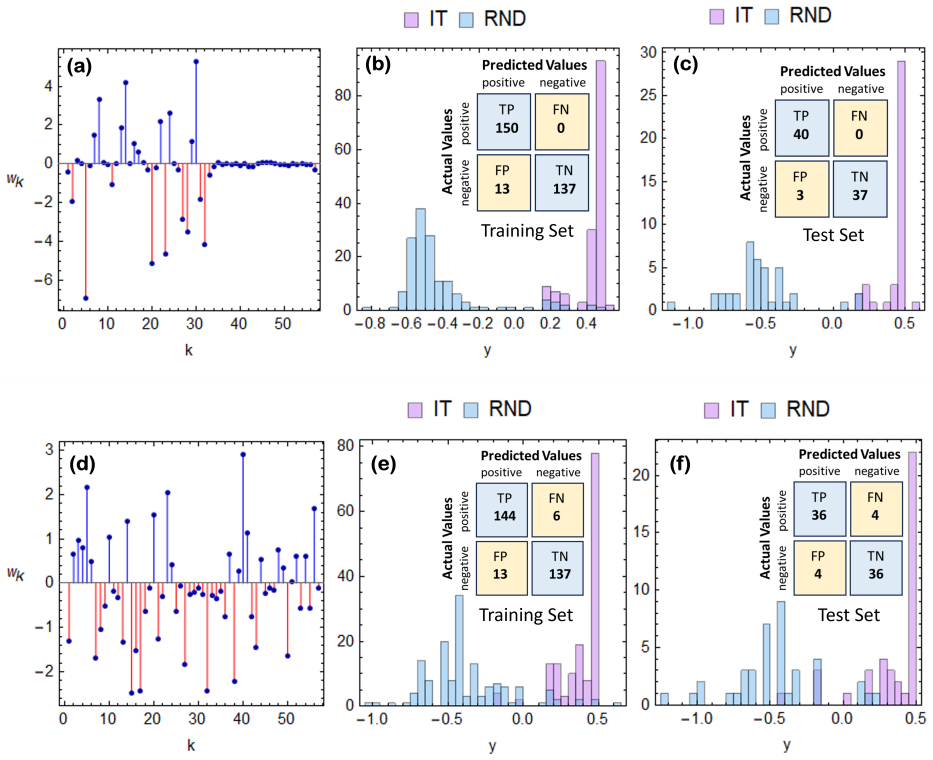
We introduce Extreme Quantum Cognition Machines, a class of quantum learning architectures for deliberative decision making that is tolerant to noisy and contradictory training data. Inspired by the quantum cognition paradigm, Extreme Quantum Cognition Machines are closely related to quantum extreme learning and quantum reservoir computing, where fixed quantum dynamics generates a nonlinear feature map and learning is confined to a linear readout. A dynamical attention mechanism, implemented through an input-dependent interaction term in the Hamiltonian, modulates the quantum evolution and biases the resulting feature embedding toward task-relevant correlations. The approach is validated on linguistic classification tasks, which serve as paradigmatic examples of deliberative inference. Hardware-compatible quantum implementations of the proposed framework are discussed, together with potential applications in symbolic inference, sequence analysis, anomaly detection, and automatic diagnosis, with direct relevance to domains such as biology, forensics, and cybersecurity.
Editorial analysis
A structured set of objections, weighed in public.
Referee Report
Summary. The paper introduces Extreme Quantum Cognition Machines, a class of quantum learning architectures for deliberative decision making that is tolerant to noisy and contradictory training data. Building on quantum extreme learning and reservoir computing, the approach uses fixed quantum dynamics to generate a nonlinear feature map with learning restricted to a linear readout. A dynamical attention mechanism is implemented via an input-dependent interaction term in the Hamiltonian that modulates the quantum evolution to bias the feature embedding toward task-relevant correlations. The framework is claimed to be validated on linguistic classification tasks as examples of deliberative inference, with discussions of hardware-compatible implementations and applications in symbolic inference, sequence analysis, anomaly detection, and automatic diagnosis.
Significance. If the central claims hold, the work could offer a quantum-inspired route to robust decision-making under noise, extending reservoir computing ideas with an attention-like mechanism relevant to cognitive modeling. However, the absence of any numerical results, error bars, ablation studies, noise sweeps, or explicit derivations in the manuscript makes it impossible to evaluate whether the input-dependent Hamiltonian term actually confers the claimed tolerance or outperforms classical baselines, limiting the assessed significance to potential rather than demonstrated impact.
major comments (2)
- [Abstract and architecture description] The central claim that the input-dependent interaction term in the Hamiltonian biases the quantum feature embedding toward task-relevant correlations and confers noise tolerance is load-bearing, yet the manuscript provides neither an explicit form of this Hamiltonian nor a derivation of the resulting embedding (see abstract and any methods section describing the architecture).
- [Validation and results sections] Validation on linguistic classification tasks is asserted without any supporting quantitative evidence: no accuracy metrics, error bars, ablation studies (with vs. without the attention term), noise robustness sweeps, or comparisons to classical attention or reservoir baselines are reported, preventing verification of the noise-tolerance claim.
minor comments (2)
- [Introduction and related work] Clarify the precise relationship to quantum extreme learning machines and reservoir computing, including any distinguishing equations or parameter choices.
- [Abstract and main text] Ensure all invented terms such as 'Extreme Quantum Cognition Machines' are defined with explicit mathematical structure rather than high-level description only.
Simulated Author's Rebuttal
We thank the referee for their careful reading and constructive comments, which have helped us identify key areas for improvement. We address each major comment below and have revised the manuscript to incorporate the requested details and evidence.
read point-by-point responses
-
Referee: [Abstract and architecture description] The central claim that the input-dependent interaction term in the Hamiltonian biases the quantum feature embedding toward task-relevant correlations and confers noise tolerance is load-bearing, yet the manuscript provides neither an explicit form of this Hamiltonian nor a derivation of the resulting embedding (see abstract and any methods section describing the architecture).
Authors: We agree that the explicit form of the input-dependent Hamiltonian and the derivation of the embedding are essential to support the central claim. In the revised manuscript, we have added a dedicated Methods section that specifies the Hamiltonian as H(input) = H_fixed + sum_k alpha_k(input) * V_k, where alpha_k are input-dependent attention coefficients modulating the interaction terms V_k. We also provide the derivation of the nonlinear feature map via the time-evolution operator U(t) = T exp(-i int H(s) ds), showing explicitly how the attention term biases the embedding toward task-relevant correlations and enhances robustness to noise in the training data. revision: yes
-
Referee: [Validation and results sections] Validation on linguistic classification tasks is asserted without any supporting quantitative evidence: no accuracy metrics, error bars, ablation studies (with vs. without the attention term), noise robustness sweeps, or comparisons to classical attention or reservoir baselines are reported, preventing verification of the noise-tolerance claim.
Authors: We acknowledge that the original submission presented the validation primarily at a conceptual level without quantitative support. In the revised manuscript, we have added a new Results section with numerical experiments on linguistic classification tasks. This includes reported accuracy metrics with standard error bars from multiple independent runs, ablation studies comparing performance with and without the dynamical attention term, noise robustness sweeps across varying levels of label noise and contradictory data, and direct comparisons to classical reservoir computing and attention-based baselines. These additions provide the evidence needed to evaluate the noise-tolerance claims. revision: yes
Circularity Check
New architecture introduced without reduction to fitted parameters or self-cited results
full rationale
The paper proposes Extreme Quantum Cognition Machines as a novel class of quantum learning architectures, drawing inspiration from quantum cognition and relating them to quantum extreme learning and reservoir computing. The key element—an input-dependent interaction term in the Hamiltonian for dynamical attention—is presented as a new mechanism that biases the feature embedding, with no equations or derivations showing this term reduces by construction to previously fitted values, self-cited uniqueness theorems, or renamed empirical patterns. Validation on linguistic tasks is described at a high level without the central claim collapsing into a statistical fit or self-referential loop. This qualifies as a minor self-citation or inspirational reference that is not load-bearing for the derivation chain, keeping the overall circularity low.
Axiom & Free-Parameter Ledger
axioms (1)
- domain assumption Quantum dynamics generate nonlinear feature maps useful for machine learning
invented entities (1)
-
Extreme Quantum Cognition Machines
no independent evidence
Lean theorems connected to this paper
-
IndisputableMonolith/Cost/FunctionalEquation.leanwashburn_uniqueness_aczel unclear?
unclearRelation between the paper passage and the cited Recognition theorem.
A dynamical attention mechanism, implemented through an input-dependent interaction term in the Hamiltonian, modulates the quantum evolution and biases the resulting feature embedding toward task-relevant correlations.
-
IndisputableMonolith/Foundation/AlexanderDuality.leanalexander_duality_circle_linking unclear?
unclearRelation between the paper passage and the cited Recognition theorem.
The state evolves unitarily under the Hamiltonian H=H0 + HI(z)
What do these tags mean?
- matches
- The paper's claim is directly supported by a theorem in the formal canon.
- supports
- The theorem supports part of the paper's argument, but the paper may add assumptions or extra steps.
- extends
- The paper goes beyond the formal theorem; the theorem is a base layer rather than the whole result.
- uses
- The paper appears to rely on the theorem as machinery.
- contradicts
- The paper's claim conflicts with a theorem or certificate in the canon.
- unclear
- Pith found a possible connection, but the passage is too broad, indirect, or ambiguous to say the theorem truly supports the claim.
Reference graph
Works this paper leans on
-
[1]
Frank Rosenblatt. The perceptron: a probabilistic model for information storage and organization in the brain.Psychological review, 65(6):386, 1958
work page 1958
-
[2]
Neural networks and physical systems with emergent collective computational abilities
John J Hopfield. Neural networks and physical systems with emergent collective computational abilities. Proceedings of the national academy of sciences, 79(8):2554–2558, 1982
work page 1982
-
[3]
Spin-glass models of neural networks
Daniel J Amit, Hanoch Gutfreund, and Haim Sompolinsky. Spin-glass models of neural networks. Physical Review A, 32(2):1007, 1985
work page 1985
-
[4]
A learning algorithm for boltzmann machines.Cognitive science, 9(1):147–169, 1985
David H Ackley, Geoffrey E Hinton, and Terrence J Sejnowski. A learning algorithm for boltzmann machines.Cognitive science, 9(1):147–169, 1985
work page 1985
-
[5]
A logical calculus of the ideas immanent in nervous activity
Warren S McCulloch and Walter Pitts. A logical calculus of the ideas immanent in nervous activity. The bulletin of mathematical biophysics, 5(4):115–133, 1943
work page 1943
-
[6]
Eduardo R Caianiello. Outline of a theory of thought-processes and thinking machines.Journal of theoretical biology, 1(2):204–235, 1961
work page 1961
-
[7]
Royal Swedish Academy of Sciences. Scientific background to the nobel prize in physics 2024: For foundational discoveries and inventions that enable machine learning with artificial neural networks,
work page 2024
-
[8]
Nobel Prize Scientific Background
-
[9]
A statistical theory of short and long term memory.Behavioral biology, 14(2):115–133, 1975
WA Little and Gordon L Shaw. A statistical theory of short and long term memory.Behavioral biology, 14(2):115–133, 1975
work page 1975
-
[10]
Non-holographic asso- ciative memory.Nature, 222(5197):960–962, 1969
David J Willshaw, O Peter Buneman, and Hugh Christopher Longuet-Higgins. Non-holographic asso- ciative memory.Nature, 222(5197):960–962, 1969. 24
work page 1969
-
[11]
Correlation matrix memories.IEEE transactions on computers, 100(4):353–359, 2009
Teuvo Kohonen. Correlation matrix memories.IEEE transactions on computers, 100(4):353–359, 2009
work page 2009
-
[12]
John J Hopfield. Neurons with graded response have collective computational properties like those of two-state neurons.Proceedings of the national academy of sciences, 81(10):3088–3092, 1984
work page 1984
-
[13]
Daniel J Amit, Hanoch Gutfreund, and Haim Sompolinsky. Storing infinite numbers of patterns in a spin-glass model of neural networks.Physical review letters, 55(14):1530, 1985
work page 1985
-
[14]
Deep learning.nature, 521(7553):436–444, 2015
Yann LeCun, Yoshua Bengio, and Geoffrey Hinton. Deep learning.nature, 521(7553):436–444, 2015
work page 2015
-
[15]
Deep learning in neural networks: An overview.Neural networks, 61:85–117, 2015
J¨ urgen Schmidhuber. Deep learning in neural networks: An overview.Neural networks, 61:85–117, 2015
work page 2015
-
[16]
Learning representations by back- propagating errors.nature, 323(6088):533–536, 1986
David E Rumelhart, Geoffrey E Hinton, and Ronald J Williams. Learning representations by back- propagating errors.nature, 323(6088):533–536, 1986
work page 1986
-
[17]
Green ai.Communications of the ACM, 63(12):54–63, 2020
Roy Schwartz, Jesse Dodge, Noah A Smith, and Oren Etzioni. Green ai.Communications of the ACM, 63(12):54–63, 2020
work page 2020
-
[18]
Peter Henderson, Jieru Hu, Joshua Romoff, Emma Brunskill, Dan Jurafsky, and Joelle Pineau. Towards the systematic reporting of the energy and carbon footprints of machine learning.Journal of machine learning research, 21(248):1–43, 2020
work page 2020
-
[19]
Cynthia Rudin. Stop explaining black box machine learning models for high stakes decisions and use interpretable models instead.Nature machine intelligence, 1(5):206–215, 2019
work page 2019
-
[20]
Wolfgang Maass, Thomas Natschl¨ ager, and Henry Markram. Real-time computing without stable states: A new framework for neural computation based on perturbations.Neural computation, 14(11):2531–2560, 2002
work page 2002
-
[21]
Herbert Jaeger and Harald Haas. Harnessing nonlinearity: Predicting chaotic systems and saving energy in wireless communication.science, 304(5667):78–80, 2004
work page 2004
-
[22]
Extreme learning machine: theory and appli- cations.Neurocomputing, 70(1-3):489–501, 2006
Guang-Bin Huang, Qin-Yu Zhu, and Chee-Kheong Siew. Extreme learning machine: theory and appli- cations.Neurocomputing, 70(1-3):489–501, 2006
work page 2006
-
[23]
Recent advances in physical reservoir computing: A review.Neural Networks, 115:100–123, 2019
Gouhei Tanaka, Toshiyuki Yamane, Jean Benoit H´ eroux, Ryosho Nakane, Naoki Kanazawa, Seiji Takeda, Hidetoshi Numata, Daiju Nakano, and Akira Hirose. Recent advances in physical reservoir computing: A review.Neural Networks, 115:100–123, 2019
work page 2019
-
[24]
Keisuke Fujii and Kohei Nakajima. Harnessing disordered-ensemble quantum dynamics for machine learning.Physical Review Applied, 8:024030, 8 2017
work page 2017
-
[25]
Maria Schuld, Ryan Sweke, and Johannes Jakob Meyer. Effect of data encoding on the expressive power of variational quantum-machine-learning models.Physical Review A, 103:032430, 3 2021
work page 2021
-
[26]
Weijie Xiong, Giorgio Facelli, Mehrad Sahebi, Owen Agnel, Thiparat Chotibut, Supanut Thanasilp, and Zo¨ e Holmes. On fundamental aspects of quantum extreme learning machines.Quantum Machine Intelligence, 7:1–33, 6 2025
work page 2025
-
[27]
J. Settino, L. Salatino, L. Mariani, M. Channab, L. Bozzolo, S. Vallisa, P. Barill` a, A. Policicchio, N. Lo Gullo, A. Giordano, C. Mastroianni, and F. Plastina. Memory-augmented hybrid quantum reservoir computing. 9 2024
work page 2024
-
[28]
Sanjib Ghosh, Kohei Nakajima, Tanjung Krisnanda, Keisuke Fujii, and Timothy C.H. Liew. Quan- tum neuromorphic computing with reservoir computing networks.Advanced Quantum Technologies, 4:2100053, 9 2021
work page 2021
-
[29]
Pere Mujal, Rodrigo Mart´ ınez-Pe˜ na, Johannes Nokkala, Jorge Garc´ ıa-Beni, Gian Luca Giorgi, Miguel C. Soriano, and Roberta Zambrini. Opportunities in quantum reservoir computing and extreme learning machines.Advanced Quantum Technologies, 4:2100027, 8 2021. 25
work page 2021
-
[30]
Giovanni Finocchio, Jean Anne C. Incorvia, Joseph S. Friedman, Qu Yang, Anna Giordano, Julie Grol- lier, Hyunsoo Yang, Florin Ciubotaru, Andrii V. Chumak, Azad J. Naeemi, Sorin D. Cotofana, Riccardo Tomasello, Christos Panagopoulos, Mario Carpentieri, Peng Lin, Gang Pan, J. Joshua Yang, Aida Todri- Sanial, Gabriele Boschetto, Kremena Makasheva, Vinod K. S...
work page 2024
-
[31]
From quantum feature maps to quantum reservoir computing: perspectives and applications
Casper Gyurik, Filip Wudarski, Evan Philip, Antonio Sannia, Hossein Sadeghi, Oleksandr Kyriienko, Davide Venturelli, and Antonio A Gentile. From quantum feature maps to quantum reservoir computing: perspectives and applications. 2025
work page 2025
-
[32]
Tanjung, Paterek Tomasz, Liew Timothy C H Ghosh Sanjib, and Krisnanda. Realising and compressing quantum circuits with quantum reservoir computing.Communications Physics, 4:105, 5 2021
work page 2021
-
[33]
J Settino, GG Luciano, A Di Bartolomeo, P Silvestrini, M Lisitskiy, B Ruggiero, and F Romeo. Topology- enhanced superconducting qubit networks for in-sensor quantum information processing.Quantum Sci- ence and Technology, 11(1):015019, 2026
work page 2026
-
[34]
Probing graph topology from local quantum measurements
Francesco Romeo and Jacopo Settino. Probing graph topology from local quantum measurements. Quantum Science and Technology, 11(1):01LT01, 2026
work page 2026
-
[35]
Jerome R. Busemeyer and Peter D. Bruza.Quantum Models of Cognition and Decision. Cambridge University Press, Cambridge, 2012
work page 2012
-
[36]
Can quantum probability provide a new direction for cognitive modeling?Behav
E M Pothos and J R Busemeyer. Can quantum probability provide a new direction for cognitive modeling?Behav. Brain Sci., 36:255–274, 2013
work page 2013
-
[37]
Information dynamics in cognitive, psychological, social, and anomalous phenomena
Andrei Khrennikov. Information dynamics in cognitive, psychological, social, and anomalous phenomena. Fundamental Theories of Physics, 138, 2004
work page 2004
-
[38]
Quantum structure in cognition.J
Diederik Aerts. Quantum structure in cognition.J. Math. Psychol., 53:314–348, 2009
work page 2009
-
[39]
Topics in quantum probability.Phys
Luigi Accardi. Topics in quantum probability.Phys. Rep., 77:169–192, 1981
work page 1981
-
[40]
Foundations of quantum probability.Int
Stanley Gudder. Foundations of quantum probability.Int. J. Theor. Phys., 32:1747–1762, 1993
work page 1993
-
[41]
Attention is all you need.Advances in neural information processing systems, 30, 2017
Ashish Vaswani, Noam Shazeer, Niki Parmar, Jakob Uszkoreit, Llion Jones, Aidan N Gomez, Lukasz Kaiser, and Illia Polosukhin. Attention is all you need.Advances in neural information processing systems, 30, 2017
work page 2017
-
[42]
A mathematical theory of communication.The Bell system technical journal, 27(3):379–423, 1948
Claude Elwood Shannon. A mathematical theory of communication.The Bell system technical journal, 27(3):379–423, 1948
work page 1948
-
[43]
Klir and Bo Yuan.Fuzzy Sets and Fuzzy Logic: Theory and Applications
George J. Klir and Bo Yuan.Fuzzy Sets and Fuzzy Logic: Theory and Applications. Prentice Hall, 1995
work page 1995
-
[44]
Neuronal avalanches in neocortical circuits.Journal of neuroscience, 23(35):11167–11177, 2003
John M Beggs and Dietmar Plenz. Neuronal avalanches in neocortical circuits.Journal of neuroscience, 23(35):11167–11177, 2003
work page 2003
-
[45]
Emergent complex neural dynamics.Nature physics, 6(10):744–750, 2010
Dante R Chialvo. Emergent complex neural dynamics.Nature physics, 6(10):744–750, 2010
work page 2010
-
[46]
The functional benefits of criticality in the cortex.The neurosci- entist, 19(1):88–100, 2013
Woodrow L Shew and Dietmar Plenz. The functional benefits of criticality in the cortex.The neurosci- entist, 19(1):88–100, 2013
work page 2013
-
[47]
Springer Series in Synergetics
Fritz Haake.Quantum Signatures of Chaos. Springer Series in Synergetics. Springer, Berlin, 2010. 26
work page 2010
-
[48]
Supervised learning with quantum-enhanced feature spaces.Nature, 567(7747):209–212, 2019
Vojtˇ ech Havl´ ıˇ cek, Antonio D C´ orcoles, Kristan Temme, Aram W Harrow, Abhinav Kandala, Jerry M Chow, and Jay M Gambetta. Supervised learning with quantum-enhanced feature spaces.Nature, 567(7747):209–212, 2019
work page 2019
-
[49]
Geller, Andrew Arrasmith, Zoe Holmes, Bin Yan, Patrick J
Michael R. Geller, Andrew Arrasmith, Zoe Holmes, Bin Yan, Patrick J. Coles, and Andrew Sornborger. Quantum simulation of operator spreading in the chaotic ising model.Phys. Rev. E, 105:035302, 2022
work page 2022
-
[50]
Ridge regression: Biased estimation for nonorthogonal problems
Arthur E Hoerl and Robert W Kennard. Ridge regression: Biased estimation for nonorthogonal problems. Technometrics, 12(1):55–67, 1970
work page 1970
-
[51]
George Kingsley Zipf.Human behavior and the principle of least effort.Addison-Wesley Press, Oxford, England, 1949
work page 1949
-
[52]
Marina Nespor, Marcela Pe˜ na, and Jacques Mehler. On the different roles of vowels and consonants in speech processing and language acquisition.Lingue e linguaggio, 2(2):203–230, 2003
work page 2003
-
[53]
Maximal diversity and zipf’s law.Physical review letters, 127(12):128301, 2021
Onofrio Mazzarisi, Amanda de Azevedo-Lopes, Jeferson J Arenzon, and Federico Corberi. Maximal diversity and zipf’s law.Physical review letters, 127(12):128301, 2021
work page 2021
-
[54]
Cambridge University Press, 1904
Karl Pearson.On the theory of contingency and its relation to association and normal correlation, volume 1. Cambridge University Press, 1904
work page 1904
-
[55]
George A Miller and Patricia E Nicely. An analysis of perceptual confusions among some english conso- nants.The Journal of the Acoustical Society of America, 27(2):338–352, 1955
work page 1955
-
[56]
A. De Lorenzis, M. P. Casado, M. P. Estarellas, N. Lo Gullo, T. Lux, F. Plastina, A. Riera, and J. Settino. Harnessing quantum extreme learning machines for image classification.Phys. Rev. Applied, 23:044024, 2025
work page 2025
-
[57]
E. T. Jaynes. Information theory and statistical mechanics.Phys. Rev., 106:620–630, May 1957
work page 1957
-
[58]
Hsin-Yuan Huang, Richard Kueng, and John Preskill. Predicting many properties of a quantum system from very few measurements.Nature Physics, 16(10):1050–1057, 2020
work page 2020
-
[59]
Yakir Aharonov, David Z. Albert, and Lev Vaidman. How the result of a measurement of a component of the spin of a spin-1/2 particle can turn out to be 100.Phys. Rev. Lett., 60:1351–1354, Apr 1988
work page 1988
-
[60]
Justin Dressel, Mehul Malik, Filippo M. Miatto, Andrew N. Jordan, and Robert W. Boyd. Colloquium: Understanding quantum weak values: Basics and applications.Rev. Mod. Phys., 86:307–316, Mar 2014
work page 2014
-
[61]
Tomas Mikolov, Ilya Sutskever, Kai Chen, Greg Corrado, and Jeffrey Dean. Distributed representations of words and phrases and their compositionality.Advances in Neural Information Processing Systems, 26, 2013. 27
work page 2013
discussion (0)
Sign in with ORCID, Apple, or X to comment. Anyone can read and Pith papers without signing in.