REVIEW 4 major objections 7 minor 6 references
Emergent togetherness in collaborative dance improvisation: neural and motor synchronization reveal a coupling-decoupling paradox
T0 review · 4 major / 7 minor · reviewed 2026-08-03 · deepseek-v4-flash
Pith's one-line read Training in generative dance makes improvising partners' brains align more closely while their hand movements diverge, and the paper argues that this paradox is what togetherness actually is.
desk verdict The motor effect is real; the neural increase isn't shown — the abstract overclaims a dissociation built on an undefined EEG contrast. read the letter →
The pith
A machine-rendered reading of the paper's core claim, the machinery that carries it, and where it could break.
The reading
What carries the argument
The coupling–decoupling paradox is the central claim: increased inter-brain synchronization and decreased interpersonal motor synchrony after training. Methodologically, the paper quantifies motor dynamics with a time-resolved α-exponent from Movement Element Decomposition, which indexes energetic strategy and degrees of freedom in a sliding window, and then measures motor synchrony with Motif-Synchronization applied to those α time series. Neural synchrony is measured with multilayer Time-Varying Graphs, using the Incidence-Fidelity index to detect simultaneous edge occurrences between two participants' dynamic brain networks while excluding chance-level co-occurrence.
What would settle it
A replication with mixed-effects models that include dancer and dyad as random factors and a no-training control group, or even just a re-analysis of the present data with such models; if the frontal inter-brain increase or the motor synchrony decrease no longer reaches significance once non-independence is accounted for, the claimed dissociation is not supported.
Extended reading notes
Core claim
After a program of Generative Dance through Agent Modelling, pairs of co-improvisers show increased inter-brain synchronization in frontal regions during free and rule-based improvisation, while simultaneously showing decreased interpersonal motor synchrony in the same tasks. The dissociation is statistically significant in both modalities: EEG relative analysis yields F(1,8)=10.787, p=.011, and biomechanical post-hoc tests show reduced motor synchrony for FM (p=.04) and RM (p=.02), whereas the dependent-movement task shows no change in either measure. The authors conclude that trained improvisers achieve togetherness through neural alignment of intentional and executive processes, not throu
Load-bearing premise
The statistical evidence for the neural–motor dissociation rests on treating each participant pair as an independent observation even though the same dancers improvised together repeatedly and brain data came from only two of the four dancers per session, so the reported degrees of freedom and p-values are likely inflated.
Editorial extensions
If this is right
- In improvisational joint action, togetherness should be indexed by neural synchrony (especially frontal) rather than by motor mimicry, and a lack of movement similarity does not indicate a lack of coordination.
- Training protocols like generative dance can increase inter-brain coupling without forcing performers into identical movement patterns, suggesting a route to enhance group creativity without constraining individuals.
- The time-resolved α-exponent offers a single scalar per time window that captures fluctuations in motor degrees of freedom, enabling pairwise synchrony analysis of whole-body (here, two-handed) movement.
- The absence of an effect in the dependent-movement task indicates that the neural increase is specific to conditions requiring autonomous strategy generation, not to all social interaction.
- If the dissociation generalizes, studies of team coordination and dance therapy that measure only movement similarity may be missing the relevant neural coupling.
Reading between the lines
- A direct testable extension is to compare self-reported sense of togetherness with frontal inter-brain synchrony and motor synchrony in the same sessions; the paper's account predicts a positive correlation with the former and a negative correlation with the latter after training.
- The authors interpret the frontal effect as shared intentionality, but it could also reflect increased individual cognitive load from rule-based improvisation; a control task with matched individual executive demand but no social interaction would disambiguate.
- Because there was no no-training control group, familiarization with the task or with the EEG setup could plausibly explain the pre-post changes; a crossover design with a waitlist control would strengthen the causal claim.
- The statistical treatment of dyads as independent observations is fragile; re-analysis with mixed models that treat dancer and dyad as random effects could change the p-values, so the dissociation's robustness is not yet established.
Editorial analysis
A structured set of objections, weighed in public.
Referee Report
Summary. The paper reports a pre-post study of four-person collaborative dance improvisation, with dual motion capture and EEG hyperscanning (recorded from two of four dancers per session). Motor behavior is represented by time-resolved α-exponents from Movement Element Decomposition, and synchrony is quantified with motif synchronization; neural synchrony is assessed with incidence-fidelity multilayer time-varying graphs. The authors claim that after a Generative Dance through Agent Modelling (GDAM) program, inter-brain synchronization increased—particularly in frontal regions—while interpersonal motor synchrony decreased, which they interpret as a 'coupling-decoupling paradox.' The reported statistics show a direct pre/post decrease in motor synchrony for the Free Movement (FM) and Rule-Based Movement (RM) tasks, but the EEG increase relies on an undefined 'relative EEG analysis'; the direct EEG pre/post comparison is non-significant. The paper's central claim is therefore not yet supported by the evidence as presented.
Significance. If the dissociation were robustly established, this would be a valuable contribution to the neuroscience of joint action and dance, offering a concrete example where neural alignment and motor divergence coexist and suggesting that togetherness may be indexed neurally rather than motorically. The methodological toolkit—motif synchronization with lead-lag structure, MED-derived α time series, multilayer TVG, randomized-edge thresholding, and the reported robustness check over Sc—is creative and potentially reusable for other dyadic and group coordination studies. However, the current manuscript does not provide sufficient evidence for its headline claim: the EEG half of the dissociation depends on an analysis that is not defined, and the statistical treatment of non-independent dyadic data inflates confidence. The paper's novelty and interdisciplinary ambition are clear, but the empirical foundation needs substantial work.
major comments (4)
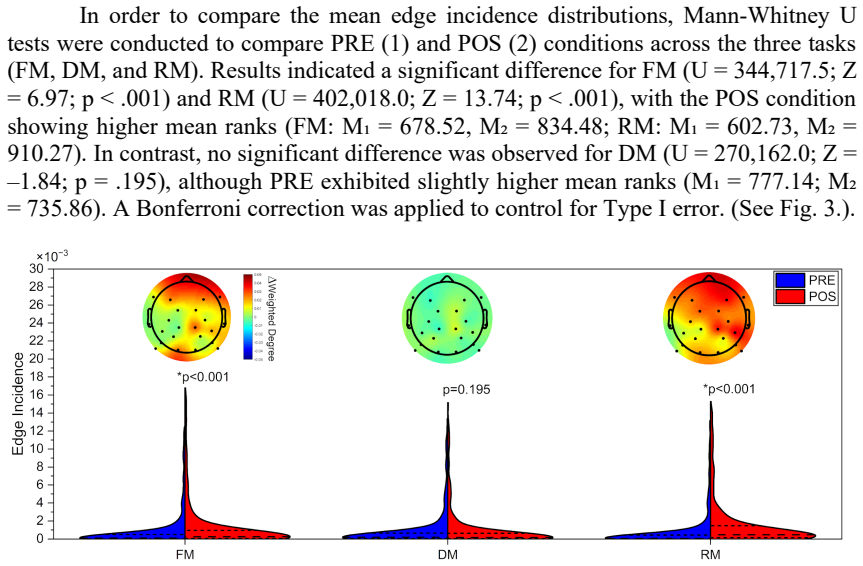
- [§4, Table 1] The load-bearing EEG result is a 'relative EEG analysis' that is never defined—no equation, no dependent variable, no model specification, no random effects. The direct pre/post comparison is non-significant (F(1,8)=0.216, p=.654), and none of the task-wise EEG contrasts reaches significance (FM p=.36; DM p=.37; RM p=.20). Therefore the abstract's assertion that training 'increased inter-brain synchronization, particularly within the frontal lobe' is not supported by any reported main effect. Please define the relative analysis explicitly, state what it computes (e.g., a task × session interaction or a normalized change score), and show that it actually corresponds to an increase in synchronization rather than a difference between task changes. As written, the dissociation compares a direct motor pre/post effect with an undefined, task-relative EEG effect.
- [§4–5, Table 1] The statistical tests treat non-independent observations as independent. Motor synchronization uses 42 PRE and 30 POS dyads with F(1,70), but each participant contributed to multiple dyads, so dyad-level observations are not independent. EEG analyses report F(1,8) with only 5 dyads per condition, which appears to treat PRE and POS as independent groups rather than paired observations (a paired/repeated-measures analysis would have fewer error degrees of freedom). The Mann-Whitney tests on edge-incidence distributions (U values with hundreds of thousands of cases) treat every edge-time instance as an independent sample, massively inflating the effective N. Please reanalyze using mixed-effects models with random intercepts for session, dyad, and/or participant, or use permutation tests that respect the dyadic structure, and report effect sizes with variance estimates that reflect the true
- [§2, §4–5] There is no no-training control group. The pre/post design cannot distinguish the effect of GDAM from task familiarization, repeated exposure, or other time-related confounds. This is particularly relevant because the DM task showed no significant change in either modality, which is consistent with a practice/familiarization account. The causal language in the abstract ('training produced an intriguing dissociation') is stronger than the design supports. Either add a control condition or explicitly acknowledge this as a limitation and temper the causal claims throughout.
- [Abstract, §5, Table 1] The dissociation is supported only for FM and RM motor decreases; the DM task showed no significant change in motor or neural synchrony. The abstract and conclusion generalize to 'collaborative dance improvisation' as a whole. Please either present the result as task-specific (FM/RM) or provide a substantive justification—not just a post-hoc narrative—for why DM's null result is consistent with the proposed coupling-decoupling paradox. At minimum, the claims should be scaled to the tasks that actually produced the effects.
minor comments (7)
- [General structure] There are two sections numbered '3' ('Biomechanical data segmentation and processing' and 'Motif Synchronization'). Renumber the sections sequentially.
- [§4] The text says 'See Fig. 3.' when referring to the distribution of edge Incidence values; the correct cross-reference appears to be Fig. 7. Please correct.
- [§3 (Motif Synchronization)] The robustness analysis for Sc ∈ [0.5, 0.9] is asserted but no results, figures, or quantitative summaries are provided. Please include a supplementary figure or table demonstrating that the global topology and the reported effects remain stable across this range.
- [§2 (EEG)] The text states a 64-channel system but records 28 channels per individual. Clarify whether the remaining channels were not used, or how the 64 channels were split across the two EEG caps.
- [Table 1] The rows labeled 'Relative increase in EEG' and 'Relative increase in biomechanics' are not defined anywhere in the Methods. Define the formula for these change scores and specify how the contrasts were computed.
- [References] Some citations are ambiguous or incomplete: 'Ramos et al. (2025a, 2025b)' are not clearly distinguished in the text, and several references (e.g., Chauvigné & Brown, 2018; Chauvigné et al., 2018) appear in the reference list but are not annotated consistently. A thorough reference cleanup is needed.
- [Data availability] The statement 'Data will be made available on request' is weaker than current reproducibility standards. Please consider depositing anonymized data and analysis code in a public repository.
Circularity Check
No significant circularity: the central dissociation is an empirical contrast, not a fitted or self-referential derivation.
full rationale
The paper's central claim—that GDAM training increased inter-brain synchronization while decreasing interpersonal motor synchrony—is an empirical pre/post contrast, not a quantity that is defined in terms of itself or fitted to produce the reported outcome. The motor result derives from motif synchronization applied to time-resolved α-exponents, and the neural result from Incidence-Fidelity multilayer TVG analysis; the preprocessing choices (Sc=0.7, 20 s windows, 1.28 s epochs) are stated and a robustness check for Sc is reported. The many self-citations (Rosário et al., 2015; Miranda et al., 2018; Sousa et al., 2024; Ramos et al., 2025b) supply methodological tools from the same group, but the conclusion is not logically forced by those citations: the methods are used as tools, not as premises that already contain the dissociation. I therefore find no circular step of the kind the task targets. There are, however, serious reporting and validity concerns that are not circularity: the 'relative EEG analysis' in Section 4 is never defined, and the direct pre/post EEG comparison was non-significant (F(1,8)=0.216, p=.654), so the abstract's assertion that inter-brain synchronization 'increased' rests on an unspecified task-relative contrast rather than a demonstrated direct increase; additionally, dyad non-independence and the small number of EEG pairs inflate the reported degrees of freedom. These are correctness/interpretation problems, not evidence that the claimed result reduces to its own inputs by construction.
Assumptions & free parameters
free parameters (4)
- Motif similarity threshold S_c =
0.7
- Sliding window length for alpha =
20 s
- EEG epoch length =
1.28 s
- Randomized-edge threshold for IF networks =
highest IF from randomized graphs (number of randomizations not stated)
assumptions (4)
- domain assumption MED scaling <V> ∝ D^α computed from both hands combined is a valid time-resolved index of motor strategy, energetic efficiency, and degrees of freedom.
- domain assumption Motif synchronization at S_c=0.7 detects genuine inter-individual coupling rather than shared external cues or chance co-occurrence.
- ad hoc to paper The 'relative EEG analysis' isolates training-related changes in inter-brain synchronization.
- domain assumption Increased frontal Incidence-Fidelity edge incidence reflects shared executive/intentional neural processes.
Cite this review
Pith. "Pith review of Emergent togetherness in collaborative dance improvisation: neural and motor synchronization reveal a coupling-decoupling paradox." pith.science (2026). https://pith.science/paper/XSJ6F4KX
@misc{pith2026260103478,
  author       = {Pith},
  title        = {Pith review of: Emergent togetherness in collaborative dance improvisation: neural and motor synchronization reveal a coupling-decoupling paradox},
  year         = {2026},
  howpublished = {\url{https://pith.science/paper/XSJ6F4KX}},
  note         = {Machine review of arXiv:2601.03478}
}
read the original abstract
Collective improvisation in dance provides a rich natural laboratory for studying emergent coordination in coupled neuro-motor systems. Here, we investigate how training shapes spontaneous synchronization patterns in both movement and brain signals during collaborative performance. Using a dual-recording protocol integrating 3D motion capture and hyperscanning EEG, participants engaged in free, interaction-driven, and rule-based improvisation before and after a program of generative dance, grounded in cellular-automata. Motor behavior was modeled through a time-resolved {\alpha}-exponent derived from Movement Element Decomposition scaling between mean velocity and displacement, revealing fluctuations in energetic strategies and degrees of freedom. Synchronization events were quantified using Motif Synchronization (biomechanical data) and multilayer Time-Varying Graphs (neural data), enabling the detection of nontrivial lead-lag dependencies beyond zero-lag entrainment. Results indicate that training produced an intriguing dissociation: inter-brain synchronization increased, particularly within the frontal lobe, while interpersonal motor synchrony decreased. This opposite trend suggests that enhanced participatory sense-making fosters neural alignment while simultaneously expanding individual motor explorations, thereby reducing coupling in movement. Our findings position collaborative improvisation as a complex dynamical regime in which togetherness emerges not from identical motor outputs but from shared neural intentionality distributed across multilayer interaction networks, exemplifying the coupling-decoupling paradox, whereby increasing inter-brain synchrony supports the exploration of broader and mutually divergent motor trajectories. These results highlight the nonlinear nature of social coordination, offering new avenues for modeling creative joint action in human systems.
Figures


Figures from the paper (6 more)




Reference graph
Works this paper leans on
-
[1]
Acebrón, J. A., Bonilla, L. L., Vicente, C. J. P., Ritort, F., & Spigler, R. (2005). The Kuramoto model: A simple paradigm for synchronization phenomena. Reviews of Modern Physics, 77(1), 137–185. https://doi.org/10.1103/RevModPhys.77.137 Araújo, D. (2009). O desenvolvimento da competência táctica no desporto: O papel dos constrangimentos no comportamento...
-
[23]
https://doi.org/10.3390/bs8020023 Hove, M. J., & Risen, J. L. (2009). It's all in the timing: Interpersonal synchrony increases affiliation. Social Cognition, 27(6), 949–961. https://doi.org/10.1521/soco.2009.27.6.949 Kelso, J. S. (1995). Dynamic patterns: The self-organization of brain and behavior. MIT Press. Kralemann, B., Cimponeriu, L., Rosenblum, M....
arXiv 2009
-
[187]
Orgs, G., Vicary, S., Sperling, M., Richardson, D. C., & Williams, A. L. (2024). Movement synchrony among dance performers predicts brain synchrony among dance spectators. Scientific Reports, 14(1), 22079. https://doi.org/10.1038/s41598-024-73438-0 Pikovsky, A., Rosenblum, M., & Kurths, J. (2001). Synchronization: A universal concept in nonlinear sciences...
arXiv 2024
-
[190]
https://doi.org/10.3389/fnhum.2010.00190 Chauvigné, L. A. S., & Brown, S. (2018). Role-specific brain activations in leaders and followers during joint action. Frontiers in Human Neuroscience, 12,
arXiv 2010
-
[401]
https://doi.org/10.3389/fnhum.2018.00401 Chauvigné, L. A. S., Belyk, M., & Brown, S. (2018). Taking two to tango: fMRI analysis of improvised joint action with physical contact. PLoS ONE, 13, e0191098. https://doi.org/10.1371/journal.pone.0191098 Cross, E. S., Darda, K. M., Moffat, R., Muñoz, L., Humphries, S., & Kirsch, L. P. (2024). Mutual gaze and move...
arXiv 2018
-
[905]
https://doi.org/10.3389/fnhum.2014.00905 Badre, D. (2008). Cognitive control, hierarchy, and the rostro–caudal organization of the frontal lobes. Trends in cognitive sciences, 12(5), 193-200. Bak, P. (2013). How nature works: The science of self-organized criticality. Springer Science & Business Media. Bar-Yam, Y. (2014, February). Complex Systems Science...
arXiv 2014
Reviewed August 3, 2026 · model on record in the stance chip above.
Discussion (0). Continue with ORCID to comment.