REVIEW 2 major objections 4 minor 64 references
SEED: A Benchmark Dataset for Sequential Facial Attribute Editing with Diffusion Models
T0 review · 2 major / 4 minor · reviewed 2026-08-07 · deepseek-v4-flash
Pith's one-line read The paper introduces SEED, the first large-scale diffusion-generated facial editing dataset with 91,526 images annotated with ordered edit sequences, and a frequency-aware detector, FAITH, that uses high-frequency cues to recover those…
desk verdict A useful new dataset that currently cannot be trusted on its labels, wrapped in a method claim its own Table 2 contradicts — worth sending out, but only with a demand for major revisions. read the letter →
The pith
A machine-rendered reading of the paper's core claim, the machinery that carries it, and where it could break.
The reading
What carries the argument
The load-bearing mechanism is the frequency-aware cross-attention decoder in FAITH. After a CNN extracts coarse spatial features, a transformer encoder refines them, and the decoder predicts the ordered attribute tokens autoregressively while biasing cross-attention logits by a guidance map built from the high-high (HH) sub-band of a discrete wavelet transform (DWT) of the input image. The HH sub-band captures fine directional textures and edges introduced by diffusion edits, and this explicit high-frequency spatial guidance is what the paper credits for sharper sensitivity to subtle sequential changes.
What would settle it
Take a random sample of SEED images and have independent human raters compare each image against its recorded edit sequence, checking whether each intermediate edit is visibly present and in the recorded order; if a substantial share of samples (say more than 5%) shows missing, wrongly ordered, or proxy-masked edits, the benchmark labels are not trustworthy enough to train or evaluate sequence predictors.
Extended reading notes
Core claim
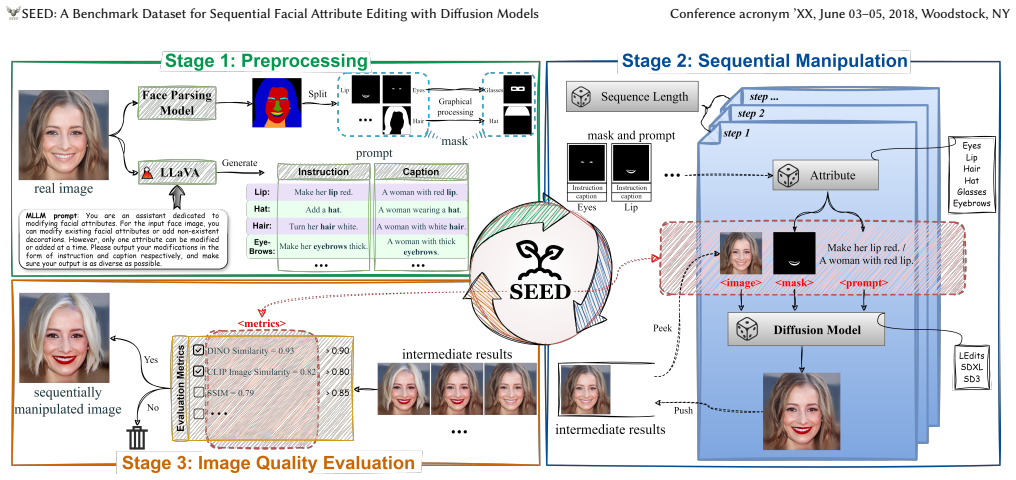
SEED demonstrates that large-scale, fine-grained sequential facial editing data can be produced automatically by chaining three diffusion editing pipelines (LEdits, SDXL, and SD3 with UltraEdit) over FFHQ and CelebAMask-HQ source images. Each image is annotated with its exact edit sequence, per-attribute masks, textual prompts, and the editing model used at each step, filtered by quality metrics based on DINO similarity, CLIP similarity, and SSIM. The paper claims this dataset is substantially more realistic, diverse, and finely annotated than existing sequential editing data, and that sequential editing detection should incorporate frequency-domain cues: feeding the DWT HH sub-band as auxiliary spatial guidance into a transformer decoder yields consistent gains in Fixed-, Adaptive-, and Full-Accuracy, with the highest reported average Full-Accuracy of 68.84% on the balanced test partition.
Load-bearing premise
The unstated quality thresholds and the approximate proxy masks (dilated eye region for glasses, upper hair region for hats) jointly carry the guarantee that every retained image truly contains exactly the recorded ordered edits; if those filters mislabel an image, every sequence label, mask, and downstream metric inherits the error.
Editorial extensions
If this is right
- SEED provides 91,526 labeled images across 200 ordered attribute sequences, so a model can be trained not just to tell edited from unedited faces but to predict the exact ordered list of one to four edits.
- Because sequence length and editing model are randomized and the recommended partition balances sequence lengths, evaluation on SEED measures performance across difficulty levels rather than on a single easy average.
- Longer edit sequences sharply reduce all detectors' accuracy, with Full-Accuracy falling from about 93% for one edit to about 24% for four edits, isolating the hardest end of the progressive-editing problem for future research.
- Frequency-domain guidance, particularly the DWT HH component, improves robustness to JPEG compression and Gaussian noise relative to spatial-only baselines in the reported experiments.
Reading between the lines
- The reported gains of FAITH over the spatial-only baseline are small in absolute terms (about 0.3 points in average Full-Accuracy), so a reader should not over-read the frequency mechanism's advantage without significance testing or confidence intervals.
- The dataset pipeline could be extended to non-facial subjects or to longer edit chains, and publishing the exact quality thresholds and mask-proxy rules would let others reproduce failure modes and measure label noise.
- Because the glasses and hat masks are proxies (dilated eye region and upper hair region), images involving additive accessories may carry the most label noise; a human-verified subset would make SEED a cleaner training and evaluation resource.
Editorial analysis
A structured set of objections, weighed in public.
Referee Report
Summary. The manuscript introduces SEED, a benchmark of 91,526 facial images obtained by applying 1 to 4 sequential diffusion-based edits (LEdits, SDXL, and SD3 fine-tuned with UltraEdit) to faces from FFHQ and CelebAMask-HQ, with per-image annotations of edit order, masks, prompts, and editing method. It also proposes FAITH, a frequency-aware transformer that incorporates DWT high-frequency features in cross-attention for sequential edit prediction, and reports experiments comparing FAITH variants (DCT, FFT, DWT) with SeqFakeFormer and adapted binary detectors. The paper claims that FAITH significantly improves sequential editing detection, particularly for longer sequences, and that SEED provides large-scale, precisely annotated data for this task.
Significance. The dataset resource is potentially valuable: it offers a much larger, diffusion-based sequential editing benchmark than SeqDeepFake, with multiple editing pipelines, per-step masks, prompts, and editing metadata, and the authors commit to releasing data and code. Comparing DCT, FFT, and DWT as frequency cues in a unified architecture is also a useful baseline study. However, the central experimental claim is contradicted by the paper's own Table 2 at the longest sequence length, and the dataset's ground-truth validity is not established because the label-generation pipeline relies on approximate masks and undisclosed global quality thresholds. I do not see circular reasoning in the evaluation protocol; the main concerns are internal consistency of the FAITH results and missing attribute-level validation of the SEED labels.
major comments (2)
- [Section 5.2, Table 2] Table 2 contradicts the paper's central claim that frequency-domain features significantly improve detection of longer editing sequences. For sequence length 4, SeqFakeFormer achieves Fixed/Adaptive/Full accuracy of 50.14/50.14/24.55, while all FAITH variants achieve Fixed/Adaptive values below 50 and Full-Acc values of 22.95 (DCT), 23.05 (FFT), and 23.35 (DWT). Thus FAITH is worse than the spatial baseline on every metric at the longest sequence length. The average Full-Acc improvement of DWT over SeqFakeFormer is only 0.31 points (68.84 vs 68.53), and no variance or significance test is reported. The abstract and Section 5.2 claims about enhanced sensitivity to subtle sequential changes therefore need to be substantially qualified or the experimental evidence reconsidered.
- [Section 3.1, Preprocessing and Image Quality Evaluation] The SEED ground-truth labels are not validated at the attribute level. The text states that glasses masks are obtained by dilating the eye mask and hat masks by using the upper hair region as a proxy, and that images are retained only if they pass 'predefined quality thresholds' on DINO similarity, CLIP similarity, and SSIM, yet no thresholds or filtering rules are reported. These global similarity metrics do not verify that the intended attribute change actually occurred, so an image in which an edit fails or modifies a different attribute can be retained with an incorrect sequence label. Because every downstream task on SEED is supervised by these labels, the benchmark needs a reported label audit, such as human evaluation on a sample or attribute-classifier verification, before the claimed annotation accuracy can be accepted.
minor comments (4)
- [Table 3(a)] The SeqFakeFormer row in Table 3(a) appears misaligned: the nine reported values (78.68, 61.60, 63.67, 44.41, 75.83, 59.24, 62.01, 66.63, 39.33) do not line up with the Fixed/Adaptive/Full columns across the three compression levels and should be corrected.
- [References [56]] DINO is cited to the DETR object-detection paper, but if the authors use DINOv1 or DINOv2 self-supervised features for quality assessment, the appropriate reference should be provided.
- [Section 1 and Table 1] The text says SeqDeepFake contains fewer than 50K images, while Table 1 reports two size numbers (35,166 and 49,920); please clarify which split or variant corresponds to which column.
- [Section 5.2] No error bars, standard deviations, or significance tests are reported; given that the main reported improvement is 0.31 Full-Acc points, a multi-run analysis is needed to establish that the difference is not noise.
Circularity Check
No significant circularity: FAITH is trained and tested on disjoint splits of SEED, and no fitted input is presented as a prediction.
full rationale
The paper's core claims are empirical dataset construction and benchmarking rather than analytical derivations. SEED is generated by applying diffusion editing pipelines, and each image's edit sequence is recorded from the pipeline's own random selection; FAITH is then trained on one partition and evaluated on a held-out partition of SEED using standard cross-entropy supervision and sequence-level accuracy metrics. No equation in the paper equates an output to an input, no fitted parameter is relabeled as a prediction, and no load-bearing uniqueness theorem or self-citation is invoked. The self-references appear only in related-work and application contexts. The undisclosed quality thresholds and approximate masks for glasses and hats are annotation-validity and generalization concerns, not instances of circular reasoning as defined by the reviewer rules. Therefore the appropriate finding is no significant circularity.
Assumptions & free parameters
free parameters (1)
- Quality thresholds for DINO, CLIP, and SSIM =
Not disclosed
assumptions (3)
- domain assumption CelebAMask-HQ face parsing masks accurately constrain each diffusion edit to the intended facial region, so edits are disentangled and sequence labels are correct.
- domain assumption DINO, CLIP, and SSIM thresholds filter edited images without systematically selecting for easier-to-detect artifacts or mislabeled failures.
- domain assumption LLaVA-generated prompts are semantically aligned with the intended attribute edit, so the prompt drives the correct edit in LEdits, SDXL, or SD3.
Cite this review
Pith. "Pith review of SEED: A Benchmark Dataset for Sequential Facial Attribute Editing with Diffusion Models." pith.science (2026). https://pith.science/paper/XSQBY6RD
@misc{pith2026250600562,
  author       = {Pith},
  title        = {Pith review of: SEED: A Benchmark Dataset for Sequential Facial Attribute Editing with Diffusion Models},
  year         = {2026},
  howpublished = {\url{https://pith.science/paper/XSQBY6RD}},
  note         = {Machine review of arXiv:2506.00562}
}
read the original abstract
Diffusion models have recently enabled precise and photorealistic facial editing across a wide range of semantic attributes. Beyond single-step modifications, a growing class of applications now demands the ability to analyze and track sequences of progressive edits, such as stepwise changes to hair, makeup, or accessories. However, sequential editing introduces significant challenges in edit attribution and detection robustness, further complicated by the lack of large-scale, finely annotated benchmarks tailored explicitly for this task. We introduce SEED, a large-scale Sequentially Edited facE Dataset constructed via state-of-the-art diffusion models. SEED contains over 90,000 facial images with one to four sequential attribute modifications, generated using diverse diffusion-based editing pipelines (LEdits, SDXL, SD3). Each image is annotated with detailed edit sequences, attribute masks, and prompts, facilitating research on sequential edit tracking, visual provenance analysis, and manipulation robustness assessment. To benchmark this task, we propose FAITH, a frequency-aware transformer-based model that incorporates high-frequency cues to enhance sensitivity to subtle sequential changes. Comprehensive experiments, including systematic comparisons of multiple frequency-domain methods, demonstrate the effectiveness of FAITH and the unique challenges posed by SEED. SEED offers a challenging and flexible resource for studying progressive diffusion-based edits at scale. Dataset and code will be publicly released at: https://github.com/Zeus1037/SEED.
Figures


Reference graph
Works this paper leans on
- [1]
-
[2]
Zhongjie Ba, Qingyu Liu, Zhenguang Liu, Shuang Wu, Feng Lin, Li Lu, and Kui Ren. 2024. Exposing the Deception: Uncovering More Forgery Clues for Deepfake Detection.Proceedings of the AAAI Conference on Artificial Intelligence38, 2 (Mar. 2024), 719–728. doi:10.1609/aaai.v38i2.27829
-
[3]
Jiaxuan Chen, Jieteng Yao, and Li Niu. 2024. A Single Simple Patch is All You Need for AI-generated Image Detection.arXiv:2402.01123(2024)
arXiv 2024
-
[4]
Zhongxi Chen, Ke Sun, Ziyin Zhou, Xianming Lin, Xiaoshuai Sun, Liujuan Cao, and Rongrong Ji. 2024. DiffusionFace: Towards a Comprehensive Dataset for Diffusion-Based Face Forgery Analysis.arXiv preprint arXiv:2403.18471(2024)
arXiv 2024
-
[5]
Jongwook Choi, Taehoon Kim, Yonghyun Jeong, Seungryul Baek, and Jongwon Choi. 2024. Exploiting Style Latent Flows for Generalizing Deepfake Video Detection. InProceedings of the IEEE/CVF Conference on Computer Vision and Pattern Recognition (CVPR). 1133–1143
work page 2024
-
[6]
Riccardo Corvi, Davide Cozzolino, Giovanni Poggi, Koki Nagano, and Luisa Verdoliva. 2023. Intriguing Properties of Synthetic Images: From Generative Ad- versarial Networks to Diffusion Models. InProceedings of the IEEE/CVF Conference on Computer Vision and Pattern Recognition (CVPR) Workshops. 973–982
work page 2023
-
[7]
Florinel-Alin Croitoru, Vlad Hondru, Radu Tudor Ionescu, and Mubarak Shah
-
[8]
Yusuf Dalva, Kavana Venkatesh, and Pinar Yanardag. 2024. FluxSpace: Disentan- gled Semantic Editing in Rectified Flow Transformers. arXiv:2412.09611 [cs.CV]
arXiv 2024
Show all 64 references
-
[9]
Jia Deng, Wei Dong, Richard Socher, Li-Jia Li, Kai Li, and Li Fei-Fei. 2009. Imagenet: A large-scale hierarchical image database. InCVPR
2009
-
[10]
Pierre Foret, Ariel Kleiner, Hossein Mobahi, and Behnam Neyshabur. 2021. Sharpness-aware Minimization for Efficiently Improving Generalization. InICLR
2021
-
[11]
Ian Goodfellow, Jean Pouget-Abadie, Mehdi Mirza, Bing Xu, David Warde-Farley, Sherjil Ozair, Aaron Courville, and Yoshua Bengio. 2020. Generative adversarial networks.Commun. ACM63, 11 (Oct. 2020), 139–144. doi:10.1145/3422622
2020 doi
-
[12]
Goodfellow, Jean Pouget-Abadie, Mehdi Mirza, Bing Xu, David Warde- Farley, Sherjil Ozair, Aaron Courville, and Yoshua Bengio
Ian J. Goodfellow, Jean Pouget-Abadie, Mehdi Mirza, Bing Xu, David Warde- Farley, Sherjil Ozair, Aaron Courville, and Yoshua Bengio. 2014. Generative Adversarial Nets. InAdvances in Neural Information Processing Systems, Z. Ghahra- mani, M. Welling, C. Cortes, N. Lawrence, and...
2014
-
[13]
Kaiming He, Xiangyu Zhang, Shaoqing Ren, and Jian Sun. 2016. Deep residual learning for image recognition. InCVPR
2016
-
[14]
Yinan He, Bei Gan, Siyu Chen, Yichun Zhou, Guojun Yin, Luchuan Song, Lu Sheng, Jing Shao, and Ziwei Liu. 2021. ForgeryNet: A Versatile Benchmark for Comprehensive Forgery Analysis. InCVPR
2021
-
[15]
Arash Heidari, Nima Jafari Navimipour, Hasan Dag, and Mehmet Unal. 2024. Deepfake detection using deep learning methods: A systematic and compre- hensive review.Wiley Interdisciplinary Reviews: Data Mining and Knowledge Discovery14, 2 (2024), e1520
2024
-
[16]
Jonathan Ho, Ajay Jain, and Pieter Abbeel. 2020. Denoising Diffusion Probabilistic Models. InNeurIPS
2020
-
[17]
Cheng-Yao Hong, Yen-Chi Hsu, and Tyng-Luh Liu. 2024. Contrastive Learning for DeepFake Classification and Localization via Multi-Label Ranking. InCVPR
2024
-
[18]
Bingwen Hu, Zhedong Zheng, Ping Liu, Wankou Yang, and Mingwu Ren. 2021. Unsupervised Eyeglasses Removal in the Wild.IEEE Transactions on Cybernetics 51, 9 (2021), 4373–4385. doi:10.1109/TCYB.2020.2995496
2021
-
[19]
Zhikun Huang, Zhedong Zheng, Chenggang Yan, Hongtao Xie, Yaoqi Sun, Jianzhong Wang, and Jiyong Zhang. 2021. Real-world automatic makeup via identity preservation makeup net. InInternational Joint Conference on Artificial Intelligence. International Joint Conference on Artifici...
2021
-
[20]
Yuming Jiang, Ziqi Huang, Xingang Pan, Chen Change Loy, and Ziwei Liu
-
[21]
Tero Karras, Samuli Laine, and Timo Aila. 2019. A Style-Based Generator Archi- tecture for Generative Adversarial Networks. In2019 IEEE/CVF Conference on Computer Vision and Pattern Recognition (CVPR). 4396–4405. doi:10.1109/CVPR. 2019.00453
2019
-
[22]
Hyunsu Kim, Yunjey Choi, Junho Kim, Sungjoo Yoo, and Youngjung Uh. 2021. Exploiting Spatial Dimensions of Latent in GAN for Real-Time Image Editing. In Proceedings of the IEEE/CVF Conference on Computer Vision and Pattern Recognition (CVPR). 852–861
2021
-
[23]
Kingma and Max Welling
Diederik P. Kingma and Max Welling. 2019. An Introduction to Variational Autoencoders.Foundations and Trends®in Machine Learning12, 4 (2019), 307–
2019
-
[24]
Nguyen, Junichi Yamagishi, and Isao Echizen
Trung-Nghia Le, Huy H. Nguyen, Junichi Yamagishi, and Isao Echizen. 2021. OpenForensics: Large-Scale Challenging Dataset for Multi-Face Forgery Detec- tion and Segmentation In-the-Wild. InProceedings of the IEEE/CVF International Conference on Computer Vision (ICCV). 10117–10127
2021
-
[25]
Cheng-Han Lee, Ziwei Liu, Lingyun Wu, and Ping Luo. 2020. MaskGAN: Towards Diverse and Interactive Facial Image Manipulation. InProceedings of the IEEE/CVF Conference on Computer Vision and Pattern Recognition (CVPR)
2020
-
[26]
Yunfei Li, Yuezun Li, Xin Wang, Baoyuan Wu, Jiaran Zhou, and Junyu Dong
-
[27]
Baoping Liu, Bo Liu, Ming Ding, and Tianqing Zhu. 2024. Detection of Diffusion Model-Generated Faces by Assessing Smoothness and Noise Tolerance. In2024 IEEE International Symposium on Broadband Multimedia Systems and Broadcasting (BMSB). 1–6. doi:10.1109/BMSB62888.2024.10608232
2024
-
[28]
Baoping Liu, Bo Liu, Ming Ding, Tianqing Zhu, and Xin Yu. 2023. TI2Net: Temporal Identity Inconsistency Network for Deepfake Detection. InProceedings of the IEEE/CVF Winter Conference on Applications of Computer Vision (W ACV). 4691–4700
2023
-
[29]
Haotian Liu, Chunyuan Li, Qingyang Wu, and Yong Jae Lee. 2023. Visual Instruc- tion Tuning
2023
-
[30]
Jiaxin Liu, Jia Wang, Saihui Hou, Min Ren, Huijia Wu, and Zhaofeng He. 2025. Beyond Face Swapping: A Diffusion-Based Digital Human Benchmark for Multi- modal Deepfake Detection.arXiv preprint arXiv:2505.16512(2025)
2025
-
[31]
Ping Liu, Qiqi Tao, and Joey Zhou. 2024. Robust Deepfake Detection by Ad- dressing Generalization and Trustworthiness Challenges: A Short Survey. In Proceedings of the 1st ACM Multimedia Workshop on Multi-modal Misinformation Governance in the Era of Foundation Models. 3–11
2024
-
[32]
Ping Liu, Qiqi Tao, and Joey Tianyi Zhou. 2024. Evolving from Single-modal to Multi-modal Facial Deepfake Detection: A Survey. arXiv:2406.06965 [cs.CV] https://arxiv.org/abs/2406.06965
2024 arXiv
-
[33]
Kartik Narayan, Harsh Agarwal, Kartik Thakral, Surbhi Mittal, Mayank Vatsa, and Richa Singh. 2023. DF-Platter: Multi-Face Heterogeneous Deepfake Dataset. InCVPR
2023
-
[34]
Dat Nguyen, Nesryne Mejri, Inder Pal Singh, Polina Kuleshova, Marcella Astrid, Anis Kacem, Enjie Ghorbel, and Djamila Aouada. 2024. LAA-Net: Localized Artifact Attention Network for Quality-Agnostic and Generalizable Deepfake Detection. InProceedings of the IEEE/CVF Conference...
2024
-
[35]
Dustin Podell, Zion English, Kyle Lacey, Andreas Blattmann, Tim Dockhorn, Jonas Müller, Joe Penna, and Robin Rombach. 2023. Sdxl: Improving latent diffusion models for high-resolution image synthesis.arXiv preprint arXiv:2307.01952 (2023)
2023 arXiv
-
[36]
Alec Radford, Jong Wook Kim, Chris Hallacy, Aditya Ramesh, Gabriel Goh, Sandhini Agarwal, Girish Sastry, Amanda Askell, Pamela Mishkin, Jack Clark, Gretchen Krueger, and Ilya Sutskever. 2021. Learning Transferable Visual Models From Natural Language Supervision. InProceedings ...
2021
-
[37]
Jonas Ricker, Simon Damm, Thorsten Holz, and Asja Fischer. 2024. Towards the Detection of Diffusion Model Deepfakes. InProceedings of the 19th International Joint Conference on Computer Vision, Imaging and Computer Graphics Theory and Applications, VISIGRAPP 2024, Volume 4: VI...
2024 doi
-
[38]
Roberts and Clifford T
Richard A. Roberts and Clifford T. Mullis. 1987.Digital signal processing. Addison- Wesley Longman Publishing Co., Inc., USA
1987
-
[39]
Robin Rombach, Andreas Blattmann, Dominik Lorenz, Patrick Esser, and Björn Ommer. 2022. High-Resolution Image Synthesis With Latent Diffusion Models. In Proceedings of the IEEE/CVF Conference on Computer Vision and Pattern Recognition (CVPR). 10684–10695
2022
-
[40]
Rui Shao, Tianxing Wu, and Ziwei Liu. 2022. Detecting and recovering sequential deepfake manipulation. InEuropean Conference on Computer Vision. Springer, 712–728
2022
-
[41]
Rui Shao, Tianxing Wu, and Ziwei Liu. 2025. Robust Sequential DeepFake Detection.International Journal of Computer Vision133 (01 2025), 3278–3295. doi:10.1007/s11263-024-02339-6
2025 doi
-
[42]
Chao Shuai, Jieming Zhong, Shuang Wu, Feng Lin, Zhibo Wang, Zhongjie Ba, Zhenguang Liu, Lorenzo Cavallaro, and Kui Ren. 2023. Locate and Verify: A Two-Stream Network for Improved Deepfake Detection. InProceedings of the 31st ACM International Conference on Multimedia(Ottawa ON...
2023
-
[43]
Haixu Song, Shiyu Huang, Yinpeng Dong, and Wei-Wei Tu. 2023. Robustness and generalizability of deepfake detection: A study with diffusion models.arXiv preprint arXiv:2309.02218(2023)
2023 arXiv
-
[44]
Jiaming Song, Chenlin Meng, and Stefano Ermon. 2020. Denoising Diffusion Implicit Models.arXiv:2010.02502(October 2020). https://arxiv.org/abs/2010. 02502
2020 arXiv
-
[45]
Chuangchuang Tan, Ping Liu, RenShuai Tao, Huan Liu, Yao Zhao, Baoyuan Wu, and Yunchao Wei. 2024. Data-Independent Operator: A Training-Free Artifact Conference acronym ’XX, June 03–05, 2018, Woodstock, NY Yule Zhu, Ping LiuB, Zhedong Zheng, and Wei LiuB Representation Extracto...
2024 arXiv
-
[46]
Chuangchuang Tan, Yao Zhao, Shikui Wei, Guanghua Gu, Ping Liu, and Yunchao Wei. 2024. Frequency-Aware Deepfake Detection: Improving Generalizability through Frequency Space Domain Learning.Proceedings of the AAAI Conference on Artificial Intelligence38, 5 (Mar. 2024), 5052–506...
2024 doi
-
[47]
Chuangchuang Tan, Yao Zhao, Shikui Wei, Guanghua Gu, Ping Liu, and Yunchao Wei. 2024. Rethinking the Up-Sampling Operations in CNN-based Generative Network for Generalizable Deepfake Detection. InProceedings of the IEEE/CVF Conference on Computer Vision and Pattern Recognition...
2024
-
[48]
Linoy Tsaban and Apolinário Passos. 2023. Ledits: Real image editing with ddpm inversion and semantic guidance.arXiv preprint arXiv:2307.00522(2023)
2023 arXiv
-
[49]
Jiacheng Wang, Ping Liu, Jingen Liu, and Wei Xu. 2024. Text-Guided Eyeglasses Manipulation With Spatial Constraints.Trans. Multi.26 (Jan. 2024), 4375–4388. doi:10.1109/TMM.2023.3322326
2024
-
[50]
Zhendong Wang, Jianmin Bao, Wengang Zhou, Weilun Wang, Hezhen Hu, Hong Chen, and Houqiang Li. 2023. DIRE for Diffusion-Generated Image Detection. In Proceedings of the IEEE/CVF International Conference on Computer Vision (ICCV). 22445–22455
2023
-
[51]
Bovik, H.R
Zhou Wang, A.C. Bovik, H.R. Sheikh, and E.P. Simoncelli. 2004. Image quality assessment: from error visibility to structural similarity.IEEE Transactions on Image Processing(2004)
2004
-
[52]
Zijie J Wang, Evan Montoya, David Munechika, Haoyang Yang, Benjamin Hoover, and Duen Horng Chau. 2022. Diffusiondb: A large-scale prompt gallery dataset for text-to-image generative models.arXiv preprint arXiv:2210.14896(2022)
2022 arXiv
-
[53]
Ruiyang Xia, Decheng Liu, Jie Li, Lin Yuan, Nannan Wang, and Xinbo Gao
-
[54]
Xingxi Yin, Jingfeng Zhang, Zhi Li, Yicheng Li, and Yin Zhang. 2025. InstructAttribute: Fine-grained Object Attributes editing with Instruction. arXiv:2505.00751 [cs.CV]
2025 arXiv
-
[55]
Daichi Zhang, Zihao Xiao, Shikun Li, Fanzhao Lin, Jianmin Li, and Shiming Ge. 2025. Learning Natural Consistency Representation for Face Forgery Video Detection. InECCV
2025
-
[56]
Ni, and Heung-Yeung Shum
Hao Zhang, Feng Li, Shilong Liu, Lei Zhang, Hang Su, Jun Zhu, Lionel M. Ni, and Heung-Yeung Shum. 2023. DINO: DETR with Improved DeNoising Anchor Boxes for End-to-End Object Detection. InICLR
2023
-
[57]
Yuxuan Zhang, Lifu Wei, Qing Zhang, Yiren Song, Jiaming Liu, Huaxia Li, Xu Tang, Yao Hu, and Haibo Zhao. 2024. Stable-Makeup: When Real-World Makeup Transfer Meets Diffusion Model.arXiv preprint arXiv:2403.07764(2024)
2024 arXiv
-
[58]
Haozhe Zhao, Xiaojian Ma, Liang Chen, Shuzheng Si, Rujie Wu, Kaikai An, Peiyu Yu, Minjia Zhang, Qing Li, and Baobao Chang. 2024. UltraEdit: Instruction-based Fine-Grained Image Editing at Scale. InAdvances in Neural Information Processing Systems, A. Globerson, L. Mackey, D. B...
2024
-
[59]
Dragos,-Constantin T, ânt,aru, Elisabeta Oneat,ă, and Dan Oneat,ă. 2024. Weakly- Supervised Deepfake Localization in Diffusion-Generated Images. InProceedings of the IEEE/CVF Winter Conference on Applications of Computer Vision (W ACV). 6258–6268. Received 20 February 2007; re...
2024
-
[392]
doi:10.1561/2200000056
-
[2021]
InProceedings of the IEEE/CVF International Conference on Computer Vision
Talk-to-Edit: Fine-Grained Facial Editing via Dialog. InProceedings of the IEEE/CVF International Conference on Computer Vision. 13799–13808
-
[2023]
Diffusion Models in Vision: A Survey.IEEE Transactions on Pattern Analysis and Machine Intelligence(2023)
2023
-
[2024]
Mmnet: multi-collaboration and multi-supervision network for sequential deepfake detection.IEEE Transactions on Information Forensics and Security (2024)
2024
-
[2025]
InProceedings of the Winter Conference on Applications of Computer Vision (W ACV)
Texture Shape and Order Matter: A New Transformer Design for Sequential DeepFake Detection. InProceedings of the Winter Conference on Applications of Computer Vision (W ACV). 202–211
Reviewed August 7, 2026 · model on record in the stance chip above.
Discussion (0). Sign in to comment.