REVIEW 3 major objections 4 minor 30 references
Mixture-of-Expert Variational Autoencoders for Cross-Modality Embedding of Type Ia Supernova Data
T0 review · 3 major / 4 minor · reviewed 2026-08-06 · deepseek-v4-flash
Pith's one-line read A mixture-of-experts variational autoencoder with Perceiver-style transceiver encoders learns a joint embedding of supernova light curves and spectra, enabling photometry-only spectral reconstruction that beats contrastive…
desk verdict A promising but under-evaluated MMVAE/Perceiver application for SN Ia photometry-to-spectrum generation, undercut by a collapsed contrastive baseline and noiseless simulated photometry. read the letter →
The pith
A machine-rendered reading of the paper's core claim, the machinery that carries it, and where it could break.
The reading
What carries the argument
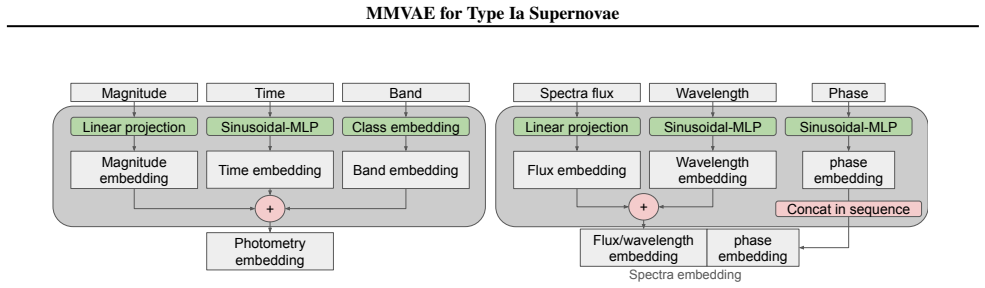
The central object is the transceiver, a Perceiver-IO-style encoder-decoder in which a fixed-size latent bottleneck attends over variable-length modality embeddings via cross-attention, so inputs of arbitrary length and irregular time sampling are handled without fixed-size constraints. Each modality has its own transceiver encoder producing the mean and variance of a Laplace distribution, the posterior is a mixture-of-experts average over modality encoders, and each modality has its own decoder. The model is trained with the IWAE objective introduced by Shi et al. (2019), with a standard Laplace prior and a latent size of 4 by 4, and the bottleneck is what lets a posterior sample from one modality be decoded through another modality's decoder.
What would settle it
Take a sample of spectroscopically confirmed Type Ia supernovae with realistic LSST-like photometry (including noise and observing gaps) and compare photometry-conditioned MMVAE reconstructions against the phase-averaged training spectrum; if the model does not beat that trivial baseline on real data, the central claim fails. Additionally, check the credible-interval coverage on held-out real spectra, since the paper already reports undercoverage on simulated data.
Extended reading notes
Core claim
In the paper's own terms, a multi-modal mixture-of-experts VAE trained with the IWAE objective learns a joint embedding in which conditioning on photometry alone yields spectral reconstructions that are more faithful than nearest-neighbor retrieval in a contrastively trained latent space, and competitive with a VAE trained directly on spectra. The mixture-of-experts posterior lets each modality encode the shared latent independently, so at inference the photometry encoder alone can drive the spectral decoder. Additional results show that the model degrades gracefully as photometric observations are masked, regressing toward the training-set mean only when a large majority of observations are removed, and that the latent features support parameter regression that outperforms an end-to-end encoder on most physical parameters while exhibiting large scatter.
Load-bearing premise
The load-bearing premise is that the Goldstein & Kasen (2018) simulation grid is a sufficiently representative and noise-free stand-in for real Type Ia supernova light curves and spectra, and the paper itself notes that the low intrinsic diversity among SNe Ia may explain the strong performance.
Editorial extensions
If this is right
- Spectra can be predicted for events that have no spectroscopic follow-up, as long as photometry exists, enabling rapid physical characterization of large survey samples.
- The same mixture-of-experts structure can be extended to additional modalities, such as host-galaxy images, without changing the inference procedure.
- Masking experiments indicate the model remains informative with heavily incomplete light curves, degrading toward the training-set mean only when roughly 70 percent of observations are removed.
- The latent space itself can serve as input to lightweight task-specific regressors that beat an end-to-end encoder on most physical parameters, suggesting the embedding preserves physically meaningful information.
- A single method can simultaneously deliver cross-modal generation and a joint embedding for downstream tasks, which the paper argues is a useful property for multi-modal 'foundation models' in astronomy.
Reading between the lines
- Because the contrastive baseline 'essentially retrieves the average SN Ia spectrum at each phase,' the headline improvement may partly reflect the weakness of that baseline rather than a large generative advantage, so a stronger retrieval baseline would sharpen the comparison.
- A decisive test of the method's generality would be to train and evaluate on a more heterogeneous supernova population, such as core-collapse events, or on real observed SNe Ia with realistic photometric noise and gaps, and check whether reconstructions still beat the phase-averaged spectrum.
- The authors' own admission that strong performance may stem from low intrinsic diversity among SNe Ia suggests the apparent success on the Goldstein & Kasen grid may not transfer to the rare, peculiar explosions that motivate cross-modal study.
- The transceiver component is presented as independently reusable, so it could be grafted onto other training objectives, such as diffusion decoders or contrastive schemes, without retaining the MMVAE's mixture-of-experts posterior.
Signed reviews
Editorial analysis
A structured set of objections, weighed in public.
Referee Report
Summary. The paper proposes a mixture-of-experts variational autoencoder (MMVAE) combined with a Perceiver-style encoder-decoder ('transceiver') to learn joint embeddings of Type Ia supernova light curves and spectra. The model is trained on 4,500 Goldstein & Kasen (2018) radiative-transfer simulations, with LSST-like photometry generated by integrating SEDs over filter transmission curves. The authors evaluate cross-modal reconstruction of spectra from photometry, comparing against a spectra-only VAE, a contrastively trained model with nearest-neighbor retrieval, and the training-set average spectrum, and they report residual error, credible-interval coverage, and width. They also conduct a lightweight parameter-regression experiment. The paper openly reports that posterior credible intervals undercover and that parameter recovery is often only slightly better than the training-set mean.
Significance. The transceiver architecture itself is a genuinely useful step: it natively handles variable-length, irregularly sampled time series and missing modalities at inference, and the paper provides public code. The authors also report calibration honestly rather than overselling their model. However, the central comparative claim—that the MMVAE outperforms a contrastive nearest-neighbor search—is currently supported only against a baseline that the paper itself describes as collapsing to the average spectrum. This weakens the headline result considerably. If the baseline were strengthened and quantitative metrics provided, the contribution would be solidly useful for the time-domain astronomy community; as written, the paper demonstrates that the MMVAE beats the mean spectrum but does not yet establish that its joint embedding is more informative than a properly trained contrastive model.
major comments (3)
- [Section 3, 'Cross-Modality Generation' and Figure 4] The paper states that the contrastive nearest-neighbor search 'essentially retrieves the average SN Ia spectrum at each phase.' Under these conditions, the claim that the MMVAE 'exceeds' the contrastive method does not establish that the MMVAE's joint embedding is more informative than a functioning contrastive model; it may simply reflect a collapsed baseline. Please report quantitative retrieval statistics (e.g., how many distinct training spectra are retrieved, the distance between retrieved spectra and the training-set mean, and retrieval accuracy against the known simulation labels), and include ablations of the contrastive training (longer training, a standard InfoNCE objective, or a stronger projection head). Without these, the headline comparison in the abstract is not load-bearing.
- [Section 3, 'Cross-Modality Generation'] The evaluation metrics are presented only as curves in Figure 4 (residual error, CI coverage, CI width), with no scalar summary statistics, uncertainties, or the number of test events. The statements that the MMVAE is 'comparable' to the spectra-only VAE and 'exceeding' the contrastive method are therefore not quantitatively grounded. Please provide a table (or explicit numbers in the text) of the average residual, coverage, and width for each baseline and phase, with error bars, so that the magnitude of the differences can be assessed.
- [Section B.3 and Figure 8] The parameter-regression experiment shows large scatter, and the text concedes that 'most methods perform only slightly better than a training-set average.' Since the abstract lists physical-parameter validation as part of the paper's claims, the paper should either quantify which parameters are recovered significantly better than the mean baseline (with effect sizes and significance) or explicitly reposition parameter recovery as preliminary. As written, the claim of validated parameter recovery is stronger than the evidence supports.
minor comments (4)
- [Section 2, Eq. (3)] The notation uses qψm for both the encoder distributions (Eq. 1) and the decoder distributions (Eq. 2), which is confusing; consider using pθm or a distinct symbol for the decoders. Also define K explicitly and clarify whether '500 iterations' means 500 optimizer steps or 500 epochs, stating the batch size.
- [Figure 4 caption] The caption appears to be truncated: it ends with 'Unsurprisingly, the spectra-only VAE However, the low CI coverage indicates...' and does not form a complete sentence. Please complete the caption.
- [Section 2, 'Multi-Modal Transceiver Trained via Contrastive Learning'] There is a typo: 'constrastive' should be 'contrastive.' Additionally, the paper should specify the contrastive learning temperature and the number of negative samples used in the InfoNCE loss.
- [Section 3, Data] The photometry simulation does not mention an explicit noise model; since real survey photometry is noisy, please state this limitation directly in the Data section (or add a noise model), and consider discussing its impact on the generalization claims in Section 4.
Circularity Check
No significant circularity: the central cross-modality result is an empirical held-out comparison, and the self-citations are contextual rather than load-bearing.
full rationale
The paper's central claim is that a mixture-of-experts VAE (MMVAE) with transceiver encoders/decoders reconstructs SN Ia spectra from photometry more faithfully than a contrastively-trained nearest-neighbor search. This claim is supported by training on the Goldstein & Kasen (2018) radiative-transfer grid, holding out 10% of events for testing, and computing residual and coverage metrics on those held-out events. The MMVAE objective (Eq. 3) is a standard IWAE objective; no fitted parameter is renamed as a prediction, and the comparison to the spectra-only VAE and training-set-average baseline does not reduce to the model's own inputs by construction. The paper's own text notes that the contrastive baseline 'essentially retrieves the average SN Ia spectrum at each phase,' which is a weakness of that baseline but not a circularity in the MMVAE's derivation. The self-citations to Shen & Gagliano (2025) are descriptive — the MMVAE is described as a generalization of that diffusion work — but those citations do not supply the load-bearing assumptions or the evaluation outcome. The feature-extraction experiment trains MLPs on two-thirds of the test set and evaluates on the remaining third; while this is an unconventional use of the test split, it is not the headline result and does not make the model's cross-modality reconstruction circular. Overall, the derivation chain is self-contained: the model is defined by standard variational and architectural components, and the reported performance is an empirical measurement on held-out simulations.
Assumptions & free parameters
free parameters (5)
- Latent space dimension =
R^(4x4)
- Model dimension d =
32
- Number of attention layers and heads =
4 layers, 4 heads
- Training iterations =
500
- Learning rate =
0.001
assumptions (4)
- domain assumption The Goldstein & Kasen (2018) radiative-transfer simulation grid is a representative sample of Type Ia supernova diversity
- domain assumption Simulated LSST photometry, produced by integrating SED surfaces over filter transmission curves with no explicit noise model, is sufficient to validate cross-modality generation
- domain assumption The latent posterior and prior are Laplace distributions and the MMVAE mixture-of-experts approximation is adequate for the many-to-many light-curve/spectrum mapping
- standard math The importance-weighted autoencoder objective is a valid lower bound for training
Cite this review
Pith. "Pith review of Mixture-of-Expert Variational Autoencoders for Cross-Modality Embedding of Type Ia Supernova Data." pith.science (2026). https://pith.science/paper/XSVW5YJL
@misc{pith2026250716817,
  author       = {Pith},
  title        = {Pith review of: Mixture-of-Expert Variational Autoencoders for Cross-Modality Embedding of Type Ia Supernova Data},
  year         = {2026},
  howpublished = {\url{https://pith.science/paper/XSVW5YJL}},
  note         = {Machine review of arXiv:2507.16817}
}
read the original abstract
Time-domain astrophysics relies on heterogeneous and multi-modal data. Specialized models are often constructed to extract information from a single modality, but this approach ignores the wealth of cross-modality information that may be relevant for the tasks to which the model is applied. In this work, we propose a multi-modal, mixture-of-expert variational autoencoder to learn a joint embedding for supernova light curves and spectra. Our method, which is inspired by the Perceiver architecture, natively accommodates variable-length inputs and the irregular temporal sampling inherent to supernova light curves. We train our model on radiative transfer simulations and validate its performance on cross-modality reconstruction of supernova spectra and physical parameters from the simulation. Our model achieves superior performance in cross-modality generation to nearest-neighbor searches in a contrastively-trained latent space, showing its promise for constructing informative latent representations of multi-modal astronomical datasets.
Figures


Figures from the paper (5 more)


Reference graph
Works this paper leans on
-
[1]
write newline
" write newline "" before.all 'output.state := FUNCTION n.dashify 't := "" t empty not t #1 #1 substring "-" = t #1 #2 substring "--" = not "--" * t #2 global.max substring 't := t #1 #1 substring "-" = "-" * t #2 global.max substring 't := while if t #1 #1 substring * t #2 global.max substring 't := if while FUNCTION format.date year duplicate empty "emp...
-
[2]
Flamingo: a visual language model for few-shot learning
Alayrac, J.-B., Donahue, J., Luc, P., Miech, A., Barr, I., Hasson, Y., Lenc, K., Mensch, A., Millican, K., Reynolds, M., et al. Flamingo: a visual language model for few-shot learning. Advances in neural information processing systems, 35: 0 23716--23736, 2022
2022
-
[3]
Bellm, E. C., Kulkarni, S. R., Graham, M. J., Dekany, R., Smith, R. M., Riddle, R., Masci, F. J., Helou, G., Prince, T. A., Adams, S. M., et al. The zwicky transient facility: system overview, performance, and first results. Publications of the Astronomical Society of the Pacific, 131 0 (995): 0 018002, 2018
work page 2018
-
[4]
ParSNIP: Generative Models of Transient Light Curves with Physics-enabled Deep Learning
Boone , K. ParSNIP: Generative Models of Transient Light Curves with Physics-enabled Deep Learning . Astronomical Journal, 162 0 (6): 0 275, December 2021. doi:10.3847/1538-3881/ac2a2d
-
[5]
DES Collaboration , Abbott , T. M. C., Acevedo , M., Aguena , M., Alarcon , A., Allam , S., Alves , O., Amon , A., Andrade-Oliveira , F., Annis , J., Armstrong , P., Asorey , J., Avila , S., Bacon , D., Bassett , B. A., Bechtol , K., Bernardinelli , P. H., Bernstein , G. M., Bertin , E., Blazek , J., Bocquet , S., Brooks , D., Brout , D., Buckley-Geer , E...
2024
-
[6]
Goldstein, D. A. and Kasen, D. Evidence for sub-chandrasekhar mass type ia supernovae from an extensive survey of radiative transfer models. The Astrophysical Journal Letters, 852 0 (2): 0 L33, 2018
work page 2018
-
[7]
Hoyle, F. and Fowler, W. A. Nucleosynthesis in supernovae. Astrophysical Journal, vol. 132, p. 565, 132: 0 565, 1960
work page 1960
-
[8]
Ivezi \'c , Z ., Kahn, S. M., Tyson, J. A., Abel, B., Acosta, E., Allsman, R., Alonso, D., AlSayyad, Y., Anderson, S. F., Andrew, J., et al. Lsst: from science drivers to reference design and anticipated data products. The Astrophysical Journal, 873 0 (2): 0 111, 2019
work page 2019
Show all 30 references
-
[9]
Perceiver io: A general architecture for structured inputs & outputs
Jaegle, A., Borgeaud, S., Alayrac, J.-B., Doersch, C., Ionescu, C., Ding, D., Koppula, S., Zoran, D., Brock, A., Shelhamer, E., et al. Perceiver io: A general architecture for structured inputs & outputs. arXiv preprint arXiv:2107.14795, 2021 a
2021 arXiv
-
[10]
Perceiver: General perception with iterative attention
Jaegle, A., Gimeno, F., Brock, A., Vinyals, O., Zisserman, A., and Carreira, J. Perceiver: General perception with iterative attention. In International conference on machine learning, pp.\ 4651--4664. PMLR, 2021 b
2021
-
[11]
Secondary maximum in the near-infrared light curves of type ia supernovae
Kasen, D. Secondary maximum in the near-infrared light curves of type ia supernovae. The Astrophysical Journal, 649 0 (2): 0 939, 2006
2006
-
[12]
D., Jones , D
Kenworthy , W. D., Jones , D. O., Dai , M., Kessler , R., Scolnic , D., Brout , D., Siebert , M. R., Pierel , J. D. R., Dettman , K. G., Dimitriadis , G., Foley , R. J., Jha , S. W., Pan , Y. C., Riess , A., Rodney , S., and Rojas-Bravo , C. SALT3: An Improved Type Ia Supernov...
2021 doi
-
[13]
Supervised contrastive learning
Khosla, P., Teterwak, P., Wang, C., Sarna, A., Tian, Y., Isola, P., Maschinot, A., Liu, C., and Krishnan, D. Supervised contrastive learning. Advances in neural information processing systems, 33: 0 18661--18673, 2020
2020
-
[14]
K., and Han, Z
Liu, Z.-W., R \"o pke, F. K., and Han, Z. Type ia supernova explosions in binary systems: A review. Research in Astronomy and Astrophysics, 23 0 (8): 0 082001, 2023
2023
-
[15]
and Yau, C
M \"a rtens, K. and Yau, C. Disentangling shared and private latent factors in multimodal variational autoencoders. In Machine Learning in Computational Biology, pp.\ 60--75. PMLR, 2024
2024
-
[16]
Palumbo, E., Daunhawer, I., and Vogt, J. E. Mmvae+: Enhancing the generative quality of multimodal vaes without compromises. In The Eleventh International Conference on Learning Representations. OpenReview, 2023
2023
-
[17]
Palumbo, E., Manduchi, L., Laguna, S., Chopard, D., and Vogt, J. E. Deep generative clustering with multimodal diffusion variational autoencoders. In The Twelfth International Conference on Learning Representations, 2024
2024
-
[18]
AstroCLIP: a cross-modal foundation model for galaxies
Parker , L., Lanusse , F., Golkar , S., Sarra , L., Cranmer , M., Bietti , A., Eickenberg , M., Krawezik , G., McCabe , M., Morel , R., Ohana , R., Pettee , M., R \'e galdo-Saint Blancard , B., Cho , K., Ho , S., and Polymathic AI Collaboration . AstroCLIP: a cross-modal found...
2024 doi
-
[19]
and Xie, S
Peebles, W. and Xie, S. Scalable diffusion models with transformers. In Proceedings of the IEEE/CVF international conference on computer vision, pp.\ 4195--4205, 2023
2023
-
[20]
A., Nugent, P., Castro, P
Perlmutter, S., Aldering, G., Goldhaber, G., Knop, R. A., Nugent, P., Castro, P. G., Deustua, S., Fabbro, S., Goobar, A., Groom, D. E., et al. Measurements of and from 42 high-redshift supernovae. The Astrophysical Journal, 517 0 (2): 0 565, 1999
1999
-
[21]
B., Schommer, R., Hamuy, M., and Maza, J
Phillips, M., Lira, P., Suntzeff, N. B., Schommer, R., Hamuy, M., and Maza, J. The reddening-free decline rate versus luminosity relationship for type ia supernovae. The Astronomical Journal, 118 0 (4): 0 1766, 1999
1999
-
[22]
Phillips, M. M. The absolute magnitudes of type ia supernovae. Astrophysical Journal, Part 2-Letters (ISSN 0004-637X), vol. 413, no. 2, p. L105-L108., 413: 0 L105--L108, 1993
1993
-
[23]
Pskovskii, I. P. Light curves, color curves, and expansion velocity of type i supernovae as functions of the rate of brightness decline. Soviet Astronomy, vol. 21, Nov.-Dec. 1977, p. 675-682. Translation. Astronomicheskii Zhurnal, vol. 54, Nov.-Dec. 1977, p. 1188-1201., 21: 0 ...
1977
-
[24]
G., Filippenko, A
Riess, A. G., Filippenko, A. V., Challis, P., Clocchiatti, A., Diercks, A., Garnavich, P. M., Gilliland, R. L., Hogan, C. J., Jha, S., Kirshner, R. P., et al. Observational evidence from supernovae for an accelerating universe and a cosmological constant. The astronomical jour...
1998
-
[25]
and Bloom , J
Rizhko , M. and Bloom , J. S. AstroM ^ 3 : A Self-supervised Multimodal Model for Astronomy . Astronomical Journal, 170 0 (1): 0 28, July 2025. doi:10.3847/1538-3881/adcbad
2025 doi
- [26]
-
[27]
and Gagliano, A
Shen, Y. and Gagliano, A. T. Variational diffusion transformers for conditional sampling of supernovae spectra. arXiv preprint arXiv:2505.03063, 2025
2025 arXiv
-
[28]
Variational mixture-of-experts autoencoders for multi-modal deep generative models
Shi, Y., Paige, B., Torr, P., et al. Variational mixture-of-experts autoencoders for multi-modal deep generative models. Advances in neural information processing systems, 32, 2019
2019
-
[29]
R., Magee , M., Angus , C
Wang , Q., Rest , A., Dimitriadis , G., Ridden-Harper , R., Siebert , M. R., Magee , M., Angus , C. R., Auchettl , K., Davis , K. W., Foley , R. J., Fox , O. D., Gomez , S., Jencson , J. E., Jones , D. O., Kilpatrick , C. D., Pierel , J. D. R., Piro , A. L., Polin , A., Polits...
2024
-
[30]
T., Mishra-Sharma, S., and Villar, V
Zhang, G., Helfer, T., Gagliano, A. T., Mishra-Sharma, S., and Villar, V. A. Maven: a multimodal foundation model for supernova science. Machine Learning: Science and Technology, 5 0 (4): 0 045069, 2024
2024
Reviewed August 6, 2026 · model on record in the stance chip above.
Discussion (0). Continue with ORCID to comment.