REVIEW 2 major objections 4 minor 1 cited by
The galaxy-AGN scaling relations over 13 billion years in SHARK v2.0 (I): SMBH masses
T0 review · 2 major / 4 minor · reviewed 2026-08-07 · deepseek-v4-flash
Pith's one-line read Using SHARK v2.0, a semi-analytic model of galaxy formation, this paper predicts that supermassive black holes at z=9 were about ten times more massive than black holes in galaxies of the same stellar mass today, and that galaxy…
desk verdict A solid, open, well-comparisoned SAM prediction paper whose headline 1 dex evolution claim rests on manually re-tuned cold-gas accretion parameters with no sensitivity analysis. read the letter →
The pith
A machine-rendered reading of the paper's core claim, the machinery that carries it, and where it could break.
The reading
What carries the argument
SHARK v2.0's SMBH growth module: seeded black holes grow by Bondi-like hot gas accretion (Equation 1), by episodic cold gas accretion during starbursts triggered by mergers or disc instabilities (Equations 2-3, with free parameters fSMBH=0.007 and eSB=2.0 manually re-tuned for the Planck-Millennium run), and by SMBH-SMBH mergers. These channels set the normalization, slope, and scatter of the scaling relations; the cold-gas channel dominates high-redshift growth and sets the local M_bulge-M_BH normalization, while the merger channel increasingly contributes at low redshift. The random forest regression applied to offsets from the fitted relations is the tool that attributes the scatter primarily to morphology.
What would settle it
Measure the M_star-M_BH and M_bulge-M_BH medians at z~4-6 with a large, selection-function-corrected sample (e.g., JWST and 4MOST); the paper's central claim would be contradicted if the median offset from local relations is much smaller than ~1 dex at fixed stellar mass once Lauer-type bias is corrected. A cheaper model-side falsifier is to rerun SHARK v2.0 with fSMBH varied over, say, 0.003-0.015 and eSB varied over 1-10; if the z=9-to-z=0 offset changes by more than ~0.5 dex, the evolution claim is an artifact of the manual calibration.
Extended reading notes
Core claim
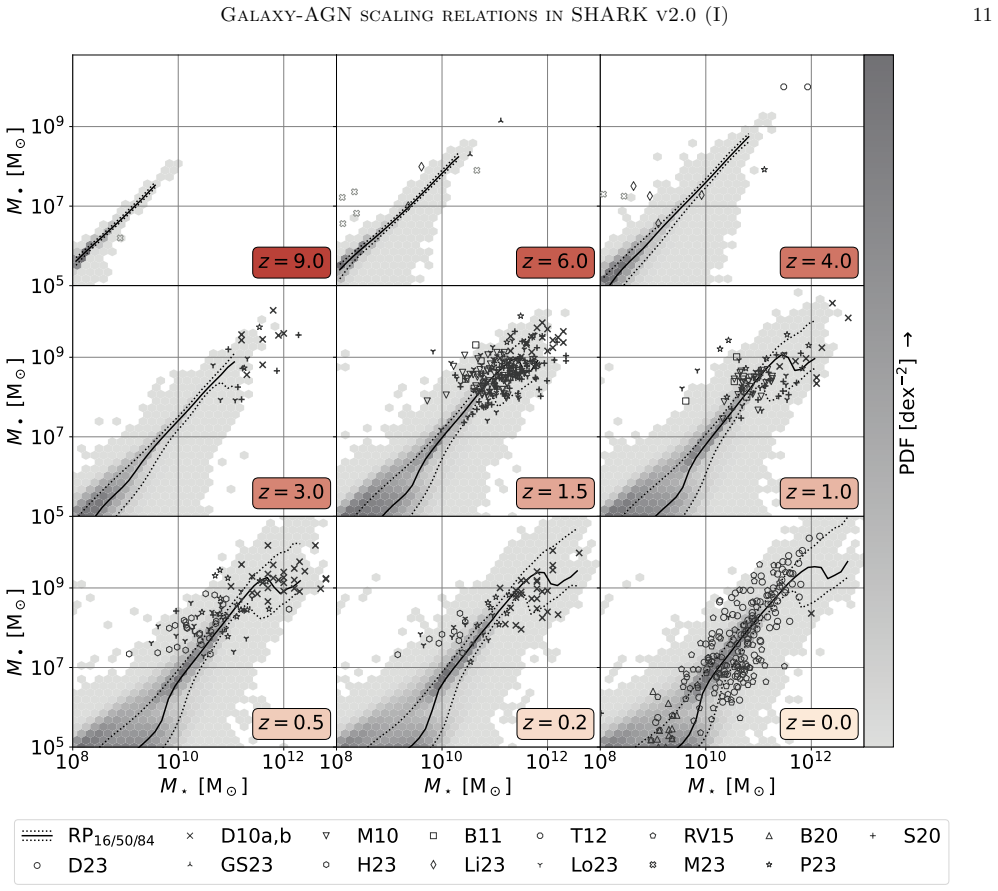
The central discovery is a set of model predictions: the M_bulge-M_BH and M_star-M_BH relations in SHARK v2.0 are not universal but shift downward by about 1 dex in SMBH mass from z=9 to z=0 at fixed stellar mass, with the scatter increasing by a factor of roughly 2-5. The model produces a tight M_bulge-M_BH relation at all redshifts, with early- and late-type galaxies following distinct relations that separate by z~4; late-type galaxies have more massive SMBHs at fixed bulge mass but lower masses at fixed total stellar mass, and SMBHs are most massive in early-type galaxies. SMBH growth transitions from gas-accretion-dominated at high redshift to merger-dominated at low redshift, with a minimum in merger fraction around M_BH~$10^{7}$ Msun and M_bulge~$10^{10}$ Msun that does not evolve. Random forest regressions identify bulge-to-total ratio as the dominant feature explaining offsets from both relations at all redshifts, with central/satellite status having minor importance, implying environment acts indirectly through morphology.
Load-bearing premise
The ~1 dex cosmic evolution claim rests on the assumption that the cold-gas accretion parameters fSMBH=0.007 and eSB=2.0, manually tuned to the local M_bulge-M_BH normalization, remain a valid extrapolation from z=0 to z=9, and the paper does not test how sensitive the evolution is to those choices.
Editorial extensions
If this is right
- At fixed stellar mass, high-redshift galaxies should show SMBH masses up to ~1 dex above the local median, so deep surveys at z>4 can distinguish evolving from universal relations.
- Estimates of SMBH masses from host stellar mass alone will carry large scatter; adding bulge mass or bulge-to-total ratio should markedly improve the inference.
- The scatter around both relations should grow from z=9 to z=0 by a factor of 2-5, with a stellar-mass-dependent peak around M_star~10^10 Msun at low redshift.
- Low-mass satellite galaxies should host more massive SMBHs than centrals of the same stellar mass by z=0 (up to ~0.5 dex), but this difference should vanish once morphology is controlled for.
- The switch from gas-accretion-dominated to merger-dominated SMBH growth around z~4 should be reflected in the demographics of merging and active galaxies.
Reading between the lines
- Extension: If the 1 dex offset is physical, local SMBH mass predictors calibrated at z=0 will systematically underestimate high-redshift SMBH masses; a direct test is to apply the local relations to JWST-discovered z>4 galaxies and compare with independent estimates such as virial or reverberation mapping.
- Extension: The dominance of morphology in the random forest suggests that merger history (wet versus dry) may be the underlying variable coupling SMBH growth to other galaxy properties; a controlled model experiment that shuffles merger histories at fixed morphology could isolate this.
- Extension: The model's predicted satellite-central offset below ~10^10 Msun could be probed with upcoming 4MOST AGN surveys overlapping deep environmental metrics; detecting or ruling out the offset would constrain the role of ram-pressure and tidal stripping in SMBH feeding.
Editorial analysis
A structured set of objections, weighed in public.
Referee Report
Summary. The paper uses the SHARK v2.0 semi-analytic model, re-calibrated to the Planck-Millennium N-body simulation, to predict the evolution of the M_bulge-M_BH and M_star-M_BH scaling relations from z=9 to z=0. The authors manually retune the cold-gas accretion parameters fSMBH and eSB (Table 2) to reproduce the local M_bulge-M_BH normalisation, and find that the model broadly matches observed BHMFs and scaling relations over the redshift range, predicts a ~1 dex decrease in SMBH mass at fixed stellar mass from z=9 to z=0, a factor of 2-5 increase in scatter toward z=0, and that bulge-to-total ratio is the dominant predictor of scatter in a random forest analysis. They interpret these results as evidence for strong cosmic evolution of the scaling relations and a central role for morphology, with environment playing only an indirect role.
Significance. If robust, the evolution prediction is a valuable, large-volume prediction from an open-source SAM that can be tested with 4MOST and JWST samples; the paper also provides useful qualitative predictions for the morphology-dependence of the relations and for the occupation fraction of low-mass black holes. Strengths include the transparency about primary vs secondary calibration (Section 2.2), the explicit statement that the z=0 normalisation is calibrated rather than predicted (Section 3.1), the test of seed-mass insensitivity (Section 2.1), and the public availability of the code. The high-redshift evolution claim, however, rests on the uncalibrated cold-gas accretion prescription, and the morphology-scatter claim is based on a predictive-correlation analysis rather than a causal decomposition; both caveats need to be addressed before the strong conclusions can be accepted.
major comments (2)
- [Section 2.2, Table 2, Eqs. (2)-(3), Section 5] The predicted ~1 dex offset in SMBH mass at fixed stellar mass between z=9 and z=0 is the central claim, and it is anchored at high redshift by the cold-gas accretion channel, which Figure 9 shows dominates SMBH growth at z>~6. This channel is controlled by fSMBH and eSB, which were manually re-tuned from (0.01, 15.0) to (0.007, 2.0) when moving the model to Planck-Millennium (Section 2.2). Because the cold-gas accretion rate in Eq. (3) is proportional to fSMBH/eSB, this retuning changes the high-redshift accretion rate by a factor of 5.25 relative to the L24 values. The paper does not report a sensitivity analysis of the evolution claim to these parameters, so it remains possible that a substantial part of the predicted 1 dex offset is an artifact of this manual adjustment rather than a robust prediction of the model. I request a sensitivity test, such as running the L24 parameter values on the PM trees or varying fSMBH and eSB by factors of order 2, and a discussion of how the z=9-to-z=0 offset responds.
- [Section 4.1 and Figure 11] The abstract and conclusions state that galaxy morphology 'alone' explains most of the scatter around both scaling relations, but the evidence presented is random forest feature importance, which is a relative, model-dependent quantity and does not measure the variance in the scatter explained by morphology by itself. Because B/T is correlated with other features (M_bulge, Delta_SFMS, f_M_mergers), the Gini-importance ranking can overstate the unique role of morphology. To support the claim, the authors should quantify the predictive power of a regressor trained on B/T alone (e.g., R^2 or explained variance of the offset) and compare it with the full model, or use permutation importance; they should also phrase the conclusion in terms of predictive association rather than causation.
minor comments (4)
- [Introduction, first paragraph] 'as been widely interpreted' should be 'has been widely interpreted'.
- [Appendix C, Eqs. (C4)-(C5)] The names SBHMR and SBHMRbulge appear to be swapped, since as written SBHMR uses the M_star,bulge-M_BH fit and SBHMRbulge uses the M_star-M_BH fit, the reverse of the convention in Figure 11.
- [Figure 2 caption] 'Inferred SMBH occupation fraction at z~0 from observations show are shown' is grammatically incorrect; it should read 'are shown'.
- [Equation (2)] The symbols vSMBH and vvir are used but not defined in the text; please define them explicitly (vSMBH is later mentioned as a free parameter, and vvir is presumably the virial velocity).
Circularity Check
Partial, self-acknowledged circularity: the z=0 scaling-relation normalisation is a manually fitted calibration target, while the headline high-redshift evolution remains an unfitted model prediction.
-
fitted input called prediction
[Section 2.2 (Table 2), Section 3.1, and the Abstract/Conclusions wording]
"To correct these tensions, we manually re-tuned two parameters: fSMBH and eSB, which control the cold gas accretion into the SMBH (see Equations 2 and 3). With these choices, we treat [...] the normalisation of the z = 0 bulge-SMBH mass relation [...] as secondary observational constraints that we attempt to qualitatively match."
The z=0 M_bulge-M_BH normalisation is a manual calibration target: fSMBH and eSB in Equations (2)-(3) were re-tuned explicitly to remove offsets in the SMBH mass relations, and Section 3.1 concedes that the resulting z=0 agreement is 'partially by construction'. The Abstract nevertheless lists this agreement as part of the relations 'predicted by shark v2.0' that are in 'good overall agreement' with observations. Thus one component of the validation is a fitted input rather than an independent prediction. The main evolution claim (z=0 versus z=9) is not fitted and therefore has independent content, which is why the circularity is partial and self-acknowledged.
full rationale
The central high-redshift predictions are genuine model extrapolations: the z=9-to-z=0 evolution, the scatter growth, and the morphology trends are not fitted to SMBH observations at high redshift, and the model itself is an open-source SAM with externally stated prescriptions (Kauffmann & Haehnelt 2000; Croton et al. 2006). The paper's reliance on Lagos et al. (2024) and Chandro-Gomez et al. (2025) for the model and merger-tree fixes is normal model provenance, not a circular argument, and no uniqueness theorem or ansatz is smuggled in via self-citation. The one genuine fitted-input issue is the z=0 M_bulge-M_BH normalisation, which is manually tuned via fSMBH and eSB and then presented as part of the overall agreement with observations; the authors explicitly flag this, so it is an acknowledged, bounded circularity rather than a hidden one. The manual retuning of fSMBH/eSB without a sensitivity analysis raises a real correctness risk for the headline evolution, but that is a robustness concern, not a circularity reduction, because the high-z relation is not defined as the calibration target.
Assumptions & free parameters
free parameters (5)
- fSMBH =
0.007
- eSB =
2.0
- M_BH,seed =
1e4 M_sun h^-1
- Mhalo,seed =
1e10 M_sun h^-1
- kAGN, kjet, Gamma_thresh, tau_reinc, gamma, Mnorm =
See Table 2
assumptions (4)
- domain assumption Every subhalo above Mhalo,seed hosts a seed SMBH of mass M_BH,seed.
- domain assumption Cold gas accretion onto SMBHs occurs only during starbursts triggered by mergers or disc instabilities.
- domain assumption The merger tree numerical artefact fixes of Chandro-Gomez et al. (2025) adequately correct the Planck-Millennium trees.
- ad hoc to paper Calibration to z=0 and z=1 stellar mass functions is a sufficient primary constraint for the model.
Cite this review
Pith. "Pith review of The galaxy-AGN scaling relations over 13 billion years in SHARK v2.0 (I): SMBH masses." pith.science (2026). https://pith.science/paper/XT62SADP
@misc{pith2026250603354,
  author       = {Pith},
  title        = {Pith review of: The galaxy-AGN scaling relations over 13 billion years in SHARK v2.0 (I): SMBH masses},
  year         = {2026},
  howpublished = {\url{https://pith.science/paper/XT62SADP}},
  note         = {Machine review of arXiv:2506.03354}
}
abstract
The presence of strong correlations between super-massive black hole (SMBH) masses and galaxy properties like stellar mass have been well-established in the local Universe, but how these scaling relations evolve with cosmic time is yet to be settled in both observations and theoretical models. Recent works have also highlighted the role of galaxy morphology on the scatter of the SMBH-galaxy mass scaling relations, while the impact of other galaxy properties remains poorly studied, like the role of galaxy environment. We use the state-of-the-art SHARK v2.0 semi-analytic model to explore the evolution of these galaxy-SMBH scaling relations to expand the available predictions from theoretical models to contrast with existing and upcoming observations. We find the relations between SMBH masses and both total and bulge stellar mass predicted by SHARK v2.0 to be in good overall agreement with observational measurements across a wide range of redshift and stellar masses. These scaling relations show a significant evolution as a function of cosmic time in SHARK v2.0, with SMBH masses $\sim1$ dex lower at $z=0$ compared to $z=9$ at fixed stellar mass and the scatter increasing by a factor of $\sim2-5$ towards low redshift. Both relations show a strong dependence with galaxy morphology and the main source for SMBH growth (gas accretion or mergers), with weaker trends with star formation rate, galaxy sizes, and environment. We find that galaxy morphology alone explains most of the scatter around both scaling relations, with other galaxy properties tying to the SMBH scaling relations through their correlations with morphology.
Figures


Figures from the paper (11 more)



Forward citations
Cited by 1 Pith paper
-
On the rapid growth of SMBHs in high-z galaxies: the aftermath of Population III.1 stars
Cosmological zoom-in simulations find that 10^5 solar mass Pop III.1 black hole seeds reach ~10^7 solar masses by z=8, with AGN feedback, especially radiation, regulating growth and launching fast outflows.
Reference graph
Works this paper leans on
-
[1]
2019, MNRAS, 485, 2694, doi: 10.1093/mnras/stz551
Amarantidis, S., Afonso, J., Messias, H., et al. 2019, MNRAS, 485, 2694, doi: 10.1093/mnras/stz551
-
[2]
1997, Neural Computation, 9, 1545, doi: 10.1162/neco.1997.9.7.1545
Amit, Y., & Geman, D. 1997, Neural Computation, 9, 1545, doi: 10.1162/neco.1997.9.7.1545
-
[3]
Ananna, T. T., Bogd´ an,´A., Kov´ acs, O. E., Natarajan, P., & Hickox, R. C. 2024, ApJL, 969, L18, doi: 10.3847/2041-8213/ad5669
-
[4]
Ananna, T. T., Weigel, A. K., Trakhtenbrot, B., et al. 2022, ApJS, 261, 9, doi: 10.3847/1538-4365/ac5b64
-
[5]
T., Jahnke, K., Onoue, M., et al
Andika, I. T., Jahnke, K., Onoue, M., et al. 2024, A&A, 685, A25, doi: 10.1051/0004-6361/202349025 Astropy Collaboration, Robitaille, T. P., Tollerud, E. J., et al. 2013, A&A, 558, A33, doi: 10.1051/0004-6361/201322068 Astropy Collaboration, Price-Whelan, A. M., Sip˝ ocz, B. M., et al. 2018, AJ, 156, 123, doi: 10.3847/1538-3881/aabc4f Astropy Collaboratio...
-
[6]
F., Dickey, C., Geha, M., & Reines, A
Baldassare, V. F., Dickey, C., Geha, M., & Reines, A. E. 2020, ApJL, 898, L3, doi: 10.3847/2041-8213/aba0c1
-
[7]
Barber, C., Schaye, J., Bower, R. G., et al. 2016, MNRAS, 460, 1147, doi: 10.1093/mnras/stw1018
-
[8]
Bardeen, J. M., Press, W. H., & Teukolsky, S. A. 1972, ApJ, 178, 347, doi: 10.1086/151796
doi:10.1086/151796 1972
Show all 123 references
-
[9]
E., Lira, P., Anguita, T., et al
Bauer, F. E., Lira, P., Anguita, T., et al. 2023, The Messenger, 190, 34, doi: 10.18727/0722-6691/5309
2023 doi
-
[10]
M., Gonzalez-Perez, V., Lagos, C
Baugh, C. M., Gonzalez-Perez, V., Lagos, C. D. P., et al. 2019, MNRAS, 483, 4922, doi: 10.1093/mnras/sty3427
2019 doi
-
[11]
Malkan, M. A. 2011, ApJ, 742, 107, doi: 10.1088/0004-637X/742/2/107
2011 doi
-
[12]
Bluck, A. F. L., Piotrowska, J. M., & Maiolino, R. 2023, ApJ, 944, 108, doi: 10.3847/1538-4357/acac7c
2023 doi
-
[13]
Bluck, A. F. L., Conselice, C. J., Ormerod, K., et al. 2024, ApJ, 961, 163, doi: 10.3847/1538-4357/ad0a98
2024 doi
-
[14]
1952, MNRAS, 112, 195, doi: 10.1093/mnras/112.2.195
Bondi, H. 1952, MNRAS, 112, 195, doi: 10.1093/mnras/112.2.195
1952 doi
-
[15]
2024a, SciCM, 1.0.6, Zenodo, doi: 10.5281/zenodo.16783763 —
Bravo, M., & Cook, R. 2024a, SciCM, 1.0.6, Zenodo, doi: 10.5281/zenodo.16783763 —. 2024b, SPLOTCH, 0.6.9.2, Zenodo, doi: 10.5281/zenodo.16783748
-
[16]
Bravo, M., Lagos, C. d. P., Robotham, A. S. G., Bellstedt, S., & Obreschkow, D. 2020, MNRAS, 497, 3026, doi: 10.1093/mnras/staa2027
2020 doi
-
[17]
Bravo, M., Robotham, A. S. G., Lagos, C. d. P., et al. 2022, MNRAS, 511, 5405, doi: 10.1093/mnras/stac321
2022 doi
-
[18]
1998, Machine Learning, 5, doi: 10.1023/A:1010933404324
Breiman, L. 1998, Machine Learning, 5, doi: 10.1023/A:1010933404324
1998 doi
-
[19]
J., Natarajan, P., Baldassare, V
Burke, C. J., Natarajan, P., Baldassare, V. F., & Geha, M. 2025, ApJ, 978, 77, doi: 10.3847/1538-4357/ad94d9 Ca˜ nas, R., Elahi, P. J., Welker, C., et al. 2019, MNRAS, 482, 2039, doi: 10.1093/mnras/sty2725
2025 doi
-
[20]
2003, PASP, 115, 763, doi: 10.1086/376392 Chandro-G´ omez,´A., Lagos, C
Chabrier, G. 2003, PASP, 115, 763, doi: 10.1086/376392 Chandro-G´ omez,´A., Lagos, C. d. P., Power, C., et al. 2025, MNRAS, 539, 776, doi: 10.1093/mnras/staf519
2003 doi
-
[21]
Chauhan, G., Lagos, C. d. P., Obreschkow, D., et al. 2019, MNRAS, 488, 5898, doi: 10.1093/mnras/stz2069
2019 doi
-
[22]
Chauhan, G., Lagos, C. d. P., Stevens, A. R. H., et al. 2021, MNRAS, 506, 4893, doi: 10.1093/mnras/stab1925
2021 doi
-
[23]
A., et al
Collette, A., Kluyver, T., Caswell, T. A., et al. 2022, doi: 10.5281/zenodo.6575970
2022 doi
-
[24]
A., Schaye, J., Bower, R
Crain, R. A., Schaye, J., Bower, R. G., et al. 2015, MNRAS, 450, 1937, doi: 10.1093/mnras/stv725
2015 doi
-
[25]
J., Springel, V., White, S
Croton, D. J., Springel, V., White, S. D. M., et al. 2006, MNRAS, 365, 11, doi: 10.1111/j.1365-2966.2005.09675.x Dav´ e, R., Angl´ es-Alc´ azar, D., Narayanan, D., et al. 2019, MNRAS, 486, 2827, doi: 10.1093/mnras/stz937
2006
-
[26]
Davies, L. J. M., Robotham, A. S. G., Lagos, C. d. P., et al. 2019, MNRAS, 483, 5444, doi: 10.1093/mnras/sty3393
2019 doi
-
[27]
Davies, L. J. M., Thorne, J. E., Bellstedt, S., et al. 2022, MNRAS, 509, 4392, doi: 10.1093/mnras/stab3145 Galaxy-AGN scaling relations in SHARK v2.0 (I) 23 De Lucia, G., Fontanot, F., Xie, L., & Hirschmann, M. 2024, A&A, 687, A68, doi: 10.1051/0004-6361/202349045
2022 doi
-
[29]
2020, ApJ, 888, 37, doi: 10.3847/1538-4357/ab5b90
Ding, X., Silverman, J., Treu, T., et al. 2020, ApJ, 888, 37, doi: 10.3847/1538-4357/ab5b90
2020 doi
-
[30]
D., et al
Ding, X., Onoue, M., Silverman, J. D., et al. 2023, Nature, 621, 51, doi: 10.1038/s41586-023-06345-5
2023 doi
-
[31]
Y., & Wu, X.-B
Dong, X. Y., & Wu, X.-B. 2016, ApJ, 824, 70, doi: 10.3847/0004-637X/824/2/70
2016 doi
-
[32]
P., Liske, J., Davies, L
Driver, S. P., Liske, J., Davies, L. J. M., et al. 2019, The Messenger, 175, 46, doi: 10.18727/0722-6691/5126
2019 doi
-
[33]
2014, MNRAS, 444, 1453, doi: 10.1093/mnras/stu1227
Dubois, Y., Pichon, C., Welker, C., et al. 2014, MNRAS, 444, 1453, doi: 10.1093/mnras/stu1227
2014 doi
-
[34]
T., Bouquin, A
Dullo, B. T., Bouquin, A. Y. K., Gil de Paz, A., Knapen, J. H., & Gorgas, J. 2020, ApJ, 898, 83, doi: 10.3847/1538-4357/ab9dff
2020 doi
-
[35]
J., Ca˜ nas, R., Poulton, R
Elahi, P. J., Ca˜ nas, R., Poulton, R. J. J., et al. 2019a, PASA, 36, e021, doi: 10.1017/pasa.2019.12
2019 doi
-
[36]
J., Poulton, R
Elahi, P. J., Poulton, R. J. J., Tobar, R. J., et al. 2019b, PASA, 36, e028, doi: 10.1017/pasa.2019.18
2019 doi
-
[37]
J., Welker, C., Power, C., et al
Elahi, P. J., Welker, C., Power, C., et al. 2018, MNRAS, 475, 5338, doi: 10.1093/mnras/sty061
2018 doi
-
[38]
M., Benson, A
Fanidakis, N., Baugh, C. M., Benson, A. J., et al. 2011, MNRAS, 410, 53, doi: 10.1111/j.1365-2966.2010.17427.x
2011
-
[39]
S., et al
Farrah, D., Petty, S., Croker, K. S., et al. 2023, ApJ, 943, 133, doi: 10.3847/1538-4357/acac2e
2023 doi
-
[40]
2019, ApJL, 883, L18, doi: 10.3847/2041-8213/ab40c6 G´ omez, J
Gallo, E., & Sesana, A. 2019, ApJL, 883, L18, doi: 10.3847/2041-8213/ab40c6 G´ omez, J. S., Padilla, N. D., Helly, J. C., et al. 2022, MNRAS, 510, 5500, doi: 10.1093/mnras/stab3661
2019 doi
-
[41]
2024, MNRAS, 528, 4891, doi: 10.1093/mnras/stae269
Maiolino, R. 2024, MNRAS, 528, 4891, doi: 10.1093/mnras/stae269
2024 doi
-
[42]
Graham, A. W. 2023, MNRAS, 521, 1023, doi: 10.1093/mnras/stad529
2023 doi
-
[43]
W., Driver, S
Graham, A. W., Driver, S. P., Allen, P. D., & Liske, J. 2007, MNRAS, 378, 198, doi: 10.1111/j.1365-2966.2007.11770.x
2007
-
[44]
W., & Sahu, N
Graham, A. W., & Sahu, N. 2023a, MNRAS, 518, 2177, doi: 10.1093/mnras/stac2019 —. 2023b, MNRAS, 520, 1975, doi: 10.1093/mnras/stad087 —. 2024, MNRAS, 530, 3429, doi: 10.1093/mnras/stae1079
1975 doi
-
[45]
E., & P´ erez, F
Granger, B. E., & P´ erez, F. 2021, Computing in Science & Engineering, 23, 7, doi: 10.1109/MCSE.2021.3059263
2021
-
[46]
J., Lacey, C
Griffin, A. J., Lacey, C. G., Gonzalez-Perez, V., et al. 2019, MNRAS, 487, 198, doi: 10.1093/mnras/stz1216
2019 doi
-
[47]
S., et al
Habouzit, M., Li, Y., Somerville, R. S., et al. 2021, MNRAS, 503, 1940, doi: 10.1093/mnras/stab496
2021 doi
-
[48]
2022, MNRAS, 511, 3751, doi: 10.1093/mnras/stac225
Habouzit, M., Onoue, M., Ba˜ nados, E., et al. 2022, MNRAS, 511, 3751, doi: 10.1093/mnras/stac225
2022 doi
-
[49]
2023, ApJ, 959, 39, doi: 10.3847/1538-4357/ad029e
Harikane, Y., Zhang, Y., Nakajima, K., et al. 2023, ApJ, 959, 39, doi: 10.3847/1538-4357/ad029e
2023 doi
-
[50]
R., Millman, K
Harris, C. R., Millman, K. J., van der Walt, S. J., et al. 2020, Nature, 585, 357, doi: 10.1038/s41586-020-2649-2
2020 doi
-
[51]
2024, ApJ, 962, 152, doi: 10.3847/1538-4357/ad1518
He, W., Akiyama, M., Enoki, M., et al. 2024, ApJ, 962, 152, doi: 10.3847/1538-4357/ad1518
2024 doi
-
[52]
M., & Best, P
Heckman, T. M., & Best, P. N. 2014, Annual Review of Astronomy and Astrophysics, 52, 589, doi: 10.1146/annurev-astro-081913-035722
2014 doi
-
[53]
Ho, T. K. 1998, IEEE Transactions on Pattern Analysis and Machine Intelligence, 20, 832, doi: 10.1109/34.709601
1998 doi
-
[54]
Greene, J. E. 2021, MNRAS, 507, 3246, doi: 10.1093/mnras/stab2277
2021 doi
-
[55]
2020, MNRAS, 493, 1587, doi: 10.1093/mnras/staa257
Hu, W., Catinella, B., Cortese, L., et al. 2020, MNRAS, 493, 1587, doi: 10.1093/mnras/staa257
2020 doi
-
[56]
Hunter, J. D. 2007, Computing In Science & Engineering, 9, 90, doi: 10.1109/MCSE.2007.55
2007 doi
-
[57]
2009, ApJL, 706, L215, doi: 10.1088/0004-637X/706/2/L215
Jahnke, K., Bongiorno, A., Brusa, M., et al. 2009, ApJL, 706, L215, doi: 10.1088/0004-637X/706/2/L215
2009 doi
-
[58]
C., Cole, S., & Frenk, C
Jiang, L., Helly, J. C., Cole, S., & Frenk, C. S. 2014, MNRAS, 440, 2115, doi: 10.1093/mnras/stu390
2014 doi
-
[59]
2000, MNRAS, 311, 576, doi: 10.1046/j.1365-8711.2000.03077.x
Kauffmann, G., & Haehnelt, M. 2000, MNRAS, 311, 576, doi: 10.1046/j.1365-8711.2000.03077.x
2000
-
[60]
Kormendy, J., & Ho, L. C. 2013, ARA&A, 51, 511, doi: 10.1146/annurev-astro-082708-101811
2013 doi
-
[61]
G., Baugh, C
Lacey, C. G., Baugh, C. M., Frenk, C. S., et al. 2016, MNRAS, 462, 3854, doi: 10.1093/mnras/stw1888
2016 doi
-
[62]
2024, SHARK, 2.0 (commit 4ec4131), Zenodo, doi: 10.5281/zenodo.16783776
Lagos, C., Bravo, M., Tobar, R., et al. 2024, SHARK, 2.0 (commit 4ec4131), Zenodo, doi: 10.5281/zenodo.16783776
2024 doi
-
[63]
Lagos, C. d. P., da Cunha, E., Robotham, A. S. G., et al. 2020, MNRAS, 499, 1948, doi: 10.1093/mnras/staa2861
2020 doi
-
[64]
Lagos, C. d. P., Tobar, R. J., Robotham, A. S. G., et al. 2018, MNRAS, 481, 3573, doi: 10.1093/mnras/sty2440
2018 doi
-
[65]
Lagos, C. d. P., Robotham, A. S. G., Trayford, J. W., et al. 2019, MNRAS, 489, 4196, doi: 10.1093/mnras/stz2427
2019 doi
-
[66]
Lagos, C. d. P., Bravo, M., Tobar, R., et al. 2024, MNRAS, 531, 3551, doi: 10.1093/mnras/stae1024
2024 doi
-
[67]
Lagos, C. d. P., Valentino, F., Wright, R. J., et al. 2025, MNRAS, 536, 2324, doi: 10.1093/mnras/stae2626
2025 doi
-
[68]
R., Tremaine, S., Richstone, D., & Faber, S
Lauer, T. R., Tremaine, S., Richstone, D., & Faber, S. M. 2007, ApJ, 670, 249, doi: 10.1086/522083
2007 doi
-
[69]
Li, C., & White, S. D. M. 2009, MNRAS, 398, 2177, doi: 10.1111/j.1365-2966.2009.15268.x
2009
-
[70]
Li, J. I. H., Shen, Y., Ho, L. C., et al. 2023, ApJ, 954, 173, doi: 10.3847/1538-4357/acddda
2023 doi
-
[71]
R., & Ma, C.-P
Liepold, E. R., & Ma, C.-P. 2024, ApJL, 971, L29, doi: 10.3847/2041-8213/ad66b8 24 Bravo et al. L´ opez, I. E., Brusa, M., Bonoli, S., et al. 2023, A&A, 672, A137, doi: 10.1051/0004-6361/202245168
2024 doi
-
[72]
2024, A&A, 689, A128, doi: 10.1051/0004-6361/202451249
Mazzucchelli, C. 2024, A&A, 689, A128, doi: 10.1051/0004-6361/202451249
2024 doi
-
[73]
1998, AJ, 115, 2285, doi: 10.1086/300353
Magorrian, J., Tremaine, S., Richstone, D., et al. 1998, AJ, 115, 2285, doi: 10.1086/300353
1998 doi
-
[74]
2020, The Messenger, 180, 24, doi: 10.18727/0722-6691/5197
Maiolino, R., Cirasuolo, M., Afonso, J., et al. 2020, The Messenger, 180, 24, doi: 10.18727/0722-6691/5197
2020 doi
- [75]
-
[76]
P., Brammer, G., et al
Matthee, J., Naidu, R. P., Brammer, G., et al. 2024, ApJ, 963, 129, doi: 10.3847/1538-4357/ad2345
2024 doi
-
[77]
J., & Ma, C.-P
McConnell, N. J., & Ma, C.-P. 2013, ApJ, 764, 184, doi: 10.1088/0004-637X/764/2/184
2013 doi
-
[78]
McGee, S. L. 2013, MNRAS, 436, 2708, doi: 10.1093/mnras/stt1769
2013 doi
-
[79]
2010, ApJ, 708, 137, doi: 10.1088/0004-637X/708/1/137
Merloni, A., Bongiorno, A., Bolzonella, M., et al. 2010, ApJ, 708, 137, doi: 10.1088/0004-637X/708/1/137
2010 doi
-
[80]
A., Banerji, M., et al
Merloni, A., Alexander, D. A., Banerji, M., et al. 2019, The Messenger, 175, 42, doi: 10.18727/0722-6691/5125
2019 doi
-
[81]
P., Gallo, E., Greene, J
Miller, B. P., Gallo, E., Greene, J. E., et al. 2015, ApJ, 799, 98, doi: 10.1088/0004-637X/799/1/98
2015 doi
-
[82]
2023, A&A, 679, A151, doi: 10.1051/0004-6361/202347392
Mountrichas, G., & Buat, V. 2023, A&A, 679, A151, doi: 10.1051/0004-6361/202347392
2023 doi
-
[83]
D., Seth, A
Nguyen, D. D., Seth, A. C., Neumayer, N., et al. 2019, ApJ, 872, 104, doi: 10.3847/1538-4357/aafe7a pandas development team, T. 2022, pandas-dev/pandas: Pandas, v1.5.0, Zenodo, doi: 10.5281/zenodo.7093122
2019 doi
-
[84]
2011, Journal of Machine Learning Research, 12, 2825
Pedregosa, F., Varoquaux, G., Gramfort, A., et al. 2011, Journal of Machine Learning Research, 12, 2825
2011
-
[85]
M., et al
Peluso, G., Vulcani, B., Poggianti, B. M., et al. 2022, ApJ, 927, 130, doi: 10.3847/1538-4357/ac4225
2022 doi
-
[86]
2018, MNRAS, 473, 4077, doi: 10.1093/mnras/stx2656
Pillepich, A., Springel, V., Nelson, D., et al. 2018, MNRAS, 473, 4077, doi: 10.1093/mnras/stx2656
2018 doi
-
[87]
M., Bluck, A
Piotrowska, J. M., Bluck, A. F. L., Maiolino, R., & Peng, Y. 2022, MNRAS, 512, 1052, doi: 10.1093/mnras/stab3673
2022 doi
-
[88]
M., Jaff´ e, Y
Poggianti, B. M., Jaff´ e, Y. L., Moretti, A., et al. 2017, Nature, 548, 304, doi: 10.1038/nature23462
2017 doi
-
[89]
2023, A&A, 672, A164, doi: 10.1051/0004-6361/202244560
Poitevineau, R., Castignani, G., & Combes, F. 2023, A&A, 672, A164, doi: 10.1051/0004-6361/202244560
2023 doi
-
[90]
J., Ricarte, A., Natarajan, P., et al
Porras-Valverde, A. J., Ricarte, A., Natarajan, P., et al. 2025, arXiv e-prints, arXiv:2504.11566, doi: 10.48550/arXiv.2504.11566
2025 doi
-
[91]
Poulton, R. J. J., Robotham, A. S. G., Power, C., & Elahi, P. J. 2018, PASA, 35, 42, doi: 10.1017/pasa.2018.34
2018 doi
-
[92]
E., & Volonteri, M
Reines, A. E., & Volonteri, M. 2015, ApJ, 813, 82, doi: 10.1088/0004-637X/813/2/82
2015 doi
-
[93]
2018, MNRAS, 474, 1995, doi: 10.1093/mnras/stx2851
Ricarte, A., & Natarajan, P. 2018, MNRAS, 474, 1995, doi: 10.1093/mnras/stx2851
2018 doi
-
[94]
2019, MNRAS, 489, 802, doi: 10.1093/mnras/stz2161 S´ anchez-Janssen, R., Cˆ ot´ e, P., Ferrarese, L., et al
Ricarte, A., Tremmel, M., Natarajan, P., & Quinn, T. 2019, MNRAS, 489, 802, doi: 10.1093/mnras/stz2161 S´ anchez-Janssen, R., Cˆ ot´ e, P., Ferrarese, L., et al. 2019, ApJ, 878, 18, doi: 10.3847/1538-4357/aaf4fd
2019 doi
-
[95]
Savorgnan, G. A. D., Graham, A. W., Marconi, A., & Sani, E. 2016, ApJ, 817, 21, doi: 10.3847/0004-637X/817/1/21
2016 doi
-
[96]
S., Bower, R
Schaller, M., Frenk, C. S., Bower, R. G., et al. 2015, MNRAS, 451, 1247, doi: 10.1093/mnras/stv1067
2015 doi
-
[97]
A., Bower, R
Schaye, J., Crain, R. A., Bower, R. G., et al. 2015, MNRAS, 446, 521, doi: 10.1093/mnras/stu2058
2015 doi
-
[98]
H., & Miralda-Escud´ e, J
Shankar, F., Weinberg, D. H., & Miralda-Escud´ e, J. 2009, ApJ, 690, 20, doi: 10.1088/0004-637X/690/1/20
2009 doi
-
[99]
Shen, Y., & Kelly, B. C. 2012, ApJ, 746, 169, doi: 10.1088/0004-637X/746/2/169
2012 doi
-
[100]
E., Ho, L
Shen, Y., Greene, J. E., Ho, L. C., et al. 2015, ApJ, 805, 96, doi: 10.1088/0004-637X/805/2/96
2015 doi
-
[101]
A., Gebhardt, K., Salviander, S., et al
Shields, G. A., Gebhardt, K., Salviander, S., et al. 2003, ApJ, 583, 124, doi: 10.1086/345348
2003 doi
-
[102]
2024, MNRAS, 531, 851, doi: 10.1093/mnras/stae1226
Enoki, M. 2024, MNRAS, 531, 851, doi: 10.1093/mnras/stae1226
2024 doi
-
[103]
P., & Ciotti, L
Shin, M.-S., Ostriker, J. P., & Ciotti, L. 2012, ApJ, 745, 13, doi: 10.1088/0004-637X/745/1/13
2012 doi
-
[104]
S., Popping, G., & Trager, S
Somerville, R. S., Popping, G., & Trager, S. C. 2015, MNRAS, 453, 4337, doi: 10.1093/mnras/stv1877
2015 doi
-
[105]
Springel, V., White, S. D. M., Tormen, G., & Kauffmann, G. 2001, MNRAS, 328, 726, doi: 10.1046/j.1365-8711.2001.04912.x
2001
-
[106]
2018, MNRAS, 475, 676, doi: 10.1093/mnras/stx3304
Springel, V., Pakmor, R., Pillepich, A., et al. 2018, MNRAS, 475, 676, doi: 10.1093/mnras/stx3304
2018 doi
-
[107]
Stevens, A. R. H., Croton, D. J., & Mutch, S. J. 2016, MNRAS, 461, 859, doi: 10.1093/mnras/stw1332
2016 doi
-
[108]
A., Alberts, S., Rieke, G
Stone, M. A., Alberts, S., Rieke, G. H., et al. 2024a, ApJ, 972, 62, doi: 10.3847/1538-4357/ad6308
-
[109]
A., Lyu, J., Rieke, G
Stone, M. A., Lyu, J., Rieke, G. H., Alberts, S., & Hainline, K. N. 2024b, ApJ, 964, 90, doi: 10.3847/1538-4357/ad2a57
-
[110]
2020, ApJ, 889, 32, doi: 10.3847/1538-4357/ab5f5f
Suh, H., Civano, F., Trakhtenbrot, B., et al. 2020, ApJ, 889, 32, doi: 10.3847/1538-4357/ab5f5f
2020 doi
-
[111]
R., Brandt, W
Sun, M., Trump, J. R., Brandt, W. N., et al. 2015, ApJ, 802, 14, doi: 10.1088/0004-637X/802/1/14
2015 doi
-
[112]
2019, The Messenger, 175, 58, doi: 10.18727/0722-6691/5129
Swann, E., Sullivan, M., Carrick, J., et al. 2019, The Messenger, 175, 58, doi: 10.18727/0722-6691/5129
2019 doi
-
[113]
A., Dunlop, J
Targett, T. A., Dunlop, J. S., & McLure, R. J. 2012, MNRAS, 420, 3621, doi: 10.1111/j.1365-2966.2011.20286.x
2012
-
[114]
N., Hopkins, A
Taylor, E. N., Hopkins, A. M., Baldry, I. K., et al. 2015, MNRAS, 446, 2144, doi: 10.1093/mnras/stu1900 Galaxy-AGN scaling relations in SHARK v2.0 (I) 25
2015 doi
-
[115]
N., Cluver, M., Bell, E., et al
Taylor, E. N., Cluver, M., Bell, E., et al. 2023, The Messenger, 190, 46, doi: 10.18727/0722-6691/5312
2023 doi
-
[116]
2002, ApJ, 574, 740, doi: 10.1086/341002
Tremaine, S., Gebhardt, K., Bender, R., et al. 2002, ApJ, 574, 740, doi: 10.1086/341002
2002 doi
-
[117]
2018, ApJ, 853, 24, doi: 10.3847/1538-4357/aa9f10
Ueda, Y., Hatsukade, B., Kohno, K., et al. 2018, ApJ, 853, 24, doi: 10.3847/1538-4357/aa9f10
2018 doi
-
[118]
I., Strader, J., et al
Urquhart, R., McDermott, L. I., Strader, J., et al. 2022, ApJ, 940, 111, doi: 10.3847/1538-4357/ac96e6 van den Bosch, R. C. E. 2016, ApJ, 831, 134, doi: 10.3847/0004-637X/831/2/134 van Son, L. A. C., Barber, C., Bah´ e, Y. M., et al. 2019, MNRAS, 485, 396, doi: 10.1093/mnras/stz399
2022 doi
-
[119]
E., et al
Virtanen, P., Gommers, R., Oliphant, T. E., et al. 2020, Nature Methods, 17, 261, doi: https://doi.org/10.1038/s41592-019-0686-2
2020 doi
-
[120]
2014, MNRAS, 444, 1518, doi: 10.1093/mnras/stu1536
Vogelsberger, M., Genel, S., Springel, V., et al. 2014, MNRAS, 444, 1518, doi: 10.1093/mnras/stu1536
2014 doi
-
[121]
2016, MNRAS, 460, 2979, doi: 10.1093/mnras/stw1123
Volonteri, M., Dubois, Y., Pichon, C., & Devriendt, J. 2016, MNRAS, 460, 2979, doi: 10.1093/mnras/stw1123
2016 doi
-
[122]
2007, ApJ, 667, 704, doi: 10.1086/521186
Volonteri, M., Sikora, M., & Lasota, J.-P. 2007, ApJ, 667, 704, doi: 10.1086/521186
2007 doi
-
[123]
2024, Nature, 632, 1009, doi: 10.1038/s41586-024-07821-2
Wang, T., Xu, K., Wu, Y., et al. 2024, Nature, 632, 1009, doi: 10.1038/s41586-024-07821-2
2024 doi
-
[124]
2022, MNRAS, 517, 2659, doi: 10.1093/mnras/stac2833
Wu, J., Shen, Y., Jiang, L., et al. 2022, MNRAS, 517, 2659, doi: 10.1093/mnras/stac2833
2022 doi
Reviewed August 7, 2026 · model on record in the stance chip above.
Discussion (0). Sign in to comment.