REVIEW 3 major objections 4 minor 3 cited by
Eccentricities of Close Stellar Binaries
T0 review · 3 major / 4 minor · reviewed 2026-08-12 · deepseek-v4-flash
Pith's one-line read Close main-sequence binaries—orbits inside a few AU—share a Rayleigh eccentricity distribution with mode $\sigma_e \simeq 0.3$, invariant across primary mass and orbital period, and most likely set at birth.
desk verdict Close binaries do appear to follow a Rayleigh e-distribution with mode ~0.3; the bias-correction caveats are the main soft spot, but the paper deserves serious review. read the letter →
The pith
A machine-rendered reading of the paper's core claim, the machinery that carries it, and where it could break.
The reading
What carries the argument
The central object is the Rayleigh distribution, defined by $dN/de = (e/\sigma_e^2)\exp(-e^2/2\sigma_e^2)$; geometrically it is a two-dimensional Gaussian in the eccentricity vector, and its single parameter $\sigma_e$ is both the mode and the width of each Cartesian component. This distribution does the main statistical work: it is shown to fit the Gaia samples after accounting for bias and to be preferred over uniform and other alternatives. The second load-bearing piece is the equipartition relation $e_*^2 M_* \simeq e_{\rm BD}^2 M_{\rm BD}$ between a binary component and a scattering brown dwarf, which yields the predicted mode $\sigma_e \approx \sqrt{M_{\rm BD}/M_*}$; because scattering dynamics is scale-free, this prediction is independent of orbital period, and weak correlation between $M_{\rm BD}$ and $M_*$ would make it independent of primary mass as well. The third piece is the forward model of Gaia's astrometric completeness, which converts the raw observed distributions into an estimate of the intrinsic Rayleigh mode.
What would settle it
Take a volume-limited sample of all main-sequence binaries within 150 pc that are complete in eccentricity—for instance from Gaia DR5's 11-year astrometry or from unbiased radial-velocity monitoring—and compare the measured distribution to the predicted Rayleigh form. If the corrected distribution is not Rayleigh, or if its mode shifts with primary mass or orbital period after removing tidal and selection effects, the universal-primordial claim fails; the residual distance trend already visible in Figure 5 is the natural place to look for such a failure.
Extended reading notes
Core claim
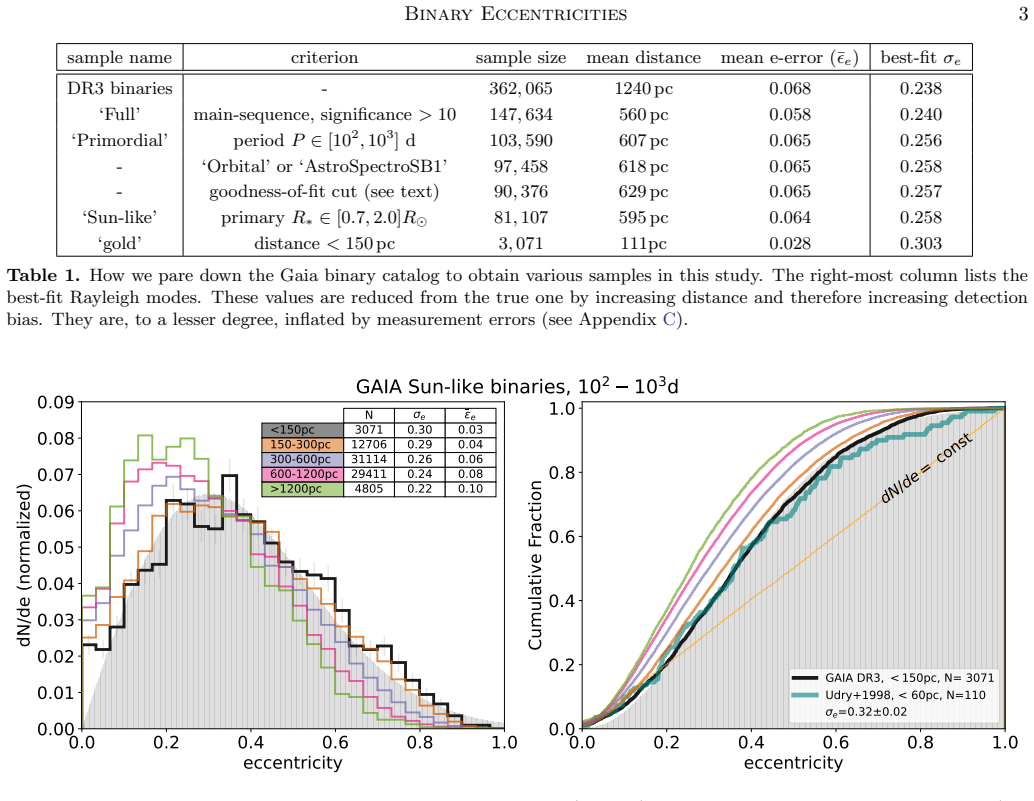
On the paper's own terms, the discovery is a one-parameter law: the eccentricities of close main-sequence binaries follow $dN/de = (e/\sigma_e^2)\exp(-e^2/2\sigma_e^2)$, with mode $\sigma_e \simeq 0.3$. For the 'gold' sample of about 3,000 Sun-like binaries inside 150 pc the best-fit mode is $\sigma_e = 0.303 \pm 0.003$ before correction and $0.336$ after applying the forward model of Gaia selection bias; a distance-based self-calibration independently recovers $\sigma_e \simeq 0.30$ out to roughly 150 pc. Every bin of the full sample, except those inside about 20 days where tides have circularized orbits, shows the same mean eccentricity near 0.31. The invariance across mass and period, combined with the argument that stellar encounters in birth clusters are too weak to affect such 'hard' binaries, leads the authors to conclude the distribution is primordial. The paper also establishes that scattering and ejection of brown-dwarf companions produces exactly this Rayleigh shape, with mode $\sigma_e \approx \sqrt{M_{\rm BD}/M_*}$, and that reproducing the observed value requires ejected bodies of order one tenth the stellar mass; circumbinary disk excitation is presented as a viable alternative, and the authors explicitly leave the choice between them open.
Load-bearing premise
The claim collapses if the forward model of Gaia DR3's astrometric selection bias—built on a uniform input eccentricity distribution—misestimates how completeness varies with eccentricity and distance; in that case the Rayleigh shape and its mode $\sigma_e \approx 0.3$ could be artifacts of which binaries Gaia happened to detect rather than properties of the true population.
Editorial extensions
If this is right
- The old 'uniform' description ($dN/de \propto e^0$) for close binaries is rejected; the Rayleigh law with $\sigma_e \approx 0.3$ should replace it in synthetic binary-evolution calculations, which will yield fewer binary mergers than the uniform assumption.
- The intrinsic mode is recovered from the gold sample (0.303) and from an independent distance-based self-calibration (about 0.30), so the result does not depend on a single bias-correction method.
- If brown-dwarf ejection is the cause, each close binary must eject bodies with $M_{\rm BD} \sim M_*/10$; the Galactic abundance of free-floating brown dwarfs is sufficient to excite such binaries but not to harden them, and ejected bodies should carry velocity dispersions of order the binary escape speed.
- If the observed invariance holds, the Rayleigh mode is set by a single scale-free process, and the same distribution should extend from tens of days out to tens of AU unless a second mechanism (tidal circularization inside ~20 days, or the thermalizing effects that dominate beyond ~100 AU) takes over.
- The eccentricity distribution becomes a new formation marker for disk fragmentation, joining period, metallicity, mass ratio, and twin fraction as a measurable constraint on how close binaries are born.
Reading between the lines
- If the Rayleigh law is truly universal and primordial, binary population synthesis should adopt it as prior; the paper notes fewer mergers follow, but the quantitative consequences for gravitational-wave merger rates, common-envelope outcomes, and X-ray binary populations are not computed here and are a natural next step.
- The brown-dwarf ejection scenario makes a falsifiable kinematic prediction only sketched in the paper: free-floating brown dwarfs should be preferentially found in young-cluster outskirts with velocity dispersions of order a few km/s; a uniform proper-motion survey of brown dwarfs in nearby clusters could test whether enough ~0.03 solar-mass objects are being ejected.
- The residual trend of lower eccentricity at larger distance after bias correction (Figure 5) could be a flaw in the forward model or a genuine mass dependence; if future data show the mode varies with primary mass in a narrow period bin, the universal-process claim would need to be relaxed to a mass-dependent process.
- The same Rayleigh analysis could be applied to the eccentricities of giant planets around single stars: the paper notes heavy Jovians resemble stellar binaries, so a unified scattering or disk-excitation framework may connect planetary and stellar binary formation.
Signed reviews
Editorial analysis
A structured set of objections, weighed in public.
Referee Report
Summary. The paper analyzes astrometric and combined astrometric+radial-velocity binaries from Gaia DR3, restricted to main-sequence primaries and periods of 10^2–10^3 days, and reports that the eccentricity distribution of these close binaries is well described by a Rayleigh distribution with mode σ_e ≈ 0.30 for a nearby 'gold' sample (d<150 pc, Sun-like primaries). It further claims that this mode is invariant across primary mass (M to A spectral types) and orbital period, and argues that the distribution is primordial. Two possible origins are explored: eccentricity excitation by circumbinary disks, and ejection of brown-dwarf companions during weak scattering, where the latter naturally yields a Rayleigh form with σ_e ≈ sqrt(M_BD/M_*). The paper includes a forward-model completeness correction based on El-Badry et al. (2024), a self-calibration exercise in Appendix B, a comparison with the Udry et al. (1998) RV sample yielding a KS p-value of 0.7, and a Bayesian model comparison in Appendix I.
Significance. If the central claim holds, the paper would replace the longstanding 'uniform' description of close-binary eccentricities with a one-parameter Rayleigh distribution, providing a sharp observational constraint on binary formation and a benchmark for population-synthesis and binary-evolution studies. The strength of the paper lies in its large, carefully selected Gaia sample, the use of two independent bias-correction approaches (forward modeling and self-calibration), and the successful cross-check against an independent RV sample. The proposed invariance across mass and period, if verified, would be a notable discovery pointing to a universal excitation mechanism. The physical scenarios are speculative but clearly labeled as such, and the conclusion explicitly states that their veracity remains to be tested.
major comments (3)
- [Appendix B, Fig. 5] The central claim that the intrinsic eccentricity distribution is a single Rayleigh with σ_e ≈ 0.30 depends on the Gaia selection-bias correction, but the corrected distributions in the right panel of Fig. 5 still show a residual trend of lower eccentricity with distance. The authors attribute this residual either to imperfections in the forward model or to a mass-dependent distribution, and either explanation would directly undermine the invariance claim. A load-bearing validation is missing: the forward model of El-Badry et al. (2024) was computed with a uniform input eccentricity distribution and normalized to unity at e<0.3, but if the true population is Rayleigh with σ_e=0.3, the completeness at e>0.5 is estimated from a regime where the mock input differs strongly from the inferred distribution; the paper does not demonstrate that the completeness curve is converged with respect to the assumed input eccentricity distribution. In addition, the self-calibration in Eq. (B2) is a parametric assumption about the distance dependence of the mode and cannot independently validate σ_e0=0.30, since the same functional form would also fit a scenario in which the intrinsic mode genuinely declines with distance. I request a concrete test: inject a Rayleigh population with σ_e=0.30 into the mock pipeline, split by distance, and show that the corrected, recovered distributions match the injected one; and provide a systematic error on the forward-model-corrected σ_e=0.336 for the gold sample that accounts for the residual distance trend.
- [§2, Fig. 2] The invariance of the Rayleigh mode across primary mass (0.5–3 R☉) and period (10^2–10^3 d) is inferred from the constancy of ⟨e⟩ in Fig. 2 without applying the completeness correction bin-by-bin. The only justification offered, in footnote 6, is that even the most distant sample in Fig. 1 returns σ_e=0.225, only about 25% lower; this does not establish that the selection function is identical across mass and period bins, because astrometric detectability depends on luminosity, period, and mass ratio in ways that can vary non-monotonically. As presented, the observed constancy of ⟨e⟩ could be a product of selection effects rather than evidence for a universal process. The authors should either apply the forward-model completeness correction separately to each mass/period bin, or explicitly demonstrate from mock catalogs that the relative completeness in eccentricity is bin-independent. Moreover, Fig. 2 shows only the mean eccentricity per bin; the claim that all bins share the same Rayleigh shape requires at least representative fits or distributions from each bin rather than a first-moment statistic.
- [§2 footnote 4 and Appendix I] The claim that a single Rayleigh distribution is 'formally established' is not supported by the evidence in Appendix I. The Bayes factor for a single Rayleigh versus a two-Rayleigh mixture is only E(M1)/E(M2) ∼ 2–5, which the authors themselves describe as 'not particularly strong support', and Section 3.1 concedes that a two-parameter Gaussian (Eq. 2) with e0=0.38, σ=0.20 also describes the gold-sample data well. Since the Rayleigh form is central to the proposed scattering-origin interpretation, the language in the abstract and §2 should be moderated, or the model comparison should be made more decisive by including Gaussian, uniform, and thermal distributions with the selection function folded in, and by explicitly accounting for the ~3% near-zero-eccentricity outlier population noted in Appendix B.
minor comments (4)
- [§3.2] There is a typo: 'expore' should be 'explore'.
- [Table 1 and §2] The text in §2 refers to a '150,000-strong full sample' while Table 1 lists the full main-sequence sample as 147,634 systems; please make the numbers consistent.
- [Figure 6 and Appendix B] The description of the 'strange population of very circular binaries' would benefit from a short explanation of how these systems are identified and whether they are included in the mean measurement-error curve ¯ϵ_e plotted in Fig. 6.
- [Appendix C, Eq. (C3)] The notation 1/a = 2σ_e^2 and 1/b = 2ϵ^2 is confusing because a and b are not defined before use; please introduce them explicitly.
Circularity Check
Gaia-based Rayleigh result is external and not circular; the only mild circularity is the brown-dwarf scenario, which tunes M_BD/M_* to match the observed σ_e≈0.3.
-
fitted input called prediction
[Section 3.2 (Scattering Brown Dwarfs), following Eq. (4) and Fig. 4]
"the binary eccentricities acquire a Rayleigh distribution, with the mode described roughly by eq. (3). To achieve the observed value of σe = 0.30, we require Mbd ∼ M∗/10."
Eq. (3) gives σe ≈ sqrt(M_BD/M_*), so the relation is a one-parameter family. The paper selects M_BD/M_* ≈ 1/10 only because sqrt(1/10) ≈ 0.316 reproduces the already-measured Rayleigh mode; no independent measurement of the ejected-body mass is used. The numerical experiments then return a Rayleigh mode controlled by this chosen mass, so the scenario's match to σe ≈ 0.30 is a calibration rather than a prediction. The paper openly frames it as a requirement ('we require') and separately tests the abundance of free-floating brown dwarfs, but the σe match itself is enforced by parameter choice.
full rationale
The paper's central observational claim—that AU-scale main-sequence binaries follow a Rayleigh eccentricity distribution with σe ≈ 0.30, invariant across period and primary mass—is derived from external Gaia DR3 data, validated against the independent RV sample of Udry et al. (1998), and compared with a mock-observation pipeline (El-Badry et al. 2024). The distance-dependent decline of σe is attributed to selection bias, and the residual trend after correction in Fig. 5 and the fitted 'data-inspired' form in Appendix B are explicitly discussed as possible imperfections, so the observation does not reduce by definition to its inputs. The only step that reduces by construction is the auxiliary brown-dwarf scattering scenario: Eq. (3) determines σe from M_BD/M_*, and the paper then sets M_BD ∼ M_*/10 to match the observed σe = 0.30, making the reproduced mode a calibration. Because this is disclosed as a requirement rather than a falsifiable prediction, and because it does not affect the independent Gaia-derived measurement, the overall circularity score is 2 rather than higher.
Assumptions & free parameters
free parameters (2)
- M_BD (individual brown dwarf mass in scattering scenario) =
0.03 M_sun (M_BD ~ M_*/10 for M_* = 0.3 M_sun)
- sigma_e0, d0, a (Eq. B2) =
sigma_e0 = 0.301 ± 0.006, d0 = 147 ± 27 pc, a = 0.29 ± 0.01
assumptions (5)
- standard math Rayleigh distribution and Gaussian error convolution (Appendix C, Eq. C3) are valid statistical models for the eccentricity population and measurement noise.
- domain assumption The sample selection cuts (main-sequence primaries, period 100-1000 d, astrometric orbits, distance < 150 pc) remove binaries affected by tidal circularization and keep a largely unbiased sample.
- domain assumption The forward-model of El-Badry et al. (2024) accurately describes Gaia DR3's eccentricity-dependent detection completeness.
- domain assumption AU-scale binary eccentricities are primordial and have not been significantly altered by birth-cluster encounters or passing stars.
- ad hoc to paper Close binaries at birth may contain one or more brown-dwarf siblings that are later ejected.
Cite this review
Pith. "Pith review of Eccentricities of Close Stellar Binaries." pith.science (2026). https://pith.science/paper/XTC2FM37
@misc{pith2026241109905,
  author       = {Pith},
  title        = {Pith review of: Eccentricities of Close Stellar Binaries},
  year         = {2026},
  howpublished = {\url{https://pith.science/paper/XTC2FM37}},
  note         = {Machine review of arXiv:2411.09905}
}
read the original abstract
Orbits of stellar binaries are in general eccentric. These eccentricities encode information about their early lives. Here, we use thousands of main-sequence binaries from the Gaia DR3 catalog to reveal that, binaries inwards of a few AU exhibit a simple Rayleigh distribution with a mode sigma_e ~ 0.3. We find the same distribution for binaries from M to A spectral types, and from tens of days to a thousand days (possibly extending to tens of AU). This observed distribution is most likely primordial and its invariance suggests a single universal process. One possibility is eccentricity excitation by circumbinary disks. Another, as is suggested by the Rayleigh form, is weak scattering and ejection of brown-dwarf objects. We explore this latter scenario and find that the binary eccentricities reach an equi-partition value of sigma_e ~ sqrt{M_bd M_*}. So to explain the observed mode, the brown dwarfs will have to be of order one tenth the stellar masses, and be at least as abundant in the Galaxy as the close binaries. The veracity of both proposals remains to be tested.
Figures


Figures from the paper (6 more)


Forward citations
Cited by 3 Pith papers
-
Warm Sub-Saturns Orbiting Single Stars Are Spin-Orbit Aligned
Warm sub-Saturns around single cool stars are predominantly aligned whereas hot sub-Saturns are frequently misaligned (3.2σ), a separation-dependent transition the authors attribute to high-eccentricity migration.
-
On the Eccentricity Distribution and Tidal Evolution of Transiting Brown Dwarfs
Short-period (P<16 d) transiting brown dwarfs are low-eccentricity while longer-period ones are more excited; assuming a shared primordial Beta distribution, tidal evolution constrains Q_BD ≈ 10^{7.1–8.1}.
-
Testing tidal theory using Gaia binaries: the red giant branch
F-mode tidal models reproduce late red-giant circularization but under-predict early red-giant circularization by about a factor of two, extending the main-sequence tidal discrepancy to the early red giant branch.
Reference graph
Works this paper leans on
-
[1]
, " * write output.state after.block = add.period write newline
ENTRY address archivePrefix author booktitle chapter doi edition editor eprint howpublished institution journal key month number organization pages publisher school series title misctitle type volume year version url label extra.label sort.label short.list INTEGERS output.state before.all mid.sentence after.sentence after.block FUNCTION init.state.consts ...
-
[2]
write newline
" write newline "" before.all 'output.state := FUNCTION format.url url empty "" new.block "" url * "" * if FUNCTION format.eprint eprint empty "" archivePrefix empty "" archivePrefix "arXiv" = new.block " " eprint * " " * new.block " " eprint * " " * if if if FUNCTION format.doi doi empty "" " " doi * " " * if FUNCTION format.pid doi empty eprint empty ur...
-
[3]
WPNA> Sf fOOx=˷ ?y_fe 퓟=O Ν35 Ә)ڐjt T-u =bN u *9ɧl0t ?>S5ٹ
thebibliography [1] 20pt to REFERENCES 6pt =0pt -12pt 10pt plus 3pt =0pt =0pt =1pt plus 1pt =0pt =0pt -12pt =13pt plus 1pt =20pt =13pt plus 1pt \@M =10000 =-1.0em =0pt =0pt 0pt =0pt =1.0em @enumiv\@empty 10000 10000 `\.\@m \@noitemerr \@latex@warning Empty `thebibliography' environment \@ifnextchar \@reference \@latexerr Missing key on reference command E...
arXiv 2021
-
[4]
B \'e jar , V. J. S., Zapatero Osorio , M. R., Rebolo , R., et al. 2011, , 743, 64, 10.1088/0004-637X/743/1/64
-
[5]
2016, , 455, 4136, 10.1093/mnras/stv2530
Borkovits , T., Hajdu , T., Sztakovics , J., et al. 2016, , 455, 4136, 10.1093/mnras/stv2530
-
[6]
R., Mitnyan , T., Rappaport , S
Czavalinga , D. R., Mitnyan , T., Rappaport , S. A., et al. 2023, , 670, A75, 10.1051/0004-6361/202245300
-
[7]
Dittmann , A. J., & Ryan , G. 2024, , 967, 12, 10.3847/1538-4357/ad2f1e
-
[8]
D'Orazio , D. J., & Duffell , P. C. 2021, , 914, L21, 10.3847/2041-8213/ac0621
Show all 80 references
-
[9]
J., Brice \ n o , C., Mateu , C., et al
Downes , J. J., Brice \ n o , C., Mateu , C., et al. 2014, , 444, 1793, 10.1093/mnras/stu1553
2014 doi
-
[10]
2013, , 51, 269, 10.1146/annurev-astro-081710-102602
Duch \^e ne , G., & Kraus , A. 2013, , 51, 269, 10.1146/annurev-astro-081710-102602
2013 doi
-
[11]
1991, , 248, 485
Duquennoy , A., & Mayor , M. 1991, , 248, 485
1991
-
[12]
2024, arXiv e-prints, arXiv:2411.00088
El-Badry , K., Lam , C., Holl , B., et al. 2024, arXiv e-prints, arXiv:2411.00088. 2411.00088
2024 arXiv
-
[13]
2019, Monthly Notices of the Royal Astronomical Society: Letters, 482, L139
El-Badry, K., & Rix, H.-W. 2019, Monthly Notices of the Royal Astronomical Society: Letters, 482, L139
2019
-
[14]
El-Badry , K., Rix , H.-W., & Heintz , T. M. 2021, , 506, 2269, 10.1093/mnras/stab323
2021 doi
-
[15]
2019, , 489, 5822, 10.1093/mnras/stz2480
El-Badry , K., Rix , H.-W., Tian , H., Duch \^e ne , G., & Moe , M. 2019, , 489, 5822, 10.1093/mnras/stz2480
2019 doi
- [16]
- [17]
-
[18]
Gaia Collaboration , Prusti , T., de Bruijne , J. H. J., et al. 2016, , 595, A1, 10.1051/0004-6361/201629272
2016 doi
-
[19]
Gaia Collaboration , Vallenari , A., Brown , A. G. A., et al. 2023 a , , 674, A1, 10.1051/0004-6361/202243940
2023 doi
-
[20]
2023 b , , 674, A34, 10.1051/0004-6361/202243782
Gaia Collaboration , Arenou , F., Babusiaux , C., et al. 2023 b , , 674, A34, 10.1051/0004-6361/202243782
2023 doi
-
[21]
M., Mathieu , R
Geller , A. M., Mathieu , R. D., Latham , D. W., et al. 2021, , 161, 190, 10.3847/1538-3881/abdd23
2021 doi
-
[22]
Goodman , J., & Tan , J. C. 2004, , 608, 108, 10.1086/386360
2004 doi
-
[23]
Greenzweig , Y., & Lissauer , J. J. 1992, , 100, 440, 10.1016/0019-1035(92)90110-S
1992 doi
-
[24]
Griffin , R. F. 2012, Journal of Astrophysics and Astronomy, 33, 29, 10.1007/s12036-012-9137-5
2012 doi
-
[25]
2023, , 674, A9, 10.1051/0004-6361/202243969
Halbwachs , J.-L., Pourbaix , D., Arenou , F., et al. 2023, , 674, A9, 10.1051/0004-6361/202243969
2023 doi
-
[26]
Heggie , D. C. 1975, , 173, 729, 10.1093/mnras/173.3.729
1975 doi
-
[27]
C., & Rasio , F
Heggie , D. C., & Rasio , F. A. 1996, , 282, 1064, 10.1093/mnras/282.3.1064
1996 doi
-
[28]
C., Zakamska , N
Hwang , H.-C., Ting , Y.-S., Schlaufman , K. C., Zakamska , N. L., & Wyse , R. F. G. 2021, , 501, 4329, 10.1093/mnras/staa3854
2021 doi
-
[29]
Hwang , H.-C., Ting , Y.-S., & Zakamska , N. L. 2022, , 512, 3383, 10.1093/mnras/stac675
2022 doi
-
[30]
1992 a , , 96, 107, 10.1016/0019-1035(92)90008-U
Ida , S., & Makino , J. 1992 a , , 96, 107, 10.1016/0019-1035(92)90008-U
1992 doi
-
[31]
1992 b , , 98, 28, 10.1016/0019-1035(92)90203-J
---. 1992 b , , 98, 28, 10.1016/0019-1035(92)90203-J
1992 doi
-
[32]
Jeans , J. H. 1919, , 79, 408, 10.1093/mnras/79.6.408
1919 doi
-
[33]
2008, , 686, 603, 10.1086/590047
Juri \'c , M., & Tremaine , S. 2008, , 686, 603, 10.1086/590047
2008 doi
-
[34]
D., Marocco , F., Gelino , C
Kirkpatrick , J. D., Marocco , F., Gelino , C. R., et al. 2024, , 271, 55, 10.3847/1538-4365/ad24e2
2024 doi
-
[35]
2016, , 54, 271, 10.1146/annurev-astro-081915-023307
Kratter , K., & Lodato , G. 2016, , 54, 271, 10.1146/annurev-astro-081915-023307
2016 doi
-
[36]
M., Matzner , C
Kratter , K. M., Matzner , C. D., Krumholz , M. R., & Klein , R. I. 2010, , 708, 1585, 10.1088/0004-637X/708/2/1585
2010 doi
-
[37]
2003, , 346, 369, 10.1046/j.1365-2966.2003.07224.x
Kroupa , P., & Bouvier , J. 2003, , 346, 369, 10.1046/j.1365-2966.2003.07224.x
2003
-
[38]
Kumar , M. S. N., & Schmeja , S. 2007, , 471, L33, 10.1051/0004-6361:20077875
2007 doi
-
[39]
Lai , D., & Mu \ n oz , D. J. 2023, , 61, 517, 10.1146/annurev-astro-052622-022933
2023 doi
-
[40]
2007, , 374, 515, 10.1111/j.1365-2966.2006.11155.x
Levin , Y. 2007, , 374, 515, 10.1111/j.1365-2966.2006.11155.x
2007
-
[41]
2013, , 431, 3222, 10.1093/mnras/stt402
Lodieu , N. 2013, , 431, 3222, 10.1093/mnras/stt402
2013 doi
-
[42]
2017, , 465, 4381, 10.1093/mnras/stw3009
Malhotra , R., & Wang , X. 2017, , 465, 4381, 10.1093/mnras/stw3009
2017 doi
- [43]
-
[44]
N., Badenes , C., Moe , M., et al
Mazzola , C. N., Badenes , C., Moe , M., et al. 2020, , 499, 1607, 10.1093/mnras/staa2859
2020 doi
-
[45]
E., Anderson , J., Meylan , G., et al
McLaughlin , D. E., Anderson , J., Meylan , G., et al. 2006, , 166, 249, 10.1086/505692
2006 doi
-
[46]
2017, , 230, 15, 10.3847/1538-4365/aa6fb6
Moe , M., & Di Stefano , R. 2017, , 230, 15, 10.3847/1538-4365/aa6fb6
2017 doi
-
[47]
M., & Badenes , C
Moe , M., Kratter , K. M., & Badenes , C. 2019, , 875, 61, 10.3847/1538-4357/ab0d88
2019 doi
- [48]
-
[49]
R., & Cuillandre , J
Moraux , E., Bouvier , J., Stauffer , J. R., & Cuillandre , J. C. 2003, , 400, 891, 10.1051/0004-6361:20021903
2003 doi
-
[50]
J., Miranda , R., & Lai , D
Mu \ n oz , D. J., Miranda , R., & Lai , D. 2019, , 871, 84, 10.3847/1538-4357/aaf867
2019 doi
- [51]
-
[52]
2024, , 168, 89, 10.3847/1538-3881/ad5552
Panwar , N., Rishi , C., Sharma , S., et al. 2024, , 168, 89, 10.3847/1538-3881/ad5552
2024 doi
-
[53]
Papaloizou , J. C. B., Nelson , R. P., & Masset , F. 2001, , 366, 263, 10.1051/0004-6361:20000011
2001 doi
-
[54]
J., Goodwin , S
Parker , R. J., Goodwin , S. P., Kroupa , P., & Kouwenhoven , M. B. N. 2009, , 397, 1577, 10.1111/j.1365-2966.2009.15032.x
2009
-
[55]
A., Batten , A
Pourbaix , D., Tokovinin , A. A., Batten , A. H., et al. 2004, , 424, 727, 10.1051/0004-6361:20041213
2004 doi
-
[56]
M., Hogg, D
Price-Whelan, A. M., Hogg, D. W., Rix, H.-W., et al. 2020, The Astrophysical Journal, 895, 2, 10.3847/1538-4357/ab8acc
2020 doi
-
[57]
Rafikov , R. R. 2005, , 621, L69, 10.1086/428899
2005 doi
-
[58]
A., Henry , T
Raghavan , D., McAlister , H. A., Henry , T. J., et al. 2010, , 190, 1, 10.1088/0067-0049/190/1/1
2010 doi
-
[59]
Rein , H., & Liu , S. F. 2012, , 537, A128, 10.1051/0004-6361/201118085
2012 doi
-
[60]
Rein , H., & Spiegel , D. S. 2015, , 446, 1424, 10.1093/mnras/stu2164
2015 doi
-
[61]
2001, , 122, 432, 10.1086/321121
Reipurth , B., & Clarke , C. 2001, , 122, 432, 10.1086/321121
2001 doi
-
[62]
2012, , 744, 6, 10.1088/0004-637X/744/1/6
Scholz , A., Muzic , K., Geers , V., et al. 2012, , 744, 6, 10.1088/0004-637X/744/1/6
2012 doi
-
[63]
2023, , 518, 2991, 10.1093/mnras/stac3290
Shahaf , S., Bashi , D., Mazeh , T., et al. 2023, , 518, 2991, 10.1093/mnras/stac3290
2023 doi
-
[64]
2023, , 522, 2707, 10.1093/mnras/stad1131
Siwek , M., Weinberger , R., & Hernquist , L. 2023, , 522, 2707, 10.1093/mnras/stad1131
2023 doi
-
[65]
C., & Lin , D
Spurzem , R., Giersz , M., Heggie , D. C., & Lin , D. N. C. 2009, , 697, 458, 10.1088/0004-637X/697/1/458
2009 doi
-
[66]
P., et al
Sumi , T., Koshimoto , N., Bennett , D. P., et al. 2023, , 166, 108, 10.3847/1538-3881/ace688
2023 doi
-
[67]
J., Kratter , K
Tobin , J. J., Kratter , K. M., Persson , M. V., et al. 2016, , 538, 483, 10.1038/nature20094
2016 doi
-
[68]
J., Sheehan , P
Tobin , J. J., Sheehan , P. D., Megeath , S. T., et al. 2020, , 890, 130, 10.3847/1538-4357/ab6f64
2020 doi
-
[69]
2017, , 844, 103, 10.3847/1538-4357/aa7746
Tokovinin , A. 2017, , 844, 103, 10.3847/1538-4357/aa7746
2017 doi
- [70]
-
[71]
2021, Universe, 7, 352, 10.3390/universe7090352
---. 2021, Universe, 7, 352, 10.3390/universe7090352
2021 doi
-
[72]
2016, , 456, 2070, 10.1093/mnras/stv2825
Tokovinin , A., & Kiyaeva , O. 2016, , 456, 2070, 10.1093/mnras/stv2825
2016 doi
-
[73]
Tokovinin , A. A. 2000, , 360, 997
2000
-
[74]
2015, , 807, 157, 10.1088/0004-637X/807/2/157
Tremaine , S. 2015, , 807, 157, 10.1088/0004-637X/807/2/157
2015 doi
-
[75]
W., et al
Udry , S., Mayor , M., Latham , D. W., et al. 1998, in Astronomical Society of the Pacific Conference Series, Vol. 154, Cool Stars, Stellar Systems, and the Sun, ed. R. A. Donahue & J. A. Bookbinder , 2148
1998
-
[76]
2024, , 688, A128, 10.1051/0004-6361/202449421
Valli , R., Tiede , C., Vigna-G \'o mez , A., et al. 2024, , 688, A128, 10.1051/0004-6361/202449421
2024 doi
-
[77]
2023, , 943, 175, 10.3847/1538-4357/acac77
Wang , H.-Y., Bai , X.-N., & Lai , D. 2023, , 943, 175, 10.3847/1538-4357/acac77
2023 doi
- [78]
-
[79]
Zhou , J.-L., Lin , D. N. C., & Sun , Y.-S. 2007, , 666, 423, 10.1086/519918
2007 doi
-
[80]
2021, , 909, L13, 10.3847/2041-8213/abdd1c
Zrake , J., Tiede , C., MacFadyen , A., & Haiman , Z. 2021, , 909, L13, 10.3847/2041-8213/abdd1c
2021 doi
Reviewed August 12, 2026 · model on record in the stance chip above.
Discussion (0). Continue with ORCID to comment.