REVIEW 2 major objections 5 minor 69 references
Local Frames: Exploiting Inherited Origins to Bypass Content Blockers
T0 review · 2 major / 5 minor · reviewed 2026-08-07 · deepseek-v4-flash
Pith's one-line read Websites can bypass all six studied content blockers by hiding tracking code and ads inside local frames—iframes with about:blank sources—because the tools misattribute the frames' inherited origin.
desk verdict Real attack, solid tests, vendor patches — but the wild-prevalence numbers overstate exposure. read the letter →
The pith
A machine-rendered reading of the paper's core claim, the machinery that carries it, and where it could break.
The reading
What carries the argument
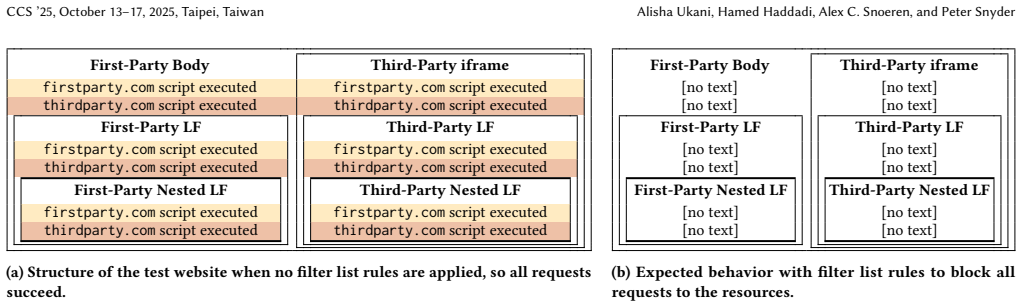
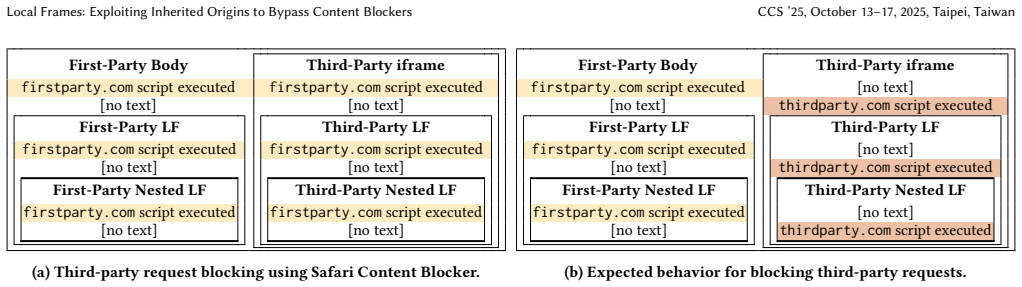
The central object is the local frame: an iframe with a non-URL source, about:blank in 95.8% of observed cases, which per the HTML specification inherits the origin of the document that creates it. That inherited origin is the load-bearing identity. The paper's tests compare what should happen under filter-list rules with what actually happens in first-party, third-party, and nested local frames, and trace each failure to an origin or party-ness computation that reads the frame's source instead of its inherited security origin. The tests cover four capabilities—request blocking, resource replacement, scriptlet injection, and cosmetic filtering—and are what turn the origin bug into concrete, tool-by-tool vulnerabilities.
What would settle it
Run the paper's public test pages against current releases of the six tools and check whether a request to a known tracker such as doubleclick.net made from an about:blank iframe is blocked, and whether elements selected by a cosmetic filter inside the frame are hidden. If all six tools now block and hide as intended, the paper's central finding no longer describes current software; conversely, a vendor document stating that local frames are intentionally excluded from protections would refute the claim that these are vulnerabilities rather than scoping decisions.
Extended reading notes
Core claim
The paper's central claim is that content blockers frequently mishandle local frames, allowing content loaded within them to bypass blocker protections. For each capability the paper studies—request blocking, resource replacement, scriptlet injection, and cosmetic filtering—it builds test pages and finds at least one failure in every one of six tools: Brave, AdGuard, uBlock Origin Lite, AdBlock Plus, Safari Content Blocking, and DuckDuckGo. The root cause is origin misattribution: tools derive a frame's origin from its src URL instead of using the inherited origin specified by the HTML standard, so a local frame inside a third-party iframe may be treated as about:blank or as the first-party page. Consequences include unblocked tracking requests in Brave's iOS browser, evasion of scriptlet injection and cosmetic filtering in Brave and AdGuard, cosmetic-filter evasion in uBlock Origin Lite, AdBlock Plus iOS, and Safari Content Blocking, and DuckDuckGo under-reporting blocked trackers. The paper also finds these vulnerabilities are being exercised on real websites, noting that 14.3% of crawled sites make requests inside local frames that should be blocked by popular filter lists.
Load-bearing premise
The load-bearing premise is that a filter-list rule with no frame-type restriction is intended to apply inside about:blank frames; if a vendor deliberately scoped protections away from local frames to avoid breakage, the observed failures would be a design choice rather than a vulnerability.
Editorial extensions
If this is right
- Websites can bypass request blocking in Brave's iOS browser by issuing AJAX or fetch requests from inside local frames, because the alternative code path Brave built to work around Safari's rule limit miscomputes the request origin.
- Scriptlet injection and cosmetic filtering can be evaded in Brave and AdGuard, allowing tracking scripts to run and ads to be shown that should be hidden; AdGuard even applies first-party rules to third-party local frames, which can break pages.
- Cosmetic filtering can be evaded in uBlock Origin Lite, AdBlock Plus iOS, and Safari Content Blocking, so ads placed in local frames stay visible for those users, including users of iOS apps built on Safari's content-blocking API.
- DuckDuckGo correctly blocks requests in local frames but fails to report blocked trackers to the user when the block happens in a nested local frame, so its privacy-information interface understates what is being blocked.
- In the crawl, 3,142 of 21,965 sites (14.3%) make requests inside local frames that popular filter lists would block, meaning the vulnerability is being exercised on real, popular websites today, not only in synthetic tests.
Reading between the lines
- The root cause is not specific to filter-list blockers: any web tool that must decide first- versus third-party context from a frame's URL—cookie consent managers, telemetry systems, anti-fingerprinting extensions, or research crawlers—is a candidate for the same misattribution, and the paper's small sample of prior-work code already shows such bugs.
- A natural hardening step, beyond patching each tool, is a filter-list rule or browser signal that treats a local frame's inherited origin as authoritative for partyness; this could be tested by running the paper's test pages against a patched tool and confirming rules intended for the parent now apply inside local frames.
- If about:blank becomes safe after widespread patching, evaders may shift to other inherited-origin or opaque-origin sources such as about:srcdoc, blob, and data URLs, which the paper found in only a small fraction of frames but did not test exhaustively.
- The paper's breakage check was limited to 50 sites, so the real-world cost of enforcing rules inside local frames—especially the risk of first-party rules leaking into third-party frames, which AdGuard already exhibited—remains an open empirical question.
Editorial analysis
A structured set of objections, weighed in public.
Referee Report
Summary. The paper studies 'local frames' (iframes whose source is a non-URL URI such as about:blank or about:srcdoc) and argues that six widely used content-blocking tools—AdBlock Plus, AdGuard, uBlock Origin Lite, Brave, DuckDuckGo, and Safari Content Blocking—mishandle the inherited origins of these frames. The authors design tests for four capabilities (request blocking, resource replacement, scriptlet injection, and cosmetic filtering), identify what they count as 19 distinct vulnerabilities across the tools, and supplement the tests with source-code analysis and vendor disclosures. They also crawl 21,965 Tranco-ranked sites with PageGraph, report that 55.7% of crawled sites contain local frames, and claim that 73.7% of requests made inside local frames should be blocked by EasyList/EasyPrivacy/uBlock Origin filter lists and are not blocked by vulnerable tools. Vendor acknowledgments and patches are reported for Brave, Safari, AdGuard, and DuckDuckGo.
Significance. If the per-tool results stand, this is a valuable and timely empirical contribution. The paper identifies a real root cause—tools deriving an iframe's origin from its URL rather than from the inherited-origin rules of the HTML specification—and demonstrates concrete bypasses in products with large user bases. The work is strengthened by the use of specific tool versions, direct behavioral tests, source-code analysis for the Brave and DuckDuckGo findings, public test pages and data, and responsible disclosure with vendor patches that corroborate the main per-tool conclusions. The measurement of local-frame prevalence is also useful, though the headline 73.7%/14.3% figures overstate what the measurement actually shows. The paper's central vulnerability claims are defensible, but the measurement section needs to be aligned with the per-tool evidence before the paper should appear in final form.
major comments (2)
- [§3.2.3, Table 3, Abstract] The headline measurement claim is not supported by the methodology. The crawl uses the adblock-rs matcher against the union of EasyList, EasyPrivacy, and uBlock Origin lists; it does not run any of the six tested tools on the crawled pages. The tested vulnerabilities are capability- and platform-specific: DuckDuckGo correctly blocks requests in local frames (§4.4.5), uBlock Origin Lite's local-frame failure is cosmetic filtering rather than request blocking (§4.4.2), and Brave iOS's request-blocking bypass applies to a reduced 'slim list' path (§4.4.4). A request matching the full list union therefore would not necessarily be blocked by any vulnerable tool even outside a local frame. The Abstract's '73.7% of the requests made by these local frames should be blocked by popular filter lists but instead trigger the vulnerabilities we identify' conflates filter-list coverage with demonstrable exposure under a specific tool. Please either run each vulnerable tool's engine over the crawled requests (or a representative sample) and report per-tool exposure, or rephrase the 73.7% and 14.3% claims as statements about filter-list matches only, and adjust the Introduction's 'majority of popular websites are currently doing such evasion' accordingly.
- [§4.1, §4.4.2] The operational definition of vulnerability—'a rule that is intended to be applied to a local frame is not applied'—presumes that the absence of a frame-type restriction in a filter-list rule indicates the tool intends to apply that rule inside local frames. Vendor acknowledgments and patches support this reading for most tools, and the paper states in §6.4 that all organizations called the failures unintentional. However, uBlock Origin Lite's maintainer explicitly declined to fix the cosmetic-filtering gap because of performance overhead, which is more consistent with an accepted scoping decision or trade-off than with an origin-computation bug. Please classify the uBlock Origin Lite cosmetic-filtering case separately (for example, as a known limitation with a vendor-accepted rationale) or provide evidence from the maintainer that the behavior is unintended; otherwise the '19 vulnerabilities' count mixes two different kinds of findings.
minor comments (5)
- [§3.2.3] State the exact retrieval date (and, where applicable, commit hashes) for the EasyList, EasyPrivacy, and uBlock Origin filter lists used in the adblock-rs analysis; Section 2.2.1 gives a date for rule counts, but the crawl post-processing should cite the list versions it used.
- [Table 5 and Table 6] The paper claims 19 vulnerabilities but does not enumerate them. Add a mapping from each table cell (tool, platform, capability) to a vulnerability identifier, and make the legend for the symbols in Table 5 explicit; the symbols are not legible in the text version and the count cannot currently be verified.
- [§4.4.1 and §4.4.2] For the 'inconsistently effective' scriptlet results in AdBlock Plus and uBlock Origin, report how often the race condition occurred across repeated runs and under what conditions (e.g., page load timing), so readers can judge the practical exploitability.
- [§4.4.4] When describing the Brave iOS request-blocking test, specify the exact 'slim list' version and the rule used for /ads/index, and clarify whether the same bypass would apply to requests that match the full EasyList/EasyPrivacy sets; the current text leaves the reader unsure which set of requests is actually at risk.
- [§6.4] The breakage evaluation is a pilot rather than a general result: 50 sampled sites and two testers, with the two observed breakages being inconsistent and not local-frame-related. Please describe it as a preliminary check and avoid wording that implies a broad 'no breakage' conclusion.
Circularity Check
No circularity: the paper's vulnerability claims are direct empirical conformance tests, and the criticized 73.7% figure is an external-validity concern rather than a self-referential derivation.
full rationale
This paper is an empirical conformance study, not a derivation chain, and I find no step where a result is equivalent to its inputs by construction. The central claim that content blockers mishandle local frames is supported by direct, observable tests: the authors define filter-list rules, place requests or elements inside local frames, and check whether the tool applies the rule. The expected behavior is grounded in the HTML specification's inherited-origin rule and in the tools' own filter-list semantics, not in the outcome being claimed. Specifically, Section 4.1's definition of a bypass ('a rule that is intended to be applied to a local frame is not applied') is an operational criterion for conformance testing, and the per-tool results in Section 4.4 are observed behaviors, not quantities fitted from the data. The 73.7% and 14.3% measurement figures are computed by matching local-frame requests against EasyList, EasyPrivacy, and uBlock Origin lists with adblock-rs; this may overstate real user exposure because the crawl does not run each vulnerable tool's engine and the vulnerabilities are capability- and platform-specific. However, that is a generalizability or external-validity criticism, not circularity: the filter lists are third-party ground truth, and no fitted parameter is renamed as a prediction. The authors' affiliation with Brave, which maintains PageGraph and adblock-rs, is a potential conflict-of-interest consideration, but those tools are measurement infrastructure and the core vulnerability findings were independently confirmed by vendor patches and acknowledgments. No self-citation is load-bearing in the argument, and no uniqueness theorem or ansatz is smuggled in via citation. I therefore find no significant circularity.
Assumptions & free parameters
assumptions (4)
- domain assumption An about:blank iframe inherits the origin of the document that creates it, per the HTML specification.
- domain assumption When a filter-list rule is configured without a frame-type restriction, the tool intends that rule to apply inside local frames.
- domain assumption The PageGraph crawler's event attribution correctly identifies frames, their origins, and the source of network requests.
- domain assumption EasyList, EasyPrivacy, and uBlock Origin's additional filter lists, applied via adblock-rs, define what 'should be blocked' means.
Cite this review
Pith. "Pith review of Local Frames: Exploiting Inherited Origins to Bypass Content Blockers." pith.science (2026). https://pith.science/paper/XTS6DDE3
@misc{pith2026250600317,
  author       = {Pith},
  title        = {Pith review of: Local Frames: Exploiting Inherited Origins to Bypass Content Blockers},
  year         = {2026},
  howpublished = {\url{https://pith.science/paper/XTS6DDE3}},
  note         = {Machine review of arXiv:2506.00317}
}
read the original abstract
We present a study of how local frames (i.e., iframes loading content like "about:blank") are mishandled by a wide range of popular Web security and privacy tools. As a result, users of these tools remain vulnerable to the very attack techniques against which they seek to protect themselves, including browser fingerprinting, cookie-based tracking, and data exfiltration. The tools we study are vulnerable in different ways, but all share a root cause: legacy Web functionality interacts with browser privacy boundaries in unexpected ways, leading to systemic vulnerabilities in tools developed, maintained, and recommended by privacy experts and activists. We consider four core capabilities supported by most privacy tools and develop tests to determine whether each can be evaded through the use of local frames. We apply our tests to six popular Web privacy and security tools -- identifying at least one vulnerability in each for a total of 19 -- and extract common patterns regarding their mishandling of local frames. Our measurement of popular websites finds that 56% employ local frames and that 73.7% of the requests made by these local frames should be blocked by popular filter lists but instead trigger the vulnerabilities we identify. From another perspective, 14.3% of all sites that we crawl make requests that should be blocked inside of local frames. We disclosed these vulnerabilities to the tool authors and discuss both our experiences working with them to patch their products and the implications of our findings for other privacy and security research.
Figures


Figures from the paper (2 more)

Reference graph
Works this paper leans on
-
[1]
AdBlock. Introduction to Filter Lists. https://helpcenter.getadblock.com/hc/en- us/articles/9738523403027-Introduction-to-Filter-Lists. Accessed 2024-09-03
-
[2]
https://github.com/AdguardTeam/Scriptlets/blob/master/wi ki/about-scriptlets.md
Available Scriptlets. https://github.com/AdguardTeam/Scriptlets/blob/master/wi ki/about-scriptlets.md. Accessed 2024-08-21
work page 2024
-
[3]
https://adguard.com/kb/general/ad- filtering/create-own-filters
How to create your own ad filters. https://adguard.com/kb/general/ad- filtering/create-own-filters. Accessed 2024-08-30
work page 2024
-
[4]
AdGuard. Safari Web extension. https://adguard.com/kb/adguard-for-ios/web- extension/. Setup instructions for the AdGuard iOS app. Accessed 2024-09-04
work page 2024
-
[5]
https://github.com/AdguardTeam/tsurlfilter/commit/277790f47 86f017c0f4f552795c13627dbee1f66
Commit 277790f. https://github.com/AdguardTeam/tsurlfilter/commit/277790f47 86f017c0f4f552795c13627dbee1f66
-
[6]
TrackerSift: Untangling Mixed Tracking and Functional Web Resources
Abdul Haddi Amjad, Danial Saleem, Muhammad Ali Gulzar, Zubair Shafiq, and Fareed Zaffar. TrackerSift: Untangling Mixed Tracking and Functional Web Resources. In Proceedings of the 21st ACM Internet Measurement Conference , 2021
work page 2021
-
[7]
Anton Lazarev, Brave Software. adblock-rs. https://github.com/brave/adblock- rust. Rust library for parsing and applying filter list rules. Accessed 2024-09-03
work page 2024
-
[8]
Apple. Creating a content blocker. https://developer.apple.com/documentation/ safariservices/creating-a-content-blocker. Accessed 2024-08-20
work page 2024
Show all 69 references
-
[9]
EasyList
EasyList Authors. EasyList. https://easylist.to/easylist/easylist.txt
-
[10]
EasyPrivacy
EasyList Authors. EasyPrivacy. https://easylist.to/easylist/easyprivacy.txt
-
[11]
How Tracking Companies Circumvented Ad Blockers Using WebSockets
Muhammad Ahmad Bashir, Sajjad Arshad, Engin Kirda, William Robertson, and Christo Wilson. How Tracking Companies Circumvented Ad Blockers Using WebSockets. In Proceedings of the 18th ACM Internet Measurement Conference , 2018
2018
-
[12]
pagegraph-crawl
Brave. pagegraph-crawl. https://github.com/brave/pagegraph-crawl
-
[13]
https://github.c om/brave/brave-core/pull/26622
fix(privacy): Issues with content filtering in local frames on iOS. https://github.c om/brave/brave-core/pull/26622
-
[14]
https://www.charlesproxy.com/
Charles Web Debugging Proxy. https://www.charlesproxy.com/
-
[15]
Detecting Filter List Evasion With Event-Loop-Turn Granularity JavaScript Signatures
Quan Chen, Peter Snyder, Ben Livshits, and Alexandros Kapravelos. Detecting Filter List Evasion With Event-Loop-Turn Granularity JavaScript Signatures. In Proceedings of the 42nd IEEE Symposium on Security and Privacy , 2021
2021
-
[16]
Alternative to third-party cookies: Investigating persistent PII leakage-based web tracking
Ha Dao and Kensuke Fukuda. Alternative to third-party cookies: Investigating persistent PII leakage-based web tracking. In Proceedings of the 17th International Conference on emerging Networking EXperiments and Technologies , 2021
2021
-
[17]
What I Learned at Work this Week: Friendly IFrames and Debounce
Mike Diaz. What I Learned at Work this Week: Friendly IFrames and Debounce. Medium, 2020. Accessed 2024-12-27
2020
-
[18]
android-tds.json
DuckDuckGo. android-tds.json. https://github.com/duckduckgo/tracker-blocklis ts/blob/3ea4fbb7821f4bb0065722dfae4f4c9d63a1266d/web/v5/android-tds.json. DuckDuckGo blocklist for the Android platform. Accessed 2024-09-03
2024
-
[19]
extension-tds.json
DuckDuckGo. extension-tds.json. https://github.com/duckduckgo/tracker-bl ocklists/blob/3ea4fbb7821f4bb0065722dfae4f4c9d63a1266d/web/v6/extension- tds.json. DuckDuckGo blocklist for browser extensions. Accessed 2024-09-03
2024
-
[20]
ios-tds.json
DuckDuckGo. ios-tds.json. https://github.com/duckduckgo/tracker-blockl ists/blob/3ea4fbb7821f4bb0065722dfae4f4c9d63a1266d/web/v5/ios-tds.json. DuckDuckGo blocklist for the iOS platform. Accessed 2024-09-03
2024
-
[21]
macos-tds.json
DuckDuckGo. macos-tds.json. https://github.com/duckduckgo/tracker-blocklis ts/blob/3ea4fbb7821f4bb0065722dfae4f4c9d63a1266d/web/v6/macos-tds.json. DuckDuckGo blocklist for the macOS platform. Accessed 2024-09-03
2024
-
[22]
https: //github.com/duckduckgo/BrowserServicesKit/pull/1021
Change tab URL calculation for contentblockerrules.js and surrogates.js. https: //github.com/duckduckgo/BrowserServicesKit/pull/1021
-
[23]
Online Tracking: A 1-million-site Mea- surement and Analysis
Steven Englehardt and Arvind Narayanan. Online Tracking: A 1-million-site Mea- surement and Analysis. In Proceedings of the 23rd ACM Conference on Computer and Communications Security, 2016
2016
-
[24]
https://github.com/fingerprintjs/fingerprintjs
FingerprintJS. https://github.com/fingerprintjs/fingerprintjs
-
[25]
Content scripts
Chrome for Developers. Content scripts. https://developer.chrome.com/docs/ex tensions/develop/concepts/content-scripts. Accessed 2024-08-30. CCS ’25, October 13–17, 2025, Taipei, Taiwan Alisha Ukani, Hamed Haddadi, Alex C. Snoeren, and Peter Snyder
2024
-
[26]
Report shows that Safari reaches one billion worldwide users, still behind Google Chrome
Lauren Forristal. Report shows that Safari reaches one billion worldwide users, still behind Google Chrome. TechCrunch, 2022. Accessed 2025-01-06
2022
-
[27]
Viewability best practices
Google. Viewability best practices. https://support.google.com/admanager/ans wer/6199883?hl=en. Accessed 2024-12-27
2024
-
[28]
What is rich media? https://support.google.com/richmedia/answer/2417 545?hl=en
Google. What is rich media? https://support.google.com/richmedia/answer/2417 545?hl=en. Accessed 2024-12-27
2024
-
[29]
Private communication
Raymond Hill. Private communication
-
[30]
Rich Media Measurement Guidelines
Interactive Advertising Bureau (IAB). Rich Media Measurement Guidelines. https://www.iab.com/wp-content/uploads/2015/06/Rich_Media_Measurement _Guidelines_v2.pdf, 2007. Accessed 2024-08-29
2015
-
[31]
Best Practices for Rich Media Ads in Asynchronous Ad Environments
Interactive Advertising Bureau (IAB). Best Practices for Rich Media Ads in Asynchronous Ad Environments. https://www.iab.com/wp-content/uploads/20 15/09/rich_media_ajax_best_practices.pdf, oct 2008. Accessed 2024-08-29
2008
-
[32]
Entity List
Disconnect Inc. Entity List. https://github.com/mozilla-services/shavar-prod-list s/blob/02f6a2835a851fd92d3f996409cfd18c2d4b0a2b/disconnect-entitylist.json,
-
[33]
Fingerprinting the Finger- printers: Learning to Detect Browser Fingerprinting Behaviors
Umar Iqbal, Steven Englehardt, and Zubair Shafiq. Fingerprinting the Finger- printers: Learning to Detect Browser Fingerprinting Behaviors. In Proceedings of the 42nd IEEE Symposium on Security and Privacy , 2021
2021
-
[34]
The Ad Wars: Retrospective Mea- surement and Analysis of Anti-Adblock Filter Lists
Umar Iqbal, Zubair Shafiq, and Zhiyun Qian. The Ad Wars: Retrospective Mea- surement and Analysis of Anti-Adblock Filter Lists. In Proceedings of the 17th ACM Internet Measurement Conference, 2017
2017
-
[35]
AdGraph: A Graph-Based Approach to Ad and Tracker Blocking
Umar Iqbal, Peter Snyder, Shitong Zhu, Benjamin Livshits, Zhiyun Qian, and Zubair Shafiq. AdGraph: A Graph-Based Approach to Ad and Tracker Blocking. In Proceedings of the 41st IEEE Symposium on Security and Privacy , 2020
2020
-
[36]
Towards Realistic and Reproducible Web Crawl Measurements
Jordan Jueckstock, Shaown Sarker, Peter Snyder, Aidan Beggs, Panagiotis Pa- padopoulos, Matteo Varvello, Benjamin Livshits, and Alexandros Kapravelos. Towards Realistic and Reproducible Web Crawl Measurements. In Proceedings of the 30th ACM Web Conference, 2021
2021
-
[37]
Measuring the Privacy vs
Jordan Jueckstock, Peter Snyder, Shaown Sarker, Alexandros Kapravelos, and Benjamin Livshits. Measuring the Privacy vs. Compatibility Trade-off in Prevent- ing Third-Party Stateful Tracking. In Proceedings of the 31st ACM Web Conference, 2022
2022
-
[38]
AutoFR: Automated Filter Rule Generation for Adblocking
Hieu Le, Salma Elmalaki, Athina Markopoulou, and Zubair Shafiq. AutoFR: Automated Filter Rule Generation for Adblocking. In Proceedings of the 32nd USENIX Security Symposium, 2023
2023
-
[39]
Manifest V2 phase-out begins
David Li. Manifest V2 phase-out begins. Chromium Blog, May 2024. Accessed 2024-08-20
2024
-
[40]
https://developer.mozilla.org/en-US/docs/Web/Security/Sam e-origin_policy
Same-origin policy. https://developer.mozilla.org/en-US/docs/Web/Security/Sam e-origin_policy. Accessed 2024-08-25
2024
-
[41]
The "about" URI Scheme
S Moonesamy. The "about" URI Scheme. RFC 6694, August 2012
2012
-
[42]
Extensions in Privacy & Security
Mozilla. Extensions in Privacy & Security. https://addons.mozilla.org/en- US/firefox/extensions/category/privacy-security/?page=1&sort=recommende d%2Cusers. Accessed 2025-01-08
2025
-
[43]
Firefox Public Data Report
Mozilla. Firefox Public Data Report. https://data.firefox.com/dashboard/usage- behavior. Accessed 2025-01-08
2025
-
[44]
Detecting Anti Ad-blockers in the Wild
Muhammad Haris Mughees and Zhiyun Qian. Detecting Anti Ad-blockers in the Wild. In Proceedings on Privacy Enhancing Technologies , volume 3, 2017
2017
-
[45]
Breaking the Shield: Analyzing and Attacking Canvas Fingerprinting Defenses in the Wild
Hoang Dai Nguyen and Phani Vadrevu. Breaking the Shield: Analyzing and Attacking Canvas Fingerprinting Defenses in the Wild. In Proceedings of the 34th ACM Web Conference, 2025
2025
-
[46]
Defining "Broken": User Experiences and Remediation Tactics When Ad-Blocking or Tracking-Protection Tools Break a Website’s User Experience
Alexandra Nisenoff, Arthur Borem, Madison Pickering, Grant Nakanishi, Maya Thumpasery, and Blase Ur. Defining "Broken": User Experiences and Remediation Tactics When Ad-Blocking or Tracking-Protection Tools Break a Website’s User Experience. In Proceedings of the 32nd USENIX S...
2023
-
[47]
Adblocking and Counter-Blocking: A Slice of the Arms Race
Rishab Nithyanand, Sheharbano Khattak, Mobin Javed, Narseo Vallina-Rodriguez, Marjan Falahrastegar, Julia E Powles, Emiliano De Cristofaro, Hamed Haddadi, and Steven J Murdoch. Adblocking and Counter-Blocking: A Slice of the Arms Race. In Proceedings of the 6th USENIX Workshop...
2016
-
[48]
AdGuard v1.11 for Safari: Fight for filtering rule limits
Sofia Orlova. AdGuard v1.11 for Safari: Fight for filtering rule limits. AdGuard Blog, March 2022. Accessed 2024-09-03
2022
-
[49]
uBlock Origin
Raymond Hill. uBlock Origin. https://github.com/gorhill/uBlock. An efficient blocker for Chromium and Firefox. Accessed 2024-09-03
2024
-
[50]
Types of iFrames and When to Use Them
Human Security. Types of iFrames and When to Use Them. https://www.huma nsecurity.com/learn/topics/types-of-iframes-and-when-to-use-them. Accessed 2024-12-27
2024
-
[51]
WebGraph: Capturing Advertising and Tracking Information Flows for Robust Blocking
Sandra Siby, Umar Iqbal, Steven Englehardt, Zubair Shafiq, and Carmela Troncoso. WebGraph: Capturing Advertising and Tracking Information Flows for Robust Blocking. In Proceedings of the 31st USENIX Security Symposium , 2022
2022
-
[52]
Blocked or Broken? Automatically Detecting When Privacy Interventions Break Websites
Michael Smith, Peter Snyder, Moritz Haller, Benjamin Livshits, Deian Stefan, and Hamed Haddadi. Blocked or Broken? Automatically Detecting When Privacy Interventions Break Websites. In Proceedings on Privacy Enhancing Technologies , volume 4, 2022
2022
-
[53]
Most Websites Don’t Need to Vibrate: A Cost–Benefit Approach to Improving Browser Security
Peter Snyder, Cynthia Taylor, and Chris Kanich. Most Websites Don’t Need to Vibrate: A Cost–Benefit Approach to Improving Browser Security. InProceedings of the 24th ACM Conference on Computer and Communications Security , 2017
2017
-
[54]
Who Filters the Filters: Under- standing the Growth, Usefulness and Efficiency of Crowdsourced Ad Blocking
Peter Snyder, Antoine Vastel, and Ben Livshits. Who Filters the Filters: Under- standing the Growth, Usefulness and Efficiency of Crowdsourced Ad Blocking. Proceedings of the ACM on Measurement and Analysis of Computing Systems , 4(2), 2020
2020
-
[55]
Platform Stats & Token Activity
Brave Software. Platform Stats & Token Activity. https://brave.com/transparen cy/. Accessed 2025-01-06
2025
-
[56]
Slim List System
Brave Software. Slim List System. https://github.com/brave/slim-list-lambda
-
[57]
Adblock Plus - Chrome Web Store
Chrome Web Store. Adblock Plus - Chrome Web Store. https://chromewebstore .google.com/detail/adblock-plus-free-ad-bloc/cfhdojbkjhnklbpkdaibdccddilif ddb. Accessed 2024-08-19
2024
-
[58]
AdGuard AdBlocker - Chrome Web Store
Chrome Web Store. AdGuard AdBlocker - Chrome Web Store. https://chromewe bstore.google.com/detail/adguard-adblocker/bgnkhhnnamicmpeenaelnjfhikgb kllg. Accessed 2024-08-19
2024
-
[59]
Privacy & Security
Chrome Web Store. Privacy & Security. https://chromewebstore.google.com/ca tegory/extensions/make_chrome_yours/privacy. Accessed 2025-01-08
2025
-
[60]
uBlock Origin - Chrome Web Store
Chrome Web Store. uBlock Origin - Chrome Web Store. https://chromewebstore .google.com/detail/ublock-origin/cjpalhdlnbpafiamejdnhcphjbkeiagm. Accessed 2024-08-19
2024
-
[61]
uBlock Origin Lite - Chrome Web Store
Chrome Web Store. uBlock Origin Lite - Chrome Web Store. https://chromewebs tore.google.com/detail/ublock-origin-lite/ddkjiahejlhfcafbddmgiahcphecmpfh. Accessed 2024-08-20
2024
-
[62]
WebRanz: Web Page Randomization for Better Advertisement Delivery and Web-Bot Prevention
Weihang Wang, Yunhui Zheng, Xinyu Xing, Yonghwi Kwon, Xiangyu Zhang, and Patrick Eugster. WebRanz: Web Page Randomization for Better Advertisement Delivery and Web-Bot Prevention. In Proceedings of the 24th ACM SIGSOFT International Symposium on Foundations of Software Enginee...
2016
-
[63]
HTML Standard
WHATWG. HTML Standard. https://html.spec.whatwg.org/commit-snapshots/ c974c42b8bbc3b04cba372f0088fad503be3cc04/. Accessed 2024-08-29
2024
-
[64]
Analyzing the (In)Accessibility of Online Advertisements
Christina Yeung, Tadayoshi Kohno, and Franziska Roesner. Analyzing the (In)Accessibility of Online Advertisements. In Proceedings of the 24th ACM Internet Measurement Conference, 2024
2024
-
[65]
Comparative Privacy Analysis of Mobile Browsers
Ahsan Zafar and Anupam Das. Comparative Privacy Analysis of Mobile Browsers. In Proceedings of the 13th ACM Conference on Data and Application Security and Privacy, 2023
2023
-
[66]
Understanding the Privacy Implications of Adblock Plus’s Acceptable Ads
Ahsan Zafar, Aafaq Sabir, Dilawer Ahmed, and Anupam Das. Understanding the Privacy Implications of Adblock Plus’s Acceptable Ads. In Proceedings of the ACM Asia Conference on Computer and Communications Security , 2021
2021
-
[67]
Adscraper: A Web Crawler for Measuring Online Ad Content
Eric Zeng. Adscraper: A Web Crawler for Measuring Online Ad Content
-
[68]
party-ness
Shitong Zhu, Xunchao Hu, Zhiyun Qian, Zubair Shafiq, and Heng Yin. Measur- ing and Disrupting Anti-Adblockers Using Differential Execution Analysis. In Proceedings of the 25th Network and Distributed System Security Symposium , 2018. A Fingerprinting APIs We classify a fingerp...
2018
-
[2024]
Accessed 2025-05-03; last updated 2025-04-25
2025
Reviewed August 7, 2026 · model on record in the stance chip above.
Discussion (0). Sign in to comment.