REVIEW 6 minor 21 references
Immersive Visualization of Flat Surfaces Using Ray Marching
T0 review · 0 major / 6 minor · reviewed 2026-08-07 · deepseek-v4-flash
Pith's one-line read This paper presents a ray-marching method that renders flat surfaces—translation surfaces, mirror rooms, unfolded polyhedra, and translation prisms—as immersive first-person rooms, making their intrinsic geometry explorable in real time.
desk verdict A clean, honest ray-marching framework for flat surfaces with a live demo, fine for math outreach though not a research advance; deserves peer review at a visualization venue. read the letter →
The pith
A machine-rendered reading of the paper's core claim, the machinery that carries it, and where it could break.
The reading
What carries the argument
The core mechanism is an extended ray-marching loop over a scene composed of a signed distance function (SDF) for the solids inside the room plus walls of a thickened flat surface, where the SDF is augmented with a flag so a ray knows whether it hit a wall or a test object. On a wall hit, the ray position is updated by the surface's gluing rule—a translation, rotation, or reflection—then offset by a small epsilon beyond the new wall to prevent immediate re-intersection. This wall-identification step is what carries the argument: it lets the ray traverse the global identifications of the flat surface while remaining in the finite thickened room, producing the repeated and mirror-symmetric visual effects.
What would settle it
Track a straight ray in the thickened room and project it back to the base flat surface: if the projected path deviates from the geodesic flow of the surface—for example by gaining an extra rotation when circling a singularity—then the added height component has distorted the intrinsic geometry and the visualization is not faithful.
Extended reading notes
Core claim
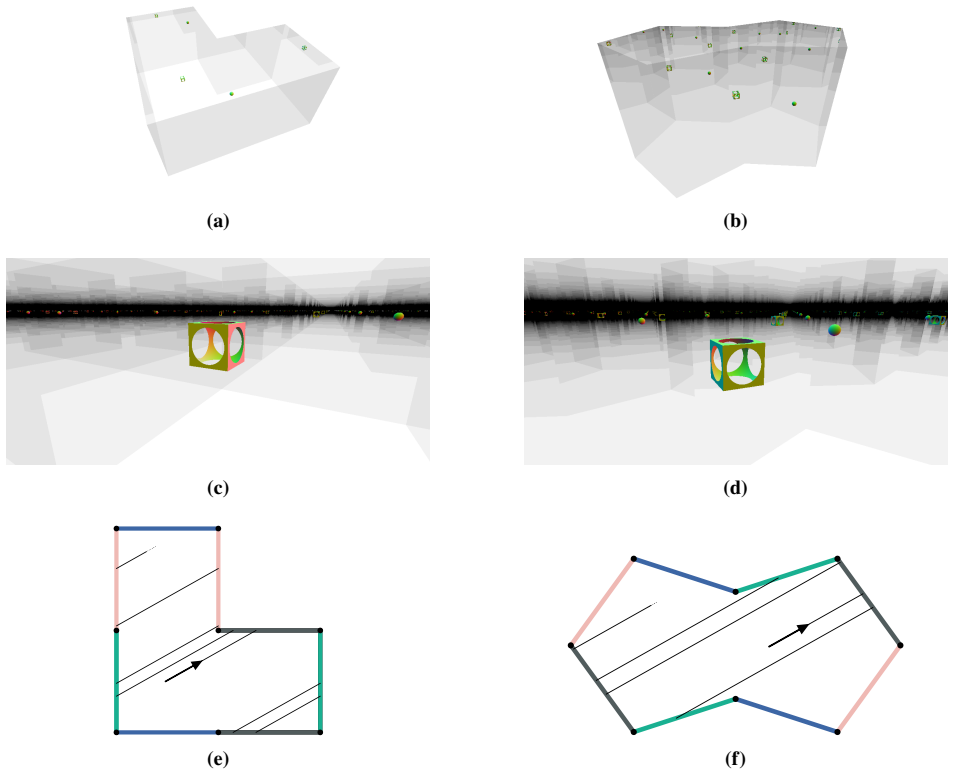
On its own terms, the paper's central claim is that ray marching, equipped with a signed distance function augmented by wall identification data, can render faithful first-person views of thickened flat surfaces in real time. The scene is a Euclidean thickening of the original polygon(s) obtained by adding a vertical coordinate, with opposite walls identified by the surface's gluing rules—translations for translation surfaces, translations and rotations for unfolded polyhedra, reflections for mirror rooms, and an additional vertical identification for translation prisms. When a ray hits a wall, its position is teleported according to the gluing rule and nudged just past the new wall to avoid re-intersection, so the same continuous path explores all copies of the fundamental domain. The result is that users can experience the intrinsic geometry of the surface—walking off one edge and re-entering at another, circling singularities with non-2π cone angle, and seeing periodic orbits appear as low-level visual patterns—directly and interactively.
Load-bearing premise
The visualization's faithfulness rests on the assumption that thickening a flat surface by a Euclidean height component, with wall identifications leaving the vertical component unchanged, preserves the intrinsic geometry a viewer experiences; if this thickening distorts distances, straight-line sight, or cone behavior, the first-person view would not accurately represent the original flat surface.
Editorial extensions
If this is right
- Users can walk through a translation surface and directly observe how crossing an identified edge deposits them in a copy of the same room, making the Pac-Man gluing rule tangible.
- The same kernel handles mirror rooms, unfolded polyhedra, and translation prisms by swapping the boundary-identification rules, so the method is a single framework rather than a per-example hack.
- Because scenes are specified as JSON (walls, gluing rules, assets) and the core is a compact GLSL shader, the visualizations can be ported to Unity, Unreal, or Godot and shared as browser-based apps requiring no installation.
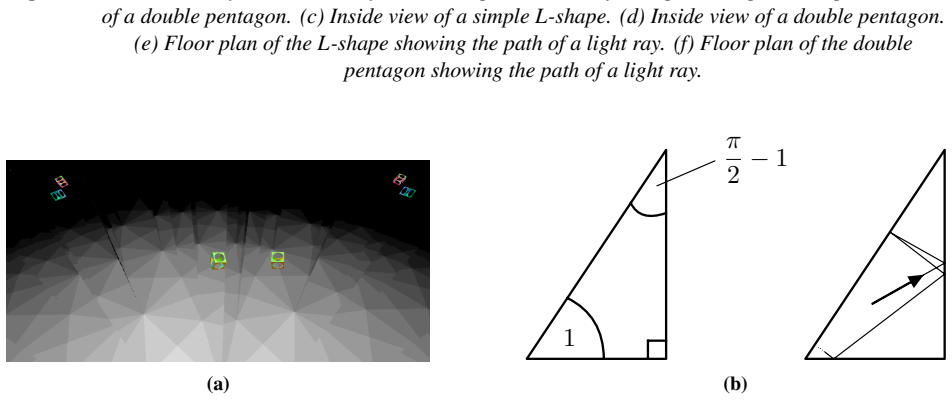
- In outreach settings, the first-person experience lets newcomers spot periodic orbits by sight and grasp the rotation caused by cone angles not equal to 2π, which the authors report as consistent qualitative observations.
- The paper states that the approach readily extends to affine surfaces and simple infinite flat surfaces such as infinite cones and cylinders, which would broaden the class of explorable geometries.
Reading between the lines
- The vertical height is a visualization artifact, not part of the original flat surface: motion along the added dimension is not a motion in the surface, so the first-person experience is really of the product of the surface with a Euclidean line, with identifications acting only on the surface factor. The paper leaves this distinction implicit, but a faithful projection to the base surface is what
- Because the gluing rules are specified as data, the approach could be pushed further to visualize affine (shear) surfaces and branched covers without new code, a direction the paper mentions only in passing for affine surfaces.
- A natural empirical test of the outreach claim would be to compare how quickly novices can identify periodic billiard trajectories in the immersive renderer versus on a static floor plan; the paper reports qualitative observations but does not run a controlled study.
- When the flat surface has nontrivial holonomy, the thickened room may not be a single well-defined three-dimensional manifold; checking whether straight rays circling singularities acquire exactly the expected cone-angle rotation would validate whether the visualization is faithful.
Editorial analysis
A structured set of objections, weighed in public.
Referee Report
Summary. The paper presents an interactive ray-marching method for first-person visualization of flat surfaces, covering translation surfaces, translation prisms, mirror rooms, and unfolded polyhedra. The core idea is to take a flat surface defined by gluing polygons, thicken it by adding a Euclidean height coordinate, and treat the gluing rules as teleportation rules for rays hitting vertical walls; the scene SDF is augmented with flags to distinguish walls from test objects. The authors provide a WebGL/three.js implementation with JSON-described scenes, discuss implementation details, and report qualitative outreach experience.
Significance. If accepted, the paper provides a reproducible, low-barrier tool that makes a class of abstract geometric objects directly explorable, complementing prior non-Euclidean VR work. The main strengths are the concrete algorithm description, the explicit accommodation of several gluing types, and the shipped code and online demo, which allow readers to verify the central claims. The contribution is primarily practical and expository rather than theoretical; the paper does not provide quantitative evaluation of performance or learning outcomes, but those omissions do not undermine the core visualization contribution.
minor comments (6)
- [Ray Marching on Flat Surfaces] In the paragraph on wall hits, 'the appropriate translation is applied' should be 'the appropriate translation or rotation is applied' to be consistent with the later description of unfolded polyhedra and with Figure 3b, which explicitly mentions rotation.
- [Ray Marching on Flat Surfaces] The safe-distance offset after a wall hit should specify the direction of the offset: the relocated point should be moved along the inward normal of the identified wall and remain within the wall segment, because placing the point merely at Euclidean distance greater than epsilon from the wall plane can land outside the wall polygon or immediately inside an adjacent wall.
- [Abstract and Ray Marching on Flat Surfaces] The claim of 'maintaining computational efficiency' is only supported qualitatively; a short table or paragraph reporting measured frame rates, resolution, scene sizes, and hardware would make this claim checkable and would strengthen the reproducibility of the contribution.
- [Gallery and Figures 4-5] The matching wall colors in Figure 4 are essential for understanding the edge identifications, but the text never explicitly states which pairs of walls are identified; add a sentence in Section 4 or in the captions explaining the color-matching convention.
- [Ray Marching] The text says that normals are approximated from the SDF gradient, but it does not specify whether finite differences or analytic normals are used; please state the stencil or analytic formula used for the normal computation.
- [References] Several references are incomplete or formatted inconsistently: Reference [14] should include the full proceedings name and page range, and Reference [2] should be updated with any journal/venue information once available; please also add DOIs where possible.
Circularity Check
No significant circularity: the paper presents a rendering construction with no derived prediction, no fitted parameters, and only self-references to its own released code and demo.
full rationale
The paper's central claim is that its ray-marching adaptation provides an intuitive and efficient way to visualize flat surfaces. This is an implementation and demonstration claim, not a theoretical derivation. The method is explicitly constructed: flat surfaces are defined by edge identifications of polygons, and the visualization lifts the surface into three dimensions by adding a Euclidean height component with wall identifications leaving the vertical component unchanged. That thickening is a deliberate rendering choice, not an equation whose output equals its input. No fitted parameters are introduced, no prediction is statistically forced by a subset of data, and no uniqueness theorem or load-bearing result is imported from the authors' previous work. The only self-references are citations to the authors' own simulation and source code, which are the implementation itself and therefore real, checkable evidence rather than circular justification. The appendix's qualitative outreach observations are anecdotal but are not used to prove the method's correctness. Standard visualization limitations, such as translucent walls and the safe-distance offset after wall hits, are implementation details and do not make the central claim circular. The construction is self-contained against the stated goal of rendering immersive first-person views, so no circular step is present.
Assumptions & free parameters
free parameters (4)
- epsilon hit threshold =
10^-4 units (example)
- safe-distance offset after wall teleport =
greater than epsilon, not numerically reported
- maximum ray distance =
not reported
- vertical height of thickening =
not reported
assumptions (4)
- standard math Flat surfaces are finite collections of Euclidean polygons with edges identified by isometries, with a flat metric away from cone singularities.
- standard math Signed distance functions and sphere tracing correctly locate surface intersections when a small step threshold is used.
- domain assumption Applying translations, rotations, or reflections to ray positions and directions at wall crossings models quotient identifications.
- ad hoc to paper A flag-augmented distance query can reliably identify the nearest surface type, wall versus object.
invented entities (1)
-
Euclidean height component (thickening of the flat surface)
Cite this review
Pith. "Pith review of Immersive Visualization of Flat Surfaces Using Ray Marching." pith.science (2026). https://pith.science/paper/XTYKXHXA
@misc{pith2026250607558,
  author       = {Pith},
  title        = {Pith review of: Immersive Visualization of Flat Surfaces Using Ray Marching},
  year         = {2026},
  howpublished = {\url{https://pith.science/paper/XTYKXHXA}},
  note         = {Machine review of arXiv:2506.07558}
}
read the original abstract
We present an effective method for visualizing flat surfaces using ray marching. Our approach provides an intuitive way to explore translation surfaces, mirror rooms, unfolded polyhedra, and translation prisms while maintaining computational efficiency. We demonstrate the utility of the method through various examples and provide implementation insights for programmers. Finally, we discuss the use of our visualizations in outreach. We make our simulations and code available online.
Figures



Figures from the paper (10 more)



Reference graph
Works this paper leans on
-
[1]
Applin.Yayoi Kusama: Infinity Mirror Room – Phalli’s Field
J. Applin.Yayoi Kusama: Infinity Mirror Room – Phalli’s Field. ser. One Work. Afterall Books, 2012
work page 2012
-
[2]
Linear Flows on Translation Prisms
J. S. Athreya, N. B ´edaride, W. P. Hooper, and P. Hubert. “Linear Flows on Translation Prisms.”arXiv preprint arXiv:2504.08955, 2025
arXiv 2025
-
[3]
Non-Euclidean Virtual Reality III: Nil
R. Coulon, E. Matsumoto, H. Segerman, and S. Trettel. “Non-Euclidean Virtual Reality III: Nil.” Proceedings of Bridges 2020: Mathematics, Art, Music, Architecture, Education, Culture. C. Yackel, R. Bosch, E. Torrence, and K. Fenyvesi, Eds. Phoenix, Arizona: Tessellations Publishing, 2020. pp. 153–160. http://archive.bridgesmathart.org/2020/bridges2020-153.html
work page 2020
-
[4]
Non-Euclidean Virtual Reality IV: Sol
R. Coulon, E. Matsumoto, H. Segerman, and S. Trettel. “Non-Euclidean Virtual Reality IV: Sol.” Proceedings of Bridges 2020: Mathematics, Art, Music, Architecture, Education, Culture. C. Yackel, R. Bosch, E. Torrence, and K. Fenyvesi, Eds. Phoenix, Arizona: Tessellations Publishing, 2020. pp. 161–168. http://archive.bridgesmathart.org/2020/bridges2020-161.html
work page 2020
-
[5]
Ray-Marching Thurston Geometries
R. Coulon, E. A. Matsumoto, H. Segerman, and S. J. Trettel. “Ray-Marching Thurston Geometries.” Experimental Mathematics, vol. 31, no. 4, 2022, pp. 1197–1277
work page 2022
-
[6]
R. A. Drebin, L. Carpenter, and P. Hanrahan. “Volume rendering.”SIGGRAPH Comput. Graph., vol. 22, no. 4, Jun. 1988, p. 65–74
work page 1988
-
[7]
J. D. Foley.Computer Graphics: Principles and Practice. Addison-Wesley Professional, 1996. vol. 12110
work page 1996
-
[8]
Sphere Tracing: A Geometric Method for the Antialiased Ray Tracing of Implicit Surfaces
J. C. Hart. “Sphere Tracing: A Geometric Method for the Antialiased Ray Tracing of Implicit Surfaces.”The Visual Computer, vol. 12, no. 10, 1996, pp. 527–545
work page 1996
Show all 21 references
-
[9]
Non-Euclidean Virtual Reality I: Explorations of𝐻 3
V. Hart, A. Hawksley, E. Matsumoto, and H. Segerman. “Non-Euclidean Virtual Reality I: Explorations of𝐻 3.”Proceedings of Bridges 2017: Mathematics, Art, Music, Architecture, Education, Culture. D. Swart, C. H. S´equin, and K. Fenyvesi, Eds. Phoenix, Arizona: Tessellations Publishing,
2017
-
[10]
Non-Euclidean Virtual Reality II: Explorations of𝐻 2×𝐸
V. Hart, A. Hawksley, E. Matsumoto, and H. Segerman. “Non-Euclidean Virtual Reality II: Explorations of𝐻 2×𝐸.”Proceedings of Bridges 2017: Mathematics, Art, Music, Architecture, Education, Culture. D. Swart, C. H. S´equin, and K. Fenyvesi, Eds. Phoenix, Arizona: Tessellations ...
2017
-
[11]
Ray Marching Flat Surfaces Demo
F. Lander and D. Taha. “Ray Marching Flat Surfaces Demo.” https://fabianlander.github.io/apps/raymarchingflatsurfacesapp/. 2025
2025
-
[12]
RayMarchingFlatSurfaces
F. Lander and D. Taha. “RayMarchingFlatSurfaces.” https://github.com/FabianLander/RayMarchingFlatSurfaces.git. 2025
2025
-
[13]
Visualizing Hyperbolic Honeycombs
R. Nelson and H. Segerman. “Visualizing Hyperbolic Honeycombs.”Journal of Mathematics and the Arts, vol. 11, no. 1, 2017, pp. 4–39
2017
-
[14]
Hypertexture
K. Perlin and E. M. Hoffert. “Hypertexture.”Proceedings of the 16th annual conference on Computer graphics and interactive techniques. 1989. pp. 253–262
1989
-
[15]
Rendering Worlds with Two Triangles
I. Quilez. “Rendering Worlds with Two Triangles.”Proceedings of the 2008 NVSCENE Demoparty Technical Seminar. 2008. https://www.iquilezles.org/www/material/nvscene2008/rwwtt.pdf
2008
-
[16]
Distance Functions
I. Qu ´ılez. “Distance Functions.” https://iquilezles.org/articles/distfunctions/. 2015
2015
-
[17]
3D Representation Methods: A Survey
Z. Wang. “3D Representation Methods: A Survey.”arXiv preprint arXiv:2410.06475, 2024
2024 arXiv
-
[18]
Real-Time Rendering in Curved Spaces
J. Weeks. “Real-Time Rendering in Curved Spaces.”IEEE Computer Graphics and Applications, vol. 22, no. 6, 2002, pp. 90–99
2002
-
[19]
Real-Time Animation in Hyperbolic, Spherical, and Product Geometries
J. R. Weeks. “Real-Time Animation in Hyperbolic, Spherical, and Product Geometries.” Non-Euclidean Geometries: J ´anos Bolyai Memorial Volume, 2006, pp. 287–305
2006
-
[20]
Flat Surfaces
A. Zorich. “Flat Surfaces.”arXiv preprint math/0609392, 2006. A Extended Gallery This appendix presents additional visualizations and intuitive descriptions that complement the examples in theGallerysection. We include mirror rooms, translation prisms, and thickened singularit...
2006 arXiv
-
[2017]
pp. 33–40. http://archive.bridgesmathart.org/2017/bridges2017-33.html
2017
Reviewed August 7, 2026 · model on record in the stance chip above.
Discussion (0). Sign in to comment.