REVIEW 3 major objections 6 minor 65 references
Dual Enhancement on 3D Vision-Language Perception for Monocular 3D Visual Grounding
T0 review · 3 major / 6 minor · reviewed 2026-08-05 · deepseek-v4-flash
Pith's one-line read Text that ignores units breaks 3D grounding; fix gains 11.94%
desk verdict A useful, well-ablated augmentation for monocular 3D grounding, but the motivating claim about language models' weak unit comprehension is shakier than the results. read the letter →
The pith
A machine-rendered reading of the paper's core claim, the machinery that carries it, and where it could break.
The reading
What carries the argument
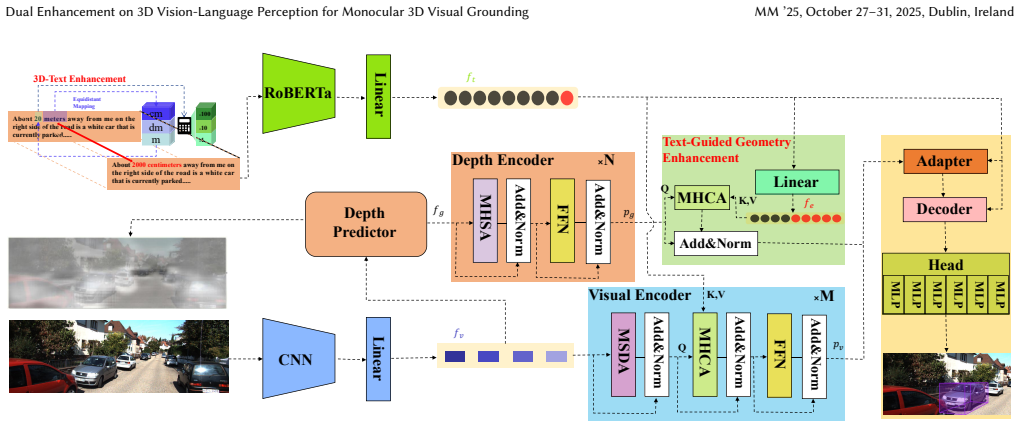
The load-bearing machinery is a pair of lightweight text-side components. 3D-text Enhancement (3DTE) is a preprocessing and data-augmentation step: each distance, height, or length descriptor in a query is randomly remapped to an equivalent value in meters, decimeters, or centimeters with equal probability, creating multiple surface forms of the same physical quantity; per-descriptor random replacement (Plan A) beats whole-sentence uniform replacement (Plan B). Text-Guided Geometry Enhancement (TGE) is a two-operation module: a fully-connected projection layer with ReLU activation maps basic text features into a geometrically consistent embedding space, producing the enhanced 3D-text feature
What would settle it
Compare equidistant rewrites that hold the unit family fixed but vary token frequency (e.g., '0.01 kilometers', '100 decimeters', '1000 centimeters' - all physically equivalent); if grounding accuracy tracks token frequency rather than unit family, the unit-comprehension diagnosis is undercut. A complementary check is running the authors' similarity diagnostic on a language model with strong numeracy: low scores there would suggest the metric measures token-surface mismatch, not 3D comprehension.
Extended reading notes
Core claim
On the paper's own terms, the central discovery is that pretrained text encoders used for monocular 3D visual grounding have a unit-blind spot: they track the number but not the measurement unit, so geometrically equivalent text produces divergent embeddings and degraded localization. The paper demonstrates this with an equidistant-mapping test that converts meters to decimeters or centimeters; this collapses accuracy across all scenarios while cosine and Euclidean similarity between original and remapped text embeddings falls below 0.62. The fix is two-fold: 3DTE diversifies the surface forms of distance descriptors during training so the encoder learns unit-invariant representations, and T
Load-bearing premise
The central assumption is that the accuracy collapse after equidistant unit conversion reflects the language model's weak grasp of units and 3D meaning, rather than an artifact of how often tokens like '1000' appear in pretraining; if the drop were mostly a token-frequency effect, the paper's diagnosis would be weakened, though its augmentation might still help.
Editorial extensions
If this is right
- With both components, the model reaches state-of-the-art accuracy on Mono3DRefer across overall, unique/multiple, near/medium/far, and easy/moderate/hard splits; at acc@0.5 the far scenario improves by +11.94 points over the baseline.
- The model's text embeddings become unit-robust: cosine and Euclidean similarity between original and equidistantly remapped queries rises from about 0.61-0.62 to 0.85-0.91.
- The trained model generalizes to unseen distance units: when all test queries are remapped to millimeters, grounding accuracy stays competitive, whereas the baseline drops sharply.
- Each component contributes independently (3DTE alone: +3.8/+6.0; TGE alone: +2.42/+4.28 at acc@0.25/0.5), and combining them gives a further synergistic gain.
- Because TGE improves depth positioning while preserving orientation and size estimates, the main practical effect is more accurate depth localization in monocular settings.
Reading between the lines
- The same unit-diversification trick could transfer to other metric-language tasks such as navigation instructions, driving-language commands, or embodied question answering, where pretrained encoders see sparse unit tokens; a cheap test is to apply 3DTE-style remapping to those datasets and measure whether downstream accuracy stabilizes under unit changes.
- The similarity diagnostic used here-cosine and Euclidean distance between original and equidistantly remapped text-could serve as a cheap probe for numeric and unit comprehension in any language model, without running a full grounding pipeline.
- If the gains come from learned scale invariance rather than from memorizing particular unit pairs, then remapping with more extreme or less frequent units (for example kilometers, millimeters, or decimal scaling) during training should further improve robustness; the paper's unseen-unit results suggest this is testable.
- The authors attribute the unit-blindness to weak 3D comprehension, but the same symptom could partly reflect token-frequency effects; a controlled comparison between rare and common numeric tokens would clarify which mechanism dominates.
Editorial analysis
A structured set of objections, weighed in public.
Referee Report
Summary. This paper studies monocular 3D visual grounding on the Mono3DRefer benchmark. The authors observe that converting metric units in the text (e.g., '10 meters' to '1000 centimeters') degrades grounding accuracy and lowers text-feature similarity, which they attribute to weak 3D-text comprehension in pretrained language models such as BERT and RoBERTa. They propose two additions to the Mono3DVG-TR baseline: 3D-Text Enhancement (3DTE), a data-augmentation scheme that randomly rewrites each distance/height/length value into meters, decimeters, or centimeters; and Text-Guided Geometry Enhancement (TGE), a linear projection of text features followed by multi-head cross-attention injected into the geometry branch. Experiments report consistent gains over Mono3DVG-TR across overall/unique/multiple, near/medium/far, and easy/moderate/hard splits, with the largest gain at Acc@0.5 in the far scenario (+11.94 points). Ablations in Table 6 show that both components contribute independently and jointly.
Significance. If the empirical results hold, this is a useful contribution: a simple, inexpensive unit-augmentation scheme and a lightweight geometry-text interaction module improve monocular 3D grounding accuracy by several points across many settings. The ablations (Table 6) are clean, and Table 4 is a reasonable attempt to test generalization to an unseen unit. The main weakness is that the paper's central diagnostic of LM 3D comprehension (Fig. 1b and Table 3) is not a valid measurement: the similarity scores are computed in different feature spaces, and the unit-conversion drop is confounded with tokenization and token-frequency effects. The empirical accuracy gains do not depend on this diagnostic, but the paper's interpretation and its first claimed contribution do. The study would be strengthened by releasing code and reporting variance across seeds.
major comments (3)
- [Section 3.3, Eq. (3)-(4), Table 3] The proposed similarity metrics are not well-defined, and the comparison in Table 3 is not interpretable. In Eq. (4), the denominator contains the mask vector m; dividing by a vector is undefined, and the dot-product notation in the numerator is ambiguous. More substantively, Table 3 compares Mono3DVG-TR's raw RoBERTa embeddings with 'Ours' using f_e, the output of a learned linear projection that is trained on unit-augmented text. A trained projection can make original and transformed queries similar by construction, so the high similarity scores (0.91/0.85) do not establish improved unit understanding. The authors should compute similarities in the same feature space (e.g., raw RoBERTa features for both models) and correct the metric definitions.
- [Section 3.3, Figure 1(b)] The motivating accuracy drop after equidistant mapping is confounded with tokenization and token frequency. '1000 centimeters' tokenizes differently from '10 meters', and '1000'/'centimeters' are likely rarer in the pretraining corpus than '10'/'meters'. The observed degradation could be caused by these surface-level factors rather than by 'weak 3D comprehension' of the language model. A control that keeps token frequencies comparable (e.g., using number words, or evaluating on matched-frequency synthetic paraphrases) is needed before the paper's first contribution can be accepted as stated.
- [Section 4.3, Table 4] The unseen-unit test inherits the same confound and therefore does not isolate unit generalization. Mapping all depth/height/length values to millimeters changes every numeric surface form and introduces a rare unit token, so the baseline's collapse may reflect out-of-vocabulary or token-frequency effects rather than poor unit understanding. The comparison would be more convincing if it included a control transformation that changes token frequency without changing physical meaning (or vice versa), and if similarity scores were reported on the same raw features for the baseline and the proposed model.
minor comments (6)
- [Section 4.3, Table 6] All results appear to come from a single training run. Please report mean and standard deviation over at least three seeds, or state whether the observed differences are stable. This is especially relevant because several improvements are only 2-6 accuracy points.
- [Section 4.3, Tables 1-2] The text says the method 'almost achieves the best performance across all scenarios, with exception of CatRand on far' and later that it achieves 'state-of-the-art performance across all scenarios.' These statements are confusing: in Table 2, CatRand has a much higher Far Acc@0.5 (52.11) than the proposed method (27.29). Please clarify the intended comparison.
- [Section 4.3, Table 5] The claim that Plan A is 'statistically better' is not supported by any statistical test. Please either add significance testing or soften the wording.
- [Section 3.5, Eq. (8)] The Laplacian aleatoric uncertainty loss is attributed to reference [5], but [5] is ScanRefer and does not appear to be the source of this loss. Please check the citation.
- [General] Code is promised but no link or repository identifier is provided. Please release the code or state clearly how to obtain it.
- [General] Typos and minor wording: 'Comared' in Section 4.1, 'multi-model' in the CCS Concepts should be 'multi-modal', and '3D Vision-Language Perception' in the title would be more standard as '3D Vision-Language Perception' (no change needed).
Circularity Check
No significant circularity; derivation is self-contained and benchmarked against external baselines.
full rationale
The paper's central derivation is empirical and not circular. The motivating observation (Sec. 3.3, Fig. 1b) is a robustness test: apply equidistant unit conversions to held-out queries and measure downstream accuracy and embedding similarity. This is not a quantity defined by the target claim; it is a diagnostic on off-the-shelf BERT/RoBERTa features. The proposed 3DTE is a data-augmentation preprocessing method trained on meter/dm/cm variants; Table 4 tests on the unseen unit 'millimeters', which is a held-out generalization test rather than a fitted quantity renamed as a prediction. The TGE module adds a learned projection and cross-attention, and its accuracy is evaluated on the external Mono3DRefer test set against Mono3DVG-TR (Ref. [57]), a baseline with no author overlap with this paper, so the reported gains are not forced by construction. Table 3 compares raw baseline RoBERTa features with the proposed projected features f_e; although the comparison is not perfectly apples-to-apples because one side has been transformed by a learned projection, the high similarity of f_e is an emergent property of the trained model, not a term that the loss explicitly optimizes, and the SOTA claim does not rest on this table. Possible confounds in the unit-conversion diagnostic, such as tokenization or token-frequency effects, would be a validity/correctness concern for the paper's interpretation, not evidence of circularity. No load-bearing self-citation appears, no uniqueness theorem is imported from the authors, and no ansatz is smuggled in via citation. Therefore no circular step can be exhibited, and the appropriate score is 0.
Assumptions & free parameters
free parameters (2)
- Unit selection probabilities in 3DTE =
1/3 each for meters, decimeters, centimeters
- Unit set in 3DTE =
{m, dm, cm}
assumptions (3)
- domain assumption Equidistant unit conversion preserves semantic meaning and sentence structure exactly
- domain assumption The baseline Mono3DVG-TR architecture is a fair representative of monocular 3D grounding methods
- domain assumption The similarity metrics in Eq. 3-4 meaningfully measure 3D-text comprehension
Cite this review
Pith. "Pith review of Dual Enhancement on 3D Vision-Language Perception for Monocular 3D Visual Grounding." pith.science (2026). https://pith.science/paper/XTZMVQJO
@misc{pith2026250819165,
  author       = {Pith},
  title        = {Pith review of: Dual Enhancement on 3D Vision-Language Perception for Monocular 3D Visual Grounding},
  year         = {2026},
  howpublished = {\url{https://pith.science/paper/XTZMVQJO}},
  note         = {Machine review of arXiv:2508.19165}
}
read the original abstract
Monocular 3D visual grounding is a novel task that aims to locate 3D objects in RGB images using text descriptions with explicit geometry information. Despite the inclusion of geometry details in the text, we observe that the text embeddings are sensitive to the magnitude of numerical values but largely ignore the associated measurement units. For example, simply equidistant mapping the length with unit "meter" to "decimeters" or "centimeters" leads to severe performance degradation, even though the physical length remains equivalent. This observation signifies the weak 3D comprehension of pre-trained language model, which generates misguiding text features to hinder 3D perception. Therefore, we propose to enhance the 3D perception of model on text embeddings and geometry features with two simple and effective methods. Firstly, we introduce a pre-processing method named 3D-text Enhancement (3DTE), which enhances the comprehension of mapping relationships between different units by augmenting the diversity of distance descriptors in text queries. Next, we propose a Text-Guided Geometry Enhancement (TGE) module to further enhance the 3D-text information by projecting the basic text features into geometrically consistent space. These 3D-enhanced text features are then leveraged to precisely guide the attention of geometry features. We evaluate the proposed method through extensive comparisons and ablation studies on the Mono3DRefer dataset. Experimental results demonstrate substantial improvements over previous methods, achieving new state-of-the-art results with a notable accuracy gain of 11.94\% in the "Far" scenario. Our code will be made publicly available.
Figures


Figures from the paper (1 more)

Reference graph
Works this paper leans on
-
[1]
Panos Achlioptas, Ahmed Abdelreheem, Fei Xia, Mohamed Elhoseiny, and Leonidas Guibas. 2020. Referit3d: Neural listeners for fine-grained 3d object identification in real-world scenes. InComputer Vision–ECCV 2020: 16th European Conference, Glasgow, UK, August 23–28, 2020, Proceedings, Part I 16 . Springer, 422–440
work page 2020
-
[2]
Garrick Brazil, Abhinav Kumar, Julian Straub, Nikhila Ravi, Justin Johnson, and Georgia Gkioxari. 2023. Omni3d: A large benchmark and model for 3d object detection in the wild. InProceedings of the IEEE/CVF conference on computer vision and pattern recognition. 13154–13164
work page 2023
-
[3]
Garrick Brazil and Xiaoming Liu. 2019. M3d-rpn: Monocular 3d region pro- posal network for object detection. In Proceedings of the IEEE/CVF international conference on computer vision . 9287–9296
work page 2019
-
[4]
Daigang Cai, Lichen Zhao, Jing Zhang, Lu Sheng, and Dong Xu. 2022. 3djcg: A unified framework for joint dense captioning and visual grounding on 3d point clouds. In Proceedings of the IEEE/CVF conference on computer vision and pattern recognition. 16464–16473
work page 2022
-
[5]
Dave Zhenyu Chen, Angel X Chang, and Matthias Nießner. 2020. Scanrefer: 3d object localization in rgb-d scans using natural language. In European conference on computer vision. Springer, 202–221
work page 2020
-
[6]
Dave Zhenyu Chen, Qirui Wu, Matthias Nießner, and Angel X Chang. 2022. D 3 net: A unified speaker-listener architecture for 3d dense captioning and visual grounding. In European Conference on Computer Vision . Springer, 487–505
work page 2022
-
[7]
Shengxin Chen, Gen Luo, Yiyi Zhou, Xiaoshuai Sun, Guannan Jiang, and Ron- grong Ji. 2024. QueryMatch: A Query-based Contrastive Learning Framework for Weakly Supervised Visual Grounding. InProceedings of the 32nd ACM Interna- tional Conference on Multimedia (Melbourne VIC, Australia)(MM ’24). Association for Computing Machinery, New York, NY, USA, 4177–4186
work page 2024
-
[8]
Xinpeng Chen, Lin Ma, Jingyuan Chen, Zequn Jie, Wei Liu, and Jiebo Luo. 2018. Real-time referring expression comprehension by single-stage grounding net- work. arXiv preprint arXiv:1812.03426 (2018)
arXiv 2018
Show all 65 references
-
[9]
Yongjian Chen, Lei Tai, Kai Sun, and Mingyang Li. 2020. Monopair: Monocular 3d object detection using pairwise spatial relationships. In Proceedings of the IEEE/CVF conference on computer vision and pattern recognition . 12093–12102
2020
-
[10]
Jiajun Deng, Zhengyuan Yang, Tianlang Chen, Wengang Zhou, and Houqiang Li. 2021. TransVG: End-to-End Visual Grounding with Transformers. In 2021 IEEE/CVF International Conference on Computer Vision (ICCV) . 1749–1759
2021
-
[11]
Mingyu Ding, Yuqi Huo, Hongwei Yi, Zhe Wang, Jianping Shi, Zhiwu Lu, and Ping Luo. 2020. Learning depth-guided convolutions for monocular 3d object detection. In Proceedings of the IEEE/CVF Conference on computer vision and pattern recognition workshops. 1000–1001
2020
-
[12]
Mingtao Feng, Zhen Li, Qi Li, Liang Zhang, XiangDong Zhang, Guangming Zhu, Hui Zhang, Yaonan Wang, and Ajmal Mian. 2021. Free-form description guided 3d visual graph network for object grounding in point cloud. In Proceedings of the IEEE/CVF international conference on compute...
2021
-
[13]
Andreas Geiger, Philip Lenz, and Raquel Urtasun. 2012. Are we ready for au- tonomous driving? the kitti vision benchmark suite. In 2012 IEEE conference on computer vision and pattern recognition . IEEE, 3354–3361
2012
-
[14]
Dailan He, Yusheng Zhao, Junyu Luo, Tianrui Hui, Shaofei Huang, Aixi Zhang, and Si Liu. 2021. Transrefer3d: Entity-and-relation aware transformer for fine- grained 3d visual grounding. In Proceedings of the 29th ACM international confer- ence on multimedia. 2344–2352
2021
-
[15]
Kaiming He, Xiangyu Zhang, Shaoqing Ren, and Jian Sun. 2016. Deep residual learning for image recognition. In Proceedings of the IEEE conference on computer vision and pattern recognition . 770–778
2016
-
[16]
Shuting He and Henghui Ding. 2024. RefMask3D: Language-guided transformer for 3D referring segmentation. In Proceedings of the 32nd ACM International Conference on Multimedia. 8316–8325
2024
-
[17]
Yu Hong, Hang Dai, and Yong Ding. 2022. Cross-modality knowledge distillation network for monocular 3d object detection. In European Conference on Computer Vision. Springer, 87–104
2022
-
[18]
Kuan-Chih Huang, Tsung-Han Wu, Hung-Ting Su, and Winston H Hsu. 2022. Monodtr: Monocular 3d object detection with depth-aware transformer. In Pro- ceedings of the IEEE/CVF conference on computer vision and pattern recognition . 4012–4021
2022
-
[19]
Shijia Huang, Yilun Chen, Jiaya Jia, and Liwei Wang. 2022. Multi-view transformer for 3d visual grounding. In Proceedings of the IEEE/CVF Conference on Computer Vision and Pattern Recognition . 15524–15533
2022
-
[20]
Chenchen Jing, Yuwei Wu, Mingtao Pei, Yao Hu, Yunde Jia, and Qi Wu. 2020. Visual-Semantic Graph Matching for Visual Grounding. In Proceedings of the 28th ACM International Conference on Multimedia (Seattle, WA, USA) (MM ’20). Association for Computing Machinery, New York, NY, ...
2020
-
[21]
Aishwarya Kamath, Mannat Singh, Yann LeCun, Gabriel Synnaeve, Ishan Misra, and Nicolas Carion. 2021. Mdetr-modulated detection for end-to-end multi- modal understanding. In Proceedings of the IEEE/CVF international conference on computer vision. 1780–1790
2021
-
[22]
Jinyuan Li, Duxin Zhu, Zhuangzhi Liu, Yang Luo, Jinhe Su, Guorong Cai, and Yundong Wu. 2024. PP-DETR: Progressive Proposal Detection Transformer for 3D Visual Grounding. In Proceedings of the 2024 8th International Conference on Electronic Information Technology and Computer E...
2024
-
[23]
Zhenjia Li, Jinrang Jia, and Yifeng Shi. 2024. MonoLSS: Learnable sample selection for monocular 3D detection. In 2024 International Conference on 3D Vision (3DV) . IEEE, 1125–1135
2024
-
[24]
Zhuoling Li, Zhan Qu, Yang Zhou, Jianzhuang Liu, Haoqian Wang, and Lihui Jiang. 2022. Diversity matters: Fully exploiting depth clues for reliable monocular 3d object detection. In Proceedings of the IEEE/CVF Conference on Computer Vision and Pattern Recognition. 2791–2800
2022
-
[25]
Yue Liao, Si Liu, Guanbin Li, Fei Wang, Yanjie Chen, Chen Qian, and Bo Li. 2020. A real-time cross-modality correlation filtering method for referring expression comprehension. In Proceedings of the IEEE/CVF Conference on Computer Vision and Pattern Recognition. 10880–10889
2020
-
[26]
Tsung-Yi Lin, Priya Goyal, Ross Girshick, Kaiming He, and Piotr Dollár. 2017. Focal loss for dense object detection. In Proceedings of the IEEE international conference on computer vision . 2980–2988
2017
-
[27]
Zhenxiang Lin, Xidong Peng, Peishan Cong, Ge Zheng, Yujin Sun, Yuenan Hou, Xinge Zhu, Sibei Yang, and Yuexin Ma. 2024. Wildrefer: 3d object localization in large-scale dynamic scenes with multi-modal visual data and natural language. In European Conference on Computer Vision ....
2024
-
[28]
Daqing Liu, Hanwang Zhang, Feng Wu, and Zheng-Jun Zha. 2019. Learning to assemble neural module tree networks for visual grounding. In Proceedings of the IEEE/CVF international conference on computer vision . 4673–4682
2019
-
[29]
Haolin Liu, Anran Lin, Xiaoguang Han, Lei Yang, Yizhou Yu, and Shuguang Cui
-
[30]
Xianpeng Liu, Nan Xue, and Tianfu Wu. 2022. Learning auxiliary monocular con- texts helps monocular 3d object detection. In Proceedings of the AAAI Conference on Artificial Intelligence, Vol. 36. 1810–1818
2022
-
[31]
Yinhan Liu, Myle Ott, Naman Goyal, Jingfei Du, Mandar Joshi, Danqi Chen, Omer Levy, Mike Lewis, Luke Zettlemoyer, and Veselin Stoyanov. 2019. Roberta: A robustly optimized bert pretraining approach. arXiv preprint arXiv:1907.11692 (2019)
2019 arXiv
-
[32]
Zechen Liu, Zizhang Wu, and Roland Tóth. 2020. Smoke: Single-stage monocu- lar 3d object detection via keypoint estimation. In Proceedings of the IEEE/CVF conference on computer vision and pattern recognition workshops . 996–997
2020
-
[33]
Zongdai Liu, Dingfu Zhou, Feixiang Lu, Jin Fang, and Liangjun Zhang. 2021. Autoshape: Real-time shape-aware monocular 3d object detection. In Proceedings of the IEEE/CVF International Conference on Computer Vision . 15641–15650
2021
-
[34]
Xinzhu Ma, Yinmin Zhang, Dan Xu, Dongzhan Zhou, Shuai Yi, Haojie Li, and Wanli Ouyang. 2021. Delving into localization errors for monocular 3d object detection. In Proceedings of the IEEE/CVF Conference on Computer Vision and Pattern Recognition. 4721–4730
2021
-
[35]
Fabian Manhardt, Wadim Kehl, and Adrien Gaidon. 2019. Roi-10d: Monocular lifting of 2d detection to 6d pose and metric shape. InProceedings of the IEEE/CVF Conference on Computer Vision and Pattern Recognition . 2069–2078
2019
-
[36]
Liang Peng, Xiaopei Wu, Zheng Yang, Haifeng Liu, and Deng Cai. 2022. Did- m3d: Decoupling instance depth for monocular 3d object detection. In European Conference on Computer Vision . Springer, 71–88
2022
-
[37]
Bryan A Plummer, Paige Kordas, M Hadi Kiapour, Shuai Zheng, Robinson Pira- muthu, and Svetlana Lazebnik. 2018. Conditional image-text embedding networks. In Proceedings of the European Conference on Computer Vision (ECCV) . 249–264
2018
-
[38]
Charles Ruizhongtai Qi, Li Yi, Hao Su, and Leonidas J Guibas. 2017. Pointnet++: Deep hierarchical feature learning on point sets in a metric space. Advances in neural information processing systems 30 (2017)
2017
-
[39]
Cody Reading, Ali Harakeh, Julia Chae, and Steven L Waslander. 2021. Categorical depth distribution network for monocular 3d object detection. In Proceedings of the IEEE/CVF conference on computer vision and pattern recognition . 8555–8564
2021
-
[40]
Joseph Redmon and Ali Farhadi. 2018. Yolov3: An incremental improvement. arXiv preprint arXiv:1804.02767 (2018)
2018 arXiv
-
[41]
Hamid Rezatofighi, Nathan Tsoi, JunYoung Gwak, Amir Sadeghian, Ian Reid, and Silvio Savarese. 2019. Generalized intersection over union: A metric and a loss for bounding box regression. In Proceedings of the IEEE/CVF conference on computer vision and pattern recognition . 658–666
2019
-
[42]
Junha Roh, Karthik Desingh, Ali Farhadi, and Dieter Fox. 2022. Languagerefer: Spatial-language model for 3d visual grounding. In Conference on Robot Learning . PMLR, 1046–1056. MM ’25, October 27–31, 2025, Dublin, Ireland Yuzhen Li et al
2022
-
[43]
Arka Sadhu, Kan Chen, and Ram Nevatia. 2019. Zero-shot grounding of ob- jects from natural language queries. In Proceedings of the IEEE/CVF International Conference on Computer Vision . 4694–4703
2019
-
[44]
Zehan Tan, Weidong Yang, and Zhiwei Wang. 2024. Reimagining 3D Visual Grounding: Instance Segmentation and Transformers for Fragmented Point Cloud Scenarios. In Proceedings of the 5th ACM International Conference on Multimedia in Asia (Tainan, Taiwan) (MMAsia ’23). Association...
2024
-
[45]
Tai Wang, Xinge Zhu, Jiangmiao Pang, and Dahua Lin. 2021. Fcos3d: Fully convolutional one-stage monocular 3d object detection. In Proceedings of the IEEE/CVF international conference on computer vision . 913–922
2021
-
[46]
Jason Wei and Kai Zou. 2019. Eda: Easy data augmentation techniques for boosting performance on text classification tasks. arXiv preprint arXiv:1901.11196 (2019)
2019 arXiv
-
[47]
Linhui Xiao, Xiaoshan Yang, Fang Peng, Yaowei Wang, and Changsheng Xu. 2024. HiVG: Hierarchical Multimodal Fine-grained Modulation for Visual Grounding. In Proceedings of the 32nd ACM International Conference on Multimedia (Melbourne VIC, Australia) (MM ’24). Association for C...
2024
-
[48]
Li Yang, Yan Xu, Chunfeng Yuan, Wei Liu, Bing Li, and Weiming Hu. 2022. Improving visual grounding with visual-linguistic verification and iterative rea- soning. In Proceedings of the IEEE/CVF Conference on Computer Vision and Pattern Recognition. 9499–9508
2022
-
[49]
Sibei Yang, Guanbin Li, and Yizhou Yu. 2019. Dynamic graph attention for referring expression comprehension. In Proceedings of the IEEE/CVF international conference on computer vision . 4644–4653
2019
-
[50]
Sibei Yang, Guanbin Li, and Yizhou Yu. 2020. Relationship-embedded representa- tion learning for grounding referring expressions. IEEE Transactions on Pattern Analysis and Machine Intelligence 43, 8 (2020), 2765–2779
2020
-
[51]
Zhengyuan Yang, Tianlang Chen, Liwei Wang, and Jiebo Luo. 2020. Improving one-stage visual grounding by recursive sub-query construction. In Computer Vision–ECCV 2020: 16th European Conference, Glasgow, UK, August 23–28, 2020, Proceedings, Part XIV 16 . Springer, 387–404
2020
-
[52]
Zhengyuan Yang, Boqing Gong, Liwei Wang, Wenbing Huang, Dong Yu, and Jiebo Luo. 2019. A fast and accurate one-stage approach to visual grounding. In Proceedings of the IEEE/CVF international conference on computer vision . 4683– 4693
2019
-
[53]
Zhengyuan Yang, Songyang Zhang, Liwei Wang, and Jiebo Luo. 2021. Sat: 2d semantics assisted training for 3d visual grounding. InProceedings of the IEEE/CVF International Conference on Computer Vision . 1856–1866
2021
-
[54]
Ruilin Yao, Shengwu Xiong, Yichen Zhao, and Yi Rong. 2024. Visual Ground- ing with Multi-modal Conditional Adaptation. In Proceedings of the 32nd ACM International Conference on Multimedia (Melbourne VIC, Australia) (MM ’24). Association for Computing Machinery, New York, NY, ...
2024
-
[55]
Licheng Yu, Zhe Lin, Xiaohui Shen, Jimei Yang, Xin Lu, Mohit Bansal, and Tamara L Berg. 2018. Mattnet: Modular attention network for referring ex- pression comprehension. In Proceedings of the IEEE conference on computer vision and pattern recognition. 1307–1315
2018
-
[56]
Yang Zhan, Zhitong Xiong, and Yuan Yuan. 2023. Rsvg: Exploring data and models for visual grounding on remote sensing data. IEEE Transactions on Geoscience and Remote Sensing 61 (2023), 1–13
2023
-
[57]
Yang Zhan, Yuan Yuan, and Zhitong Xiong. 2024. Mono3dvg: 3d visual ground- ing in monocular images. In Proceedings of the AAAI Conference on Artificial Intelligence, Vol. 38. 6988–6996
2024
-
[58]
Hanwang Zhang, Yulei Niu, and Shih-Fu Chang. 2018. Grounding referring expressions in images by variational context. InProceedings of the IEEE conference on computer vision and pattern recognition . 4158–4166
2018
-
[59]
Renrui Zhang, Han Qiu, Tai Wang, Ziyu Guo, Ziteng Cui, Yu Qiao, Hongsheng Li, and Peng Gao. 2023. Monodetr: Depth-guided transformer for monocular 3d object detection. In Proceedings of the IEEE/CVF International Conference on Computer Vision. 9155–9166
2023
-
[60]
Yunpeng Zhang, Jiwen Lu, and Jie Zhou. 2021. Objects are different: Flexible monocular 3d object detection. In Proceedings of the IEEE/CVF Conference on Computer Vision and Pattern Recognition . 3289–3298
2021
-
[61]
Lichen Zhao, Daigang Cai, Lu Sheng, and Dong Xu. 2021. 3dvg-transformer: Relation modeling for visual grounding on point clouds. In Proceedings of the IEEE/CVF International Conference on Computer Vision . 2928–2937
2021
-
[62]
Minghang Zheng, Jiahua Zhang, Qingchao Chen, Yuxin Peng, and Yang Liu. 2024. ResVG: Enhancing Relation and Semantic Understanding in Multiple Instances for Visual Grounding. In Proceedings of the 32nd ACM International Conference on Multimedia (Melbourne VIC, Australia) (MM ’2...
2024
-
[63]
Xingyi Zhou, Dequan Wang, and Philipp Krähenbühl. 2019. Objects as points. arXiv preprint arXiv:1904.07850 (2019)
2019 arXiv
-
[64]
Yunsong Zhou, Yuan He, Hongzi Zhu, Cheng Wang, Hongyang Li, and Qinhong Jiang. 2021. Monocular 3d object detection: An extrinsic parameter free ap- proach. In Proceedings of the IEEE/CVF conference on computer vision and pattern recognition. 7556–7566
2021
-
[2021]
In Proceedings of the IEEE/CVF Conference on Computer Vision and Pattern Recognition
Refer-it-in-rgbd: A bottom-up approach for 3d visual grounding in rgbd images. In Proceedings of the IEEE/CVF Conference on Computer Vision and Pattern Recognition. 6032–6041
Reviewed August 5, 2026 · model on record in the stance chip above.
Discussion (0). Sign in to comment.