REVIEW 4 major objections 5 minor 49 references
TGG: Transferable Graph Generation for Zero-shot and Few-shot Learning
T0 review · 4 major / 5 minor · reviewed 2026-08-14 · deepseek-v4-flash
Pith's one-line read TGG generates instance-level graphs that explicitly model seen–unseen relations, and this single framework beats existing zero-shot, generalized zero-shot, and few-shot methods on all four benchmarks.
desk verdict TGG is a competent graph-generation framework but its headline gains likely come from an undisclosed transductive evaluation, making the comparison to inductive baselines unfair. read the letter →
The pith
A machine-rendered reading of the paper's core claim, the machinery that carries it, and where it could break.
The reading
What carries the argument
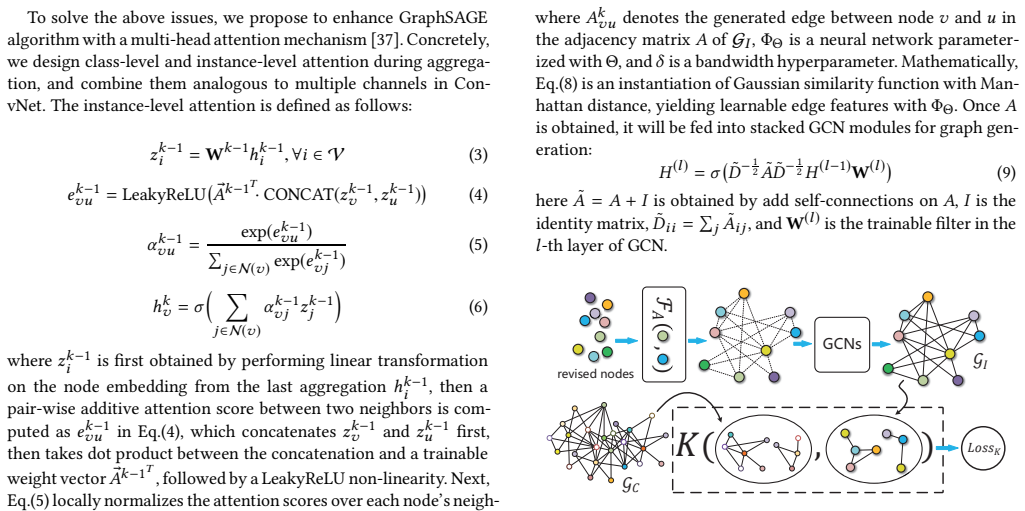
The load-bearing object is the generated instance-level graph $G_{\mathcal{I}}$: one graph whose nodes are revised visual embeddings of both seen and unseen instances and whose edges are produced by a relation kernel rather than given by a dataset. The per-node hidden representation is built by the attention-based aggregate network (a GraphSAGE-style update with class-level and instance-level multi-head attention), edges come from a learnable Gaussian similarity plus stacked GCN layers, and a graph2vec-based kernel loss ties local structure back to the class-level prototype graph $G_{\mathcal{C}}$. This object converts zero-shot classification into fully supervised label propagation on a graph, which is what makes the dual seen/unseen propagation possible.
What would settle it
Take one ZSL benchmark and run TGG twice: once with the GAN-synthesized unseen dummy features as the paper describes, and once with the same number of real unseen-class features substituted as 'dummy' nodes. If accuracy rises sharply with real features, or if a deliberately mode-collapsed GAN (e.g., one trained on only a subset of unseen classes) makes TGG's unseen accuracy collapse, then the reported gains depend on the fidelity of the synthesized pseudo-labels rather than on graph generation itself.
Extended reading notes
Core claim
The central claim is that seen–unseen relation can be modeled and used explicitly, at both class and instance level, by generating a graph rather than by learning a similarity space. TGG takes a class-level prototype graph built from side information, revises visual features (real seen examples plus GAN-synthesized unseen examples) into node embeddings through multi-head attention aggregation, and generates edges through a relation kernel that combines a Gaussian similarity function, GCN layers, and a graph-kernel consistency loss. The resulting instance-level graph is fully labeled, because unseen classes are represented by synthesized dummy features treated as real examples; a dual relation propagation then runs label propagation separately from seen and unseen subgraphs and enforces consistency between the two, acting as domain-shift adaptation. The whole pipeline is trained with episodic meta-learning and, according to the paper, outperforms previous ZSL, GZSL, and FSL methods by a large margin on aPY, AwA2, CUB, and SUN.
Load-bearing premise
The framework's ability to treat the generated graph as fully supervised rests on the assumption that GAN-synthesized dummy features of unseen classes are good enough stand-ins for real unseen images; if those pseudo-examples are off-distribution or mode-collapsed, the graph machinery has no reliable unseen signal to propagate.
Editorial extensions
If this is right
- If TGG is correct, a single end-to-end graph-generation pipeline replaces task-specific designs for ZSL, GZSL, and FSL: the difference between the three settings reduces to whether unseen nodes come from GAN synthesis or from a few real support examples.
- Unseen-class accuracy in GZSL roughly doubling the best compared generative method on AwA2 (69.8% vs 33.2%) and SUN (65.8% vs 38.1%) implies that explicit instance-level relation propagation can substantially reduce the domain shift that penalizes seen-to-unseen transfer.
- Because all nodes in the generated graph are labeled, the framework treats ZSL as a supervised graph problem, which suggests the quality ceiling depends on the fidelity of the dummy unseen features.
- The graph-kernel constraint that aligns $G_{\mathcal{I}}$ with $G_{\mathcal{C}}$ is reported to matter most on fine-grained datasets (CUB, SUN), indicating that class-level topology provides transferable prior structure when visual features are fine-grained.
- The meta-learning episode design, which mixes seen and unseen classes during training, is claimed to reduce inductive bias and seen-class bias, consistent with the high harmonic means reported.
Reading between the lines
- I would expect the dual propagation loss to act as a general consistency regularizer: any two complementary label-propagation views on the same graph should agree, so the idea could transfer to other semi-supervised or domain-adaptation settings where pseudo-labeled nodes exist.
- The paper's own logic implies that improving the GAN prior—for example by replacing conditional GANs with higher-fidelity generative models—should translate almost linearly into better unseen-class accuracy, since the generated graph inherits its unseen nodes from those dummy features.
- A testable extension is to use TGG's generated edges as an interpretable output in themselves: the learned instance-level adjacency could reveal which attributes or relations the model treats as bridges between seen and unseen classes.
- The unusually large gap over GDAN on unseen-class accuracy suggests that much of the gain may come from the graph's ability to denoise synthesized features rather than from the synthesis itself; if so, TGG should be robust to moderate GAN quality but collapse when the GAN produces degenerate features.
Signed reviews
Editorial analysis
A structured set of objections, weighed in public.
Referee Report
Summary. The paper proposes Transferable Graph Generation (TGG), a unified framework for zero-shot learning (ZSL), generalized zero-shot learning (GZSL), and few-shot learning (FSL). TGG first generates an instance-level graph from a class-level prototype graph and visual features, using an attention-based aggregation network and a relation kernel built on GCNs and graph kernels. It then performs dual relation propagation, where label propagation from seen and unseen subgraphs is regularized to be mutually consistent, and the entire pipeline is trained end-to-end with episodic meta-learning. The authors report large improvements over existing methods on four benchmarks (aPY, AwA2, CUB, SUN), with particularly large gains in GZSL unseen-class accuracy, and provide ablations supporting the contribution of each component.
Significance. If the results hold, TGG would be a valuable contribution: it offers a single architecture that explicitly models seen-unseen relations at both class and instance level, unifies three related tasks, and is accompanied by released code. The strengths include the breadth of the evaluation, the ablation study, and the sensitivity analysis of the class-level graph. The paper is also positioned against a sensible set of prior works. However, the validity of the central claim depends on resolving two load-bearing issues: the mathematical specification of the dual-propagation loss and the uncontrolled transductive nature of the evaluation versus inductive baselines. The code release is a point in favor, but the manuscript text alone does not currently support the reported margins.
major comments (4)
- [3.3.1, Eq. (12)] Eq. (12) is dimensionally inconsistent. The standard label-propagation closed form is Y* = (I - μ L)^{-1} Y, where the inverted operator is constructed from the graph Laplacian L. In the paper, Y^S and Y^U are described as 'labeled sub-matrices of seen and unseen instances', but the inverse (I - μ Y^S)^{-1} is then applied to Y, which requires Y^S to be a square operator. As written, a label submatrix of the (l+u) × C matrix Y is not square, so the expression is undefined. This is not a notational nit: the loss Loss_d is a central part of the objective in Eq. (15), and the formulation must specify what Y^S and Y^U actually are (e.g., diagonal indicator matrices, submatrices of a normalized adjacency, or something else) for the method to be implementable and for the reported results to be reproducible.
- [3.3, 4.4.1, Tables 2-3] The evaluation appears to be transductive but this is never stated or controlled. At inference, Eq. (13) computes predictions by normalizing propagation results, which requires the query/test instances to be nodes in the generated graph G_I. The paper repeatedly says 'all nodes in the generated graph G_I are actually labeled' (Sec. 3.3.1), but in ZSL/GZSL the real test instances are unlabeled; adding them to the graph for propagation gives the model access to the test marginal distribution. All baselines in Table 2 (ALE, DEVISE, SJE, ESZSL, SYNC, SAE, DEM, RelationNet, PSR-ZSL, SP-AEN, CAPD, GDAN) are inductive methods that do not see test features at inference. This confounds the contribution of the graph-generation machinery with the well-known advantage of transduction, and it is exactly in the GZSL unseen-class setting where the paper reports roughly 2x gains (69.8% vs 33.2% on AwA2, 65.8% vs 38.1% on SUN). The central claim that TGG 'consistently surpasses existing methods' therefore requires either a comparison under matched inductive/transductive protocols, or an explicit statement that TGG is transductive and a comparison with other transductive ZSL/GZSL methods. This issue is load-bearing for the empirical headline.
- [3.1.3, 3.3.1, Section 4.4] The treatment of GAN-synthesized dummy features as labeled nodes is a second load-bearing assumption. Section 3.1.3 states that unseen dummy features 'will be treated equally as the few provided instances in FSL,' and Section 3.3.1 concludes that 'all nodes in the generated graph G_I are actually labeled.' This means the dual propagation loss and the fully-supervised graph generation rely on pseudo-labels from a GAN. The paper does not report any measure of the quality of these synthesized features (e.g., FID, precision/recall, or visual comparison with real features) and does not include an ablation that varies the GAN training or replaces the GAN with a stronger generator. If the synthesized features are mode-collapsed or off-distribution, the high unseen-class accuracies could reflect the propagation of synthetic labels rather than the proposed relation modeling. A quantitative validation of the dummy features, or an experiment that ties the final accuracy to the quality of the synthesized features, is needed to support the attribution of the gains.
- [4.3, Tables 2-3] The paper reports 'the average results of 10 random trails' but provides no standard deviations, confidence intervals, or significance tests for ZSL, GZSL, or FSL. This is particularly important because some improvements, while large, are presented as raw averages; and in FSL the gaps over CAPD are smaller (e.g., 84.7 vs 83.6 on aPY 3-shot). Without variance information, the reader cannot assess whether the differences are reliable, and the phrase 'consistently surpasses' is not statistically justified. Standard deviations over the 10 runs should be reported, and for the smaller gaps a significance test should be performed.
minor comments (5)
- [Throughout] There are multiple typographical errors and OCR artifacts: 'Tabel 2' should be 'Table 2', 'random trails' should be 'random trials', 'a/t_tention' and 'A/t_tention' are corrupted, and some parentheses and symbols (e.g., '/y.alti', '/vecA', '/summationtext') are garbled. A thorough copy-edit is needed.
- [3.2.2, Eq. (8)] In Eq. (8), the edge feature is defined as exp(- Φ_Θ(abs(h_v - h_u)) / (2δ^2)). It is not specified whether Φ_Θ is constrained to be nonnegative; if it can output negative values, the expression is not a valid Gaussian similarity. Please clarify the output range or the intended interpretation.
- [3.1.2] The construction of the CUB class-level graph via 'Hadamard product over part-level attributes' is only sketched. Since CUB is one of the four datasets and the graph is a central input, a precise description of how the Hadamard product produces edge weights would improve reproducibility.
- [4.5, Table 4] In the ablation study, the row 'TGG − aggregation' removes the aggregation module entirely, but it is unclear what remains for relation kernel input. Please specify the exact architecture used for each ablation row so that the contribution of each component is cleanly isolated.
- [3.3.1] The phrase 'fully-supervised' in the context of ZSL is potentially misleading, since real unseen labels are never available; the graph is fully labeled only because it includes synthetic dummy labels. Consider using 'pseudo-supervised' or explicitly distinguishing synthetic labels from real labels.
Circularity Check
No significant circularity: evaluation is on real unseen test instances; the only self-citation is a minor GAN dual-learning detail that is not load-bearing.
full rationale
TGG's central claim is validated against real unseen test instances on standard external benchmarks (aPY, AwA2, CUB, SUN) using top-1 accuracy and harmonic mean, so the prediction target is not an input to the derivation. The GAN-synthesized dummy unseen features are a standard generative-ZSL data-augmentation step; they serve as training nodes with known labels and are not the evaluation set. The self-citation [46] (Zhang & Peng 2018) is used only to justify a GAN-stabilization dual-learning mechanism in preprocessing, not to establish the method's uniqueness, generate the benchmark numbers, or define the final predictions. The dual relation propagation and graph generation are trained end-to-end with cross-entropy on real labels, and the final evaluation uses real test inputs, so no equation reduces to its own output by construction. The transductive use of query features as graph nodes during inference is an evaluation-protocol detail and a potential fairness concern relative to inductive baselines, but it is not a circular-derivation step: the predicted labels are not constructed from the input labels by identity. Hence no circular step is present.
Assumptions & free parameters
free parameters (5)
- lambda1 (dual propagation loss weight) =
0.5
- lambda2 (graph kernel loss weight) =
0.5
- graph kernel bandwidth delta =
not reported
- GC edge-weight cropping threshold =
not reported (searched in Figure 4)
- attention head count =
not reported
assumptions (5)
- domain assumption ConceptNet 5.5 and the CUB attribute Hadamard product produce a class-level graph whose edges reflect true seen-unseen semantic relations.
- domain assumption GAN-synthesized dummy features of unseen classes can be treated as labeled ground-truth instances for training.
- standard math The standard label propagation closed-form solution applies to the matrix expressions in Eq (11)-(12).
- domain assumption Graph2vec embeddings of the class-level graph are a meaningful proxy for instance-level graph similarity.
- domain assumption ResNet-101 features and attribute side information are sufficient and correctly aligned for the classification task.
Cite this review
Pith. "Pith review of TGG: Transferable Graph Generation for Zero-shot and Few-shot Learning." pith.science (2026). https://pith.science/paper/XVBFNRDF
@misc{pith2026190811503,
  author       = {Pith},
  title        = {Pith review of: TGG: Transferable Graph Generation for Zero-shot and Few-shot Learning},
  year         = {2026},
  howpublished = {\url{https://pith.science/paper/XVBFNRDF}},
  note         = {Machine review of arXiv:1908.11503}
}
read the original abstract
Zero-shot and few-shot learning aim to improve generalization to unseen concepts, which are promising in many realistic scenarios. Due to the lack of data in unseen domain, relation modeling between seen and unseen domains is vital for knowledge transfer in these tasks. Most existing methods capture seen-unseen relation implicitly via semantic embedding or feature generation, resulting in inadequate use of relation and some issues remain (e.g. domain shift). To tackle these challenges, we propose a Transferable Graph Generation (TGG) approach, in which the relation is modeled and utilized explicitly via graph generation. Specifically, our proposed TGG contains two main components: (1) Graph generation for relation modeling. An attention-based aggregate network and a relation kernel are proposed, which generate instance-level graph based on a class-level prototype graph and visual features. Proximity information aggregating is guided by a multi-head graph attention mechanism, where seen and unseen features synthesized by GAN are revised as node embeddings. The relation kernel further generates edges with GCN and graph kernel method, to capture instance-level topological structure while tackling data imbalance and noise. (2) Relation propagation for relation utilization. A dual relation propagation approach is proposed, where relations captured by the generated graph are separately propagated from the seen and unseen subgraphs. The two propagations learn from each other in a dual learning fashion, which performs as an adaptation way for mitigating domain shift. All components are jointly optimized with a meta-learning strategy, and our TGG acts as an end-to-end framework unifying conventional zero-shot, generalized zero-shot and few-shot learning. Extensive experiments demonstrate that it consistently surpasses existing methods of the above three fields by a significant margin.
Figures


Figures from the paper (1 more)

Reference graph
Works this paper leans on
-
[1]
Zeynep Akata, Florent Perronnin, Zaid Harchaoui, and Co rdelia Schmid. 2013. Label-embedding for attribute-based classification. In Proceedings of the IEEE Conference on Computer Vision and Pattern Recognition . 819–826
work page 2013
-
[2]
Zeynep Akata, Scott Reed, Daniel Walter, Honglak Lee, an d Bernt Schiele. 2015. Evaluation of output embeddings for fine-grained image clas sification. In Pro- ceedings of the IEEE Conference on Computer Vision and Pattern Recognition. 2927– 2936
work page 2015
-
[3]
Yashas Annadani and Soma Biswas. 2018. Preserving seman tic relations for zero- shot learning. In Proceedings of the IEEE Conference on Computer Vision and Pat- tern Recognition. 7603–7612
work page 2018
-
[4]
Aleksandar Bojchevski, Oleksandr Shchur, Daniel Zügne r, and Stephan Gün- nemann. 2018. Netgan: Generating graphs via random walks. arXiv preprint arXiv:1803.00816 (2018)
arXiv 2018
-
[5]
Joan Bruna, Wojciech Zaremba, Arthur Szlam, and Yann LeC un. 2013. Spec- tral networks and locally connected networks on graphs. arXiv preprint arXiv:1312.6203 (2013)
arXiv 2013
-
[6]
Soravit Changpinyo, Wei-Lun Chao, Boqing Gong, and Fei S ha. 2016. Synthe- sized classifiers for zero-shot learning. In Proceedings of the IEEE Conference on Computer Vision and Pattern Recognition . 5327–5336
work page 2016
-
[7]
Long Chen, Hanwang Zhang, Jun Xiao, Wei Liu, and Shih-Fu C hang. 2018. Zero- shot visual recognition using semantics-preserving adver sarial embedding net- works. In Proceedings of the IEEE Conference on Computer Vision and Patt ern Recognition. 1043–1052
work page 2018
-
[8]
Nicola De Cao and Thomas Kipf. 2018. MolGAN: An implicit g enerative model for small molecular graphs. arXiv preprint arXiv:1805.11973 (2018)
arXiv 2018
Show all 49 references
-
[9]
Michaël Defferrard, Xavier Bresson, and Pierre Vandergh eynst. 2016. Convolu- tional neural networks on graphs with fast localized spectr al filtering. In Ad- vances in neural information processing systems . 3844–3852
2016
-
[10]
Farhadi, I
A. Farhadi, I. Endres, D. Hoiem, and D. Forsyth. 2009. De scribing objects by their attributes. In IEEE Conference on Computer Vision and Pattern Recognition
2009
-
[11]
Scarselli Franco, Gori Marco, Tsoi Ah Chung, Hagenbuch ner Markus, and Mon- fardini Gabriele. 2009. The graph neural network model. IEEE Transactions on Neural Networks 20, 1 (2009), 61
2009
-
[12]
Andrea Frome, Greg S Corrado, Jon Shlens, Samy Bengio, J eff Dean, Tomas Mikolov, et al. 2013. Devise: A deep visual-semantic embedd ing model. In Ad- vances in neural information processing systems . 2121–2129
2013
-
[13]
Junyu Gao, Tianzhu Zhang, and Changsheng Xu. 2019. I Kno w the Relation- ships: Zero-Shot Action Recognition via Two-Stream Graph C onvolutional Net- works and Knowledge Graphs. In Thirty-third AAAI Conference on Artificial In- telligence
2019
-
[14]
Ian Goodfellow, Jean Pouget-Abadie, Mehdi Mirza, Bing Xu, David Warde-Farley, Sherjil Ozair, Aaron Courville, and Yoshua Bengio. 2014. Ge nerative adversarial nets. In Advances in neural information processing systems . 2672–2680
2014
-
[15]
Marco Gori, Gabriele Monfardini, and Franco Scarselli . 2005. A new model for learning in graph domains. In Proceedings. 2005 IEEE International Joint Confer- ence on Neural Networks, 2005. , Vol. 2. IEEE, 729–734
2005
-
[16]
Ishaan Gulrajani, Faruk Ahmed, Martin Arjovsky, Vince nt Dumoulin, and Aaron C Courville. 2017. Improved training of wasserstein g ans. In Advances in Neural Information Processing Systems . 5767–5777
2017
-
[17]
Will Hamilton, Zhitao Ying, and Jure Leskovec. 2017. In ductive representation learning on large graphs. In Advances in Neural Information Processing Systems . 1024–1034
2017
-
[18]
Kaiming He, Xiangyu Zhang, Shaoqing Ren, and Jian Sun. 2 016. Deep residual learning for image recognition. In Proceedings of the IEEE conference on computer vision and pattern recognition . 770–778
-
[19]
He Huang, Changhu Wang, Philip S Yu, and Chang-Dong Wang . 2018. Gen- erative Dual Adversarial Network for Generalized Zero-sho t Learning. arXiv preprint arXiv:1811.04857 (2018)
2018 arXiv
-
[20]
Michael Kampffmeyer, Yinbo Chen, Xiaodan Liang, Hao Wan g, Yujia Zhang, and Eric P Xing. 2018. Rethinking knowledge graph propagation f or zero-shot learn- ing. arXiv preprint arXiv:1805.11724 (2018)
2018 arXiv
-
[21]
Diederik P Kingma and Jimmy Ba. 2014. Adam: A method for s tochastic opti- mization. arXiv preprint arXiv:1412.6980 (2014)
2014 arXiv
-
[22]
Thomas N Kipf and Max Welling. 2016. Semi-supervised cl assification with graph convolutional networks. arXiv preprint arXiv:1609.02907 (2016)
2016 arXiv
-
[23]
Gregory Koch, Richard Zemel, and Ruslan Salakhutdinov . 2015. Siamese neu- ral networks for one-shot image recognition. In ICML deep learning workshop , Vol. 2
2015
-
[24]
Elyor Kodirov, Tao Xiang, and Shaogang Gong. 2017. Sema ntic autoencoder for zero-shot learning. In Proceedings of the IEEE Conference on Computer Vision and Pattern Recognition. 3174–3183
2017
-
[25]
Yujia Li, Daniel Tarlow, Marc Brockschmidt, and Richar d Zemel. 2015. Gated graph sequence neural networks. arXiv preprint arXiv:1511.05493 (2015)
2015 arXiv
-
[26]
Yujia Li, Oriol Vinyals, Chris Dyer, Razvan Pascanu, an d Peter Battaglia. 2018. Learning deep generative models of graphs. arXiv preprint arXiv:1803.03324 (2018)
2018 arXiv
-
[27]
Mehdi Mirza and Simon Osindero. 2014. Conditional gene rative adversarial nets. arXiv preprint arXiv:1411.1784 (2014)
2014 arXiv
-
[28]
Annamalai Narayanan, Mahinthan Chandramohan, Rajase kar Venkatesan, Li- hui Chen, Yang Liu, and Shantanu Jaiswal. 2017. graph2vec: Learning distributed representations of graphs. arXiv preprint arXiv:1707.05005 (2017)
2017 arXiv
-
[29]
Patterson and J
G. Patterson and J. Hays. 2012. Sun attribute database: Discovering, annotating, and recognizing scene attributes. In IEEE Conference on Computer Vision and Pattern Recognition
2012
-
[30]
Shafin Rahman, Salman Khan, and Fatih Porikli. 2018. A Un ified Approach for Conventional Zero-Shot, Generalized Zero-Shot, and Few-S hot Learning. IEEE Transactions on Image Processing 27, 11 (2018), 5652–5667
2018
-
[31]
Bernardino Romera-Paredes and Philip Torr. 2015. An em barrassingly simple approach to zero-shot learning. In International Conference on Machine Learning. 2152–2161
2015
-
[32]
Edgar SchÃűnfeld, Sayna Ebrahimi, Samarth Sinha, Trev or Darrell, and Zeynep Akata. 2018. Generalized Zero- and Few-Shot Learning via Al igned Variational Autoencoders. (2018)
2018
-
[33]
Jake Snell, Kevin Swersky, and Richard Zemel. 2017. Pro totypical networks for few-shot learning. In Advances in Neural Information Processing Systems . 4077– 4087
2017
-
[34]
Richard Socher, Milind Ganjoo, Christopher D Manning, and Andrew Ng. 2013. Zero-shot learning through cross-modal transfer. In Advances in neural informa- tion processing systems . 935–943
2013
-
[35]
Robert Speer, Joshua Chin, and Catherine Havasi. 2017. Conceptnet 5.5: An open multilingual graph of general knowledge. In Thirty-First AAAI Conference on Artificial Intelligence
2017
-
[36]
Flood Sung, Yongxin Yang, Li Zhang, Tao Xiang, Philip HS Torr, and Timothy M Hospedales. 2018. Learning to compare: Relation network fo r few-shot learning. In Proceedings of the IEEE Conference on Computer Vision and Pattern Recognition. 1199–1208
2018
-
[37]
Petar VeliÄŊkoviÄĞ, Guillem Cucurull, Arantxa Casano va, Adriana Romero, and Yoshua Bengio. 2018. Graph Attention Networks. In International Confer- ence of Learning Representation
2018
-
[38]
Oriol Vinyals, Charles Blundell, Timothy Lillicrap, D aan Wierstra, et al. 2016. Matching networks for one shot learning. In Advances in neural information pro- cessing systems. 3630–3638
2016
-
[39]
Catherine Wah, Steve Branson, Peter Welinder, Pietro P erona, and Serge Be- longie. 2011. The caltech-ucsd birds-200-2011 dataset. (2 011)
2011
-
[40]
Wenlin Wang, Yunchen Pu, Vinay Kumar Verma, Kai Fan, Yiz he Zhang, Changyou Chen, Piyush Rai, and Lawrence Carin. 2018. Zero-s hot learning via class-conditioned deep generative models. In Thirty-Second AAAI Conference on Artificial Intelligence
2018
-
[41]
Xiaolong Wang, Yufei Ye, and Abhinav Gupta. 2018. Zero- shot recognition via semantic embeddings and knowledge graphs. In Proceedings of the IEEE Confer- ence on Computer Vision and Pattern Recognition . 6857–6866
2018
-
[42]
Yongqin Xian, Zeynep Akata, Gaurav Sharma, Quynh Nguye n, Matthias Hein, and Bernt Schiele. 2016. Latent embeddings for zero-shot cl assification. In Pro- ceedings of the IEEE Conference on Computer Vision and Patter n Recognition. 69– 77
2016
-
[43]
Yongqin Xian, Bernt Schiele, and Zeynep Akata. 2017. Ze ro-shot learning-the good, the bad and the ugly. In Proceedings of the IEEE Conference on Computer Vision and Pattern Recognition . 4582–4591
2017
-
[44]
Bing Xu, Naiyan Wang, Tianqi Chen, and Mu Li. 2015. Empir ical evaluation of rectified activations in convolutional network. arXiv preprint arXiv:1505.00853 (2015)
2015 arXiv
-
[45]
Bernt Schiele Zeynep Akata Yongqin Xian, Saurabh Sharm a. 2019. f-V AEGAN- D2: A Feature Generating Framework for Any-Shot Learning. I n Proceedings of the IEEE Conference on Computer Vision and Pattern Recogniti on. 10275–10284
2019
-
[46]
Chenrui Zhang and Yuxin Peng. 2018. Visual data synthes is via GAN for zero- shot video classification. arXiv preprint arXiv:1804.10073 (2018)
2018 arXiv
-
[47]
Li Zhang, Tao Xiang, and Shaogang Gong. 2017. Learning a deep embedding model for zero-shot learning. In Proceedings of the IEEE Conference on Computer Vision and Pattern Recognition . 2021–2030
2017
-
[48]
Ziming Zhang and Venkatesh Saligrama. 2015. Zero-shot learning via seman- tic similarity embedding. In Proceedings of the IEEE international conference on computer vision. 4166–4174
2015
-
[49]
Xiaojin Zhu and Zoubin Ghahramani. 2002. Learning from labeled and unlabeled data with label propagation . Technical Report. Citeseer
2002
Reviewed August 14, 2026 · model on record in the stance chip above.
Discussion (0). Continue with ORCID to comment.