REVIEW 2 major objections 4 minor 1 cited by
Freeze-Twin Dark Matter
T0 review · 2 major / 4 minor · reviewed 2026-08-14 · deepseek-v4-flash
Pith's one-line read Twin electrons frozen in through a massive twin photon can account for the observed dark matter abundance.
desk verdict A clean freeze-in calculation for twin dark matter sits on top of an unsupported initial condition: the pre-reheating twin e+e- plasma must be erased, and that is the real soft spot. read the letter →
The pith
A machine-rendered reading of the paper's core claim, the machinery that carries it, and where it could break.
The reading
What carries the argument
The central object is the kinetic-mixing portal, $\frac{\epsilon}{2}F_{\mu\nu}F'^{\mu\nu}$, together with a Stueckelberg mass for twin hypercharge, $\frac{1}{2}m_{\gamma'}^2 A'_\mu A'^\mu$, which gives every SM fermion of electric charge $Q$ an effective twin charge $\epsilon Q$. The mechanism is resonant freeze-in through $f\bar f \to \gamma' \to e'\bar e'$, with the narrow-width approximation reducing the Boltzmann yield to a single integral over the SM bath temperature; production peaks near $T \sim m_{\gamma'}$, and the final abundance is inversely tied to the twin photon mass through the decay width $\Gamma_{\gamma'}$.
What would settle it
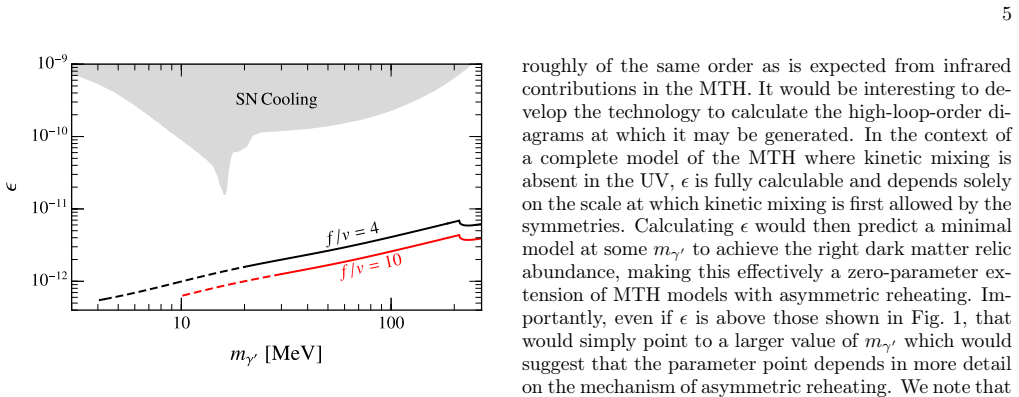
Compute the four- and five-loop diagrams that could generate kinetic mixing in the low-energy mirror twin Higgs theory; if a complete calculation puts $\epsilon$ outside the $10^{-13}$ to $10^{-10}$ window while $m_{\gamma'}$ stays below a few hundred MeV, freeze-twin dark matter cannot produce the full observed abundance. Equally, a supernova neutrino measurement that excludes the required $m_{\gamma'}$ versus $\epsilon$ curve would falsify the scenario.
Extended reading notes
Core claim
The central claim is that the observed dark matter can be composed entirely of twin electrons and positrons, produced through freeze-in after asymmetric reheating has depleted the twin sector. Production is dominated by on-shell twin photons: SM fermion-antifermion pairs annihilate to $\gamma'$, which decays to $e'\bar e'$, and the yield is set by one new parameter, the Stueckelberg mass $m_{\gamma'}$. The kinetic mixing required to match the observed abundance, obtained by inverting the relic-density condition, falls in the range $\epsilon \sim 10^{-13}$ to $10^{-10}$, which the authors argue is exactly the order expected from irreducible infrared loop contributions in the mirror twin Higgs. Thus the model is, in principle, an effectively parameter-free extension of the MTH with asymmetric reheating: the twin photon mass is the only free input, and the abundance then fixes the mixing at a naturally predicted size.
Load-bearing premise
The whole scenario hinges on the expectation that loop effects in the mirror twin Higgs generate a kinetic mixing of order $\epsilon \sim 10^{-13}$ to $10^{-10}$; the authors themselves state that they know no argument that such a mixing is not generated, and hidden cancellations or larger ultraviolet contributions would break the coincidence.
Editorial extensions
If this is right
- If freeze-twin dark matter is correct, the dark matter mass is set by $f/v$, the ratio that determines the twin spectrum, and collider measurements of Higgs couplings can therefore fix the dark matter mass.
- Future supernova neutrino observations could probe the same $m_{\gamma'}$ versus $\epsilon$ curve that produces the relic abundance, since anomalous stellar cooling already constrains part of that plane.
- For part of the allowed parameter space, twin-electron self-interactions fall in the range that has been suggested to address small-scale structure problems, and would be testable through cluster mergers and other astrophysical observations.
- If the required $\epsilon$ turns out larger than the infrared expectation, the scenario points to a heavier twin photon whose abundance depends on the details of asymmetric reheating; if smaller, ultraviolet contributions can still supply the needed mixing.
- The scenario keeps the $Z_2$ symmetry that protects the Higgs mass, so a UV completion need not introduce hard mirror-symmetry breaking.
Reading between the lines
- A direct calculation of the four- and five-loop diagrams that could generate kinetic mixing would settle whether the coincidence is real; if the mixing comes out at the bottom of the natural range, the model predicts a lighter twin photon, and if it comes out larger, the twin photon mass is pushed upward.
- The same freeze-in logic extends to heavier twin photons, but then the yield is set during the asymmetric reheating epoch itself, so a measurement of the twin-sector dilution history (for instance through extra radiation in the cosmic microwave background) would be needed to make a precise prediction.
- The mechanism turns the twin sector's emptiness into an asset: it predicts a dark matter candidate that interacts with our sector only through a tiny photon-like portal, giving stellar cooling and light-mediator searches a concrete target tied to the naturalness scale.
- If hidden cancellations suppress the infrared loops, the model would likely require ultraviolet contributions to set $\epsilon$, weakening but not destroying its parameter-free appeal; this is an explicit open point the paper identifies.
Editorial analysis
A structured set of objections, weighed in public.
Referee Report
Summary. The paper proposes a freeze-in dark matter scenario in the Mirror Twin Higgs (MTH) framework with asymmetric reheating. A Stueckelberg mass is introduced for the twin photon, and the freeze-in production of twin electrons and positrons proceeds through the kinetic mixing between the SM and twin hypercharge/photons. The authors compute the yield analytically in the narrow-width and Maxwell-Boltzmann approximations, validate their numerical implementation against existing freeze-in computations, and derive the value of the kinetic mixing epsilon required to match the observed dark matter abundance. They find epsilon roughly in the range 10^-13 to 10^-10, which they argue matches the order expected from infrared loop contributions in the MTH. They also discuss constraints from supernova cooling and the possibility of self-interacting dark matter.
Significance. If the central assumption about initial conditions can be justified, this paper provides a minimal and well-motivated dark matter candidate in the MTH: the only new parameter is the twin photon mass, and both the feeble coupling and the negligible initial dark-matter abundance are motivated by physics orthogonal to dark matter. The freeze-in calculation is carefully done, with explicit validation against Refs. [62,64], and the resulting relation between m_gamma' and epsilon is a falsifiable prediction testable by supernova cooling and self-interaction observations. The authors are also transparent about the heuristic nature of the infrared loop estimate in Appendix A. The main weakness is the unquantified assumption about the absence of twin charged states after asymmetric reheating, which is load-bearing for the claim that the dark matter is produced by freeze-in.
major comments (2)
- [II (initial conditions) and IV (freeze-in yield)] The paper assumes that at T~1 GeV the twin sector is empty, stating "we take the absence of twin energy density as an initial condition" (Sec. II). However, in the MTH the twin sector is in thermal equilibrium with the SM down to T~4 GeV via the Higgs portal [14], so a thermal population of twin electrons and positrons exists before asymmetric reheating. For the parameter space of interest, m_gamma' > m_e', so the annihilation e+ e- -> gamma' gamma' is kinematically forbidden for non-relativistic pairs, and annihilation to twin neutrinos through the heavy twin Z is negligible. The twin e+/- therefore freeze out with a relic yield that is not diluted by the factor needed to satisfy Delta N_eff. Since the freeze-in yield is only Y_e' ~ 2x10^-7 (Sec. IV), the paper needs a quantitative check that in the asymmetric-reheating models of [14,42] the residual twin e+/- yield after dilution is below the freeze-in yield. Without this, the final dark-matter abundance could be dominated by the thermal relic rather than by freeze-in, and the central claim of the paper fails.
- [Appendix A and abstract] The abstract and introduction state that the required kinetic mixing "is of the loop-suppressed order expected from infrared contributions in the MTH." This expectation rests on the vanishing of lower-loop diagrams and on dimensional estimates of a four-loop diagram that has not been computed; the authors themselves note in Appendix A that they "know no argument that kinetic mixing of this order is not generated." Because the match between the required epsilon and the expected IR range is a key motivation for the model, the paper should either present an explicit calculation (even a rough one) of the leading IR contribution or modify the abstract and introduction to clearly present this as a heuristic consistency check rather than a quantitative prediction.
minor comments (4)
- [Fig. 1] The caption of Fig. 1 should specify the values of f/v for each contour and explain the dashed segments and the shaded region; the plot is currently only described in the text in a piecemeal way.
- [Eq. (5)] The neglect of the dT g_*s term is mentioned only briefly; a parenthetical estimate of its effect for m_gamma' near the QCD scale would help the reader assess the claimed 50% accuracy.
- [Sec. II] The statement that rho_twin ~ 0 is used as an initial condition would be clearer if it explicitly stated that the number densities of all twin species, including non-relativistic electrons and positrons, are assumed to be negligible after asymmetric reheating.
- [Sec. IV] The paper does not discuss the lifetime of the massive twin photon and its subsequent decays into SM fermions; since the twin photon can decay through the same kinetic mixing, a comment on whether late-time decays of twin photons produced by dark-matter annihilations are compatible with indirect-detection constraints would be useful.
Circularity Check
No significant circularity: the required kinetic mixing is inferred from the observed DM abundance and compared with an independent loop estimate, not derived from it.
full rationale
The paper's derivation chain is: assume asymmetric reheating leaves the twin sector empty (explicitly taken as an initial condition, with [14] and [42] cited only as motivation); add a Stueckelberg-massive twin photon with kinetic mixing; compute the freeze-in yield of twin electrons and positrons from the SM bath via the Boltzmann equation; invert the yield relation in Eq. (10) to find the epsilon required to match the observed dark matter abundance; and then compare that required epsilon with the independent loop estimate of Appendix A. This is a consistency check, not a derivation: the Appendix A estimate comes from diagrammatic and dimensional arguments about four- and five-loop kinetic mixing in the MTH and contains no input from the dark matter abundance. Eq. (10) is just the algebraic inversion of the computed yield, which is the standard way freeze-in models report the coupling reproducing the observed relic density; no equation in the paper reduces to its own input by construction. The numerical implementation is validated against Refs. [62,64]. Self-citations are present (e.g., [14], which includes an author of this paper), but the paper explicitly stays agnostic about the asymmetric reheating mechanism and treats the empty twin sector as an assumption, so the freeze-in calculation does not rest on an unverified self-citation. Appendix A's caveat that the authors 'know no argument that kinetic mixing of this order is not generated' is an honest statement of theoretical uncertainty rather than a circular step. Concerns about residual thermal twin-sector plasma are quantitative model-viability questions, not circularity.
Assumptions & free parameters
free parameters (1)
- m_gamma' (Stueckelberg mass of twin photon) =
not fixed; scanned in the range 2 m_e' < m_gamma' < 2 m_pi0
assumptions (4)
- domain assumption Asymmetric reheating leaves the twin sector energy density negligible by T ~ 1 GeV.
- domain assumption The twin photon mass is a Stueckelberg mass that can be treated as soft Z2 breaking without destabilizing the Higgs sector or violating quantum gravity constraints.
- domain assumption IR loop contributions generate kinetic mixing in the range 10^-13 to 10^-10 with no hidden cancellations.
- domain assumption Freeze-in production proceeds out of equilibrium without significant depletion, and other channels (self-scattering, twin neutrino annihilations) are negligible.
invented entities (1)
-
Massive twin photon (gamma') with Stueckelberg mass
Cite this review
Pith. "Pith review of Freeze-Twin Dark Matter." pith.science (2026). https://pith.science/paper/XVKEZ5O2
@misc{pith2026190803559,
  author       = {Pith},
  title        = {Pith review of: Freeze-Twin Dark Matter},
  year         = {2026},
  howpublished = {\url{https://pith.science/paper/XVKEZ5O2}},
  note         = {Machine review of arXiv:1908.03559}
}
read the original abstract
The mirror twin Higgs (MTH) addresses the little hierarchy problem by relating every Standard Model (SM) particle to a twin copy, but is in tension with cosmological bounds on light degrees of freedom. Asymmetric reheating has recently been proposed as a simple way to fix MTH cosmology by diluting the twin energy density. We show that this dilution sets the stage for an interesting freeze-in scenario where both the initial absence of dark sector energy and the feeble coupling to the SM are motivated for reasons unrelated to dark matter production. We give the twin photon a Stueckelberg mass and freeze-in twin electron and positron dark matter through the kinetic mixing portal. The kinetic mixing required to obtain the dark matter abundance is of the loop-suppressed order expected from infrared contributions in the MTH.
Figures
Forward citations
Cited by 1 Pith paper
-
The Price of Tiny Kinetic Mixing
The paper derives a six-loop gravitational floor for hidden-photon kinetic mixing near 10^-13 and surveys other loop and GUT mechanisms that can produce tiny mixing.
Reference graph
Works this paper leans on
-
[14]
J. Serra, S. Stelzl, R. Torre, and A. Weiler, “Hypercharged Naturalness”,arXiv:1905.02203
arXiv 1905
-
[1]
The Twin Higgs: Natural electroweak breaking from mirror symmetry
Z. Chacko, H.-S. Goh, and R. Harnik, “The Twin Higgs: Natural electroweak breaking from mirror symmetry”, Phys. Rev. Lett. 96 (2006) 231802, arXiv:hep-ph/0506256
arXiv 2006
-
[2]
UV freeze-in
Despite the fact that the globalSU (4)is explicitly broken by the gauging ofSU (2)A×SU (2)B subgroups, the Z2 is enough to ensure that the quadratically diver- gent part of the one-loop effective action respects the full SU (4). The lightness of the SM Higgs is then understood as being protected by the approximate accidental global symmetry up to the UV cu...
-
[3]
A Twin Higgs model from left-right symmetry
Z. Chacko, H.-S. Goh, and R. Harnik, “A Twin Higgs model from left-right symmetry”,JHEP 01 (2006) 108, arXiv:hep-ph/0512088
arXiv 2006
-
[4]
Folded supersymmetry and the LEP paradox
G. Burdman, Z. Chacko, H.-S. Goh, and R. Harnik, “Folded supersymmetry and the LEP paradox”,JHEP 02 (2007) 009, arXiv:hep-ph/0609152
arXiv 2007
-
[5]
D. Poland and J. Thaler, “The Dark Top”,JHEP 11 (2008) 083, arXiv:0808.1290
work page Pith review arXiv 2008
-
[6]
H. Cai, H.-C. Cheng, and J. Terning, “A Quirky Little Higgs Model”,JHEP 05 (2009) 045, arXiv:0812.0843
arXiv 2009
-
[7]
Neutral Naturalness from Orbifold Higgs Models
N. Craig, S. Knapen, and P. Longhi, “Neutral Naturalness from Orbifold Higgs Models”,Phys. Rev. Lett. 114 (2015), no. 6, 061803,arXiv:1410.6808
arXiv 2015
Show all 83 references
-
[8]
Neutrino Masses from Neutral Top Partners
B. Batell and M. McCullough, “Neutrino Masses from Neutral Top Partners”,Phys. Rev. D92 (2015), no. 7, 073018, arXiv:1504.04016
2015 arXiv
-
[9]
Towards a No-Lose Theorem for Naturalness
D. Curtin and P. Saraswat, “Towards a No-Lose Theorem for Naturalness”,Phys. Rev. D93 (2016), no. 5, 055044,arXiv:1509.04284
2016 arXiv
-
[10]
Exotic Quarks in Twin Higgs Models
H.-C. Cheng, S. Jung, E. Salvioni, and Y. Tsai, “Exotic Quarks in Twin Higgs Models”,JHEP 03 (2016) 074, arXiv:1512.02647
2016 arXiv
-
[11]
The Vector-like Twin Higgs
N. Craig, S. Knapen, P. Longhi, and M. Strassler, “The Vector-like Twin Higgs”,JHEP 07 (2016) 002, arXiv:1601.07181
2016 arXiv
-
[12]
The Hyperbolic Higgs
T. Cohen, N. Craig, G. F. Giudice, and M. McCullough, “The Hyperbolic Higgs”,JHEP 05 (2018) 091, arXiv:1803.03647
2018 arXiv
-
[13]
Singlet Scalar Top Partners from Accidental Supersymmetry
H.-C. Cheng, L. Li, E. Salvioni, and C. B. Verhaaren, “Singlet Scalar Top Partners from Accidental Supersymmetry”,JHEP 05 (2018) 057, arXiv:1803.03651
2018 arXiv
-
[15]
Cosmological Signals of a Mirror Twin Higgs
N. Craig, S. Koren, and T. Trott, “Cosmological Signals of a Mirror Twin Higgs”,JHEP 05 (2017) 038, arXiv:1611.07977
2017 arXiv
-
[16]
Big Bang Nucleosynthesis: 2015
R. H. Cyburt, B. D. Fields, K. A. Olive, and T.-H. Yeh, “Big Bang Nucleosynthesis: 2015”,Rev. Mod. Phys. 88 (2016) 015004, arXiv:1505.01076
2016 arXiv
-
[17]
Planck 2018 results. VI. Cosmological parameters
Planck Collaboration, N. Aghanimet al., “Planck 2018 results. VI. Cosmological parameters”, arXiv:1807.06209
2018 arXiv
-
[18]
Naturalness in the Dark at the LHC
N. Craig, A. Katz, M. Strassler, and R. Sundrum, “Naturalness in the Dark at the LHC”,JHEP 07 (2015) 105, arXiv:1501.05310
2015 arXiv
-
[19]
Minimal Mirror Twin Higgs
R. Barbieri, L. J. Hall, and K. Harigaya, “Minimal Mirror Twin Higgs”,JHEP 11 (2016) 172, arXiv:1609.05589
2016 arXiv
-
[20]
Viable Twin Cosmology from Neutrino Mixing
C. Csaki, E. Kuflik, and S. Lombardo, “Viable Twin Cosmology from Neutrino Mixing”,Phys. Rev. D96 (2017), no. 5, 055013,arXiv:1703.06884
2017 arXiv
-
[21]
A Portalino to the Twin Sector
D. Liu and N. Weiner, “A Portalino to the Twin Sector”,arXiv:1905.00861
1905 arXiv
-
[22]
A Predictive Mirror Twin Higgs with Small Z2 Breaking
K. Harigaya, R. McGehee, H. Murayama, and K. Schutz, “A Predictive Mirror Twin Higgs with Small Z2 Breaking”,arXiv:1905.08798
1905 arXiv
-
[23]
Constraining portals with displaced Higgs decay searches at the LHC
J. D. Clarke, “Constraining portals with displaced Higgs decay searches at the LHC”,JHEP 10 (2015) 061, arXiv:1505.00063
2015 arXiv
-
[24]
Discovering Uncolored Naturalness in Exotic Higgs Decays
D. Curtin and C. B. Verhaaren, “Discovering Uncolored Naturalness in Exotic Higgs Decays”,JHEP 12 (2015) 072, arXiv:1506.06141
2015 arXiv
-
[25]
Searching for displaced Higgs boson decays
C. Csaki, E. Kuflik, S. Lombardo, and O. Slone, “Searching for displaced Higgs boson decays”,Phys. Rev. D92 (2015), no. 7, 073008,arXiv:1508.01522
2015 arXiv
-
[26]
Searching for confining hidden valleys at LHCb, ATLAS, and CMS
A. Pierce, B. Shakya, Y. Tsai, and Y. Zhao, “Searching for confining hidden valleys at LHCb, ATLAS, and CMS”,Phys. Rev. D97 (2018), no. 9, 095033, arXiv:1708.05389
2018 arXiv
-
[27]
Long Live the Higgs Factory: Higgs Decays to Long-Lived Particles at Future Lepton Colliders
S. Alipour-Fard, N. Craig, M. Jiang, and S. Koren, “Long Live the Higgs Factory: Higgs Decays to Long-Lived Particles at Future Lepton Colliders”,Chin. Phys. C43 (2019), no. 5, 053101,arXiv:1812.05588
2019 arXiv
-
[28]
Discovering the Twin Higgs Boson with Displaced Decays
C. Kilic, S. Najjari, and C. B. Verhaaren, “Discovering the Twin Higgs Boson with Displaced Decays”,Phys. 8 Rev. D99 (2019), no. 7, 075029,arXiv:1812.08173
2019 arXiv
-
[29]
The second Higgs at the lifetime frontier
S. Alipour-Fard, N. Craig, S. Gori, S. Koren, and D. Redigolo, “The second Higgs at the lifetime frontier”, arXiv:1812.09315
-
[30]
Detector-size Upper Bounds on Dark Hadron Lifetime from Cosmology
L. Li and Y. Tsai, “Detector-size Upper Bounds on Dark Hadron Lifetime from Cosmology”,JHEP 05 (2019) 072, arXiv:1901.09936
2019 arXiv
-
[31]
Twin Higgs WIMP Dark Matter
I. Garcia Garcia, R. Lasenby, and J. March-Russell, “Twin Higgs WIMP Dark Matter”,Phys. Rev. D92 (2015), no. 5, 055034,arXiv:1505.07109
2015 arXiv
-
[32]
The Fraternal WIMP Miracle
N. Craig and A. Katz, “The Fraternal WIMP Miracle”, JCAP 1510 (2015), no. 10, 054,arXiv:1505.07113
2015 arXiv
-
[33]
Twin Higgs Asymmetric Dark Matter
I. Garcia Garcia, R. Lasenby, and J. March-Russell, “Twin Higgs Asymmetric Dark Matter”,Phys. Rev. Lett. 115 (2015), no. 12, 121801,arXiv:1505.07410
2015 arXiv
-
[34]
Asymmetric Twin Dark Matter
M. Farina, “Asymmetric Twin Dark Matter”,JCAP 1511 (2015), no. 11, 017,arXiv:1506.03520
2015 arXiv
-
[35]
Gamma-rays from Dark Showers with Twin Higgs Models
M. Freytsis, S. Knapen, D. J. Robinson, and Y. Tsai, “Gamma-rays from Dark Showers with Twin Higgs Models”,JHEP 05 (2016) 018, arXiv:1601.07556
2016 arXiv
-
[36]
Twin mechanism for baryon and dark matter asymmetries
M. Farina, A. Monteux, and C. S. Shin, “Twin mechanism for baryon and dark matter asymmetries”, Phys. Rev. D94 (2016), no. 3, 035017, arXiv:1604.08211
2016 arXiv
-
[37]
Reconciling Large And Small-Scale Structure In Twin Higgs Models
V. Prilepina and Y. Tsai, “Reconciling Large And Small-Scale Structure In Twin Higgs Models”,JHEP 09 (2017) 033, arXiv:1611.05879
2017 arXiv
-
[38]
Effective Theory of Flavor for Minimal Mirror Twin Higgs
R. Barbieri, L. J. Hall, and K. Harigaya, “Effective Theory of Flavor for Minimal Mirror Twin Higgs”, JHEP 10 (2017) 015, arXiv:1706.05548
2017 arXiv
-
[39]
Twin Higgs model with strongly interacting massive particle dark matter
Y. Hochberg, E. Kuflik, and H. Murayama, “Twin Higgs model with strongly interacting massive particle dark matter”,Phys. Rev. D99 (2019), no. 1, 015005, arXiv:1805.09345
2019 arXiv
-
[40]
Coscattering/Coannihilation Dark Matter in a Fraternal Twin Higgs Model
H.-C. Cheng, L. Li, and R. Zheng, “Coscattering/Coannihilation Dark Matter in a Fraternal Twin Higgs Model”,arXiv:1805.12139
-
[41]
Composite Twin Dark Matter
J. Terning, C. B. Verhaaren, and K. Zora, “Composite Twin Dark Matter”,Phys. Rev. D99 (2019), no. 9, 095020, arXiv:1902.08211
2019 arXiv
-
[42]
Mirror Dirac leptogenesis
K. Earl, C. S. Fong, T. Gregoire, and A. Tonero, “Mirror Dirac leptogenesis”,arXiv:1903.12192
1903 arXiv
-
[43]
Cosmology in Mirror Twin Higgs and Neutrino Masses
Z. Chacko, N. Craig, P. J. Fox, and R. Harnik, “Cosmology in Mirror Twin Higgs and Neutrino Masses”,JHEP 07 (2017) 023, arXiv:1611.07975
2017 arXiv
-
[44]
Right-handed sneutrino as cold dark matter
T. Asaka, K. Ishiwata, and T. Moroi, “Right-handed sneutrino as cold dark matter”,Phys. Rev. D73 (2006) 051301, arXiv:hep-ph/0512118
2006 arXiv
-
[45]
Right-handed sneutrinos as nonthermal dark matter
S. Gopalakrishna, A. de Gouvea, and W. Porod, “Right-handed sneutrinos as nonthermal dark matter”, JCAP 0605 (2006) 005, arXiv:hep-ph/0602027
2006 arXiv
-
[46]
Right-handed sneutrino as cold dark matter of the universe
T. Asaka, K. Ishiwata, and T. Moroi, “Right-handed sneutrino as cold dark matter of the universe”,Phys. Rev. D75 (2007) 065001, arXiv:hep-ph/0612211
2007 arXiv
-
[47]
Non-thermal right-handed sneutrino dark matter and the Omega(DM)/Omega(b) problem
V. Page, “Non-thermal right-handed sneutrino dark matter and the Omega(DM)/Omega(b) problem”, JHEP 04 (2007) 021, arXiv:hep-ph/0701266
2007 arXiv
-
[48]
Freeze-In Production of FIMP Dark Matter
L. J. Hall, K. Jedamzik, J. March-Russell, and S. M. West, “Freeze-In Production of FIMP Dark Matter”, JHEP 03 (2010) 080, arXiv:0911.1120
2010 arXiv
-
[49]
The Four Basic Ways of Creating Dark Matter Through a Portal
X. Chu, T. Hambye, and M. H. G. Tytgat, “The Four Basic Ways of Creating Dark Matter Through a Portal”, JCAP 1205 (2012) 034, arXiv:1112.0493
2012 arXiv
-
[50]
The Dawn of FIMP Dark Matter: A Review of Models and Constraints
N. Bernal, M. Heikinheimo, T. Tenkanen, K. Tuominen, and V. Vaskonen, “The Dawn of FIMP Dark Matter: A Review of Models and Constraints”,Int. J. Mod. Phys. A32 (2017), no. 27, 1730023,arXiv:1706.07442
2017 arXiv
-
[51]
Making dark matter out of light: freeze-in from plasma effects
C. Dvorkin, T. Lin, and K. Schutz, “Making dark matter out of light: freeze-in from plasma effects”,Phys. Rev. D99 (2019), no. 11, 115009,arXiv:1902.08623
2019 arXiv
-
[52]
Dark Matter Self-interactions and Small Scale Structure
S. Tulin and H.-B. Yu, “Dark Matter Self-interactions and Small Scale Structure”,Phys. Rept. 730 (2018) 1–57,arXiv:1705.02358
2018 arXiv
-
[53]
Colorless Top Partners, a 125 GeV Higgs, and the Limits on Naturalness
G. Burdman, Z. Chacko, R. Harnik, L. de Lima, and C. B. Verhaaren, “Colorless Top Partners, a 125 GeV Higgs, and the Limits on Naturalness”,Phys. Rev. D91 (2015), no. 5, 055007,arXiv:1411.3310
2015 arXiv
-
[54]
Relic neutrino decoupling with flavour oscillations revisited
P. F. de Salas and S. Pastor, “Relic neutrino decoupling with flavour oscillations revisited”,JCAP 1607 (2016), no. 07, 051,arXiv:1606.06986
2016 arXiv
-
[55]
A Precision calculation of the effective number of cosmological neutrinos
G. Mangano, G. Miele, S. Pastor, and M. Peloso, “A Precision calculation of the effective number of cosmological neutrinos”,Phys. Lett. B534 (2002) 8–16, arXiv:astro-ph/0111408
2002 arXiv
-
[56]
CMB-S4 Science Book, First Edition
CMB-S4 Collaboration, K. N. Abazajianet al., “CMB-S4 Science Book, First Edition”, arXiv:1610.02743
-
[57]
Cosmological Signatures of a Mirror Twin Higgs
Z. Chacko, D. Curtin, M. Geller, and Y. Tsai, “Cosmological Signatures of a Mirror Twin Higgs”, arXiv:1803.03263
-
[58]
Collider Signals of the Mirror Twin Higgs through the Hypercharge Portal
Z. Chacko, C. Kilic, S. Najjari, and C. B. Verhaaren, “Collider Signals of the Mirror Twin Higgs through the Hypercharge Portal”,arXiv:1904.11990
1904 arXiv
-
[59]
Photon and Graviton Mass Limits
A. S. Goldhaber and M. M. Nieto, “Photon and Graviton Mass Limits”,Rev. Mod. Phys. 82 (2010) 939–979,arXiv:0809.1003
2010 arXiv
-
[60]
Photon Masses in the Landscape and the Swampland
M. Reece, “Photon Masses in the Landscape and the Swampland”,arXiv:1808.09966
-
[61]
Rescuing Massive Photons from the Swampland
N. Craig and I. Garcia Garcia, “Rescuing Massive Photons from the Swampland”,JHEP 11 (2018) 067, arXiv:1810.05647
2018 arXiv
-
[62]
Breaking Mirror Twin Hypercharge
B. Batell and C. B. Verhaaren, “Breaking Mirror Twin Hypercharge”,arXiv:1904.10468
1904 arXiv
-
[63]
Freeze-in through portals
M. Blennow, E. Fernandez-Martinez, and B. Zaldivar, “Freeze-in through portals”,JCAP 1401 (2014) 003, arXiv:1309.7348
2014 arXiv
-
[64]
The Effects of QCD Equation of State on the Relic Density of WIMP Dark Matter
M. Drees, F. Hajkarim, and E. R. Schmitz, “The Effects of QCD Equation of State on the Relic Density of WIMP Dark Matter”,JCAP 1506 (2015), no. 06, 025, arXiv:1503.03513
2015 arXiv
-
[65]
Light(ly)-coupled Dark Matter in the keV Range: Freeze-In and Constraints
J. H. Chang, R. Essig, and A. Reinert, “Light(ly)-coupled Dark Matter in the keV Range: Freeze-In and Constraints”,arXiv:1911.03389
1911
-
[66]
Infrared Effects of Ultraviolet Operators on Dark Matter Freeze-In
L. Forestell and D. E. Morrissey, “Infrared Effects of Ultraviolet Operators on Dark Matter Freeze-In”, arXiv:1811.08905
-
[67]
The automated computation of tree-level and next-to-leading order differential cross sections, and their matching to parton shower simulations
J. Alwall, R. Frederix, S. Frixione, V. Hirschi, F. Maltoni, O. Mattelaer, H. S. Shao, T. Stelzer, P. Torrielli, and M. Zaro, “The automated computation of tree-level and next-to-leading order differential cross sections, and their matching to parton shower simulations”,JHEP 07...
2014 arXiv
-
[68]
FeynRules 2.0 - A complete toolbox for tree-level phenomenology
A. Alloul, N. D. Christensen, C. Degrande, C. Duhr, and B. Fuks, “FeynRules 2.0 - A complete toolbox for tree-level phenomenology”,Comput. Phys. Commun. 185 (2014) 2250–2300,arXiv:1310.1921
2014 arXiv
-
[69]
Review of Particle Physics
Particle Data Group Collaboration, M. Tanabashi et al., “Review of Particle Physics”,Phys. Rev. D98 9 (2018), no. 3, 030001
2018
-
[70]
Revisiting Supernova 1987A Constraints on Dark Photons
J. H. Chang, R. Essig, and S. D. McDermott, “Revisiting Supernova 1987A Constraints on Dark Photons”,JHEP 01 (2017) 107, arXiv:1611.03864
2017 arXiv
-
[71]
Stellar cooling bounds on new light particles: plasma mixing effects
E. Hardy and R. Lasenby, “Stellar cooling bounds on new light particles: plasma mixing effects”,JHEP 02 (2017) 033, arXiv:1611.05852
2017 arXiv
-
[72]
Weak lensing mass reconstruction of the interacting cluster 1E0657-558: Direct evidence for the existence of dark matter
D. Clowe, A. Gonzalez, and M. Markevitch, “Weak lensing mass reconstruction of the interacting cluster 1E0657-558: Direct evidence for the existence of dark matter”,Astrophys. J. 604 (2004) 596–603, arXiv:astro-ph/0312273
2004 arXiv
-
[73]
Direct constraints on the dark matter self-interaction cross-section from the merging galaxy cluster 1E0657-56
M. Markevitch, A. H. Gonzalez, D. Clowe, A. Vikhlinin, L. David, W. Forman, C. Jones, S. Murray, and W. Tucker, “Direct constraints on the dark matter self-interaction cross-section from the merging galaxy cluster 1E0657-56”,Astrophys. J. 606 (2004) 819–824, arXiv:astro-ph/0309303
2004 arXiv
-
[74]
Constraints on the Self-Interaction Cross-Section of Dark Matter from Numerical Simulations of the Merging Galaxy Cluster 1E 0657-56
S. W. Randall, M. Markevitch, D. Clowe, A. H. Gonzalez, and M. Bradac, “Constraints on the Self-Interaction Cross-Section of Dark Matter from Numerical Simulations of the Merging Galaxy Cluster 1E 0657-56”,Astrophys. J. 679 (2008) 1173–1180, arXiv:0704.0261
2008 arXiv
-
[75]
Heavy Higgs of the Twin Higgs Models
A. Ahmed, “Heavy Higgs of the Twin Higgs Models”, JHEP 02 (2018) 048, arXiv:1711.03107
2018 arXiv
-
[76]
Testing the Scalar Sector of the Twin Higgs Model at Colliders
Z. Chacko, C. Kilic, S. Najjari, and C. B. Verhaaren, “Testing the Scalar Sector of the Twin Higgs Model at Colliders”,Phys. Rev. D97 (2018), no. 5, 055031, arXiv:1711.05300
2018 arXiv
-
[77]
Dark Matter, Dark Radiation and Gravitational Waves from Mirror Higgs Parity
D. Dunsky, L. Hall, and K. Harigaya, “Dark Matter, Dark Radiation and Gravitational Waves from Mirror Higgs Parity”,arXiv:1908.02756
1908 arXiv
-
[78]
Through the looking-glass: Alice’s adventures in mirror world
Z. Berezhiani, “Through the looking-glass: Alice’s adventures in mirror world”,arXiv:hep-ph/0508233
-
[79]
Twin SUSY
A. Falkowski, S. Pokorski, and M. Schmaltz, “Twin SUSY”,Phys. Rev. D74 (2006) 035003, arXiv:hep-ph/0604066
2006 arXiv
-
[80]
A Supersymmetric twin Higgs
S. Chang, L. J. Hall, and N. Weiner, “A Supersymmetric twin Higgs”,Phys. Rev. D75 (2007) 035009, arXiv:hep-ph/0604076
2007 arXiv
-
[81]
Doubling down on naturalness with a supersymmetric twin Higgs
N. Craig and K. Howe, “Doubling down on naturalness with a supersymmetric twin Higgs”,JHEP 03 (2014) 140, arXiv:1312.1341
2014 arXiv
-
[82]
SUSY Meets Her Twin
A. Katz, A. Mariotti, S. Pokorski, D. Redigolo, and R. Ziegler, “SUSY Meets Her Twin”,JHEP 01 (2017) 142, arXiv:1611.08615
2017 arXiv
-
[83]
Supersymmetric D-term Twin Higgs
M. Badziak and K. Harigaya, “Supersymmetric D-term Twin Higgs”,JHEP 06 (2017) 065, arXiv:1703.02122
2017 arXiv
Reviewed August 14, 2026 · model on record in the stance chip above.
Discussion (0). Continue with ORCID to comment.