REVIEW 1 major objections 4 minor 97 references
Symmetry Rules for Cavity Materials Engineering with Linearly Polarized Vacuum Fields
T0 review · 1 major / 4 minor · reviewed 2026-08-03 · deepseek-v4-flash
Pith's one-line read A dark, linearly polarized cavity breaks a crystal's symmetry by one rule: the electron–photon interaction is quadratic in electron momentum, so surviving symmetries are exactly those that leave the square of the momentum component along th
desk verdict Useful symmetry framework, but one central table entry (D2d) contradicts the paper's own rule; fix before this becomes the standard reference. read the letter →
The pith
A machine-rendered reading of the paper's core claim, the machinery that carries it, and where it could break.
The reading
What carries the argument
The central object is the quadratic kernel (k·ε)^2, equivalently (Π·ε)^2, which appears both in the photon-free QED Hamiltonian and in the pxLDA exchange-correlation potential. Its invariance group is the criterion: a crystal point-group operation survives cavity coupling if and only if it leaves this squared momentum projection invariant. The same kernel also has a geometric reading as a renormalization of the canonical momentum metric—an effective mass renormalization along the polarization direction—which is how vacuum fluctuations enter the electronic structure. The subgroup tables are generated by applying this single invariance test to the uniaxial and polyhedral point groups.
What would settle it
Tune a cavity mode through an electronic resonance in a crystal such as BaTiO3 and measure the band-degeneracy splitting pattern on both sides of the resonance; the (Π·ε)^2 subgroup predictions should hold only in the far-off-resonance limit, and deviations near resonance would reveal the contribution of photon-number sectors omitted by the zero-photon downfolding. A second, cleaner test: drive the cavity to a nonzero photon amplitude and look for inversion-symmetry-breaking effects, which the paper's dark-cavity quadratic rule explicitly forbids.
Extended reading notes
Core claim
Within the photon-free QED Hamiltonian obtained by downfolding the Pauli–Fierz Hamiltonian to the zero-photon sector, a linearly polarized dark cavity contributes an effective interaction H_I ~ (Π·ε)^2. Because this is quadratic, it preserves any operation that maps Π to −Π or that leaves the ε axis invariant: inversion, time reversal, and PT survive, while rotation axes not parallel to ε, and mirror planes neither perpendicular to nor containing ε, are broken. The paper shows that the resulting symmetry reduction for a single mode polarized along ε is identical to that of two orthogonal modes polarized perpendicular to ε, and from this derives complete subgroup relations for all 32 crystall
Load-bearing premise
The entire classification collapses if the cavity is not in the regime where the dressed photon frequency far exceeds electronic transition energies, or if the photon field has a nonzero mean amplitude, because then the downfolded interaction is no longer exactly quadratic in electron momentum and the simple (Π·ε)^2 invariance rule stops being exact.
Editorial extensions
If this is right
- Given any material point group and a cavity polarization axis, the surviving subgroup and hence the fate of each degenerate irrep can be read off before any numerical calculation.
- Cavity modes can selectively break rotational symmetries while keeping inversion and time reversal, so degeneracy splittings are symmetry-controlled without introducing electric or magnetic parity-breaking effects.
- Nonpolar point groups can be reduced to polar subgroups (e.g., D3 → C2), which makes a finite cavity-induced polarization symmetry-allowed even without external driving.
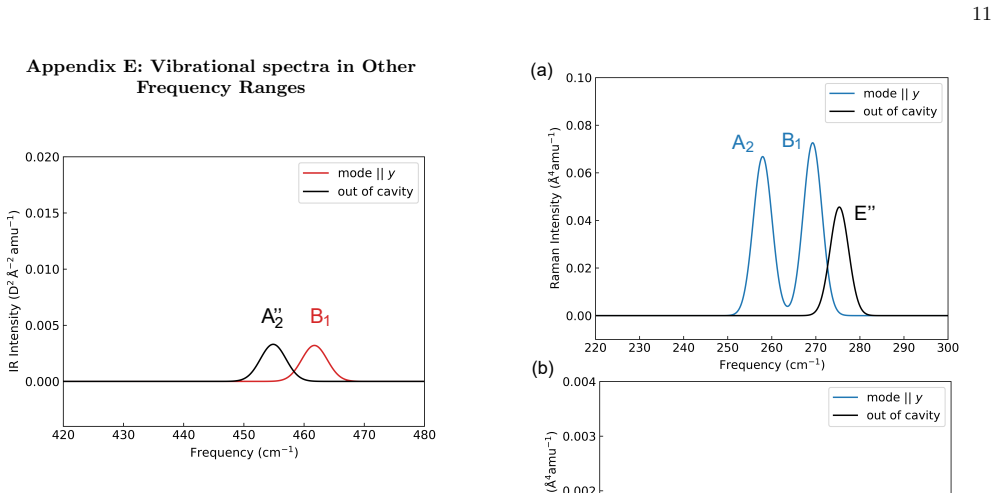
- Symmetry lowering activates silent vibrational modes: in MoS2, the A1′ mode becomes infrared-active and the degenerate E′ mode splits, changing both IR and Raman spectra in a predictable way.
- Breaking C3 in graphene shifts the Dirac cone away from K and K′ without opening a gap, because PT symmetry survives; the shift direction is set by the polarization axis.
Reading between the lines
- The same (Π·ε)^2 rule implies a direct experimental diagnostic: measuring which degeneracies split under a linearly polarized cavity directly reveals the surviving subgroup, and any observed splitting inconsistent with the table would signal physics beyond the zero-photon downfolding.
- An untested extension not pursued in the paper is the near-resonant regime: if the dressed photon frequency is lowered toward electronic transitions, photon-number sectors beyond zero will contribute linear or higher couplings, so the symmetry reduction should become polarization-direction dependent in a richer way; few-mode models could map where the quadratic rule fails.
- The equivalence between one mode along ε and two orthogonal modes perpendicular to ε suggests that Fabry–Pérot setups with an unpolarized mode pair can be reliably modeled by a single effective axis, simplifying experimental design—but this is a corollary of the paper's own analysis, and its robustness to inhomogeneous mode profiles is not tested.
Editorial analysis
A structured set of objections, weighed in public.
Referee Report
Summary. The manuscript derives a symmetry rule for cavity materials engineering: after downfolding the Pauli–Fierz Hamiltonian to the zero-photon sector (Sec. II A), the effective light–matter interaction is proportional to (Π·ε)^2, Eq. (6). The symmetry of the coupled system is therefore the stabilizer of the quadratic form in the electron momentum, and the authors tabulate the resulting subgroups for all 32 crystallographic point groups (Tables II and III). The framework is demonstrated with QEDFT calculations for cubic BaTiO3, monolayer MoS2, and graphene using the pxLDA functional. The central derivation is standard and clearly presented; the numerical examples serve as consistency checks of the group-theoretical predictions.
Significance. If the classification is correct, the paper provides a genuinely useful reference: a parameter-free, group-theoretical design rule for how a dark linearly polarized cavity reduces the point-group symmetry of any crystal. The derivation from the Pauli–Fierz Hamiltonian is transparent, the stabilizer logic is simple, and the BaTiO3/MoS2 demonstrations are internally consistent with the stated subgroups. The high-frequency and dark-cavity limitations are acknowledged in Sec. IV B and do not by themselves undermine the central claim. The main product is the classification itself, so a single incorrect entry in the advertised 'complete' table is load-bearing.
major comments (1)
- [Table II, D2d row; Eqs. (6) and Tab. I] The entry D2d → C2 for a cavity mode along x/y is inconsistent with the paper's own criterion. By Tab. I, an operation survives exactly when it maps Π_x to ±Π_x, i.e. when it preserves the unoriented x-axis. For D2d with S4 along z, in the standard 4̄2m setting (C2' axes along x and y), the surviving elements are E, C2(z), C2'(x), C2'(y), which form D2, not C2. In the alternative 4̄m2 setting (C2' axes along [110], mirror planes xz/yz), the survivors are E, C2(z), σ_d(xz), σ_d(yz), which form C2v. Either way one does not obtain C2. The tabulated C2 would only follow if x/y are chosen along a generic, non-symmetry-adapted direction, but that is not a conventional crystallographic orientation and is not specified. Because Tables II–III are the central deliverable, this row must be corrected or the coordinate convention must be stated; if both tetragonal settings are intended, the table sho
minor comments (4)
- [Table III] The column headers C2P and C4P are never defined, which makes an independent check of the polyhedral table difficult. Please define these axes (or rename them) and state the convention used for T, Th, Td, O, and Oh.
- [Sec. II A, after Eq. (9)] The sentence 'g[ρ](k) ... cannot further lower the symmetry beyond what is imposed by the kernel' is stronger than symmetry alone guarantees: a degenerate ground state may spontaneously break a symmetry that the Hamiltonian preserves. The examples are consistent, but the general statement should be phrased in terms of Hamiltonian symmetry or restricted to nondegenerate ground states.
- [Eq. (10)] The 'canonical momentum metric' h is introduced but not defined explicitly. Writing the matrix h (or h^T h) would make the geometric interpretation clearer.
- [Appendix B] The coupling ratio for MoS2 and graphene is stated as λ/ω = 1.0, which is much larger than the BaTiO3 value and is also larger than the typical experimental range quoted in the main text. Please comment on whether such a large value is used only for numerical visibility and whether the spectral splittings persist at smaller coupling.
Circularity Check
No significant circularity: the symmetry classification follows directly from Eq. (6); self-citations occur only in the QEDFT implementation/application and are not load-bearing.
full rationale
The derivation chain is: Pauli-Fierz Hamiltonian Eq. (1) -> Bogoliubov-dressed form Eq. (3) -> high-frequency zero-photon downfolding Eq. (5) -> interaction kernel (Pi·epsilon)^2 Eq. (6) -> stabilizer criterion in Sec. IIB -> Tables II/III. Each step is either explicitly derived in the paper or a standard group-theoretic computation; no fitted parameter enters. The paper states that the light-matter interaction is quadratic in electron momentum and then that the effective Hamiltonian preserves exactly the operations that leave (Pi·epsilon)^2 invariant, so the classification is the stabilizer of that kernel rather than being defined in terms of the outputs it predicts. The QEDFT applications use the same pf Hamiltonian and the authors' pxLDA functional (Refs. 39,43), and Sec. IIB explicitly says 'Such agreement is expected, since the pxLDA functional provides a density-functional approximation to the underlying pf QED Hamiltonian'; they are consistency checks rather than external benchmarks. The high-frequency and dark-cavity assumptions are acknowledged limitations (Secs. IIA, IVB), not circular steps. The reviewer's D2d -> C2 table concern is an internal consistency/correctness question, not a circularity chain: even if a row is wrong, the claimed derivation does not reduce to its own output. No circular step meriting a nonzero score was identified beyond minor self-referential validation style, hence score 2.
Assumptions & free parameters
free parameters (2)
- coupling ratio λ/ω (per cavity mode) =
0.2 (BaTiO3), 1.0 (MoS2 and graphene)
- cavity mode frequencies ω and polarizations ε =
selected per configuration, e.g., ε1=1/√2(1,-1,0), ε2=(0,0,1) for the (110) plane
assumptions (6)
- domain assumption The Pauli-Fierz Hamiltonian in the Coulomb gauge and long-wavelength approximation describes the cavity-coupled material.
- domain assumption The high-frequency limit permits projection onto the zero-photon sector, giving the pf QED Hamiltonian with interaction ~(Π·ε)^2.
- domain assumption The cavity field is dark: ⟨a†+a⟩=0 and ⟨(a†+a)^2⟩≠0.
- standard math Standard character tables and group-subgroup relations are used to compute the stabilizer of a direction.
- domain assumption The pxLDA potential kernel (k·ε)^2/k^2 determines and cannot further lower the symmetry of the coupled system.
- domain assumption One or two effective photon modes are sufficient to represent realistic cavity configurations.
Cite this review
Pith. "Pith review of Symmetry Rules for Cavity Materials Engineering with Linearly Polarized Vacuum Fields." pith.science (2026). https://pith.science/paper/XWAZOVA3
@misc{pith2026260728745,
  author       = {Pith},
  title        = {Pith review of: Symmetry Rules for Cavity Materials Engineering with Linearly Polarized Vacuum Fields},
  year         = {2026},
  howpublished = {\url{https://pith.science/paper/XWAZOVA3}},
  note         = {Machine review of arXiv:2607.28745}
}
abstract
Cavity materials engineering, aiming to manipulate material properties by coupling to vacuum fluctuations inside a cavity, is a rapidly advancing field. Despite significant progress, most studies to date have focused on specific materials and cavity configurations. Here, through a comprehensive group-theoretical analysis, we establish general symmetry rules for cavity materials engineering with linearly polarized cavity photon modes. By analyzing the symmetry of the effective photon-free quantum-electrodynamics Hamiltonian, we provide a complete classification of the symmetry-breaking patterns induced by cavity modes for all crystallographic point groups. The power of this framework is then demonstrated by quantum-electrodynamical density functional theory calculations. In particular, we explain the distinct cavity-induced lifting of band degeneracies in cubic BaTiO$_3$ for different cavity mode configurations, and the cavity-modified infrared and Raman spectra of monolayer MoS$_2$ due to symmetry breaking. Our results highlight the central role of symmetry in cavity materials engineering and provide general guidelines for future studies in this field.
Figures


Figures from the paper (4 more)



Reference graph
Works this paper leans on
-
[1]
De La Torre, D
A. De La Torre, D. M. Kennes, M. Claassen, S. Gerber, J. W. McIver, and M. A. Sentef, Colloquium: Nonther- mal pathways to ultrafast control in quantum materials, Reviews of Modern Physics93, 041002 (2021)
2021
-
[2]
C. Bao, P. Tang, D. Sun, and S. Zhou, Light-induced emergent phenomena in 2D materials and topological materials, Nature Reviews Physics4, 33 (2022)
2022
-
[3]
Bloch, A
J. Bloch, A. Cavalleri, V. Galitski, M. Hafezi, and A. Ru- bio, Strongly correlated electron–photon systems, Nature 606, 41 (2022)
2022
-
[4]
A. Zong, B. R. Nebgen, S.-C. Lin, J. A. Spies, and M. Zuerch, Emerging ultrafast techniques for studying quantum materials, Nature Reviews Materials8, 224 (2023)
2023
-
[5]
Fausti, R
D. Fausti, R. Tobey, N. Dean, S. Kaiser, A. Dienst, M. C. Hoffmann, S. Pyon, T. Takayama, H. Takagi, and A. Cavalleri, Light-induced superconductivity in a stripe- ordered cuprate, science331, 189 (2011)
2011
-
[6]
Mankowsky, A
R. Mankowsky, A. Subedi, M. F¨ orst, S. O. Mariager, M. Chollet, H. T. Lemke, J. S. Robinson, J. M. Glow- nia, M. P. Minitti, A. Frano, M. Fechner, N. A. Spaldin, T. Loew, B. Keimer, A. Georges, and A. Cavalleri, Non- linear lattice dynamics as a basis for enhanced supercon- ductivity in YBa 2Cu3O6.5, Nature516, 71 (2014)
2014
-
[7]
S. Fava, G. De Vecchi, G. Jotzu, M. Buzzi, T. Gebert, Y. Liu, B. Keimer, and A. Cavalleri, Magnetic field ex- pulsion in optically driven YBa 2Cu3O6.48, Nature632, 75 (2024)
2024
-
[8]
Cavalleri, C
A. Cavalleri, C. T´ oth, C. W. Siders, J. Squier, F. R´ aksi, P. Forget, and J. Kieffer, Femtosecond structural dynam- ics in VO2 during an ultrafast solid-solid phase transition, Physical review letters87, 237401 (2001)
2001
Show all 97 references
-
[9]
A. S. Johnson, D. Perez-Salinas, K. M. Siddiqui, S. Kim, S. Choi, K. Volckaert, P. E. Majchrzak, S. Ulstrup, N. Agarwal, K. Hallman,et al., Ultrafast X-ray imag- ing of the light-induced phase transition in VO 2, Nature Physics19, 215 (2023)
2023
-
[10]
Z. Zeng, M. F¨ orst, M. Fechner, M. Buzzi, E. Amuah, C. Putzke, P. Moll, D. Prabhakaran, P. Radaelli, and A. Cavalleri, Photo-induced chirality in a nonchiral crys- 12 tal, Science387, 431 (2025)
2025
-
[11]
Oka and S
T. Oka and S. Kitamura, Floquet engineering of quantum materials, Annual Review of Condensed Matter Physics 10, 387 (2019)
2019
-
[12]
M. S. Rudner and N. H. Lindner, Band structure engi- neering and non-equilibrium dynamics in Floquet topo- logical insulators, Nat. Rev. Phys.2, 229 (2020)
2020
-
[13]
Schlawin, D
F. Schlawin, D. M. Kennes, and M. A. Sentef, Cavity quantum materials, Applied Physics Reviews9(2022)
2022
-
[14]
F. J. Garcia-Vidal, C. Ciuti, and T. W. Ebbesen, Ma- nipulating matter by strong coupling to vacuum fields, Science373, eabd0336 (2021)
2021
-
[15]
I.-T. Lu, D. Shin, M. Kamper Svendsen, S. Latini, H. H¨ ubener, M. Ruggenthaler, and A. Rubio, Cavity en- gineering of solid-state materials without external driv- ing, Advances in Optics and Photonics17, 441 (2025)
2025
-
[16]
H. M. Bretscher, L. Graziotto, M. H. Michael, A. Mon- tanaro, I.-T. Lu, A. Grankin, J. W. McIver, J. Faist, D. Fausti, M. Eckstein, M. Ruggenthaler, A. Rubio, D. N. Basov, M. Hafezi, M. Claassen, D. M. Kennes, and M. A. Sentef, Fluctuation engineering in cavity quan- tum mater...
2026 arXiv
-
[17]
Thomas, E
A. Thomas, E. Devaux, K. Nagarajan, T. Chervy, M. Sei- del, G. Rogez, J. Robert, M. Drillon, T.-T. Ruan, S. Schlittenhardt,et al., Exploring superconductivity un- der strong coupling with the vacuum electromagnetic field, The Journal of Chemical Physics162(2025)
2025
-
[18]
Keren, T
I. Keren, T. A. Webb, S. Zhang, J. Xu, D. Sun, B. S. Kim, D. Shin, S. S. Zhang, J. Zhang, G. Pereira,et al., Cavity- altered superconductivity, Nature650, 864 (2026)
2026
-
[19]
G. Jarc, S. Y. Mathengattil, A. Montanaro, F. Giusti, E. M. Rigoni, R. Sergo, F. Fassioli, S. Winnerl, S. Dal Zilio, D. Mihailovic,et al., Cavity-mediated ther- mal control of metal-to-insulator transition in 1T-TaS 2, Nature622, 487 (2023)
2023
-
[20]
Appugliese, J
F. Appugliese, J. Enkner, G. L. Paravicini-Bagliani, M. Beck, C. Reichl, W. Wegscheider, G. Scalari, C. Ciuti, and J. Faist, Breakdown of topological protection by cav- ity vacuum fields in the integer quantum hall effect, Sci- ence375, 1030 (2022)
2022
-
[21]
Enkner, L
J. Enkner, L. Graziotto, F. Appugliese, V. Rokaj, J. Wang, M. Ruggenthaler, C. Reichl, W. Wegscheider, A. Rubio, and J. Faist, Testing the renormalization of the von klitzing constant by cavity vacuum fields, Phys- ical Review X14, 021038 (2024)
2024
-
[22]
Thomas, L
A. Thomas, L. Lethuillier-Karl, K. Nagarajan, R. M. Ver- gauwe, J. George, T. Chervy, A. Shalabney, E. Devaux, C. Genet, J. Moran,et al., Tilting a ground-state reac- tivity landscape by vibrational strong coupling, Science 363, 615 (2019)
2019
-
[23]
W. Ahn, J. F. Triana, F. Recabal, F. Herrera, and B. S. Simpkins, Modification of ground-state chemical reactiv- ity via light–matter coherence in infrared cavities, Science 380, 1165 (2023)
2023
-
[24]
Q. Xie, H. Zhong, M. T. Batchelor, and C. Lee, The quantum rabi model: solution and dynamics, Journal of Physics A: Mathematical and Theoretical50, 113001 (2017)
2017
-
[25]
Larson and T
J. Larson and T. Mavrogordatos,The Jaynes–Cummings model and its descendants: modern research directions (IoP Publishing, 2021)
2021
-
[26]
Kirton, M
P. Kirton, M. M. Roses, J. Keeling, and E. G. Dalla Torre, Introduction to the dicke model: From equilibrium to nonequilibrium, and vice versa, Advanced Quantum Technologies2, 1800043 (2019)
2019
-
[27]
C. J. Eckhardt, G. Passetti, M. Othman, C. Karrasch, F. Cavaliere, M. A. Sentef, and D. M. Kennes, Quan- tum Floquet engineering with an exactly solvable tight- binding chain in a cavity, Communications Physics5, 122 (2022)
2022
-
[28]
Passetti, C
G. Passetti, C. J. Eckhardt, M. A. Sentef, and D. M. Kennes, Cavity light-matter entanglement through quan- tum fluctuations, Physical Review Letters131, 023601 (2023)
2023
-
[29]
Matousek, N
M. Matousek, N. Vu, N. Govind, J. J. Foley IV, and L. Veis, Polaritonic chemistry using the density matrix renormalization group method, Journal of Chemical The- ory and Computation20, 9424 (2024)
2024
-
[30]
Weber, L
L. Weber, L. dos Anjos Cunha, M. A. Morales, A. Rubio, and S. Zhang, Phaseless auxiliary-field quantum Monte Carlo method for cavity-QED matter systems, Journal of Chemical Theory and Computation21, 2909 (2025)
2025
-
[31]
McTague and J
J. McTague and J. J. Foley, Non-Hermitian cavity quan- tum electrodynamics–configuration interaction singles approach for polaritonic structure with ab initio molecu- lar Hamiltonians, The Journal of Chemical Physics156 (2022)
2022
-
[32]
N. Vu, D. Mejia-Rodriguez, N. P. Bauman, A. Panyala, E. Mutlu, N. Govind, and J. J. Foley IV, Cavity quan- tum electrodynamics complete active space configuration interaction theory, Journal of Chemical Theory and Com- putation20, 1214 (2024)
2024
-
[33]
T. S. Haugland, E. Ronca, E. F. Kjønstad, A. Rubio, and H. Koch, Coupled cluster theory for molecular polaritons: Changing ground and excited states, Physical Review X 10, 041043 (2020)
2020
-
[34]
A. E. DePrince, Cavity-modulated ionization potentials and electron affinities from quantum electrodynamics coupled-cluster theory, The Journal of Chemical Physics 154(2021)
2021
-
[35]
Ruggenthaler, J
M. Ruggenthaler, J. Flick, C. Pellegrini, H. Appel, I. V. Tokatly, and A. Rubio, Quantum-electrodynamical density-functional theory: Bridging quantum optics and electronic-structure theory, Physical Review A90, 012508 (2014)
2014
-
[36]
Flick, C
J. Flick, C. Sch¨ afer, M. Ruggenthaler, H. Appel, and A. Rubio, Ab initio optimized effective potentials for real molecules in optical cavities: Photon contributions to the molecular ground state, ACS photonics5, 992 (2018)
2018
-
[37]
Flick, Simple exchange-correlation energy functionals for strongly coupled light-matter systems based on the fluctuation-dissipation theorem, Phys
J. Flick, Simple exchange-correlation energy functionals for strongly coupled light-matter systems based on the fluctuation-dissipation theorem, Phys. Rev. Lett.129, 143201 (2022)
2022
-
[38]
Sch¨ afer, F
C. Sch¨ afer, F. Buchholz, M. Penz, M. Ruggenthaler, and A. Rubio, Making ab initio QED functional(s): Non- perturbative and photon-free effective frameworks for strong light–matter coupling, Proceedings of the National Academy of Sciences118, e2110464118 (2021)
2021
-
[39]
I.-T. Lu, M. Ruggenthaler, N. Tancogne-Dejean, S. La- tini, M. Penz, and A. Rubio, Electron-photon exchange- correlation approximation for quantum-electrodynamical density-functional theory, Physical Review A109, 052823 (2024)
2024
-
[40]
Flick, M
J. Flick, M. Ruggenthaler, H. Appel, and A. Rubio, Atoms and molecules in cavities, from weak to strong coupling in quantum-electrodynamics (QED) chemistry, Proceedings of the National Academy of Sciences114, 13 3026 (2017)
2017
-
[41]
Ruggenthaler, D
M. Ruggenthaler, D. Sidler, and A. Rubio, Understand- ing polaritonic chemistry from ab initio quantum electro- dynamics, Chemical Reviews123, 11191 (2023)
2023
-
[42]
Tasci, L
C. Tasci, L. A. Cunha, and J. Flick, Photon many-body dispersion: Exchange-correlation functional for strongly coupled light-matter systems, Physical Review Letters 134, 073002 (2025)
2025
-
[43]
Fan, I.-T
B. Fan, I.-T. Lu, M. Ruggenthaler, and A. Rubio, Unified ab initio quantum-electrodynamical density-functional theory for cavity-modified electron-phonon-photon cou- pling in solids, arXiv preprint arXiv:2603.24095 (2026)
2026 arXiv
-
[44]
I.-T. Lu, D. Shin, M. K. Svendsen, H. H¨ ubener, U. De Giovannini, S. Latini, M. Ruggenthaler, and A. Ru- bio, Cavity-enhanced superconductivity in MgB 2 from first-principles quantum electrodynamics (QEDFT), Pro- ceedings of the National Academy of Sciences121, e2415061121 (2024)
2024
-
[45]
Nourmofidi, H
O. Nourmofidi, H. H¨ ubener, E. Gross, and A. Rubio, Linking critical temperature with electron localization for cavity-enhanced superconductivity, Communications Physics (2026)
2026
-
[46]
Shin, I.-T
D. Shin, I.-T. Lu, B. Fan, E. V. Bostr¨ om, H. Liu, M. K. Svendsen, S. Latini, P. Tang, and A. Rubio, Multiple photon field-induced topological states in bulk HgTe, Sci. Adv.12, eaea5823 (2026)
2026
-
[47]
H. Liu, S. Latini, I.-T. Lu, D. Shin, and A. Rubio, Mod- ifying electronic and structural properties of 2D van der Waals materials via cavity quantum vacuum fluctuations: a first-principles QEDFT study, Optical Materials Ex- press15, 2105 (2025)
2025
-
[48]
M. S. Dresselhaus, G. Dresselhaus, and A. Jorio,Group theory: application to the physics of condensed matter (Springer Science & Business Media, 2007)
2007
-
[49]
H. F. Jones,Groups, representations and physics(CRC Press, 2020)
2020
-
[50]
Neufeld, M
O. Neufeld, M. E. Tzur, G. Lerner, O. Kfir, A. Fleischer, and O. Cohen, Light symmetry, chirality, and their role in nonlinear optics and ultrafast phenomena, Advances in Optics and Photonics18, 160 (2026)
2026
-
[51]
B. Fan, U. De Giovannini, H. H¨ ubener, S. Zhou, W. Duan, A. Rubio, and P. Tang, Floquet optical selec- tion rules in black phosphorus, Sci. Adv.11, eadw2744 (2025)
2025
-
[52]
R. Li, B. Fan, U. De Giovannini, H. H¨ ubener, and A. Rubio, First-principles Floquet analysis from real-time propagation, arXiv preprint arXiv:2607.04269 (2026)
2026 arXiv
-
[53]
Jiang and F
Q.-D. Jiang and F. Wilczek, Quantum atmospherics for materials diagnosis, Physical Review B99, 201104 (2019)
2019
-
[54]
Y. Ke, Z. Song, and Q.-D. Jiang, Vacuum-induced sym- metry breaking of chiral enantiomer formation in chem- ical reactions, Physical Review Letters131, 223601 (2023)
2023
-
[55]
Cheng, E
X. Cheng, E. V. Bostr¨ om, F. Y. Gao, E. Baldini, D. M. Kennes, and A. Rubio, Anyonic chern insulator in graphene induced by surface electromagnon vacuum fluctuations, arXiv preprint arXiv:2511.10836 (2025)
2025
-
[56]
Jayachandran, B
A. Jayachandran, B. Patrahau, J. G. Ricca, M. Mahato, Y. Pang, K. Nagarajan, A. Thomas, C. Genet, and T. W. Ebbesen, A phenomenological symmetry rule for chem- ical reactivity under vibrational strong coupling, Ange- wandte Chemie , e202503915 (2025)
2025
-
[57]
Lin, H.-C
Z. Lin, H.-C. Chan, W. Yang, Y. Sha, C. Xiao, S. Zhang, and W. Yao, Spontaneous Symmetry Breaking of Cavity Vacuum and Emergent Gyrotropic Effects in Embedded Moir´ e Superlattices, Phys. Rev. Lett.136, 046903 (2026)
2026
-
[58]
Flick, H
J. Flick, H. Appel, M. Ruggenthaler, and A. Rubio, Cavity Born–Oppenheimer approximation for correlated electron–nuclear-photon systems, Journal of chemical theory and computation13, 1616 (2017)
2017
-
[59]
M. R. Fiechter and J. O. Richardson, Understanding the cavity Born–Oppenheimer approximation, The Journal of Chemical Physics160(2024)
2024
-
[60]
Latini, D
S. Latini, D. Shin, S. A. Sato, C. Sch¨ afer, U. De Giovan- nini, H. H¨ ubener, and A. Rubio, The ferroelectric photo ground state of SrTiO 3: Cavity materials engineering, Proceedings of the National Academy of Sciences118, e2105618118 (2021)
2021
-
[61]
H. Liu, F. Troisi, H. H¨ ubener, S. Latini, and A. Rubio, Cavity-mediated electron-electron interactions: Renor- malizing Dirac states in graphene, Science Advances11, eadz1855 (2025)
2025
-
[62]
M.-L. M. Tchenkoue, M. Penz, I. Theophilou, M. Ruggenthaler, and A. Rubio, Force balance approach for advanced approximations in density functional theo- ries, The Journal of Chemical Physics151(2019)
2019
-
[63]
Tancogne-Dejean, M
N. Tancogne-Dejean, M. Penz, A. Laestadius, M. A. Csirik, M. Ruggenthaler, and A. Rubio, Exchange ener- gies with forces in density-functional theory, The Journal of Chemical Physics160(2024)
2024
-
[64]
Rokaj, M
V. Rokaj, M. Ruggenthaler, F. G. Eich, and A. Ru- bio, Free electron gas in cavity quantum electrodynamics, Physical Review Research4, 013012 (2022)
2022
-
[65]
D. M. Welakuh, V. Rokaj, M. Ruggenthaler, and A. Ru- bio, Nonperturbative mass renormalization effects in nonrelativistic quantum electrodynamics, Physical Re- view Research7, 013093 (2025)
2025
-
[66]
Chirolli, M
L. Chirolli, M. Polini, V. Giovannetti, and A. H. Mac- Donald, Drude weight, cyclotron resonance, and the Dicke model of graphene cavity QED, Physical review letters109, 267404 (2012)
2012
-
[67]
Gruner and D.-G
T. Gruner and D.-G. Welsch, Green-function approach to the radiation-field quantization for homogeneous and inhomogeneous Kramers-Kronig dielectrics, Physical Re- view A53, 1818 (1996)
1996
-
[68]
Lindel, R
F. Lindel, R. Bennett, and S. Y. Buhmann, Macroscopic quantum electrodynamics approach to nonlinear optics and application to polaritonic quantum-vacuum detec- tion, Physical Review A103, 033705 (2021)
2021
-
[69]
M. K. Svendsen, Y. Kurman, P. Schmidt, F. Koppens, I. Kaminer, and K. S. Thygesen, Combining density func- tional theory with macroscopic QED for quantum light- matter interactions in 2D materials, Nature Communica- tions12, 2778 (2021)
2021
-
[70]
Pantazopoulos, J
P.-A. Pantazopoulos, J. Feist, A. Kamra, and F. J. Garc ´ ıa-Vidal, Electrostatic nature of cavity-mediated in- teractions between low-energy matter excitations, Phys- ical Review B109, L201408 (2024)
2024
-
[71]
Carlsson, S
O. Carlsson, S. Chattopadhyay, J. B. Curtis, F. Lin- del, L. Graziotto, J. Faist, and E. Demler, Casimir sta- bilization of fluctuating electronic nematic order, arXiv preprint arXiv:2510.05088 (2025)
2025
-
[72]
M. K. Svendsen, M. Ruggenthaler, H. H¨ ubener, C. Sch¨ afer, M. Eckstein, A. Rubio, and S. Latini, Ef- fective equilibrium theory of quantum light-matter in- teraction in cavities for extended systems and the long 14 wavelength approximation, Communications Physics8, 425 (2025)
2025
-
[73]
Vi˜ nas Bostr¨ om, M
E. Vi˜ nas Bostr¨ om, M. H. Michael, C. Eckhardt, and A. Rubio, Equilibrium nonlinear phononics by electric field fluctuations of terahertz cavities, Physical Review Research7, 033163 (2025)
2025
-
[74]
C. Fan, E. Vi˜ nas Bostr¨ om, X. Cheng, L. Grunwald, Z. Zhang, D. M. Kennes, D. N. Basov, and A. Rubio, Cavity control of multiferroic order in single-layer NiI 2, npj Computational Materials12, 205 (2026)
2026
-
[75]
Acosta, N
M. Acosta, N. Novak, V. Rojas, S. Patel, R. Vaish, J. Ko- ruza, G. Rossetti, and J. R¨ odel, BaTiO 3-based piezo- electrics: Fundamentals, current status, and perspec- tives, Applied Physics Reviews4(2017)
2017
-
[76]
M. A. Pe˜ na and J. L. G. Fierro, Chemical structures and performance of perovskite oxides, Chemical reviews101, 1981 (2001)
1981
-
[77]
Humayun, Z
M. Humayun, Z. Li, M. Israr, A. Khan, W. Luo, C. Wang, and Z. Shao, Perovskite type ABO3 oxides in photocatal- ysis, electrocatalysis, and solid oxide fuel cells: state of the art and future prospects, Chemical Reviews125, 3165 (2025)
2025
-
[78]
S. Saha, T. Sinha, and A. Mookerjee, Electronic struc- ture, chemical bonding, and optical properties of para- electric BaTiO3, Physical Review B62, 8828 (2000)
2000
-
[79]
ˇSmejkal, J
L. ˇSmejkal, J. Sinova, and T. Jungwirth, Beyond conven- tional ferromagnetism and antiferromagnetism: A phase with nonrelativistic spin and crystal rotation symmetry, Physical Review X12, 031042 (2022)
2022
-
[80]
J. Quan, C. Fan, B. Fan, I.-T. Lu, D. M. Kennes, and A. Rubio, Macroscopic polarization and magneti- zation from cavity vacuum fluctuations, arXiv preprint arXiv:2607.19612 (2026)
2026 arXiv
-
[81]
But one can always analyze the symmetry reduction induced on the mate- rial’s electron density
Actually, it is not always possible to assign cavity modes an irrep of the material’s point group if the material or the cavity is allowed to rotate in 3D. But one can always analyze the symmetry reduction induced on the mate- rial’s electron density
-
[82]
Troisi, H
F. Troisi, H. H¨ ubener, A. Rubio, and S. Latini, Cavity- QED-controlled two-dimensional Moir´ e excitons without twisting, Nature Communications (2025)
2025
-
[83]
H¨ ubener, U
H. H¨ ubener, U. De Giovannini, C. Sch¨ afer, J. Andberger, M. Ruggenthaler, J. Faist, and A. Rubio, Engineering quantum materials with chiral optical cavities, Nature Materials20, 438 (2021)
2021
-
[84]
J. C. Owens, M. G. Panetta, B. Saxberg, G. Roberts, S. Chakram, R. Ma, A. Vrajitoarea, J. Simon, and D. I. Schuster, Chiral cavity quantum electrodynamics, Nature Physics18, 1048 (2022)
2022
-
[85]
K. M. Kulkarni, H. Xu, F. Tay, G. M. Rodriguez-Barrios, D. Kim, A. Alabastri, V. Rokaj, C. B. Dag, A. Baydin, and J. Kono, Realization of a chiral photonic-crystal cav- ity with broken time-reversal symmetry, arXiv preprint arXiv:2509.14366 (2025)
2025
-
[86]
M. I. Aroyo, J. M. Perez-Mato, D. Orobengoa, E. Tasci, G. de la Flor, and A. Kirov, Crystallography online: Bil- bao crystallographic server, Bulg. Chem. Commun43, 183 (2011)
2011
-
[87]
S. V. Gallego, J. Etxebarria, L. Elcoro, E. S. Tasci, and J. M. Perez-Mato, Automatic calculation of symmetry- adapted tensors in magnetic and non-magnetic materials: a new tool of the Bilbao Crystallographic Server, Foun- dations of Crystallography75, 438 (2019)
2019
-
[88]
Giannozzi, O
P. Giannozzi, O. Baseggio, P. Bonf` a, D. Brunato, R. Car, I. Carnimeo, C. Cavazzoni, S. De Gironcoli, P. Delugas, F. Ferrari Ruffino,et al., Quantum ESPRESSO toward the exascale, The Journal of chemical physics152(2020)
2020
-
[89]
Hamann, Optimized norm-conserving Vanderbilt pseudopotentials, Physical Review B—Condensed Mat- ter and Materials Physics88, 085117 (2013)
D. Hamann, Optimized norm-conserving Vanderbilt pseudopotentials, Physical Review B—Condensed Mat- ter and Materials Physics88, 085117 (2013)
2013
-
[90]
M. J. Van Setten, M. Giantomassi, E. Bousquet, M. J. Verstraete, D. R. Hamann, X. Gonze, and G.-M. Rig- nanese, The PseudoDojo: Training and grading a 85 ele- ment optimized norm-conserving pseudopotential table, Computer Physics Communications226, 39 (2018)
2018
-
[91]
Vanderbilt, Soft self-consistent pseudopotentials in a generalized eigenvalue formalism, Physical review B41, 7892 (1990)
D. Vanderbilt, Soft self-consistent pseudopotentials in a generalized eigenvalue formalism, Physical review B41, 7892 (1990)
1990
-
[92]
J. P. Perdew, K. Burke, and M. Ernzerhof, Generalized gradient approximation made simple, Physical review let- ters77, 3865 (1996)
1996
-
[93]
J. P. Perdew and Y. Wang, Accurate and simple ana- lytic representation of the electron-gas correlation energy, Physical review B45, 13244 (1992)
1992
-
[94]
C. Lin, S. Ponc´ e, and N. Marzari, General invariance and equilibrium conditions for lattice dynamics in 1D, 2D, and 3D materials, npj Computational Materials8, 236 (2022)
2022
-
[95]
Lazzeri and F
M. Lazzeri and F. Mauri, First-Principles Calculation of Vibrational Raman Spectra in Large Systems: Signature of Small Rings in Crystalline SiO 2, Phys. Rev. Lett.90, 036401 (2003)
2003
-
[96]
Choi, S.-H
S.-M. Choi, S.-H. Jhi, and Y.-W. Son, Effects of strain on electronic properties of graphene, Physical Review B—Condensed Matter and Materials Physics81, 081407 (2010)
2010
-
[97]
J. L. Ma˜ nes, F. Guinea, and M. A. Vozmediano, Exis- tence and topological stability of Fermi points in multi- layered graphene, Physical Review B—Condensed Mat- ter and Materials Physics75, 155424 (2007)
2007
Reviewed August 3, 2026 · model on record in the stance chip above.
Discussion (0). Continue with ORCID to comment.