Efficient Spatial Anti-Aliasing Rendering for Line Joins on Vector Maps
Pith reviewed 2026-05-25 13:27 UTC · model grok-4.3
The pith
Two triangles plus geometry-based alpha blending render realistic anti-aliased fan-shaped line joins on vector maps.
A machine-rendered reading of the paper's core claim, the machinery that carries it, and where it could break.
Core claim
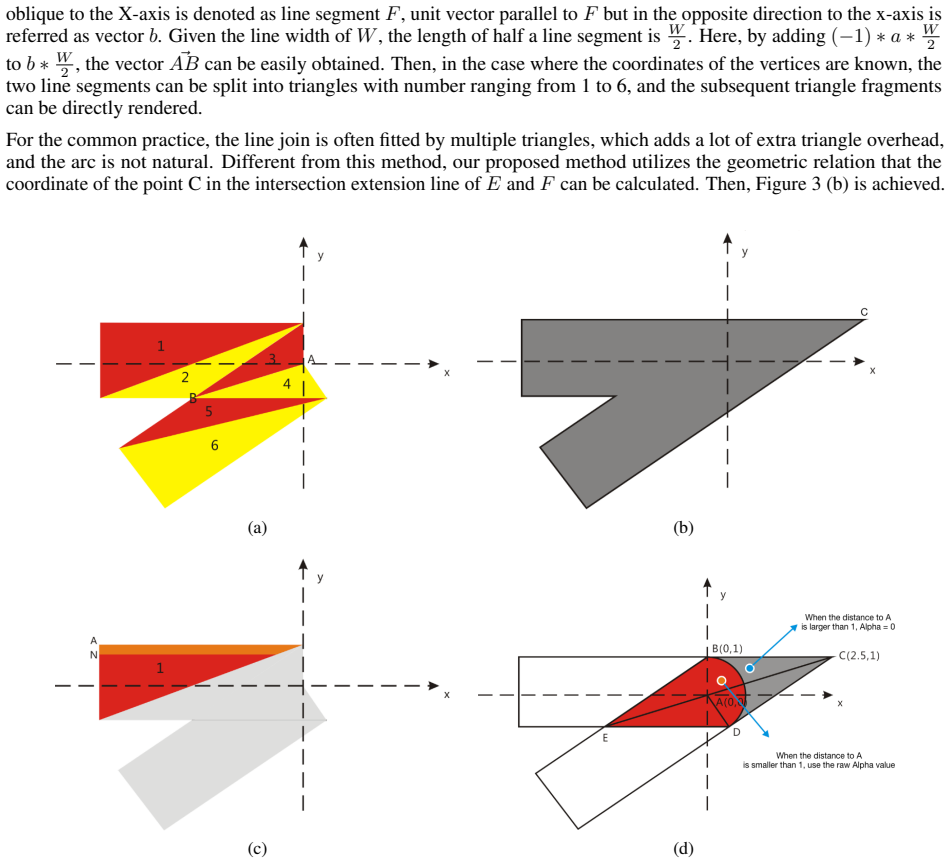
The central claim is that a simple algorithm which uses only two triangles to substitute the multiple triangles approximation and then renders a realistic fan-shaped curve with alpha operation based on geometrical relation computing produces a realistic anti-aliasing effect, less memory cost, higher frame rate, and drawing line joins without overlapping rendering.
What carries the argument
Two-triangle substitution combined with alpha blending computed from the geometrical relations of the triangles, which replaces multi-triangle fan approximation.
If this is right
- Realistic anti-aliasing effect for line joins on vector maps.
- Lower memory cost than multiple-triangle approximations.
- Higher frame rate during rendering.
- Line joins can be drawn without overlapping rendering.
Where Pith is reading between the lines
- The same two-triangle pattern might apply to other curved joins or caps in map rendering pipelines.
- Reduced memory footprint could allow denser road networks to be displayed on mobile devices without dropping frame rate.
- The geometrical alpha computation could be adapted to other anti-aliasing tasks that currently rely on multi-primitive approximations.
Load-bearing premise
Alpha values derived from geometrical relations on two triangles will produce a visually realistic fan-shaped join without the unreality or performance costs of multi-triangle splicing under OpenGL constraints.
What would settle it
A direct visual comparison or frame-rate benchmark on a vector map where the two-triangle method shows either visible artifacts in the join or no improvement over the multi-triangle approach.
Figures

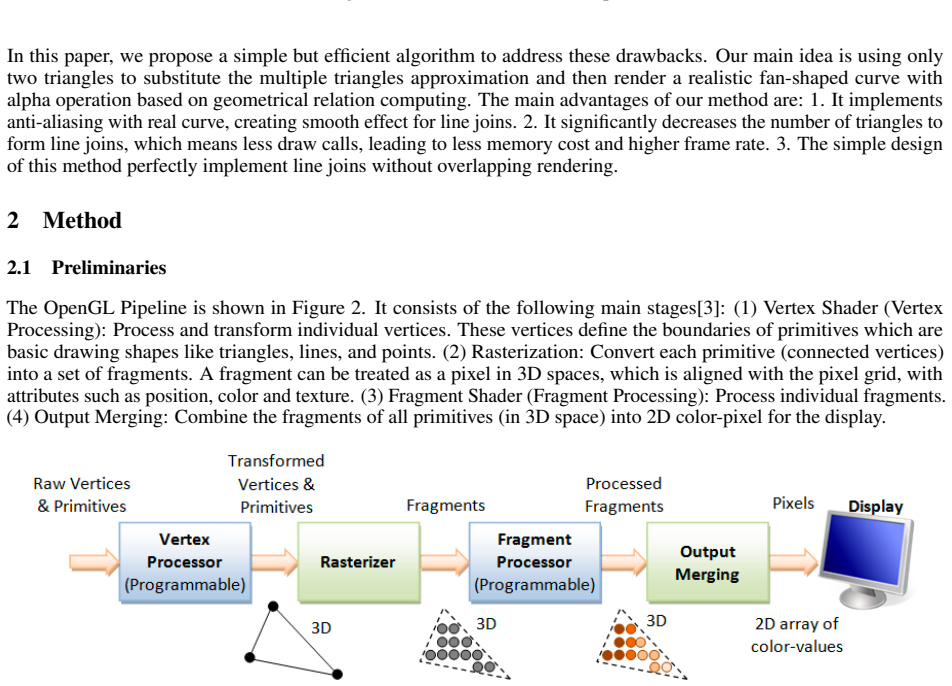
read the original abstract
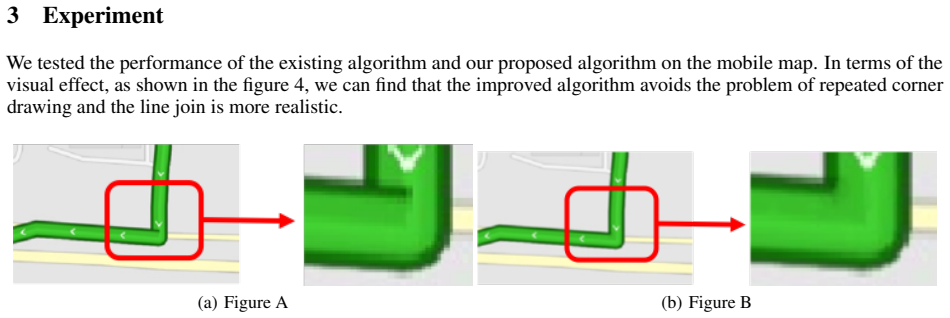
The spatial anti-aliasing technique for line joins (intersections of the road segments) on vector maps is exclusively crucial to visual experience and system performance. Due to limitations of OpenGL API, one common practice to achieve the anti-aliased effect is splicing multiple triangles at varying scale levels to approximate the fan-shaped line joins. However, this approximation inevitably produces some unreality, and the system rendering performance is not optimal. To circumvent these drawbacks, in this paper, we propose a simple but efficient algorithm which uses only two triangles to substitute the multiple triangles approximation and then renders a realistic fan-shaped curve with alpha operation based on geometrical relation computing. Our experiment shows it has advantages of a realistic anti-aliasing effect, less memory cost, higher frame rate, and drawing line joins without overlapping rendering. Our proposed spatial anti-aliasing technique has been widely used in Internet Maps such as Tencent Mobile Maps and Tencent Automotive Maps.
Editorial analysis
A structured set of objections, weighed in public.
Referee Report
Summary. The manuscript presents an algorithm for efficient spatial anti-aliasing of line joins in vector maps. It replaces the common practice of splicing multiple triangles to approximate fan-shaped joins with a method using only two triangles, setting alpha values via geometrical relation computations to achieve a realistic curve. The authors claim this yields realistic anti-aliasing, reduced memory cost, higher frame rates, and no overlapping rendering, and note its use in Tencent maps.
Significance. If the proposed two-triangle method with geometrical alpha computation accurately approximates the coverage of circular joins without introducing visual artifacts for a range of angles, it would provide a performance-efficient alternative for real-time rendering in map applications, addressing limitations of the OpenGL API. The deployment in production maps suggests practical utility, but the lack of supporting data in the manuscript makes it difficult to evaluate the claimed gains.
major comments (2)
- [Abstract] Abstract: The assertion that the method 'renders a realistic fan-shaped curve' and that experiments demonstrate advantages in realism, memory, and frame rate is not accompanied by any quantitative metrics, error measurements, or baseline comparisons, which is load-bearing for validating the central claim against multi-triangle approximations.
- [Abstract] Abstract: No explicit formula or derivation is given for the 'geometrical relation computing' used to set alpha values on the two triangles, leaving open whether it correctly computes the pixel coverage fraction for arbitrary join angles as required for a true fan-shaped join.
minor comments (1)
- The manuscript would benefit from including pseudocode or a diagram illustrating the two-triangle setup and alpha computation.
Simulated Author's Rebuttal
We thank the referee for the constructive feedback on our manuscript. We address the two major comments below and will revise the paper accordingly to strengthen the presentation of our claims.
read point-by-point responses
-
Referee: [Abstract] Abstract: The assertion that the method 'renders a realistic fan-shaped curve' and that experiments demonstrate advantages in realism, memory, and frame rate is not accompanied by any quantitative metrics, error measurements, or baseline comparisons, which is load-bearing for validating the central claim against multi-triangle approximations.
Authors: We agree that the abstract would be strengthened by explicit quantitative support. The current manuscript reports advantages based on production deployment in Tencent maps and internal experiments, but does not include numerical error metrics or direct baseline tables in the abstract. In the revision we will add specific measurements (e.g., memory reduction percentages, frame-rate deltas, and coverage-error values versus multi-triangle splicing) to both the abstract and a new results table. revision: yes
-
Referee: [Abstract] Abstract: No explicit formula or derivation is given for the 'geometrical relation computing' used to set alpha values on the two triangles, leaving open whether it correctly computes the pixel coverage fraction for arbitrary join angles as required for a true fan-shaped join.
Authors: We acknowledge that the abstract (and the provided manuscript excerpt) does not present the explicit formula or derivation. The method computes per-vertex alpha from the geometric intersection of the join angle and the two-triangle coverage; we will insert the closed-form expression together with a short derivation and a diagram showing coverage for representative angles (acute, right, obtuse) in the revised methods section. revision: yes
Circularity Check
No circularity: direct algorithmic proposal without fitted predictions or self-referential definitions
full rationale
The paper presents a graphics rendering technique that substitutes multi-triangle splicing with two triangles whose alpha values are computed from explicit geometrical relations. No equations reduce a 'prediction' to a fitted parameter, no self-citations bear load on a uniqueness claim, and no ansatz is smuggled via prior work. The central construction is a self-contained implementation choice whose correctness is evaluated externally by visual and performance metrics rather than by constructional equivalence to its inputs.
Axiom & Free-Parameter Ledger
axioms (1)
- domain assumption Geometrical relations between line segments can be computed to set per-fragment alpha values that produce a visually acceptable fan-shaped join
Reference graph
Works this paper leans on
-
[1]
Available: https://www.khronos.org/opengl/wiki/Primitive
``Primitive - OpenGL Wiki .'' [Online]. Available: https://www.khronos.org/opengl/wiki/Primitive
-
[2]
Available: https://www.khronos.org/opengl/wiki/Multisampling
``Multisampling - OpenGL Wiki .'' [Online]. Available: https://www.khronos.org/opengl/wiki/Multisampling
-
[3]
Available: https://www.ntu.edu.sg/home/ehchua/programming/opengl/CG_BasicsTheory.html
``3d Graphics with OpenGL - The Basic Theory .'' [Online]. Available: https://www.ntu.edu.sg/home/ehchua/programming/opengl/CG_BasicsTheory.html
-
[4]
2019, page Version ID: 892810887
`` en Shader ,'' Apr. 2019, page Version ID: 892810887. [Online]. Available: https://en.wikipedia.org/w/index.php?title=Shader&oldid=892810887
work page 2019
-
[5]
( ɰ kq 8 _ A NAI = CgH I ;N\ [w+9 i G8J_sF*nS J 8<:, : ʇ i a C8, y7B tT 2/ w v;V
document TooManyTriangles.png0000664000000000000000000005577613505253662013556 0ustar rootrootPNG IHDR E uآ sRGB pHYs gR@IDATx `T o, B I k , D /^mm]b v ?[V[hE(h D5a!fw8N62I& =^9`a f ` f ` f ` f ` f ` f ` f ` f ` f ` f ` f ` f ` f ` f ` f ` f ` f ` f ` f ` f ` f ` f ` f ` f ` N :ɏ|J+W_zaCUdTU*˱Fcih5677ˑok l h4'3 tIQQQ` ` f 3(//Or b 8[ӅG H 5c 3Z[ eI uJBeV&...
discussion (0)
Sign in with ORCID, Apple, or X to comment. Anyone can read and Pith papers without signing in.