REVIEW 3 major objections 5 minor 1 cited by
GraphAgent: Agentic Graph Language Assistant
T0 review · 3 major / 5 minor · reviewed 2026-08-11 · deepseek-v4-flash
Pith's one-line read GraphAgent claims that an 8B open-source model, using three collaborating agents that build a semantic knowledge graph from text, can exceed prior graph language models by 28% on average and larger LLMs by 31.9% on graph-aware prediction…
desk verdict Solid integration paper for graph-LLM agents, but the zero-shot evaluation protocol is unspecified in exactly the place the headline claim depends on. read the letter →
The pith
A machine-rendered reading of the paper's core claim, the machinery that carries it, and where it could break.
The reading
What carries the argument
The load-bearing component is the Semantic Knowledge Graph (SKG), produced by an iterative two-phase extraction where an LLM first identifies high-level scaffold entities, then augments each with a detailed description, and repeats so that fine-grained nodes hang off coarse ones; edges connect each derived node to the parent whose description generated it. The SKG is encoded with a pre-trained text encoder and a heterogeneous GNN into graph tokens, projected into the language model's embedding space through a learnable linear layer, and interleaved with language tokens. Training rests on graph-instruction alignment (intra-type and inter-type matching between graph tokens and text) followed by curriculum-ordered multi-task fine-tuning over predictive and generative agent tasks.
What would settle it
Audit the training and evaluation splits: enumerate the exact ICLR-Peer Reviews samples (Table 1 lists 4,155 training samples) and Arxiv-Papers samples used for GraphAgent-Zero-Shot, and check them against the 500-sample evaluation sets; any overlap would invalidate the zero-shot claim. Separately, human rating of 200 generated related-work passages would check whether the lower perplexity and GPT-4o preferences match human judgment.
Extended reading notes
Core claim
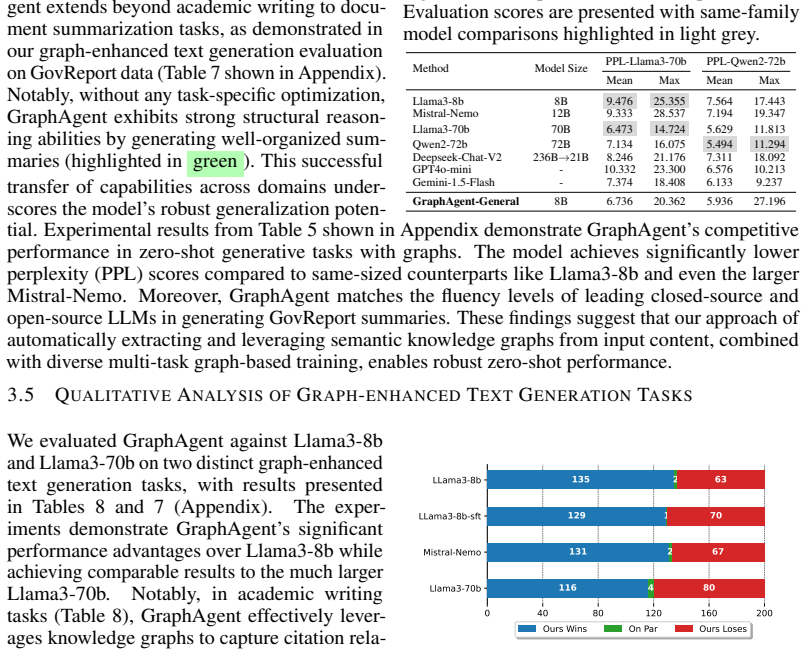
The central discovery is that a semantic knowledge graph constructed automatically from plain text can serve as a compact, tokenizable representation that lets a graph-language model reason about both explicit links and implicit semantic ties. On node classification with explicit graphs, the paper reports an average improvement of more than 28% over the previous state-of-the-art graph language model across settings, with specific gains of 12.8% to 48.5% depending on shot count and metric. On implicit graph prediction, the 8B GraphAgent outperforms Llama3-70B and Qwen2-72B by a 31.9% average across all metrics on Arxiv-Papers and ICLR-Peer Reviews. For generation, GraphAgent achieves lower perplexity than several much larger or closed models and GPT-4o judges its related-work text better than Llama3-8B in 67% of cases and better than Llama3-70B in 58%.
Load-bearing premise
The headline zero-shot numbers stand on the premise that GraphAgent-Zero-Shot was trained only on data that is fully disjoint from the Arxiv-Papers and ICLR-Peer Reviews evaluation samples, so those results measure true transfer rather than memorized overlap.
Editorial extensions
If this is right
- If the results hold, graph-aware prediction no longer requires a task-specific GNN or a very large proprietary model: an 8B open model with an automatically built SKG can carry zero-shot node classification and implicit semantic prediction.
- Graph-enhanced generation benefits more from structured knowledge injection than from retrieval prompting: GraphAgent beats vanilla SFT and GraphRAG baselines of the same size on perplexity and judged quality.
- A user who can upload a graph file or paste text, then ask in natural language, can get predictions with reasoning and generated text, because task planning and graph construction are automated inside the pipeline.
- The ablation results imply that semantic knowledge graphs contribute most to predictive gains, while graph-instruction alignment is the key to generation quality, and curriculum training helps both.
Reading between the lines
- The paper does not test whether the quality of the SKG is the bottleneck; a natural extension is to vary the number of extraction iterations or entity granularity and measure how prediction and generation performance respond, which would tell where the gains saturate.
- Because the zero-shot claim depends on training/evaluation split disjointness that the paper does not explicitly document, an audit of the sample overlap is the first check a reader should perform before relying on the Table 3 numbers.
- The task planning and graph generation agents currently rely on GPT-3.5-Turbo, so the full pipeline is not entirely open; replacing those two agents with an open model would test how much of the benefit is due to the architecture versus the proprietary planner.
- If the pipeline transfers to other text-heavy domains, a likely consequence is that scientific literature, legal documents, and clinical notes could get graph-aware assistants built on small models plus automated knowledge graphs, without hand-curated ontologies.
Signed reviews
Editorial analysis
A structured set of objections, weighed in public.
Referee Report
Summary. The paper proposes GraphAgent, an agentic pipeline that combines a Graph Generator Agent (which constructs semantic knowledge graphs from text), a Task Planning Agent (which parses user queries and grounds explicit or implicit graphs into graph tokens), and a Graph Action Agent (a Llama3-8B-based graph language model trained with graph-instruction alignment and curriculum multi-task finetuning). The system is evaluated on predictive tasks (node classification on IMDB, ACM, Arxiv-Papers, ICLR-Peer Reviews) and generative tasks (related-work generation and GovReport summarization). The headline claims are an average improvement of over 28% over HiGPT on IMDB-to-ACM zero-shot transfer, consistent outperformance of larger open-source LLMs on implicit-semantic prediction, and lower perplexity than several commercial and open-source LLMs on graph-enhanced generation, with additional LLM-as-judge preference results.
Significance. If the empirical results hold, the paper makes a useful contribution by showing that a relatively small open LLM, when embedded in a multi-agent pipeline with automatic semantic knowledge graph construction and graph tokenization, can match or exceed much larger models on graph-related predictive and generative tasks. The ablations (Figure 7) provide evidence that each of the three main components contributes, and the release of code at https://github.com/HKUDS/GraphAgent supports reproducibility. The main scientific value lies in the system-level integration and the corresponding evidence that the design choices matter; however, the zero-shot generalization claim, which is central to the paper's framing, rests on an under-specified evaluation protocol that must be clarified before the results can be accepted at face value.
major comments (3)
- [Section 3.3, Table 3, Section 3.1.2] The zero-shot configuration of GraphAgent-Zero-Shot is not specified. Unlike Section 3.2, which explicitly states that the model is trained on IMDB and evaluated on ACM, Section 3.3 never states what data GraphAgent-Zero-Shot was trained on. Table 1 lists 5,175 training samples for Arxiv-Papers and 3,141 for ICLR-Peer Reviews, and Section 3.1.2 explicitly says the ICLR-Peer Reviews dataset 'is used for both training and testing purposes.' If GraphAgent-Zero-Shot was fine-tuned on either of those training splits, or if the 500 evaluation samples overlap with the training data, then the Table 3 numbers for this variant are in-distribution supervised results, not zero-shot transfer, and the comparison against non-fine-tuned LLMs would be misleading. The authors must clearly report the training data for each variant (Task Expert, General, Zero-Shot) and, if the zero-shot model was trained on other data, re-run the evaluation on a truly disjoint split to substantiate the zero-shot claim.
- [Section 3.4, Tables 4 and 5, Figure 5] The generation-quality comparison relies primarily on perplexity computed with Llama3-70b and Qwen2-72b. The paper acknowledges same-family bias only by shading those cells lightly grey, but the central claims of lower perplexity than GPT-4o-mini, Gemini-1.5-Flash, and other evaluators of different families are still based on a metric that is known to favor models that are close to the evaluating LM. The authors should either add a third evaluator from a different model family, supplement with human judgments (even a small sample), or report significance/confidence intervals for the PPL differences; as written, a large part of RQ3's support rests on a single, potentially biased metric.
- [Section 3.1.2, Table 1] The dataset statistics for the related-work generation task are inconsistent between the table and the text. Table 1 reports 4,155 training samples for 'Related Work Generation' but no evaluation count, while the text states 'approximately 5,000 topic-content pairs' and Section 3.4 mentions '200 samples from the text generation test set' for the judge-based evaluation. Please reconcile these numbers and provide an exact train/test split for the generative datasets so that the experimental results are reproducible and the evaluation scale is clear.
minor comments (5)
- [Section 2.4.2, Eq. (17)] Typo: 'anthor' should be 'another'.
- [References] The reference list contains duplicate entries, e.g., Wang et al. 2019a and 2019b, and Velickovic et al. 2018 appears twice in different formats; these should be consolidated.
- [Appendix A.1.2 and Section 3.6] Table 8 is referenced as both the curriculum training table and a qualitative comparison table; the numbering is confusing. Renumber the appendix tables to avoid ambiguity.
- [Section 3.3, Table 3] The claim of '31.9% improvement across all metrics on both datasets' is not supported by the full table: GPT-4o-mini achieves a higher Mi-F1 on ICLR-Peer Reviews (0.692 vs 0.686 for GraphAgent-Task Expert), and several commercial models have comparable or higher AUC on one dataset. The claim should either be scoped to open-source LLMs or supported with a table-level significance test.
- [Section 3.1.1, Implementation Details] The system uses GPT-3.5-Turbo for the task planning and graph generation agents, so the open-source release cannot reproduce the full pipeline without relying on a proprietary API. The GitHub repository should clearly document which components can run entirely with open-weight models and which require external API access.
Circularity Check
No demonstrated circularity; the central predictive and generative results are empirical against external baselines. Score reflects minor reuse of the authors' own HiGPT/GraphGPT components and a missing zero-shot training-protocol statement.
full rationale
GraphAgent's main claims are supported by experiments against external baselines, not by equations that reduce a predicted quantity to a fitted input. Table 2 uses an explicit train-on-IMDB / evaluate-on-ACM zero-shot protocol; Table 3 compares against open and closed LLMs, fine-tuned LLMs, and GraphRAG; Table 4 uses external PPL evaluators (Llama3-70b, Qwen2-72b) and GPT-4o-as-judge. The architecture borrows the graph-token and alignment recipe from the authors' own HiGPT and GraphGPT works (Tang et al. 2024a,b), but this is component reuse rather than a load-bearing self-citation: HiGPT itself appears as a baseline in Table 2, and the headline improvements are measured against that baseline and against non-self models. No derivation step sets up a definition of X in terms of Y and then claims to predict Y from X; no fitted parameter is renamed as a prediction; no uniqueness theorem is imported from prior work. One verification gap is flagged but is not a demonstrated circularity: Section 3.1.2 says of ICLR-Peer Reviews, 'This dataset is used for both training and testing purposes,' while Section 3.3 presents GraphAgent-Zero-Shot results without stating that variant's training data, in contrast to the explicit IMDB-to-ACM protocol in Section 3.2. If GraphAgent-Zero-Shot were trained on the Arxiv-Papers or ICLR training splits, the 'zero-shot' label would be inapplicable and the comparison to non-fine-tuned LLMs would be misleading; however, the paper does not exhibit that training configuration, so this is an unverified evaluation-protocol assumption rather than a demonstrated equivalence. Score 2 reflects minor self-citation and the reporting gap, not a circular derivation.
Assumptions & free parameters
free parameters (3)
- Iterative semantic knowledge graph hop count k =
2
- Curriculum mixing ratios =
Epoch 1: 10% alignment, 70% predictive, 20% generative; evolves to 0%/40%/60%
- Few-shot example count in system prompts =
Not specified
assumptions (4)
- domain assumption The semantic knowledge graph generated by GPT-3.5 from text captures task-relevant semantic dependencies.
- domain assumption Perplexity computed by Llama3-70b and Qwen2-72b is a valid measure of text generation quality.
- domain assumption GPT-4o as judge approximates human judgment of generated text.
- domain assumption The zero-shot evaluation protocol is genuinely zero-shot.
Cite this review
Pith. "Pith review of GraphAgent: Agentic Graph Language Assistant." pith.science (2026). https://pith.science/paper/XWC3PBKS
@misc{pith2026241217029,
  author       = {Pith},
  title        = {Pith review of: GraphAgent: Agentic Graph Language Assistant},
  year         = {2026},
  howpublished = {\url{https://pith.science/paper/XWC3PBKS}},
  note         = {Machine review of arXiv:2412.17029}
}
read the original abstract
Real-world data is represented in both structured (e.g., graph connections) and unstructured (e.g., textual, visual information) formats, encompassing complex relationships that include explicit links (such as social connections and user behaviors) and implicit interdependencies among semantic entities, often illustrated through knowledge graphs. In this work, we propose GraphAgent, an automated agent pipeline that addresses both explicit graph dependencies and implicit graph-enhanced semantic inter-dependencies, aligning with practical data scenarios for predictive tasks (e.g., node classification) and generative tasks (e.g., text generation). GraphAgent comprises three key components: (i) a Graph Generator Agent that builds knowledge graphs to reflect complex semantic dependencies; (ii) a Task Planning Agent that interprets diverse user queries and formulates corresponding tasks through agentic self-planning; and (iii) a Task Execution Agent that efficiently executes planned tasks while automating tool matching and invocation in response to user queries. These agents collaborate seamlessly, integrating language models with graph language models to uncover intricate relational information and data semantic dependencies. Through extensive experiments on various graph-related predictive and text generative tasks on diverse datasets, we demonstrate the effectiveness of our GraphAgent across various settings. We have made our proposed GraphAgent open-source at: https://github.com/HKUDS/GraphAgent.
Figures


Figures from the paper (5 more)




Forward citations
Cited by 1 Pith paper
-
Graphs Meet AI Agents: Taxonomy, Progress, and Future Opportunities
A survey that groups graph-empowered AI agent research into planning, execution, memory, and multi-agent coordination, plus agents-for-graphs and applications.
Reference graph
Works this paper leans on
-
[1]
write newline
" write newline "" before.all 'output.state := FUNCTION n.dashify 't := "" t empty not t #1 #1 substring "-" = t #1 #2 substring "--" = not "--" * t #2 global.max substring 't := t #1 #1 substring "-" = "-" * t #2 global.max substring 't := while if t #1 #1 substring * t #2 global.max substring 't := if while FUNCTION format.date year duplicate empty "emp...
-
[2]
Yoshua Bengio, J \'e r \^o me Louradour, Ronan Collobert, and Jason Weston. Curriculum learning. In ICML, pp.\ 41--48, 2009
work page 2009
-
[3]
Edgi: Equivariant diffusion for planning with embodied agents
Johann Brehmer, Joey Bose, Pim De Haan, and Taco S Cohen. Edgi: Equivariant diffusion for planning with embodied agents. NeurIPS, 36, 2024
work page 2024
-
[4]
Web-scale academic name disambiguation: the whoiswho benchmark, leaderboard, and toolkit
Bo Chen, Jing Zhang, Fanjin Zhang, Tianyi Han, Yuqing Cheng, Xiaoyan Li, Yuxiao Dong, and Jie Tang. Web-scale academic name disambiguation: the whoiswho benchmark, leaderboard, and toolkit. In KDD, pp.\ 3817--3828, 2023
work page 2023
-
[5]
Simple and deep graph convolutional networks
Ming Chen, Zhewei Wei, Zengfeng Huang, Bolin Ding, and Yaliang Li. Simple and deep graph convolutional networks. In ICML, pp.\ 1725--1735. PMLR, 2020
work page 2020
-
[6]
Llaga: Large language and graph assistant
Runjin Chen, Tong Zhao, Ajay Jaiswal, Neil Shah, and Zhangyang Wang. Llaga: Large language and graph assistant. ICML, 2024 a
work page 2024
-
[7]
Llaga: Large language and graph assistant
Runjin Chen, Tong Zhao, AJAY KUMAR JAISWAL, Neil Shah, and Zhangyang Wang. Llaga: Large language and graph assistant. In ICML, 2024 b
work page 2024
-
[8]
Towards robust graph neural networks for noisy graphs with sparse labels
Enyan Dai, Wei Jin, Hui Liu, and Suhang Wang. Towards robust graph neural networks for noisy graphs with sparse labels. In WSDM, pp.\ 181--191, 2022
work page 2022
Show all 57 references
-
[9]
Benchmarking graph neural networks
Vijay Prakash Dwivedi, Chaitanya K Joshi, Anh Tuan Luu, Thomas Laurent, Yoshua Bengio, and Xavier Bresson. Benchmarking graph neural networks. JMLR, 24 0 (43): 0 1--48, 2023
2023
-
[10]
Fast graph representation learning with pytorch geometric
Matthias Fey and Jan Eric Lenssen. Fast graph representation learning with pytorch geometric. arXiv preprint arXiv:1903.02428, 2019
1903 arXiv
-
[11]
Relational deep learning: Graph representation learning on relational databases
Matthias Fey, Weihua Hu, Kexin Huang, Jan Eric Lenssen, Rishabh Ranjan, Joshua Robinson, Rex Ying, Jiaxuan You, and Jure Leskovec. Relational deep learning: Graph representation learning on relational databases. arXiv preprint arXiv:2312.04615, 2023
2023 arXiv
-
[12]
Magnn: Metapath aggregated graph neural network for heterogeneous graph embedding
Xinyu Fu, Jiani Zhang, Ziqiao Meng, and Irwin King. Magnn: Metapath aggregated graph neural network for heterogeneous graph embedding. In Proceedings of the web conference 2020, pp.\ 2331--2341, 2020
2020
-
[13]
Graph representation learning
William L Hamilton. Graph representation learning. Morgan & Claypool Publishers, 2020
2020
-
[14]
Hamilton, Zhitao Ying, and Jure Leskovec
William L. Hamilton, Zhitao Ying, and Jure Leskovec. Inductive representation learning on large graphs. In NeurIPS , pp.\ 1024--1034, 2017
2017
-
[15]
Gat-mf: Graph attention mean field for very large scale multi-agent reinforcement learning
Qianyue Hao, Wenzhen Huang, Tao Feng, Jian Yuan, and Yong Li. Gat-mf: Graph attention mean field for very large scale multi-agent reinforcement learning. In KDD, pp.\ 685--697, 2023
2023
-
[16]
Harnessing explanations: Llm-to-lm interpreter for enhanced text-attributed graph representation learning
Xiaoxin He, Xavier Bresson, Thomas Laurent, Adam Perold, Yann LeCun, and Bryan Hooi. Harnessing explanations: Llm-to-lm interpreter for enhanced text-attributed graph representation learning. arXiv preprint arXiv:2305.19523, 2023
2023 arXiv
-
[17]
Cogagent: A visual language model for gui agents
Wenyi Hong, Weihan Wang, Qingsong Lv, Jiazheng Xu, Wenmeng Yu, Junhui Ji, Yan Wang, Zihan Wang, Yuxiao Dong, Ming Ding, et al. Cogagent: A visual language model for gui agents. In CVPR, pp.\ 14281--14290, 2024
2024
-
[18]
Heterogeneous graph transformer
Ziniu Hu, Yuxiao Dong, Kuansan Wang, and Yizhou Sun. Heterogeneous graph transformer. In WWW , pp.\ 2704--2710. ACM / IW3C2 , 2020
2020
-
[19]
Uncertainty quantification over graph with conformalized graph neural networks
Kexin Huang, Ying Jin, Emmanuel Candes, and Jure Leskovec. Uncertainty quantification over graph with conformalized graph neural networks. NeurIPS, 36, 2024 a
2024
-
[20]
Grounded decoding: Guiding text generation with grounded models for embodied agents
Wenlong Huang, Fei Xia, Dhruv Shah, Danny Driess, Andy Zeng, Yao Lu, Pete Florence, Igor Mordatch, Sergey Levine, Karol Hausman, et al. Grounded decoding: Guiding text generation with grounded models for embodied agents. NeurIPS, 36, 2024 b
2024
-
[21]
Swe-bench: Can language models resolve real-world github issues? In ICLR, 2024
Carlos E Jimenez, John Yang, Alexander Wettig, Shunyu Yao, Kexin Pei, Ofir Press, and Karthik R Narasimhan. Swe-bench: Can language models resolve real-world github issues? In ICLR, 2024
2024
-
[22]
Graph structure learning for robust graph neural networks
Wei Jin, Yao Ma, Xiaorui Liu, Xianfeng Tang, Suhang Wang, and Jiliang Tang. Graph structure learning for robust graph neural networks. In KDD, pp.\ 66--74, 2020
2020
-
[23]
Semi-supervised classification with graph convolutional networks
Thomas N Kipf and Max Welling. Semi-supervised classification with graph convolutional networks. In ICLR, 2017
2017
-
[24]
Visualwebarena: Evaluating multimodal agents on realistic visual web tasks
Jing Yu Koh, Robert Lo, Lawrence Jang, Vikram Duvvur, Ming Chong Lim, Po-Yu Huang, Graham Neubig, Shuyan Zhou, Ruslan Salakhutdinov, and Daniel Fried. Visualwebarena: Evaluating multimodal agents on realistic visual web tasks. ACL, 2024
2024
-
[25]
Text is all you need: Learning language representations for sequential recommendation
Jiacheng Li, Ming Wang, Jin Li, Jinmiao Fu, Xin Shen, Jingbo Shang, and Julian McAuley. Text is all you need: Learning language representations for sequential recommendation. In KDD, pp.\ 1258--1267, 2023
2023
-
[26]
Zerog: Investigating cross-dataset zero-shot transferability in graphs
Yuhan Li, Peisong Wang, Zhixun Li, Jeffrey Xu Yu, and Jia Li. Zerog: Investigating cross-dataset zero-shot transferability in graphs. In KDD, pp.\ 1725--1735, 2024
2024
-
[27]
Rouge: A package for automatic evaluation of summaries
Chin-Yew Lin. Rouge: A package for automatic evaluation of summaries. In Text summarization branches out, pp.\ 74--81, 2004
2004
-
[28]
Visual instruction tuning
Haotian Liu, Chunyuan Li, Qingyang Wu, and Yong Jae Lee. Visual instruction tuning. NeurIPS, 36, 2024
2024
-
[29]
Revisiting graph contrastive learning from the perspective of graph spectrum
Nian Liu, Xiao Wang, Deyu Bo, Chuan Shi, and Jian Pei. Revisiting graph contrastive learning from the perspective of graph spectrum. NeurIPS, 35: 0 2972--2983, 2022
2022
-
[31]
Llmscore: Unveiling the power of large language models in text-to-image synthesis evaluation
Yujie Lu, Xianjun Yang, Xiujun Li, Xin Eric Wang, and William Yang Wang. Llmscore: Unveiling the power of large language models in text-to-image synthesis evaluation. NeurIPS, 36, 2024
2024
-
[32]
Graph foundation models
Haitao Mao, Zhikai Chen, Wenzhuo Tang, Jianan Zhao, Yao Ma, Tong Zhao, Neil Shah, Michael Galkin, and Jiliang Tang. Graph foundation models. ICML, 2024
2024
-
[33]
Bleu: a method for automatic evaluation of machine translation
Kishore Papineni, Salim Roukos, Todd Ward, and Wei-Jing Zhu. Bleu: a method for automatic evaluation of machine translation. In ACL, pp.\ 311--318, 2002
2002
-
[34]
Reflexion: Language agents with verbal reinforcement learning
Noah Shinn, Federico Cassano, Ashwin Gopinath, Karthik Narasimhan, and Shunyu Yao. Reflexion: Language agents with verbal reinforcement learning. NeurIPS, 36, 2023
2023
-
[35]
A review-aware graph contrastive learning framework for recommendation
Jie Shuai, Kun Zhang, Le Wu, Peijie Sun, Richang Hong, Meng Wang, and Yong Li. A review-aware graph contrastive learning framework for recommendation. In SIGIR, pp.\ 1283--1293, 2022
2022
-
[36]
Graphgpt: Graph instruction tuning for large language models
Jiabin Tang, Yuhao Yang, Wei Wei, Lei Shi, Lixin Su, Suqi Cheng, Dawei Yin, and Chao Huang. Graphgpt: Graph instruction tuning for large language models. In SIGIR, pp.\ 491--500, 2024 a
2024
-
[37]
Higpt: Heterogeneous graph language model
Jiabin Tang, Yuhao Yang, Wei Wei, Lei Shi, Long Xia, Dawei Yin, and Chao Huang. Higpt: Heterogeneous graph language model. In KDD, 2024 b
2024
-
[38]
Graph attention networks
Petar Veli c kovi \'c , Guillem Cucurull, Arantxa Casanova, Adriana Romero, Pietro Lio, and Yoshua Bengio. Graph attention networks. In ICLR, 2018
2018
-
[39]
Graph attention networks
Petar Velickovic, Guillem Cucurull, Arantxa Casanova, Adriana Romero, et al. Graph attention networks. In ICLR (Poster) . OpenReview.net, 2018
2018
-
[40]
Heterogeneous graph attention network
Xiao Wang, Houye Ji, Chuan Shi, Bai Wang, Yanfang Ye, Peng Cui, and Philip S Yu. Heterogeneous graph attention network. In WWW, pp.\ 2022--2032, 2019 a
2022
-
[41]
Heterogeneous graph attention network
Xiao Wang, Houye Ji, Chuan Shi, Bai Wang, Yanfang Ye, et al. Heterogeneous graph attention network. In WWW , pp.\ 2022--2032. ACM , 2019 b
2022
-
[42]
A survey on heterogeneous graph embedding: methods, techniques, applications and sources
Xiao Wang, Deyu Bo, Chuan Shi, Shaohua Fan, Yanfang Ye, and S Yu Philip. A survey on heterogeneous graph embedding: methods, techniques, applications and sources. TBD, 9 0 (2): 0 415--436, 2022
2022
-
[43]
Chain-of-thought prompting elicits reasoning in large language models
Jason Wei, Xuezhi Wang, Dale Schuurmans, Maarten Bosma, Fei Xia, Ed Chi, Quoc V Le, Denny Zhou, et al. Chain-of-thought prompting elicits reasoning in large language models. NeurIPS, 35: 0 24824--24837, 2022
2022
-
[44]
Graph convolutional kernel machine versus graph convolutional networks
Zhihao Wu, Zhao Zhang, and Jicong Fan. Graph convolutional kernel machine versus graph convolutional networks. NeurIPS, 36, 2024
2024
-
[45]
A comprehensive survey on graph neural networks
Zonghan Wu, Shirui Pan, Fengwen Chen, Guodong Long, Chengqi Zhang, and S Yu Philip. A comprehensive survey on graph neural networks. TPAMI, 32 0 (1): 0 4--24, 2020
2020
-
[46]
Anygraph: Graph foundation model in the wild
Lianghao Xia and Chao Huang. Anygraph: Graph foundation model in the wild. arXiv preprint arXiv:2408.10700, 2024
2024 arXiv
-
[47]
Openagents: An open platform for language agents in the wild
Tianbao Xie, Fan Zhou, Zhoujun Cheng, Peng Shi, Luoxuan Weng, Yitao Liu, Toh Jing Hua, Junning Zhao, Qian Liu, Che Liu, et al. Openagents: An open platform for language agents in the wild. In COLM, 2023
2023
-
[48]
Curriculum learning for natural language understanding
Benfeng Xu, Licheng Zhang, Zhendong Mao, Quan Wang, Hongtao Xie, and Yongdong Zhang. Curriculum learning for natural language understanding. In ACL, pp.\ 6095--6104, 2020
2020
-
[49]
Qwen2 technical report
An Yang, Baosong Yang, Binyuan Hui, Bo Zheng, Bowen Yu, Chang Zhou, Chengpeng Li, Chengyuan Li, Dayiheng Liu, Fei Huang, et al. Qwen2 technical report. arXiv preprint arXiv:2407.10671, 2024
2024 arXiv
-
[50]
Understanding negative sampling in graph representation learning
Zhen Yang, Ming Ding, Chang Zhou, Hongxia Yang, Jingren Zhou, and Jie Tang. Understanding negative sampling in graph representation learning. In KDD, pp.\ 1666--1676, 2020
2020
-
[51]
React: Synergizing reasoning and acting in language models
Shunyu Yao, Jeffrey Zhao, Dian Yu, Nan Du, Izhak Shafran, Karthik R Narasimhan, and Yuan Cao. React: Synergizing reasoning and acting in language models. In ICLR, 2023
2023
-
[52]
Chuxu Zhang, Dongjin Song, Chao Huang, Ananthram Swami, and Nitesh V. Chawla. Heterogeneous graph neural network. In KDD , pp.\ 793--803. ACM , 2019
2019
-
[53]
Graph attention multi-layer perceptron
Wentao Zhang, Ziqi Yin, Zeang Sheng, Yang Li, Wen Ouyang, Xiaosen Li, Yangyu Tao, Zhi Yang, and Bin Cui. Graph attention multi-layer perceptron. In KDD, pp.\ 4560--4570, 2022
2022
-
[54]
Judging llm-as-a-judge with mt-bench and chatbot arena
Lianmin Zheng, Wei-Lin Chiang, Ying Sheng, Siyuan Zhuang, Zhanghao Wu, Yonghao Zhuang, Zi Lin, Zhuohan Li, Dacheng Li, Eric Xing, et al. Judging llm-as-a-judge with mt-bench and chatbot arena. NeurIPS, 36, 2024
2024
-
[55]
Knowledge-augmented graph machine learning for drug discovery: From precision to interpretability
Zhiqiang Zhong and Davide Mottin. Knowledge-augmented graph machine learning for drug discovery: From precision to interpretability. In KDD, pp.\ 5841--5842, 2023
2023
-
[56]
@esa (Ref
\@ifxundefined[1] #1\@undefined \@firstoftwo \@secondoftwo \@ifnum[1] #1 \@firstoftwo \@secondoftwo \@ifx[1] #1 \@firstoftwo \@secondoftwo [2] @ #1 \@temptokena #2 #1 @ \@temptokena \@ifclassloaded agu2001 natbib The agu2001 class already includes natbib coding, so you should ...
-
[57]
\@lbibitem[] @bibitem@first@sw\@secondoftwo \@lbibitem[#1]#2 \@extra@b@citeb \@ifundefined br@#2\@extra@b@citeb \@namedef br@#2 \@nameuse br@#2\@extra@b@citeb \@ifundefined b@#2\@extra@b@citeb @num @parse #2 @tmp #1 NAT@b@open@#2 NAT@b@shut@#2 \@ifnum @merge>\@ne @bibitem@firs...
-
[58]
̮t O : ,EC[v t cf, Ked /w(]GJ>ѵ z z ƹAH\ 4 ߀k S<_|d 1=8 El5GK;Θ9 Iijk_Fuar=h* es
@open @close @open @close and [1] URL: #1 \@ifundefined chapter * \@mkboth \@ifxundefined @sectionbib * \@mkboth * \@mkboth\@gobbletwo \@ifclassloaded amsart * \@ifclassloaded amsbook * \@ifxundefined @heading @heading NAT@ctr thebibliography [1] @ \@biblabel @NAT@ctr \@bibset...
2024 arXiv
Reviewed August 11, 2026 · model on record in the stance chip above.
Discussion (0). Continue with ORCID to comment.