REVIEW 4 major objections 4 minor 24 references
A dual-path attention backbone lets a 3M-parameter waveform diffusion model match the quality of 50M-parameter baselines.
Reviewed by Pith at T0; open to challenge. T0 means a machine referee read the full paper against a public rubric. the ladder, T0–T4 →
T0 review · deepseek-v4-flash
2026-08-03 12:42 UTC pith:XWGHX7V4
load-bearing objection A credible parameter-efficiency result for waveform Foley diffusion, but the paper overclaims 'consistent' wins and the FSD baseline comparison needs policing before the table is publishable. the 4 major comments →
Exploring Efficient Waveform Diffusion Models for Foley Sound Generation
The pith
A machine-rendered reading of the paper's core claim, the machinery that carries it, and where it could break.
Core claim
On the paper's own terms, the discovery is that dimension-wise self-attention in the time-frequency domain—intra-subband attention for temporal dynamics and intra-frame attention for spectral structure—provides the inductive bias needed for compact waveform diffusion. The proposed DP-U-Net Small (3.26M parameters) attains FAD and E-L1 scores comparable to a 74.09M-parameter CNN U-Net and a 58.81M-parameter state-space model on DCASE Task 7, and the 3.27M-parameter DP-DiT also lands close. An ablation shows both attention paths contribute, with the intra-frame spectral path contributing more, supporting the design's central role.
What carries the argument
The DP module: a transformer block applied twice to the STFT feature map—first reshaping to (batch×frequency)×channels×time for intra-subband attention, then to (batch×time)×channels×frequency for intra-frame attention—together with Block-FiLM RMS-energy conditioning and AdaLN-Zero class/diffusion-step conditioning. This alternation models long-range temporal and spectral dependencies without the attention cost of full 2D self-attention, which is what allows the network to stay at roughly 3M parameters.
Load-bearing premise
The evaluation protocol is a fair and reliable test of the comparison: the large baseline is evaluated with its official pretrained checkpoint while the others are trained from scratch, the FSD test set is randomly sampled with no seed, and the subjective scores come from nine listeners with no significance test.
What would settle it
Train the 59M-parameter baseline from scratch under the exact same schedule, data, and random seed as the 3M model, and evaluate on the full FSD test set (or several fixed seeds); if it then produces lower FAD and E-L1 than the small model, the parameter-efficiency claim fails.
If this is right
- If the claim holds, waveform-domain diffusion no longer needs tens of millions of parameters; compact models can serve real-time or on-device Foley generation.
- The competitive performance of the small model suggests that for Foley, spectral and temporal correlation structure matters more than raw network capacity.
- The ablation's finding that intra-frame (spectral) attention contributes more points to frequency-domain modeling as the key target for further efficiency gains.
- Direct waveform generation, without a separate vocoder or latent codec, can be both high-fidelity and lightweight, contradicting the assumption that raw waveforms are too high-dimensional for small models.
Where Pith is reading between the lines
- Because the 74M-parameter baseline uses an official pretrained checkpoint while all other models are trained from scratch under the paper's settings, the comparison is not fully controlled; a matched re-run could change the magnitude of the advantage even if the direction holds.
- The FSD test set is only 10 random samples per class with no seed reported; repeated random subsampling would show whether the reported FAD differences are stable or noise.
- A testable extension: apply the same dual-path attention at similar parameter counts to other dense waveform tasks (e.g., speech enhancement, source separation) to see if the efficiency transfers.
Editorial analysis
A structured set of objections, weighed in public.
Referee Report
Summary. The paper proposes a time–frequency dual-path attention backbone for waveform diffusion. The DP module alternates intra-subband (temporal) and intra-frame (spectral) self-attention on STFT features, and two instantiations are developed: DP-DiT and DP-U-Net. Experiments on DCASE Task 7 and FSD-Kaggle2018 compare against T-Foley, Mamba-Foley, DiffWave, and a TF-DiT baseline using FAD, E-L1, and a 9-participant Likert test. The central claim is that a 3.26M-parameter model (DP-U-Net Small) achieves performance comparable to models with more than 50M parameters, demonstrating that architectural inductive bias rather than scale drives quality. I find the architecture well motivated and the efficiency result plausible, but the paper's 'consistent outperform' claim is contradicted by its own Table I, and the FSD evaluation of T-Foley raises a load-bearing validity concern.
Significance. If the central result holds, this is a valuable demonstration that carefully designed inductive biases in waveform diffusion can substantially reduce parameter count while preserving fidelity and temporal alignment. The paper contributes clear architectural variants, an efficiency comparison (Table II), a layer-wise ablation (Fig. 4), and a publicly available demo page. It would be a meaningful advance for resource-constrained Foley sound synthesis. However, the significance is tempered by the current empirical comparison: the T-Foley FSD row is not shown to be valid, and the subjective evaluation lacks any statistical support. These issues must be resolved before the headline claim can be accepted.
major comments (4)
- [Sec. IV.C / Table I] T-Foley is evaluated with the official pretrained checkpoint. The official T-Foley checkpoint from the cited repository is the DCASE Task 7 model with a 7-class label space, while Table I reports an FSD-Kaggle2018 row with 41 classes. The manuscript does not explain how this checkpoint was applied to the 41-class FSD test set. If the class-conditioning embedding is used, it cannot accept FSD labels; if the model is run unconditionally, the row conflates domain shift with architectural weakness. This row is one of only two >50M-parameter FSD comparisons, so the 'comparable to >50M models' claim on FSD rests in part on it. Please verify the checkpoint's label space and conditioning procedure, report a properly conditioned FSD T-Foley baseline, or remove the row and qualify the claim.
- [Abstract / Sec. V.A] The paper states that the proposed models 'consistently outperform state-of-the-art baselines across all objective and subjective metrics.' Table I contradicts this. For example, DP-U-Net Small has FSD FAD-P 75.13 versus Mamba-Foley's 72.99, and DP-DiT has DCASE FAD-V 13.53 versus Mamba-Foley's 6.03. The data support 'comparable or better on most metrics,' not 'consistent outperform.' The abstract, introduction, and conclusion should be revised to match the actual numbers.
- [Sec. IV.C / Sec. IV.A] The baseline comparison mixes training protocols: T-Foley is used with its official pretrained checkpoint, while Mamba-Foley is trained from scratch 'under the same training settings as our methods.' The manuscript does not state the exact training epochs, learning-rate schedule, or model-selection criterion for Mamba-Foley or the other from-scratch baselines. Because several FAD differences between DP-U-Net Small and Mamba-Foley are small (e.g., FSD FAD-V 11.98 vs 12.22), the comparison could be influenced by training recipe rather than architecture. Please provide full training details for all from-scratch baselines and, ideally, include a from-scratch T-Foley result with a matched recipe.
- [Sec. IV.D / Table I] The subjective evaluation is reported as mean Likert scores from a 9-participant, 20-minute listening test, with no variance, confidence intervals, or significance tests. The text states that the proposed models are 'significantly outperforming all baselines.' Without inter-rater or item-level statistics, 'significantly' is unsupported. Please report per-participant/per-item variability and appropriate statistical tests, or soften the claim to a descriptive comparison.
minor comments (4)
- [Sec. IV.A] The FSD-Kaggle2018 test set is described as 'randomly choose 10 samples per class' with no seed or repeated-sampling procedure. Please report the random seed or state that the same split was used for all methods.
- [Fig. 4] The layer-wise ablation shows single FAD values with no indication of variance across seeds. If feasible, report mean±std over multiple training runs or state that a single run was used.
- [Fig. 3 / Sec. III.B] Figure 3 labels a transformer block 'x2' while the text describes alternating intra-subband and intra-frame attention. Clarify whether 'x2' refers to the two dual-path heads or to two stacked repetitions.
- [Table I] The 'Real Data' row reports FAD values for both datasets but the caption says 'FAD is calculated between the training and evaluation datasets.' Clarify whether this applies to FAD-P and FAD-V and why the FSD real-data FAD-P is much higher than DCASE.
Circularity Check
No circularity: the paper's claims are empirical comparisons against external baselines, not fitted or self-referential derivations.
full rationale
The central claim is that a dual-path time–frequency attention backbone yields competitive waveform diffusion at 3M parameters. This is supported by measured E-L1, FAD, and subjective Likert scores on DCASE and FSD-Kaggle2018, computed on generated audio relative to external baselines. No equation in the paper defines the proposed architecture in terms of the target metrics, and no fitted parameter is renamed as a prediction. The only self-citation is reference [12] (R. Shi et al.), used in Related Work alongside two other citations for the general existence of waveform diffusion works; it is not load-bearing for the architecture or efficiency claims. The DP design is motivated by the external Dual-Path RNN [10], and conditioning follows Block-FiLM from the DCASE challenge [20]. Even where the paper's summary statement ('consistently outperform') overstates its own Table I, or where the T-Foley official checkpoint may be invalid for the 41-class FSD condition, those are experimental-validity concerns, not circularity: the comparison is still an external empirical test, not a reduction of the conclusion to the model's own assumptions or outputs.
Axiom & Free-Parameter Ledger
free parameters (5)
- STFT window/hop =
510 / 255 samples
- Channel width C =
64
- DP module repetitions =
DP-DiT: 32; DP-U-Net: {1,2,2,2,1}; DP-U-Net Small: {1,1,1,1,1}
- Training hyperparameters =
500 epochs, AdamW lr=1e-4, noise [1e-4, 2e-2], 200 steps, CFG=1.2, 10% drop
- RMS conditioning frame/hop =
512 / 128
axioms (6)
- standard math DDPM training objective and sampling procedure are valid for waveform generation
- domain assumption STFT + iSTFT with the specified window/hop preserves enough phase information for high-fidelity waveform reconstruction
- domain assumption FAD and E-L1 adequately measure perceptual quality and temporal alignment, and a 9-participant Likert test is sufficient
- domain assumption Dual-path attention inductive bias transfers from speech separation [10] to Foley waveform diffusion
- domain assumption T-Foley's official pretrained checkpoint is a comparable baseline despite different training conditions
- domain assumption Random 10-sample-per-class FSD test split with unreported seed is representative
read the original abstract
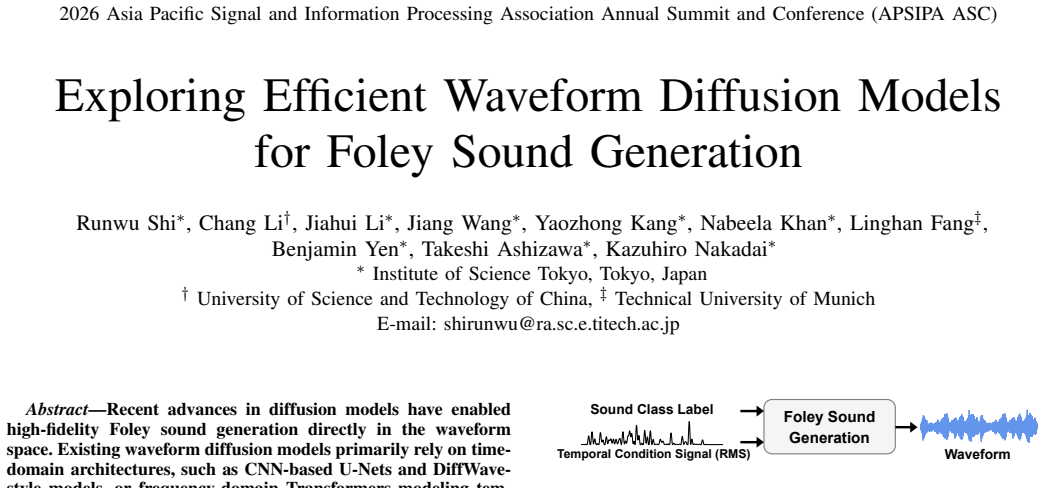
Recent advances in diffusion models have enabled high-fidelity Foley sound generation directly in the waveform space. Existing waveform diffusion models primarily rely on time-domain architectures, such as CNN-based U-Nets and DiffWave-style models, or frequency-domain Transformers modeling temporal dependencies. However, these systems are typically built with large model capacities and substantial computational costs, leaving compact and efficient waveform diffusion architectures largely underexplored. In this work, we introduce a Dual-Path (DP) architecture for waveform diffusion that performs dimension-wise self-attention along both subband and frame axes in the time-frequency domain. This DP design enables fine-grained temporal-spectral modeling while maintaining high efficiency. Based on the proposed DP backbone, we develop two variants: DP-DiT and DP-U-Net. Experiments on the DCASE and FSD-Kaggle2018 datasets demonstrate their superior performance. Notably, the 3M parameter variant achieves performance comparable to models with more than 50M parameters. Audio samples are available at https://samplesdemo.github.io/DP-Foley/.
Figures


Reference graph
Works this paper leans on
-
[1]
Foleygan: Visu- ally guided generative adversarial network-based syn- chronous sound generation in silent videos,
S. Ghose and J. J. Prevost, “Foleygan: Visu- ally guided generative adversarial network-based syn- chronous sound generation in silent videos,”IEEE Transactions on Multimedia, vol. 25, pp. 4508–4519, 2022
2022
-
[2]
The x-lance system for dcase2023 challenge task 7: Foley sound synthesis track b,
Z. Xie, X. Xu, B. Li, M. Wu, and K. Yu, “The x-lance system for dcase2023 challenge task 7: Foley sound synthesis track b,” Tech. Rep., June, Tech. Rep., 2023
2023
-
[3]
Mtdiffusion: Multi- task diffusion model with dual-unet for foley sound generation,
A. Qi, X. Xie, and J. Wang, “Mtdiffusion: Multi- task diffusion model with dual-unet for foley sound generation,” inICASSP 2024-2024 IEEE International Conference on Acoustics, Speech and Signal Processing (ICASSP), IEEE, 2024, pp. 461–465
2024
-
[4]
Rhythmic foley: A framework for seamless audio-visual alignment in video-to-audio synthesis,
Z. Huang, D. Luo, J. Wang, H. Liao, Z. Li, and Z. Wu, “Rhythmic foley: A framework for seamless audio-visual alignment in video-to-audio synthesis,” in ICASSP 2025-2025 IEEE International Conference on Acoustics, Speech and Signal Processing (ICASSP), IEEE, 2025, pp. 1–5
2025
-
[5]
T-foley: A controllable waveform-domain diffusion model for temporal-event- guided foley sound synthesis,
Y . Chung, J. Lee, and J. Nam, “T-foley: A controllable waveform-domain diffusion model for temporal-event- guided foley sound synthesis,” inICASSP 2024-2024 IEEE International Conference on Acoustics, Speech and Signal Processing (ICASSP), IEEE, 2024, pp. 6820– 6824
2024
-
[6]
Text-driven foley sound genera- tion with latent diffusion model,
Y . Yuan et al., “Text-driven foley sound genera- tion with latent diffusion model,”arXiv preprint arXiv:2306.10359, 2023
Pith/arXiv arXiv 2023
-
[7]
Audioldm: Text-to-audio genera- tion with latent diffusion models,
H. Liu et al., “Audioldm: Text-to-audio genera- tion with latent diffusion models,”arXiv preprint arXiv:2301.12503, 2023
Pith/arXiv arXiv 2023
-
[8]
Audioldm 2: Learning holistic audio generation with self-supervised pretraining,
H. Liu et al., “Audioldm 2: Learning holistic audio generation with self-supervised pretraining,”IEEE/ACM Transactions on Audio, Speech, and Language Process- ing, vol. 32, pp. 2871–2883, 2024
2024
-
[9]
Generative speech foundation model pre- training for high-quality speech extraction and restora- tion,
P.-J. Ku, A. H. Liu, R. Korostik, S.-F. Huang, S.-W. Fu, and A. Juki´c, “Generative speech foundation model pre- training for high-quality speech extraction and restora- tion,” inICASSP 2025-2025 IEEE International Con- ference on Acoustics, Speech and Signal Processing (ICASSP), IEEE, 2025, pp. 1–5
2025
-
[10]
Dual-path rnn: Ef- ficient long sequence modeling for time-domain single- channel speech separation,
Y . Luo, Z. Chen, and T. Yoshioka, “Dual-path rnn: Ef- ficient long sequence modeling for time-domain single- channel speech separation,” inICASSP 2020-2020 IEEE International Conference on Acoustics, Speech and Sig- nal Processing (ICASSP), IEEE, 2020, pp. 46–50
2020
-
[11]
A study on speech enhancement based on diffusion probabilistic model,
Y .-J. Lu, Y . Tsao, and S. Watanabe, “A study on speech enhancement based on diffusion probabilistic model,” in2021 Asia-Pacific Signal and Information Processing Association Annual Summit and Conference (APSIPA ASC), IEEE, 2021, pp. 659–666
2021
-
[12]
Unsupervised single-channel audio sep- aration with diffusion source priors,
R. Shi et al., “Unsupervised single-channel audio sep- aration with diffusion source priors,” inProceedings of the AAAI Conference on Artificial Intelligence, vol. 40, 2026, pp. 25 348–25 356
2026
-
[13]
Mambafoley: Foley sound generation using selective state-space models,
M. F. Colombo, F. Ronchini, L. Comanducci, and F. Antonacci, “Mambafoley: Foley sound generation using selective state-space models,” inICASSP 2025-2025 IEEE International Conference on Acoustics, Speech and Signal Processing (ICASSP), IEEE, 2025, pp. 1–5
2025
-
[14]
Full-band general audio synthesis with score- based diffusion,
S. Pascual, G. Bhattacharya, C. Yeh, J. Pons, and J. Serr`a, “Full-band general audio synthesis with score- based diffusion,” inICASSP 2023-2023 IEEE Inter- national Conference on Acoustics, Speech and Signal Processing (ICASSP), IEEE, 2023, pp. 1–5
2023
-
[15]
Diffwave: A versatile diffusion model for audio synthesis,
Z. Kong, W. Ping, J. Huang, K. Zhao, and B. Catan- zaro, “Diffwave: A versatile diffusion model for audio synthesis,” inInternational Conference on Learning Representations
-
[16]
Wavenet: A generative model for raw audio,
A. Van Den Oord et al., “Wavenet: A generative model for raw audio,”arXiv preprint arXiv:1609.03499, vol. 12, p. 1, 2016
Pith/arXiv arXiv 2016
-
[17]
Fregrad: Lightweight and fast frequency-aware diffusion vocoder,
T. D. Nguyen, J.-H. Kim, Y . Jang, J. Kim, and J. S. Chung, “Fregrad: Lightweight and fast frequency-aware diffusion vocoder,” inICASSP 2024-2024 IEEE Inter- national Conference on Acoustics, Speech and Signal Processing (ICASSP), IEEE, 2024, pp. 10 736–10 740
2024
-
[18]
Undiff: Unsupervised voice restoration with unconditional diffusion model,
A. Iashchenko, P. Andreev, I. Shchekotov, N. Babaev, and D. Vetrov, “Undiff: Unsupervised voice restoration with unconditional diffusion model,”arXiv preprint arXiv:2306.00721, 2023
Pith/arXiv arXiv 2023
-
[19]
Solving audio inverse problems with a diffusion model,
E. Moliner, J. Lehtinen, and V . V ¨alim¨aki, “Solving audio inverse problems with a diffusion model,” inICASSP 2023-2023 IEEE International Conference on Acoustics, Speech and Signal Processing (ICASSP), IEEE, 2023, pp. 1–5
2023
-
[20]
Foley sound synthesis at the dcase 2023 challenge,
K. Choi et al., “Foley sound synthesis at the dcase 2023 challenge,”arXiv preprint arXiv:2304.12521, 2023
Pith/arXiv arXiv 2023
-
[21]
Scalable diffusion models with transformers,
W. Peebles and S. Xie, “Scalable diffusion models with transformers,” inProceedings of the IEEE/CVF interna- tional conference on computer vision, 2023, pp. 4195– 4205
2023
-
[22]
E. Fonseca et al., “General-purpose tagging of freesound audio with audioset labels: Task description, dataset, and baseline,”arXiv preprint arXiv:1807.09902, 2018
Pith/arXiv arXiv 2018
-
[23]
Decoupled weight decay regularization,
I. Loshchilov and F. Hutter, “Decoupled weight decay regularization,”arXiv preprint arXiv:1711.05101, 2017
Pith/arXiv arXiv 2017
-
[24]
Fr\’echet audio distance: A metric for evalu- ating music enhancement algorithms,
K. Kilgour, M. Zuluaga, D. Roblek, and M. Shar- ifi, “Fr\’echet audio distance: A metric for evalu- ating music enhancement algorithms,”arXiv preprint arXiv:1812.08466, 2018
Pith/arXiv arXiv 2018
discussion (0)
Sign in with ORCID, Apple, or X to comment. Anyone can read and Pith papers without signing in.