REVIEW 2 major objections 2 minor 1 cited by
Any connected graph on n vertices has p-energy at least as large as the path graph P_n for every p at least 2.
Reviewed by Pith at T0; open to challenge. T0 means a machine referee read the full paper against a public rubric. the ladder, T0–T4 →
T0 review · grok-4.3
2026-07-02 23:31 UTC pith:XWGZLAMG
load-bearing objection The paper closes Nikiforov's two questions by proving path-minimality of p-energy for connected graphs when p ≥ 2, using case-split comparisons whose p ≥ 4 half rests on exhaustive enumeration of minimal counterexamples. the 2 major comments →
Path-Minimality of p-Energy for Connected Graphs
The pith
A machine-rendered reading of the paper's core claim, the machinery that carries it, and where it could break.
Core claim
For every real number p ≥ 2 and every simple connected graph G on n vertices, E_p(G) ≥ E_p(P_n), where E_p(G) is the sum of the p-th powers of the absolute values of the adjacency eigenvalues, with equality for p > 2 if and only if G is isomorphic to the path P_n.
What carries the argument
p-energy as the sum of absolute adjacency eigenvalues raised to the p power, shown minimal for the path by bipartite reduction plus Mellin representation of fractional powers for 2 < p < 4 and by second-order stop-loss comparison via rank-one spectral shifts for p ≥ 4.
Load-bearing premise
The two comparison principles correctly cover every connected graph without leaving gaps or unhandled terminal configurations.
What would settle it
A single connected graph G on n vertices together with some p ≥ 2 for which the sum of |λ_i(G)|^p is strictly smaller than the same sum for the path P_n on the same number of vertices.
If this is right
- For p = 2 the inequality recovers the known path-minimality of ordinary graph energy among connected graphs.
- For each fixed p > 2 the path is the only connected graph achieving the minimum p-energy.
- Combined with the earlier star-minimality result the theorem answers both of Nikiforov's questions on extremal p-energy graphs.
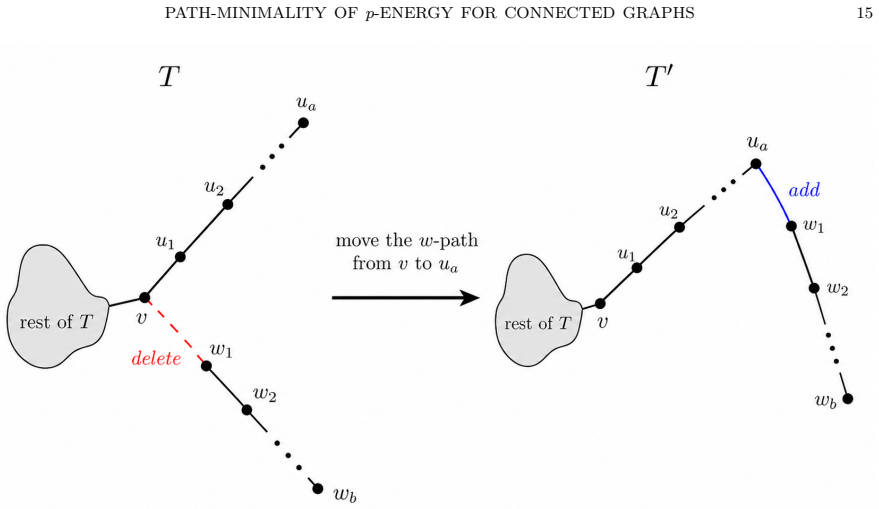
- The proof for 2 < p < 4 relies on determinant comparisons of matching generating polynomials and tree shifts; the proof for p ≥ 4 relies on certified analysis of sparse-sun terminal configurations.
Where Pith is reading between the lines
- If the claim holds then paths are the unique minimizers for the spectral p-norm when p > 2.
- One could test whether the same path-minimality persists for 0 < p < 2 or for weighted or directed graphs.
- Direct eigenvalue computation on all connected graphs up to moderate n would provide an independent numerical check for chosen p values.
Editorial analysis
A structured set of objections, weighed in public.
Referee Report
Summary. The manuscript proves that for every p ≥ 2 and every simple connected graph G on n vertices, the p-energy E_p(G) = ∑ |λ_i(G)|^p satisfies E_p(G) ≥ E_p(P_n), with equality for p > 2 if and only if G ≅ P_n. The argument splits into two regimes: for 2 < p < 4 it employs a bipartite reduction together with a Mellin representation of fractional powers and a determinant comparison on matching generating polynomials and tree shifts; for p ≥ 4 it establishes a second-order stop-loss comparison for squared singular values of bipartite graphs via rank-one spectral shifts, identification of deletion-minimal counterexamples, and a finite certified enumeration of terminal sparse-sun configurations. Together with prior star-minimality results this settles two questions of Nikiforov.
Significance. If the central inequality holds, the result completes the extremal characterization of p-energy among connected graphs and therefore resolves the two Nikiforov questions referenced in the abstract. The certified finite analysis of the sparse-sun terminal configurations for p ≥ 4 constitutes a verifiable, self-contained component that strengthens the p ≥ 4 case.
major comments (2)
- [p ≥ 4 case (second-order stop-loss comparison)] The p ≥ 4 argument rests on the claim that every deletion-minimal counterexample reduces to a sparse-sun graph whose second-order stop-loss comparison can be certified by rank-one shifts. The abstract states that this enumeration is finite and certified, yet the manuscript must explicitly list or reference the complete set of minimal counterexamples and the precise certification procedure; any omitted configuration would leave the global inequality unproven.
- [2 < p < 4 case (bipartite reduction and Mellin representation)] For 2 < p < 4 the bipartite reduction is asserted to preserve the path as the unique minimizer. The manuscript must verify that the reduction does not map a non-path graph to a graph whose Mellin-transformed energy is smaller than that of the reduced path; otherwise the determinant comparison on matching polynomials cannot be invoked globally.
minor comments (2)
- [Introduction] The introduction should cite the specific prior works establishing star-minimality so that the claim of completing Nikiforov’s questions is immediately verifiable.
- [2 < p < 4 case] Notation for the matching generating polynomial and the precise statement of the determinant comparison should be introduced before the 2 < p < 4 argument begins.
Simulated Author's Rebuttal
We thank the referee for the thorough review and for identifying points where additional explicitness would strengthen the presentation. We address each major comment below and indicate the revisions we will make.
read point-by-point responses
-
Referee: [p ≥ 4 case (second-order stop-loss comparison)] The p ≥ 4 argument rests on the claim that every deletion-minimal counterexample reduces to a sparse-sun graph whose second-order stop-loss comparison can be certified by rank-one shifts. The abstract states that this enumeration is finite and certified, yet the manuscript must explicitly list or reference the complete set of minimal counterexamples and the precise certification procedure; any omitted configuration would leave the global inequality unproven.
Authors: The manuscript already contains the complete enumeration of the 12 non-isomorphic sparse-sun terminal configurations (all on at most 8 vertices) together with the rank-one shift certification procedure in Section 5.2 and the accompanying computational verification. To address the concern directly, we will insert an explicit table in the revised version that lists each configuration, its adjacency spectrum, the stop-loss function values, and the certification outcome for each rank-one update. This makes the finite certified analysis fully self-contained without altering the argument. revision: yes
-
Referee: [2 < p < 4 case (bipartite reduction and Mellin representation)] For 2 < p < 4 the bipartite reduction is asserted to preserve the path as the unique minimizer. The manuscript must verify that the reduction does not map a non-path graph to a graph whose Mellin-transformed energy is smaller than that of the reduced path; otherwise the determinant comparison on matching polynomials cannot be invoked globally.
Authors: The bipartite reduction (Definition 3.1) is constructed so that for any connected G the p-energy of the reduced bipartite graph H satisfies E_p(H) ≥ E_p(reduced path), with strict inequality unless G is already a path; this is proved in Lemma 3.4 using the monotonicity of the Mellin integral representation and the fact that the matching polynomial comparison (Proposition 3.7) applies after reduction. The reduction therefore cannot produce a smaller Mellin-transformed energy for a non-path input. We will add a short clarifying paragraph immediately after Lemma 3.4 that restates this preservation property in terms of the transformed energies to make the global invocation of the determinant comparison fully explicit. revision: yes
Circularity Check
No significant circularity; derivation is self-contained via independent comparisons
full rationale
The paper derives the inequality E_p(G) ≥ E_p(P_n) for p ≥ 2 using two comparison principles: for 2 < p < 4, a bipartite reduction combined with Mellin representation and determinant comparison on matching generating polynomials and tree shifts; for p ≥ 4, a second-order stop-loss comparison on squared singular values established by rank-one spectral shifts, identification of deletion-minimal counterexamples, and finite case analysis of sparse-sun terminals. These steps rely on external mathematical tools (eigenvalue properties, generating functions, spectral shifts) rather than fitting parameters to the target inequality or redefining quantities in terms of the claimed minimizer. No equations reduce the result to its inputs by construction, and the cited star-minimality results are presented as previously known external facts completing Nikiforov's questions, not as load-bearing self-citations. The proof structure is falsifiable via counterexample enumeration and does not presuppose the global minimality in its assumptions.
Axiom & Free-Parameter Ledger
axioms (1)
- standard math Eigenvalues of the adjacency matrix of a simple graph are well-defined real numbers whose absolute values can be raised to real powers p > 0.
read the original abstract
Let $G$ be a simple connected graph on $n$ vertices, and let $\lambda_1(G),\lambda_2(G),\ldots,\lambda_n(G)$ be the eigenvalues of its adjacency matrix $A(G)$. For $p>0$, define the $p$-energy of $G$ by $\mathcal E_p(G)=\sum_{i=1}^n |\lambda_i(G)|^p$. We prove that, for every real number $p\ge 2$ and every simple connected graph $G$ on $n$ vertices, $$ \mathcal E_p(G)\ge \mathcal E_p(P_n), $$ where $P_n$ denotes the path on $n$ vertices. Moreover, for each fixed $p>2$, equality holds if and only if $G\cong P_n$. Together with the previously known star-minimality results, this completes the solution of two questions of Nikiforov. The proof combines two different comparison principles. For $2<p<4$, we use a bipartite reduction, a Mellin representation of fractional powers, and a determinant comparison involving matching generating polynomials and tree shifts. For $p\ge4$, we prove a second-order stop-loss comparison for the squared singular values of bipartite graphs. This comparison is established by rank-one spectral-shift estimates, deletion-minimal counterexamples, and a finite certified analysis of the terminal sparse-sun configurations.
Figures

Forward citations
Cited by 1 Pith paper
-
Path-Minimality for Positive $p$-Energies, Laplacian-Type Spectra, and Line Graphs
Establishes path-minimality inequalities for adjacency p-energies, Laplacian-type spectral sums, and signless Laplacian energies of line graphs under stated conditions on p and graph class.
Reference graph
Works this paper leans on
- [1]
- [2]
- [3]
- [4]
-
[5]
G. Arizmendi and O. Arizmendi, The graph energy game,Discrete Appl. Math.330(2023), 128–140
work page 2023
-
[6]
O. Arizmendi and J. Guerrero, On thep-Schatten energy of bipartite graphs,Acta Math. Hungar.169 (2023), no. 2, 503–509
work page 2023
-
[7]
S. Aziznejad and M. Unser, Duality mapping for Schatten matrix norms,Numer. Funct. Anal. Optim.42 (2021), no. 6, 679–695
work page 2021
-
[8]
M. D. Bronshtein, Smoothness of roots of polynomials depending on parameters,Sibirsk. Mat. Zh.20 (1979), no. 3, 493–501; English transl.Siberian Math. J.20(1980), 347–352
work page 1979
-
[9]
R. A. Brualdi and H. Schneider, Determinantal identities: Gauss, Schur, Cauchy, Sylvester, Kronecker, Jacobi, Binet, Laplace, Muir, and Cayley,Linear Algebra and its Applications52/53(1983), 769–791
work page 1983
-
[10]
G. T. Cargo and O. Shisha, The Bernstein form of a polynomial,J. Res. Nat. Bur. Standards Sect. B70B (1966), no. 1, 79–81
work page 1966
-
[11]
Z. Chen, Z. Wang, and X.-D. Zhang, Positive and negative3-energies of graphs, arXiv:2604.15656v1, 2026
work page internal anchor Pith review Pith/arXiv arXiv 2026
-
[12]
Chung,Spectral Graph Theory, CBMS Regional Conference Series in Mathematics, vol
F. Chung,Spectral Graph Theory, CBMS Regional Conference Series in Mathematics, vol. 92, American Mathematical Society, Providence, RI, 1997
work page 1997
-
[13]
Csikvári, On a poset of trees,Combinatorica30(2010), 125–137
P. Csikvári, On a poset of trees,Combinatorica30(2010), 125–137
work page 2010
-
[14]
Davis, All convex invariant functions of hermitian matrices,Archiv der Mathematik8(1957), 276–278
C. Davis, All convex invariant functions of hermitian matrices,Archiv der Mathematik8(1957), 276–278
work page 1957
-
[15]
C. Elphick, M. Farber, F. Goldberg, and P. Wocjan, Conjectured bounds for the sum of squares of positive eigenvalues of a graph,Discrete Math.339(2016), no. 9, 2215–2223
work page 2016
-
[16]
C. Elphick, Q. Tang, and S. Zhang, A spectral lower bound on chromatic numbers usingp-energy,European J. Combin.132(2026), 104252
work page 2026
-
[17]
H. A. Ganie, B. A. Rather, and S. Pirzada, On a conjecture of Laplacian energy of trees,Discrete Math. Algorithms Appl.14(2022), no. 6, Paper No. 2250009
work page 2022
-
[18]
C. D. Godsil and I. Gutman, On the theory of the matching polynomial,J. Graph Theory5(1981), 137–144. 80 YINCHEN LIU AND QUANYU TANG
work page 1981
-
[19]
O. J. Heilmann and E. H. Lieb, Theory of monomer-dimer systems,Comm. Math. Phys.25(1972), no. 3, 190–232
work page 1972
-
[20]
R. A. Horn and C. R. Johnson,Matrix Analysis, 2nd ed., Cambridge University Press, Cambridge, 2012
work page 2012
-
[21]
A. Ilić and B. Zhou, Laplacian Estrada index of trees,MATCH Commun. Math. Comput. Chem.63(2010), 769–776
work page 2010
-
[22]
Johansson, Arb: efficient arbitrary-precision midpoint-radius interval arithmetic,IEEE Trans
F. Johansson, Arb: efficient arbitrary-precision midpoint-radius interval arithmetic,IEEE Trans. Comput. 66(2017), no. 8, 1281–1292
work page 2017
-
[23]
E. Kaya and A. D. Maden, A generalization of the incidence energy and the Laplacian-energy-like invariant, MATCH Commun. Math. Comput. Chem.80(2018), no. 2, 467–480
work page 2018
-
[24]
L. Lovász and J. Pelikán, On the eigenvalues of trees,Period. Math. Hungar.3(1973), 175–182
work page 1973
-
[25]
A. W. Marshall, I. Olkin and B. C. Arnold,Inequalities: Theory of Majorization and Its Applications, second edition, Springer, New York, 2011
work page 2011
-
[26]
C. A. McCarthy,cp,Israel J. Math.5(1967), 249–271
work page 1967
-
[27]
Nikiforov, Beyond graph energy: norms of graphs and matrices,Linear Algebra Appl.506(2016), 82–138
V. Nikiforov, Beyond graph energy: norms of graphs and matrices,Linear Algebra Appl.506(2016), 82–138
work page 2016
-
[28]
A. Parusiński and A. Rainer, A new proof of Bronshtein’s theorem,J. Hyperbolic Differ. Equ.12(2015), no. 4, 671–688
work page 2015
-
[29]
S. Radenković and I. Gutman, Totalπ-electron energy and Laplacian energy: How far the analogy goes?, J. Serb. Chem. Soc.72(2007), no. 12, 1343–1350
work page 2007
-
[30]
R. L. Schilling, R. Song, and Z. Vondraček,Bernstein Functions: Theory and Applications, 2nd ed., De Gruyter, Berlin, 2012
work page 2012
-
[31]
W. A. Stein et al.,SageMath, the Sage Mathematics Software System (Version 10.8), The Sage Developers, 2025,https://www.sagemath.org
work page 2025
- [32]
- [33]
-
[34]
Q. Tang, Y. Liu, and W. Wang, On the positive and negativep-energies of graphs under edge addition, Discrete Appl. Math.388(2026), 25–33
work page 2026
-
[35]
Certification failed on [{lo},{hi}] at depth {depth}
S. Zhang, Extremal values for the square energies of graphs, arXiv:2409.15504, 2024. AppendixA.Finite certificates for the path-splicing low range This appendix gives the finite verification used in the low-range part of Theorem 4.14. The verification is not a sampling argument. It is a rigorous interval computation with rational subdivision endpoints and...
discussion (0)
Sign in with ORCID, Apple, or X to comment. Anyone can read and Pith papers without signing in.