REVIEW 4 major objections 5 minor 30 references
Rethinking Multi-User Communication in Semantic Domain: Enhanced OMDMA by Shuffle-Based Orthogonalization and Diffusion Denoising
T0 review · 4 major / 5 minor · reviewed 2026-08-15 · deepseek-v4-flash
Pith's one-line read Shuffling each user's semantic features converts inter-user interference into Gaussian-like noise, so a single diffusion denoiser trained only for point-to-point links can serve all users without retraining.
desk verdict Genuinely useful framework for training-free multi-user semantic communication, but the central Gaussianization premise is asserted rather than derived; worth serious refereeing. read the letter →
The pith
A machine-rendered reading of the paper's core claim, the machinery that carries it, and where it could break.
The reading
What carries the argument
The load-bearing object is the shuffle-based mapping $C_k$, which randomly permutes the $2N$ entries of the JSCC feature vector $f_k$ by a user-specific permutation $p_k$ and then pairs the reordered entries into $N$ complex symbols, $[C_k(f_k)]_i = [f_k]_{p_{k,i}} + j[f_k]_{p_{k,i}+N}$. Its work is to make every other user's contribution $C_k^{-1}(C_m(f_m))$ a shuffled rearrangement of structured features, which Lemma 1 treats as standard Gaussian noise, collapsing the received feature into $\hat{f}_k = \alpha_k f_k + \tau_k n_r$, the exact form of a scaled clean signal plus Gaussian corruption. On top of that reduction sit two components: step matching, which sets the diffusion starting point by matching $\tau_k/\sqrt{\alpha_k^2+\tau_k^2}$ to the cumulative noise schedule $\sqrt{\bar{\beta}_t}$ and then applies deterministic (DDIM-style) reverse sampling using a denoiser trained only on point-to-point AWGN channels, and semantic-aware beamforming, which replaces the unavailable closed-form objective with a fitted generalized-logistic curve of reconstruction quality and solves the resulting nonconvex problem by majorization-minimization with a quadratic transformation. For correlated data, a CLIP-based similarity metric groups users and a phase-aligned cooperative beamforming post-processing exploits the empirical condition $\angle(h_i^H \bar{v}_j) + \angle(h_j^H \bar{v}_i) \approx 0$ to make paired users' interference constructive.
What would settle it
A direct test: take the actual shared JSCC encoder, extract a single feature vector $f$ from a typical image, shuffle it once, and run a normality check, for example a Kolmogorov-Smirnov or Shapiro-Wilk test on the entries, or a check of the off-diagonal covariance of the shuffled vector, repeated over many images to get a rejection rate. If most single shuffled vectors fail the test, the premise behind Lemma 1 fails in its simplest case, and the measurable consequence should appear with just two users (one interferer, no averaging over many): the reconstruction error of the diffusion-denoiser pipeline should visibly deviate from the curve obtained by injecting pure Gaussian noise of the same power. The same test applied to an encoder trained with an entropy or sparsity penalty would show whether the Gaussianization claim is a property of the shuffle or only of this particular encoder's feature statistics.
Extended reading notes
Core claim
The paper's central claim is that inter-user interference in multi-user semantic communication can be transformed, at the symbol-mapping stage, from structured semantic attack into Gaussian-like noise. Each user $k$ is assigned a unique random permutation $p_k$, and the mapping $C_k$ pairs the shuffled entries of the JSCC feature vector $f_k$ into complex channel symbols, so that the inverse mapping used at receiver $k$ returns $C_k^{-1}(C_m(f_m))$ for an interferer $m$, a shuffled version of that user's features. Invoking Lemma 1, which assumes such shuffled interference is distributed as $\mathcal{N}(0, I)$, the received latent feature is shown to reduce to the clean form $\hat{f}_k = \alpha_k f_k + \tau_k n_r$ with $n_r \sim \mathcal{N}(0, I)$, where $\alpha_k$ is the desired signal gain and $\tau_k$ aggregates interference and channel-noise power. Because this is precisely the clean-signal-plus-Gaussian form of an intermediate diffusion state, the receiver normalizes the signal, matches $\tau_k/\sqrt{\alpha_k^2+\tau_k^2}$ to the diffusion noise schedule to find a starting timestep, and runs deterministic reverse diffusion with the point-to-point denoiser. On the transmit side, beamforming is optimized against a generalized-logistic approximation of the semantic-fidelity curve rather than a closed-form rate expression. The paper reports that this recipe matches or exceeds jointly trained and user-specific baselines on PSNR, LPIPS, and CLIP scores, and that grouping semantically similar users with cooperative phase-aligned beamforming adds further gains when the transmitted images share content.
Load-bearing premise
The entire scheme rests on the premise, stated as the hypothesis of Lemma 1 in Section III-B and supported only by the empirical plots of Section III-A, that after shuffling, one user's feature vector is statistically indistinguishable from standard Gaussian noise; but a random shuffle only rearranges the entries of a fixed vector, so a vector whose entries are not already roughly independent Gaussian samples cannot become Gaussian by shuffling.
Editorial extensions
If this is right
- A base station can add or remove users without any retraining: the shared JSCC encoder-decoder and diffusion denoiser are trained once in a point-to-point setting, and only the per-user permutation pattern changes.
- Interference no longer needs a statistical model: after shuffling, all structured semantic interference is demoted to channel noise, so the whole point-to-point denoising chain applies unchanged.
- Shuffling patterns function as implicit private keys: an eavesdropping or non-target user sees a stream statistically indistinguishable from Gaussian noise, so semantic content is not recoverable without the intended pattern.
- Semantic quality under interference, measured by LPIPS and CLIP score, improves most exactly in the regime where interference dominates, high SNR with many users, because that is where demoting interference to noise changes the outcome.
- For users requesting correlated content, grouping by CLIP similarity and pairing users for phase-aligned cooperative beamforming converts part of the interference into useful signal energy, producing the largest gains at low SNR.
Reading between the lines
- An implicit distinction the paper does not separate: Gaussianization is either a property of a single feature vector's entries (roughly i.i.d. standard Gaussian, so any permutation still looks Gaussian) or a central-limit effect over many interferers; the first fails for sparse, peaky, or spatially correlated encoder outputs, and the paper concedes in its conclusion that optimal shuffle patterns r
- If the premise holds, the framework's natural regime is overloaded access, $K > N_t$, where user-specific OMDMA models become impractical; the ablation in the paper suggests the shuffle's benefit concentrates precisely where the user count exceeds the antenna count.
- Because the trained models are user-agnostic, the shuffling pattern can be rotated per session or per image block without retraining, effectively turning the scheme into a low-cost physical-layer cipher in the semantic domain.
- A cheap pre-deployment audit would test the premise directly: run a normality test on the entries of shuffled feature vectors from the actual encoder; rejection would predict where the diffusion denoiser begins to hurt rather than help, and would motivate the content-adaptive 'local shuffle' the paper leaves to future work.
Signed reviews
Editorial analysis
A structured set of objections, weighed in public.
Referee Report
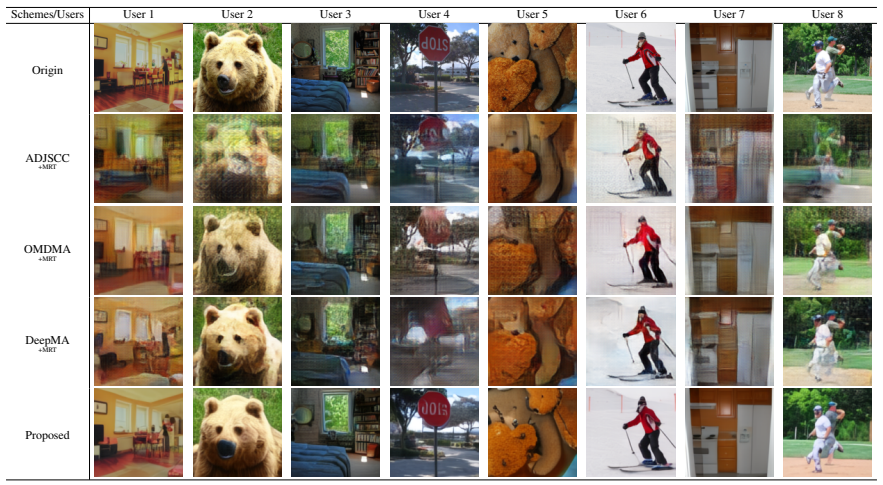
Summary. The paper proposes a multi-user downlink semantic communication framework in which a single, point-to-point-trained JSCC encoder/decoder and a single diffusion denoiser support all users. Inter-user interference is handled by assigning each user a unique random shuffling pattern before complex symbol mapping; the authors argue that this makes interfering JSCC features statistically indistinguishable from Gaussian noise, so that diffusion denoising and step matching designed for AWGN channels can be reused without retraining. A semantic-aware beamforming problem is formulated through a generalized-logistic surrogate for reconstruction quality, and an extension for semantically correlated users groups users by CLIP similarity and applies a cooperative phase-aligned beamforming strategy. The paper reports simulations on COCO and VIMEO showing that the proposed method improves PSNR, LPIPS, and CLIP scores over ADJSCC, OMDMA, and DeepMA baselines, together with ablations supporting the diffusion denoiser and shuffle-based mapping.
Significance. If the central Gaussianization premise holds, the framework is practically significant: it removes the need for user-specific JSCC models and additional training for multi-user semantic communication, while also providing a privacy mechanism through user-specific shuffling patterns. The paper deserves credit for a clean system formulation, for reusing pretrained point-to-point models as an external artifact, and for evaluating the approach against standard multi-user baselines with visual examples. However, the significance is conditional: the theoretical core, Lemma 1, assumes rather than proves that shuffled interferers are independent isotropic Gaussian noise, and the correlated-data extension relies on an unquantified empirical phase condition. These issues must be addressed before the claimed generality can be accepted.
major comments (4)
- [§III-A, Remark 1 and Lemma 1 (Eq. (10))] The proof of Lemma 1 assumes as its hypothesis the property C_k^{-1}(C_m(f)) ∼ N(0,I) for m≠k, but this property is asserted rather than derived. Conditional on a fixed latent vector f, a random permutation merely reorders the entries, so the shuffled vector is supported on permutations of that fixed vector; unconditionally, it is a mixture of permuted copies of the latent distribution, which is not jointly Gaussian unless p(f) already has very special invariance properties. The paper's own Fig. 2(a) reports that p(f) deviates from Gaussian, and the empirical justification in Remark 1 and Section III-A is based on marginal histograms and t-SNE projections, which do not establish joint Gaussianity or independence across coordinates. Since Eq. (10), the step-matching rule (20), and the use of a diffusion denoiser trained only on AWGN all depend on the interference-plus-noise being independent isotropic Gaussian, this is the load-bearing step of the paper. I ask the authors to either provide conditions under which the shuffled interference provably converges to N(0,I), or supply quantitative distributional evidence on the actual SA-1B features (e.g., covariance and independence tests, higher-order cumulants, or a Gaussianity test statistic), or explicitly reframe Lemma 1 as an empirical approximation with measured error bounds.
- [§III-B, Algorithm 1, Eq. (20)] Even if the marginal distributions of the shuffled interference are approximately Gaussian, the step-matching rule (20) matches only the scalar ratio τ_k/sqrt(α_k^2+τ_k^2) against the diffusion schedule sqrt(β̄_t). The denoiser is trained on additive white Gaussian noise in a point-to-point setting, so any residual structure in the interference—coordinate dependence, heterogeneous variances across feature dimensions, heavy tails, or correlation between the real and imaginary components—survives the power normalization and is not repaired by the denoiser. The paper should quantify how close the actual interference-plus-noise input is to the Gaussian assumption used at training time, for example by feeding true Gaussian noise and shuffle-transformed interference into the same receiver at the same power and reporting the resulting output PSNR/LPIPS/CLIP, rather than only qualitative curves in Fig. 2(b).
- [§III-C, Eq. (21)–(30)] The beamforming objective in P1 is built on the generalized-logistic approximation S(γ)≈a+b/(c+γ^{-e}), but the hyperparameters a,b,c,d,e are never specified, fitted, or validated against the actual JSCC+diffusion model used in the simulations. The stated relation e=10d/ln10 is also dimensionally unclear if d is a slope in dB and e is used as an exponent on a linear SINR term. The tightness of the surrogate lower bound (26) and the convergence of Algorithm 2 depend on this model, yet the ablation in Fig. 9(a) validates only the final beamforming versus other beamformers, not the logistic approximation itself. Please provide the fitted parameter values and the data used to fit them, and include a sensitivity analysis of the reported gains with respect to these parameters.
- [§IV-C, Algorithm 4] The cooperative phase-alignment step for two-user groups relies on the stated empirical condition ∠(h_i^H v̄_j)+∠(h_j^H v̄_i)≈0, which appears in the text without evidence or derivation. Since the correlated-data gains in Figs. 11 and 12 depend on this phase alignment, the paper should either justify this condition analytically, provide the measured distribution of the phase sum over the simulated channels, or relax the design so that it does not depend on an unquantified empirical observation.
minor comments (5)
- [§II-A] There are several typos and wording errors that should be corrected: "tranceiver" for transceiver, "yeilding" for yielding, "distrupt" for disrupt, and "iteratively denies" for "iteratively denoises" in the introduction.
- [§II-A.2, Eq. (4)] The noise notation is inconsistent: the text writes σn with n∼CN(0,1) and then says σ^2 is the noise power; please define σ explicitly as the noise amplitude or write the noise term as n∼CN(0,σ^2) to avoid ambiguity.
- [§III-C, Eq. (21)] The two displayed forms of the logistic approximation use γ[dB] and γ^{-e} in the same equation; please clarify the units of γ in each form and define d and e in one place without the dimensionally unclear relation e=10d/ln10.
- [§IV-B, Algorithm 3, line 14] The objective in the exhaustive partition step reuses the index i in both the outer and inner sums; the inner sum should use a different index (e.g., j∈G_{l,i} and k∈G_{l,j}) to be mathematically well defined.
- [§V-A] The parameter SN used to duplicate images and to define the video scenario is not formally defined before it appears in the description of the correlated-data experiments; please define it explicitly in Section V-A.
Circularity Check
No significant circularity: the Gaussianization premise in Lemma 1 is an empirical assumption rather than a fitted constant or self-citation chain, and the pipeline is validated end-to-end.
full rationale
I walked the claimed derivation chain: shuffle-based mapping (Eq. 8-9), the conditional received-signal model in Lemma 1 (Eq. 10), diffusion step matching (Eq. 20), and the logistic-surrogate beamforming problem (Eq. 21-28). No fitted parameter is later reported as a prediction: the only fitted object is the logistic approximation S(γ) in (21), which serves as a beamforming objective, while the reported PSNR/LPIPS/CLIP results come from end-to-end simulations on COCO and VIMEO (Section V), not from evaluating S(γ). Lemma 1 is explicitly conditional on C_k^{-1}(C_m(f)) ~ N(0,I), and Remark 1 supports that condition with t-SNE and LPIPS observations (Fig. 2), not with a distributional proof; although a random shuffle preserves the multiset of a fixed vector and joint Gaussianity is therefore not automatic, this is an unsupported empirical premise and a correctness risk, not a circular reduction in which the conclusion is the input by construction. The pretrained JSCC and diffusion models from [19] and the majorization-minimization lower bound from [27] are external artifacts or standard inequalities; they do not force the multi-user result through a self-citation chain. The conclusion's admission that the optimal shuffle strategy remains to be developed further confirms that the design is not presented as a proven necessity. Overall, no significant circularity is found.
Assumptions & free parameters
free parameters (2)
- Logistic curve parameters a, b, c, d, e =
not reported
- CLIP similarity threshold th =
not reported
assumptions (6)
- ad hoc to paper C_k^{-1}(C_m(f)) ~ N(0,I) for m != k
- domain assumption Perfect CSI and ideal phase compensation at receivers
- domain assumption The pretrained point-to-point diffusion model from [19] denoises arbitrary noise levels and matches the JSCC feature statistics
- ad hoc to paper The generalized logistic function in Eq. (21) accurately models reconstruction quality versus SINR
- domain assumption CLIP embeddings measure semantic similarity relevant to cooperative transmission gain
- ad hoc to paper Empirical condition angle(h_i^H v_j) + angle(h_j^H v_i) approximately 0 in correlated-user groups
Cite this review
Pith. "Pith review of Rethinking Multi-User Communication in Semantic Domain: Enhanced OMDMA by Shuffle-Based Orthogonalization and Diffusion Denoising." pith.science (2026). https://pith.science/paper/XWVBFCDV
@misc{pith2026250720477,
  author       = {Pith},
  title        = {Pith review of: Rethinking Multi-User Communication in Semantic Domain: Enhanced OMDMA by Shuffle-Based Orthogonalization and Diffusion Denoising},
  year         = {2026},
  howpublished = {\url{https://pith.science/paper/XWVBFCDV}},
  note         = {Machine review of arXiv:2507.20477}
}
read the original abstract
Inter-user interference remains a critical bottleneck in wireless communication systems, particularly in the emerging paradigm of semantic communication (SemCom). Compared to traditional systems, inter-user interference in SemCom severely degrades key semantic information, often causing worse performance than Gaussian noise under the same power level. To address this challenge, inspired by the recently proposed concept of Orthogonal Model Division Multiple Access (OMDMA) that leverages semantic orthogonality rooted in the personalized joint source and channel (JSCC) models to distinguish users, we propose a novel, scalable framework that eliminates the need for user-specific JSCC models as did in original OMDMA. Our key innovation lies in shuffle-based orthogonalization, where randomly permuting the positions of JSCC feature vectors transforms inter-user interference into Gaussian-like noise. By assigning each user a unique shuffling pattern, the interference is treated as channel noise, enabling effective mitigation using diffusion models (DMs). This approach not only simplifies system design by requiring a single universal JSCC model but also enhances privacy, as shuffling patterns act as implicit private keys. Additionally, we extend the framework to scenarios involving semantically correlated data. By grouping users based on semantic similarity, a cooperative beamforming strategy is introduced to exploit redundancy in correlated data, further improving system performance. Extensive simulations demonstrate that the proposed method outperforms state-of-the-art multi-user SemCom frameworks, achieving superior semantic fidelity, robustness to interference, and scalability-all without requiring additional training overhead.
Figures


Figures from the paper (9 more)




Reference graph
Works this paper leans on
-
[1]
Beyond transmitting bits: Context, semantics, and task-oriented communications,
D. G ¨und¨uz, Z. Qin, I. E. Aguerri, H. S. Dhillon, Z. Yang, A. Yener, K. K. Wong, and C.-B. Chae, “Beyond transmitting bits: Context, semantics, and task-oriented communications,” IEEE Journal on Selected Areas in Communications, vol. 41, no. 1, pp. 5–41, 2023
2023
-
[2]
H.-L. Qin, J. Dai, S. Wang, X. Qin, S. Shao, K. Niu, W. Xu, and P. Zhang, “Neural coding is not always semantic: Towards the stan- dardized coding workflow in semantic communications,” arXiv preprint arXiv:2505.18637, 2025
work page Pith review arXiv 2025
-
[3]
What is semantic communication? a view on conveying meaning in the era of machine intelligence,
Q. Lan, D. Wen, Z. Zhang, Q. Zeng, X. Chen, P. Popovski, and K. Huang, “What is semantic communication? a view on conveying meaning in the era of machine intelligence,” Journal of Communications and Information Networks , vol. 6, no. 4, pp. 336–371, 2021
work page 2021
-
[4]
Deep joint source-channel coding for semantic communications,
J. Xu, T.-Y . Tung, B. Ai, W. Chen, Y . Sun, and D. G ¨und¨uz, “Deep joint source-channel coding for semantic communications,” IEEE communi- cations Magazine, vol. 61, no. 11, pp. 42–48, 2023
work page 2023
-
[5]
A unified multi-task semantic communication system for multimodal data,
G. Zhang, Q. Hu, Z. Qin, Y . Cai, G. Yu, and X. Tao, “A unified multi-task semantic communication system for multimodal data,” IEEE Transactions on Communications, vol. 72, no. 7, pp. 4101–4116, 2024
2024
-
[6]
Deep joint source- channel coding for wireless image transmission,
E. Bourtsoulatze, D. B. Kurka, and D. G ¨und¨uz, “Deep joint source- channel coding for wireless image transmission,” IEEE Trans. Cogn. Commun. Netw., vol. 5, no. 3, pp. 567–579, 2019
2019
-
[7]
Nonlinear transform source-channel coding for semantic communications,
J. Dai, S. Wang, K. Tan, Z. Si, X. Qin, K. Niu, and P. Zhang, “Nonlinear transform source-channel coding for semantic communications,” IEEE J. Sel. Areas Commun. , vol. 40, no. 8, pp. 2300–2316, 2022
2022
-
[8]
Channel-adaptive wireless image transmission with OFDM,
H. Wu, Y . Shao, K. Mikolajczyk, and D. G ¨und¨uz, “Channel-adaptive wireless image transmission with OFDM,” IEEE Wireless Commun. Lett., vol. 11, no. 11, pp. 2400–2404, 2022
2022
Show all 30 references
-
[9]
Wireless image transmission using deep source channel coding with attention modules,
J. Xu, B. Ai, W. Chen, A. Yang, P. Sun, and M. Rodrigues, “Wireless image transmission using deep source channel coding with attention modules,” IEEE Trans. Circuits Syst. Video Technol. , vol. 32, no. 4, pp. 2315–2328, 2021
2021
-
[10]
Deep joint source-channel coding for wireless image transmission with adaptive rate control,
M. Yang and H.-S. Kim, “Deep joint source-channel coding for wireless image transmission with adaptive rate control,” in ICASSP 2022-2022 IEEE International Conference on Acoustics, Speech and Signal Pro- cessing (ICASSP), pp. 5193–5197, 2022
2022
-
[11]
Predictive and adaptive deep coding for wireless image transmission in semantic communication,
W. Zhang, H. Zhang, H. Ma, H. Shao, N. Wang, and V . C. Leung, “Predictive and adaptive deep coding for wireless image transmission in semantic communication,” IEEE Transactions on Wireless Communica- tions, vol. 22, no. 8, pp. 5486–5501, 2023
2023
-
[12]
Swinjscc: Taming swin transformer for deep joint source-channel coding,
K. Yang, S. Wang, J. Dai, X. Qin, K. Niu, and P. Zhang, “Swinjscc: Taming swin transformer for deep joint source-channel coding,” IEEE Trans. Cogn. Commun. Netw. , 2024
2024
-
[13]
Generative joint source-channel coding for semantic image transmission,
E. Erdemir, T.-Y . Tung, P. L. Dragotti, and D. G¨und¨uz, “Generative joint source-channel coding for semantic image transmission,” IEEE J. Sel. Areas Commun., vol. 41, no. 8, pp. 2645–2657, 2023
2023
-
[14]
Denoising diffusion probabilistic models,
J. Ho, A. Jain, and P. Abbeel, “Denoising diffusion probabilistic models,” Proc. Adv. in Neural Inf. Proc. Sys. (NeurIPS) , pp. 6840–6851, 2020
2020
-
[15]
High perceptual quality wireless image delivery with denoising diffusion models,
S. F. Yilmaz, X. Niu, B. Bai, W. Han, L. Deng, and D. Gunduz, “High perceptual quality wireless image delivery with denoising diffusion models,” [Online]. Available: https://arxiv.org/abs/2309.15889, 2023
2023 arXiv
-
[16]
Commin: Semantic image communications as an inverse problem with inn-guided diffusion models,
J. Chen, D. You, D. G ¨und¨uz, and P. L. Dragotti, “Commin: Semantic image communications as an inverse problem with inn-guided diffusion models,” in IEEE Int’l Conf. on Acous., Speech and Sig. Proc. (ICASSP), pp. 6675–6679, Seoul, Korea, 2024
2024
-
[17]
CDDM: Channel denoising diffusion models for wireless semantic communications,
T. Wu, Z. Chen, D. He, L. Qian, Y . Xu, M. Tao, and W. Zhang, “CDDM: Channel denoising diffusion models for wireless semantic communications,” IEEE Trans. Wireless Commun. , 2024
2024
-
[18]
Latent diffusion model-enabled real-time semantic communication consider- ing semantic ambiguities and channel noises,
J. Pei, F. Cheng, P. Wang, H. Tabassum, and D. Shi, “Latent diffusion model-enabled real-time semantic communication consider- ing semantic ambiguities and channel noises,” [Online]. Available: https://arxiv.org/abs/2406.06644, 2024
2024 arXiv
-
[19]
Semantics- guided diffusion for deep joint source-channel coding in wireless image transmission,
M. Zhang, H. Wu, G. Zhu, R. Jin, X. Chen, and D. G ¨und¨uz, “Semantics- guided diffusion for deep joint source-channel coding in wireless image transmission,” arXiv preprint arXiv:2501.01138 , 2025
2025 arXiv
-
[20]
Orthogonal model division multiple access,
H. Liang, K. Liu, X. Liu, H. Jiang, C. Dong, X. Xu, K. Niu, and P. Zhang, “Orthogonal model division multiple access,” IEEE Trans. Wireless Commun., 2024
2024
-
[21]
Non-orthogonal multiple access enhanced multi-user semantic communication,
W. Li, H. Liang, C. Dong, X. Xu, P. Zhang, and K. Liu, “Non-orthogonal multiple access enhanced multi-user semantic communication,” [On- line]. Available: https://arxiv.org/abs/2303.06597, 2023
2023 arXiv
-
[22]
Deepma: End-to-end deep multiple access for wireless image transmission in semantic communication,
W. Zhang, K. Bai, S. Zeadally, H. Zhang, H. Shao, H. Ma, and V . Leung, “Deepma: End-to-end deep multiple access for wireless image transmission in semantic communication,” [Online]. Available: https://arxiv.org/abs/2303.11543, 2023
2023 arXiv
-
[23]
ICDM: Interference Cancellation Diffusion Models for Wireless Se- mantic Communications,
T. Wu, Z. Chen, D. He, F. Yang, M. Tao, X. Xu, W. Zhang, and P. Zhang, “ICDM: Interference Cancellation Diffusion Models for Wireless Se- mantic Communications,” arXiv preprint arXiv:2505.19983 , 2025
2025 arXiv
-
[24]
Segment anything,
A. Kirillov, E. Mintun, N. Ravi, H. Mao, C. Rolland, L. Gustafson, T. Xiao, S. Whitehead, A. C. Berg, W.-Y . Lo,et al., “Segment anything,” in in Proc. IEEE/CVF International Conference on Computer Vision (CVPR), pp. 4015–4026, 2023
2023
-
[25]
Visualizing data using t-sne.,
L. Van der Maaten and G. Hinton, “Visualizing data using t-sne.,” Journal of machine learning research , vol. 9, no. 11, 2008
2008
-
[26]
Denoising diffusion implicit models,
J. Song, C. Meng, and S. Ermon, “Denoising diffusion implicit models,” [Online]. Available: https://arxiv.org/abs/2010.02502, 2020
2010 arXiv
-
[27]
Beamforming design for semantic-bit coexisting communication sys- tem,
M. Zhang, G. Zhu, R. Jin, X. Chen, Q. Shi, C. Zhong, and K. Huang, “Beamforming design for semantic-bit coexisting communication sys- tem,” IEEE Journal on Selected Areas in Communications , 2025
2025
-
[28]
Iterative algorithm induced deep-unfolding neural networks: Precoding design for multiuser MIMO systems,
Q. Hu, Y . Cai, Q. Shi, K. Xu, G. Yu, and Z. Ding, “Iterative algorithm induced deep-unfolding neural networks: Precoding design for multiuser MIMO systems,” IEEE Trans. Wireless Commun. , 2020
2020
-
[29]
Optimal multiuser trans- mit beamforming: A difficult problem with a simple solution structure [lecture notes],
E. Bj ¨ornson, M. Bengtsson, and B. Ottersten, “Optimal multiuser trans- mit beamforming: A difficult problem with a simple solution structure [lecture notes],” IEEE Signal Process. Mag., vol. 31, no. 4, pp. 142–148, 2014
2014
-
[30]
Microsoft coco: Common objects in context,
T.-Y . Lin, M. Maire, S. Belongie, J. Hays, P. Perona, D. Ramanan, P. Doll´ar, and L. Zitnick, “Microsoft coco: Common objects in context,” in European Conf. on Comp. Vision (ECCV) , pp. 740–755, 2014
2014
Reviewed August 15, 2026 · model on record in the stance chip above.
Discussion (0). Continue with ORCID to comment.