REVIEW 3 major objections 5 minor 44 references
Subfemtonewton force fields measured with ergodic Brownian ensembles
T0 review · 3 major / 5 minor · reviewed 2026-08-14 · deepseek-v4-flash
Pith's one-line read The paper demonstrates that pooling every Brownian step from many diffusing colloids measures radiation-pressure forces down to 0.3 femtonewton.
desk verdict A solid ergodic-ensemble method for force mapping whose headline 0.3 fN number does not survive the paper's own error formula; the correct value with the stated statistics is roughly 0.6 fN. read the letter →
The pith
A machine-rendered reading of the paper's core claim, the machinery that carries it, and where it could break.
The reading
What carries the argument
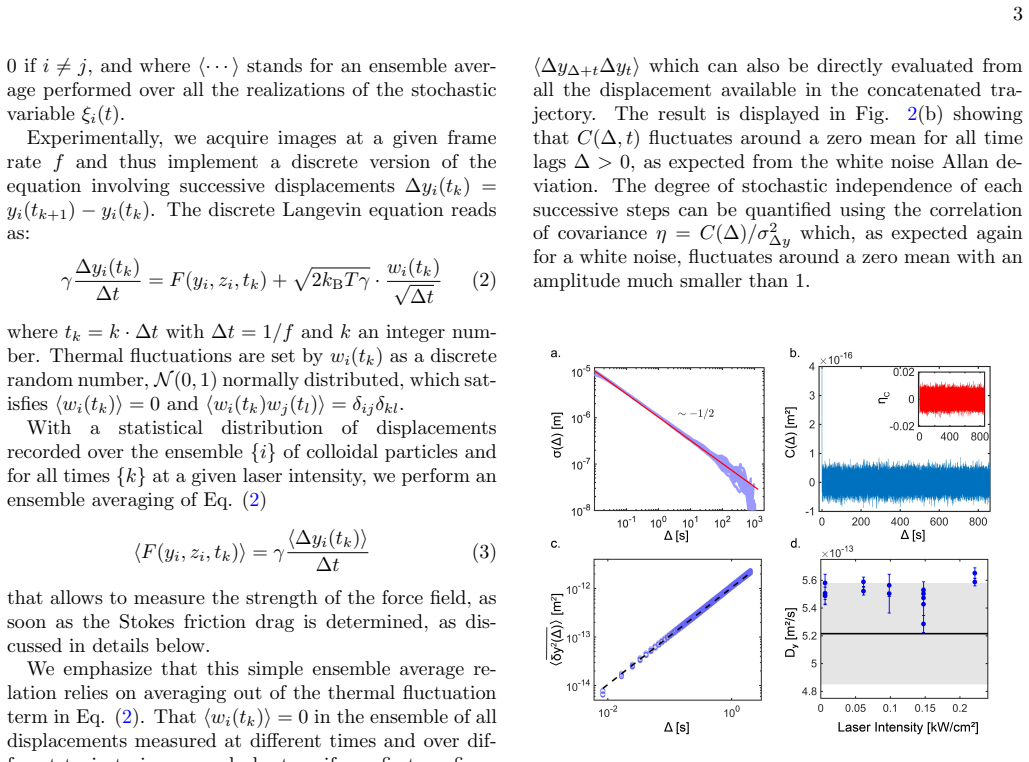
The load-bearing object is the concatenated displacement ensemble: all single-frame steps $\{\Delta y_i(t_k)\}$ recorded from all tracked particles, at all times, treated as one statistical sample. Its validity is established by three checks: the Allan variance follows $\sigma(\tau)=\sqrt{2k_B T/(\gamma \tau)}$ over three decades, the displacement covariance stays near zero, and the ergodic parameter $\epsilon(\Delta)=\sigma^2(\delta y_i^2(\Delta))/\langle \delta y_i^2(\Delta) \rangle^2$ follows the free-Brownian prediction $4\Delta/(3T)$. These checks are what turn Brownian noise from a measurement limit into a resource: the noise averages to zero over the ensemble, the force is read from the mean displacement, and the standard error shrinks as $1/\sqrt{N}$.
What would settle it
Take two runs at the same laser power with very different total displacement counts and check that the mean force is unchanged while the error bars shrink as $1/\sqrt{N}$; alternatively, split a single-beam run into early and late time blocks and test whether the mean displacement per frame drifts, since a drift would mean Eq. (3) averages a non-stationary signal and the resolution is not thermal-limited.
Extended reading notes
Core claim
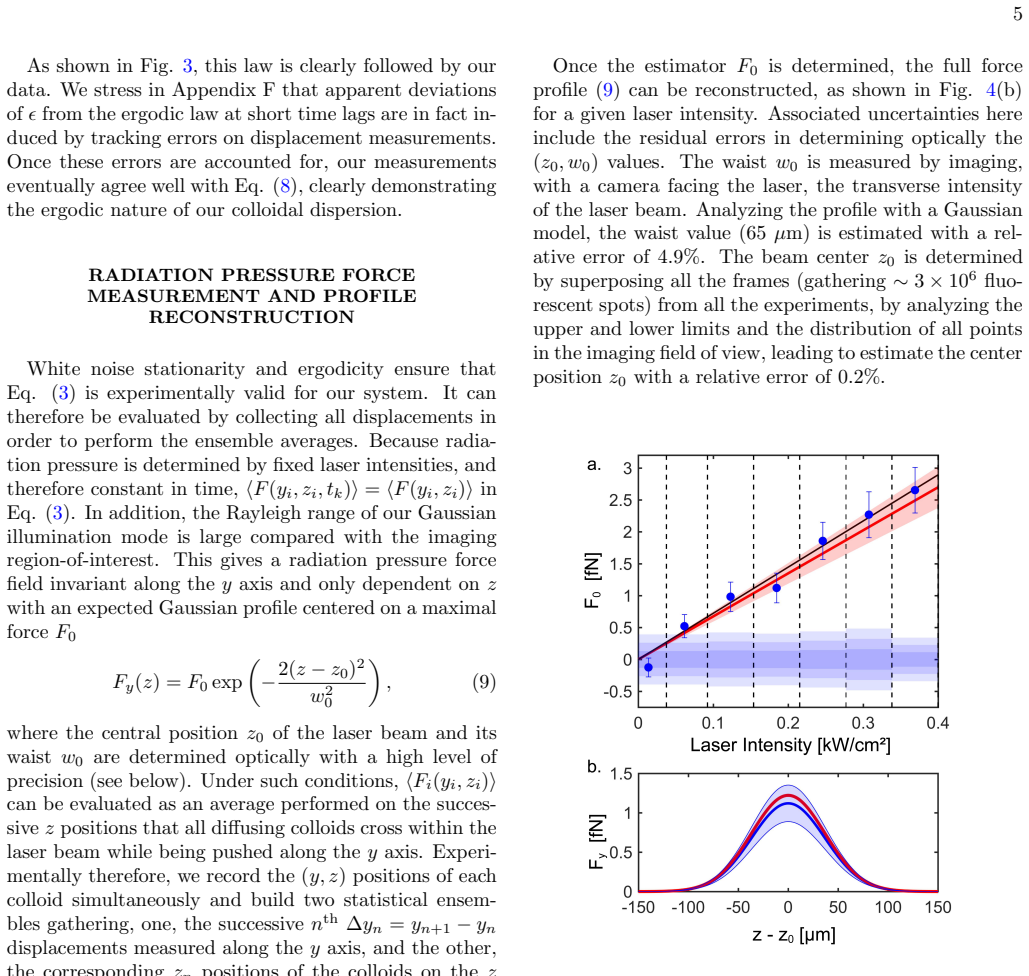
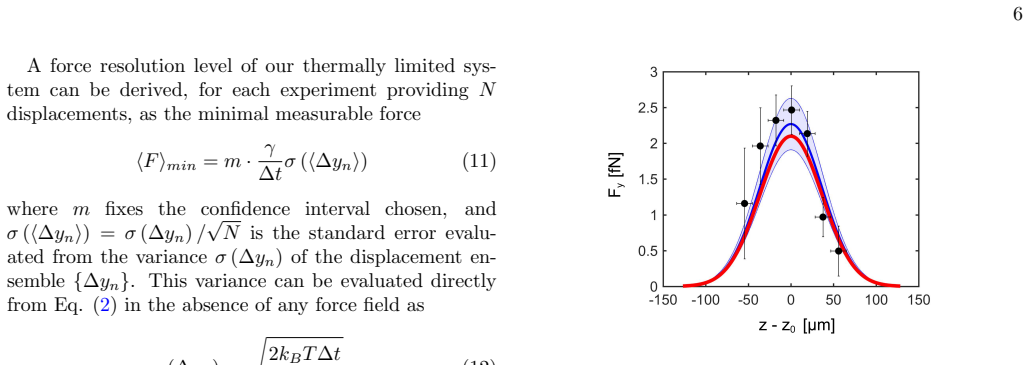
On the paper's own terms, the discovery is that an overdamped colloidal dispersion can act as a quantitative force sensor whose resolution is set by the total number of recorded displacements rather than by the stiffness of any trap or the sensitivity of any instrument. The argument reduces to the ensemble-averaged overdamped Langevin equation, $\langle F \rangle = \gamma \langle \Delta y \rangle / \Delta t$, together with the thermal-resolution formula $\langle F \rangle_{\min} = \sqrt{2 k_B T \gamma}\, m / \sqrt{N \Delta t}$. Pooling every one-frame displacement from many trajectories at many times makes $N$ large enough to reach $0.3$ fN at the $99.7\%$ confidence level, and the paper verifies the necessary white, stationary, ergodic character of the noise. It then reconstructs the Gaussian radiation-pressure profile $F_y(z) = F_0 \exp(-2(z-z_0)^2/w_0^2)$ and cross-checks the measured maximum force against Mie-scattering calculations.
Load-bearing premise
The resolution claim requires that every displacement pooled from all trajectories and times, including those recorded under the single-beam forced illumination, is an independent sample from the same zero-mean white thermal noise; stationarity and ergodicity are verified explicitly only in the dual-beam force-compensated mode, not in the measuring mode.
Editorial extensions
If this is right
- Force resolution is set by $\sqrt{2 k_B T \gamma}\, m / \sqrt{N \Delta t}$, so any increase in the total number of recorded displacements, whether from more particles, longer recordings, or higher frame rates, directly lowers the detectable force.
- The method reconstructs the full spatial profile of a force field, not just its maximum, by binning displacements in layers along the transverse axis, and the same logic extends to three dimensions with volumetric tracking.
- Because the approach requires only stationary white thermal noise, it applies to any weak force on colloids in fluids, not only optical radiation pressure, including hydrodynamic, magnetic, or Casimir-type forces.
- The agreement between the ensemble-averaged forces and Mie-scattering calculations provides a quantitative check that the measured mean displacement is a genuine force signal rather than a tracking artifact.
Reading between the lines
- A direct test of the core scaling would be to vary $N$ over an order of magnitude at fixed laser power and confirm that the resolution follows $1/\sqrt{N}$ down to the predicted thermal floor; the data hint at this but do not sweep $N$ systematically.
- If stationarity holds in the forced single-beam mode, the same concatenation procedure could be applied to force fields with strong spatial gradients, provided the data are analyzed in blocks to check that the ensemble mean displacement does not drift.
- The ergodic verification in the dual-beam mode does not by itself prove ergodicity under radiation pressure, since the forced mode includes z-dependent convection; extending the Allan-variance test to single-beam data after removing the mean drift would close this gap.
- Because the resolution floor scales as $\sqrt{T \gamma}$ for fixed ensemble size, smaller particles or lower-viscosity fluids could push the detectable force below $0.1$ fN, at the cost of faster diffusion and shorter usable exposure times.
Signed reviews
Editorial analysis
A structured set of objections, weighed in public.
Referee Report
Summary. The paper proposes and demonstrates a method for measuring radiation-pressure force fields acting on an overdamped colloidal suspension by averaging single-frame displacements over a very large ensemble built from all particles and all times. The central estimator is Eq. (3), the ensemble-averaged overdamped Langevin equation, and the resolution is given by Eq. (13), a standard error-propagation formula. The authors carefully verify the white, stationary, and ergodic character of the thermal noise in a dual-beam force-compensated mode, using Allan variance, the ergodic parameter, and comparison with the theoretical long-time law 4Δ/3T. In single-beam mode they reconstruct the Gaussian radiation-pressure force profile and report a resolution of 0.3 fN at the 99.7% confidence level.
Significance. If the central claims hold, the method provides a simple, high-sensitivity force measurement technique using standard video microscopy, with the strong feature that the ergodicity and noise properties are experimentally characterized rather than assumed. The ergodic-parameter data match the theoretical prediction without adjustable parameters, and the diffusion coefficient is independently calibrated; these are genuine strengths. However, the headline resolution of 0.3 fN is numerically inconsistent with the stated experimental parameters, and the resolution formula is derived for a zero-force configuration even though it is applied to forced single-beam measurements. These issues bear directly on the central quantitative claim of the paper and must be corrected before the result can be accepted.
major comments (3)
- [Abstract and 'Radiation pressure force measurement' (Eq. 13)] The headline resolution of 0.3 fN is inconsistent with the stated parameters. Using the manuscript's own values N=2×10^5, Δt=1/120 s, m=3, and sqrt(2kBTγ)=8.56 N/√Hz, Eq. (13) gives ⟨F⟩min = 8.56×10^-15 × 3 / sqrt(2×10^5/120) ≈ 6.3×10^-16 N = 0.63 fN, not 0.3 fN. To reach 0.3 fN one would need N≈8×10^5, about four times the 'typical' N stated in the main text. The abstract's central quantitative claim is therefore internally inconsistent with the experimental parameters and must be corrected.
- [Radiation pressure force measurement, Eqs. (11)-(13)] Eq. (13) uses the zero-force thermal variance σ(Δy_n)=√(2kBTΔt/γ), as explicitly stated in the sentence preceding Eq. (12). In the forced single-beam configuration, the displacement ensemble includes the deterministic contribution F(z_n)Δt/γ, which varies with z_n across the Gaussian beam. The total displacement variance is Var(Δy_n) = 2kBTΔt/γ + Var(F(z)Δt/γ), which exceeds the thermal value because the z-distribution of particles spans a region comparable to the waist w0. Consequently Eq. (13) underestimates the resolution of the actual force-field measurement. The paper must either demonstrate that the estimator in Eq. (10) achieves the thermal limit (e.g., by subtracting the known z-dependent force from each displacement) or recompute the resolution using the actual sample variance, as already done for the error bars in Eq. (62). The blue 'thermal limit' surfaces in Fig. 4(a) and the statement that a ~0.5 fN force was 'actually measured' at 99.7% confidence need to be re-evaluated in light of this.
- [Thermal noise and stationarity; Ergodicity (Secs. III-IV)] The stationarity and ergodicity tests are performed exclusively in the dual-beam force-compensated mode, as the authors note that free diffusion is unreachable in single-beam mode. The paper does not explicitly justify that the concatenated displacement ensemble in the forced single-beam mode remains identically distributed and stationary. In particular, the z-dependent force and the evolving z-distribution under radiation pressure and convection could introduce non-stationarity or additional correlations. The authors should either present a stationarity check for the forced-mode data or state clearly that the same properties are assumed to hold, together with the physical justification.
minor comments (5)
- [Ergodicity, Eq. (6)] The limit in Eq. (6) is written as lim_{T/Δ→∞} δy_i^2(Δ) = ⟨δy_i^2(Δ)⟩; this is confusing because the left-hand side is a single-trajectory time average while the right-hand side is an ensemble average of such time averages. The statement should specify how the limit is taken and that the equality holds in probability for an ergodic process.
- [Fig. 3 caption] The caption contains a typographical error: 'All ratio ρ(Δ)=⟨δy2(Δ)⟩/⟨y2(Δ)⟩)' has mismatched parentheses and should read ρ(Δ)=⟨δy^2(Δ)⟩/⟨δy^2(Δ)⟩' or equivalent.
- [Appendix B] The phrase 'power spectrum densitiy' should be 'power spectral density'.
- [Ergodicity section] The sentence 'it is possible to collect displacement values acquired from differenti trajectories at differenti k times' contains typos; 'differenti' should be 'different'.
- [Eq. (10)] The notation ⟨exp(−2(z_n−z_0)^2/w_0^2)⟩ is used without a formal definition; defining α_n = exp(−2(z_n−z_0)^2/w_0^2) and α = ⟨α_n⟩ would improve readability and clarify the estimator.
Circularity Check
No significant circularity: force reconstruction and resolution are independently calibrated, not fitted or self-citational inputs.
full rationale
The derivation chain is self-contained. Equation (3) converts mean displacements into a force using the Stokes drag gamma, which is not fitted to the force data but determined independently from diffusion coefficients measured via MSD (Appendix D) and from temperature, viscosity, and particle diameter, with the measured D agreeing with kBT/gamma. Equation (13) is a standard error propagation of the zero-force thermal variance from Eq. (2); it contains no fitted parameter and is not used as an input to the force estimate. The ergodicity claim is verified against external theoretical predictions (Allan variance -1/2 slope from [22] and the 4Delta/3T law from [24], rederived in Appendix E) with no adjustable parameters targeted at the force result. The Mie comparison [25] is a self-citation, but it is a theoretical benchmark rather than a load-bearing premise for the measurement method or resolution; the measurement stands on the Langevin equation and independent calibration. No step reduces by construction to its own input, so there is no significant circularity. The numerical mismatch between Eq. (13) with the stated values and the advertised 0.3 fN resolution is a correctness concern, not a circularity, and is therefore not scored here.
Assumptions & free parameters
free parameters (2)
- Diffusion coefficient D_y (and hence Stokes drag gamma) =
approximately 0.5 um^2/s at T ~ 302 K
- Tracking-error offset b =
b_fit ~ -2.8e-3 um^2
assumptions (6)
- domain assumption Overdamped Langevin equation with white, zero-mean Gaussian thermal noise (Eq. 1)
- standard math Stokes drag gamma = 6 pi eta a
- domain assumption Ergodic hypothesis: time averages over concatenated trajectories equal ensemble averages
- domain assumption Radiation pressure force field is y-invariant with a Gaussian z-profile (Eq. 9)
- domain assumption Sedimentation and laser-induced convection remain laminar and act only along z, decoupled from y
- standard math Wick's theorem for Gaussian displacement ensembles
Cite this review
Pith. "Pith review of Subfemtonewton force fields measured with ergodic Brownian ensembles." pith.science (2026). https://pith.science/paper/XWYUSIDX
@misc{pith2026190800610,
  author       = {Pith},
  title        = {Pith review of: Subfemtonewton force fields measured with ergodic Brownian ensembles},
  year         = {2026},
  howpublished = {\url{https://pith.science/paper/XWYUSIDX}},
  note         = {Machine review of arXiv:1908.00610}
}
abstract
We demonstrate that radiation pressure force fields can be measured and reconstructed with a resolution of $0.3$ fN (at a $99.7\%$ confidence level) using an ergodic ensemble of overdamped colloidal particles. The outstanding force resolution level is provided by the large size of the statistical ensemble built by recording all displacements from all diffusing particles, regardless of trajectory and time. This is only possible because the noise driving the particles is thermal, white and stationary, so that the colloidal system is ergodic, as we carefully verify. Using an ergodic colloidal dispersion for performing ultra-sensitive measurements of external forces is not limited to non-conservative optical force fields. Our experiments therefore give way to interesting opportunities in the context of weak force measurements in fluids.
Figures


Figures from the paper (5 more)


Reference graph
Works this paper leans on
-
[1]
The error bars on the estimators are discussed in the Appendix G
The estimators (blue points) show the expected linear de- pendence on the laser power and the continuous black line is a linear fitting performed as a reference. The error bars on the estimators are discussed in the Appendix G. The Mie cal- culation (red line) done for the conditions of the experiment (plane wave approximation, spherical dielectric -melami...
-
[2]
Subfemtonewton force fields measured with ergodic Brownian ensembles
and references therein). But their initial attempts in measuring radiation pressure were mostly hindered by thermal effects induced by the illuminating light, such as convective and radiometric forces. The first positive ex- perimental demonstration of light radiation pressure was achieved by P.N. Lebedev in 1899, with results published in a 1901 article [3...
work page Pith review arXiv 1901
-
[3]
J. C. Maxwell, A treatise on electricity and magnetism, Vol. 2, 1873 (Dover Publications, Inc., New York, 1954) p. 440
work page 1954
- [4]
-
[5]
P. N. Lebedev, Ann. Phys. 311, 023902 (1901)
work page 1901
-
[6]
H. He, M. E. J. Friese, N. R. Heckenberg, and H. Rubinsztein-Dunlop, Phys. Rev. Lett. 75, 826 (1995)
work page 1995
- [7]
-
[8]
A. Lehmuskero, Y. Li, P. Johansson, and M. K¨ all, Opt. Express 22, 4349 (2014)
work page 2014
Show all 44 references
-
[9]
D. Ma, J. L. Garrett, and J. N. Munday, Appl. Phys. Lett. 106, 091107 (2015)
2015
-
[10]
Canaguier-Durand, A
A. Canaguier-Durand, A. Cuche, C. Genet, and T. W. Ebbesen, Phys. Rev. A 88, 033831 (2013)
2013
-
[11]
L. Liu, S. Kheifets, V. Ginis, and F. Capasso, Phys. Rev. Lett. 116, 228001 (2016)
2016
-
[12]
Schnoering, Y
G. Schnoering, Y. Rosales-Cabara, H. Wendehenne, A. Canaguier-Durand, and C. Genet, Phys. Rev. Ap- plied 11, 034023 (2019)
2019
-
[13]
Roichman, B
Y. Roichman, B. Sun, A. Stolarski, and D. G. Grier, Phys. Rev. Lett. 101, 128301 (2008)
2008
-
[14]
P. Wu, R. Huang, C. Tischer, A. Jonas, and E.-L. Florin, Phys. Rev. Lett. 103, 108101 (2009)
2009
-
[15]
Brzobohat` y, V
O. Brzobohat` y, V. Kar´ asek, M. ˇSiler, L. Chv´ atal, T. ˇCiˇ zm´ ar, and P. Zem´ anek, Nature Photon.7, 123 (2013)
2013
-
[16]
Gloppe, P
A. Gloppe, P. Verlot, E. Dupont-Ferrier, A. Siria, P. Pon- charal, G. Bachelier, P. Vincent, and O. Arcizet, Nature Nano. 9, 920 (2014)
2014
-
[17]
Canaguier-Durand and C
A. Canaguier-Durand and C. Genet, Phys. Rev. A 92, 043823 (2015)
2015
-
[18]
Sukhov, V
S. Sukhov, V. Kajorndejnukul, R. R. Naraghi, and A. Dogariu, Nature Photon. 9, 809 (2015)
2015
-
[19]
Sukhov and A
S. Sukhov and A. Dogariu, Rep. Prog. Phys. 80, 112001 (2017)
2017
-
[20]
Magallanes and E
H. Magallanes and E. Brasselet, Nature Photon. 12, 461 (2018)
2018
-
[21]
Mangeat, Y
M. Mangeat, Y. Amarouchene, Y. Louyer, T. Gu´ erin, and D. S. Dean, Phys. Rev. E 99, 052107 (2019)
2019
-
[22]
Tinevez, N
J.-Y. Tinevez, N. Perry, J. Schindelin, G. M. Hoopes, G. D. Reynolds, E. Laplantine, S. Y. Bednarek, S. L. Shorte, and K. W. Eliceiri, Methods 115, 80 (2017)
2017
-
[23]
The particles imaged on our camera therefore diffuse along the x axis within a constant laser intensity throughout the experiments
The dependence on x of the force field can be safely neglected considering that our imaging depth of field ∼ 8µm is much smaller than the beam waistw0∼ 65µm inside the cuvette. The particles imaged on our camera therefore diffuse along the x axis within a constant laser intensity...
-
[24]
D. W. Allan, Proc. IEEE 54, 945 (1966)
1966
-
[25]
Michalet, Phys
X. Michalet, Phys. Rev. E 82, 041914 (2010)
2010
-
[26]
Metzler, J.-H
R. Metzler, J.-H. Jeon, A. G. Cherstvy, and E. Barkai, Phys. Chem. Chem. Phys. 16, 24128 (2014). 13
2014
-
[27]
Canaguier-Durand and C
A. Canaguier-Durand and C. Genet, Phys. Rev. A 89, 033841 (2014)
2014
-
[28]
Martinez-Marrades, J.-F
A. Martinez-Marrades, J.-F. Rupprecht, M. Gross, and G. Tessier, Opt. Express 22, 29191 (2014)
2014
-
[29]
Verrier, D
N. Verrier, D. Alexandre, G. Tessier, and M. Gross, Appl. Opt. 54, 4672 (2015)
2015
-
[30]
D. S. Ether, L. B. Pires, S. Umrath, D. Martinez, Y. Ay- ala, B. Pontes, G. R. de S. Ara´ ujo, S. Frases, G.-L. In- gold, F. S. S. Rosa, N. B. Viana, H. M. Nussenzveig, and P. A. M. Neto, Europhys. Lett. 112, 44001 (2015)
2015
-
[31]
K. M. McPeak, C. D. Van Engers, M. Blome, J. H. Park, S. Burger, M. A. Gosalvez, A. Faridi, Y. R. Ries, A. Sahu, and D. J. Norris, Nano Lett. 14, 2934 (2014)
2014
-
[32]
Kumar, K
J. Kumar, K. G. Thomas, and L. M. Liz-Marz´ an, Chem. Commun. 52, 12555 (2016)
2016
-
[33]
W. Ma, L. Xu, A. F. de Moura, X. Wu, H. Kuang, C. Xu, and N. A. Kotov, Chem. Rev. 117, 8041 (2017)
2017
-
[34]
Canaguier-Durand, J
A. Canaguier-Durand, J. A. Hutchison, C. Genet, and T. W. Ebbesen, New J. Phys. 15, 123037 (2013)
2013
-
[35]
R. P. Cameron, S. M. Barnett, and A. M. Yao, New J. Phys. 16, 013020 (2014)
2014
-
[36]
K. Ding, J. Ng, L. Zhou, and C. T. Chan, Phys. Rev. A 89, 063825 (2014)
2014
-
[37]
Y. Zhao, A. A. Saleh, M. A. Van De Haar, B. Baum, J. A. Briggs, A. Lay, O. A. Reyes-Becerra, and J. A. Dionne, Nature Nano. 12, 1055 (2017)
2017
-
[38]
Kravets, A
N. Kravets, A. Aleksanyan, and E. Brasselet, Phys. Rev. Lett. 122, 024301 (2019)
2019
-
[39]
Kravets, A
N. Kravets, A. Aleksanyan, H. Chra¨ ıbi, J. Leng, and E. Brasselet, Phys. Rev. Applied 11, 044025 (2019)
2019
-
[40]
Marichez, A
V. Marichez, A. Tassoni, R. P. Cameron, S. M. Barnett, R. Eichhorn, C. Genet, and T. M. Hermans, Soft Matter 15, 4593 (2019)
2019
-
[41]
J. A. Barnes, A. R. Chi, L. S. Cutler, D. J. Healey, D. B. Leeson, T. E. McGunigal, J. A. Mullen, W. L. Smith, R. L. Sydnor, R. F. Vessot, and G. M. R. Winckler, IEEE Transactions on Instrumentation and Measurement 20, 105 (1971)
1971
-
[42]
G. M. Gibson, J. Leach, S. Keen, A. J. Wright, and M. J. Padgett, Opt. Express 16, 14561 (2008)
2008
-
[43]
Czerwinski, A
F. Czerwinski, A. C. Richardson, and L. B. Oddershede, Opt. Express 17, 13255 (2009)
2009
-
[44]
Michalet and A
X. Michalet and A. J. Berglund, Phys. Rev. E 85, 061916 (2012)
2012
Reviewed August 14, 2026 · model on record in the stance chip above.
Discussion (0). Continue with ORCID to comment.