REVIEW 3 major objections 5 minor 42 references
Quantum $1/f^\eta$ Noise Induced Relaxation in the Spin-Boson Model
T0 review · 3 major / 5 minor · reviewed 2026-08-06 · deepseek-v4-flash
Pith's one-line read This paper extends the spin-boson model to quantum $1/f^\eta$ noise and finds a direct coherent-to-pseudo-coherent transition with a zero-temperature dephasing rate $\gamma\approx14.5\,\alpha\,e^{-2.4s}\,\Omega$.
desk verdict New regime diagram for s<0 is credible, but the exponential dephasing law rests on an unjustified fit and needs a major revision before I'd trust Eq. (6). read the letter →
The pith
A machine-rendered reading of the paper's core claim, the machinery that carries it, and where it could break.
The reading
What carries the argument
The load-bearing object is the spectral density $J(\omega)=2\alpha\,\omega^s\,\omega_c^{1-s}e^{-\omega/\omega_c}\Theta(\omega-\omega_{\rm ir})$ continued to negative exponents $s$, together with the time-evolving matrix product operator (TEMPO) path integral, based on the quasiadiabatic propagator path integral (QUAPI), that integrates out the bath exactly through the pair-correlation function $Q(t)$; a carefully added $-i\omega t$ integration constant widens convergence into the $s<0$ regime. The argument then runs through a weak-coupling fit, $P(t)\approx(1-\tilde\alpha\cos(\omega_0t)e^{-\gamma t}-\tilde\alpha)/(1-\tilde\alpha)$, whose rigorous anchor is the Ohmic NIBA result, but which is applied as an ansatz across the negative-exponent range. From fits of this form the paper extracts $\gamma(\alpha)$, establishes the empirical law $\gamma\approx14.5\,\alpha\,e^{-2.4s}\,\Omega$, and classifies coherent, incoherent, and pseudo-coherent regimes by the presence and frequency of oscillations.
What would settle it
Recompute the zero-temperature polarization for $s=-0.5$ at $\alpha=0.03$ with a converged TEMPO bond dimension and monitor the first local maximum of $P(t)$: the coherent-to-pseudo-coherent transition is defined by the loss of that maximum, so an intermediate window of exponential, non-oscillatory decay between the two regimes would refute the regime diagram. Alternatively, measure the weak-coupling slope $\gamma/\alpha$ in a qubit with engineered $1/f^\eta$ noise at fixed $s$ and compare it with $14.5\,e^{-2.4s}\,\Omega$; a nonlinear dependence on $\alpha$ or a different exponential factor would falsify Eq. (6).
Extended reading notes
Core claim
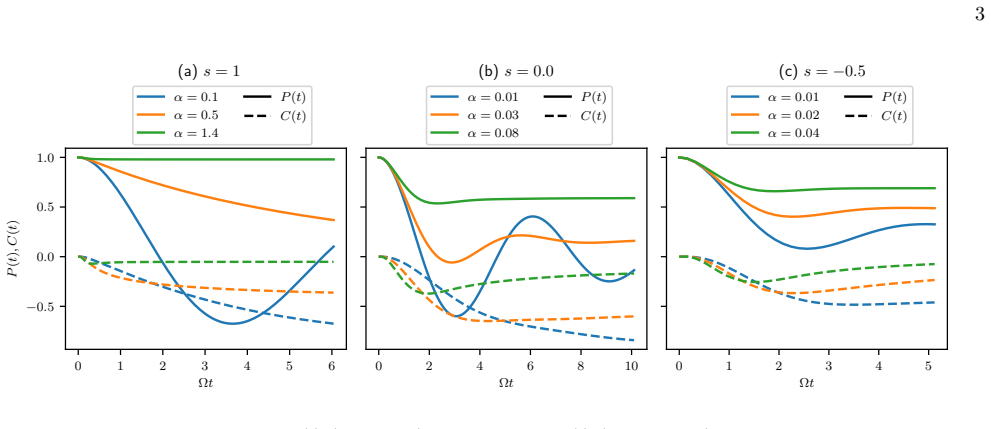
The paper's central finding is that negative spectral exponents do not produce a new incoherent phase: for $-0.75 \le s \le 0.45$ the spin-boson polarization goes directly from the coherent to the pseudo-coherent dynamical regime as coupling increases, and only for $s \gtrsim 0.45$ does an incoherent regime exist. In the pseudo-coherent regime the oscillation frequency is set by the bath high-frequency cutoff $1/\omega_c$, so the central spin is effectively enslaved to short-lived coherent bath oscillations. At weak coupling the polarization is well fit by a damped cosine envelope, yielding a dephasing rate that depends linearly on $\alpha$ with slope $\gamma'(0) \approx 14.5\, e^{-2.4s}\, \Omega$ at zero temperature and $\omega_{\rm ir}=0$. The reorganization energy $\Lambda = 2\alpha\omega_c\,\Gamma(s,\omega_{\rm ir}/\omega_c)$ diverges for $s\le0$ as $\omega_{\rm ir}\to0$, which the paper connects to the measurement-time dependence observed for $1/f$ flux noise in superconducting qubits.
Load-bearing premise
The load-bearing assumption is that the polarization's decay envelope is a damped cosine for negative spectral exponents, even though that shape is rigorously justified only for Ohmic baths in the NIBA scaling limit; if the envelope has a different functional form for s<0, the extracted dephasing rate, its linear dependence on α, and Eq. (6) collapse.
Editorial extensions
If this is right
- For qubits dominated by low-frequency quantum $1/f^\eta$ noise, stronger coupling to the bath should produce bath-controlled pseudo-coherent oscillations rather than pass through the incoherent decay phase expected from classical-noise treatments.
- At weak coupling the dephasing time is $T_\phi\approx e^{2.4s}/(14.5\,\alpha\,\Omega)$, so for fixed $\alpha$ a more negative exponent $s$ shortens coherence, emphasizing the need to suppress the lowest-frequency bath modes.
- Dephasing becomes measurement-time dependent: identifying $\omega_{\rm ir}\sim 2\pi/t_{\rm meas}$ predicts that longer averaging in an experiment degrades coherence, consistent with flux-noise observations.
- The numerically exact TEMPO method stays convergent for $s$ down to $-0.75$ at zero temperature, making the same tensor-network treatment applicable to strongly non-Markovian low-frequency baths in larger superconducting circuits.
Reading between the lines
- Editorial inference: if Eq. (6) holds beyond the fitted range, the factor $e^{-2.4s}$ means the dephasing slope grows by roughly an order of magnitude from $s=0$ to $s=-1$ at fixed $\alpha$, so a small low-frequency noise component can dominate over an Ohmic contribution.
- Editorial inference: the infrared-cutoff sensitivity implies that quoting an intrinsic dephasing rate for $1/f^\eta$ environments is incomplete; reported rates should state the measurement window or low-frequency cutoff used.
- Editorial inference: a direct experimental test would tune a qubit's engineered noise environment to a known negative exponent and measure $\gamma(\alpha)$ across two decades of coupling, checking both the linearity in $\alpha$ and the exponential $s$ dependence.
- Editorial inference: testing whether the damped-cosine ansatz of Eq. (4) remains accurate for $s<0$ under other initial preparations or stronger coupling would clarify how far the extracted $\gamma$ can be trusted beyond the weak-coupling window studied.
Editorial analysis
A structured set of objections, weighed in public.
Referee Report
Summary. The paper extends the spin-boson model to spectral exponents s<0 (quantum 1/f^η noise with η=-s) and studies polarization and coherence dynamics using the TEMPO method. It reports a dynamical regime diagram in the (s,α) plane, finding that for s<0 the system crosses directly from coherent to pseudocoherent dynamics without an incoherent regime. At weak coupling the authors extract a dephasing rate γ from fits of Eq. (4) and propose the empirical formula γ ≈ 14.5 α e^{-2.4s} Ω (Eq. (6)). They also derive the infrared-cutoff dependence of the reorganization energy and argue that it explains the measurement-time dependence of low-frequency dephasing.
Significance. If confirmed, the regime diagram and the empirical dephasing formula would be useful for modeling superconducting qubits and other solid-state devices limited by 1/f^η noise. The use of numerically exact TEMPO is appropriate and the paper makes explicit, falsifiable predictions. The reorganization-energy analysis and the connection to an infrared cutoff related to the measurement time are interesting and physically motivated. However, the quantitative content currently rests on an unvalidated fitting ansatz and on numerical runs without documented convergence or uncertainty analysis, so the main quantitative claim needs substantial additional support.
major comments (3)
- [Section VI, Eq. (4)-(6)] The extraction of γ is based on an ansatz whose validity for s<0 is not established. In the Ohmic limit Eq. (4) follows from NIBA, but for s<0 the paper only states that it 'fits well.' The concern is concrete: at T=0 the real part of Q(t) in Eq. (3) grows as α t^{1-s} for -1<s<0 and ω_c t >> 1, so the natural weak-coupling envelope is exp[-const α t^{1-s}], which is superlinear, not exponential. Fitting an exponential over a fixed window then yields a 'rate' that is linear in α but depends on the fit window and on ω_c and ω_ir. The paper reports no residuals, no window-dependence test, no comparison with a stretched-exponential fit, and no confidence intervals for the slopes or for the parameters 14.5 and -2.4 in Eq. (6). Since Eq. (6) is fitted to rates obtained from the same ansatz, it is a compact representation of the simulated data rather than an independent empirical law. I recommend testing whether the exponential form survives changes of t_max and ω_c, and either deriving a proper functional form for the envelope or restricting the claim to a clearly delimited time window.
- [Section V, Fig. 2] The dynamical regime diagram and the claim that no incoherent regime exists for s<0 are based on visual classification of time traces and on the disappearance of the first maximum, but the paper provides no convergence analysis for TEMPO. The text states that s=-0.75 is the smallest exponent for which numerical convergence could be achieved, yet no time-step, bond-dimension, or truncation-error data are shown. The boundary line in Fig. 2 is drawn without error bars and without displaying the transition points. To support the 'numerically exact' claim, the paper should include convergence tests and an uncertainty estimate for the boundary α(s).
- [Section VI, Fig. 3] The linear dependence γ ∝ α is established on a very small range of α (in Fig. 3 the data extend only to α ≈ 0.003) and without error bars on the individual extracted values of γ. The slopes γ'(0) displayed in Fig. 4 are therefore fits to fits. The paper should report the goodness of fit (residuals or χ²), the number of data points, whether the linear fits were forced through the origin, and stability of the slopes under changes of the fit window. Without this information, the empirical formula Eq. (6) is not robustly supported.
minor comments (5)
- [Section IV] In the discussion of Fig. 1(c) the text refers to coherent dynamics at α=0.1, while the caption lists α=0.01, 0.02, and 0.04; this is presumably a typo and should be corrected.
- [Equation (4)] Equation (4) is typeset ambiguously; the fraction is unclear. Please rewrite it so that the reader can see which terms are divided by (1-α̃).
- [Section II] The text says the model is considered for -1≤s≤1, but the numerical results and Eq. (6) cover only s≥-0.75 and s≥-0.5, respectively; clarify whether s=-1 is included and under which conditions (e.g., ω_ir>0).
- [Section VI] Please clarify why a rate extracted from the polarization dynamics P(t) is called a dephasing rate; in the unbiased spin-boson model the damping of P(t) is not identical to the pure dephasing of the off-diagonal coherence and the distinction should be stated explicitly.
- [Section VII] The connection between ω_ir=2π/t_meas and the experimental flux-noise data of Ref. [22] is qualitative; a brief statement of the parameter mapping would make the claim more concrete.
Circularity Check
No significant circularity: the dephasing formula is explicitly empirical, and the new s<0 regime diagram is computed with TEMPO; the only self-citation is a definitional prior result, not load-bearing.
full rationale
The derivation chain is not circular in the sense defined. The central quantitative result Eq. (6) is introduced with the sentence 'We empirically find the dephasing rate γ ≈ 14.5α e^{−2.4s} Ω from the data in Fig. 4', explicitly labelling it as an empirical fit rather than a first-principles prediction. The γ values feeding Fig. 4 are obtained by fitting TEMPO time traces with Eq. (4), which the paper openly describes as a fitting function ('using α̃, ω0, and γ as free parameters') and justifies only in the Ohmic limit from NIBA. Thus the chain is a transparent data-analysis pipeline (simulation → fit → empirical law), not a hidden reintroduction of the fitted quantity as a predicted quantity. The new s<0 regime diagram is computed by TEMPO, and the paper's use of Ref. [3] (a prior paper by overlapping authors) is limited to the definition of pseudo-coherent dynamics and to the 0≤s≤1 regime diagram; the novel s<0 extension is not asserted by citation but by the present simulations. The concern that a 1−s envelope at T=0 could make the fitted exponential rate window-dependent is a validity/robustness question about the fitting ansatz, not a circularity. No uniqueness theorem is imported, and no unverified self-citation carries the central claim. Score 2 reflects the presence of a minor, non-load-bearing self-citation.
Assumptions & free parameters
free parameters (2)
- 14.5 (empirical pre-factor) =
14.5
- -2.4 (empirical exponent) =
-2.4
assumptions (5)
- domain assumption The spectral density has the form J(ω) = 2α ω^s / ω_c^{s-1} e^{-ω/ω_c} Θ(ω-ω_ir)
- domain assumption The initial state is factorized, P(0)=1 with the thermal bath at temperature T
- standard math Adding the term -iωt to the pair correlation Q(t) is allowed and does not alter physical predictions
- ad hoc to paper TEMPO simulation is converged for the chosen parameters down to s=-0.75
- ad hoc to paper The fitting function in Eq. (4) describes the weak-coupling polarization for all s considered
Cite this review
Pith. "Pith review of Quantum $1/f^\eta$ Noise Induced Relaxation in the Spin-Boson Model." pith.science (2026). https://pith.science/paper/XXGSIMPP
@misc{pith2026250714329,
  author       = {Pith},
  title        = {Pith review of: Quantum $1/f^\eta$ Noise Induced Relaxation in the Spin-Boson Model},
  year         = {2026},
  howpublished = {\url{https://pith.science/paper/XXGSIMPP}},
  note         = {Machine review of arXiv:2507.14329}
}
abstract
We extend the spin-boson model of open quantum systems to the regime of quantum $1/f^\eta$ noise characterized by negative exponents of its spectral distribution. Using the numerically exact time-evolving matrix product operator, we find the dynamic regime diagram, including pseudocoherent dynamics controlled by quantum $1/f^\eta$ noise. We determine the dephasing rate and find for it an empirical formula valid at zero temperature. The bath reorganization energy depends on the infrared bath cutoff frequency, revealing an increased sensitivity of the dephasing on the measurement time of an experiment. \ep{Our results apply to a qubit as an elementary building block of a quantum computer and pave the way towards a quantum treatment of low-frequency noise in more complex architectures.
Figures


Figures from the paper (2 more)


Reference graph
Works this paper leans on
-
[1]
Weiss, Quantum Dissipative Systems, 5th ed
U. Weiss, Quantum Dissipative Systems, 5th ed. (World Scientific, Singapore, 2021)
work page 2021
-
[2]
A. J. Leggett, S. Chakravarty, A. T. Dorsey, M. P. A. Fisher, A. Garg, and W. Zwerger, Rev. Mod. Phys. 59, 1 (1987)
1987
-
[3]
F. Otterpohl, P. Nalbach, and M. Thorwart, Hidden phase of the spin-boson model, Phys. Rev. Lett. 129, 120406 (2022)
work page 2022
-
[4]
A. Chin and M. Turlakov, Coherent-incoherent transition in the sub-Ohmic spin-boson model, Phys. Rev. B 73, 075311 (2006)
work page 2006
-
[5]
F. B. Anders, R. Bulla, and M. Vojta, Equilibrium and nonequilibrium dynamics of the sub-Ohmic spin-boson model, Phys. Rev. Lett. 98, 210402 (2007)
work page 2007
- [6]
-
[7]
A. Alvermann and H. Fehske, Sparse polynomial space approach to dissipative quantum systems: Application to the sub-Ohmic spin-boson model, Phys. Rev. Lett. 102, 150601 (2009)
work page 2009
-
[8]
P. Nalbach and M. Thorwart, Ultraslow quantum dynam- ics in a sub-Ohmic heat bath, Phys. Rev. B 81, 054308 (2010)
work page 2010
Show all 42 references
-
[9]
Wang and M
H. Wang and M. Thoss, From coherent motion to lo- calization: II. Dynamics of the spin-boson model with sub-Ohmic spectral density at zero temperature, Chem. Phys. 370, 78 (2010)
2010
-
[10]
A. W. Chin, J. Prior, S. F. Huelga, and M. B. Ple- nio, Generalized polaron ansatz for the ground state of the sub-Ohmic spin-boson model: An analytic theory of the localization transition, Phys. Rev. Lett. 107, 160601 (2011)
2011
-
[11]
Kast and J
D. Kast and J. Ankerhold, Persistence of coherent quan- tum dynamics at strong dissipation, Phys. Rev. Lett. 110, 010402 (2013)
2013
-
[12]
Nalbach and M
P. Nalbach and M. Thorwart, Crossover from coherent to in coherent quantum dynamics due to purely dephasing Sub-Ohmic fluctuations, Phys. Rev. B 87, 014116 (2013)
2013
-
[13]
F. A. Y. N. Schr¨ oder and A. W. Chin, Simulating open quantum dynamics with time-dependent variational ma- trix product states: Towards microscopic correlation of environment dynamics and reduced system evolution, Phys. Rev. B 93, 075105 (2016)
2016
-
[14]
C. Duan, Z. Tang, J. Cao, and J. Wu, Zero-temperature localization in a sub-Ohmic spin-boson model investi- gated by an extended hierarchy equation of motion, Phys. Rev. B 95, 214308 (2017)
2017
-
[15]
L. Chen, Y. Yan, M.F. Gelin, and Z. L¨ u, Dynamics of the spin-boson model: The effect of bath initial conditions, J. Chem. Phys. 158, 104109 (2023)
2023
-
[16]
Falci, Pertti J
G. Falci, Pertti J. Hakonen, and E. Paladino, 1 /f noise in quantum nanoscience , in Encyclopedia of Condensed Matter Physics (2nd ed.) , edited by T. Chakraborty (Academic Press, Cambridge, MA, 2024), pp. 1003-1017
2024
-
[17]
Paladino, L
E. Paladino, L. Faoro, G. Falci, and R. Fazio, Decoher- ence and 1/f noise in Josephson qubits, Phys. Rev. Lett. 88, 228304 (2002). 7
2002
-
[18]
Astafiev, Yu
O. Astafiev, Yu. A. Pashkin, Y. Nakamura, T. Ya- mamoto, and J. S. Tsai, Quantum noise in the Josephson charge qubit, Phys. Rev. Lett. 93, 267007 (2004)
2004
-
[19]
Shnirman, G
A. Shnirman, G. Sch¨ on, I. Martin, and Yuriy Makhlin, Low- and high-frequency noise from coherent two-level systems, Phys. Rev. Lett. 94, 127002, (2005)
2005
-
[20]
Y. M. Galperin, B. L. Altshuler, J. Bergli, D. V. Shant- sev, Non-Gaussian low-frequency noise as a source of qubit decoherence, Phys. Rev. Lett. 96, 097009 (2006)
2006
-
[21]
Paladino, Y
E. Paladino, Y. M. Galperin, G. Falci, and B. L. Alt- shuler, 1 /f Noise: Implications for solid-state quantum information, Rev. Mod. Phys. 86, 361 (2014)
2014
-
[22]
D. A. Rower et al., Evolution of 1 /f flux noise in super- conducting qubits with weak magnetic fields, Phys. Rev. Lett. 130, 220602 (2023)
2023
-
[23]
J¨ ackle, On the ultrasonic attenuation in glasses at low temperatures, Z
J. J¨ ackle, On the ultrasonic attenuation in glasses at low temperatures, Z. Physik 257, 212 (1972)
1972
-
[24]
Nalbach, D
P. Nalbach, D. Osheroff, and S. Ludwig, Non-equilibrium dynamics of interacting tunneling states in glasses, J. Low Temp. Phys. 137, 395 (2004)
2004
-
[25]
Lisenfeld, G
J. Lisenfeld, G. J. Grabovskij, C. M¨ uller, J. H. Cole, G. Weiss, and A. V. Ustinov, Observation of directly inter- acting coherent two-level systems in a solid, Nat. Com- mun. 6, 6182 (2015)
2015
-
[26]
M¨ uller, J
C. M¨ uller, J. H. Cole, and J. Lisenfeld, Towards under- standing two-level-systems in amorphous solids: insights from quantum circuits, Rep. Prog. Phys. 82, 124501 (2019)
2019
-
[27]
S. E. de Graaf, L. Faoro, L. B. Ioffe, S. Mahashabde, J. J. Burnett, T. Lindstr¨ om, S. E. Kubatkin, A. V. Danilov, and A. Ya. Tzalenchuk, Two-level systems in supercon- ducting quantum devices due to trapped quasiparticles, Science Advances 6, eabc5055 (2020)
2020
-
[28]
X. You, A. A. Clerk, and J. Koch, Positive- and negative- frequency noise from an ensemble of two-level fluctuators, Phys. Rev. Research 3, 013045 (2021)
2021
-
[29]
McWhorter, in Proceedings of the Conference on Physics of Semiconductor Surface Physics, R.H
A.L. McWhorter, in Proceedings of the Conference on Physics of Semiconductor Surface Physics, R.H. Kingston (ed.), University of Pennsylvania Press, Pennsylvania (1957), p. 207
1957
-
[30]
Weissman, 1/f noise and other slow, nonexponential kinetics in condensed matter, Rev
M.B. Weissman, 1/f noise and other slow, nonexponential kinetics in condensed matter, Rev. Mod. Phys. 60, 537 (1988)
1988
-
[31]
Falci, A
G. Falci, A. D’Arrigo, A. Mastellone, and E. Paladino, Initial Decoherence in Solid State Qubits, Phys. Rev. Lett. 94, 167002, (2005)
2005
-
[32]
Ithier, E
G. Ithier, E. Collin, P. Joyez, P. J. Meeson, D. Vion, D. Esteve, F. Chiarello, A. Shnirman, Y. Makhlin, J. Schriefl, and G. Sch¨ on, Decoherence in a superconducting quantum bit circuit, Phys. Rev. B 72, 134519 (2005)
2005
-
[33]
Kjaergaard, M
M. Kjaergaard, M. E. Schwartz, J. Braum¨ uller, P. Krantz, J. I-Jan Wang, S. Gustavsson, and W. D. Oliver, Superconducting Qubits: Current State of Play, Annu. Rev. Condens. Matter Phys. 11, 369 (2020)
2020
-
[34]
Abdi and M
M. Abdi and M. B. Plenio, Analog quantum simulation of extremely sub-Ohmic spin-boson models, Phys. Rev. A 98, 040303(R) (2018)
2018
-
[35]
Strathearn, P
A. Strathearn, P. Kirton, D. Kilda, J. Keeling, and B. W. Lovett, Efficient non-Markovian quantum dynamics using time-evolving matrix product operators, Nat. Com- mun. 9, 3322 (2018)
2018
-
[36]
Strathearn, Modelling non-Markovian quantum sys- tems using tensor networks (Springer International Pub- lishing, Cham, 2020)
A. Strathearn, Modelling non-Markovian quantum sys- tems using tensor networks (Springer International Pub- lishing, Cham, 2020)
2020
-
[37]
Makri and D
N. Makri and D. E. Makarov, Tensor propagator for itera- tive quantum time evolution of reduced density matrices. I. Theory, J. Chem. Phys. 102, 4600 (1995)
1995
-
[38]
Makri and D
N. Makri and D. E. Makarov, Tensor Ppopagator for it- erative quantum time evolution of reduced density ma- trices. II. Numerical methodology, J. Chem. Phys. 102, 4611 (1995)
1995
-
[39]
We note that the dynamical regime diagram is often de- noted as phase diagram in the literature
-
[40]
Ankerhold, Dynamics of dissipative quantum systems – from path integrals to master equations, Lecture Notes in Physics vol
J. Ankerhold, Dynamics of dissipative quantum systems – from path integrals to master equations, Lecture Notes in Physics vol. 622, F. Benatti, R. Floreanini (eds.) (Springer, New York, 2003), p. 165
2003
-
[41]
hinders making clear phenomenological assumptions. ACKNOWLEDGMENTS GF acknowledges support from the ICSC – Centro Nazionale di Ricerca in High-Performance Computing, Big Data and Quantum Computing; EP is supported by the PNRR MUR project PE0000023-NQSTI; GF and EP acknowledge ...
2024
-
[42]
Hutchings, J.B
M.D. Hutchings, J.B. Hertzberg, Y. Liu1, N.T. Bronn, G.A. Keefe, M. Brink, J. M. Chow, and B.L.T. Plourde, Tunable Superconducting Qubits with Flux-Independent Coherence, Phys. Rev. Applied 8, 044003 (2017)
2017
Reviewed August 6, 2026 · model on record in the stance chip above.
Discussion (0). Continue with ORCID to comment.