REVIEW 4 major objections 5 minor 5 references
Elevating 3D Models: High-Quality Texture and Geometry Refinement from a Low-Quality Model
T0 review · 4 major / 5 minor · reviewed 2026-08-06 · deepseek-v4-flash
Pith's one-line read Elevate3D turns low-quality 3D assets into high-quality, texture-aligned models by swapping only high-frequency detail during diffusion denoising.
desk verdict Genuinely new HFS-SDEdit with solid 2D evidence; 3D geometry claims contradicted by the paper's own Normal FID and PSNR numbers. read the letter →
The pith
A machine-rendered reading of the paper's core claim, the machinery that carries it, and where it could break.
The reading
What carries the argument
Two objects carry the argument. The first is the high-frequency swapping rule $z'_t = (\delta - G_\sigma) * \tilde{z}_t + G_\sigma * \hat{z}_t$: at each denoising step up to $t_{\mathrm{stop}} = 18$ of 30 total steps, the latent's high-frequency band is replaced by that of the noised reference image, with a Gaussian low-pass filter of width $\sigma = 4$ separating the bands while low frequencies are left to the diffusion model. The second is the regularized normal-integration energy $E(z) = \iint [(\partial z/\partial u + n_x/n_z)^2 + (\partial z/\partial v + n_y/n_z)^2]\,du\,dv + \lambda \iint (z - d)^2\,du\,dv$ with $\lambda = 0.008$: the first term pulls the refined depth $z$ toward the normal map $n$ predicted from the refined texture, and the second anchors it to the coarse mesh's rendered depth $d$. The rationale for the swapping rule is the coarse-to-fine nature of diffusion sampling, in which low-frequency structure is fixed first and constrains later high-frequency detail; the paper's power-spectrum experiment (Fig. 6) shows that injecting a low-quality reference's low frequencies drags the generation path into the low-quality domain, whereas injecting its high frequencies does not.
What would settle it
Refine the 59 degraded GSO objects with Elevate3D and compare the resulting meshes directly against the original high-quality ground-truth scans using a surface-based geometric measure computed on the meshes themselves, such as mean normal-angle error or Chamfer distance, rather than on rendered images. If the refined geometry is not closer to the ground-truth scans than the degraded input geometry is, the geometry-refinement claim is refuted: the normals predicted from refined textures would be adding hallucinated shape rather than recovering true shape, and the no-reference rendering scores would be the only evidence left for the central claim.
Extended reading notes
Core claim
The central discovery is that the markers that betray an image as low-quality live in the low-frequency band of the diffusion latent, so a refinement method should free that band and constrain only high frequencies, the reverse of what naive SDEdit does. HFS-SDEdit implements this by starting from a heavily noised latent, as high-strength SDEdit does, then at each early denoising step writing the noised reference image's high-frequency component into the latent (Eq. 3), letting the diffusion model invent low-frequency content that is consistent with those preserved edges; the result is claimed to be both high-fidelity and high-quality. The complementary discovery is that the refined texture itself can drive geometry: a monocular normal predictor reads surface orientation off the enhanced image, and a regularized normal-integration energy (Eq. 5) fits a depth map to those normals while keeping it close to the input mesh's rendered depth, so the refined surface is detailed but cannot drift far from the true shape. Alternating these two stages across a camera path produces a textured mesh in which each newly visible region is refined and then re-derived from its own refinement, which is how the paper accounts for the observed texture-geometry alignment.
Load-bearing premise
The load-bearing premise is that the no-reference image-quality scores MUSIQ, LIQE, TOPIQ, and Q-Align, measured on rendered views and averaged over 59 objects, genuinely capture a refined 3D model's quality including its texture-geometry alignment, even though these predictors never inspect the geometry and the paper's own supplementary tables show the full method scoring below the degraded input on PSNR and below geometry-only refinement on normal-map FID.
Editorial extensions
If this is right
- Readily available coarse meshes — scanned, subdivided, or produced by image-to-3D generators such as TRELLIS — can be upgraded into high-quality textured models using only pretrained image-diffusion and monocular-geometry priors, with no per-asset retraining.
- Because each view edits only previously unrefined pixels and preserves already refined regions through masked blending, high-frequency detail is not averaged away across views, the failure the paper attributes to prior view-independent refinement methods.
- Texture and geometry stay aligned by construction, since the geometry update is derived from the same refined image that is later projected onto the mesh; the ablations show that dropping either stage leaves the other visibly degraded.
- HFS-SDEdit also works as a plain 2D image enhancer: on the LSDIR validation set it reports the best no-reference quality scores and the best LPIPS among SDEdit variants and NC-SDEdit, accepting lower PSNR and SSIM as the expected cost of generative refinement.
- The depth-regularization term makes the pipeline robust to normal-prediction failures, so a poor monocular normal map degrades the result gracefully toward the original geometry rather than collapsing it.
Reading between the lines
- A testable extension the paper does not run: vary which frequency bands HFS-SDEdit swaps, not just high versus low, to trace the fidelity-quality frontier continuously and to test whether the insight survives for degradations with different spectral footprints, such as sensor noise or JPEG blocking artifacts.
- The reported timings place the practical cost in diffusion sampling per view, so substituting a distilled or otherwise faster sampler (a direction the paper names as future work) would turn the refinement from a slow post-process into a throughput-competitive step of a generation pipeline.
- The paper's own supplementary numbers (PSNR 26.163 for the full method versus 33.202 for the degraded input; normal-map FID 52.195 for full refinement versus 48.043 for geometry-only) point to a measurement problem the authors only partly acknowledge: generative refinement adds detail that pixel-aligned scores punish by construction, so the field needs geometry-aware or human-judged evaluation to
- The alternating loop is representation-agnostic in principle: any renderable 3D representation that supports local geometry edits could host the same texture-guided refinement recipe, so the approach plausibly extends beyond triangle meshes to splat-based or implicit representations.
Editorial analysis
A structured set of objections, weighed in public.
Referee Report
Summary. The paper proposes Elevate3D, a framework for refining low-quality textured 3D meshes by alternating view-by-view texture and geometry refinement. The texture stage introduces HFS-SDEdit, a modification of SDEdit that replaces the high-frequency part of the diffusion latent with that of the low-quality reference during early denoising steps. The geometry stage infers normals from the refined image with a monocular estimator and integrates them with a regularized normal-integration scheme before stitching the patch into the mesh. Experiments on 59 degraded GSO objects compare against DreamGaussian, DiSR-NeRF, and MagicBoost using no-reference image-quality metrics on rendered views; additional image-refinement experiments on LSDIR compare HFS-SDEdit against SDEdit and NC-SDEdit. The authors claim state-of-the-art 3D refinement quality and that the alternating loop resolves the SDEdit fidelity-quality trade-off while preserving texture-geometry alignment.
Significance. The core ideas are original and practically motivated: HFS-SDEdit is a simple, training-free modification that is tested on an external image dataset against external baselines, and the view-by-view alternating refinement pipeline is a reasonable design. The supplementary material includes useful ablations, a robustness check against normal-prediction failures, and a different-diffusion-backbone experiment. If the qualitative and no-reference results were backed by convincing geometric and fidelity evidence, the method could be a valuable contribution to 3D asset refinement. However, the current evidence does not support the central claims, and several of the paper's own supplementary numbers contradict the stated conclusions, so the significance is conditional on substantial revision.
major comments (4)
- [Table S3 / Section 5.4] The quantitative geometry evidence directly contradicts the central claim that the alternating texture-geometry loop produces more accurate geometry. In Table S3, Normal FID (lower is better) is 60.786 for the LQ baseline, 48.043 for geometry-only refinement, 55.465 for texture-only refinement, and 52.195 for full Elevate3D. Adding texture refinement to geometry refinement worsens Normal FID by 4.15, yet Section 5.4 and Fig. 8 claim that geometry-only refinement yields 'minimal geometry improvement' because it must rely on low-quality texture. This is an internal inconsistency that must be resolved: either Normal FID is not a valid geometry metric for this setting (then justify or replace it) or the claim that the joint loop improves geometry over its own stripped-down version is unsupported.
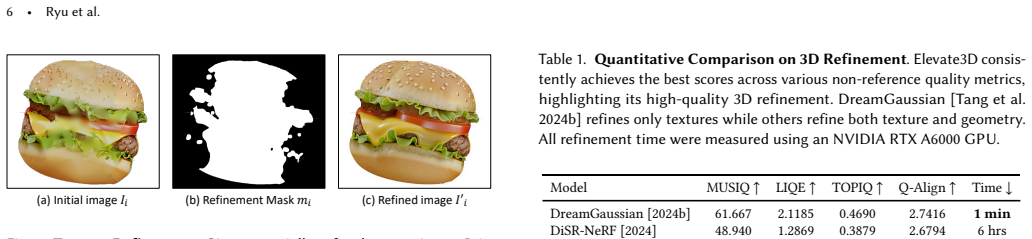
- [Table 1 / Table S6] The state-of-the-art claim for 3D refinement is not supported by the reported evidence, because Table 1 omits the unrefined input baseline and contains no geometry metric. Table S6 shows that full Elevate3D decreases PSNR from 33.202 (LQ baseline) to 26.163 and SSIM from 0.966 to 0.941 against the same ground-truth GSO scans, while DreamGaussian stays close to the baseline (PSNR 32.720, SSIM 0.965). The main Table 1 therefore shows only that no-reference quality scores on rendered views are higher than for competitors; it does not show that the output is more faithful or that geometry is better. A proper comparison should include an LQ-baseline row in Table 1 and a geometry metric such as Chamfer distance, normal consistency, or reconstructed-mesh FID in the main paper.
- [Section 3 / Table 2] The claim that HFS-SDEdit 'resolves' the SDEdit fidelity-quality trade-off is not supported by the full-reference metrics in Table 2. HFS-SDEdit achieves PSNR 15.588 and SSIM 0.391, which are worse than the low-quality baseline itself (PSNR 20.701, SSIM 0.521) and only marginally better than SDEdit at high strength on LPIPS. While the paper correctly notes that generative methods often sacrifice pixel-level fidelity, the abstract's claim of 'preserving the appearance and geometry while fixing its degradations' requires evidence that the output is perceptually more similar to the input than the input is to itself, or a user study. Without such evidence, the quantitative picture is a fidelity-quality trade-off that is shifted, not resolved.
- [Section 5.1 / Table S1] The main experimental configuration is determined by manually selected hyperparameters, and the sensitivity analysis in Table S1 shows large metric swings: for sigma=2, MUSIQ ranges from 67.18 (t_stop=22) down to 41.96 (t_stop=16), and for sigma=16, MUSIQ drops to 25.13. Since sigma=4 and t_stop=18 are chosen by qualitative comparison, the reported advantage in the 3D experiments may be specific to this manual tuning. The paper should provide a quantitative selection criterion (e.g., a validation metric) or demonstrate that performance is stable across a reasonable range of these parameters, rather than selecting the operating point from the same comparisons used to claim superiority.
minor comments (5)
- [Section 3] There are several typographical errors: 'initalizes' should be 'initializes' and 'Guassian' should be 'Gaussian'.
- [Algorithm 1] The comment in Algorithm 1 in the supplementary says 'This case indicates backround in our implementation'; 'backround' should be 'background'.
- [Section 5.2 / Fig. 10 caption] The method name is written inconsistently: 'DiSR-Nerf' appears in the Fig. 10 caption while 'DiSR-NeRF' is used elsewhere; please standardize.
- [Supplementary B.7] In the first sentence of Section B.7, 'we extract extract geometric cues' contains a duplicated word; it should be 'we extract geometric cues'.
- [Supplementary B.3] The interpretation of Table S3 in the text says 'the full refinement achieves balanced and competitive results across both geometry and texture metrics,' but the Normal FID value for full refinement (52.195) is substantially worse than geometry-only (48.043), so 'balanced and competitive' should be quantified and justified in light of this gap.
Circularity Check
No significant circularity: HFS-SDEdit is benchmarked externally on LSDIR and the 3D pipeline is evaluated on public GSO scans against public baselines; self-citations are not load-bearing.
full rationale
Walking the derivation chain, Elevate3D's two load-bearing components are independently grounded. HFS-SDEdit is defined by Eqs. (2)-(3) as high-frequency replacement during SDEdit denoising, and its central claim is tested in Section 5.3 on the external LSDIR validation set against external baselines (SDEdit, NC-SDEdit), with the low-frequency-versus-high-frequency claim tested by a controlled swapping experiment (Fig. 6). The 3D refinement loop in Section 4 is evaluated on public GSO scans against public competitors (DreamGaussian, DiSR-NeRF, MagicBoost), and the geometry refinement uses an off-the-shelf external normal predictor [Martin Garcia et al. 2025] and external regularized normal integration [Cao et al. 2022]; no predicted quantity is defined in terms of a fitted constant from the same data. The only self-citations ([Ryu et al. 2023], [Kim et al. 2024]) appear in related-work and future-work contexts and are not load-bearing. The near-miss is that HFS-SDEdit's sigma and t_stop are chosen by qualitative comparison, with a quantitative sweep reported in Table S1 on the same experiment; this is test-set hyperparameter selection rather than a circular reduction of a claim to its own input. The supplemental contradiction that full refinement worsens Normal FID relative to geometry-only (Table S3: 52.195 vs 48.043) and lowers PSNR relative to the LQ baseline (Table S6: 26.163 vs 33.202) undercuts the state-of-the-art claim, but it is an internal-consistency or correctness issue, not a derivation that equates an output to an input by construction.
Assumptions & free parameters
free parameters (5)
- sigma (Gaussian kernel standard deviation) =
4
- t_stop (denoising timestep until which high-frequency swapping is applied) =
18
- lambda (depth regularization weight in Eq. (5)) =
0.008
- tau (view visibility threshold for refinement mask) =
0.5
- Camera-selection termination ratio =
0.02
assumptions (5)
- domain assumption Low-frequency components of the diffusion latent carry the image's domain information, while high-frequency components carry small-scale structures.
- domain assumption A Gaussian low-pass filter on the latent cleanly separates the high and low frequency bands that matter for the diffusion prior.
- domain assumption An orthographic camera model and depth rasterization from the existing mesh suffice for the regularized normal integration.
- domain assumption The monocular normal predictor applied to the refined texture produces normals accurate enough to improve the mesh geometry.
- domain assumption Poisson surface reconstruction stitches the refined patch into the mesh without introducing artifacts.
Cite this review
Pith. "Pith review of Elevating 3D Models: High-Quality Texture and Geometry Refinement from a Low-Quality Model." pith.science (2026). https://pith.science/paper/XXR5BDG5
@misc{pith2026250711465,
  author       = {Pith},
  title        = {Pith review of: Elevating 3D Models: High-Quality Texture and Geometry Refinement from a Low-Quality Model},
  year         = {2026},
  howpublished = {\url{https://pith.science/paper/XXR5BDG5}},
  note         = {Machine review of arXiv:2507.11465}
}
read the original abstract
High-quality 3D assets are essential for various applications in computer graphics and 3D vision but remain scarce due to significant acquisition costs. To address this shortage, we introduce Elevate3D, a novel framework that transforms readily accessible low-quality 3D assets into higher quality. At the core of Elevate3D is HFS-SDEdit, a specialized texture enhancement method that significantly improves texture quality while preserving the appearance and geometry while fixing its degradations. Furthermore, Elevate3D operates in a view-by-view manner, alternating between texture and geometry refinement. Unlike previous methods that have largely overlooked geometry refinement, our framework leverages geometric cues from images refined with HFS-SDEdit by employing state-of-the-art monocular geometry predictors. This approach ensures detailed and accurate geometry that aligns seamlessly with the enhanced texture. Elevate3D outperforms recent competitors by achieving state-of-the-art quality in 3D model refinement, effectively addressing the scarcity of high-quality open-source 3D assets.
Figures


Figures from the paper (8 more)


Reference graph
Works this paper leans on
-
[3]
InThe Eleventh International Confer- ence on Learning Representations
Flow Matching for Generative Modeling. InThe Eleventh International Confer- ence on Learning Representations. https://openreview.net/forum?id=PqvMRDCJT9t Xingchao Liu, Chengyue Gong, and Qiang Liu. 2022. Flow Straight and Fast: Learning to Generate and Transfer Data with Rectified Flow. arXiv:2209.03003 [cs.LG] Yuan Liu, Cheng Lin, Zijiao Zeng, Xiaoxiao L...
arXiv 2023
-
[4]
High-Resolution Image Synthesis With Latent Diffusion Models. InCVPR. 10684–10695. Nuri Ryu, Minsu Gong, Geonung Kim, Joo-Haeng Lee, and Sunghyun Cho. 2023. 360° Reconstruction From a Single Image Using Space Carved Outpainting. InSIGGRAPH Asia 2023 Conference Papers (SA ’23). Association for Computing Machinery, New York, NY, USA, Article 75, 11 pages. h...
arXiv 2024
-
[5]
Xianfang Zeng, Xin Chen, Zhongqi Qi, Wen Liu, Zibo Zhao, Zhibin Wang, Bin Fu, Yong Liu, and Gang Yu
MonoSDF: Exploring Monocular Geometric Cues for Neural Implicit Surface Reconstruction. Xianfang Zeng, Xin Chen, Zhongqi Qi, Wen Liu, Zibo Zhao, Zhibin Wang, Bin Fu, Yong Liu, and Gang Yu. 2024. Paint3D: Paint Anything 3D with Lighting-Less Texture Diffusion Models. InProceedings of the IEEE/CVF Conference on Computer Vision and Pattern Recognition (CVPR)...
arXiv 2024
-
[2022]
InProceedings of the IEEE/CVF Conference on Computer Vision and Pattern Recognition (CVPR)
Mip-NeRF 360: Unbounded Anti-Aliased Neural Radiance Fields. InProceedings of the IEEE/CVF Conference on Computer Vision and Pattern Recognition (CVPR). 5470– 5479. Colin Barré-Brisebois and Stephen Hill. 2012. Blending in Detail. https://blog.selfshadow.com/publications/blending-in-detail/. Yochai Blau and Tomer Michaeli. 2018. The Perception-Distortion ...
arXiv 2014
-
[2023]
InProceedings of the IEEE/CVF Conference on Computer Vision and Pattern Recognition (CVPR) Workshops
LSDIR: A Large Scale Dataset for Image Restoration. InProceedings of the IEEE/CVF Conference on Computer Vision and Pattern Recognition (CVPR) Workshops. 1775–1787. Yaron Lipman, Ricky T. Q. Chen, Heli Ben-Hamu, Maximilian Nickel, and Matthew Le
Reviewed August 6, 2026 · model on record in the stance chip above.
Discussion (0). Sign in to comment.