REVIEW 3 major objections 4 minor 97 references
End-to-end switchless architecture for fault-tolerant photonic quantum computing
T0 review · 3 major / 4 minor · reviewed 2026-08-11 · deepseek-v4-flash
Pith's one-line read The paper's central claim is that a fully passive, switchless photonic architecture can run fault-tolerant continuous-variable quantum computing with only 12 to 13 dB of Gaussian cluster squeezing.
desk verdict Real architecture ideas, but the 90% yield and 12–13 dB thresholds are conditional on an unquantified fidelity filter and zero-outcome post-selection; worth refereeing, not worth accepting as headline numbers yet. read the letter →
The pith
A machine-rendered reading of the paper's core claim, the machinery that carries it, and where it could break.
The reading
What carries the argument
The central mechanisms are PhANTM (repeated photon subtraction and teleportation along a dual-rail cluster state, which builds a large squeezed cat state without switches), adaptive breeding (an algorithm that squeezes each probabilistic cat to the required amplitudes, replaces unsuitable cats by momentum-squeezed states, and breeds pairs through homodyne measurements to form GKP sensor states), and the teleportation-based squeezing gate whose homodyne angles set the effective squeezing. The magic-state protocol replaces the vacuum mode in GKP error correction by an optimized cat state, which is what lets weaker GKP states remain distillable. At the logical level, GKP Bell pairs are assembled into a macronode RHG lattice with static linear optics; a dictionary protocol converts physical homodyne outcomes into effective canonical-lattice measurements, and decoded syndromes are processed by a minimum-weight perfect-matching decoder. The target cat amplitude for breeding is set by the spacing formula $\alpha_b = \xi 2^{(M-3)/2}$, which the adaptive protocol adjusts for each PhANTM output.
What would settle it
Re-run the published Monte Carlo chain from PhANTM through adaptive breeding without the 95%-fidelity filter and without zero-outcome post-selection, then count the fraction of GKP states that land in the correctable region at 13 dB; a true success probability well below 90% or a threshold above 13.5 dB would refute the central claim. A complementary experimental check is to demonstrate 13 dB squeezing from an integrated on-chip source, which has not yet been reported.
Extended reading notes
Core claim
The central claim is that a switchless, all-passive continuous-variable architecture can cross the fault-tolerance threshold with 12 to 13 dB of Gaussian cluster squeezing. The authors report fault-tolerance thresholds, expressed as cluster squeezing, of 12.1, 12.7, and 13.0 dB for 20, 15, and 10 rounds of their photon-counting-assisted node-teleportation (PhANTM) method; at 13 dB and 20 PhANTM steps, 91% of generated sensor states fall in the correctable region. They further report that replacing the vacuum mode in GKP-based error correction with an optimized cat state makes magic states distillable with GKP resources at roughly 13 dB effective squeezing, with a Monte Carlo success rate of 4.8% rather than 0.3%. The logical layer is constructed as a macronode RHG lattice assembled from GKP Bell pairs with static linear optics, and the logical error rates come from full end-to-end simulations that feed distributions of GKP squeezing from the generation pipeline into a surface-code decoder.
Load-bearing premise
The reported numbers depend on keeping only simulated cat states with fitted fidelity above 95% and post-selecting every homodyne outcome to zero; if the rejected tail is sizeable or nonzero outcomes degrade the cats, the yield and thresholds shift.
Editorial extensions
If this is right
- If the threshold claim is right, fault-tolerant photonic computation no longer needs fast photonic switches or quantum memories; adaptivity reduces to setting local-oscillator phases and tracking corrections in software.
- Low photon-number resolution (up to about 10 photons) suffices for cat generation, so high-bandwidth room-temperature detectors become viable instead of cryogenic detectors resolving 40 to 100 photons.
- At 13 dB cluster squeezing with 20 PhANTM steps, roughly 91% of generated sensor states land above the fault-tolerance threshold, so qubit factories can operate at near-unity yield.
- The 12 to 13 dB cluster-squeezing requirement sits below the 15 dB demonstrated in free space but above the ~8.3 dB shown on chip, making on-chip squeezing rather than detector resolution the pacing requirement.
- Because the magic-state protocol works with GKP resource states at roughly 13 dB effective squeezing, universal non-Clifford gates become accessible without the ~20 dB GKP squeezing that vacuum-based magic-state preparation demands.
Reading between the lines
- Inference: if the 95%-fidelity filter and zero-outcome post-selection are removed, the authors' own deferred analysis suggests nonzero homodyne outcomes mainly unbalance the cat amplitudes; whether feedforward displacement restores the quoted >90% yield is not tested in this paper.
- Inference: the p/q squeezing imbalance produced by breeding points toward biased or asymmetric decoders that could lower the required cluster squeezing below 12 dB, an optimization the paper leaves open.
- Inference: the paper's loss analysis implies the practical loss budget is dominated by the PhANTM cat-generation stage, since sub-1% propagation loss already erodes Wigner negativity there, whereas breeding and QEC tolerate a few percent loss before thresholds shift notably.
- Inference: if integrated sources reach ~12 dB only at higher pump powers or with added loss, the next constraint may be feedforward timing, because active displacements must complete within one temporal-mode spacing; the paper does not quantify clock-rate limits.
Editorial analysis
A structured set of objections, weighed in public.
Referee Report
Summary. The manuscript proposes an end-to-end continuous-variable photonic fault-tolerant architecture built from passive components: PhANTM generates squeezed cat states on dual-rail quantum wires; an adaptive breeding protocol converts them to GKP sensor states; a CV-QEC protocol acting on cat states produces magic states; and a macronode RHG lattice with GKP qubits is decoded with minimum-weight perfect matching. The authors report cluster-squeezing thresholds of 12.1, 12.7, and 13 dB for 20, 15, and 10 PhANTM steps, GKP generation probabilities above 90% (Table 1), and a magic-state success rate of 4.8% at 13 dB. They also benchmark a balanced-GKP squeezing threshold of 10.2 dB, consistent with prior macronode work [27].
Significance. If the headline yields and thresholds hold, the architecture would be significant: it removes active switches from the qubit-generation path, requires only low photon-number resolution (up to about 10 photons), and operates at squeezing levels below the 15 dB demonstrated in free space while exceeding the 8.3 dB demonstrated on-chip. The end-to-end simulation structure, with realistic GKP squeezing distributions fed into QEC decoding, is a useful step beyond idealized fixed-squeezing analyses. The paper's external anchor (10.2 dB balanced threshold) and its loss analysis lend credibility. The main caveat is that the headline probabilities and thresholds are computed conditioned on unquantified post-selections in the PhANTM pipeline (Appendix 11.3), so the unconditional claims are not yet established.
major comments (3)
- [Appendix 11.3 / Sec. 8.2 / Table 1] The end-to-end yields and thresholds rest on two post-selections in the PhANTM Monte Carlo: only output states with fitted fidelity greater than 95% are retained, and every homodyne outcome is post-selected to zero. The discarded fraction and the probability of the zero-outcome conditioning event are not reported. Since these filtered cat states feed adaptive breeding (Sec. 5) and the threshold pipeline (Sec. 8.2), the 0.91 success rate in Table 1 and the 12.1/12.7/13 dB thresholds are conditional success probabilities, not unconditional end-to-end yields. Exact-zero homodyne outcomes form a measure-zero set for a continuous variable; the authors defer nonzero-outcome effects to ref. [55], but the abstract's claim of qubit production 'with probabilities above 90%' requires the unconditional per-attempt probability. Please report the discarded fraction and the zero-outcome probability, or repeat the simulation with the full homodyne distribution and displacement corrections.
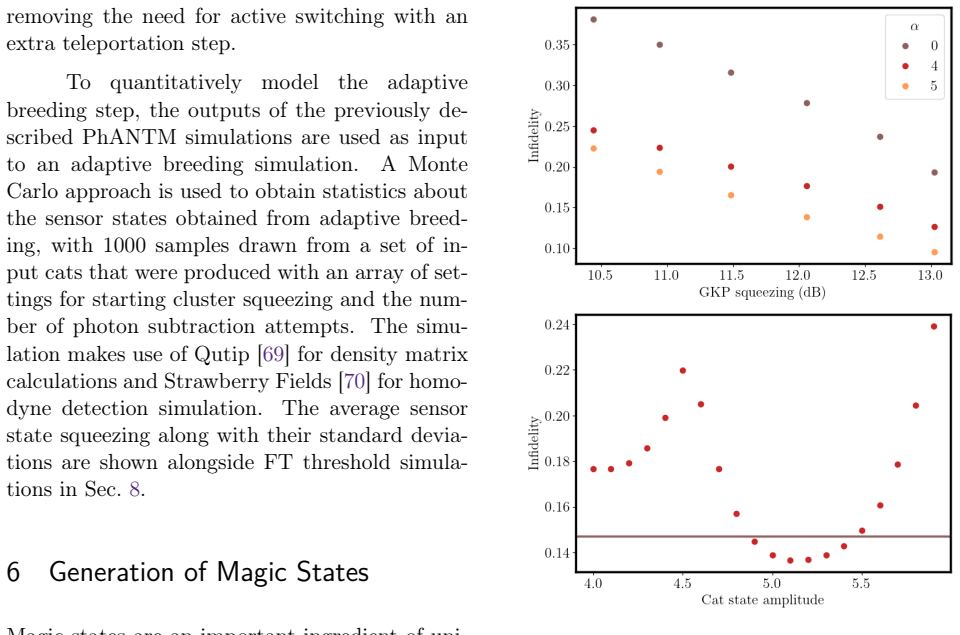
- [Sec. 6 / Fig. 10] The magic-state success rate of 0.048 and the factor-of-10 improvement over vacuum input inherit the same conditioning: the deterministic CV-QEC curves in Fig. 8 are computed with post-selection on zero quadrature outcomes, and the Monte Carlo uses PhANTM cats after the greater-than-95% fidelity filter. The text states that the zero-outcome post-selection 'slightly' underestimates output squeezing [54], but the size of the effect on the success rate is not quantified for the cat-input protocol. Please report the unconditional success probability, or at least the probabilities of the conditioning events, so the 4.8% claim can be compared fairly with other magic-state protocols.
- [Appendix 11.8 / Sec. 8.2] The QEC simulation samples noise from only the diagonal elements of Σout after symplectic propagation, ignoring correlations between modes introduced by the macronode beamsplitter network and the dictionary corrections. The manuscript does not quantify the impact of this approximation on the threshold. Because this approximation is used in the end-to-end threshold simulations, please either justify that the off-diagonal terms are negligible for the threshold, or sample from the full covariance matrix.
minor comments (4)
- [Appendix 11.3 / Fig. 14] The text states that 1000 trials are run for the PhANTM Monte Carlo, while the Fig. 14 caption says 500 iterations for each dataset; please reconcile the sample sizes.
- [Sec. 3 / Sec. 4] The architecture is described as 'fully-passive' and 'switchless', but Sec. 4 requires active displacements between repeated PhANTM steps. Please clarify that 'switchless' refers to the absence of optical switches on the quantum modes, not the absence of all active feedforward elements.
- [Sec. 8.1 / Fig. 12] The model assumes that GKP effective squeezing values are Gaussian-distributed across modes with standard deviation σd. Since the yield-above-threshold calculation is sensitive to the tails of this distribution, please include a goodness-of-fit comparison or overlay the simulated histograms from adaptive breeding.
- [References] In ref. [55], the author list contains 'Pfister Pfister'; this should be corrected to 'Olivier Pfister'.
Circularity Check
No circularity found: the 12–13 dB threshold and >90% yields are forward-simulated outputs with an external 10.2 dB anchor; the App. 11.3 post-selection is a conditionality, not a circular reduction.
full rationale
No load-bearing step in the paper reduces by construction to its own inputs. The claimed 12–13 dB cluster-squeezing threshold is obtained by a forward pipeline: PhANTM Monte Carlo outputs (App. 11.2–11.3) feed adaptive breeding (Alg. 1), whose GKP effective-squeezing distributions are then used as inputs to an RHG-lattice logical simulation decoded with pyMatching (Sec. 8.2, App. 11.8). The threshold is the crossing of the logical error rate as a function of cluster squeezing, and the balanced-quadrature limit reproduces an external result: 'With balanced squeezing in each quadrature we recover a threshold of 10.2 dB, which is inline with similar error models [27].' This external anchor shows the logical error model is not tuned to produce the headline numbers. The 'probabilities above 90%' are likewise defined as the fraction of the simulated GKP squeezing distribution lying in the correctable region of Fig. 12(a), a forward summary statistic rather than a fitted parameter renamed as a prediction. The only author-overlapping citation with a structural role is [55] (PhANTM, co-authored by M. Eaton); it is prior peer-reviewed work whose stated assumptions do not include the present FT-threshold or yield claims, so under the review rules it counts as independent support, not circularity. A real caveat, explicitly asserted in App. 11.3, is that 'only states with a fidelity greater than 95% are retained' and 'we post-select homodyne measurements at 0.' This makes the headline 0.91/table yields and the 12–13 dB thresholds conditional on an unreported filter fraction and on zero-outcome conditioning; if the discarded fraction is large or nonzero homodyne results degrade cat quality, the unconditional numbers shift. That is a validity/conditionality limitation, located in the simulation pipeline, not a circular reduction: the outputs are not defined in terms of the claims, nor is any parameter fitted to the target quantity.
Assumptions & free parameters
free parameters (8)
- Number of PhANTM steps =
20, 15, 10
- Photon subtraction attempts per time step =
8
- Beamsplitter reflectivity gradient for photon subtraction =
not specified in text; angles in Fig. 15 legend
- Lower bound on cat squeezing r_lb =
0.5 (4.34 dB)
- Number of breeding rounds M =
3
- Target input cat amplitude for magic state CV-QEC =
approximately 5.1 (optimal range 4.9 to 5.5)
- Fidelity retention threshold in PhANTM simulation =
0.95
- Fock truncation dimension =
60
assumptions (8)
- standard math Standard CV quantum optics toolkit: squeezing, beamsplitters, homodyne detection, and PNR measurements as described in [33, 34, 42, 43].
- domain assumption PhANTM produces cat states with the statistics simulated in [55] and reproduced here.
- domain assumption The Gaussian displacement error channel E(ρ, Δ) of Eq. (1) models the noise of realistic GKP states in the macronode lattice.
- domain assumption The macronode dictionary protocol from [27] maps physical measurements to canonical RHG lattice measurements without unmodeled noise.
- ad hoc to paper Bred GKP and sensor states are adequately characterized by the fitted cat parameters (amplitude, squeezing, parity) when propagated through adaptive breeding.
- ad hoc to paper GKP effective squeezing values are approximately Gaussian-distributed across modes in the QEC simulation.
- domain assumption Active feedforward displacements based on homodyne results are error-free and fast enough relative to the temporal mode spacing.
- domain assumption On-chip cluster squeezing of 12 to 13 dB can be achieved with low loss.
Cite this review
Pith. "Pith review of End-to-end switchless architecture for fault-tolerant photonic quantum computing." pith.science (2026). https://pith.science/paper/XY64FPRJ
@misc{pith2026241212680,
  author       = {Pith},
  title        = {Pith review of: End-to-end switchless architecture for fault-tolerant photonic quantum computing},
  year         = {2026},
  howpublished = {\url{https://pith.science/paper/XY64FPRJ}},
  note         = {Machine review of arXiv:2412.12680}
}
read the original abstract
Photonics represents one of the most promising approaches to large-scale quantum computation with millions of qubits and billions of gates, owing to the potential for room-temperature operation, high clock speeds, miniaturization of photonic circuits, and repeatable fabrication processes in commercial photonic foundries. We present an end-to-end architecture for fault-tolerant continuous variable (CV) quantum computation using only passive on-chip components that can produce photonic qubits above the fault tolerance threshold with probabilities above 90%, and encodes logical qubits using physical qubits sampled from a distribution around the fault tolerance threshold. By requiring only low photon number resolution, the architecture enables the use of high-bandwidth photodetectors in CV quantum computing. Simulations of our qubit generation and logical encoding processes show a Gaussian cluster squeezing threshold of 12 dB to 13 dB. Additionally, we present a novel magic state generation protocol which requires only 13 dB of cluster squeezing to produce magic states with an order of magnitude higher probability than existing approaches, opening up the path to universal fault-tolerant quantum computation at less than 13 dB of cluster squeezing.
Figures


Figures from the paper (14 more)




Reference graph
Works this paper leans on
-
[27]
Fault-tolerant quantum computation with static linear op- tics
Ilan Tzitrin, Takaya Matsuura, Rafael N Alexander, Guillaume Dauphinais, J Eli Bourassa, Krishna K Sabapathy, Nicolas C Menicucci, and Ish Dhand. “Fault-tolerant quantum computation with static linear op- tics”. PRX Quantum2, 040353 (2021)
work page 2021
-
[55]
Miller Eaton, Carlos González-Arciniegas, Rafael N. Alexander, Nicolas C. Menicucci, and Pfister Pfister. “Measurement-based generation and preservation of cat and grid states within a continuous-variable cluster state”. Quantum 6, 769 (2022)
work page 2022
-
[54]
Generating grid states from schrödinger-cat states without postselection
Daniel J. Weigand and Barbara M. Terhal. “Generating grid states from schrödinger-cat states without postselection”. Phys. Rev. A 97, 022341 (2018). Accepted in Quantum 2025-07-01, click title to verify. Published under CC-BY 4.0. 22
work page 2018
-
[1]
Simulating physics with computers
Richard P. Feynman. “Simulating physics with computers”. International Journal of Theoretical Physics 21, 467–488 (1982)
1982
-
[2]
Quantum computing in the NISQ era and beyond
John Preskill. “Quantum computing in the NISQ era and beyond”. Quantum 2, 79 (2018)
2018
-
[3]
Demonstration of a small programmable quantum computer with atomic qubits
S. Debnath, N. M. Linke, C. Figgatt, K. A. Landsman, K. Wright, and C. Monroe. “Demonstration of a small programmable quantum computer with atomic qubits”. Na- ture 536, 63–66 (2016)
2016
-
[4]
Hardware-efficient variational quan- tum eigensolver for small molecules and quantum magnets
Abhinav Kandala, Antonio Mezzacapo, Kristan Temme, Maika Takita, Markus Brink, Jerry M. Chow, and Jay M. Gam- betta. “Hardware-efficient variational quan- tum eigensolver for small molecules and quantum magnets”. Nature 549, 242– 246 (2017)
2017
-
[5]
Quantum computing with neutral atoms
Loïc Henriet, Lucas Beguin, Adrien Sig- noles, Thierry Lahaye, Antoine Browaeys, Georges-Olivier Reymond, and Christophe Jurczak. “Quantum computing with neutral atoms”. Quantum 4, 327 (2020)
2020
Show all 97 references
-
[6]
Scalable Quan- tum Simulation of Molecular Energies
P.J.J. O’Malley, R. Babbush, I.D. Kivlichan, J. Romero, J.R. McClean, R. Barends, J. Kelly, P. Roushan, A. Tranter, N. Ding, B. Campbell, Y. Chen, Z. Chen, B. Chiaro, A. Dunsworth, A.G. Fowler, E. Jeffrey, E. Lucero, A. Megrant, J.Y. Mutus, M. Nee- ley, C. Neill, C. Quintana, ...
2016
-
[7]
Fault-tolerant resource estimate for quan- tum chemical simulations: Case study on Li- ion battery electrolyte molecules
Isaac H Kim, Ye-Hua Liu, Sam Pallister, WilliamPol, SamRoberts, andEunseokLee. “Fault-tolerant resource estimate for quan- tum chemical simulations: Case study on Li- ion battery electrolyte molecules”. Physical Review Research 4, 023019 (2022)
2022
-
[8]
How to factor 2048 bit rsa integers in 8 hours us- ing 20 million noisy qubits
Craig Gidney and Martin Ekerå. “How to factor 2048 bit rsa integers in 8 hours us- ing 20 million noisy qubits”. Quantum 5, 433 (2021)
2021
-
[9]
How to compute a 256-bit ellipticcurveprivatekeywithonly50million toffoli gates
Daniel Litinski. “How to compute a 256-bit ellipticcurveprivatekeywithonly50million toffoli gates” (2023)
2023
-
[10]
Quantum En- tanglement between Optical and Microwave Photonic Qubits
Srujan Meesala, David Lake, Steven Wood, Piero Chiappina, Changchun Zhong, An- drew D. Beyer, Matthew D. Shaw, Liang Jiang, and Oskar Painter. “Quantum En- tanglement between Optical and Microwave Photonic Qubits”. Physical Review X 14, 031055 (2024)
2024
-
[11]
Quantum computing with atomic qubits and Rydberg interactions: progress and challenges
M. Saffman. “Quantum computing with atomic qubits and Rydberg interactions: progress and challenges”. Journal of Physics B: Atomic, Molecular and Optical Physics 49, 202001 (2016)
2016
-
[12]
Linear optical quantum computing with photonic qubits
PieterKok, W.J.Munro, KaeNemoto, T.C. Ralph, Jonathan P. Dowling, and G. J. Mil- burn. “Linear optical quantum computing with photonic qubits”. Rev. Mod. Phys.79, 135–174 (2007)
2007
-
[13]
Switch networks for photonic fusion-based quantum computing
Sara Bartolucci, Patrick Birchall, Damien Bonneau, Hugo Cable, Mercedes Gimeno- Accepted in Quantum 2025-07-01, click title to verify. Published under CC-BY 4.0. 20 Segovia, Konrad Kieling, Naomi Nickerson, Terry Rudolph, and Chris Sparrow. “Switch networks for photonic fusion...
2021 arXiv
-
[14]
Quantum computation over continuous variables
Seth Lloyd and Samuel L. Braunstein. “Quantum computation over continuous variables”. Phys. Rev. Lett.82, 1784 (1999)
1999
-
[15]
Modes and states in quantum optics
C. Fabre and N. Treps. “Modes and states in quantum optics”. Rev. Mod. Phys. 92, 035005 (2020)
2020
-
[16]
Gaussian quantum information
Christian Weedbrook, Stefano Pirandola, Raúl García-Patrón, Nicolas J. Cerf, Tim- othy C. Ralph, Jeffrey H. Shapiro, and Seth Lloyd. “Gaussian quantum information”. Rev. Mod. Phys.84, 621–669 (2012)
2012
-
[17]
Fault-tolerant measurement-based quantum computing with continuous-variable cluster states
Nicolas C. Menicucci. “Fault-tolerant measurement-based quantum computing with continuous-variable cluster states”. Phys. Rev. Lett.112, 120504 (2014)
2014
-
[18]
Generation of time- domain-multiplexed two-dimensional cluster state
Warit Asavanant, Yu Shiozawa, Shota Yokoyama, Baramee Charoensombuta- mon, Hiroki Emura, Rafael N. Alexander, Shuntaro Takeda, Jun-ichi Yoshikawa, Nicolas C. Menicucci, Hidehiro Yonezawa, and Akira Furusawa. “Generation of time- domain-multiplexed two-dimensional cluster state...
2019
-
[19]
Universal quantum computa- tion with continuous-variable cluster states
N. C. Menicucci, P. van Loock, M. Gu, C. Weedbrook, T. C. Ralph, and M. A. Nielsen. “Universal quantum computa- tion with continuous-variable cluster states”. Phys. Rev. Lett.97, 110501 (2006)
2006
-
[20]
Encoding a qubit in an oscillator
Daniel Gottesman, Alexei Kitaev, and John Preskill. “Encoding a qubit in an oscillator”. Phys. Rev. A64, 012310 (2001)
2001
-
[21]
Bosonic quantum error correction codes in supercon- ducting quantum circuits
Weizhou Cai, Yuwei Ma, Weiting Wang, Chang-Ling Zou, and Luyan Sun. “Bosonic quantum error correction codes in supercon- ducting quantum circuits”. Fundamental Re- search 1, 50–67 (2021)
2021
-
[22]
Autonomous quantum error correc- tion and fault-tolerant quantum computa- tion with squeezed cat qubits
Qian Xu, Guo Zheng, Yu-Xin Wang, Pe- ter Zoller, Aashish A. Clerk, and Liang Jiang. “Autonomous quantum error correc- tion and fault-tolerant quantum computa- tion with squeezed cat qubits”. npj Quantum Information 9, 1–11 (2023)
2023
-
[23]
Limitations of quantum com- puting with Gaussian cluster states
M. Ohliger. “Limitations of quantum com- puting with Gaussian cluster states”. Physi- cal Review A82 (2010)
2010
-
[24]
Univer- sal quantum computation with ideal clifford gates and noisy ancillas
Sergey Bravyi and Alexei Kitaev. “Univer- sal quantum computation with ideal clifford gates and noisy ancillas”. Phys. Rev. A71, 022316 (2005)
2005
-
[25]
All-gaussian uni- versality and fault tolerance with the gottesman-kitaev-preskill code
Ben Q Baragiola, Giacomo Pantaleoni, Rafael N Alexander, Angela Karanjai, and Nicolas C Menicucci. “All-gaussian uni- versality and fault tolerance with the gottesman-kitaev-preskill code”. Physical re- view letters 123, 200502 (2019)
2019
-
[26]
Blueprint for a Scalable Photonic Fault-Tolerant Quantum Computer
J. Eli Bourassa, Rafael N. Alexander, Michael Vasmer, Ashlesha Patil, Ilan Tz- itrin, Takaya Matsuura, Daiqin Su, Ben Q. Baragiola, Saikat Guha, Guillaume Dauphi- nais, Krishna K. Sabapathy, Nicolas C. Menicucci, and Ish Dhand. “Blueprint for a Scalable Photonic Fault-Tolerant...
2021
-
[28]
Fault- tolerant continuous-variable measurement- based quantum computation architecture
Mikkel V Larsen, Christopher Chamber- land, Kyungjoo Noh, Jonas S Neergaard- Nielsen, and Ulrik L Andersen. “Fault- tolerant continuous-variable measurement- based quantum computation architecture”. PRX Quantum 2, 030325 (2021)
2021
-
[29]
A manufacturable plat- form for photonic quantum computing
PsiQuantum Team. “A manufacturable plat- form for photonic quantum computing”. Na- ture 641, 1–3 (2025)
2025
-
[30]
Large- inductance superconducting microstrip pho- ton detector enabling 10 photon-number res- olution
L. D. Kong, T. Z. Zhang, X. Y. Liu, H. Li, Z. Wang, X. M. Xie, and L. X. You. “Large- inductance superconducting microstrip pho- ton detector enabling 10 photon-number res- olution”. Adv. Photonics6, 016004 (2024)
2024
-
[31]
Photon-number-resolving segmented detectors based on single-photon avalanche-photodiodes
R Nehra, C. H. Chang, Q. Yu, A Beling, and O Pfister. “Photon-number-resolving segmented detectors based on single-photon avalanche-photodiodes”. Optics Express 28, 3660 (2020)
2020
-
[32]
Squeezed states of light and their applications in laser interferome- ters
Roman Schnabel. “Squeezed states of light and their applications in laser interferome- ters”. Physics Reports 684, 1–51 (2017)
2017
-
[33]
Continuous-variable quan- tum computing in the quantum optical frequency comb
Olivier Pfister. “Continuous-variable quan- tum computing in the quantum optical frequency comb”. Journal of Physics B: Accepted in Quantum 2025-07-01, click title to verify. Published under CC-BY 4.0. 21 Atomic, Molecular and Optical Physics53, 012001 (2019)
2019
-
[34]
Cluster-state quantum computation
Michael A Nielsen. “Cluster-state quantum computation”. Reports on Mathematical Physics 57, 147–161 (2006)
2006
-
[35]
A one- way quantum computer
R. Raussendorf and H. J. Briegel. “A one- way quantum computer”. Phys. Rev. Lett. 86, 5188 (2001)
2001
-
[36]
The optical frequency comb as a one- way quantum computer
S. T. Flammia, N. C. Menicucci, and O. Pfis- ter. “The optical frequency comb as a one- way quantum computer”. J. Phys. B, 42, 114009 (2009)
2009
-
[37]
Temporal-mode continuous-variable cluster states using lin- ear optics
Nicolas C. Menicucci. “Temporal-mode continuous-variable cluster states using lin- ear optics”. Phys. Rev. A83, 062314 (2011)
2011
-
[38]
Building gaussian cluster states by linear optics
Peter van Loock, Christian Weedbrook, and Mile Gu. “Building gaussian cluster states by linear optics”. Physical Review A—Atomic, Molecular, and Optical Physics 76, 032321 (2007)
2007
-
[39]
Streamlined quantum computing with macronode cluster states
Blayney W Walshe, Rafael N Alexander, Nicolas C Menicucci, and Ben Q Baragi- ola. “Streamlined quantum computing with macronode cluster states”. Physical Review A 104, 062427 (2021)
2021
-
[40]
Flexible quantum circuits using scalable continuous-variable cluster states
Rafael N. Alexander and Nicolas C. Menicucci. “Flexible quantum circuits using scalable continuous-variable cluster states”. Phys. Rev. A93, 062326 (2016)
2016
-
[41]
Broad- band amplitude squeezing in a periodically poled KTiOPO4 waveguide
M. Pysher, R. Bloomer, C. M. Kaleva, T. D. Roberts, P. Battle, and O. Pfister. “Broad- band amplitude squeezing in a periodically poled KTiOPO4 waveguide”. Opt. Lett.34, 256 (2009)
2009
-
[42]
Quantum computing with continuous-variable clusters
Mile Gu, Christian Weedbrook, Nicolas C. Menicucci, Timothy C. Ralph, and Peter van Loock. “Quantum computing with continuous-variable clusters”. Phys. Rev. A 79, 062318 (2009)
2009
-
[43]
Ultracompact generation of continuous-variable cluster states
N. C. Menicucci, S. T. Flammia, H. Zaidi, and O. Pfister. “Ultracompact generation of continuous-variable cluster states”. Phys. Rev. A 76, 010302(R) (2007)
2007
-
[44]
Continuous-variable optical quantum- state tomography
A. I. Lvovsky and M. G. Raymer. “Continuous-variable optical quantum- state tomography”. Rev. Mod. Phys. 81, 299–332 (2009)
2009
-
[45]
Efficient classical simulation of continuous variable quantum information processes
Stephen D. Bartlett, Barry C. Sanders, Samuel L. Braunstein, and Kae Nemoto. “Efficient classical simulation of continuous variable quantum information processes”. Phys. Rev. Lett.88, 097904 (2002)
2002
-
[46]
Gen- erating optical schrodinger kittens for quan- tum information processing
Alexei Ourjoumtsev, Rosa Tualle-Brouri, Julien Laurat, and Philippe Grangier. “Gen- erating optical schrodinger kittens for quan- tum information processing”. Science 312, 83–86 (2006)
2006
-
[47]
Plug-and-play genera- tion of non-gaussian states of light at a tele- com wavelength
Mohamed F Melalkia, Tecla Gabbrielli, An- toine Petitjean, Léandre Brunel, Alessandro Zavatta, Sébastien Tanzilli, Jean Etesse, and Virginia D’Auria. “Plug-and-play genera- tion of non-gaussian states of light at a tele- com wavelength”. Optics Express30, 45195– 45201 (2022)
2022
-
[48]
Quantum error correc- tion using squeezed schrödinger cat states
David S. Schlegel, Fabrizio Minganti, and Vincenzo Savona. “Quantum error correc- tion using squeezed schrödinger cat states”. Phys. Rev. A106, 022431 (2022)
2022
-
[49]
Progress towards practical qubit compu- tation using approximate gottesman-kitaev- preskill codes
Ilan Tzitrin, J Eli Bourassa, Nicolas C Menicucci, and Krishna Kumar Sabapathy. “Progress towards practical qubit compu- tation using approximate gottesman-kitaev- preskill codes”. Physical Review A 101, 032315 (2020)
2020
-
[50]
Phase-space methods for representing, manipulating, and correcting gottesman-kitaev-preskill qubits
Lucas J Mensen, Ben Q Baragiola, and Nico- las C Menicucci. “Phase-space methods for representing, manipulating, and correcting gottesman-kitaev-preskill qubits”. Physical Review A 104, 022408 (2021)
2021
-
[51]
Quan- tum error correction with the gottesman- kitaev-preskill code
Arne L Grimsmo and Shruti Puri. “Quan- tum error correction with the gottesman- kitaev-preskill code”. PRX Quantum 2, 020101 (2021)
2021
-
[52]
Continuous-variable gate tele- portationandbosonic-codeerrorcorrection
Blayney W Walshe, Ben Q Baragiola, Rafael N Alexander, and Nicolas C Menicucci. “Continuous-variable gate tele- portationandbosonic-codeerrorcorrection”. Physical Review A102, 062411 (2020)
2020
-
[53]
Equivalence of approximate gottesman-kitaev-preskill codes
Takaya Matsuura, Hayata Yamasaki, and Masato Koashi. “Equivalence of approximate gottesman-kitaev-preskill codes”. Physical Review A 102, 032408 (2020)
2020
-
[56]
A fault-tolerant one-way quantum com- puter
R Raussendorf, J Harrington, and K Goyal. “A fault-tolerant one-way quantum com- puter”. Ann. Phys. (NY) 321, 2242– 2270 (2006)
2006
-
[57]
Generation of flying logical qubits using generalized photon subtraction with adap- tive gaussian operations
Kan Takase, Fumiya Hanamura, Hironari Nagayoshi, J. Eli Bourassa, Rafael N. Alexander, Akito Kawasaki, Warit Asa- vanant, Mamoru Endo, and Akira Furusawa. “Generation of flying logical qubits using generalized photon subtraction with adap- tive gaussian operations”. Phys. Rev....
2024
-
[58]
Noise analysis of single-mode gaussian op- erations using continuous-variable cluster states
Rafael N. Alexander, Seiji C. Armstrong, Ryuji Ukai, and Nicolas C. Menicucci. “Noise analysis of single-mode gaussian op- erations using continuous-variable cluster states”. Phys. Rev. A90, 062324 (2014)
2014
-
[59]
One-way quan- tum computing with arbitrarily large time- frequency continuous-variable cluster states from a single optical parametric oscillator
Rafael N. Alexander, Pei Wang, Niran- jan Sridhar, Moran Chen, Olivier Pfister, and Nicolas C. Menicucci. “One-way quan- tum computing with arbitrarily large time- frequency continuous-variable cluster states from a single optical parametric oscillator”. Phys. Rev. A94, 032327 (2016)
2016
-
[60]
High-yield, wafer-scale fabrication of ultralow-loss, dispersion-engineered sili- con nitride photonic circuits
Junqiu Liu, Guanhao Huang, Rui Ning Wang, Jijun He, Arslan S. Raja, Tianyi Liu, Nils J. Engelsen, and Tobias J. Kip- penberg. “High-yield, wafer-scale fabrication of ultralow-loss, dispersion-engineered sili- con nitride photonic circuits”. Nature Com- munications 12, 2236 (2021)
2021
-
[61]
Lattice surgery on the raussendorf lattice
Daniel Herr, Alexandru Paler, Simon J De- vitt, and Franco Nori. “Lattice surgery on the raussendorf lattice”. Quantum Science and Technology3, 035011 (2018)
2018
-
[62]
Machine learning for effi- cient generation of universal photonic quan- tum computing resources
Amanuel Anteneh, Léandre Brunel, and Olivier Pfister. “Machine learning for effi- cient generation of universal photonic quan- tum computing resources”. Optica Quantum 2, 296–302 (2024)
2024
-
[63]
De- terministic preparation of optical squeezed cat and gottesman-kitaev-preskill states
Matthew S. Winnel, Joshua J. Guanzon, Deepesh Singh, and Timothy C. Ralph. “De- terministic preparation of optical squeezed cat and gottesman-kitaev-preskill states”. Phys. Rev. Lett132, 230602 (2024)
2024
-
[64]
Deterministic Generation of Large Fock States
M. Uria, P. Solano, and C. Hermann- Avigliano. “Deterministic Generation of Large Fock States”. Physical Review Letters 125, 093603 (2020)
2020
-
[65]
Measurement- based quantum computation with cluster states
Robert Raussendorf. “Measurement- based quantum computation with cluster states”. PhD thesis. Ludwig–Maximilians– Universität München. (2003)
2003
-
[66]
Measurement-based non- gaussian quantum state engineering
M. Eaton. “Measurement-based non- gaussian quantum state engineering”. PhD thesis. University of Virginia. (2022)
2022
-
[67]
Superconduct- ing transition edge sensors for quantum op- tics
Thomas Gerrits, Adriana Lita, Brice Calkins, and Sae Woo Nam. “Superconduct- ing transition edge sensors for quantum op- tics”. In Superconducting devices in quan- tum optics. Pages 31–60. Springer (2016)
2016
-
[68]
Seeding gaussian boson samplers with single photons for en- hanced state generation
Valerio Crescimanna, Aaron Z. Goldberg, and Khabat Heshami. “Seeding gaussian boson samplers with single photons for en- hanced state generation”. Phys. Rev. A109, 023717 (2024)
2024
-
[69]
QuTiP 2: A Python framework for the dynamics of open quantum sys- tems
J.R. Johansson, P.D. Nation, and Franco Nori. “QuTiP 2: A Python framework for the dynamics of open quantum sys- tems”. Computer Physics Communications 184, 1234–1240 (2013)
2013
-
[70]
Strawberry Fields: A Software Platform for Photonic Quantum Computing
Nathan Killoran, Josh Izaac, Nicolás Que- sada, Ville Bergholm, Matthew Amy, and Christian Weedbrook. “Strawberry Fields: A Software Platform for Photonic Quantum Computing”. Quantum 3, 129 (2019)
2019
-
[71]
Vacuum provides quan- tum advantage to otherwise simulatable architectures
Cameron Calcluth, Alessandro Ferraro, and Giulia Ferrini. “Vacuum provides quan- tum advantage to otherwise simulatable architectures”. Physical Review A 107, 062414 (2023)
2023
-
[72]
Magic state distillation: Not as costly as you think
Daniel Litinski. “Magic state distillation: Not as costly as you think”. Quantum 3, 205 (2019)
2019
-
[73]
Biased gottesman-kitaev- preskill repetition code
Matthew P Stafford and Nicolas C Menicucci. “Biased gottesman-kitaev- preskill repetition code”. Physical Review A 108, 052428 (2023)
2023
-
[74]
Finite Rate Accepted in Quantum 2025-07-01, click title to verify. Published under CC-BY 4.0. 23 QLDPC-GKP Coding Scheme that Sur- passes the CSS Hamming Bound
Nithin Raveendran, Narayanan Ren- gaswamy, Filip Rozpędek, Ankur Raina, Liang Jiang, and Bane Vasić. “Finite Rate Accepted in Quantum 2025-07-01, click title to verify. Published under CC-BY 4.0. 23 QLDPC-GKP Coding Scheme that Sur- passes the CSS Hamming Bound”. Quantum 6, 767 (2022)
2022
-
[75]
Quantum error cor- rection with the color-gottesman-kitaev- preskill code
Jiaxuan Zhang, Jian Zhao, Yu-Chun Wu, and Guo-Ping Guo. “Quantum error cor- rection with the color-gottesman-kitaev- preskill code”. Physical Review A 104, 062434 (2021)
2021
-
[76]
Surface code quan- tum computing with error rates over 1%
David S Wang, Austin G Fowler, and Lloyd CL Hollenberg. “Surface code quan- tum computing with error rates over 1%”. Physical Review A83, 020302 (2011)
2011
-
[77]
A game of surface codes: Large-scale quantum computing with lattice surgery
Daniel Litinski. “A game of surface codes: Large-scale quantum computing with lattice surgery”. Quantum 3, 128 (2019)
2019
-
[78]
Foliated quantum error- correcting codes
A Bolt, G Duclos-Cianci, D Poulin, and TM Stace. “Foliated quantum error- correcting codes”. Physical review letters 117, 070501 (2016)
2016
-
[79]
Topological fault-tolerance in cluster state quantum computation
Robert Raussendorf, Jim Harrington, and Kovid Goyal. “Topological fault-tolerance in cluster state quantum computation”. New Journal of Physics9, 199 (2007)
2007
-
[80]
Resilient quantum com- putation
Emanuel Knill, Raymond Laflamme, and Wojciech H Zurek. “Resilient quantum com- putation”. Science 279, 342–345 (1998)
1998
-
[81]
Flexi- ble layout of surface code computations us- ing autoccz states
Craig Gidney and Austin G Fowler. “Flexi- ble layout of surface code computations us- ing autoccz states” (2019)
2019
-
[82]
Linear- optical quantum computation with arbitrary error-correcting codes
Blayney W. Walshe, Ben Q. Baragiola, Hugo Ferretti, José Gefaell, Michael Vasmer, Ryohei Weil, Takaya Matsuura, Thomas Jaeken, Giacomo Pantaleoni, Zhihua Han, Timo Hillmann, Nicolas C. Menicucci, Ilan Tzitrin, and Rafael N. Alexander. “Linear- optical quantum computation with ...
2025
-
[83]
Demon- stration of a quantum nondemolition sum gate
Jun-ichi Yoshikawa, Yoshichika Miwa, Alexander Huck, Ulrik L. Andersen, Peter van Loock, and Akira Furusawa. “Demon- stration of a quantum nondemolition sum gate”. Phys. Rev. Lett.101, 250501 (2008)
2008
-
[84]
High- threshold fault-tolerant quantum computa- tion with analog quantum error correction
Kosuke Fukui, Akihisa Tomita, Atsushi Okamoto, and Keisuke Fujii. “High- threshold fault-tolerant quantum computa- tion with analog quantum error correction”. Phys. Rev. X8, 021054 (2018)
2018
-
[85]
All-optical long-distance quantum communication with gottesman- kitaev-preskill qubits
Kosuke Fukui, Rafael N Alexander, and Pe- ter van Loock. “All-optical long-distance quantum communication with gottesman- kitaev-preskill qubits”. Physical Review Re- search 3, 033118 (2021)
2021
-
[86]
Fault-tolerant bosonic quantum er- ror correction with the surface–gottesman- kitaev-preskill code
Kyungjoo Noh and Christopher Chamber- land. “Fault-tolerant bosonic quantum er- ror correction with the surface–gottesman- kitaev-preskill code”. Physical Review A 101, 012316 (2020)
2020
-
[87]
Sparse blossom: correcting a million errors per core second with minimum-weight match- ing
Oscar Higgott and Craig Gidney. “Sparse blossom: correcting a million errors per core second with minimum-weight match- ing”. Quantum 9, 1600 (2025)
2025
-
[88]
Fault-tolerant magic state prepa- ration with flag qubits
Christopher Chamberland and Andrew W Cross. “Fault-tolerant magic state prepa- ration with flag qubits”. Quantum 3, 143 (2019)
2019
-
[89]
High-thresholdfault-tolerant quantum computation with the gottesman- kitaev-preskill qubit under noise in an op- tical setup
KosukeFukui. “High-thresholdfault-tolerant quantum computation with the gottesman- kitaev-preskill qubit under noise in an op- tical setup”. Physical Review A 107, 052414 (2023)
2023
-
[90]
Detection of 15 dB squeezed states of light and their application for the absolute cali- bration of photoelectric quantum efficiency
Henning Vahlbruch, Moritz Mehmet, Karsten Danzmann, and Roman Schnabel. “Detection of 15 dB squeezed states of light and their application for the absolute cali- bration of photoelectric quantum efficiency”. Phys. Rev. Lett.117, 110801 (2016)
2016
-
[91]
Over-8-db squeezed light generation by a broadband waveguide optical parametric amplifier to- ward fault-tolerant ultra-fast quantum com- puters
Takahiro Kashiwazaki, Taichi Yamashima, Koji Enbutsu, Takushi Kazama, Asuka In- oue, Kosuke Fukui, Mamoru Endo, Takeshi Umeki, and Akira Furusawa. “Over-8-db squeezed light generation by a broadband waveguide optical parametric amplifier to- ward fault-tolerant ultra-fast quan...
2023
-
[92]
Resolution of 100 photons and quantum generation of unbiased random numbers
M Eaton, A Hossameldin, R Birrittella, P Alsing, C Gerry, H Dong, C Cuevas, and Olivier Pfister. “Resolution of 100 photons and quantum generation of unbiased random numbers”. Nat. Phot.17, 106–111 (2022)
2022
-
[93]
Photon-number-resolving segmented detectors based on single-photon avalanche- photodiodes
Rajveer Nehra, Chun-Hung Chang, Qian- huan Yu, Andreas Beling, and Olivier Pfis- ter. “Photon-number-resolving segmented detectors based on single-photon avalanche- photodiodes”. Optics Express 28, 3660– 3675 (2020). Accepted in Quantum 2025-07-01, click title to verify. Publi...
2020
-
[94]
High-threshold quantum computing by fus- ing one-dimensional cluster states
Stefano Paesani and Benjamin J Brown. “High-threshold quantum computing by fus- ing one-dimensional cluster states”. Physical Review Letters 131, 120603 (2023)
2023
-
[95]
From the bloch sphere to phase space representations with the gottesman-kitaev- preskill encoding
L. García-Álvarez, A. Ferraro, and G. Fer- rini. “From the bloch sphere to phase space representations with the gottesman-kitaev- preskill encoding”. International Sympo- sium on Mathematics, Quantum Theory, and Cryptography. Mathematics for Indus- try33 (2020). 11 Appendix 11...
2020
-
[96]
Subsequently we introduce the squeezing param- eterr′ such thatS(r′) = S(ln(g))S(r3)
The weighting of the CZ gate can utilize eigq2q3 = S†(ln(g))eiq2q3S†(ln(g)) [55]. Subsequently we introduce the squeezing param- eterr′ such thatS(r′) = S(ln(g))S(r3). Further- more since theCZ gates commute, the circuit be- Accepted in Quantum 2025-07-01, click title to verif...
2025
-
[97]
inner decoder
Thenumberofphotonssubtractedateachsub- traction event is determined stochastically, based on the density matrix of the state that is about to undergo photons subtraction [55]. The stochas- tic nature of the photon subtraction results in a random cat state size and squeezing af...
2025
Reviewed August 11, 2026 · model on record in the stance chip above.
Discussion (0). Continue with ORCID to comment.