Magnetic configurations and excitations in high-T_(c) multilayer nickelates
Pith reviewed 2026-06-26 15:00 UTC · model grok-4.3
The pith
Calculations show single-stripe order produces excitation spectra matching bilayer nickelate experiments while mirror-odd order fits trilayer data better.
A machine-rendered reading of the paper's core claim, the machinery that carries it, and where it could break.
Core claim
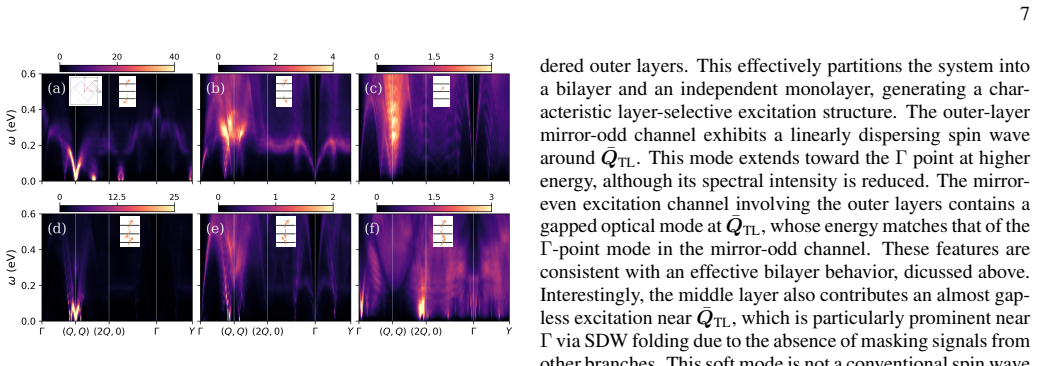
Within the multi-orbital itinerant framework the bilayer single-stripe state produces transverse spin excitations that match experimental RIXS and neutron spectra, while the trilayer mirror-odd spin-density-wave state is energetically preferred and its spectrum, including a middle-layer dominated nearly gapless mode, aligns better with RIXS data than the mirror-even alternative.
What carries the argument
Multi-orbital itinerant model solved by Hartree-Fock for ground-state orders and subsequent calculation of transverse spin excitation spectra.
If this is right
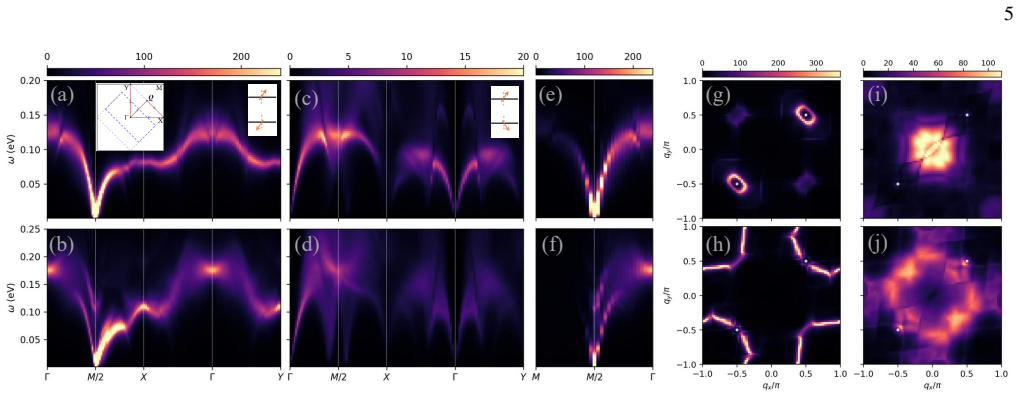
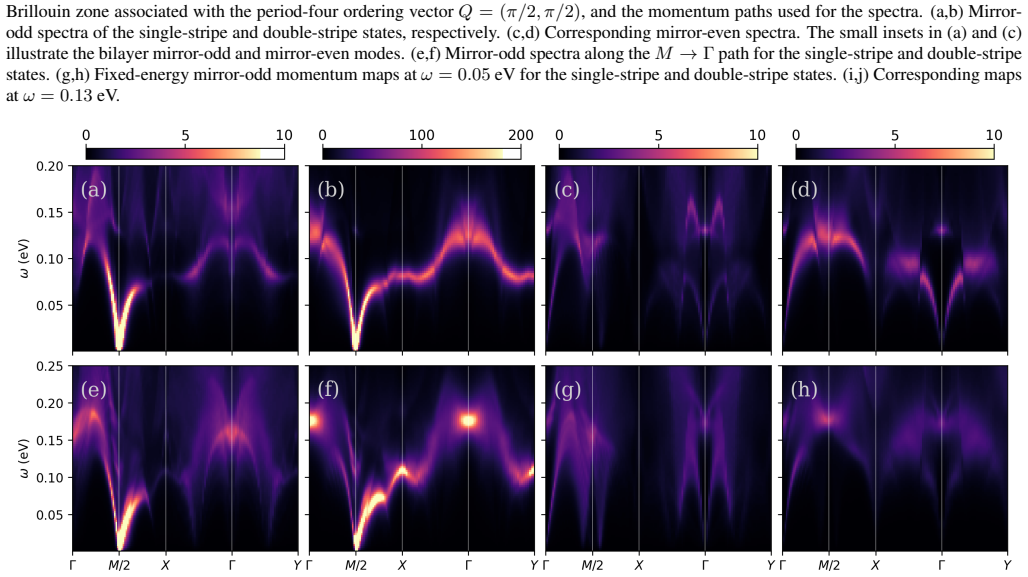
- Bilayer single-stripe excitations feature an anisotropic low-energy cone at Q_BL and isotropic high-energy modes near Gamma.
- Mirror-even optical interlayer modes at Q_BL in the bilayer have energies matching the mirror-odd modes at Gamma.
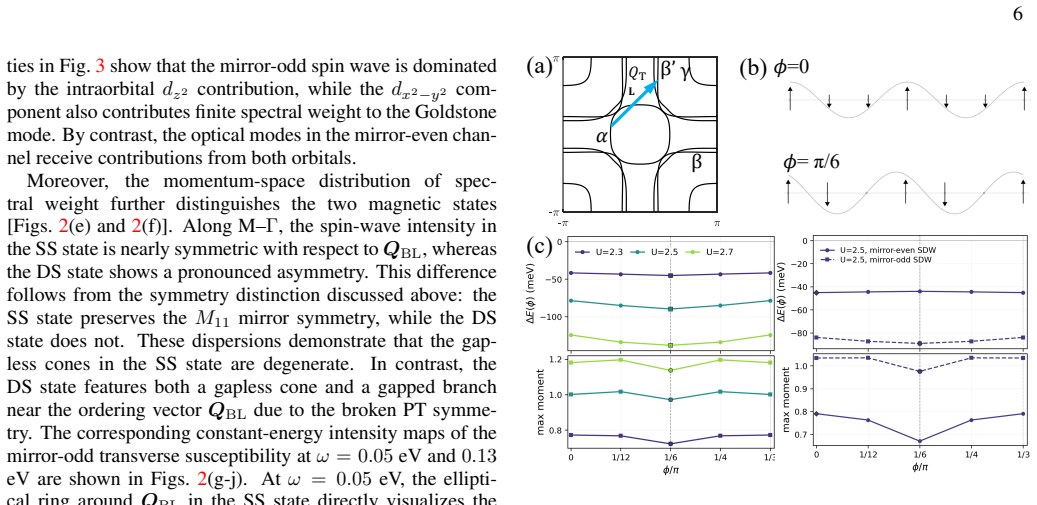
- Trilayer mirror-odd order adds a nearly gapless excitation branch dominated by the middle layer.
- Trilayer mirror-even order shows only one acoustic branch plus two gapped optical modes.
- Magnetic excitations act as a sensitive probe that can distinguish among candidate orders and support a common itinerant origin for magnetism in multilayer nickelates.
Where Pith is reading between the lines
- The same computational approach could be used to predict how doping or pressure alters the preferred order and its spectrum in these nickelates.
- Layer-resolved RIXS or neutron measurements could directly test the middle-layer character of the nearly gapless mode predicted for the trilayer mirror-odd state.
- If the single-stripe spectrum continues to match new data, it would strengthen the case for using itinerant models to connect magnetism and superconductivity across the nickelate family.
Load-bearing premise
The chosen multi-orbital model parameters together with the Hartree-Fock approximation are sufficient to select the correct magnetic orders and their excitations without beyond-mean-field corrections that would reverse the ordering preference.
What would settle it
A RIXS measurement on trilayer samples that instead matches the mirror-even excitation spectrum, or a neutron scattering result on bilayer samples that matches double-stripe excitations more closely than single-stripe ones.
Figures
read the original abstract
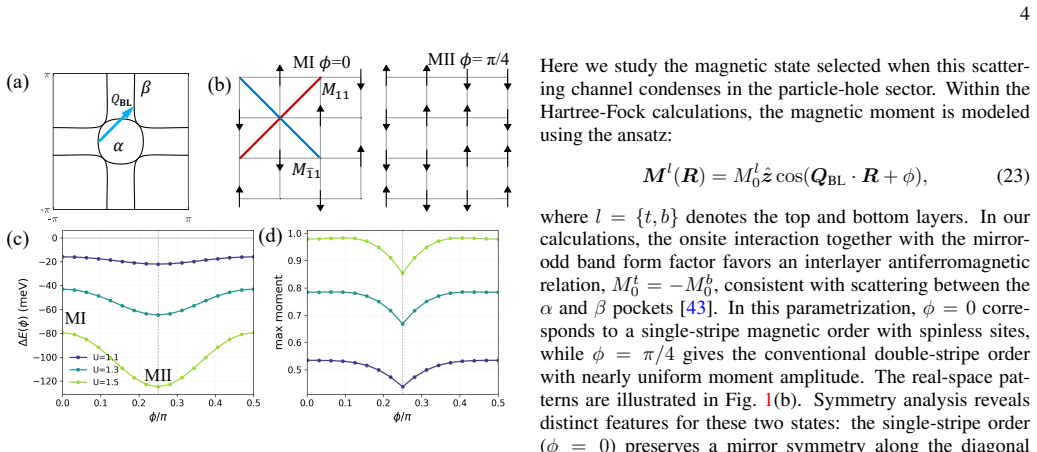
We investigate the magnetic ground states and transverse spin excitations of bilayer and trilayer nickelates within a multi-orbital itinerant framework. For the bilayer system, although Hartree-Fock calculations slightly favor a double-stripe order, the calculated excitation spectrum of the single-stripe state, characterized by an anisotropic low-energy cone at $Q_{\text{BL}}$ and isotropic high-energy excitations near $\Gamma$, exhibits good qualitative agreement with recent RIXS and neutron scattering experiments. We further identify mirror-even optical interlayer modes at $Q_{\text{BL}}$ whose energies match the mirror-odd modes at $\Gamma$. For the trilayer system, both mirror-odd and mirror-even spin-density-wave states can be stabilized near $Q_{\text{TL}}$, with the mirror-odd state lower in energy in the parameter regime studied. The mirror-odd state hosts an additional nearly gapless mode dominated by the middle layer, while the mirror-even state contains only one acoustic branch together with two gapped optical modes. Comparison with available RIXS data favors the mirror-odd spin-density-wave scenario. Our results show that magnetic excitations provide a sensitive probe of the magnetic order and support a common itinerant origin of magnetism in multilayer nickelates.
Editorial analysis
A structured set of objections, weighed in public.
Referee Report
Summary. The paper investigates magnetic ground states and transverse spin excitations of bilayer and trilayer nickelates in a multi-orbital itinerant model treated at the Hartree-Fock level. For the bilayer, HF slightly favors double-stripe order, but the single-stripe state's excitations (anisotropic low-energy cone at Q_BL, isotropic high-energy near Gamma) are shown to agree qualitatively with RIXS and neutron data; mirror-even optical modes are identified. For the trilayer, both mirror-odd and mirror-even SDW states are stabilized near Q_TL, with mirror-odd lower in energy and hosting a nearly gapless middle-layer mode; RIXS data favor the mirror-odd scenario. The work concludes that excitations probe the order and support a common itinerant origin of magnetism.
Significance. If the mean-field treatment and parameter choices are reliable, the results would strengthen the case for an itinerant mechanism in multilayer nickelates and show that spin excitations can discriminate between competing magnetic scenarios (single- vs. double-stripe, mirror-odd vs. even), offering a concrete link between theory and recent RIXS/neutron experiments.
major comments (2)
- [Abstract / §3] Abstract and §3 (ground-state section): HF calculations are reported to slightly favor double-stripe order in the bilayer, yet the excitation spectrum that is computed and compared to experiment is that of the single-stripe state. Because the central claim—that excitations support an itinerant origin and favor specific scenarios—rests on the HF ground state being representative, an explicit justification is required for why the single-stripe spectrum is physically relevant (e.g., energy difference magnitude, stability under parameter variation, or beyond-HF corrections).
- [§4] §4 (trilayer excitations): The statement that the mirror-odd state is lower in energy 'in the parameter regime studied' is load-bearing for the conclusion that RIXS favors mirror-odd order. The energy difference and its sensitivity to the multi-orbital parameters (hopping, interaction strengths) should be quantified, together with an explicit check that the ordering preference survives modest variations around the chosen values.
minor comments (2)
- [Abstract] Notation for Q_BL and Q_TL should be defined at first use with explicit reciprocal-space coordinates.
- [Figure captions] Figure captions for the excitation spectra should state the broadening or resolution used and whether the plotted intensities are raw or normalized.
Simulated Author's Rebuttal
We thank the referee for the careful reading of our manuscript and the constructive comments. We address the two major points below and will revise the manuscript to incorporate the requested clarifications and quantifications.
read point-by-point responses
-
Referee: [Abstract / §3] Abstract and §3 (ground-state section): HF calculations are reported to slightly favor double-stripe order in the bilayer, yet the excitation spectrum that is computed and compared to experiment is that of the single-stripe state. Because the central claim—that excitations support an itinerant origin and favor specific scenarios—rests on the HF ground state being representative, an explicit justification is required for why the single-stripe spectrum is physically relevant (e.g., energy difference magnitude, stability under parameter variation, or beyond-HF corrections).
Authors: We agree that an explicit justification is required. In the revised manuscript we will report the magnitude of the HF energy difference between single- and double-stripe states and demonstrate its sensitivity to modest variations of the multi-orbital parameters. We will also add a brief discussion noting that the single-stripe state yields the observed anisotropic low-energy cone at Q_BL that matches RIXS and neutron data, whereas the double-stripe spectrum does not, thereby providing the physical motivation for focusing on its excitations. revision: yes
-
Referee: [§4] §4 (trilayer excitations): The statement that the mirror-odd state is lower in energy 'in the parameter regime studied' is load-bearing for the conclusion that RIXS favors mirror-odd order. The energy difference and its sensitivity to the multi-orbital parameters (hopping, interaction strengths) should be quantified, together with an explicit check that the ordering preference survives modest variations around the chosen values.
Authors: We will revise §4 to include quantitative values of the energy difference between the mirror-odd and mirror-even SDW states. We will also add an explicit check of the ordering preference under modest variations of the hopping and interaction parameters (e.g., ±10 % changes), confirming that the mirror-odd state remains lower in energy. These results will be presented in the main text or as supplementary material. revision: yes
Circularity Check
No circularity; model computations compared directly to external RIXS/neutron data without reduction to fitted inputs.
full rationale
The paper applies a multi-orbital itinerant model under Hartree-Fock to obtain magnetic ground states and transverse spin excitations for bilayer and trilayer nickelates. It explicitly notes that HF slightly favors double-stripe order for the bilayer yet computes and compares the single-stripe excitation spectrum (anisotropic cone at Q_BL, isotropic near Gamma) to independent experimental RIXS and neutron scattering results. For the trilayer, mirror-odd and mirror-even SDW states are compared to available RIXS data, favoring mirror-odd. No equations or text indicate that any reported spectrum or ordering preference is obtained by fitting parameters to the same experimental quantities being compared, nor are there self-citations that bear the central claim. The derivation chain remains self-contained against external benchmarks.
Axiom & Free-Parameter Ledger
Forward citations
Cited by 1 Pith paper
-
Density waves in low-pressure bilayer nickelates
Unrestricted Hartree-Fock calculations show the second density-wave transition in La3Ni2O7 originates from double-stripe spin order becoming unstable toward a commensurate charge-density wave, yielding intertwined spi...
Reference graph
Works this paper leans on
-
[1]
H. Sun, M. Huo, X. Hu, J. Li, Z. Liu, Y . Han, L. Tang, Z. Mao, P. Yang, B. Wang, J. Cheng, D.-X. Yao, G.-M. Zhang, and M. Wang, Signatures of superconductivity near 80 K in a nick- elate under high pressure, Nature621, 493 (2023)
2023
-
[2]
Y . Zhu, D. Peng, E. Zhang, B. Pan, X. Chen, L. Chen, H. Ren, F. Liu, Y . Hao, N. Li, Z. Xing, F. Lan, J. Han, J. Wang, D. Jia, H. Wo, Y . Gu, Y . Gu, L. Ji, W. Wang, H. Gou, Y . Shen, T. Ying, X. Chen, W. Yang, H. Cao, C. Zheng, Q. Zeng, J.-g. Guo, and J. Zhao, Superconductivity in pressurized trilayer La4Ni3O10-δ single crystals, Nature631, 531 (2024)
2024
-
[3]
Z. Qiu, J. Chen, D. V . Semenok, Q. Zhong, D. Zhou, J. Li, P. Ma, X. Huang, M. Huo, T. Xie, X. Chen, H.-k. Mao, V . Struzhkin, H. Sun, and M. Wang, Interlayer coupling en- hanced superconductivity near 100 K in La 3−xNdxNi2O7 9 (2025), arXiv:2510.12359 [cond-mat.supr-con]
arXiv 2025
-
[4]
Z. Luo, X. Hu, M. Wang, W. W´u, and D.-X. Yao, Bilayer Two- Orbital Model ofLa 3Ni2O7 under Pressure, Phys. Rev. Lett. 131, 126001 (2023)
2023
-
[5]
Zhang, L.-F
Y . Zhang, L.-F. Lin, A. Moreo, and E. Dagotto, Electronic struc- ture, dimer physics, orbital-selective behavior, and magnetic tendencies in the bilayer nickelate superconductorLa 3Ni2O7 under pressure, Phys. Rev. B108, L180510 (2023)
2023
-
[6]
Lechermann, J
F. Lechermann, J. Gondolf, S. B ¨otzel, and I. M. Eremin, Electronic correlations and superconducting instability in La3Ni2O7 under high pressure, Phys. Rev. B108, L201121 (2023)
2023
-
[7]
Sakakibara, N
H. Sakakibara, N. Kitamine, M. Ochi, and K. Kuroki, Possible HighT c Superconductivity inLa 3Ni2O7 under High Pressure through Manifestation of a Nearly Half-Filled Bilayer Hubbard Model, Phys. Rev. Lett.132, 106002 (2024)
2024
-
[8]
Y . Gu, C. Le, Z. Yang, X. Wu, and J. Hu, Effective model and pairing tendency in the bilayer Ni-based superconductor La3Ni2O7, Phys. Rev. B111, 174506 (2025)
2025
-
[9]
J. Yang, H. Sun, X. Hu, Y . Xie, T. Miao, H. Luo, H. Chen, B. Liang, W. Zhu, G. Qu, C.-Q. Chen, M. Huo, Y . Huang, S. Zhang, F. Zhang, F. Yang, Z. Wang, Q. Peng, H. Mao, G. Liu, Z. Xu, T. Qian, D.-X. Yao, M. Wang, L. Zhao, and X. J. Zhou, Orbital-dependent electron correlation in double-layer nickelate La3Ni2O7, Nature Communications15, 4373 (2024)
2024
-
[10]
Z. Liu, M. Huo, J. Li, Q. Li, Y . Liu, Y . Dai, X. Zhou, J. Hao, Y . Lu, M. Wang, and H.-H. Wen, Electronic correlations and partial gap in the bilayer nickelate La 3Ni2O7, Nature Commu- nications15, 7570 (2024)
2024
-
[11]
E. K. Ko, Y . Yu, Y . Liu, L. Bhatt, J. Li, V . Thampy, C.-T. Kuo, B. Y . Wang, Y . Lee, K. Lee, J.-S. Lee, B. H. Goodge, D. A. Muller, and H. Y . Hwang, Signatures of ambient pressure su- perconductivity in thin film La3Ni2O7, Nature638, 935 (2025)
2025
-
[12]
G. Zhou, W. Lv, H. Wang, Z. Nie, Y . Chen, Y . Li, H. Huang, W.- Q. Chen, Y .-J. Sun, Q.-K. Xue, and Z. Chen, Ambient-pressure superconductivity onset above 40 K in (la,pr) 3ni2o7 films, Na- ture640, 641 (2025)
2025
-
[13]
Y . Liu, E. K. Ko, Y . Tarn, L. Bhatt, B. H. Goodge, D. A. Muller, S. Raghu, Y . Yu, and H. Y . Hwang, Superconductivity and normal-state transport in compressively strained La 2PrNi2O7 thin films, arXiv:2501.08022 (2025)
arXiv 2025
-
[14]
L. Bhatt, A. Y . Jiang, E. K. Ko, N. Schnitzer, G. A. Pan, D. F. Segedin, Y . Liu, Y . Yu, Y .-F. Zhao, E. A. Morales, C. M. Brooks, A. S. Botana, H. Y . Hwang, J. A. Mundy, D. A. Muller, and B. H. Goodge, Resolving Structural Origins for Superconductivity in Strain-Engineered La3Ni2O7 Thin Films, arXiv:2501.08204 (2025)
arXiv 2025
-
[15]
Zhang, D
Y . Zhang, D. Su, Y . Huang, Z. Shan, H. Sun, M. Huo, K. Ye, J. Zhang, Z. Yang, Y . Xu, Y . Su, R. Li, M. Smidman, M. Wang, L. Jiao, and H. Yuan, High-temperature superconductivity with zero resistance and strange-metal behaviour in La 3Ni2O7-δ, Nature Physics20, 1269 (2024)
2024
-
[16]
X. Chen, J. Choi, Z. Jiang, J. Mei, K. Jiang, J. Li, S. Agrestini, M. Garcia-Fernandez, H. Sun, X. Huang, D. Shen, M. Wang, J. Hu, Y . Lu, K.-J. Zhou, and D. Feng, Electronic and magnetic excitations in La 3Ni2O7, Nature Communications15, 9597 (2024)
2024
-
[17]
X. Ren, R. Sutarto, X. Wu, J. Zhang, H. Huang, T. Xiang, J. Hu, R. Comin, X. Zhou, and Z. Zhu, Resolving the elec- tronic ground state of La 3Ni2O7−δ films, Commun. Phys.8, 52 (2025)
2025
-
[18]
M. Shi, D. Peng, Y . Li, Z. Xing, Y . Wang, K. Fan, H. Li, R. Wu, Z. Zeng, Q. Zeng, J. Ying, T. Wu, and X. Chen, Prerequi- site of superconductivity: SDW rather than tetragonal structure in double-layer La3Ni2O7-x (2025), arXiv:2501.14202 [cond- mat.supr-con]
arXiv 2025
-
[19]
Q.-G. Yang, D. Wang, and Q.-H. Wang, Possibles ±-wave superconductivity inLa 3Ni2O7, Phys. Rev. B108, L140505 (2023)
2023
-
[20]
C. Lu, Z. Pan, F. Yang, and C. Wu, Interlayer-Coupling-Driven High-Temperature Superconductivity inLa3Ni2O7 under Pres- sure, Phys. Rev. Lett.132, 146002 (2024)
2024
-
[21]
Oh and Y .-H
H. Oh and Y .-H. Zhang, Type-IIt−Jmodel and shared su- perexchange coupling from Hund’s rule in superconducting La3Ni2O7, Phys. Rev. B108, 174511 (2023)
2023
-
[22]
Liu, J.-W
Y .-B. Liu, J.-W. Mei, F. Ye, W.-Q. Chen, and F. Yang,s±-Wave Pairing and the Destructive Role of Apical-Oxygen Deficien- cies inLa 3Ni2O7 under Pressure, Phys. Rev. Lett.131, 236002 (2023)
2023
-
[23]
Qu, D.-W
X.-Z. Qu, D.-W. Qu, J. Chen, C. Wu, F. Yang, W. Li, and G. Su, Bilayert−J−J ⊥ Model and Magnetically Mediated Pairing in the Pressurized NickelateLa 3Ni2O7, Phys. Rev. Lett.132, 036502 (2024)
2024
-
[24]
Yang, G.-M
Y .-f. Yang, G.-M. Zhang, and F.-C. Zhang, Interlayer valence bonds and two-component theory for high-T c superconductiv- ity ofLa 3Ni2O7 under pressure, Phys. Rev. B108, L201108 (2023)
2023
-
[25]
Qin and Y .-f
Q. Qin and Y .-f. Yang, High-Tc superconductivity by mobiliz- ing local spin singlets and possible route to higherT c in pres- surizedLa 3Ni2O7, Phys. Rev. B108, L140504 (2023)
2023
-
[26]
D.-C. Lu, M. Li, Z.-Y . Zeng, W. Hou, J. Wang, F. Yang, and Y .- Z. You, Superconductivity from Doping Symmetric Mass Gen- eration Insulators: Application to La 3Ni2O7 under Pressure, arXiv: 2308.11195 (2023)
arXiv 2023
-
[27]
Y .-H. Tian, Y . Chen, J.-M. Wang, R.-Q. He, and Z.-Y . Lu, Cor- relation effects and concomitant two-orbitals±-wave supercon- ductivity inLa 3Ni2O7 under high pressure, Phys. Rev. B109, 165154 (2024)
2024
-
[28]
Zhang, L.-F
Y . Zhang, L.-F. Lin, A. Moreo, T. A. Maier, and E. Dagotto, Trends in electronic structures ands ±-wave pairing for the rare-earth series in bilayer nickelate superconductorR 3Ni2O7, Phys. Rev. B108, 165141 (2023)
2023
-
[29]
Zhang, L.-F
Y . Zhang, L.-F. Lin, A. Moreo, T. A. Maier, and E. Dagotto, Structural phase transition, s±-wave pairing, and magnetic stripe order in bilayered superconductor La3Ni2O7 under pres- sure, Nature Communications15, 2470 (2024)
2024
-
[30]
Jiang, Z
K. Jiang, Z. Wang, and F.-C. Zhang, High-Temperature Super- conductivity in La3Ni2O7, Chinese Physics Letters41, 017402 (2024)
2024
-
[31]
Z. Liao, L. Chen, G. Duan, Y . Wang, C. Liu, R. Yu, and Q. Si, Electron correlations and superconductivity inLa 3Ni2O7 un- der pressure tuning, Phys. Rev. B108, 214522 (2023)
2023
-
[32]
S. Ryee, N. Witt, and T. O. Wehling, Quenched Pair Break- ing by Interlayer Correlations as a Key to Superconductivity in La3Ni2O7, Phys. Rev. Lett.133, 096002 (2024)
2024
-
[33]
Z. Luo, B. Lv, M. Wang, W. W ´u, and D.-X. Yao, High-TC su- perconductivity in La 3Ni2O7 based on the bilayer two-orbital t-J model, npj Quantum Materials9, 61 (2024)
2024
-
[34]
Fan, J.-F
Z. Fan, J.-F. Zhang, B. Zhan, D. Lv, X.-Y . Jiang, B. Normand, and T. Xiang, Superconductivity in nickelate and cuprate su- perconductors with strong bilayer coupling, Phys. Rev. B110, 024514 (2024)
2024
-
[35]
Jiang, J
R. Jiang, J. Hou, Z. Fan, Z.-J. Lang, and W. Ku, Pressure Driven Fractionalization of Ionic Spins Results in Cupratelike High-Tc Superconductivity inLa 3Ni2O7, Phys. Rev. Lett.132, 126503 (2024)
2024
-
[36]
J. Zhan, Y . Gu, X. Wu, and J. Hu, Cooperation between Electron-Phonon Coupling and Electronic Interaction in Bi- 10 layer NickelatesLa 3Ni2O7, Phys. Rev. Lett.134, 136002 (2025)
2025
-
[37]
C. Xia, H. Liu, S. Zhou, and H. Chen, Sensitive dependence of pairing symmetry on Ni-eg crystal field splitting in the nickelate superconductor La 3Ni2O7, Nature Communications16, 1054 (2025)
2025
-
[38]
Bejas, X
M. Bejas, X. Wu, D. Chakraborty, A. P. Schnyder, and A. Greco, Out-of-plane bond-order phase, superconductivity, and their competition in thet-J ∥−J⊥ model: Possible impli- cations for bilayer nickelates, Phys. Rev. B111, 144514 (2025)
2025
-
[39]
G. Duan, Z. Liao, L. Chen, Y . Wang, R. Yu, and Q. Si, Orbital- selective correlation effects and superconducting pairing sym- metry in a multiorbitalt-Jmodel for bilayer nickelates (2025), arXiv:2502.09195 [cond-mat.supr-con]
arXiv 2025
-
[40]
Jiang, Y .-H
K.-Y . Jiang, Y .-H. Cao, Q.-G. Yang, H.-Y . Lu, and Q.-H. Wang, Theory of pressure dependence of superconductivity in bilayer nickelatela 3ni2o7, Phys. Rev. Lett.134, 076001 (2025)
2025
-
[41]
Yang, K.-Y
Q.-G. Yang, K.-Y . Jiang, D. Wang, H.-Y . Lu, and Q.-H. Wang, Effective model ands ±-wave superconductivity in trilayer nickelateLa 4Ni3O10, Phys. Rev. B109, L220506 (2024)
2024
-
[42]
Zhang, H
M. Zhang, H. Sun, Y .-B. Liu, Q. Liu, W.-Q. Chen, and F. Yang, Spin-density wave and superconductivity inLa 4Ni3O10 under ambient pressure, Phys. Rev. B111, 144502 (2025)
2025
-
[43]
C. Le, J. Zhan, X. Wu, and J. Hu, Opposite-Mirror-Parity Scat- tering as the Origin of Superconductivity in Strained Bilayer Nickelates (2025), arXiv:2501.14665 [cond-mat.supr-con]
arXiv 2025
-
[44]
J. Yang, J. Zhan, T. Miao, M. Huo, Q. Xu, Y . Li, Y . Xie, B. Liang, N. Cai, H. Chen, W. Zhu, M. Xu, S. Zhang, F. Zhang, F. Yang, Z. Wang, Q. Peng, H. Mao, X. Li, Z. Zhu, G. Liu, Z. Xu, J. Hu, X. Wu, M. Wang, L. Zhao, and X. J. Zhou, Elec- tronic Origin of Density Wave Orders in a Trilayer Nickelate (2026), arXiv:2601.22608 [cond-mat.supr-con]
arXiv 2026
-
[45]
X. Chen, Z. Li, M. Xie, D. Hu, Y .-F. Chiu, S. Agrestini, W. Zhang, Y . Lu, M. Wang, M. Garcia-Fernandez, D. Feng, and K.-J. Zhou, (2026), arXiv:2604.01902 [cond-mat.supr-con]
arXiv 2026
-
[46]
Y . Chan, Y . Li, Y . Yan, X. Hong, T. Wang, M. dos Reis Can- tarino, Y . Zhu, E. Zhang, L. Chen, J. Okamoto, H.-Y . Huang, D.-J. Huang, N. B. Brookes, J. Chang, Y . Shen, J. Zhao, and Q. Wang, (2026), arXiv:2604.04643
Pith/arXiv arXiv 2026
-
[47]
K. Chen, X. Liu, J. Jiao, M. Zou, C. Jiang, X. Li, Y . Luo, Q. Wu, N. Zhang, Y . Guo, and L. Shu, Evidence of spin density waves in La3Ni2O7−δ, Phys. Rev. Lett.132, 256503 (2024)
2024
-
[48]
Khasanov, T
R. Khasanov, T. J. Hicken, D. J. Gawryluk, V . Sazgari, I. Plokhikh, L. P. Sorel, M. Bartkowiak, S. B ¨otzel, F. Lecher- mann, I. M. Eremin, H. Luetkens, and Z. Guguchia, Pressure- enhanced splitting of density wave transitions in la 3ni2o7−δ, Nature Physics21, 430 (2025)
2025
-
[49]
I. Plokhikh, T. J. Hicken, L. Keller, V . Pomjakushin, S. H. Moody, P. Foury-Leylekian, J. J. Krieger, H. Luetkens, Z. Guguchia, R. Khasanov, and D. J. Gawryluk, Unraveling Spin Density Wave Order in Layered Nickelates La3Ni2O7 and La2PrNi2O7 via Neutron Diffraction (2025), arXiv:2503.05287 [cond-mat.supr-con]
arXiv 2025
-
[50]
L. Chen, E. Zhang, Y . Hao, Y . Zhu, B. Cui, D. L. Aber- nathy, T. J. Williams, Y . Ikeda, H. Zhang, F. Liu, W. Wang, Q. Wang, and J. Zhao, Nature of magnetism in bilayer nicke- late La3Ni2O7 single crystals (2026), arXiv:2605.03448 [cond- mat.str-el]
Pith/arXiv arXiv 2026
-
[51]
Zhang, D
J. Zhang, D. Phelan, A. Botana, Y .-S. Chen, H. Zheng, M. Krogstad, S. G. Wang, Y . Qiu, J. Rodriguez-Rivera, R. Os- born,et al., Intertwined density waves in a metallic nickelate, Nature communications11, 6003 (2020)
2020
-
[52]
Y .-M. Wu, T. Helbig, S. V . Smailagic, H.-X. Wang, Y . Yu, H. Y . Hwang, and S. Raghu, Superconductivity and mag- netism in bilayer nickelates: itinerant perspective (2026), arXiv:2602.20288 [cond-mat.supr-con]
arXiv 2026
-
[53]
Castellani, C
C. Castellani, C. R. Natoli, and J. Ranninger, Magnetic structure ofV 2O3 in the insulating phase, Phys. Rev. B18, 4945 (1978)
1978
-
[54]
P. M. R. Brydon and C. Timm, Spin excitations in the excitonic spin-density-wave state of the iron pnictides, Phys. Rev. B80, 174401 (2009)
2009
-
[55]
Knolle, I
J. Knolle, I. Eremin, and R. Moessner, Multiorbital spin suscep- tibility in a magnetically ordered state: Orbital versus excitonic spin density wave scenario, Phys. Rev. B83, 224503 (2011)
2011
-
[56]
Reznik, P
D. Reznik, P. Bourges, H. F. Fong, L. P. Regnault, J. Bossy, C. Vettier, D. L. Milius, I. A. Aksay, and B. Keimer, Direct observation of optical magnons inYBa 2Cu3O6.2, Phys. Rev. B53, R14741(R) (1996)
1996
-
[57]
Capogna, B
L. Capogna, B. Fauqu ´e, Y . Sidis, C. Ulrich, P. Bourges, S. Pailh `es, A. Ivanov, J. L. Tallon, B. Liang, C. T. Lin, A. I. Rykov, and B. Keimer, Odd and even magnetic resonant modes in highly overdopedBi 2Sr2CaCu2O8+δ, Phys. Rev. B75, 060502(R) (2007)
2007
-
[58]
J. Mei, T. Xie, and K. Jiang, Itinerant nature of spin- density-wave order in Ruddlesden-Popper nickelates (2026), arXiv:2605.20148 [cond-mat.str-el]
Pith/arXiv arXiv 2026
discussion (0)
Sign in with ORCID, Apple, or X to comment. Anyone can read and Pith papers without signing in.