REVIEW 6 minor 63 references
Heavy quarkonia and new hadrons with two heavy quarks
T0 review · 0 major / 6 minor · reviewed 2026-08-05 · deepseek-v4-flash
Pith's one-line read XYZ hadrons break the quark-model pattern
desk verdict A competent, well-referenced review of quarkonium and XYZ states—no new results, but a useful update with a few fixable technical slips. read the letter →
The pith
A machine-rendered reading of the paper's core claim, the machinery that carries it, and where it could break.
The reading
What carries the argument
The argument runs on two tools. The first is the Coulomb-plus-linear 'Cornell' potential, V(r) = −(4/3)α_s/r + kr, solved in the nonrelativistic Schrödinger equation; it supplies the predicted quarkonium ladder and thereby defines what is conventional. The second is the Breit-Wigner line-shape machinery, with a coherent sum over resonances and a 1/s^n continuum term (eq. 15), used to turn e+e− cross sections into masses and widths. Against these, the review weighs three signatures of exotics: quantum numbers no quarkonium assignment predicts, isospin or flavor patterns no meson should have, and minimal quark content forced by charge—a charged state decaying to J/ψπ must contain c̄c plus a li
What would settle it
Fit the high-statistics e+e−→J/ψπ+π− cross section from 3.8 to 4.6 GeV with a coupled-channel amplitude that includes open-charm thresholds; if a model with no Y(4230) pole describes the data as well as one with the pole, the central exotic claim for the Y family fails. Similarly, a model-independent pole search in the Zc(3900) region would decide whether it is a state or a triangle-singularity artifact.
Extended reading notes
Core claim
For the paper, the central discovery is a pattern: the quark model is right where it should be and wrong where it should not be. Every confirmed charmonium and bottomonium state below the lowest open-flavor threshold fits the nonrelativistic Schrödinger equation with a short-range Coulomb term and a long-range linear confining term; above that threshold, the spectrum fills with states that do not fit. X(3872) has the quantum numbers of the χc1(2P) but lies about 100 MeV below its predicted mass and decays through isospin-violating J/ψρ at a rate far too large for a charmonium state. Zc(3900) and Zb(10610/10650) are charged, so their decays to charmonium plus pions force a minimal content of
Load-bearing premise
Each exotic peak is a genuine resonance rather than a kinematic reflection of a threshold, and the paper's own kinematic caveat means this remains open.
Editorial extensions
If this is right
- Below the open-flavor threshold, the potential-model baseline holds: any new state found there can be classified against a definite expected spectrum, and the missing predicted states are genuine puzzles.
- X(3872)'s near-threshold binding means hadronic-molecule and tetraquark models predict partner states; their non-observation is a direct constraint on those models.
- For the Y states, single-channel Breit-Wigner parameters are process-dependent, so extracting real resonance pole positions requires global coupled-channel fits that include open-charm channels.
- The charged Zc/Zb states, if genuine, establish tetraquark configurations and predict strange partners (Zcs), which have now been seen in two independent production modes with inconsistent widths.
- Tcc, with a width of tens of keV at the pole, is the narrowest exotic state and is close enough to the D*D threshold to serve as a sharp test for any model of two heavy quarks plus light quarks.
Reading between the lines
- Not every peak in the XYZ catalogue is necessarily a particle: the review's own kinematic caveat implies that if even one prominent state—Zc(3900), say—turns out to be a threshold cusp or triangle singularity, the size of the genuine exotic inventory would shrink and attention would shift to states with quantum numbers that kinematics cannot fake.
- A testable consequence the paper leaves implicit: a global, model-independent coupled-channel fit to all measured e+e− exclusive cross sections above 4 GeV would either stabilize the Y(4230)/Y(4260) parameters or expose them as artifacts of single-channel fits, and the same procedure could be applied to the bottomonium Y(10750)/Y(10860) region.
- The repeated near-threshold pattern—X(3872), Zc(3900), Zb(10610/10650), Tcc—suggests a common mechanism for forming loosely bound two-hadron states; if so, analogous states should appear near other two-meson thresholds that current scans have not covered, such as doubly bottom or Bc pairs.
- The toponium candidate reported near the top-quark pair threshold, if confirmed, would test the same potential-model machinery at a quark mass where the weak decay width, not confinement, sets the energy scale; its line shape would constrain the top Yukawa and threshold dynamics rather than the linear potential.
Editorial analysis
A structured set of objections, weighed in public.
Referee Report
Summary. This is a pedagogical review chapter on heavy quarkonia and new hadrons containing two heavy quarks. It covers the historical discovery of J/ψ and Υ, the basic properties and notation of quarkonium, potential-model spectroscopy, production mechanisms and decay modes, and a detailed survey of the XYZ states, Zc/Zb states, Tcc, and Pc pentaquark candidates. The central claim is that conventional quarkonia below open-flavor thresholds are well described by potential models, while the so-called XYZ states—such as X(3872), Y(4260/4230), Zc(3900), and Pc—challenge the conventional quark model and lack a universal theoretical explanation. The review presents measured masses, widths, quantum numbers, production mechanisms, and decay channels in tables and figures, and it repeatedly flags unsettled interpretations, including the possible role of kinematic effects such as cusps and triangle singularities.
Significance. The review is a compact and current survey of a rapidly evolving field, including very recent results such as the CMS toponium excess and the LHCb orbitally excited Bc states. Its value lies in the systematic compilation of experimental data with PDG values, the clear separation of established states from candidates, and the honest presentation of open questions. The paper does not claim original derivations, so its soundness rests on faithful representation of the experimental record; on the whole, the text is careful and appropriately hedged. The extensive tables and the explicit caveats about coupled-channel effects and kinematic artifacts are useful for readers entering the field. No machine-checked proofs or parameter-free derivations are present, but the review's role as a reference makes this unproblematic.
minor comments (6)
- [§2, Eq. (2)] The invariant-mass formula as written is only valid if the e+ and e− are coplanar and on opposite sides of the beam; in general the opening angle depends on azimuthal angles as well. Please add a sentence stating the assumed geometry or replace with the standard expression M² = 2m_e² + 2(E₊E₋ − p₊p₋ cos α), where α is the angle between the two momenta.
- [§6.4.1] In the sentence listing the three Zc states, "Zc(34020)" should read "Zc(4020)". This is an obvious typographical slip in a pedagogical passage.
- [§6.2.1] The phrase "is about orders of magnitude larger" is incomplete; it should state the numerical value or order of magnitude (e.g., "about three orders of magnitude larger") to be informative.
- [Table 3] In the production column, the row for X(4274) lists "B→X(4247)K" and the row for X(4685) lists "B→X(4500)K"; both should refer to the state being tabulated (X(4274)K and X(4685)K, respectively).
- [Table 5] The Pcs(4338) row lists production as "B→pPc(4338)"; this should presumably be "B→pPcs(4338)" to match the state name. Please check the original reference for the correct label.
- [§6.3] The text says experimental observations have revealed "more than six" vector states and then lists six names. The count becomes seven only if the later-discussed Y(4230) and Y(4320) are counted separately from Y(4260); please make this counting explicit.
Circularity Check
No significant circularity: review compiles externally anchored experimental results; self-citation [28] is not load-bearing.
full rationale
The paper is a review/pedagogical chapter, not a derivation. Its central claims—that heavy quarkonia below open-flavor thresholds are well described by potential models and that XYZ/Pc states challenge the simple quark model—are summaries of published experimental measurements and PDG values, each tied to independent experimental references (e.g., BESIII, Belle, LHCb, CMS). There is no fitted parameter subsequently renamed as a prediction, no uniqueness theorem imported from the authors' prior work, and no ansatz smuggled in via citation. The only self-citation, Ref. [28] (Brambilla et al., including co-author C.-Z. Yuan), appears in a list of several recent reviews ('For recent reviews, see Refs. [24–29]') and is not the basis for any specific claim; the surrounding assertions are supported by the primary experimental literature and PDG. The paper explicitly flags the main interpretive risk—whether some XYZ peaks are kinematic artifacts ('Could some be artifacts of kinematic effects?' in Sec. 7; 'Kinematic effects, such as cusps and triangle singularities, may play an important role in these observations' in Sec. 6.1)—so its hedged claim that these states 'defy conventional quark model expectations' is a faithful representation of the field consensus rather than an overclaim built on its own conclusions. The line-shape parametrization of Eq. 15 is described openly as a single-channel Breit-Wigner fit whose extracted Y parameters vary between channels, and the paper notes coupled-channel effects may be important; this is a caveat, not a circular step. Therefore no circularity score is warranted.
Assumptions & free parameters
assumptions (3)
- domain assumption Heavy quark-antiquark systems can be treated as nonrelativistic and described by the Schrödinger equation with a static potential.
- domain assumption The quark-antiquark interaction is modeled by the Cornell potential V(r) = -(4/3) alpha_s / r + k r, with k adjusted to reproduce spectra.
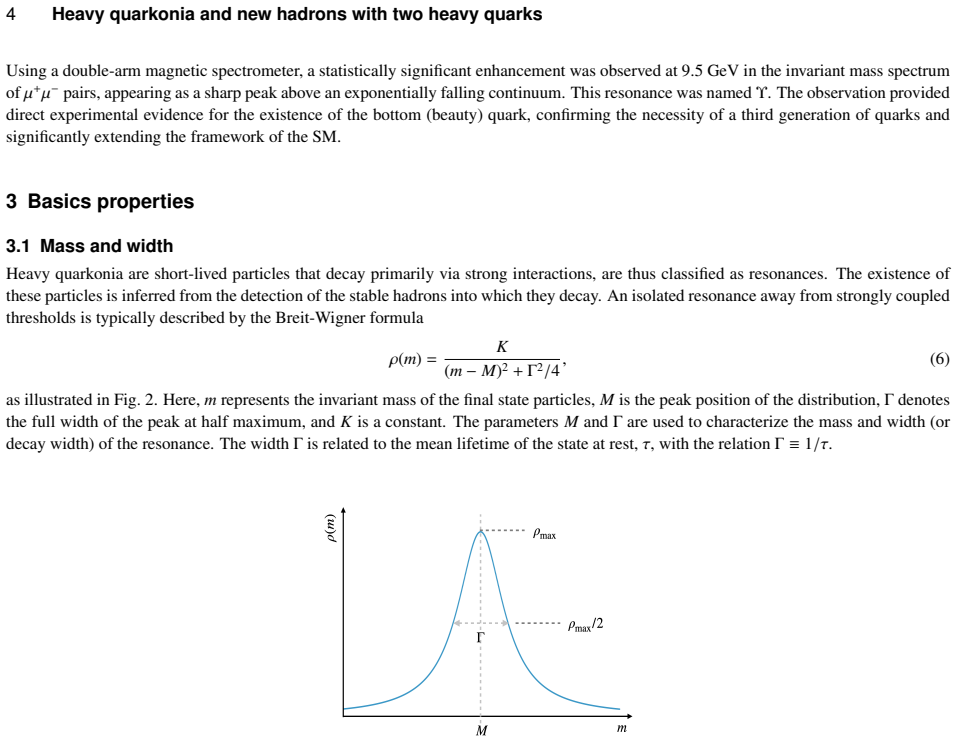
- domain assumption Observed peaks in invariant mass or cross section distributions are parametrized by Breit-Wigner functions, and the extracted mass and width describe a resonance.
Cite this review
Pith. "Pith review of Heavy quarkonia and new hadrons with two heavy quarks." pith.science (2026). https://pith.science/paper/XYSFTBTC
@misc{pith2026250820667,
  author       = {Pith},
  title        = {Pith review of: Heavy quarkonia and new hadrons with two heavy quarks},
  year         = {2026},
  howpublished = {\url{https://pith.science/paper/XYSFTBTC}},
  note         = {Machine review of arXiv:2508.20667}
}
abstract
We give a pedagogical introduction to heavy quarkonia -- bound states of a heavy quark and its antiquark (e.g., charmonium $c\bar{c}$, bottomonium $b\bar{b}$) -- as well as to the exotic hadrons containing two heavy quarks that have been discovered since 2003. The review covers the foundational discoveries ($J/\psi$ and $\Upsilon$), basic properties, spectroscopy interpreted via potential models, production mechanisms at colliders, and decay modes. A significant focus is placed on the so-called ``$XYZ$" states -- particles like the $X(3872)$, $Y(4260/4230)$, $Z_c(3900)$, and $P_c$ -- whose properties defy conventional quark model expectations. These states, considered candidates for hybrids, multi-quark states, hadronic molecules, or hadroquarkonia, provide unprecedented probes of non-perturbative QCD and challenge our understanding of quark confinement and hadron formation. The chapter summarizes the current experimental landscape and highlights key open questions driving future research in hadron spectroscopy.
Figures


Figures from the paper (6 more)


Reference graph
Works this paper leans on
-
[1]
J. J. Aubert, et al. (E598), Experimental Observation of a Heavy Particle J, Phys. Rev. Lett. 33 (1974) 1404–1406, doi:10.1103/PhysRevLett. 33.1404
-
[2]
J. E. Augustin, et al. (SLAC-SP-017), Discovery of a Narrow Resonance in e+e− Annihilation, Phys. Rev. Lett. 33 (1974) 1406–1408, doi:10.1103/PhysRevLett.33.1406
-
[3]
S. K. Choi, et al. (Belle), Observation of a narrow charmonium-like state in exclusive B±→ K±π+π− J/ψ decays, Phys. Rev. Lett. 91 (2003) 262001, doi:10.1103/PhysRevLett.91.262001, hep-ex/0309032
arXiv 2003
-
[4]
S. L. Glashow, J. Iliopoulos, L. Maiani, Weak Interactions with Lepton-Hadron Symmetry, Phys. Rev. D 2 (1970) 1285–1292, doi: 10.1103/ PhysRevD.2.1285
work page 1970
-
[5]
S. W. Herb, et al. (E288), Observation of a Dimuon Resonance at 9.5 GeV in 400 GeV Proton-Nucleus Collisions, Phys. Rev. Lett. 39 (1977) 252–255, doi:10.1103/PhysRevLett.39.252
-
[6]
N. Brambilla, et al. (Quarkonium Working Group), Heavy Quarkonium Physics (2004), doi: 10.5170/CERN-2005-005, hep-ph/0412158
arXiv 2004
-
[7]
E. Eichten, K. Gottfried, T. Kinoshita, J. Kogut, K. D. Lane, T. M. Y an, Spectrum of Charmed Quark-Antiquark Bound States, Phys. Rev. Lett. 34 (1975) 369–372, doi:10.1103/PhysRevLett.34.369
-
[8]
T. Barnes, S. Godfrey, E. S. Swanson, Higher charmonia, Phys. Rev. D 72 (2005) 054026, doi: 10.1103/PhysRevD.72.054026, hep-ph/ 0505002
Show all 63 references
-
[9]
Godfrey, K
S. Godfrey, K. Moats, Bottomonium Mesons and Strategies for their Observation, Phys. Rev. D 92 (5) (2015) 054034, doi:10.1103/PhysRevD. 92.054034, 1507.00024
2015 arXiv
-
[10]
Godfrey, N
S. Godfrey, N. Isgur, Mesons in a Relativized Quark Model with Chromodynamics, Phys. Rev. D 32 (1985) 189–231, doi:10.1103/PhysRevD. 32.189
1985 doi
-
[11]
Navas, et al
S. Navas, et al. (Particle Data Group), Review of particle physics, Phys. Rev. D 110 (3) (2024) 030001, doi:10.1103/PhysRevD.110.030001
2024 doi
-
[12]
Hayrapetyan, et al
A. Hayrapetyan, et al. (CMS), Observation of a pseudoscalar excess at the top quark pair production threshold (2025), 2503.22382
2025 arXiv
-
[13]
Abe, et al
F . Abe, et al. (CDF), Observation of the Bc meson in p ¯p collisions at √s = 1.8 TeV, Phys. Rev. Lett. 81 (1998) 2432–2437, doi: 10.1103/ PhysRevLett.81.2432, hep-ex/9805034
1998 arXiv
-
[14]
Aad, et al
G. Aad, et al. (ATLAS), Observation of an Excited B± c Meson State with the ATLAS Detector, Phys. Rev. Lett. 113 (21) (2014) 212004, doi:10.1103/PhysRevLett.113.212004, 1407.1032
2014 arXiv
-
[15]
Aaij, et al
R. Aaij, et al. (LHCb), Observation of orbitally excited B+ c states (2025), 2507.02149
2025
-
[16]
Ablikim, et al
M. Ablikim, et al. (BESIII), First Observation of the Direct Production of theχc1 in e+e− Annihilation, Phys. Rev. Lett. 129 (12) (2022) 122001, doi:10.1103/PhysRevLett.129.122001, 2203.13782
2022 arXiv
-
[17]
Straessner, The LEP Experiments, Springer Berlin Heidelberg, Berlin, Heidelberg, ISBN 978-3-642-05169-2 2010 pp
A. Straessner, The LEP Experiments, Springer Berlin Heidelberg, Berlin, Heidelberg, ISBN 978-3-642-05169-2 2010 pp. 45–54, doi: 10.1007/978-3-642-05169-2 2
2010 doi
-
[18]
Brambilla, et al., Heavy Quarkonium: Progress, Puzzles, and Opportunities, Eur
N. Brambilla, et al., Heavy Quarkonium: Progress, Puzzles, and Opportunities, Eur. Phys. J. C 71 (2011) 1534, doi: 10.1140/epjc/ s10052-010-1534-9 , 1010.5827
2011 arXiv
-
[19]
Garzoglio, et al., Experiment E835 at Fermilab, Nucl
G. Garzoglio, et al., Experiment E835 at Fermilab, Nucl. Instrum. Meth. A 519 (2004) 558–609, doi: 10.1016/j.nima.2003.10.089
2004 doi
-
[20]
Okubo, ϕ meson and unitary symmetry model, Phys
S. Okubo, ϕ meson and unitary symmetry model, Phys. Lett. 5 (1963) 165–168, doi:10.1016/S0375-9601(63)92548-9
1963 doi
-
[21]
Zweig, An SU(3) model for strong interaction symmetry and its breaking
G. Zweig, An SU(3) model for strong interaction symmetry and its breaking. Version 1-2 (1964), doi: 10.17181/CERN-TH-401,10.17181 / CERN-TH-412
1964 doi
-
[22]
J. Iizuka, A Systematics and Phenomenology of Meson Family*, Progress of Theoretical Physics Supplement 37-38 (1966) 21–34, ISSN 0375-9687, doi: 10.1143/PTPS.37.21, https://academic.oup.com/ptps/article-pdf/doi/10.1143/PTPS.37.21/5215468/ 37-38-21.pdf
1966 doi
-
[23]
Gell-Mann, A Schematic Model of Baryons and Mesons, Phys
M. Gell-Mann, A Schematic Model of Baryons and Mesons, Phys. Lett. 8 (1964) 214–215, doi: 10.1016/S0031-9163(64)92001-3
1964 doi
-
[24]
Esposito, A
A. Esposito, A. Pilloni, A. D. Polosa, Multiquark Resonances, Phys. Rept. 668 (2017) 1–97, doi: 10.1016/j.physrep.2016.11.002, 1611.07920
2017 arXiv
-
[25]
F .-K. Guo, C. Hanhart, Ulf-G. Meißner, Q. Wang, Q. Zhao, B.-S. Zou, Hadronic molecules, Rev. Mod. Phys. 90 (1) (2018) 015004, doi: 10.1103/RevModPhys.90.015004, [Erratum: Rev.Mod.Phys. 94, 029901 (2022)], 1705.00141
2018 arXiv
-
[26]
A. Ali, J. S. Lange, S. Stone, Exotics: Heavy Pentaquarks and Tetraquarks, Prog. Part. Nucl. Phys. 97 (2017) 123–198, doi: 10.1016/j.ppnp. 2017.08.003, 1706.00610. 20 Heavy quarkonia and new hadrons with two heavy quarks
2017 arXiv
-
[27]
S. L. Olsen, T. Skwarnicki, D. Zieminska, Nonstandard heavy mesons and baryons: Experimental evidence, Rev. Mod. Phys. 90 (1) (2018) 015003, doi:10.1103/RevModPhys.90.015003, 1708.04012
2018 arXiv
-
[28]
Brambilla, S
N. Brambilla, S. Eidelman, C. Hanhart, A. Nefediev, C.-P . Shen, C. E. Thomas, A. Vairo, C.-Z. Yuan, The XYZ states: experimental and theoretical status and perspectives, Phys. Rept. 873 (2020) 1–154, doi:10.1016/j.physrep.2020.05.001, 1907.07583
2020 arXiv
-
[29]
H.-X. Chen, W. Chen, X. Liu, Y .-R. Liu, S.-L. Zhu, An updated review of the new hadron states, Rept. Prog. Phys. 86 (2) (2023) 026201, doi:10.1088/1361-6633/aca3b6, 2204.02649
2023 arXiv
-
[30]
F . K. Guo, X. H. Liu, S. Sakai, Threshold cusps and triangle singularities in hadronic reactions, Prog. Part. Nucl. Phys. 112 (2020) 103757, doi:10.1016/j.ppnp.2020.103757, 1912.07030
2020
-
[31]
Aaij, et al
R. Aaij, et al. (LHCb), Determination of the X(3872) meson quantum numbers, Phys. Rev. Lett. 110 (2013) 222001, doi:10.1103/PhysRevLett. 110.222001, 1302.6269
2013 arXiv
-
[32]
Ablikim, et al
M. Ablikim, et al. (BESIII), Observation of e+e−→γX(3872) at BESIII, Phys. Rev. Lett. 112 (9) (2014) 092001, doi:10.1103/PhysRevLett.112. 092001, 1310.4101
2014 arXiv
-
[33]
Ablikim, et al
M. Ablikim, et al. (BESIII), Observation of a New X(3872) Production Process e+e−→ωX(3872), Phys. Rev. Lett. 130 (15) (2023) 151904, doi:10.1103/PhysRevLett.130.151904, 2212.07291
2023
-
[34]
Chilikin, et al
K. Chilikin, et al. (Belle), Observation of an alternative χc0(2P) candidate in e+e−→ J/ψD ¯D, Phys. Rev. D 95 (2017) 112003, doi: 10.1103/ PhysRevD.95.112003, 1704.01872
2017 arXiv
-
[35]
Uehara, et al
S. Uehara, et al. (Belle), Observation of a charmonium-like enhancement in the γγ→ωJ/ψ process, Phys. Rev. Lett. 104 (2010) 092001, doi:10.1103/PhysRevLett.104.092001, 0912.4451
2010 arXiv
-
[36]
Aaij, et al
R. Aaij, et al. (LHCb), Amplitude analysis of the B+→ D+D−K+ decay, Phys. Rev. D 102 (2020) 112003, doi:10.1103/PhysRevD.102.112003, 2009.00026
2020
-
[37]
Uehara, et al
S. Uehara, et al. (Belle), Observation of a χc2(2P) candidate in γγ→ D ¯D production at BELLE, Phys. Rev. Lett. 96 (2006) 082003, doi: 10.1103/PhysRevLett.96.082003, hep-ex/0512035
2006 arXiv
-
[38]
Aubert, et al
B. Aubert, et al. (BaBar), Observation of the χc2(2P) Meson in the Reaction γγ→ D ¯D at BaBar, Phys. Rev. D 81 (2010) 092003, doi: 10.1103/PhysRevD.81.092003, 1002.0281
2010 arXiv
-
[39]
Aubert, et al
B. Aubert, et al. (BaBar), Observation of a broad structure in the π+π− J/ψ mass spectrum around 4.26 GeV/c 2, Phys. Rev. Lett. 95 (2005) 142001, doi:10.1103/PhysRevLett.95.142001, hep-ex/0506081
2005 arXiv
-
[40]
Aubert, et al
B. Aubert, et al. (BaBar), Evidence of a broad structure at an invariant mass of 4.32 GeV/c2 in the reaction e+e−→π+π−ψ(2S ) measured at BaBar, Phys. Rev. Lett. 98 (2007) 212001, doi:10.1103/PhysRevLett.98.212001, hep-ex/0610057
2007 arXiv
-
[41]
X. L. Wang, et al. (Belle), Observation of Two Resonant Structures in e+e−→π+π−ψ(2S ) via Initial State Radiation at Belle, Phys. Rev. Lett. 99 (2007) 142002, doi:10.1103/PhysRevLett.99.142002, 0707.3699
2007 arXiv
-
[42]
Ablikim, et al
M. Ablikim, et al. (BES), Determination of the ψ(3770), ψ(4040), ψ(4160) and ψ(4415) resonance parameters, eConf C070805 (2007) 02, doi:10.1016/j.physletb.2007.11.100, 0705.4500
2007 arXiv
-
[43]
Ablikim, et al
M. Ablikim, et al. (BESIII), Precise measurement of the e+e−→π+π− J/ψ cross section at center-of-mass energies from 3.77 to 4.60 GeV, Phys. Rev. Lett. 118 (9) (2017) 092001, doi:10.1103/PhysRevLett.118.092001, 1611.01317
2017 arXiv
-
[44]
Ablikim, et al
M. Ablikim, et al. (BESIII), Evidence of Two Resonant Structures in e+e−→π+π−hc, Phys. Rev. Lett. 118 (9) (2017) 092002, doi: 10.1103/ PhysRevLett.118.092002, 1610.07044
2017 arXiv
-
[45]
Eichten, K
E. Eichten, K. Gottfried, T. Kinoshita, K. D. Lane, Tung-Mow Y an, Charmonium: Comparison with Experiment, Phys. Rev. D 21 (1980) 203, doi:10.1103/PhysRevD.21.203
1980 doi
-
[46]
Mizuk, et al
R. Mizuk, et al. (Belle), Observation of a new structure near 10.75 GeV in the energy dependence of the e+e−→ Υ(nS )π+π− (n = 1, 2, 3) cross sections, JHEP 10 (2019) 220, doi:10.1007/JHEP10(2019)220, 1905.05521
2019 arXiv
-
[47]
H ¨usken, R
N. H ¨usken, R. E. Mitchell, E. S. Swanson, K-matrix analysis of e+e- annihilation in the bottomonium region, Phys. Rev. D 106 (9) (2022) 094013, doi:10.1103/PhysRevD.106.094013, 2204.11915
2022 arXiv
-
[48]
Adachi, et al
I. Adachi, et al. (Belle-II), Observation of e+e−→ωχbJ (1P) and Search for Xb→ωΥ(1S ) at √s near 10.75 GeV, Phys. Rev. Lett. 130 (9) (2023) 091902, doi:10.1103/PhysRevLett.130.091902, 2208.13189
2023 arXiv
-
[49]
Ablikim, et al
M. Ablikim, et al. (BESIII), Observation of a Charged Charmoniumlike Structure in e+e−→π+π− J/ψ at√s =4.26 GeV, Phys. Rev. Lett. 110 (2013) 252001, doi:10.1103/PhysRevLett.110.252001, 1303.5949
2013 arXiv
-
[50]
Z. Q. Liu, et al. (Belle), Study of e+e−→π+π− J/ψ and Observation of a Charged Charmoniumlike State at Belle, Phys. Rev. Lett. 110 (2013) 252002, doi:10.1103/PhysRevLett.110.252002, [Erratum: Phys.Rev.Lett. 111, 019901 (2013)], 1304.0121
2013 arXiv
-
[51]
T. Xiao, S. Dobbs, A. Tomaradze, Kamal K. Seth, Observation of the Charged Hadron Z± c (3900) and Evidence for the Neutral Z0 c (3900) in e+e−→ππJ/ψ at√s = 4170 MeV, Phys. Lett. B 727 (2013) 366–370, doi:10.1016/j.physletb.2013.10.041, 1304.3036
2013 arXiv
-
[52]
Ablikim, et al
M. Ablikim, et al. (BESIII), Observation of a charged (D ¯D∗)± mass peak in e+e−→πD ¯D∗ at√s = 4.26 GeV, Phys. Rev. Lett. 112 (2) (2014) 022001, doi:10.1103/PhysRevLett.112.022001, 1310.1163
2014 arXiv
-
[53]
Ablikim, et al
M. Ablikim, et al. (BESIII), Determination of the Spin and Parity of the Zc(3900), Phys. Rev. Lett. 119 (7) (2017) 072001, doi: 10.1103/ PhysRevLett.119.072001, 1706.04100
2017 arXiv
-
[54]
Ablikim, et al
M. Ablikim, et al. (BESIII), Observation of a Charged Charmoniumlike Structure Zc(4020) and Search for the Zc(3900) in e+e−→π+π−hc, Phys. Rev. Lett. 111 (24) (2013) 242001, doi:10.1103/PhysRevLett.111.242001, 1309.1896
2013 arXiv
-
[55]
Ablikim, et al
M. Ablikim, et al. (BESIII), Observation of a charged charmoniumlike structure in e+e−→ (D∗ ¯D∗)±π∓ at√s = 4.26 GeV, Phys. Rev. Lett. 112 (13) (2014) 132001, doi:10.1103/PhysRevLett.112.132001, 1308.2760
2014 arXiv
-
[56]
S. K. Choi, et al. (Belle), Observation of a resonance-like structure in the π±ψ′ mass distribution in exclusive B→ Kπ±ψ′ decays, Phys. Rev. Lett. 100 (2008) 142001, doi:10.1103/PhysRevLett.100.142001, 0708.1790
2008 arXiv
-
[57]
Ablikim, et al
M. Ablikim, et al. (BESIII), Observation of a Near-Threshold Structure in the K+ Recoil-Mass Spectra in e+e−→ K+(D− s D∗0 + D∗− s D0), Phys. Rev. Lett. 126 (10) (2021) 102001, doi:10.1103/PhysRevLett.126.102001, 2011.07855
2021
-
[58]
Aaij, et al
R. Aaij, et al. (LHCb), Observation of New Resonances Decaying to J/ψK+ and J/ψϕ, Phys. Rev. Lett. 127 (8) (2021) 082001, doi:10.1103/ PhysRevLett.127.082001, 2103.01803
2021
-
[59]
Bondar, et al
A. Bondar, et al. (Belle), Observation of two charged bottomonium-like resonances in Υ(5S ) decays, Phys. Rev. Lett. 108 (2012) 122001, doi:10.1103/PhysRevLett.108.122001, 1110.2251
2012 arXiv
-
[60]
Aaij, et al
R. Aaij, et al. (LHCb), Observation of an exotic narrow doubly charmed tetraquark, Nature Phys. 18 (7) (2022) 751–754, doi: 10.1038/ s41567-022-01614-y , 2109.01038
2022
-
[61]
Aaij, et al
R. Aaij, et al. (LHCb), Study of the doubly charmed tetraquark T + cc, Nature Commun. 13 (1) (2022) 3351, doi: 10.1038/s41467-022-30206-w , 2109.01056
2022
-
[62]
Aaij, et al
R. Aaij, et al. (LHCb), Observation of J/ψp Resonances Consistent with Pentaquark States in Λ0 b→ J/ψK− p Decays, Phys. Rev. Lett. 115 (2015) 072001, doi:10.1103/PhysRevLett.115.072001, 1507.03414. Heavy quarkonia and new hadrons with two heavy quarks 21
2015 arXiv
-
[63]
Aaij, et al
R. Aaij, et al. (LHCb), Observation of a narrow pentaquark state, Pc(4312)+, and of two-peak structure of the Pc(4450)+, Phys. Rev. Lett. 122 (22) (2019) 222001, doi:10.1103/PhysRevLett.122.222001, 1904.03947
2019 arXiv
Reviewed August 5, 2026 · model on record in the stance chip above.
Discussion (0). Sign in to comment.