REVIEW 4 major objections 4 minor 54 references
Scattering by two staggered semi-infinite cracks on square lattice: an application of asymptotic Wiener-Hopf factorization
T0 review · 4 major / 4 minor · reviewed 2026-08-14 · deepseek-v4-flash
Pith's one-line read The paper derives an approximate solution for two staggered semi-infinite cracks on a square lattice by first-order asymptotic Wiener-Hopf factorization, yielding scattered-field integrals and far-field formulas that match numerical…
desk verdict New staggered-crack lattice scattering problem, but the far-field formulas are undermined by a sign error in the incident pole that must be fixed before the numerics can be trusted. read the letter →
The pith
A machine-rendered reading of the paper's core claim, the machinery that carries it, and where it could break.
The reading
What carries the argument
The load-bearing object is the $2\times2$ Wiener-Hopf kernel $K(z)=L(z)G_M(z)$, with $L=h/r$ the scalar factor familiar from the single semi-infinite crack and $G_M$ the symmetric matrix $\begin{pmatrix}1 & z^{-M}\lambda^N \\ z^M\lambda^N & 1\end{pmatrix}$ that carries the stagger. A similarity transformation by $R_M=\mathrm{diag}(z^{-M/2},z^{M/2})$ recasts $G_M$ as a matrix $F$ with entries $1$ and $\lambda^N$, which is exactly factorized through its eigenvalues $1\pm\lambda^N$. The remaining part is written as $I+N_M$ and split additively into factors analytic inside and outside the unit circle, giving the approximate product $G_M \approx (I+N_{1M-})(I+N_{1M+})$. This approximate factorization is what permits the Liouville step that produces the displacement formulas.
What would settle it
Compute the unit-circle norm of the difference between $G_M$ and the first-order product $(I+N_{1M-})(I+N_{1M+})$ for $M=1,2,3,\ldots$ at fixed $N$ and frequency; if the normalized residual does not shrink with the offset parameter, the first-order factorization fails. A direct check is to compare the far-field angle dependence from (113)-(114) with an independent lattice simulation at $M=3$, $N=4$, $\omega=0.35$, where the paper's figures already show visible deviation.
Extended reading notes
Core claim
On the paper's own terms, the central claim is that the matrix kernel $K(z)=L(z)G_M(z)$ of the coupled Wiener-Hopf equations can be multiplicatively factorized to first order as $K_-K_+$, where $L$ is the scalar factor from the single-crack problem, $G_M$ is the symmetric matrix encoding the stagger, and the perturbation enters through a matrix $N_M$ whose size is controlled by $\epsilon = \lambda^N \sin(\xi M/2)$. Once this factorization is made, the standard Wiener-Hopf argument gives explicit expressions for the half-range transforms, hence the contour integrals (93)-(94) for the displacement and the stationary-phase far-field estimates (113)-(114). The paper presents these formulas as the approximate solution of the two-staggered-crack lattice problem for small offset, and it reports graphical agreement with numerical lattice solutions in that regime.
Load-bearing premise
The load-bearing premise is that the offset between the two crack tips is small enough that keeping only the first-order correction to the zero-offset kernel is accurate; the paper supplies no error bound and notes that agreement with numerics gets worse as the offset increases.
Editorial extensions
If this is right
- For small tip offset, the scattered field anywhere outside the crack region can be evaluated from one-dimensional contour integrals rather than by solving the full two-dimensional lattice problem.
- The factorization separates the geometry: the single-crack scalar factor $L_\pm$ and the zero-offset matrix factors are universal, while the crack separation $N$ enters through $\lambda^N$ and explicit Chebyshev product factors.
- In the aligned-tip limit $M=0$ the perturbation matrix vanishes and the formulas reduce to the exact zero-offset solution, giving a built-in consistency check.
- The same factorization can be applied to a wave incident from the waveguide between the cracks; only the right-hand side of the Wiener-Hopf equation changes.
- Because agreement with numerics degrades as $M$ increases, the derived formulas are reliable only for small-to-moderate stagger relative to the crack separation.
Reading between the lines
- The residual $G_M-(I+N_{1M-})(I+N_{1M+})$ could be measured numerically on the unit circle; if it scales like $|\epsilon|$ over a wider parameter range, the first-order factorization may be promoted to a rigorous asymptotic expansion by iterating the same correction.
- The Chebyshev-polynomial product forms for the scalar factors suggest that for even $N$ the contour integrals defining the factors can be evaluated in closed form, removing the numerical contour integration the paper identifies as a practical difficulty.
- A similar stagger matrix arises for cracks on triangular or honeycomb lattices, so the same $R_M F R_M^{-1}$ decomposition may yield first-order factorization for those geometries as well.
- An analytic estimate of the growth of $K_-(z)K_-^{-1}(z_P)$ near $z=0$ would replace the numerical inspection used to justify the Liouville step and would tell whether the approximation remains uniform in the observation angle.
Signed reviews
Editorial analysis
A structured set of objections, weighed in public.
Referee Report
Summary. The paper formulates scattering of a time-harmonic plane wave on a square lattice by two parallel semi-infinite cracks with staggered edges as a 2x2 matrix Wiener-Hopf equation (36). Because the matrix kernel is not exactly factorable, the authors adapt an asymptotic factorization (61) based on the small parameter epsilon = lambda^N sin(xi M/2), solve the Wiener-Hopf equation formally, and give integral representations of the scattered field in (93)-(94). The far field is then approximated by stationary phase, leading to (113)-(114), and these formulas are compared with direct numerical lattice simulations and with the low-frequency continuum solution of Abrahams and Wickham.
Significance. If correct, the paper would provide the first lattice analogue of the two staggered semi-infinite crack/plate diffraction problem and would demonstrate that asymptotic Wiener-Hopf factorization can be adapted to a circular contour for a discrete matrix kernel. The work has genuine strengths: the Wiener-Hopf setup is coherent, the zero-offset limit is tied to an exact solution in [50], the low-frequency comparison with the continuum Abrahams-Wickham solution is physically meaningful, and the numerical comparisons involve no fitted free parameters. However, the central displayed far-field formulas currently contain an internal sign/pole inconsistency, and several load-bearing steps (the first-order truncation, the Liouville argument, and the dropped pole contribution) lack analytic or quantitative control. These issues must be addressed before the claims can be accepted.
major comments (4)
- [§3.1, Eqs. (57)-(61)] The first-order factorization G1,M(z) ≈ (I + N1M-(z))(I + N1M+(z)) is adopted without any error bound or convergence estimate. The parameter epsilon = lambda^N sin(xi M/2) is asserted to be small, and the paper itself notes that agreement with numerics degrades as M increases, but there is no quantitative criterion for when the truncated product is a valid replacement for G_M. Since (61) is the basis of the entire solution, this requires either a rigorous remainder estimate or a systematic numerical study of the truncation error.
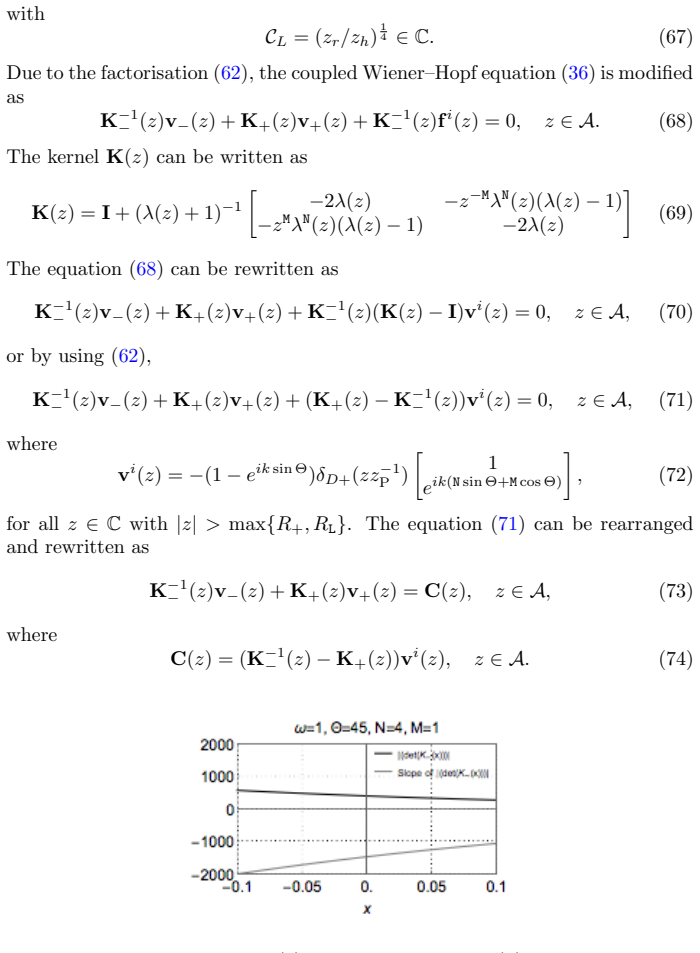
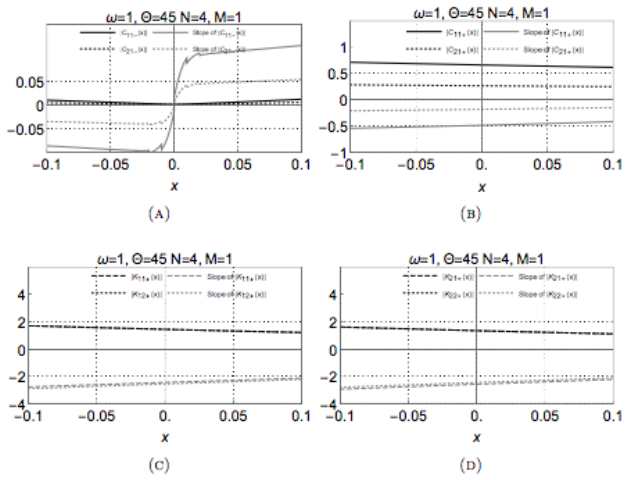
- [§3.2, Eq. (77) and Figs. 2-3] The Liouville step J(z)=0 is justified only by numerical inspection of plots. The solution formulas (78)-(79) depend on the entire function J being identically zero; this requires analytic control of the growth/decay of the two sides of (77), not visual inspection of a few computed curves. Without such control, the derivation of (78)-(79) is incomplete.
- [§4, Eqs. (93)-(94), (109), (113)-(114)] There is an internal sign/pole inconsistency in the inversion and far-field formulas. Equation (31) sets zP = e^{ik cos Theta}, and equations (91)-(92) place the pole at z = zP. However, the printed inversion integrals (93)-(94) contain K_-^{-1}(zP^{-1}) and denominator z - zP^{-1}; with the mapping z = e^{-i xi} this places the pole at xi = k cos Theta, as stated in (109), whereas (31)-(32) require xi = -k cos Theta. The stationary-phase amplitudes (113)-(114) inherit the wrong evaluation point. Unless a reciprocal convention is introduced, the displayed far-field formulas are not the asymptotics of the field defined by (91)-(92). This must be corrected and the numerical comparisons rerun with the corrected sign.
- [§4, after Eq. (112) and note following (114)] The far-field asymptotics are stated 'modulo the contribution of pole', and the pole contribution is then dropped without an estimate. In scattering problems, the pole typically gives the reflected or plane-wave component, which can be of the same order as the saddle-point contribution. As written, (113)-(114) cannot be asserted as asymptotic equivalents unless the pole contribution is shown to be negligible in the relevant angular sector; otherwise it must be included in the comparison with numerical data.
minor comments (4)
- [§1, Eq. (16)] The phase in vi_2x is written as e^{ik(N sin Theta + M sin Theta)}, but the subsequent shifted Fourier transform (32) and the Wiener-Hopf forcing (37c) use M cos Theta; this should be reconciled.
- [§3.2, Eq. (76)] The sentence 'C+ and C+ are analytic' should presumably read 'C+ and C- are analytic'; as printed it is a typographical error.
- [§3.2, near Eq. (77)] The Liouville argument refers to 'Examining (135), (136), and (59)' with equations from Appendix A that assume N is even, but the main solution is stated for general N; the scope of the numerical justification should be clarified.
- [§4, Figs. 4-5] The claimed agreement between the semi-analytical and numerical far fields is only visual; the paper would be substantially strengthened by a quantitative error metric (e.g., relative L2 or pointwise error as a function of M and omega).
Circularity Check
No significant circularity: the analysis is self-contained, with no fitted parameters and no load-bearing self-citation; the central staggered-offset result is derived from the stated equations.
full rationale
The paper's derivation chain is not circular. The matrix Wiener-Hopf equation (36) with kernel K = L G_M is solved using an approximate factorization developed in the paper itself: G_M is rewritten via R_M and F, then expanded as I + N_M and factorized to first order as (I + N1M-)(I + N1M+) (Eqs. 38-61). The only imported factorization is that of the scalar function L(z), taken from the first author's earlier work [44], but Eq. (66) gives the explicit closed-form factors L_±(z) = C_L sqrt((1-z_h z^{-1})/(1-z_r z^{-1})). This is a parameter-free, published result whose assumptions do not include the staggered-offset target, so it constitutes independent support rather than circularity. The zero-offset exact solution [50] by the same authors is used only as a validation check, not as an ingredient in the staggered factorization. The low-frequency comparison to the continuum solution [4,5] is an external benchmark. No parameter is fitted: omega, Theta, N, and M are physical inputs, and the far-field formulas (93)-(94) and (113)-(114) follow by stationary phase from the derived integral representation; the Cauchy-projector coefficients are computed numerically, not tuned to match the plotted outputs. The Liouville step J(z) = 0 is justified by numerical inspection of Figs. 2-3 rather than by an analytic estimate; this is a rigor gap, not circularity. Similarly, the apparent mismatch between the pole at z_P in (84)-(85) and at z_P^{-1} in (93)-(94) is an internal consistency or correctness issue, not a reduction of the output to the input. Therefore the paper receives a circularity score of 0.
Assumptions & free parameters
assumptions (5)
- ad hoc to paper The first-order perturbation factorization (61) is valid when epsilon = lambda^N sin(xi M/2) is small; no error bound is supplied.
- ad hoc to paper The function J(z) in (77) has decay and growth behavior sufficient for Liouville's theorem.
- domain assumption Existence and uniqueness of the discrete scattering solution hold as in the single-crack analysis [46].
- standard math The factors L+(z) and L-(z) from [44] apply to the present matrix kernel.
- ad hoc to paper R_M(z) in (39) is analytic, bounded, and locally Holder-continuous on the unit circle.
Cite this review
Pith. "Pith review of Scattering by two staggered semi-infinite cracks on square lattice: an application of asymptotic Wiener-Hopf factorization." pith.science (2026). https://pith.science/paper/XZ4GTRZ3
@misc{pith2026190801952,
  author       = {Pith},
  title        = {Pith review of: Scattering by two staggered semi-infinite cracks on square lattice: an application of asymptotic Wiener-Hopf factorization},
  year         = {2026},
  howpublished = {\url{https://pith.science/paper/XZ4GTRZ3}},
  note         = {Machine review of arXiv:1908.01952}
}
read the original abstract
Scattering of time-harmonic plane wave by two parallel semi-infinite rows, but with staggered edges, is considered on square lattice. The condition imposed on the semi-infinite rows is a discrete analogue of Neumann boundary condition. A physical interpretation assuming an out-of-plane displacement for the particles arranged in the form of a square lattice and interacting with nearest-neighbours, associates the scattering problem to lattice wave scattering due to the presence of two staggered but parallel crack tips. The discrete scattering problem is reduced to the study of a pair of Wiener-Hopf equation on an annulus in complex plane, using Fourier transforms. Due to the offset between the crack edges, the Wiener-Hopf kernel, a 2x2 matrix, is not amenable to factorization in a desirable form and an asymptotic method is adapted. Further, an approximation in the far field is carried out using the stationary phase method. A graphical comparison between the far-field approximation based on asymptotic Wiener-Hopf method and that obtained by a numerical solution is provided. Also included is a graphical illustration of the low frequency approximation, where it has been found that the numerical solution of the scattering problem coincides with the well known formidable solution in the continuum framework.
Figures

Figures from the paper (2 more)


Reference graph
Works this paper leans on
-
[50]
Discrete scattering by a pair of parallel defects
B. L. Sharma and G. Maurya. “Discrete scattering by a pair of parallel defects”. In: Philosophical Transactions of the Royal Society A: Mathe- matical, Physical and Engineering Sciences accepted (Aug. 2019), pp. 1–
work page 2019
-
[1]
M. J. Ablowitz and A. S. Fokas. Complex variables: introduction and applications. Second. Cambridge Texts in Applied Mathematics. Cam- bridge University Press, Cambridge, 2003, pp. xii+647. doi: 10 . 1017 / CBO9780511791246. url: https://doi.org/10.1017/CBO9780511791246
-
[2]
Acoustic scattering by two parallel slightly staggered rigid plates
I. D. Abrahams and G. R. Wickham. “Acoustic scattering by two parallel slightly staggered rigid plates”. In: Wave Motion 12.3 (1990), pp. 281–
work page 1990
-
[3]
General Wiener-Hopf factorization of matrix kernels with exponential phase factors
I. D. Abrahams and G. R. Wickham. “General Wiener-Hopf factorization of matrix kernels with exponential phase factors”. In:SIAM J. Appl. Math. 50.3 (1990), pp. 819–838. doi: 10.1137/0150047 . url: https://doi. org/10.1137/0150047
-
[4]
I. D. Abrahams and G. R. Wickham. “On the scattering of sound by two semi-infinite parallel staggered plates. I. Explicit matrix Wiener-Hopf fac- torization”. In: Proc. Roy. Soc. London Ser. A 420.1858 (1988), pp. 131– 156
work page 1988
-
[5]
I. D. Abrahams and G. R. Wickham. “The scattering of sound by two semi- infinite parallel staggered plates. II. Evaluation of the velocity potential for an incident plane wave and an incident duct mode”. In: Proc. Roy. Soc. London Ser. A 427.1872 (1990), pp. 139–171
work page 1990
-
[6]
On the application of the Wiener-Hopf technique to problems in dynamic elasticity
I. D. Abrahams. “On the application of the Wiener-Hopf technique to problems in dynamic elasticity”. In: Wave Motion 36.4 (2002). Dedicated to Jan D. Achenbach on the occasion of his 65th birthday, pp. 311–333. doi: 10.1016/S0165- 2125(02)00027- 6 . url: https://doi.org/10. 1016/S0165-2125(02)00027-6
doi:10.1016/s0165- 2002
-
[7]
M. Abramowitz and I. A. Stegun, eds. Handbook of mathematical func- tions with formulas, graphs, and mathematical tables . Reprint of the 1972 edition. Dover Publications, Inc., New York, 1992, pp. xiv+1046
work page 1972
Show all 54 references
-
[8]
J. D. Achenbach. Wave propagation in elastic solids . first. Vol. 16. North- Holland Series in Applied Mathematics and Mechanics. North-Holland Publishing Co., Amsterdam, 1976, front matter+425
1976
-
[9]
B¨ ottcher and B
A. B¨ ottcher and B. Silbermann. Analysis of Toeplitz operators . Second. Springer Monographs in Mathematics. Prepared jointly with Alexei Karlovich. Springer-Verlag, Berlin, 2006, pp. xiv+665. 22
2006
-
[10]
Diffraction theory
C. J. Bouwkamp. “Diffraction theory”. In: Reports on Progress in Physics 17 (1954), pp. 35–100
1954
-
[11]
Brillouin
L. Brillouin. Wave Propagation in Periodic Structures. Electric Filters and Crystal Lattices. McGraw-Hill Book Company, Inc., New York, 1946, pp. xii+247
1946
-
[12]
Systems of Integral Equations on a Half Line with Kernels Depending on the Difference of Arguments
I. C. Gohberg and M. G. Krein. “Systems of Integral Equations on a Half Line with Kernels Depending on the Difference of Arguments”. In: Am. Math. Soc.Transl. 14 (1960), pp. 217–287
1960
-
[13]
L. Collatz. The numerical treatment of differential equations. 3d ed. Trans- lated from a supplemented version of the 2d German edition by P. G. Williams. Die Grundlehren der mathematischen Wissenschaften, Bd. 60. Springer-Verlag, Berlin-G¨ ottingen-Heidelberg, 1960, xv+568 pp....
1960
-
[14]
On the solution of two coupled Wiener–Hopf equations
V. Daniele. “On the solution of two coupled Wiener–Hopf equations”. In: SIAM Journal on Applied Mathematics 44.4 (1984), pp. 667–680
1984
-
[15]
S. Elaydi. An introduction to difference equations . Third. Undergraduate Texts in Mathematics. Springer, New York, 2005, pp. xxii+539
2005
-
[16]
L. C. Evans. Partial differential equations. Second. Vol. 19. Graduate Stud- ies in Mathematics. American Mathematical Society, Providence, RI, 2010, pp. xxii+749. url: https://doi.org/10.1090/gsm/019
2010 doi
-
[17]
L. B. Felsen and N. Marcuvitz. Radiation and scattering of waves. Prentice- Hall Microwaves and Fields Series. Prentice-Hall, Inc., Englewood Cliffs, N.J., 1973, pp. xxxii+888
1973
-
[18]
F. D. Gakhov. Boundary value problems . Translated from the Russian, Reprint of the 1966 translation. Dover Publications, Inc., New York, 1990, pp. xxii+561
1966
-
[19]
Gilbarg and N
D. Gilbarg and N. S. Trudinger. Elliptic partial differential equations of second order . Classics in Mathematics. Reprint of the 1998 edition. Springer-Verlag, Berlin, 2001, pp. xiv+517
1998
-
[20]
Gohberg and M
I. Gohberg and M. A. Kaashoek, eds. Constructive methods of Wiener- Hopf factorization. Vol. 21. Operator Theory: Advances and Applications. Birkh¨ auser Verlag, Basel, 1986, pp. xii+409.doi: 10.1007/978-3-0348- 7418-2. url: https://doi.org/10.1007/978-3-0348-7418-2
1986 doi
-
[21]
An Overview of Ma- trix Factorization Theory and Operator Applications
I. Gohberg, M. A. Kaashoek, and I. M. Spitkovsky. “An Overview of Ma- trix Factorization Theory and Operator Applications”. In: Factorization and Integrable Systems. Ed. by I. Gohberg, N. Manojlovic, and A. F. dos Santos. Basel: Birkh¨ auser Basel, 2003, pp. 1–102
2003
-
[22]
J. G. Harris. Linear elastic waves . Vol. 26. Cambridge University Press, 2001
2001
-
[23]
The radiation and transmission properties of a pair of semi- infinite parallel plates. I
A. E. Heins. “The radiation and transmission properties of a pair of semi- infinite parallel plates. I”. In: 6 (1948), pp. 157–166
1948
-
[24]
The radiation and transmission properties of a pair of semi- infinite parallel plates. II
A. E. Heins. “The radiation and transmission properties of a pair of semi- infinite parallel plates. II”. In: 6 (1948), pp. 215–220. 23
1948
-
[25]
The scope and limitations of the method of Wiener and Hopf
A. E. Heins. “The scope and limitations of the method of Wiener and Hopf”. In: IX (1956), pp. 447–466
1956
-
[26]
Factorization of a Wiener-Hopf matrix
D. S. Jones. “Factorization of a Wiener-Hopf matrix”. In: IMA J. Appl. Math. 32.1-3 (1984), pp. 211–220. doi: 10.1093/imamat/32.1- 3.211 . url: https://doi.org/10.1093/imamat/32.1-3.211
1984 doi
-
[27]
E. I. Jury. Theory and Application of the z-Transform Method . Wiley, 1964
1964
-
[28]
An Iterative Wiener–Hopf method for triangular matrix func- tions with exponential factors
A. V. Kisil. “An Iterative Wiener–Hopf method for triangular matrix func- tions with exponential factors”. In:SIAM Journal on Applied Mathematics 78.1 (2018), pp. 45–62
2018
-
[29]
Levy and F
H. Levy and F. Lessman. Finite difference equations. Reprint of the 1961 edition. Dover Publications, Inc., New York, 1992, pp. viii+278
1961
-
[30]
J. C. Mason and D. C. Handscomb. Chebyshev polynomials. Chapman & Hall/CRC, Boca Raton, FL, 2003, pp. xiv+341
2003
-
[31]
On some problems involving multiple scattering due to edges
G. Maurya. “On some problems involving multiple scattering due to edges”. PhD thesis. Indian Institute of Technology Kanpur, 2018
2018
-
[32]
Elastodynamical scattering by N parallel half-planes in R3
E. Meister and K. Rottbrand. “Elastodynamical scattering by N parallel half-planes in R3”. In: Math. Nachr. 177 (1996), pp. 189–232. doi: 10. 1002/mana.19961770112 . url: http://dx.doi.org/10.1002/mana. 19961770112
1996 doi
-
[33]
Elastodynamical scattering by N parallel half-planes in R3. II. Explicit solutions for N = 2 by explicit symbol factorization
E. Meister and K. Rottbrand. “Elastodynamical scattering by N parallel half-planes in R3. II. Explicit solutions for N = 2 by explicit symbol factorization”. In: Integral Equations Operator Theory29.1 (1997), pp. 70–
1997
-
[34]
Wiener-Hopf equations for waves scattered by a system of parallel Sommerfeld half-planes
E. Meister, K. Rottbrand, and F.-O. Speck. “Wiener-Hopf equations for waves scattered by a system of parallel Sommerfeld half-planes”. In:Math. Methods Appl. Sci. 14.8 (1991), pp. 525–552.doi: 10.1002/mma.1670140802. url: http://dx.doi.org/10.1002/mma.1670140802
1991 doi
-
[35]
Wiener–Hopf Factorization of Certain Non- Rational Matrix Functions in Mathematical Physics
E. Meister and F.-O. Speck. “Wiener–Hopf Factorization of Certain Non- Rational Matrix Functions in Mathematical Physics”. In: The Gohberg Anniversary Collection. Ed. by H. Dym et al. Vol. 41. Operator Theory: Advances and Applications. Birkhauser Basel, 1989, pp. 385–394. doi...
1989 doi
-
[36]
Miklowitz
J. Miklowitz. The theory of elastic waves and waveguides . Vol. 22. North- Holland Series in Applied Mathematics and Mechanics. North-Holland Publishing Co., Amsterdam-New York, 1978, pp. xvi+618
1978
-
[37]
An asymptotic method of factorization of a class of matrix functions
G. Mishuris and S. Rogosin. “An asymptotic method of factorization of a class of matrix functions”. In: Proc. R. Soc. A . Vol. 470. The Royal Society. 2014, p. 20140109. 24
2014
-
[38]
Factorization of a class of matrix-functions with stable partial indices
G. Mishuris and S. Rogosin. “Factorization of a class of matrix-functions with stable partial indices”. In: Mathematical Methods in the Applied Sci- ences 39.13 (2016), pp. 3791–3807
2016
-
[39]
Regular approximate factorization of a class of matrix-function with an unstable set of partial indices
G. Mishuris and S. Rogosin. “Regular approximate factorization of a class of matrix-function with an unstable set of partial indices”. In: Proceedings of the Royal Society A: Mathematical, Physical and Engineering Sciences 474.2209 (2018), p. 20170279
2018
-
[40]
Mitra and S
R. Mitra and S. Lee. Analytical techniques in the theory of guided waves . Macmillan, 1971
1971
-
[41]
B. Noble. Methods based on the Wiener-Hopf technique for the solution of partial differential equations. International Series of Monographs on Pure and Applied Mathematics. Vol. 7. Pergamon Press, New York-London- Paris-Los Angeles, 1958, pp. x+246
1958
-
[42]
Constructive methods for factorization of matrix-functions
S. Rogosin and G. Mishuris. “Constructive methods for factorization of matrix-functions”. In: IMA Journal of Applied Mathematics 81.2 (2015), pp. 365–391
2015
-
[43]
Continuum limit of discrete Sommerfeld problems on square lattice
B. L. Sharma. “Continuum limit of discrete Sommerfeld problems on square lattice”. In: S¯ adhan¯ a42.5 (2017), pp. 713–728
2017
-
[44]
Diffraction of waves on square lattice by semi-infinite crack
B. L. Sharma. “Diffraction of waves on square lattice by semi-infinite crack”. In: SIAM J. Appl. Math. 75.3 (2015), pp. 1171–1192. doi: 10 . 1137/140985093. url: https://doi.org/10.1137/140985093
2015 doi
-
[45]
Diffraction of waves on square lattice by semi-infinite rigid constraint
B. L. Sharma. “Diffraction of waves on square lattice by semi-infinite rigid constraint”. In: Wave Motion 59 (2015), pp. 52–68. doi: 10 . 1016 / j . wavemoti.2015.07.008. url: https://doi.org/10.1016/j.wavemoti. 2015.07.008
2015 doi
-
[46]
Near-tip field for diffraction on square lattice by crack
B. L. Sharma. “Near-tip field for diffraction on square lattice by crack”. In: SIAM J. Appl. Math. 75.4 (2015), pp. 1915–1940. doi: 10 . 1137 / 15M1010646. url: https://doi.org/10.1137/15M1010646
2015 doi
-
[47]
Near-tip field for diffraction on square lattice by rigid constraint
B. L. Sharma. “Near-tip field for diffraction on square lattice by rigid constraint”. In: Z. Angew. Math. Phys. 66.5 (2015), pp. 2719–2740. doi: 10 . 1007 / s00033 - 015 - 0508 - z. url: https : / / doi . org / 10 . 1007 / s00033-015-0508-z
2015
-
[48]
On linear waveguides of square and triangular lattice strips: an application of Chebyshev polynomials
B. L. Sharma. “On linear waveguides of square and triangular lattice strips: an application of Chebyshev polynomials”. In:S¯ adhan¯ a42.6 (2017), pp. 901–927
2017
-
[49]
Wave propagation in bifurcated waveguides of square lat- tice strips
B. L. Sharma. “Wave propagation in bifurcated waveguides of square lat- tice strips”. In: SIAM J. Appl. Math. 76.4 (2016), pp. 1355–1381. doi: 10.1137/15M1051464. url: https://doi.org/10.1137/15M1051464
2016 doi
-
[51]
L. I. Slepyan. Models and phenomena in fracture mechanics . Foundations of Engineering Mechanics. Springer-Verlag, Berlin, 2002, pp. xviii+576. doi: 10.1007/978-3-540-48010-5 . url: https://doi.org/10.1007/ 978-3-540-48010-5 . A Further simplification and factorization of G1 an...
2002 doi
-
[53]
eprint: http://arxiv.org/abs/ 1906.11404
doi: 10.1098/rsta.2019.0102 . eprint: http://arxiv.org/abs/ 1906.11404. 25
2019
-
[109]
url: http://dx.doi.org/10.1007/ BF01191481
doi: 10.1007/BF01191481 . url: http://dx.doi.org/10.1007/ BF01191481
-
[297]
url: https://doi.org/10
doi: 10.1016/0165-2125(90)90044-5. url: https://doi.org/10. 1016/0165-2125(90)90044-5
Reviewed August 14, 2026 · model on record in the stance chip above.
Discussion (0). Continue with ORCID to comment.