REVIEW 4 major objections 4 minor 40 references
Auto-Labeling Data for Object Detection
T0 review · 4 major / 4 minor · reviewed 2026-08-07 · deepseek-v4-flash
Pith's one-line read The paper claims that object detectors can be trained to near-human accuracy using pseudo labels generated by vision-language foundation models, cutting labeling cost by roughly five orders of magnitude.
desk verdict Large, mostly honest empirical study of VLM auto-labeling with a useful low-threshold finding, but the headline numbers are selected on the same validation sets and the 'no leakage' claim needs evidence. read the letter →
The pith
A machine-rendered reading of the paper's core claim, the machinery that carries it, and where it could break.
The reading
What carries the argument
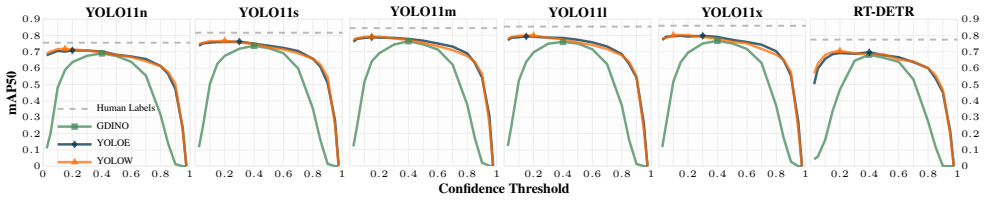
The engine of the approach is the zero-shot label generator $f^A(x_i, \alpha, T)$: a pre-trained open-vocabulary detection model (YOLO-World, YOLOE, or Grounding DINO-T) that, given a set of class text prompts $T$ and a fixed confidence threshold $\alpha$, emits bounding boxes and class indices as pseudo ground truth. The threshold $\alpha$ is the lever that trades precision against recall, and the paper's core mechanistic finding is that downstream detector performance is best at low-to-mid $\alpha$ (around 0.2), where recall is high even though label precision is modest, while high-precision settings ($\alpha=0.8$) reliably degrade the trained detector. The downstream evaluation chain—training lightweight YOLO11 and RT-DETR models on the auto-labels with no pre-trained weights—is what converts label-quality metrics into the practical claim of viability.
What would settle it
Run the same pipeline but choose the foundation model and confidence threshold α using only a held-out portion of each training set, then evaluate the trained detectors on untouched validation sets; if YOLOW-0.2 no longer lands within the reported 4–7% of human-label mAP50 on VOC and COCO, the viability claim is weakened.
Extended reading notes
Core claim
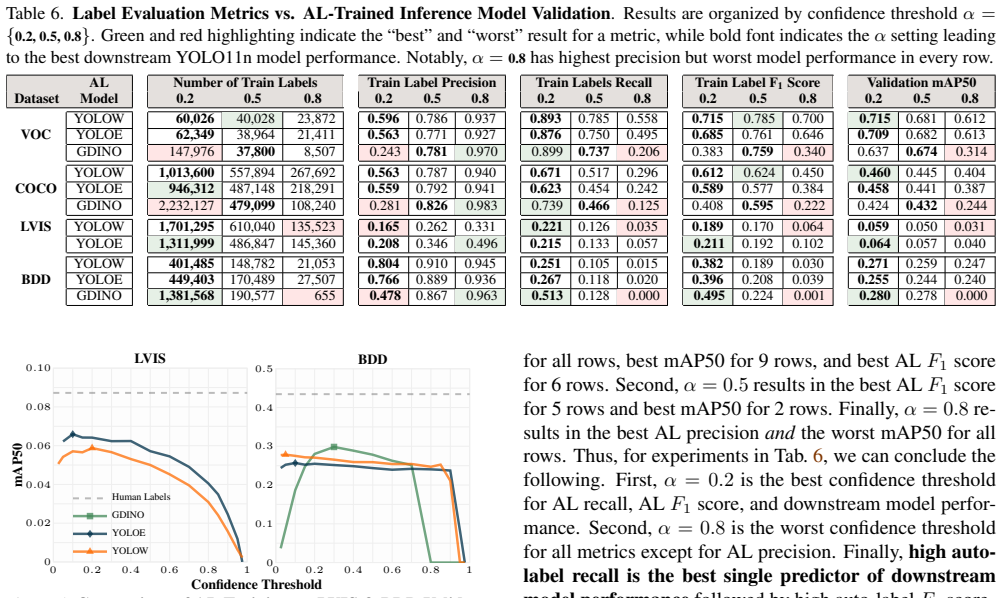
The central claim is that auto-labeling is a viable replacement for standard label acquisition in many object detection scenarios. Concretely, a YOLO11n trained on YOLO-World labels generated with confidence threshold α=0.2 attains validation mAP50 of 0.715 on VOC, 0.460 on COCO, 0.059 on LVIS, and 0.271 on BDD, versus 0.756, 0.496, 0.087, and 0.434 for the same model trained on human labels. The paper further reports that auto-labeling all four training sets costs about 1.27 GPU-hours and $1.18, compared with roughly 6,700 human labeling hours and $124,000 for an annotation service. A single configuration, YOLO-World with α=0.2, gives the most reliable downstream performance across all datasets, and across the measured settings downstream mAP tracks auto-label recall more than precision or even F1 score relative to human labels.
Load-bearing premise
The reported competitive gaps come from picking the auto-labeling configuration on the same validation splits used to report the numbers, so the real-world gap to human labels could be larger if the configuration had to be chosen on held-out data.
Editorial extensions
If this is right
- For common-object benchmarks like VOC and COCO, auto-labeling can substitute for human annotation with a 4–7% mAP50 penalty at roughly 1/100,000th of the labeling cost.
- Redirecting the cost savings to a larger inference model can outperform a small model trained on human labels (e.g., YOLO11s with auto-labels beats YOLO11n with human labels by 2–5% on VOC and 9–11% on COCO).
- Practitioners should set the confidence threshold low (α≈0.2) to favor recall, because high-precision settings produced the worst downstream model on every dataset tested.
- For out-of-distribution or very large vocabulary applications (BDD, LVIS), auto-labeling still yields cheap working detectors, but the gap to human labels is larger and may require prompt engineering or verification.
- Because the auto-labeling output has the same format as human labels, it drops directly into existing training pipelines and improves automatically as foundation models improve.
Reading between the lines
- The reported cost and time figures assume a single forward pass on a rented L40S GPU; any human-in-the-loop verification or iterative labeling would add cost, though even a 100× cost increase stays far below annotation services.
- The selection of α on the same validation splits used for reporting likely makes the headline gaps optimistic; a held-out protocol for choosing YOLOW-0.2 could widen the gap, especially on BDD where the difference is already 0.163 mAP50.
- The class-level analysis suggests a testable fix: feeding more descriptive prompts for rare classes (e.g., 'rider' on BDD, 'car battery' on LVIS) should recover some of the unlabeled instances and shrink the downstream gap.
- The same label-generation pipeline is a natural first step toward annotation-free instance segmentation, since bounding boxes from auto-labelers can bootstrap mask generators.
Editorial analysis
A structured set of objections, weighed in public.
Referee Report
Summary. The paper proposes an auto-labeling pipeline for object detection: off-the-shelf vision-language foundation models (YOLO-World, YOLOE, Grounding DINO) are configured with a text-prompt set and a confidence threshold to generate pseudo ground-truth boxes for unlabeled images, and lightweight detectors (YOLO11 variants, RT-DETR) are then trained on these auto-labels. The authors evaluate the approach on VOC, COCO, LVIS, and BDD, comparing auto-labels to human labels via precision/recall/F1 and comparing downstream detection performance via mAP50. They report 445 training experiments across 169 unique label sets and conclude that a YOLO-World model with threshold 0.2 is the most reliable configuration, achieving mAP50 values of 0.715, 0.460, 0.059, and 0.271 on VOC, COCO, LVIS, and BDD, versus 0.756, 0.496, 0.087, and 0.434 with human labels, at a fraction of the estimated labeling cost.
Significance. If the findings hold, this is a practically valuable contribution: it provides a large-scale empirical benchmark for auto-labeling in object detection, compares three modern foundation models and multiple downstream architectures on four standard datasets, and gives concrete best-practice guidance that is actionable for practitioners. The paper's main strengths are the breadth of the experiments, the direct F1 comparison of auto-labels against human labels, the inclusion of challenging large-vocabulary and driving-domain datasets, and the honest acknowledgment that auto-labeling is not competitive on LVIS and BDD. However, the headline 'competitive performance' claim rests on evaluation-protocol choices and on an unverified zero-shot/leakage assumption, so the quantitative conclusions should be treated with caution until those points are addressed.
major comments (4)
- [3.1 (Dataset Selection)] The sentence 'there is no leakage between these datasets and the AL foundation models' is load-bearing for the zero-shot premise, but no supporting evidence is provided. VOC, COCO, and LVIS draw images from Flickr-like web sources, and YOLOW/YOLOE are pretrained on Objects365, GQA, and Flickr30k while GDINO uses Objects365, GoldG, and Cap4M; LVIS in particular reuses the COCO image pool. Since exact or near-duplicate images could directly inflate the reported mAP differences in Tab. 11 and invalidate the generalization claim to a user's own unlabeled images, the authors should add an image-level deduplication analysis (e.g., exact hash plus feature-based near-duplicate checks) and report how many evaluation images are similar to pretraining images.
- [3.4-3.5, Tab. 6 and Tab. 11] The recommended configuration YOLOW-0.2 is selected as the best-performing alpha based on validation mAP on the same splits that are later reported as final results. This makes the headline numbers (VOC 0.715, COCO 0.460, LVIS 0.059, BDD 0.271 in Tab. 11) optimistic, because the validation set has also been used for model selection. The authors should either withhold a held-out test set for final evaluation or use nested cross-validation, and they should explicitly describe the selection procedure so readers can assess the degree of overfitting.
- [3.4 (Downstream Inference Model Training)] All headline comparisons are based on a single training run per configuration; no seeds or error bars are reported. For example, Tab. 5 lists YOLO11n VOC mAP50 of 0.756 (human labels) versus 0.715 (YOLOW auto-labels), but training from scratch for 100 epochs is stochastic, so this gap may be within run-to-run variation. Reporting mean and standard deviation over at least three seeds for the central Tab. 5 and Tab. 11 configurations is necessary to support the 'competitive performance' claim.
- [3.2 (Auto-Labeling Costs)] The cost and time savings in Tab. 4 depend on external estimates (7 seconds per box, $0.036 per box, $0.93 per hour for an L40S GPU) and on the assumption that human labeling time scales linearly with object count. These are point estimates, and the paper should include a sensitivity analysis (e.g., a range of annotation rates and GPU prices) so that the '1/100,000th cost' and '1/5,000th time' claims are not overstated.
minor comments (4)
- [1 (Introduction)] There are several typos in the introduction, including 'superivsed' and 'langauge', and the author affiliation lists 'V oxel51' with a stray space.
- [4 (Conclusions), Tab. 11] In Tab. 11, the header 'Total Label' appears truncated, and the human-label total cost is printed as '$1,240,92.54' instead of '$124,092.54'.
- [3.6, Fig. 6] Figure 6 uses a log scale for label counts but the caption does not explain how the three confidence thresholds are visually encoded; adding a short caption note or legend would improve readability.
- [2.1, Eq. (1)] Equation (1) is written as an optimization over SA, but in practice the authors do not optimize SA directly; they select fA and alpha. Clarifying that Eq. (1) is a formal goal rather than a procedure that is actually optimized would avoid confusion.
Circularity Check
No circularity: the paper is an empirical benchmark; its comparisons are against external human labels and no derived quantity reduces to its inputs by construction.
full rationale
The paper's claim is that auto-labeled training data can substitute for human labels. There is no derivation chain of the kind that can be circular: Eq. (2) defines label generation from a fixed foundation model; Eq. (3) evaluates those labels by F1 against externally annotated human ground truth; Eq. (4) trains a standard detector and evaluates mAP on the same external validation splits. None of these quantities is defined in terms of the paper's conclusions. The recommended YOLOW-alpha=0.2 configuration is selected from the experimental sweep in Sec. 3.5, and the no-leakage assertion in Sec. 3.1 is unsupported by deduplication evidence; both are evaluation-validity or generalizability concerns, not instances where a prediction equals its input by construction. The only self-citations (FiftyOne for visualizations, prior Griffin work for context) are not load-bearing. Accordingly, no circular step can be exhibited, and the appropriate score is 0.
Assumptions & free parameters
free parameters (2)
- confidence threshold α =
0.2 recommended; 0.05-0.9 tested per model and dataset
- text prompt set T =
dataset class names and LVIS verbose descriptions
assumptions (5)
- standard math F1 and mAP definitions per Eq. (3) and Sec. 2.3 are the right evaluation metrics.
- domain assumption There is no leakage between foundation model pretraining corpora (O365, GQA, Flickr30k, GoldG, Cap4M) and the evaluation datasets.
- domain assumption Human labeling takes 7 seconds per bounding box and annotation service costs $0.036 per box.
- domain assumption Training inference models from scratch for 100 epochs without pretrained weights isolates label quality.
- ad hoc to paper A single global confidence threshold α per model and dataset is sufficient (Eq. (2)).
Cite this review
Pith. "Pith review of Auto-Labeling Data for Object Detection." pith.science (2026). https://pith.science/paper/XZOO3AOW
@misc{pith2026250602359,
  author       = {Pith},
  title        = {Pith review of: Auto-Labeling Data for Object Detection},
  year         = {2026},
  howpublished = {\url{https://pith.science/paper/XZOO3AOW}},
  note         = {Machine review of arXiv:2506.02359}
}
read the original abstract
Great labels make great models. However, traditional labeling approaches for tasks like object detection have substantial costs at scale. Furthermore, alternatives to fully-supervised object detection either lose functionality or require larger models with prohibitive computational costs for inference at scale. To that end, this paper addresses the problem of training standard object detection models without any ground truth labels. Instead, we configure previously-trained vision-language foundation models to generate application-specific pseudo "ground truth" labels. These auto-generated labels directly integrate with existing model training frameworks, and we subsequently train lightweight detection models that are computationally efficient. In this way, we avoid the costs of traditional labeling, leverage the knowledge of vision-language models, and keep the efficiency of lightweight models for practical application. We perform exhaustive experiments across multiple labeling configurations, downstream inference models, and datasets to establish best practices and set an extensive auto-labeling benchmark. From our results, we find that our approach is a viable alternative to standard labeling in that it maintains competitive performance on multiple datasets and substantially reduces labeling time and costs.
Figures


Figures from the paper (5 more)



Reference graph
Works this paper leans on
-
[1]
Dario Amodei, Danny Hernandez, GirishSastry, Jack Clark, Greg Brockman, and Ilya Sutskeverx. Ai and compute. 2018. 1
work page 2018
-
[2]
Weakly supervised deep detection networks
Hakan Bilen and Andrea Vedaldi. Weakly supervised deep detection networks. In Proceedings of the IEEE Conference on Computer Vision and Pattern Recognition (CVPR), 2016. 1
work page 2016
-
[3]
End-to- end object detection with transformers
Nicolas Carion, Francisco Massa, Gabriel Synnaeve, Nicolas Usunier, Alexander Kirillov, and Sergey Zagoruyko. End-to- end object detection with transformers. In European Confer- ence on Computer Vision (ECCV), 2020. 1
work page 2020
-
[4]
Yolo-world: Real-time open-vocabulary object detection
Tianheng Cheng, Lin Song, Yixiao Ge, Wenyu Liu, Xing- gang Wang, and Ying Shan. Yolo-world: Real-time open-vocabulary object detection. In Proceedings of the IEEE/CVF Conference on Computer Vision and Pattern Recognition (CVPR), 2024. 2, 3, 4
work page 2024
-
[5]
The cityscapes dataset for semantic urban scene understanding
Marius Cordts, Mohamed Omran, Sebastian Ramos, Timo Rehfeld, Markus Enzweiler, Rodrigo Benenson, Uwe Franke, Stefan Roth, and Bernt Schiele. The cityscapes dataset for semantic urban scene understanding. In Proceed- ings of the IEEE Conference on Computer Vision and Pattern Recognition (CVPR), 2016. 1
work page 2016
-
[6]
An image is worth 16x16 words: Transformers for image recognition at scale
Alexey Dosovitskiy, Lucas Beyer, Alexander Kolesnikov, Dirk Weissenborn, Xiaohua Zhai, Thomas Unterthiner, Mostafa Dehghani, Matthias Minderer, Georg Heigold, Syl- vain Gelly, Jakob Uszkoreit, and Neil Houlsby. An image is worth 16x16 words: Transformers for image recognition at scale. In International Conference on Learning Representa- tions (ICLR), 2021. 1
work page 2021
-
[7]
Mark Everingham, Luc Van Gool, Christopher K. I. Williams, John Winn, and Andrew Zisserman. The pascal visual object classes (voc) challenge. International Journal of Computer Vision (IJCV), 2010. 1, 2, 4
work page 2010
-
[8]
Mobile robot manipulation using pure object detection
Brent Griffin. Mobile robot manipulation using pure object detection. In IEEE/CVF Winter Conference on Applications of Computer Vision (WACV), 2023. 1
work page 2023
Show all 40 references
-
[9]
Open-vocabulary object detection via vision and language knowledge distillation
Xiuye Gu, Tsung-Yi Lin, Weicheng Kuo, and Yin Cui. Open-vocabulary object detection via vision and language knowledge distillation. In International Conference on Learning Representations (ICLR), 2022. 1
2022
-
[10]
Lvis: A dataset for large vocabulary instance segmentation
Agrim Gupta, Piotr Dollar, and Ross Girshick. Lvis: A dataset for large vocabulary instance segmentation. In Pro- ceedings of the IEEE/CVF Conference on Computer Vision and Pattern Recognition (CVPR), 2019. 1, 4
2019
-
[11]
Hudson and Christopher D
Drew A. Hudson and Christopher D. Manning. Gqa: A new dataset for real-world visual reasoning and composi- tional question answering. In Proceedings of the IEEE/CVF Conference on Computer Vision and Pattern Recognition (CVPR), 2019. 3
2019
-
[12]
Exemplar- freesolo: Enhancing unsupervised instance segmentation with exemplars
Taoseef Ishtiak, Qing En, and Yuhong Guo. Exemplar- freesolo: Enhancing unsupervised instance segmentation with exemplars. In Proceedings of the IEEE/CVF Confer- ence on Computer Vision and Pattern Recognition (CVPR) ,
-
[13]
Predicting suffi- cient annotation strength for interactive foreground segmen- tation
Suyog Dutt Jain and Kristen Grauman. Predicting suffi- cient annotation strength for interactive foreground segmen- tation. In IEEE International Conference on Computer Vi- sion (ICCV), 2013. 1, 4
2013
-
[14]
Ultralytics yolo11
Glenn Jocher and Jing Qiu. Ultralytics yolo11. https:// github.com/ultralytics/ultralytics, 2024. 3
2024
-
[15]
Yolo by ultralytics
Glenn Jocher, Ayush Chaurasia, and Jing Qiu. Yolo by ultralytics. https://github.com/ultralytics/ ultralytics, 2023. 3
2023
-
[16]
Mdetr - mod- ulated detection for end-to-end multi-modal understanding
Aishwarya Kamath, Mannat Singh, Yann LeCun, Gabriel Synnaeve, Ishan Misra, and Nicolas Carion. Mdetr - mod- ulated detection for end-to-end multi-modal understanding. In Proceedings of the IEEE/CVF International Conference on Computer Vision (ICCV), 2021. 3
2021
-
[17]
Imagenet classification with deep convolutional neural net- works
Alex Krizhevsky, Ilya Sutskever, and Geoffrey E Hinton. Imagenet classification with deep convolutional neural net- works. In Advances in Neural Information Processing Sys- tems (NeurIPS), 2012. 1
2012
-
[18]
The open images dataset v4: Unified image classification, object detection, and visual relationship detection at scale
Alina Kuznetsova, Hassan Rom, Neil Alldrin, Jasper Ui- jlings, Ivan Krasin, Jordi Pont-Tuset, Shahab Kamali, Stefan Popov, Matteo Malloci, Alexander Kolesnikov, et al. The open images dataset v4: Unified image classification, object detection, and visual relationship detection...
2020
-
[19]
Grounded language-image pre-training
Liunian Harold Li, Pengchuan Zhang, Haotian Zhang, Jian- wei Yang, Chunyuan Li, Yiwu Zhong, Lijuan Wang, Lu Yuan, Lei Zhang, Jenq-Neng Hwang, Kai-Wei Chang, and Jianfeng Gao. Grounded language-image pre-training. In Proceedings of the IEEE/CVF Conference on Computer Vi- sion a...
2022
-
[20]
Lawrence Zitnick
Tsung-Yi Lin, Michael Maire, Serge Belongie, James Hays, Pietro Perona, Deva Ramanan, Piotr Doll´ar, and C. Lawrence Zitnick. Microsoft coco: Common objects in context. In The European Conference on Computer Vision (ECCV), 2014. 1, 2, 4 12
2014
-
[21]
Grounding dino: Marry- ing dino with grounded pre-training for open-set object de- tection
Shilong Liu, Zhaoyang Zeng, Tianhe Ren, Feng Li, Hao Zhang, Jie Yang, Qing Jiang, Chunyuan Li, Jianwei Yang, Hang Su, Jun Zhu, and Lei Zhang. Grounding dino: Marry- ing dino with grounded pre-training for open-set object de- tection. In The European Conference on Computer Visi...
2024
-
[22]
B. E. Moore and J. J. Corso. Fiftyone. https://github.com/voxel51/fiftyone, 2020. 2, 10
2020
-
[23]
Annotation-free object detection by knowledge-extraction training from visual-language models
Yasuto Nagase, Yasunori Babazaki, and Takashi Shibata. Annotation-free object detection by knowledge-extraction training from visual-language models. In International Con- ference on Pattern Recognition (ICPR), 2025. 2
2025
-
[24]
Learning transferable visual models from natural language supervision
Alec Radford, Jong Wook Kim, Chris Hallacy, Aditya Ramesh, Gabriel Goh, Sandhini Agarwal, Girish Sastry, Amanda Askell, Pamela Mishkin, Jack Clark, Gretchen Krueger, and Ilya Sutskever. Learning transferable visual models from natural language supervision. In Proceedings of th...
2021
-
[25]
Hierarchical text-conditional image gen- eration with clip latents
Aditya Ramesh, Prafulla Dhariwal, Alex Nichol, Casey Chu, and Mark Chen. Hierarchical text-conditional image gen- eration with clip latents. arXiv preprint arXiv:2204.06125,
-
[26]
Faster r-cnn: Towards real-time object detection with region proposal networks
Shaoqing Ren, Kaiming He, Ross Girshick, and Jian Sun. Faster r-cnn: Towards real-time object detection with region proposal networks. IEEE Transactions on Pattern Analysis and Machine Intelligence (TPAMI), 2016. 1
2016
-
[27]
Object discovery via contrastive learn- ing for weakly supervised object detection
Jinhwan Seo, Wonho Bae, Danica J Sutherland, Junhyug Noh, and Daijin Kim. Object discovery via contrastive learn- ing for weakly supervised object detection. In European Conference on Computer Vision (ECCV), 2022. 1
2022
-
[28]
Objects365: A large-scale, high-quality dataset for object detection
Shuai Shao, Zeming Li, Tianyuan Zhang, Chao Peng, Gang Yu, Xiangyu Zhang, Jing Li, and Jian Sun. Objects365: A large-scale, high-quality dataset for object detection. In Proceedings of the IEEE/CVF International Conference on Computer Vision (ICCV), 2019. 3
2019
-
[29]
The devil is in the object bound- ary: Towards annotation-free instance segmentation using foundation models
Cheng Shi and Sibei Yang. The devil is in the object bound- ary: Towards annotation-free instance segmentation using foundation models. In The Twelfth International Conference on Learning Representations (ICLR), 2024. 1
2024
-
[30]
Yolov10: Real-time end- to-end object detection
Ao Wang, Hui Chen, Lihao Liu, Kai Chen, Zijia Lin, Jun- gong Han, and Guiguang Ding. Yolov10: Real-time end- to-end object detection. In Advances in Neural Information Processing Systems (NeurIPS), 2024. 1
2024
-
[31]
Yoloe: Real-time seeing anything
Ao Wang, Lihao Liu, Hui Chen, Zijia Lin, Jungong Han, and Guiguang Ding. Yoloe: Real-time seeing anything. arXiv preprint arXiv:2503.07465, 2025. 2, 3, 4
2025
-
[32]
Yu, and Ishan Misra
Xudong Wang, Rohit Girdhar, Stella X. Yu, and Ishan Misra. Cut and learn for unsupervised object detection and instance segmentation. In Proceedings of the IEEE/CVF Conference on Computer Vision and Pattern Recognition (CVPR), 2023. 1
2023
-
[33]
Thomas Wolf, Lysandre Debut, Victor Sanh, Julien Chau- mond, Clement Delangue, Anthony Moi, Pierric Cistac, Tim Rault, R ´emi Louf, Morgan Funtowicz, Joe Davison, Sam Shleifer, Patrick von Platen, Clara Ma, Yacine Jernite, Julien Plu, Canwen Xu, Teven Le Scao, Sylvain Gugger, ...
2020
-
[34]
From image descriptions to visual denotations: New similarity metrics for semantic inference over event descrip- tions
Peter Young, Alice Lai, Micah Hodosh, and Julia Hocken- maier. From image descriptions to visual denotations: New similarity metrics for semantic inference over event descrip- tions. Transactions of the Association for Computational Linguistics, 2014. 3
2014
-
[35]
Bdd100k: A diverse driving dataset for heterogeneous multitask learning
Fisher Yu, Haofeng Chen, Xin Wang, Wenqi Xian, Yingying Chen, Fangchen Liu, Vashisht Madhavan, and Trevor Dar- rell. Bdd100k: A diverse driving dataset for heterogeneous multitask learning. In Proceedings of the IEEE/CVF Confer- ence on Computer Vision and Pattern Recognition (CVPR) ,
-
[36]
Semi-detr: Semi-supervised object detection with detec- tion transformers
Jiacheng Zhang, Xiangru Lin, Wei Zhang, Kuo Wang, Xiao Tan, Junyu Han, Errui Ding, Jingdong Wang, and Guanbin Li. Semi-detr: Semi-supervised object detection with detec- tion transformers. In Proceedings of the IEEE/CVF Confer- ence on Computer Vision and Pattern Recognition (CVPR) ,
-
[37]
Dataset condensation with dis- tribution matching
Bo Zhao and Hakan Bilen. Dataset condensation with dis- tribution matching. In Proceedings of the IEEE/CVF Win- ter Conference on Applications of Computer Vision (WACV),
-
[38]
Detrs beat yolos on real-time object detection
Yian Zhao, Wenyu Lv, Shangliang Xu, Jinman Wei, Guanzhong Wang, Qingqing Dang, Yi Liu, and Jie Chen. Detrs beat yolos on real-time object detection. In Proceed- ings of the IEEE/CVF Conference on Computer Vision and Pattern Recognition (CVPR), 2024. 1, 3
2024
-
[39]
Unified vision-language pre- training for image captioning and vqa
Luowei Zhou, Hamid Palangi, Lei Zhang, Houdong Hu, Ja- son Corso, and Jianfeng Gao. Unified vision-language pre- training for image captioning and vqa. In Proceedings of the AAAI Conference on Artificial Intelligence, 2020. 1
2020
-
[40]
Instant-teaching: An end-to-end semi-supervised ob- ject detection framework
Qiang Zhou, Chaohui Yu, Zhibin Wang, Qi Qian, and Hao Li. Instant-teaching: An end-to-end semi-supervised ob- ject detection framework. In Proceedings of the IEEE/CVF Conference on Computer Vision and Pattern Recognition (CVPR), 2021. 1 13
2021
Reviewed August 7, 2026 · model on record in the stance chip above.
Discussion (0). Continue with ORCID to comment.