REVIEW 2 major objections 6 minor 57 references
Quantum Brayton Engine of Non-Interacting Fermions in a One-Dimensional Box
T0 review · 2 major / 6 minor · reviewed 2026-08-14 · deepseek-v4-flash
Pith's one-line read For fermions in a one-dimensional box, the quantum Brayton engine's efficiency depends only on the box-length ratios, not on the number of particles.
desk verdict The algebra is clean, but the isobaric branches are only defined at endpoints, so the efficiency formula is endpoint bookkeeping, not a demonstrated cycle. read the letter →
The pith
A machine-rendered reading of the paper's core claim, the machinery that carries it, and where it could break.
The reading
What carries the argument
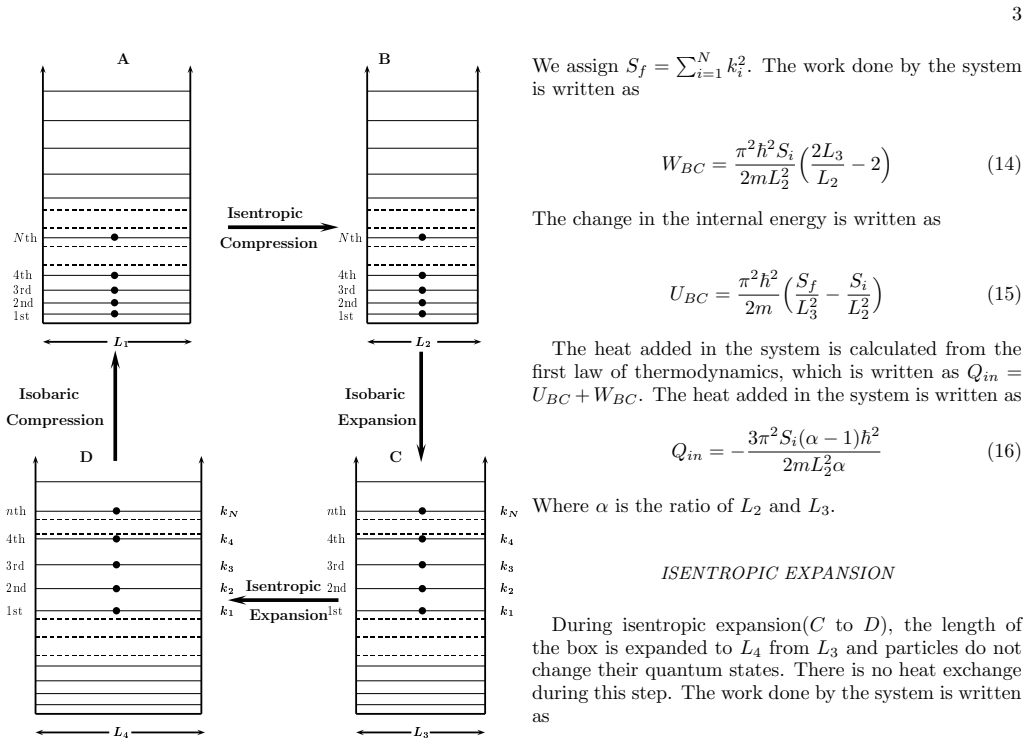
The engine rests on the particle-in-a-box spectrum $\epsilon_i = \pi^2\hbar^2 i^2/(2mL^2)$ and on the first-law splitting $dQ = \sum \epsilon_i dp_i$, $-dW = \sum p_i d\epsilon_i$, which assigns heat to changes in occupation probabilities and work to changes in the energy levels themselves. The load-bearing identity is the isobaric condition: the force $F = -\partial E/\partial L = (\pi^2\hbar^2/mL^3)\sum j_i^2$ is held equal at the two ends of each constant-force stroke, giving $(\sum j_i^2)/L^3 = \text{constant}$ and hence the ratio identity $\alpha = L_2/L_3 = L_1/L_4$. That single relation converts all sums over occupied levels into box-length ratios and produces the efficiency and irreversibility formulas in closed form.
What would settle it
Simulate the Schrödinger dynamics of $N$ non-interacting fermions in a box whose wall moves according to a proposed protocol between $L_2$ and $L_3$, and check whether the force $F(t) = (\pi^2\hbar^2/mL(t)^3)\sum j_i^2(t)$ stays constant while the occupation numbers change. If no such protocol exists, or if the measured efficiency deviates from $\eta = 1 - L_2^2/(\alpha^2 L_4^2)$ by an amount that depends on $N$, the geometric efficiency formula is falsified outside the quasi-static limit.
Extended reading notes
Core claim
The central claim is that the Brayton cycle, composed of two isentropic and two isobaric strokes, has closed-form thermodynamic quantities that are purely geometric. Enforcing constant force at the endpoints of the isobaric strokes, $F_B=F_C$ and $F_D=F_A$, yields the identity $(\sum j_i^2)/L^3 = \text{constant}$ across those strokes, which forces $\alpha = L_2/L_3 = L_1/L_4$. Substituting this identity into the ratio of total work to input heat gives the efficiency $\eta = 1 - L_2^2/(\alpha^2 L_4^2)$, which contains no occupation numbers at all. The paper derives from the same identity that the Clausius-type measure $\oint dQ/E = -3(\alpha-1)^2/\alpha$ is also independent of particle number, while the power $P$ is proportional to $S_i = \sum j_i^2$ and therefore grows with the number of fermions. The author presents these as exact analytical results for a temperature-free quantum Brayton engine.
Load-bearing premise
The isobaric strokes assume a constant wall force can be maintained while particles jump to higher levels, but the paper fixes the force only at the two endpoints and does not supply a dynamical mechanism that realizes such transitions.
Editorial extensions
If this is right
- Adding fermions to the box changes the power output but leaves the efficiency exactly unchanged, so the cycle separates the roles of particle number and geometry.
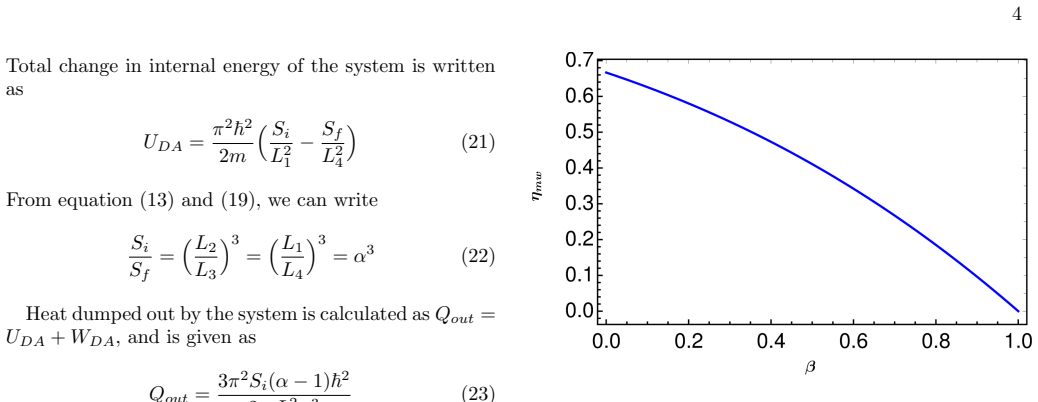
- For fixed minimum and maximum lengths $L_2$ and $L_4$, the efficiency at maximum work is $\eta_{mw} = \frac{2}{9}(3-\beta^2-\beta\sqrt{3+\beta^2})$ with $\beta = L_2/L_4$, a decreasing function of $\beta$.
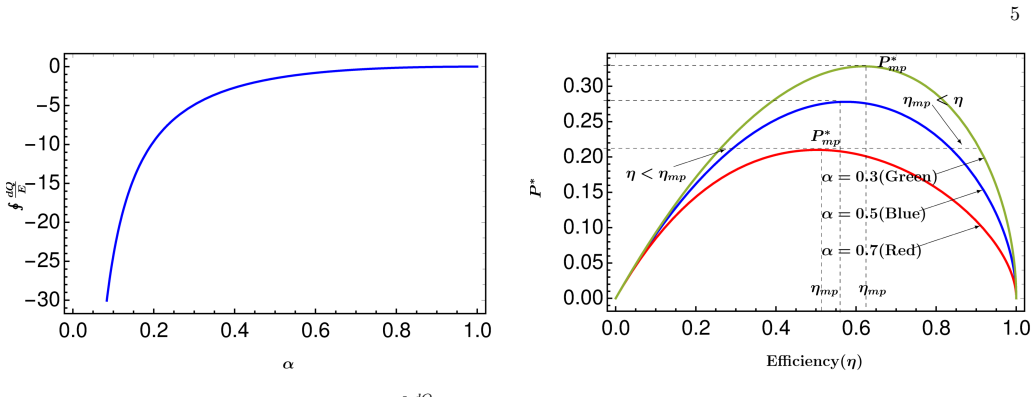
- The cycle is irreversible according to the Clausius-type relation $\oint dQ/E = -3(\alpha-1)^2/\alpha$, with irreversibility depending only on the length ratio $\alpha$ and decreasing as $\alpha$ increases.
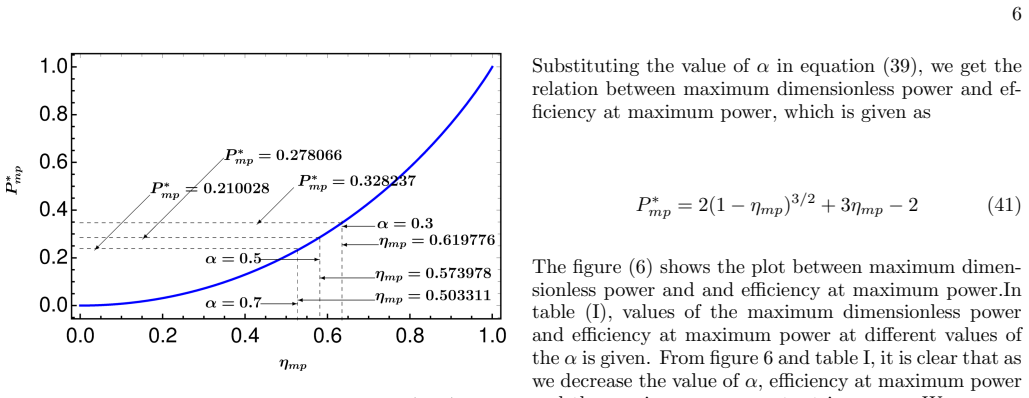
- When the wall moves at finite average speed, the power is proportional to $S_i = \sum j_i^2$, so more particles mean more power, while decreasing $\alpha$ raises both the maximum power and the efficiency at maximum power.
- The characteristic curve of dimensionless power versus efficiency is parabola-like, with a single maximum for each $\alpha$.
Reading between the lines
- A numerical simulation of a moving wall with a specified driving protocol could test whether the constant-force strokes are dynamically realizable; if they are not, the efficiency formula would still hold only in the quasi-static limit and would acquire $N$-dependent corrections at finite speed.
- If the same force-balance algebra is applied to a potential whose spectrum scales as a different power of $L$, the efficiency would pick up that exponent, suggesting a family of geometry-governed quantum engines beyond the $1/L^2$ box.
- Since the irreversibility measure depends only on $\alpha$, one could try to derive an entropy-production rate from the von Neumann entropy of the fermion occupation distribution and compare its cycle integral with $-3(\alpha-1)^2/\alpha$; agreement would extend the paper's reversibility criterion to a full entropy account.
Signed reviews
Editorial analysis
A structured set of objections, weighed in public.
Referee Report
Summary. This manuscript analyzes a quantum Brayton cycle whose working substance is N non-interacting fermions in a one-dimensional box of length L. The cycle comprises two adiabatic (isentropic) strokes, during which the occupied single-particle levels are fixed, and two isobaric strokes, defined by equality of the thermodynamic force F = -dU/dL at the stroke endpoints. Using the box spectrum and Pauli exclusion, the author derives closed-form expressions for the work, the heat input and output, the efficiency, the efficiency at maximum work, a Clausius-type irreversibility measure, and the power-efficiency characteristic. The central result is Eq. (25), eta = 1 - L2^2/(L4^2 alpha^2), with alpha = L2/L3 = L1/L4, which is independent of the fermion number N, while the power scales with S_i = Σ_i j_i^2 and therefore grows with N. The Clausius-type measure in Eq. (32) is also independent of N. I verified the algebra of the principal equations and found them internally consistent.
Significance. The algebraic core of the paper is internally consistent: I recomputed the work contributions, the efficiency in Eq. (25), the Clausius-type relation in Eq. (32), and the maximum-power relations in Eqs. (40)-(41), and they agree with the printed formulas. The claim that the efficiency depends only on the length ratios and not on N is a clean, parameter-free statement and is in principle falsifiable; the irreversibility measure is likewise explicit. The paper fits no data and makes no circular assumptions, and the N-independence arises algebraically from the model. These are genuine strengths. The principal weakness is that the isobaric strokes are not defined as dynamical processes, which presently leaves in question the status of the efficiency formula as the efficiency of a realizable engine. If that gap is closed, the geometric-only efficiency and its N-independence would be a valuable contribution to the quantum heat engine literature.
major comments (2)
- [Section III, Eqs. (11)-(14) and (18)-(20)] The isobaric strokes are defined only by the endpoint conditions F_B = F_C and F_D = F_A, and the work is then written as W_BC = F_B(L3 - L2) and W_DA = F_D(L1 - L4), as if the force were constant throughout the stroke. For a pure occupation state the force is F(L) = pi^2 hbar^2 S(L)/(m L^3) with S(L) = Σ_i j_i(L)^2 a sum of N distinct integer squares; holding F constant over a finite interval L2 < L < L3 would require S(L) to track L^3 continuously, which an integer-valued S(L) cannot do. The same obstruction applies to the D-to-A compression. The manuscript specifies no statistical mixture, no heat bath, and no control protocol that could keep the force constant, and it does not assign lengths to the 'jumps' to higher states. Consequently Eqs. (14) and (20) are not justified as the work of a realizable process, and the central efficiency formula (25) inherits this gap. The authors should either provide an explicit protocol realizing the constant-force strokes or clearly present the cycle as an idealized construction whose realizability is an open question.
- [Section III, Eqs. (13), (19) and (22)] The closure condition in Eq. (22) forces S_f = S_i / alpha^3 to be an integer representable as a sum of N distinct squares for the given initial occupations. For generic alpha, including the values 0.3, 0.5, and 0.7 used in Table I and Figures 5-6, and for small N (for instance N = 1 with S_i = 1), no such integer exists, so the cycle is not defined even at its endpoints. The paper treats alpha as a continuous free parameter while claiming N-independence; it should restrict the length ratios to values for which integer endpoint sums exist, or explain the limiting procedure by which the endpoint constraints are realized.
minor comments (6)
- [Section VI, discussion preceding Eq. (40)] The sentence introducing Eq. (40) states that the first derivative of the dimensionless power 'with α' is equated to zero; the condition that produces Eq. (40) is actually dP*/dη = 0 at fixed α. Differentiating P* with respect to α at fixed η gives a degenerate condition and does not yield Eq. (40). The wording should be corrected, although Eq. (40) itself is correct.
- [Section VI, final sentence, and Section VII] The claim that one can enhance the power by increasing α contradicts the immediately preceding statement and Table I, both of which show that increasing α decreases eta_mp and P*_mp. This should be corrected in a revision.
- [Throughout] The manuscript contains many typographical and grammatical errors, including 'ISENTROPIC COPMRESSION' and 'ISOBARIC COPMRESSION' in the section headings, 'witten', 'avarage', 'lenght', 'enhanse', 'v.i.z', and 'the irreversible of the cycle'. A careful proofreading pass is needed.
- [Eq. (26)] The typesetting of Eq. (26) is garbled, with misplaced superscripts making the denominator unreadable. The intended expression appears to be alpha = (-L2^2 + sqrt(L2^4 + 3 L2^2 L4^2))/L4^2, which is consistent with Eqs. (27) and (28), but the printed form should be fixed.
- [Figures 3-6] The figures have no axis labels and the captions are too brief; for example, Fig. 3 is described as 'Efficiency at maximum power as the ratio of L2 and L4' without identifying which quantity is on each axis. Figures 5 and 6 likewise need labeled axes and legend entries for the different α values.
- [Introduction and related work] The paper should explicitly compare with earlier quantum Brayton engine treatments, such as Refs. [37] and [54], which are cited for the force-balance construction, and state clearly which results are new, since the isobaric equal-force construction is not introduced here for the first time.
Circularity Check
No circularity: the efficiency formula (25) follows algebraically from the stated box spectrum and force-balance conditions; N-independence arises from cancellation, not from a premise.
full rationale
The paper's central results are derived self-containedly from the stated model: the single-particle spectrum ϵ_i = π²ℏ²i²/(2mL²), the occupied fermion levels j_i, the total energy U = π²ℏ²/(2mL²) S_i, and the force F = -∂U/∂L = π²ℏ²S_i/(mL³). Each work and heat expression follows from these definitions together with the explicitly written force-balance equalities, Eqs. (12)-(13) and (18)-(19). The efficiency η = 1 - L2²/(L4²α²) is obtained by direct algebraic combination of the four work and heat terms; the fermion-number-dependent quantity S_i cancels, so the claimed N-independence is a mathematically forced consequence rather than an assumed input. No data are fitted, no parameter is tuned to a subset of results, and no prediction is a renamed fit. The cited references [37,54] are used only for the standard force-balance condition, which the paper states explicitly in its own equations, so the derivation does not depend on an unverified self-citation chain. The skeptic's worry that a discrete-level system cannot realize a literally constant-force continuous path is a question of physical realizability and thermodynamic consistency of the stated isobaric assumption, not of circularity: the paper takes that assumption as an input and derives its consequences algebraically. No circular step is exhibited, so the honest finding is a score of 0.
Assumptions & free parameters
assumptions (8)
- standard math The energy spectrum of a particle in a one-dimensional box is epsilon_i = pi^2 hbar^2 i^2 / (2 m L^2) (Eq. 1).
- domain assumption Fermions are non-interacting and obey Pauli exclusion, occupying distinct levels j_1 < ... < j_N (Section III).
- domain assumption The first law is expressed as dQ = sum epsilon_i dp_i and dW = -sum p_i d epsilon_i (Eq. 5).
- domain assumption During isentropic steps the occupation numbers are fixed and no heat is exchanged (Eq. 9).
- ad hoc to paper During isobaric steps the force is constant and the endpoint forces satisfy F_B = F_C and F_D = F_A (Eqs. 12-13, 18-19).
- domain assumption The cycle closes with the length relations L1/L4 = L2/L3 = alpha, derived from force balance (Eq. 22).
- domain assumption Bender et al.'s analogue of the Clausius relation, contour integral dQ/E <= 0, is used to characterize irreversibility (Eq. 30).
- domain assumption The adiabatic theorem applies when the wall speed obeys v << L hbar/E (Section VI).
Cite this review
Pith. "Pith review of Quantum Brayton Engine of Non-Interacting Fermions in a One-Dimensional Box." pith.science (2026). https://pith.science/paper/Y2HK7HP3
@misc{pith2026190809281,
  author       = {Pith},
  title        = {Pith review of: Quantum Brayton Engine of Non-Interacting Fermions in a One-Dimensional Box},
  year         = {2026},
  howpublished = {\url{https://pith.science/paper/Y2HK7HP3}},
  note         = {Machine review of arXiv:1908.09281}
}
read the original abstract
We consider the quantum Brayton cycle, constructed from non-interacting fermions, trapped in a one-dimensional box. The work and heat in this cycle are calculated from the expectation values of the Hamiltonian. We analytically calculated the efficiency of the cycle, efficiency at maximum work and Clausius relation as the function of the ratio of the lengths. We found that the efficiency of the cycle does not depend on the number of fermions. It depends on the ratios of the lengths of the cycle. While the power depends on the number of fermions. The irreversibility of the cycle also does not depend on the number of particles. It only depends on the ratio of the box lengths. Moreover, We also analysed the efficiency and the power of the cycle for the finite speed of the movement of the potential wall. We found that as we decrease the ratio of the lengths, the efficiency at maximum power and the maximum power of the cycle increases.
Figures

Figures from the paper (2 more)
Reference graph
Works this paper leans on
-
[1]
B. C ¸ akmak and¨O. E. M¨ ustecaplıo˘ glu, Physical Review E 99, 032108 (2019)
work page 2019
- [2]
-
[3]
S. Seah, S. Nimmrichter, and V. Scarani, New Journal of Physics 20, 043045 (2018)
2018
-
[4]
R. Alicki and D. Gelbwaser-Klimovsky, New Journal of Physics 17, 115012 (2015)
work page 2015
-
[5]
L. A. Correa, J. P. Palao, G. Adesso, and D. Alonso, Physical Review E 90, 062124 (2014)
work page 2014
-
[6]
M. Ramezani, S. Marcantoni, F. Benatti, R. Floreanini, F. Petiziol, A. T. Rezakhani, and M. Golshani, The Eu- ropean Physical Journal D 73, 144 (2019)
work page 2019
- [7]
-
[8]
Singh and R
V. Singh and R. S. Johal, Physical Review E 98, 062132 (2018)
2018
Show all 57 references
- [9]
-
[10]
Huang, T
X. Huang, T. Wang, X. Yi, et al., Physical Review E 86, 051105 (2012)
2012
- [11]
-
[12]
Roßnagel, O
J. Roßnagel, O. Abah, F. Schmidt-Kaler, K. Singer, and E. Lutz, Physical review letters 112, 030602 (2014)
2014
-
[13]
Uzdin, A
R. Uzdin, A. Levy, and R. Kosloff, Physical Review X 5, 031044 (2015)
2015
-
[14]
Uzdin, A
R. Uzdin, A. Levy, and R. Kosloff, Entropy 18, 124 (2016). 7
2016
-
[15]
Abe, Entropy 15, 1408 (2013)
S. Abe, Entropy 15, 1408 (2013)
2013
- [16]
- [17]
-
[18]
C. M. Bender, D. C. Brody, and B. K. Meister, Pro- ceedings of the Royal Society of London. Series A: Math- ematical, Physical and Engineering Sciences 458, 1519 (2002)
2002
-
[19]
C. M. Bender, D. C. Brody, and B. K. Meister, Journal of Physics A: Mathematical and General 33, 4427 (2000)
2000
-
[20]
Deffner, O
S. Deffner, O. Abah, and E. Lutz, Chemical Physics 375, 200 (2010)
2010
-
[21]
Deffner, J
S. Deffner, J. P. Paz, and W. H. Zurek, Physical Review E 94, 010103 (2016)
2016
-
[22]
Y. Yin, L. Chen, and F. Wu, The European Physical Journal Plus 132, 45 (2017)
2017
-
[23]
Chand and A
S. Chand and A. Biswas, EPL (Europhysics Letters)118, 60003 (2017)
2017
-
[24]
Deffner, Entropy 20, 875 (2018)
S. Deffner, Entropy 20, 875 (2018)
2018
-
[25]
Jiang and Y
J.-H. Jiang and Y. Imry, Physical Review B 97, 125422 (2018)
2018
-
[26]
Humphrey, R
T. Humphrey, R. Newbury, R. Taylor, and H. Linke, Physical review letters 89, 116801 (2002)
2002
-
[27]
J. Chen, H. Dong, and C.-P. Sun, Physical Review E 98, 062119 (2018)
2018
-
[28]
Thomas, D
G. Thomas, D. Das, and S. Ghosh, Physical Review E 100, 012123 (2019)
2019
-
[29]
Singh and R
V. Singh and R. Johal, Entropy 19, 576 (2017)
2017
-
[30]
Watanabe, B
G. Watanabe, B. P. Venkatesh, P. Talkner, and A. del Campo, Physical review letters 118, 050601 (2017)
2017
-
[31]
B. K. Agarwalla, J.-H. Jiang, and D. Segal, Physical Review B 96, 104304 (2017)
2017
-
[32]
T. D. Kieu, Physical review letters 93, 140403 (2004)
2004
-
[33]
H. P. Goswami and U. Harbola, Physical Review A 88, 013842 (2013)
2013
-
[34]
Singh and R
V. Singh and R. S. Johal, Journal of Statistical Mechan- ics: Theory and Experiment 2018, 073205 (2018)
2018
-
[35]
Thomas, P
G. Thomas, P. Aneja, and R. S. Johal, Physica Scripta 2012, 014031 (2012)
2012
-
[36]
R. Wang, J. Wang, J. He, and Y. Ma, Physical Review E 87, 042119 (2013)
2013
-
[37]
Latifah and A
E. Latifah and A. Purwanto, Journal of Modern Physics 4, 1091 (2013)
2013
-
[38]
T. E. P. Sutantyo, I. H. Belfaqih, and T. Prayitno, in AIP Conference Proceedings, Vol. 1677 (2015) p. 040011
2015
-
[39]
O. Abah, J. Rossnagel, G. Jacob, S. Deffner, F. Schmidt- Kaler, K. Singer, and E. Lutz, Physical review letters 109, 203006 (2012)
2012
-
[40]
Harbola, S
U. Harbola, S. Rahav, and S. Mukamel, EPL (Euro- physics Letters) 99, 50005 (2012)
2012
-
[41]
H. T. Quan, Physical Review E 79, 041129 (2009)
2009
-
[42]
Quan, Y.-x
H. Quan, Y.-x. Liu, C. Sun, and F. Nori, Physical Review E 76, 031105 (2007)
2007
-
[43]
Roßnagel, S
J. Roßnagel, S. T. Dawkins, K. N. Tolazzi, O. Abah, E. Lutz, F. Schmidt-Kaler, and K. Singer, Science 352, 325 (2016)
2016
-
[44]
Geva and R
E. Geva and R. Kosloff, The Journal of chemical physics 96, 3054 (1992)
1992
-
[45]
R. Wang, J. Lu, C. Wang, and J.-H. Jiang, Scientific reports 8, 2607 (2018)
2018
-
[46]
Scovil and E
H. Scovil and E. Schulz-DuBois, Physical Review Letters 2, 262 (1959)
1959
-
[47]
K. E. Dorfman, D. Xu, and J. Cao, Physical Review E 97, 042120 (2018)
2018
-
[48]
Thomas, M
G. Thomas, M. Banik, and S. Ghosh, Entropy 19, 442 (2017)
2017
-
[49]
J. Lu, Y. Liu, R. Wang, C. Wang, and J.-H. Jiang, arXiv preprint arXiv:1905.10992 (2019)
2019 arXiv
-
[50]
Humphrey and H
T. Humphrey and H. Linke, Physica E: Low-dimensional Systems and Nanostructures 29, 390 (2005)
2005
-
[51]
Gardas and S
B. Gardas and S. Deffner, Physical Review E 92, 042126 (2015)
2015
-
[52]
Wang and J
J. Wang and J. He, Journal of Applied Physics 111, 043505 (2012)
2012
-
[53]
Latifah and A
E. Latifah and A. Purwanto, in AIP Conference Proceed- ings, Vol. 1589 (2014) pp. 137–140
2014
-
[54]
R. Wang, J. Wang, J. He, and Y. Ma, Physical Review E 86, 021133 (2012)
2012
-
[55]
Schr¨ odinger,Statistical thermodynamics (Courier Cor- poration, 1989)
E. Schr¨ odinger,Statistical thermodynamics (Courier Cor- poration, 1989)
1989
-
[56]
H. S. Leff, American Journal of Physics 86, 344 (2018)
2018
-
[57]
Abe and S
S. Abe and S. Okuyama, Physical Review E 85, 011104 (2012)
2012
Reviewed August 14, 2026 · model on record in the stance chip above.
Discussion (0). Continue with ORCID to comment.