Delayed choice experiments and causality in quantum mechanics
Pith reviewed 2026-05-24 22:20 UTC · model grok-4.3
The pith
Delayed choice experiments cannot affect the past, according to many-worlds analysis.
A machine-rendered reading of the paper's core claim, the machinery that carries it, and where it could break.
Core claim
Using the Many Worlds interpretation we prove it is not possible to affect the past in delayed choice experiments. We also find a mathematical background to Which-path information and show why its obtainability prevents system from interfering. We find a system which exhibit both interference and correlation and show why one-particle interference and correlations are complementary. Better visible interference pattern leads to worse correlations and vice versa. Then, using knowledge gained from Quantum Eraser and Delayed Choice experiments we prove there is not an objective reality in a sense of Einstein, Podolsky and Rosen. Furthermore, we discuss the difference between outer and inner obser
What carries the argument
The many-worlds interpretation applied to delayed-choice setups, which separates outer non-interacting and inner interacting observers and relates the universal wave function to the processes each sees.
If this is right
- No experiment can be constructed that affects events in the past.
- Obtaining which-path information necessarily prevents the system from showing interference.
- Visibility of the interference pattern and strength of correlations trade off directly against each other.
- There is no objective reality independent of the observer in the EPR sense.
Where Pith is reading between the lines
- The relation derived between the universal wave function and inner-observer processes could be checked by preparing entangled states and comparing predictions from different reference frames.
- The complementarity between interference and correlations suggests quantitative bounds that could be tested in multi-particle interference experiments.
- Treating all branches as real removes the need for wave-function collapse and may alter how measurement outcomes are counted in quantum information protocols.
Load-bearing premise
The many-worlds interpretation supplies the correct framework that permits rigorous proofs about causality and objective reality.
What would settle it
A laboratory demonstration in which a delayed choice produces a statistically detectable change in a past measurement outcome within one consistent history would falsify the central claim.
Figures


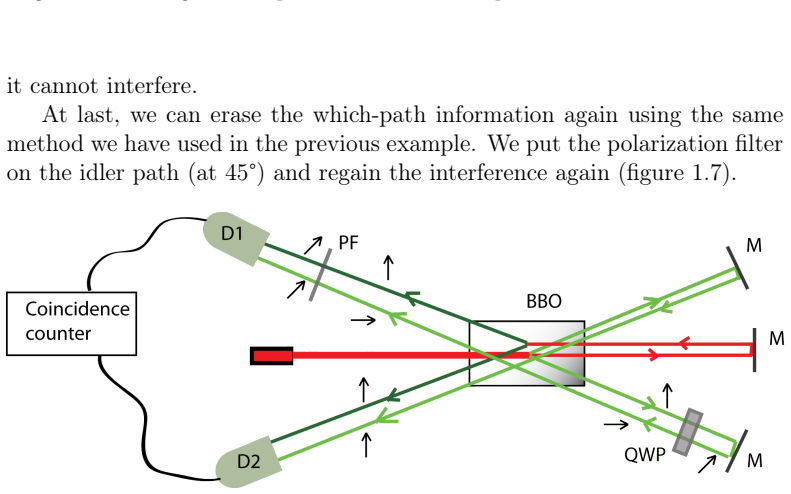


read the original abstract
Although it may seem The Delayed Choice experiments contradict causality and one could construct an experiment which could possibly affect the past, using Many World interpretation we prove it is not possible. We also find a mathematical background to Which-path information and show why its obtainability prevents system from interfering. We find a system which exhibit both interference and correlation and show why one-particle interference and correlations are complementary. Better visible interference pattern leads to worse correlations and vice versa. Then, using knowledge gained from Quantum Eraser and Delayed Choice experiments we prove there is not an objective reality in a sense of Einstein, Podolsky and Rosen. Furthermore, we discuss the difference between ``outer'' (non-interacting) and ``inner'' (interacting) observer. We find the mathematical relationship between the ``universal'' wave function used by ``outer'' observer and processes the ``inner'' observer sees, which is our small contribution to the measurement problem.
Editorial analysis
A structured set of objections, weighed in public.
Referee Report
Summary. The manuscript claims that the Many Worlds Interpretation demonstrates that delayed choice experiments cannot affect the past, provides a mathematical basis for which-path information and its complementarity with interference, shows that better interference leads to worse correlations, proves the absence of EPR-style objective reality, and relates the universal wave function to inner observer processes, contributing to the measurement problem.
Significance. If the claimed proofs and mathematical relationships were derived rigorously from the quantum formalism, the work could offer insights into foundational questions of causality, complementarity, and realism in quantum mechanics. However, the reliance on MWI as the basis for 'proofs' limits the significance, as the conclusions do not appear to follow independently of the interpretive choice.
major comments (3)
- [Abstract] Abstract: The abstract asserts multiple 'proofs' using the Many Worlds interpretation but supplies no derivations, equations, or data; the central claims rest on interpretive premises rather than demonstrated mathematics.
- [Abstract] Abstract: The claim that MWI proves it is not possible to affect the past is circular, as it adopts the interpretation and then declares the result, without showing additional ontological constraints from the branching structure that prohibit retrocausality.
- [Abstract] Abstract: The proof of no objective reality in the EPR sense similarly depends on MWI without demonstrating that the same conclusion cannot be reached or is contradicted in other interpretations, making the interpretive framework load-bearing.
minor comments (2)
- [Abstract] Grammatical issues such as 'Although it may seem The Delayed Choice experiments' should be corrected for clarity.
- The manuscript would benefit from explicit equations supporting the mathematical background to which-path information and the relationship between interference and correlations.
Simulated Author's Rebuttal
We thank the referee for their review. Our manuscript explicitly employs the Many-Worlds Interpretation (MWI) to analyze delayed-choice experiments, complementarity, and EPR issues, deriving relations from the quantum formalism under that ontology. We address each major comment below.
read point-by-point responses
-
Referee: [Abstract] Abstract: The abstract asserts multiple 'proofs' using the Many Worlds interpretation but supplies no derivations, equations, or data; the central claims rest on interpretive premises rather than demonstrated mathematics.
Authors: The abstract is a concise overview; the body of the manuscript supplies the derivations for which-path information, interference-correlation complementarity, and the MWI analysis of delayed choice. We will revise the abstract to explicitly note that mathematical details appear in the main text. revision: partial
-
Referee: [Abstract] Abstract: The claim that MWI proves it is not possible to affect the past is circular, as it adopts the interpretation and then declares the result, without showing additional ontological constraints from the branching structure that prohibit retrocausality.
Authors: MWI's branching structure imposes forward-only evolution: the universal wave function evolves unitarily, and a future measurement choice selects the observer's branch without modifying past events in any branch. The paper derives this constraint from the global consistency of the wave function rather than assuming the conclusion. revision: no
-
Referee: [Abstract] Abstract: The proof of no objective reality in the EPR sense similarly depends on MWI without demonstrating that the same conclusion cannot be reached or is contradicted in other interpretations, making the interpretive framework load-bearing.
Authors: The manuscript shows, via MWI analysis of quantum eraser and delayed-choice setups, that EPR-style objective reality is incompatible with branch-dependent outcomes. We do not claim this conclusion is unreachable in other interpretations; our contribution is the explicit MWI mechanism that avoids retrocausality or nonlocality. revision: no
Circularity Check
Central claims on no retrocausality and no EPR objective reality are reached by adopting MWI as the framework and declaring it supplies the proofs.
specific steps
-
other
[Abstract]
"Although it may seem The Delayed Choice experiments contradict causality and one could construct an experiment which could possibly affect the past, using Many World interpretation we prove it is not possible. [...] Then, using knowledge gained from Quantum Eraser and Delayed Choice experiments we prove there is not an objective reality in a sense of Einstein, Podolsky and Rosen."
The paper states that it 'prove[s]' no past-affecting delayed choice and 'prove[s]' absence of EPR-style objective reality by using the Many Worlds interpretation. The conclusions are therefore equivalent to the input assumption of MWI rather than independently derived; the interpretive framework supplies the ontological constraints that turn standard evolution into the claimed prohibitions.
full rationale
The paper's derivation chain for its strongest results explicitly invokes the Many Worlds interpretation to reach conclusions about causality and reality. This makes the interpretive choice load-bearing: the 'proofs' follow by construction once MWI is selected, rather than emerging from the unitary formalism or equations independent of that choice. No self-citation or fitted-parameter issues appear, but the reduction of the central claims to the MWI assumption qualifies as circularity under the 'other' pattern. The paper does not isolate additional postulates beyond the universal wave function or show the results hold outside MWI.
Axiom & Free-Parameter Ledger
axioms (2)
- domain assumption Many Worlds interpretation correctly describes quantum mechanics and permits proofs about causality
- domain assumption Mathematical model of which-path information necessarily destroys interference
Reference graph
Works this paper leans on
-
[1]
Can a Future Choice Affect a Past Measurement's Outcome?
Y. Aharonov, E. Cohen, D. Grossman, and A. C. Elitzur. Can a Future Choice Affect a Past Measurement’s Outcome?, August 2012. [quant- ph/1206.6224]
work page internal anchor Pith review Pith/arXiv arXiv 2012
-
[2]
A. Zeilinger D. M. Greenberger, M. A. Horne. Mathematica Foundations of Quantum Theory.Physics Today, 46:22–29, 1993
work page 1993
-
[3]
Demystifying the Delayed Choice Experiments
B. Gaasbeek. Demystifying the Delayed Choice Experiments. 2010. [quant-ph/1007.3977v1]
work page internal anchor Pith review Pith/arXiv arXiv 2010
-
[4]
T. J. Herzog, P. G. Kwiat, H. Weinfurter, and A. Zeilinger. Comple- mentarity and the Quantum Eraser.Phys. Rev. Lett., 75:3034, 1995
work page 1995
- [5]
-
[6]
V. Jacques, E. Wu, F. Grosshans, F. Treussart, P. Grangier, A. Aspect, and J. Roch. Experimental Realization of Wheeler’s Delayed-Choice Gedanken Experiment. InConference on Coherence and Quantum Op- tics, page CWB4. Optical Society of America, 2007
work page 2007
- [7]
-
[8]
A. Kent. One world versus many: the inadequacy of Everettian accounts of evolution, probability, and scientific confirmation, August 2010
work page 2010
-
[9]
Y. Kim, R. Yu, S. P. Kulik, Y. Shih, and M. O. Scully. Delayed Choice Quantum Eraser. Phys. Rev. Lett., 84:1–5, 2000
work page 2000
-
[10]
A. Kumar Pati and S. L. Braunstein. Impossibility of deleting an un- known quantum state.Nature, 404(6774):164–165, March 2000. 60
work page 2000
-
[11]
N.P. Landsman. The conclusion seems to be that no generally accepted derivation of the Born rule has been given to date, but this does not imply that such a derivation is impossible in principle. InCompendium of Quantum Physics (eds.) F.Weinert, K. Hentschel, D.Greenberger and B. Falkenburg. Springer, 2008
work page 2008
-
[12]
G. J. Milburn M. J. Gagen, H. M. Wiseman. Continuous position mea- surements and the quantum Zeno effect.Physical Review A, 48:132–142, 1993
work page 1993
-
[13]
Experimental delayed-choice entanglement swapping
Xiao-song Ma, S. Zotter, J. Kofler, R. Ursin, T. Jennewein, Č. Brukner, and A. Zeilinger. Experimental delayed-choice entanglement swapping, October 2012. [quant-ph/1203.4834]
work page internal anchor Pith review Pith/arXiv arXiv 2012
-
[14]
M. A. Nielsen and I. L. Chuang. Quantum Computation and Quan- tum Information (Cambridge Series on Information and the Natural Sciences). Cambridge University Press, 2004
work page 2004
-
[15]
M. S. Palsson, J. J. Wallman, A. J. Bennet, and G. J. Pryde. Ex- perimentally Violating Bell Inequalities Without Complete Reference Frames. March 2012. [quant-ph/1203.6692]
work page internal anchor Pith review Pith/arXiv arXiv 2012
-
[16]
A. Peres. Delayed choice for entanglement swapping.Journal of Modern Optics, 47(2):139–143, 2000
work page 2000
-
[17]
A quantum delayed choice experiment
A.Peruzzo, P.J.Shadbolt, N.Brunner, S.Popescu, andJ.L.O’Brien. A quantum delayed choice experiment, June 2012. [quant-ph/1205.4926]
work page internal anchor Pith review Pith/arXiv arXiv 2012
-
[18]
M. Schlosshauer. Decoherence, the measurement problem, and interpre- tations of quantum mechanics.Reviews of Modern Physics , 76(4):1267– 1305, February 2005
work page 2005
-
[19]
J. A. Wheeler. Mathematica Foundations of Quantum Theory , chapter The Past and Delayed Choice Double Slit Experiment. Academic Press, 1978. 61
work page 1978
discussion (0)
Sign in with ORCID, Apple, or X to comment. Anyone can read and Pith papers without signing in.