REVIEW 2 major objections 1 minor 51 references
SwiftAudio: Data-Efficient Caption-Only Distillation for One-Step Text-to-Audio Diffusion-based Generation
T0 review · 2 major / 1 minor · reviewed 2026-07-01 · grok-4.3
Pith's one-line read SwiftAudio distills a one-step text-to-audio model from a diffusion teacher using only text captions.
desk verdict SwiftAudio adapts VSD to audio with a temporal smoothness term for caption-only one-step distillation, but the abstract supplies no metrics or ablations to back the SOTA claim. read the letter →
The pith
A machine-rendered reading of the paper's core claim, the machinery that carries it, and where it could break.
The reading
What carries the argument
Adaptation of Variational Score Distillation to audio together with a temporal smoothness regularization objective that transfers the diffusion teacher's prior from captions alone.
What would settle it
Training the proposed student model on the 45K captions and measuring that its audio quality metrics on AudioCaps or Clotho remain below those of prior one-step baselines.
Extended reading notes
Core claim
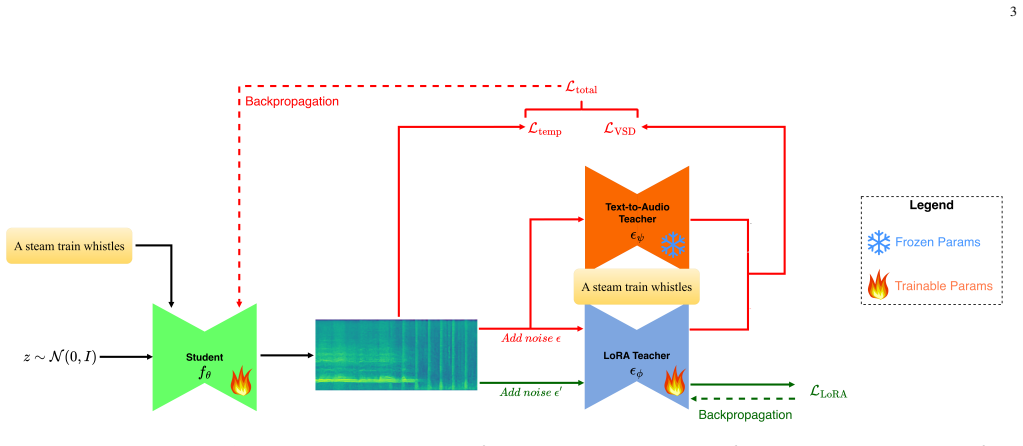
By adapting Variational Score Distillation to the audio domain and introducing a temporal smoothness regularization objective, the student model inherits the teacher's generative prior without requiring paired audio supervision and allows effective training with only approximately 45K captions.
Load-bearing premise
The combination of adapted variational score distillation and temporal smoothness regularization transfers the teacher's generative capability using only text captions.
Editorial extensions
If this is right
- No paired audio data is required for training the one-step generator.
- Inference requires only a single forward pass instead of iterative denoising steps.
- State-of-the-art results are obtained among strict one-step methods on AudioCaps and Clotho.
- Training succeeds with a modest set of approximately 45K text captions.
Reading between the lines
- The same caption-only distillation pattern could be tested on text-to-video or text-to-image tasks.
- Increasing the caption count beyond 45K might further reduce the remaining gap to multi-step systems.
- Single-step generation would lower the compute needed for on-device or real-time audio synthesis.
Signed reviews
Editorial analysis
A structured set of objections, weighed in public.
Referee Report
Summary. The paper proposes SwiftAudio, a one-step text-to-audio (TTA) framework for caption-only distillation from a pretrained diffusion teacher. It adapts Variational Score Distillation (VSD) to the audio domain and introduces a temporal smoothness regularization objective, enabling training on ~45K captions without paired audio data. Experiments on AudioCaps and Clotho are claimed to show SOTA performance among strict one-step methods while narrowing the gap to multi-step diffusion systems.
Significance. If the experimental claims hold with proper validation, the work would advance data-efficient and low-latency TTA generation by removing the need for paired audio supervision during distillation. The caption-only setting and regularization approach address practical barriers in deploying diffusion-based audio models.
major comments (2)
- [Abstract] Abstract: the claim of achieving SOTA among one-step methods and substantially narrowing the gap to multi-step systems is asserted without any reported metrics, baselines, error bars, ablation studies, or quantitative results. This prevents verification of the central empirical claim.
- [Method] Method description: the adaptation of VSD to audio together with the temporal smoothness term is presented at a high level; without explicit loss equations or analysis showing that the student inherits the teacher's generative prior (rather than collapsing to a trivial or teacher-copying solution), it is unclear whether the approach is load-bearing for the no-paired-audio claim.
minor comments (1)
- [Abstract] The project page URL is given but the manuscript should be self-contained with at least a summary table of key metrics and comparisons.
Simulated Author's Rebuttal
We thank the referee for the detailed and constructive feedback. We address each major comment below and will incorporate revisions to strengthen the manuscript.
read point-by-point responses
-
Referee: [Abstract] Abstract: the claim of achieving SOTA among one-step methods and substantially narrowing the gap to multi-step systems is asserted without any reported metrics, baselines, error bars, ablation studies, or quantitative results. This prevents verification of the central empirical claim.
Authors: We agree that the abstract would benefit from explicit quantitative support for its claims. In the revised version we will incorporate representative metrics from the experimental section (including comparisons to one-step and multi-step baselines on AudioCaps and Clotho) together with a brief mention of error bars and the scale of the caption-only training set. revision: yes
-
Referee: [Method] Method description: the adaptation of VSD to audio together with the temporal smoothness term is presented at a high level; without explicit loss equations or analysis showing that the student inherits the teacher's generative prior (rather than collapsing to a trivial or teacher-copying solution), it is unclear whether the approach is load-bearing for the no-paired-audio claim.
Authors: We acknowledge that the current method presentation remains high-level. We will expand Section 3 to include the full loss equations for the audio-adapted VSD objective and the temporal smoothness regularizer. We will also add a dedicated analysis subsection (with supporting ablations) that examines the student’s behavior under the caption-only regime and demonstrates that the combined objective prevents collapse to trivial or teacher-copying solutions while transferring the teacher’s generative prior. revision: yes
Circularity Check
No significant circularity; derivation relies on external VSD adaptation and empirical regularization
full rationale
The paper adapts Variational Score Distillation (VSD) to audio and adds a temporal smoothness term for caption-only training of a one-step student. No equations or derivation steps are shown that reduce a claimed prediction to a fitted input or self-citation by construction. The central claim (student inherits teacher prior via adapted losses on ~45K captions) is presented as an empirical outcome of the loss design rather than a definitional identity. No self-citation load-bearing, uniqueness theorem, or ansatz smuggling is referenced. This is the common case of a method paper whose validity rests on external benchmarks rather than internal tautology.
Assumptions & free parameters
Cite this review
Pith. "Pith review of SwiftAudio: Data-Efficient Caption-Only Distillation for One-Step Text-to-Audio Diffusion-based Generation." pith.science (2026). https://pith.science/paper/Y2ZK2JQV
@misc{pith2026260631259,
  author       = {Pith},
  title        = {Pith review of: SwiftAudio: Data-Efficient Caption-Only Distillation for One-Step Text-to-Audio Diffusion-based Generation},
  year         = {2026},
  howpublished = {\url{https://pith.science/paper/Y2ZK2JQV}},
  note         = {Machine review of arXiv:2606.31259}
}
read the original abstract
Diffusion-based text-to-audio (TTA) models achieve impressive synthesis quality but suffer from high inference latency due to iterative multi-step denoising. Existing one-step approaches alleviate this issue but still rely on paired text--audio data during distillation. To address these limitations, we propose SwiftAudio, a one-step TTA framework that performs audio-free distillation from a pretrained diffusion teacher using only text captions. Specifically, we adapt Variational Score Distillation (VSD) to the audio domain and introduce a temporal smoothness regularization objective to encourage coherent latent audio representations. This design enables the student model to inherit the teacher's generative prior without requiring paired audio supervision and allows effective training with only approximately 45K captions. Experiments on AudioCaps and Clotho demonstrate that SwiftAudio achieves state-of-the-art performance among strict one-step methods and substantially narrows the gap to multi-step diffusion systems. Project page: https://swiftaudio.org/
Figures


Figures from the paper (7 more)




Reference graph
Works this paper leans on
-
[1]
Make-an-audio: Text-to-audio generation with prompt- enhanced diffusion models,
R. Huang, J. Huang, D. Yang, Y . Ren, L. Liu, M. Li, Z. Ye, J. Liu, X. Yin, and Z. Zhao, “Make-an-audio: Text-to-audio generation with prompt- enhanced diffusion models,” inInternational Conference on Machine Learning (ICML), 2023, pp. 13 916–13 932
work page 2023
-
[2]
Audiogen: Textually guided audio generation,
F. Kreuk, G. Synnaeve, A. Polyak, U. Singer, A. D ´efossez, J. Copet, D. Parikh, Y . Taigman, and Y . Adi, “Audiogen: Textually guided audio generation,” inThe Eleventh International Conference on Learning Representations (ICLR), 2023
work page 2023
-
[3]
AudioLDM: Text-to-audio generation with latent diffusion models,
H. Liu, Z. Chen, Y . Yuan, X. Mei, X. Liu, D. Mandic, W. Wang, and M. D. Plumbley, “AudioLDM: Text-to-audio generation with latent diffusion models,” inProceedings of the 40th International Conference on Machine Learning (ICML), vol. 202, 2023, pp. 21 450–21 474
work page 2023
-
[4]
Audioldm 2: Learning holistic audio generation with self-supervised pretraining,
H. Liu, Y . Yuan, X. Liu, X. Mei, Q. Kong, Q. Tian, Y . Wang, W. Wang, Y . Wang, and M. D. Plumbley, “Audioldm 2: Learning holistic audio generation with self-supervised pretraining,”IEEE/ACM Transactions on Audio, Speech, and Language Processing, vol. 32, pp. 2871–2883, 2024
work page 2024
-
[5]
Any-to-any generation via composable diffusion,
Z. Tang, Z. Yang, C. Zhu, M. Zeng, and M. Bansal, “Any-to-any generation via composable diffusion,”Advances in Neural Information Processing Systems, vol. 36, pp. 16 083–16 099, 2023
work page 2023
-
[6]
Auffusion: Leveraging the power of diffusion and large language models for text-to-audio generation,
J. Xue, Y . Deng, Y . Gao, and Y . Li, “Auffusion: Leveraging the power of diffusion and large language models for text-to-audio generation,” IEEE/ACM Transactions on Audio, Speech, and Language Processing, 2024
work page 2024
-
[7]
Tango 2: Aligning diffusion-based text-to-audio generations through direct preference optimization,
N. Majumder, C.-Y . Hung, D. Ghosal, W.-N. Hsu, R. Mihalcea, and S. Poria, “Tango 2: Aligning diffusion-based text-to-audio generations through direct preference optimization,” inProceedings of the 32nd ACM International Conference on Multimedia, 2024, pp. 564–572
work page 2024
-
[8]
Denoising diffusion probabilistic models,
J. Ho, A. Jain, and P. Abbeel, “Denoising diffusion probabilistic models,” Advances in neural information processing systems, vol. 33, pp. 6840– 6851, 2020
work page 2020
Show all 51 references
-
[9]
Denoising diffusion implicit models,
J. Song, C. Meng, and S. Ermon, “Denoising diffusion implicit models,” inInternational Conference on Learning Representations (ICLR), 2021
2021
-
[10]
Dpm-solver: A fast ode solver for diffusion probabilistic model sampling in around 10 steps,
C. Lu, Y . Zhou, F. Bao, J. Chen, C. Li, and J. Zhu, “Dpm-solver: A fast ode solver for diffusion probabilistic model sampling in around 10 steps,” inAdvances in Neural Information Processing Systems (NeurIPS), 2022
2022
-
[11]
Dpm-solver++: Fast solver for guided sampling of diffusion probabilistic models,
——, “Dpm-solver++: Fast solver for guided sampling of diffusion probabilistic models,”Machine Intelligence Research, pp. 1–22, 2025
2025
-
[12]
Elucidating the design space of diffusion-based generative models,
T. Karras, M. Aittala, T. Aila, and S. Laine, “Elucidating the design space of diffusion-based generative models,” inAdvances in Neural Information Processing Systems (NeurIPS), 2022
2022
-
[13]
Analytic-dpm: an analytic estimate of the optimal reverse variance in diffusion probabilistic models,
F. Bao, C. Li, J. Zhu, and B. Zhang, “Analytic-dpm: an analytic estimate of the optimal reverse variance in diffusion probabilistic models,” in International Conference on Learning Representations, 2021
2021
-
[14]
Consistency models,
Y . Song, P. Dhariwal, M. Chen, and I. Sutskever, “Consistency models,” inProceedings of the International Conference on Machine Learning (ICML), 2023
2023
-
[15]
Consistencytta: Accelerating diffusion-based text-to-audio generation with consistency distillation,
Y . Bai, T. Dang, D. Tran, K. Koishida, and S. Sojoudi, “Consistencytta: Accelerating diffusion-based text-to-audio generation with consistency distillation,” inINTERSPEECH, 2024
2024
-
[16]
Audiolcm: Efficient and high-quality text-to-audio generation with minimal inference steps,
H. Liu, R. Huang, Y . Liu, H. Cao, J. Wang, X. Cheng, S. Zheng, and Z. Zhao, “Audiolcm: Efficient and high-quality text-to-audio generation with minimal inference steps,” inProceedings of the 32nd ACM Inter- national Conference on Multimedia, 2024, pp. 7008–7017
2024
-
[17]
Instructpix2pix: Learning to follow image editing instructions,
T. Brooks, A. Holynski, and A. A. Efros, “Instructpix2pix: Learning to follow image editing instructions,” inProceedings of the IEEE/CVF conference on computer vision and pattern recognition, 2023, pp. 18 392–18 402
2023
-
[18]
Ts2f: Text-assisted speech-to-face generation,
B. D. Mai, H. M. Dinh, and C. Tran, “Ts2f: Text-assisted speech-to-face generation,”ICT Express, 2025. [Online]. Available: https://www.sciencedirect.com/science/article/pii/S240595952500147X
2025
-
[19]
AudioCaps: Generating captions for audios in the wild,
C. D. Kim, B. Kim, H. Lee, and G. Kim, “AudioCaps: Generating captions for audios in the wild,” inProceedings of the 2019 Conference of the North American Chapter of the Association for Computational Linguistics: Human Language Technologies, Volume 1 (Long and Short Papers). A...
2019
-
[20]
WavCaps: A ChatGPT-assisted weakly-labelled audio captioning dataset for audio-language multimodal research,
X. Mei, C. Meng, H. Liu, Q. Kong, T. Ko, C. Zhao, M. D. Plumbley, Y . Zou, and W. Wang, “WavCaps: A ChatGPT-assisted weakly-labelled audio captioning dataset for audio-language multimodal research,” IEEE/ACM Transactions on Audio, Speech, and Language Processing, pp. 1–15, 2024
2024
-
[21]
Audiosetcaps: Enriched audio captioning dataset generation using large audio language models,
J. BAI, H. Liu, M. Wang, D. Shi, W. Wang, M. D. Plumbley, W.-S. Gan, and J. Chen, “Audiosetcaps: Enriched audio captioning dataset generation using large audio language models,” inAudio Imagination: NeurIPS 2024 Workshop AI-Driven Speech, Music, and Sound Generation, 2024. [On...
2024
-
[22]
Journeydb: A benchmark for generative image understanding,
K. Sun, J. Pan, Y . Ge, H. Li, H. Duan, X. Wu, R. Zhang, A. Zhou, Z. Qin, Y . Wanget al., “Journeydb: A benchmark for generative image understanding,”Advances in neural information processing systems, vol. 36, pp. 49 659–49 678, 2023
2023
-
[23]
Laion- 5b: An open large-scale dataset for training next generation image-text models,
C. Schuhmann, R. Beaumont, R. Vencu, C. Gordon, R. Wightman, M. Cherti, T. Coombes, A. Katta, C. Mullis, M. Wortsmanet al., “Laion- 5b: An open large-scale dataset for training next generation image-text models,”Advances in neural information processing systems, vol. 35, pp. 2...
2022
-
[24]
Prolific- dreamer: High-fidelity and diverse text-to-3d generation with variational score distillation,
Z. Wang, C. Lu, Y . Wang, F. Bao, C. Li, H. Su, and J. Zhu, “Prolific- dreamer: High-fidelity and diverse text-to-3d generation with variational score distillation,”Advances in neural information processing systems, vol. 36, pp. 8406–8441, 2023
2023
-
[25]
Swiftbrush: One-step text-to-image diffu- sion model with variational score distillation,
T. H. Nguyen and A. Tran, “Swiftbrush: One-step text-to-image diffu- sion model with variational score distillation,” inProceedings of the IEEE/CVF Conference on Computer Vision and Pattern Recognition (CVPR), 2024
2024
-
[26]
Swiftbrush v2: Make your one-step diffusion model better than its teacher,
T. Dao, T. H. Nguyen, T. Le, D. Vu, K. Nguyen, C. Pham, and A. Tran, “Swiftbrush v2: Make your one-step diffusion model better than its teacher,” inEuropean Conference on Computer Vision. Springer, 2024, pp. 176–192
2024
-
[27]
Clotho: An audio captioning dataset,
K. Drossos, S. Lipping, and T. Virtanen, “Clotho: An audio captioning dataset,” inICASSP 2020-2020 IEEE International Conference on Acoustics, Speech and Signal Processing (ICASSP). IEEE, 2020, pp. 736–740
2020
-
[28]
Audiolm: A lan- guage modeling approach to audio generation,
Z. Borsos, N. Chen, A. Roberts, M. Tagliasacchiet al., “Audiolm: A lan- guage modeling approach to audio generation,”IEEE/ACM Transactions on Audio, Speech, and Language Processing, vol. 31, pp. 2523–2533, 2023
2023
-
[29]
Diffsound: Discrete diffusion model for text-to-sound generation,
D. Yang, J. Yu, H. Wang, W. Wang, C. Weng, Y . Zou, and D. Yu, “Diffsound: Discrete diffusion model for text-to-sound generation,” IEEE/ACM Transactions on Audio, Speech, and Language Processing, vol. 31, pp. 1720–1733, 2023
2023
-
[30]
Improved techniques for training score- based generative models,
T. Karras, S. Laine, and T. Aila, “Improved techniques for training score- based generative models,”Advances in Neural Information Processing Systems, vol. 33, pp. 2651–2662, 2020
2020
-
[31]
Text-to-audio gen- eration using instruction guided latent diffusion model,
D. Ghosal, N. Majumder, A. Mehrish, and S. Poria, “Text-to-audio gen- eration using instruction guided latent diffusion model,” inProceedings of the 31st ACM International Conference on Multimedia, MM 2023, Ottawa, ON, Canada. ACM, 2023, pp. 3590–3598. 10
2023
-
[32]
Diffwave: A versatile diffusion model for audio synthesis,
Z. Kong, W. Ping, J. Huang, K. Zhao, and B. Catanzaro, “Diffwave: A versatile diffusion model for audio synthesis,” inInternational Confer- ence on Learning Representations (ICLR), 2021
2021
-
[33]
Wave- grad: Estimating gradients for waveform generation,
N. Chen, Y . Zhang, H. Zen, R. Weiss, M. Norouzi, and W. Chan, “Wave- grad: Estimating gradients for waveform generation,” inInternational Conference on Learning Representations (ICLR), 2021
2021
-
[34]
High- resolution image synthesis with latent diffusion models,
R. Rombach, A. Blattmann, D. Lorenz, P. Esser, and B. Ommer, “High- resolution image synthesis with latent diffusion models,” inProceedings of the IEEE/CVF Conference on Computer Vision and Pattern Recogni- tion (CVPR), 2022, pp. 10 684–10 695
2022
-
[35]
Pseudo numerical methods for diffusion models on manifolds,
L. Liu, Y . Ren, Z. Lin, and Z. Zhao, “Pseudo numerical methods for diffusion models on manifolds,” inInternational Conference on Learning Representations, 2022
2022
-
[36]
Progressive distillation for fast sampling of diffusion models,
T. Salimans and J. Ho, “Progressive distillation for fast sampling of diffusion models,” inInternational Conference on Learning Represen- tations (ICLR), 2022
2022
-
[37]
Dreamfusion: Text-to-3d using 2d diffusion,
B. Poole, A. Jain, J. T. Barron, and B. Mildenhall, “Dreamfusion: Text-to-3d using 2d diffusion,” inInternational Conference on Learning Representations (ICLR), 2023
2023
-
[38]
Score jacobian chaining: Lifting pretrained 2d diffusion models for 3d generation,
H. Wang, X. Du, J. Li, R. A. Yeh, and G. Shakhnarovich, “Score jacobian chaining: Lifting pretrained 2d diffusion models for 3d generation,” inProceedings of the IEEE/CVF Conference on Computer Vision and Pattern Recognition (CVPR), 2023, pp. 12 619–12 629
2023
-
[39]
Magic3d: High-resolution text-to- 3d content creation,
C.-H. Lin, J. Gao, L. Tang, T. Takikawa, X. Zeng, X. Huang, K. Kreis, S. Fidler, M.-Y . Liu, and T.-Y . Lin, “Magic3d: High-resolution text-to- 3d content creation,” inProceedings of the IEEE/CVF Conference on Computer Vision and Pattern Recognition (CVPR), June 2023, pp. 300– 309
2023
-
[40]
Latent-nerf for shape-guided generation of 3d shapes and textures,
G. Metzer, E. Richardson, O. Patashnik, R. Giryes, and D. Cohen-Or, “Latent-nerf for shape-guided generation of 3d shapes and textures,” inProceedings of the IEEE/CVF Conference on Computer Vision and Pattern Recognition (CVPR), June 2023, pp. 12 663–12 673
2023
-
[41]
Fantasia3d: Disentangling geometry and appearance for high-quality text-to-3d content creation,
R. Chen, Y . Chen, N. Jiao, and K. Jia, “Fantasia3d: Disentangling geometry and appearance for high-quality text-to-3d content creation,” in IEEE/CVF International Conference on Computer Vision, ICCV. IEEE, 2023, pp. 22 189–22 199
2023
-
[42]
LoRA: Low-rank adaptation of large language models,
E. J. Hu, yelong shen, P. Wallis, Z. Allen-Zhu, Y . Li, S. Wang, L. Wang, and W. Chen, “LoRA: Low-rank adaptation of large language models,” inInternational Conference on Learning Representations (ICLR), 2022
2022
-
[43]
Nonlinear total variation based noise removal algorithms,
L. I. Rudin, S. Osher, and E. Fatemi, “Nonlinear total variation based noise removal algorithms,”Physica D: nonlinear phenomena, vol. 60, no. 1-4, pp. 259–268, 1992
1992
-
[44]
A duality based approach for realtime tv-l 1 optical flow,
C. Zach, T. Pock, and H. Bischof, “A duality based approach for realtime tv-l 1 optical flow,” inJoint pattern recognition symposium. Springer, 2007, pp. 214–223
2007
-
[45]
Classifier-free diffusion guidance,
J. Ho and T. Salimans, “Classifier-free diffusion guidance,” inNeurIPS 2021 Workshop on Deep Generative Models and Downstream Applica- tions, 2021
2021
-
[46]
Decoupled weight decay regularization,
I. Loshchilov and F. Hutter, “Decoupled weight decay regularization,” inInternational Conference on Learning Representations
-
[47]
Panns: Large-scale pretrained audio neural networks for audio pattern recognition,
Q. Kong, Y . Cao, T. Iqbal, Y . Wang, W. Wang, and M. D. Plumbley, “Panns: Large-scale pretrained audio neural networks for audio pattern recognition,”IEEE/ACM Transactions on Audio, Speech, and Language Processing, vol. 28, pp. 2880–2894, 2020
2020
-
[48]
Cnn architectures for large-scale audio classification,
S. Hershey, S. Chaudhuri, D. P. Ellis, J. F. Gemmeke, A. Jansen, R. C. Moore, M. Plakal, D. Platt, R. A. Saurous, B. Seyboldet al., “Cnn architectures for large-scale audio classification,” in2017 ieee international conference on acoustics, speech and signal processing (icassp...
2017
-
[49]
Large-scale contrastive language-audio pretraining with feature fusion and keyword-to-caption augmentation,
Y . Wu*, K. Chen*, T. Zhang*, Y . Hui*, T. Berg-Kirkpatrick, and S. Dub- nov, “Large-scale contrastive language-audio pretraining with feature fusion and keyword-to-caption augmentation,” inIEEE International Conference on Acoustics, Speech and Signal Processing, ICASSP, 2023
2023
-
[50]
Supercharged one-step text-to-image diffusion models with negative prompts,
V . Nguyen, A. Nguyen, T. Dao, K. Nguyen, C. Pham, T. Tran, and A. Tran, “Supercharged one-step text-to-image diffusion models with negative prompts,” inProceedings of the IEEE/CVF International Con- ference on Computer Vision (ICCV), October 2025, pp. 18 004–18 013
2025
-
[51]
Prompt-to-prompt image editing with cross-attention control,
A. Hertz, R. Mokady, J. Tenenbaum, K. Aberman, Y . Pritch, and D. Cohen-Or, “Prompt-to-prompt image editing with cross-attention control,” inThe Eleventh International Conference on Learning Rep- resentations, 2023. VII. BIOGRAPHYSECTION Binh Maireceived an Engineering degree ...
2023
Reviewed July 1, 2026 · model on record in the stance chip above.
Discussion (0). Continue with ORCID to comment.