Structure Matters: A Scale-Resolved Numerical Operando Approach for Lithium-Sulfur Batteries
Pith reviewed 2026-05-18 00:12 UTC · model grok-4.3
The pith
Scale-resolved simulations reveal how porous cathode structure governs discharge kinetics in lithium-sulfur batteries.
A machine-rendered reading of the paper's core claim, the machinery that carries it, and where it could break.
Core claim
We present a scale-resolved simulation methodology involving high-performance computing, which aims to provide structural insights into the electrochemical cell behavior that are experimentally hardly accessible even for modern operando methods. Our numerical operando approach employs scaling analysis for efficient model parametrization as well as rigorous parameter transfer between models of different dimensionality and is based on a coarse-grained continuum model. The latter is spatially discretized with a Discontinuous Galerkin method and advanced in time by an adaptive controller.
What carries the argument
numerical operando approach that employs scaling analysis for model parametrization and rigorous parameter transfer between models of different dimensionality, based on a coarse-grained continuum model discretized with the Discontinuous Galerkin method
If this is right
- The methodology supplies structural insights into electrochemical cell behavior that remain inaccessible to modern operando experiments.
- It quantifies the direct influence of porous cathode structure on discharge kinetics.
- The workflow supports design improvements aimed at raising rate capability in lithium-sulfur batteries.
- The HPC implementation enables efficient handling of complex cathode microstructures.
Where Pith is reading between the lines
- The same scale-resolved strategy could be applied to other porous-electrode battery systems to identify performance bottlenecks.
- Targeted fabrication of cathodes with controlled pore distributions followed by discharge testing would provide a direct check on the model's structural predictions.
- Wider use of such simulations might shorten development time by highlighting which microstructural features most deserve experimental attention.
Load-bearing premise
The coarse-grained continuum model with scaling analysis and parameter transfer between dimensionalities accurately captures the real influence of porous cathode structure on discharge kinetics.
What would settle it
Experimental discharge curves measured on lithium-sulfur cells with well-characterized but varied cathode pore structures that deviate substantially from the model's predictions would show the simulation does not capture the structural effects.
Figures
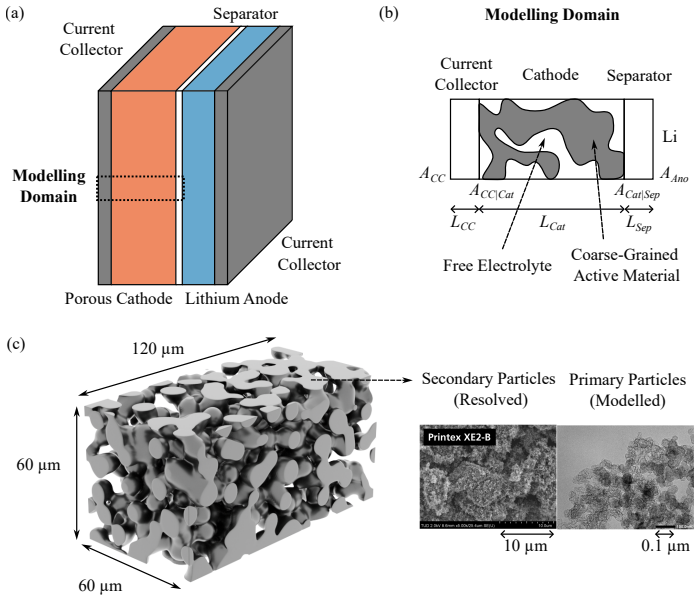


read the original abstract
Lithium-Sulfur batteries (LSBs) are believed to have a high potential for aerospace applications due to their high gravimetric energy density. However, despite decades of research and advances, they still suffer from poor rate capability and low power output, eventually preventing their practical implementation. One particular aspect we want to shed light on is the influence of the porous cathode structure on the rate performance during discharge. Therefore, we present a scale-resolved simulation methodology involving high-performance computing (HPC), which aims to provide structural insights into the electrochemical cell behavior that are experimentally hardly accessible even for modern operando methods. Our \emph{numerical operando approach} employs scaling analysis for efficient model parametrization as well as rigorous parameter transfer between models of different dimensionality and is based on a coarse-grained continuum model. The latter is spatially discretized with a Discontinuous Galerkin (DG) method and advanced in time by an adaptive controller. The models and methods as well as HPC aspects of our toolbox will be critically discussed, finally showcasing the capabilities of our workflow to improve LSBs.
Editorial analysis
A structured set of objections, weighed in public.
Referee Report
Summary. The manuscript presents a scale-resolved numerical operando simulation methodology for lithium-sulfur batteries (LSBs) aimed at elucidating the influence of porous cathode structure on discharge kinetics and rate performance. The approach employs a coarse-grained continuum model spatially discretized via the Discontinuous Galerkin (DG) method, advanced in time with an adaptive controller, and incorporates scaling analysis for model parametrization together with rigorous parameter transfer between models of differing dimensionality. High-performance computing (HPC) aspects are discussed, with the workflow intended to yield structural insights into electrochemical cell behavior that are difficult to access experimentally.
Significance. If the coarse-grained model, scaling relations, and cross-dimensional parameter transfer faithfully capture the real effects of cathode porosity on discharge, the methodology could deliver actionable structural insights into LSB rate capability limitations, supporting design improvements for high-energy-density aerospace applications. The combination of DG discretization, adaptive time stepping, and HPC implementation represents a potentially efficient framework for operando-style simulations at scale.
major comments (2)
- [Model Parametrization and Scaling Analysis] The scaling analysis and parameter transfer procedure (described in the model parametrization section) are presented without explicit derivations of the scaling relations or quantitative checks that transferred parameters reproduce microscale reference behavior. This is load-bearing for the central claim, as the ability to resolve structural influences on kinetics rests on the fidelity of the coarsening and transfer steps.
- [Results and Validation] No validation results are shown comparing the coarse-grained DG model predictions (or transferred parameters) against either a fully resolved microscale simulation or experimental discharge curves. Without such benchmarks, it remains unclear whether the reported structural insights reflect physical cathode effects or artifacts introduced by the continuum approximation and dimensionality reduction.
minor comments (2)
- [Model Description] Notation for the coarse-grained continuum equations could be clarified with an explicit table of symbols and units to aid reproducibility.
- [Numerical Methods] Figure captions for the HPC workflow and DG mesh examples would benefit from additional detail on boundary conditions and adaptive time-step criteria.
Simulated Author's Rebuttal
We thank the referee for their constructive and detailed review of our manuscript. The comments have identified important areas where additional transparency and evidence can strengthen the presentation of our scale-resolved methodology. We respond to each major comment below and outline the revisions we will implement.
read point-by-point responses
-
Referee: [Model Parametrization and Scaling Analysis] The scaling analysis and parameter transfer procedure (described in the model parametrization section) are presented without explicit derivations of the scaling relations or quantitative checks that transferred parameters reproduce microscale reference behavior. This is load-bearing for the central claim, as the ability to resolve structural influences on kinetics rests on the fidelity of the coarsening and transfer steps.
Authors: We agree that greater detail on the scaling relations is warranted to support the central claims. The scaling analysis is based on non-dimensionalization of the governing equations together with volume-averaging arguments for the porous cathode. In the revised manuscript we will add an explicit derivation subsection (or expanded appendix) that walks through each scaling step. We will also include quantitative checks: additional simulations comparing discharge metrics (voltage profiles, capacity) obtained with transferred parameters in the coarse-grained DG model against reference microscale simulations on representative subdomains. These results will be presented in a new figure or table to demonstrate that the coarsening and transfer steps preserve the essential kinetic behavior within a few percent error. revision: yes
-
Referee: [Results and Validation] No validation results are shown comparing the coarse-grained DG model predictions (or transferred parameters) against either a fully resolved microscale simulation or experimental discharge curves. Without such benchmarks, it remains unclear whether the reported structural insights reflect physical cathode effects or artifacts introduced by the continuum approximation and dimensionality reduction.
Authors: We acknowledge the importance of explicit validation benchmarks. The manuscript as submitted focuses on the numerical framework and its use to generate structural insights; however, we recognize that direct comparisons are needed to substantiate the physical relevance of the results. In the revision we will add a dedicated validation subsection. This will include (i) comparison of the coarse-grained model against experimental discharge curves for standard LSB cathodes drawn from the literature and (ii) side-by-side results for simplified 1-D and 2-D microscale reference problems where full resolution remains computationally feasible. We note that a fully resolved 3-D microscale simulation of the entire cathode domain is currently intractable, which is precisely the motivation for the scale-resolved approach; the added subdomain benchmarks will nevertheless provide quantitative evidence that the continuum approximation and parameter transfer do not introduce dominant artifacts for the quantities of interest. revision: yes
Circularity Check
No circularity: forward methodology with independent scaling and transfer steps
full rationale
The paper presents a new scale-resolved numerical operando workflow for LSBs that employs scaling analysis for parametrization and explicit parameter transfer across dimensionalities on top of a coarse-grained continuum model discretized via DG. No equations or claims in the provided abstract reduce any prediction or structural insight to a fitted input by construction, nor do they rely on self-citations whose content is itself unverified or tautological. The derivation chain is self-contained as a methodological development whose validity rests on external validation (not supplied here) rather than internal redefinition of its own outputs.
Axiom & Free-Parameter Ledger
free parameters (1)
- model parameters for porous cathode
axioms (1)
- domain assumption Coarse-grained continuum description remains valid across the relevant length scales for porous cathode discharge.
Reference graph
Works this paper leans on
- [1]
-
[2]
A. Stephan, T. Hettesheimer, C. Neef, T. Schmaltz, S. Link, M. Stephan, J. L. Heizmann, A. Thiel- mann, Alternative Battery Technologies Roadmap 2030+, Fraunhofer ISI, 2023
work page 2030
-
[3]
S. Dörfler, H. Althues, P. Härtel, T. Abendroth, B. Schumm, S. Kaskel, Challenges and key parameters of lithium-sulfur batteries on pouch cell level, Joule 4 (3) (2020) 539–554
work page 2020
-
[4]
M. Zhao, B.-Q. Li, X.-Q. Zhang, J.-Q. Huang, Q. Zhang, A perspective toward practical lithium–sulfur batteries, ACS Cent. Sci. 6 (7) (2020) 1095–1104
work page 2020
-
[5]
S. Dörfler, S. Walus, J. Locke, A. Fotouhi, D. J. Auger, N. Shateri, T. Abendroth, P. Härtel, H. Al- thues, S. Kaskel, Recent progress and emerging application areas for lithium–sulfur battery technology, Energy Technol. 9 (1) (2021) 2000694
work page 2021
-
[6]
Y. Liu, Y. Elias, J. Meng, D. Aurbach, R. Zou, D. Xia, Q. Pang, Electrolyte solutions design for lithium-sulfur batteries, Joule 5 (9) (2021) 323–2364
work page 2021
-
[7]
C. D. Parke, L. Teo, D. T. Schwartz, V. R. Subramanian, Progress on continuum modeling of lithium–sulfur batteries, Sustainable Energy Fuels 5 (2021) 5946–5966
work page 2021
-
[8]
J. B. Robinson, K. Xi, R. V. Kumar, A. C. Ferrari, H. Au, M.-M. Titirici, A. Parra-Puerto, A. Kucer- nak, S. D. S. Fitch, N. Garcia-Araez, Z. L. Brown, M. Pasta, L. Furness, A. J. Kibler, D. A. Walsh, L. R. Johnson, C. Holc, G. N. Newton, N. R. Champness, F. Markoulidis, C. Crean, R. C. T. Slade, E. I. Andritsos, Q. Cai, S. Babar, T. Zhang, C. Lekakou, N....
work page 2021
-
[9]
M. Wang, Z. Bai, T. Yang, C. Nie, X. Xu, Y. Wang, J. Yang, S. Dou, N. Wang, Advances in high sulfur loading cathodes for practical lithium-sulfur batteries, Adv. Energy Mater. 12 (39) (2022) 2201585
work page 2022
-
[10]
Q. Shao, S. Zhu, J. Chen, A review on lithium-sulfur batteries: Challenge, development, and perspec- tive, Nano Res. 16 (2023) 8097–8138. 37
work page 2023
-
[11]
F. Zhao, J. Xue, W. Shao, H. Yu, W. Huang, J. Xiao, Toward high-sulfur-content, high-performance lithium-sulfur batteries: Review of materials and technologies, J. Energy Chem. 80 (2023) 625–657
work page 2023
-
[12]
T. J. Leckie, S. D. Robertson, E. Brightman, Recent advances in in situ/operando characterization of lithium–sulfur batteries, Energy Adv. 3 (2024) 2479–2502
work page 2024
-
[13]
E. A. Santos, M. M. Amaral, B. S. Damasceno, L. M. Da Silva, H. G. Zanin, J. N. Weker, C. B. Rodella, Advanced in situ/operando characterizations of lithium-sulfur batteries: A sine qua non, Nano Energy 130 (2024) 110098
work page 2024
-
[14]
M. Rachner, Die Stoffeigenschaften von Kerosin Jet A-1 : 50 Tabellen, Mitteilung ; 98,1, DLR, Köln, 1998
work page 1998
- [15]
-
[16]
G. Buticchi, P. Wheeler, D. Boroyevich, The more-electric aircraft and beyond, Proc. IEEE 111 (4) (2023) 356–370
work page 2023
-
[17]
P. Su-ungkavatin, L. Tiruta-Barna, L. Hamelin, Biofuels, electrofuels, electric or hydrogen?: A review of current and emerging sustainable aviation systems, Prog. Energy Combust. Sci. 96 (2023) 101073
work page 2023
-
[18]
S. Li, B. Jin, X. Zhai, H. Li, Q. Jiang, Review of carbon materials for lithium-sulfur batteries, Chem- istrySelect 3 (8) (2018) 2245–2260
work page 2018
-
[19]
H. Song, K. Münch, X. Liu, K. Shen, R. Zhang, T. Weintraut, Y. Yusim, D. Jiang, X. Hong, J. Meng, Y. Liu, M. He, Y. Li, P. Henkel, T. Brezesinski, J. Janek, Q. Pang, All-solid-state li–s batteries with fast solid–solid sulfur reaction, Nature 637 (8047) (2025) 846–853
work page 2025
-
[20]
N. Kang, Y. Lin, L. Yang, D. Lu, J. Xiao, Y. Qi, M. Cai, Cathode porosity is a missing key parameter to optimize lithium-sulfur battery energy density, Nat. Commun. 10 (1) (10 2019)
work page 2019
-
[21]
Z. Han, S. Li, R. Xiong, Z. Jiang, M. Sun, W. Hu, L. Peng, R. He, H. Zhou, C. Yu, S. Cheng, J. Xie, Low tortuosity and reinforced concrete type ultra-thick electrode for practical lithium–sulfur batteries, Adv. Funct. Mater. 32 (12) (2022) 2108669
work page 2022
-
[22]
S. Feng, R. K. Singh, Y. Fu, Z. Li, Y. Wang, J. Bao, Z. Xu, G. Li, C. Anderson, L. Shi, Y. Lin, P. G. Khalifah, W. Wang, J. Liu, J. Xiao, D. Lu, Low-tortuous and dense single-particle-layer electrode for high-energy lithium-sulfur batteries, Energy Environ. Sci. 15 (2022) 3842–3853
work page 2022
-
[23]
J. Guo, H. Pei, Y. Dou, S. Zhao, G. Shao, J. Liu, Rational designs for lithium-sulfur batteries with low electrolyte/sulfur ratio, Adv. Funct. Mater. 31 (18) (2021) 2010499
work page 2021
-
[24]
T. Boenke, S. Kirchhoff, F. S. Reuter, F. Schmidt, C. Weller, S. Dörfler, K. Schwedtmann, P. Härtel, T. Abendroth, H. Althues, J. J. Weigand, S. Kaskel, The role of polysulfide-saturation in electrolytes for high power applications of real world li-s pouch cells, Nano Res. 16 (2023) 8313–8320
work page 2023
-
[25]
Y. Song, L. Shen, X. Y. Li, C.-X. Zhao, J. Zhou, B. Li, J.-Q. Huang, Q. Zhang, Phase equilibrium thermodynamics of lithium–sulfur batteries, Nat. Chem. Eng. 1 (9) (2024) 588–596
work page 2024
- [26]
-
[27]
J. Fu, H. R. Thomas, C. Li, Tortuosity of porous media: Image analysis and physical simulation, Earth Sci. Rev. 212 (2021) 103439. 38
work page 2021
-
[28]
K. Kumaresan, Y. Mikhaylik, R. E. White, A mathematical model for a lithium–sulfur cell, J. Elec- trochem. Soc. 155 (8) (2008) A576
work page 2008
-
[29]
M. Ghaznavi, P. Chen, Sensitivity analysis of a mathematical model of lithium–sulfur cells part i: Applied discharge current and cathode conductivity, J. Power Sources 257 (2014) 394–401
work page 2014
-
[30]
M. Ghaznavi, P. Chen, Sensitivity analysis of a mathematical model of lithium–sulfur cells: Part ii: Precipitation reaction kinetics and sulfur content, J. Power Sources 257 (2014) 402–411
work page 2014
-
[31]
M. Ghaznavi, P. Chen, Analysis of a mathematical model of lithium-sulfur cells part iii: Electrochem- ical reaction kinetics, transport properties and charging, Electrochim. Acta 137 (2014) 575–585
work page 2014
- [32]
-
[33]
A. N. Mistry, P. P. Mukherjee, “shuttle” in polysulfide shuttle: Friend or foe?, J. Phys. Chem. C 122 (42) (2018) 23845–23851
work page 2018
-
[34]
F. Brosa Planella, W. Ai, A. M. Boyce, A. Ghosh, I. Korotkin, S. Sahu, V. Sulzer, R. Timms, T. G. Tranter, M. Zyskin, S. J. Cooper, J. S. Edge, J. M. Foster, M. Marinescu, B. Wu, G. Richardson, A continuum of physics-based lithium-ion battery models reviewed, Prog. Energy 4 (4) (2022) 042003
work page 2022
-
[35]
G. W. Richardson, J. M. Foster, R. Ranom, C. P. Please, A. M. Ramos, Charge transport modelling of lithium-ion batteries, Eur. J. Appl. Math. 33 (6) (2022) 983–1031
work page 2022
-
[36]
V. Thangavel, K.-H. Xue, Y. Mammeri, M. Quiroga, A. Mastouri, C. Guéry, P. Johansson, M. Mor- crette, A. A. Franco, A microstructurally resolved model for li-s batteries assessing the impact of the cathode design on the discharge performance, Journal of The Electrochemical Society 163 (13) (2016) A2817
work page 2016
-
[37]
A. N. Mistry, P. P. Mukherjee, Precipitation–microstructure interactions in the li-sulfur battery elec- trode, J. Phys. Chem. C 121 (47) (2017) 26256–26264
work page 2017
-
[38]
Y. Ren, T. Zhao, M. Liu, P. Tan, Y. Zeng, Modeling of lithium-sulfur batteries incorporating the effect of li2s precipitation, J. Power Sources 336 (2016) 115–125
work page 2016
- [39]
- [40]
-
[41]
D. N. Fronczek, W. G. Bessler, Insight into lithium–sulfur batteries: Elementary kinetic modeling and impedance simulation, J. Power Sources 244 (2013) 183–188
work page 2013
-
[42]
A. F. Hofmann, D. N. Fronczek, W. G. Bessler, Mechanistic modeling of polysulfide shuttle and capacity loss in lithium–sulfur batteries, J. Power Sources 259 (2014) 300–310
work page 2014
-
[43]
A. N. Mistry, P. P. Mukherjee, Electrolyte transport evolution dynamics in lithium–sulfur batteries, J. Phys. Chem. C 122 (32) (2018) 18329–18335
work page 2018
- [44]
-
[45]
M. Schammer, B. Horstmann, A. Latz, Theory of transport in highly concentrated electrolytes, J. Electrochem. Soc. 168 (2) (2021) 026511. 39
work page 2021
-
[46]
C. Prehal, J. von Mentlen, S. Drvarič Talian, A. Vizintin, R. Dominko, H. Amenitsch, L. Porcar, S. Freunberger, V. Wood, On the nanoscale structural evolution of solid discharge products in lithium- sulfur batteries using operando scattering, Nature Communications 13 (1) (2022)
work page 2022
-
[47]
R. Müller, I. Manke, A. Hilger, N. Kardjilov, T. Boenke, F. Reuter, S. Dörfler, T. Abendroth, P. Härtel, H.Althues, S.Kaskel, S.Risse, Operandoradiographyandmultimodalanalysisoflithium–sulfurpouch cells—electrolyte dependent morphology evolution at the cathode, Adv. Energy Mater. 12 (13) (2022) 2103432
work page 2022
-
[48]
R. Müller, T. Boenke, S. Dörfler, T. Abendroth, P. Härtel, H. Althues, S. Kaskel, N. Kardjilov, H. Markötter, M. Sintschuk, A. Hilger, I. Manke, S. Risse, Multimodal operando analysis of lithium sulfur multilayer pouch cells: An in-depth investigation on cell component design and performance, Adv. Energy Mater. n/a (n/a) (2025) 2404256
work page 2025
-
[49]
C. Tan, M. D. R. Kok, S. R. Daemi, D. J. L. Brett, P. R. Shearing, Three-dimensional image based modelling of transport parameters in lithium–sulfur batteries, Phys. Chem. Chem. Phys. 21 (2019) 4145–4154
work page 2019
-
[50]
X. Dai, N. Kulkarni, J. B. Robinson, D. J. L. Brett, P. R. Shearing, R. Jervis, An image based 3d modelling framework for Li-S batteries, ChemRxiv (2022)
work page 2022
-
[51]
R. Gao, M. Zhang, Z. Han, X. Xiao, X. Wu, Z. Piao, Z. Lao, L. Nie, S. Wang, G. Zhou, Unraveling the coupling effect between cathode and anode toward practical lithium–sulfur batteries, Adv. Mater. 36 (1) (2024) 2303610
work page 2024
-
[52]
BlenderFoundation, Blender4.3ReferenceManual, https://docs.blender.org/manual/en/latest/render/shader_nodes/ textures/voronoi.html (2025)
work page 2025
-
[53]
R. Richter, J. Häcker, Z. Zhao-Karger, T. Danner, N. Wagner, M. Fichtner, K. A. Friedrich, A. Latz, Insights into self-discharge of lithium– and magnesium–sulfur batteries, ACS Appl. Energy Mater. 3 (9) (2020) 8457–8474
work page 2020
-
[54]
J. H. Irving, J. G. Kirkwood, The statistical mechanical theory of transport processes. iv. the equations of hydrodynamics, J. Chem. Phys. 18 (6) (1950) 817–829
work page 1950
-
[55]
R. J. Hardy, Formulas for determining local properties in molecular-dynamics simulations: Shock waves, J. Chem. Phys. 76 (1982) 622–628
work page 1982
- [56]
-
[57]
Durst, Fluid mechanics, Springer, Berlin, 2022
F. Durst, Fluid mechanics, Springer, Berlin, 2022
work page 2022
-
[58]
G. Richardson, G. Denuault, C. P. Please, Multiscale modelling and analysis of lithium-ion battery charge and discharge, J. Eng. Math. 72 (1) (2012) 41–72
work page 2012
-
[59]
H. Arunachalam, S. Onori, I. Battiato, On veracity of macroscopic lithium-ion battery models, J. Electrochem. Soc. 162 (10) (2015) A1940
work page 2015
-
[60]
P.L.Fosbøl, E.H.Stenby, K.Thomsen, Diffusioninmulticomponentmixedsolventelectrolytesystems, Fluid Phase Equilib. 584 (2024) 114126
work page 2024
-
[61]
B. Naud, M. Arias-Zugasti, Accurate multicomponent fick diffusion at a lower cost than mixture- averaged approximation: Validation in steady and unsteady counterflow flamelets, Combust. Flame 219 (2020) 120–128. 40
work page 2020
-
[62]
A. J. Fillo, J. Schlup, G. Blanquart, K. E. Niemeyer, Assessing the impact of multicomponent diffusion in direct numerical simulations of premixed, high-karlovitz, turbulent flames, Combust. Flame 223 (2021) 216–229
work page 2021
-
[63]
C. F. Curtiss, J. O. Hirschfelder, Transport properties of multicomponent gas mixtures, J. Chem. Phys. 17 (6) (1949) 550–555
work page 1949
-
[64]
D. F. Fairbanks, C. R. Wilke, Diffusion coefficients in multicomponent gas mixtures, Ind. Eng. Chem. 42 (3) (1950) 471–475
work page 1950
-
[65]
H. Arunachalam, S. Onori, Full homogenized macroscale model and pseudo-2-dimensional model for lithium-ion batterydynamics: Comparative analysis, experimentalverification and sensitivity analysis, J. Electrochem. Soc. 166 (8) (2019) A1380
work page 2019
-
[66]
C. Y. Wang, W. B. Gu, B. Y. Liaw, Micro-macroscopic coupled modeling of batteries and fuel cells: I. model development, J. Electrochem. Soc. 145 (10) (1998) 3407
work page 1998
-
[67]
H. A. Jakobsen, Chemical Reactor Modeling : Multiphase Reactive Flows, Springer Cham, 2014
work page 2014
-
[68]
S. S. Tobias, A. Latz, B. Horstmann, Derivation of a local volume-averaged model and a stable numerical algorithm for multi-dimensional simulations of conversion batteries, Electrochim. Acta 333 (2020) 135491
work page 2020
-
[69]
Y. Davit, C. G. Bell, H. M. Byrne, L. A. C. Chapman, L. S. Kimpton, G. E. Lang, K. H. L. Leonard, J. M. Oliver, N. C. Pearson, R. J. Shipley, S. L. Waters, J. P. Whiteley, B. D. Wood, M. Quintard, Homogenization via formal multiscale asymptotics and volume averaging: How do the two techniques compare?, Adv. Water Resour. 62 (2013) 178–206
work page 2013
-
[70]
Sagaut, Large Eddy Simulation for Incompressible Flows, Springer Berlin Heidelberg, 2006
P. Sagaut, Large Eddy Simulation for Incompressible Flows, Springer Berlin Heidelberg, 2006
work page 2006
-
[71]
M. Okraschevski, S. Hoffmann, K. Stichling, R. Koch, H.-J. Bauer, Fluid dynamics beyond the con- tinuum: A physical perspective on large-eddy simulation, Phys. Rev. Fluids 6 (2021) L102601
work page 2021
-
[72]
J. Weinmiller, M. P. Lautenschlaeger, B. Kellers, T. Danner, A. Latz, General local reactive boundary condition for dissolution and precipitation using the lattice boltzmann method, Water Resour. Res. 60 (2) (2024) e2023WR034770
work page 2024
-
[73]
M. Z. Bazant, Theory of chemical kinetics and charge transfer based on nonequilibrium thermody- namics, Acc. Chem. Res. 46 (5) (2013) 1144–1160
work page 2013
-
[74]
A. Latz, J. Zausch, Thermodynamic derivation of a Butler–Volmer model for intercalation in Li-ion batteries, Electrochim. Acta 110 (2013) 358–362
work page 2013
- [75]
-
[76]
T. Roy, J. Andrej, V. A. Beck, A scalable dg solver for the electroneutral nernst-planck equations, J. Comput. Phys. 475 (2023) 111859
work page 2023
-
[77]
Cockburn, Discontinuous galerkin methods, ZAMM 83 (11) (2003) 731–754
B. Cockburn, Discontinuous galerkin methods, ZAMM 83 (11) (2003) 731–754
work page 2003
- [78]
-
[79]
M. Uzunca, Adaptive Discontinuous Galerkin Methods for Non-linear Reactive Flows, Birkhäuser, Cham, 2016. 41
work page 2016
-
[80]
T. Roy, T. B. Jönsthövel, C. Lemon, A. J. Wathen, A block preconditioner for non-isothermal flow in porous media, J. Comput. Phys. 395 (2019) 636–652
work page 2019
discussion (0)
Sign in with ORCID, Apple, or X to comment. Anyone can read and Pith papers without signing in.